Feeds:
Posts
Comments

Archive for the ‘Society’ Category

I always wanted to have a voice. What I didn’t know about were the obligations that come along with it.

Last night I sat with a group of friends and watched the Academy Awards. Aside from one meaningful look, I didn’t say anything about the Boob Song. It was exactly the brand of humor that I don’t know what to do about, because I can see why people think it’s funny, and yet, if I think about it for more than five seconds, it’s not at all funny. (Libba Bray’s suggestion, however, is.) It actually completely pisses me off, especially in reference to an already deeply misogynistic industry.

But I didn’t say anything. (Although I did splutter indignantly at the joke at Penelope Cruz’s expense that combined sexism and racism. I mean, wow.) I’d like to think it was a world-weary kind of not saying anything, but it wasn’t. It was a self-doubting, “other people find this funny so maybe there’s not actually a problem and anyway I don’t want to seem like a negative killjoy” sort of not saying anything. Even when I have a voice, it seems, it can be difficult to use it.

When I started writing, I knew very little about social issues: sexism, racism, homophobia, ableism, classism, etc. But I very quickly became aware there was a lot for me to learn, because I began following the science fiction community in early 2009, which was around the same time the Racefail conversations were happening. It was at that point that I realized how much I didn’t know and how important it was for me to start educating myself.

I still have a lot to learn. I know I don’t always get it right. But I feel strongly that with the privilege of having a voice, of becoming a writer whose works will be read, whether that’s here on the blog or in my fiction, comes the responsibility for me to learn about issues of gender, of race, of class, and of sexuality. Because whether I like it or not, whether I mean to or not, whether I am conscious of them or not, my own biases will come through in my work.

I can’t erase all my biases, certainly not in the four years I’ve been thinking more deeply on these subjects, but at the very least I can examine myself, aspire to understand more, and do what I can to counteract these biases. Because as a writer, I am engaging in the conversation of our society, and what I say (or do not say) matters. The words I choose matter.

So when I fail to say anything about a derogatory Boob Song, I have to examine that response. I have to ask myself if I’m being wishy washy in my writing, if I’m worrying about being un-fun and trying to convince myself things are fine when they aren’t instead of working harder and writing about my convictions and observations.

This kind of self reflection makes me want to tell you how offensive I find the premise of the new Oz movie, Oz the Great and Powerful, which seems like it’s going to be about all these awesome, powerful, and magical women who, in spite of their power, need a bumbling man who’s not from around here to set everything (and everyone) straight. And then I begin to wonder if the movie is going to feminize magical power while the Wizard saves the day with common sense and practical and/or technical know-how that the magical women can’t possibly do themselves. And then I think about how the original Oz stories, in spite of being written in the early 20th century and being deeply problematic in several ways, featured Dorothy and Ozma as the prominent protagonist-heroines. I think of how uncomfortable I was the first time I read The Marvelous Land of Oz at age seven when —spoiler alert–the boy protagonist Tip turned out to be the girl princess Ozma, and how this made me question gender assumptions until upon re-reading I was completely on board with that particular plot twist. And how having this movie set in the same world in 2013 only with a man to save the womenfolk seems like we’re going backwards instead of forwards.

This self examination makes me wonder how many times I’ve decided not to write about things like the Oz movie here on the blog, because it’s so much easier not to speak up.

The truth is, since I’ve begun learning and thinking about social issues, I see and experience things that make me uncomfortable all the time. And one of the most uncomfortable thoughts of all is knowing there’s so much stuff I’m missing, so many problems I’m not seeing because they’re so tightly embedded into my cultural context, into my upbringing, and into the assumptions I bring with me when I view the world. And one of the other uncomfortable thoughts is how often I keep my mouth shut.

So this is me, using the voice I worked hard to get. The Boob Song wasn’t actually funny as much as it was depressing and offensive. The Oz movie looks dreadful, even if the previews are pretty. We are all informed by the society we grew up and live in, whether we realize it or want it to be true or not.

And we can try our best to say something about what we notice and what we learn.
Read Full Post »

I normally don’t write a post for Thanksgiving Day because I figure a lot of you will be too busy inducing food comas and hanging out with people to read any blogs. But some of you don’t celebrate Thanksgiving, and others of you might want a well-deserved five-minute break from all activities Thanksgiving, so this year, here I am.

And guess what. I’m not even going to be talking about gratitude. Revolutionary, I know.

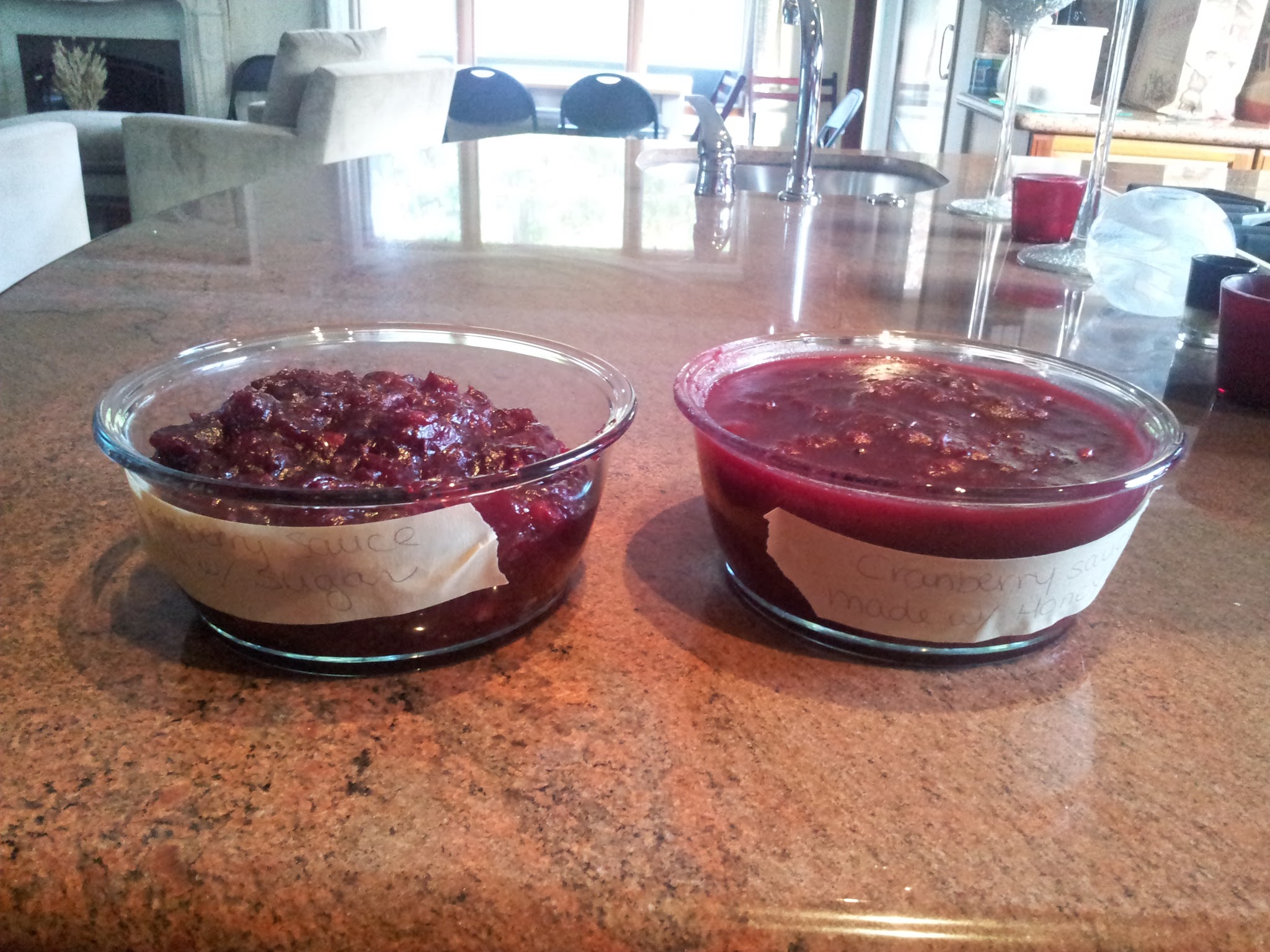
Although I will post a vanity pic of my first ever homemade cranberry sauce.

Instead, I want to talk about emotions. Our culture often puts certain value judgements on emotions. We have the “We must always be happy” myth. We also have the “tears are for wimps” myth. And we have the “Emotions are bad and must be suppressed–yay detachment!” idea.

I’m the first to agree that the ability to reframe and see the positive side of life is a great gift. Those of you who are regular readers have seen me write about that several times. Positivity helps with emotional resilience, and I think it tends to make people generally happier. All of which is fabulous.

But it’s fine when we have emotions besides happiness. It’s fine to sit there and admit to yourself that something really sucks. It’s fine to be frightened, or angry, or sad, or confused. It’s fine to be completely and utterly miserable. It’s fine to have a bad day. It’s fine if you don’t like Thanksgiving, or if your family is stressing you out, or if you’re worried that the mashed potatoes aren’t going to turn out. It’s fine if you feel shy because look and see all of these people you don’t know.

You don’t need my permission to feel however it is that you feel right now. You don’t need anyone’s permission. Go ahead and feel it. You don’t have to do anything about it, after all. A feeling doesn’t have to propel you into action. It can simply be.

We can repress and get down on ourselves when we aren’t feeling exactly what we’re “supposed” to feel. Or we can celebrate the fact that we’re alive right now and we get to feel the full spectrum of emotions. Some of them are tougher, for sure. Some of them we wish we weren’t feeling. But most of them happen to most of us at one point or another.

The idea that we must be constantly happy at all times is not particularly helpful. In fact, I find it downright exhausting. My favorite people are the ones that are okay with me however I happen to be feeling right then, even if I’m feeling cranky, or stressed, or really sad. The ones that need me to be happy all the time are not privy to the entireness of Amy, and I think that’s too bad. But regardless, I get to experience the entireness of Amy, just as all of you get to experience the entireness of who you are and how you feel. This is a beautiful thing. And it is part of being human.

Maybe there’s some irony in me being positive about not being positive and having emotions like sadness and fear and anger. But I don’t think we hear this message enough. It’s okay to feel how we feel. It’s okay if we don’t exist in an ecstatic cloud of happiness all the time.

It’s okay to accept the humanity of emotion.

Read Full Post »

I stumbled across an interview with Brene Brown (whose TED talk I mentioned last week), and at the end she says if she was going to found a museum, she would call it “a Museum of Epic Failure.” At which point I instantly emailed a link to the article to my friend and said, “This is the title of my next blog post!”

Photo by the National Museum of American History Smithsonian Institute

We have such strange ideas about failure and success. I meet people again and again who assume that, having failed at something once, it makes sense to automatically give up and not try again. They wonder at the fact that I have written THREE novels, even though none of them are yet published. They make comments that call into question the entire premise of one of my failures, as if I have now automatically learned better.

Sure, sometimes a failure, and the lessons we learn by failing, cause us to change directions. Sometimes we decide we’re better suited to doing something different, or we’ve found a new passion to pursue. Sometimes our viewpoint has changed so that we no longer want the same things we wanted before. But failure can also mean that the next time we try, we’ll apply what we’ve learned this time around and do better.

Meanwhile, when we stop doing something we’ve been successful at in some form or another, people get confused and tell us it’s “too bad.” And if they like us (aka social success), they tell us to “never change.” There’s this idea that once success has been achieved, we need to hold onto it tightly while avoiding change at all costs.

This is an example of black and white thinking at its finest, where success is positive and good and to be cherished, while failure is negative and bad and to be avoided.

What is often overlooked is the necessity of failure. When we take a risk, it is risky because there is the possibility of failure. If we were one hundred percent sure we’d succeed, it wouldn’t be a risk at all, would it? And so many great successes and helpful learning moments come from the willingness to take a risk and allow ourselves to be vulnerable.

Most great art–be it visual, literary, musical, or theatrical–comes from reaching to see where we can go, from exposing ourselves in the act of creation.

Most great relationships–be they platonic or romantic–come from opening up and being authentic with one another, while not knowing how we’ll be received.

Most great entrepreneurial ventures–be they tech start-ups or service businesses or local merchants–come from taking the leap into the unknown and committing ourselves and our resources to a particular vision.

When we are engaged in these activities and being honest with ourselves, we know we are taking risks. We know we may fail. And it is when we allow ourselves the space to fail (say goodbye to perfectionism!) that we are capable of our best work.

Which is when we realize that failure isn’t inherently bad. It teaches us, it pushes us, it leads down paths we wouldn’t have noticed by ourselves. It makes success, when it comes, more meaningful, even while it keeps us grounded and connected. And when failure comes instead, and we feel flattened by its impact, we can remind ourselves of the alternative: staying safe, cramped, and complacent while being too afraid to really try.

We are each in the process of creating our own personal Museum of Epic Failure. I’ve already collected many interesting exhibits in mine. And each one has helped to shape who I am today.

Even things that are uncomfortable can have reasons to be celebrated. Is there a failure you’ve experienced that you learned something important from or that you’re grateful for now? Feel free to share in the comments.

Read Full Post »

“I aspire to eccentricity,” I said recently at a party. “By the time I reach my sixties, I want to claim it completely. I want to be a full-blown eccentric.”

It takes a special kind of strength to claim our eccentricity, to go against social norms and expectations, to wave the weird flag. There’s a subculture in the US, consisting of artistic types, unconventional types, adventurous types, and free spirits, who consider the statement “You’re weird” to be one of the highest compliments. It’s a reclamation of words that cut to the bone on the elementary school playground.

What’s interesting about being a free spirit, or a rebel, or any of these other labels, is that there isn’t one way to do it. We talked a couple of years ago about Hollywood’s depictions of free spirits as spacy, often irresponsible, Bohemian, manic pixie dream girls. But allowing ourselves to fit into these pre-constructed molds is an inherent act of conformity. In order to truly be a free spirit, to claim that eccentricity within, we do ourselves a disservice if we follow the map society hands us. “Here’s what you’re supposed to be if you’re a free spirit.” Ha! When the whole point is to decide for yourself.

We are held back by these maps, by these preconceptions. The well-honed ability of human beings to practice self-deception will never cease to amaze me. I am so good at it, I don’t even realize I’m doing it. It is only when these maps, these boundaries, and these assumptions are challenged that we can begin to truly cultivate ourselves, eccentricities and all. Otherwise, not only do we limit the choices in our stories to a much more narrow band than necessary, but we fail to know ourselves.

Photo by H Koppdelaney

If we look at what lurks underneath this disconnect, we’ll often find fear. Fear of being different. Fear of not being loved. Fear of change. Fear of loss of safety. Fear of having to confront hard truths, of being stuck into the red hot forge until we become malleable enough to be re-shaped and see more clearly.

In order to know ourselves, in order to discover what shape our eccentricities will take, we have to walk into the fear. We have to gently nudge ourselves forward, and we have to experience the pain that comes with seeing that reality does not always conform with our expectations, our beliefs, and our desires. Claiming eccentricity fully means spending our lives exploring, both what it means to be us and how that intersects with the rest of the world. It means ignoring that innate desire to mirror what and who is around us. It means thinking instead of automatically agreeing. It means creating a ripple of discomfort around ourselves, and perhaps learning to defuse it somewhat with humor, charisma, and tact (and sometimes choosing purposefully to let the discomfort stand). It means choosing how we express ourselves.

What we find when we strip ourselves down, layer by layer, is true eccentricity. A lot of people call this authenticity. I think maybe it’s the same thing, only authenticity sounds more noble. It’s simultaneously a loss of innocence and a rebirth of innocence. Nothing is the way it seemed–not society, not the people we know, not even ourselves. (Get stuck here and you achieve bitterness, disillusionment, cynicism.)

Beyond it, though, lies the innocence of being connected to ourselves in the moment. The innocence of “I am.” The innocence of the joy that is generated by living in harmony with who we are.

I made a joke at a party. But this is really what I meant. There’s something a little eccentric about that, don’t you think?

Read Full Post »

One of the traits I mentioned last week that is connected with resilience is perspective, and part of perspective is the ability to find or create meaning. In a conversation about resilience, that meaning is most often crafted around circumstances of difficulty, but really humans are looking everywhere for meaning all the time.

Photo by Patrick Hoesly

James Altucher gives a great example of this in his latest Q&A post, in which someone asks him whether their sadness will ever go away. James’s answer, especially the fourth point of it, is a textbook example of emotional resilience by creating meaning: “When I feel sad… the universe will grieve but then rejoice because it’s learning so much. Then I can rejoice because every pain, every sadness, every moment, is ME, the universe manifest, learning something new.” He believes that every moment of his life is a learning experience for the universe, and therefore his life is infused with meaning. And this helps him deal with feelings of sadness.

A few days after I read this Q&A, I read Karawynn Long’s latest post, “How American culture is causing widespread misery.” She talks about the correlation between a shift in American culture and increasing rates of depression, and offers some suggestions as to what we individually can do about this. It’s really fascinating, especially this part: “As our culture shifted to exalt the benefits of personal choice and individual success, Seligman explains, we were also losing confidence in the larger constructs of society. Previously, he says, Americans lived in “a context of meaning and hope.” When we encountered failure, we could take reassurance from something larger than ourselves: “a belief in the nation, in God, in one’s family, or in a purpose that transcends our lives.” But as Carter noted, in the middle of the twentieth century that reassurance began to disintegrate.”

So with an increasing distrust in government, along with declines in active religious faith and more closely knit (and often geographically close) families, Americans suffered from more depression. In other words, with loss of meaning came decreased emotional resilience.

Of course, we can, and do, find meaning elsewhere, whether or not we believe in God or our families or the government. Personally, I have found a great deal of meaning in teaching, particularly children and teens, and while I’m not teaching at present, I suspect I’ll do it again at some point in the future. I find meaning in my writing, both my fiction (fiction is inherently about creating meaning) and on this blog. I find meaning through the communities I am part of, in the relationships I have formed, and in self transformation. I find meaning through learning more about the world and universe around me, and through shifting perspectives to remember how small I really am, both in scales of size and time.

What we are fighting against is a sense of futility, the thought that nothing we do matters or makes a difference, the urge to coast or settle or fall into a rut. Instead we believe in the butterfly effect. We believe our choices matter, whether that be the choice to recycle that piece of paper or to smile at the clerk at the grocery store or to give a significant amount of money to a charity or Kickstarter. We create meaning by being mindful about the cause and effect of what we do every day.

How do you create meaning in your life?

Read Full Post »

A couple of weeks ago, I was reading over some of my older blog entries. When I’d finished, I sat back and thought, “Huh. That was actually kind of personal.” At least, more personal than I had remembered.

There’s a place where the personal and the important intersect. And we who blog are then called to make a decision: how important is so important that I can’t stay silent about this? In my case, that means I often end up blogging about issues related to people pleasing and boundaries (and occasionally feminism). I know there are lots of people who grew up in dysfunctional families just like I did, who have similar issues, and I know how helpful it can be to know there are others out there in the world dealing with the same kind of thing you’re dealing with. It’s too important for me to stay silent.

This trade-off was brought strongly to mind during this year’s Worldcon, where I was lucky enough to spend some time with Jay Lake. For those of you who don’t know who he is, Jay is a prolific SF/F writer of some note. He also blogs. For the past few years, he has blogged in an unusually open fashion about his difficulties with cancer. He blogs about disease, about mortality, about what he feels his cancer has stolen from him. He blogs about determination, depression, despair, and joy.

He told me he gets more fan mail from his cancer blog than he does from all his published fiction.

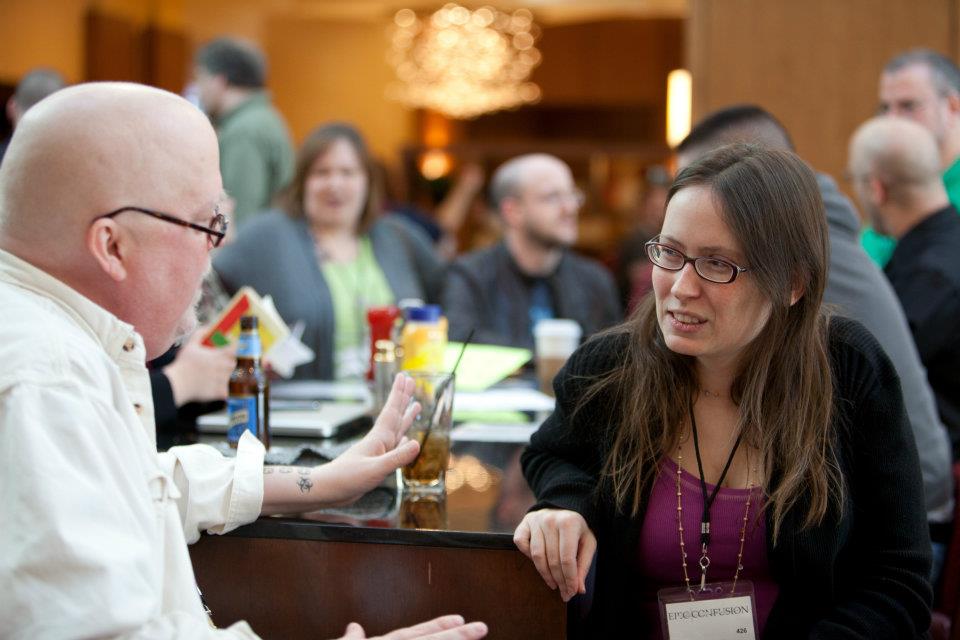
Me and Jay at Epic ConFusion this January. Photo by Al Bogdan.

And he pays a price for being personal. I spent time with him at several points during the convention, and every single time, we were approached by people who expressed their sorrow about his health, or asked about it, or gave him their good wishes that he would recover. On the one hand, it was beautiful to see this outpouring of support from the community.

But I looked at him at one point, late-ish in the evening, after a particularly long stream of generic good wishes, and I thought, “This must get completely exhausting.”

And that is the price. Not everyone will be able to look past the cancer and see the man. Because he has blogged so openly about his disease, he can’t necessarily create a veneer of normalcy for himself when at public events like Worldcon. Part of his public identity is linked to his cancer.

But he pays the price with grace, and I admire him so much for doing so. Because it is too important to stay silent. We need to hear about cancer, about illness, about mortality, and about the physical and emotional struggles that come with these oh-so-human things. Our society tends to have dysfunctional attitudes around illness, around death and dying, around grief and loss, and part of changing those attitudes is talking about these things in a frank and open way. And people who have cancer, people who have other serious illnesses, people who have loved ones who are sick, many of them are helped by Jay’s blog, where by writing authentically about his own personal experience, he puts words to so many other people’s experiences.

So I think about this blog, which is perhaps a bit more personal than I had originally intended. And then I think about Jay. And I’m glad to have written about what I think is important.

I’m in fabulous company.


Read Full Post »

I read this essay by A.V. Flox about leisure last week, and it lit up a lamp inside my brain:

“There is something very wrong with defining yourself by your work and achievements, it drives people to a point where the most important goal is the acquisition of things instead of the enjoyment of things. And for what? You should work — don’t get me wrong. But work so you can enjoy. Don’t make achievement a substitute for living.”

I love leisure. I love lazy mornings and lazy afternoons. I love spending the day buried in a book or three. I love finding an interesting person and talking to them for hours about everything and nothing. I love losing track of time, not in a stressful, “now I’m going to be late” kind of way, but in a “it doesn’t really matter because I’m not missing something pressing, and isn’t this delightful?” kind of way. I love meandering through cities and towns and parks, and stopping for ice cream or crepes or lemonade.

I also love noticing pleasure. The pleasure in a fine day of the ideal temperature. The pleasure of running your hand through the soft fur of a little dog or cat. The pleasure of food, the pleasure of fresh air, the pleasure of a warm hand in mine. When I think about being happy, I often think about those things that give me especial pleasure: Disneyland. Christmas. Little dogs. Ice cream. Magical conversations at 1 in the morning.

Photo by John Althouse Cohen

I agree with A.V. that American culture does not encourage the cultivation of leisure. I too have known the driven person who is scheduled within an inch of her life or who can’t bear to spend half the day doing nothing much. Sometimes, of course, one can’t afford the luxury of leisure. But often it doesn’t seem to be encouraged even if one has the time. It is not looked upon kindly.

I call your attention to the virtue associated with rising early. I do not rise early. I get up later than the majority of people, and I stay up later. I understand that I am fortunate to be able to dictate my own hours, and I know this might not always be case. But in the meantime why shouldn’t I do as I like? And yet some people react to my late wake up time as if it is a personal affront or an illustration of laziness. Why? Is it perhaps a reaction against the perceived leisure that comes with being able to follow one’s own internal rhythms of sleeping and waking?

And yet living for enjoyment is such an effective way to be happier. When I am writing to achieve, I feel stress and worry and come out of the present moment. When I write because of the pleasure it gives me, I feel as if I could continue writing for the rest of my life. When I have an unpleasant day and then I sit down to a bowl of ice cream or a game of backgammon, I am able to renew my positive energy and truly believe that tomorrow will be a different day, even while I’m discovering what there is to appreciate about today.

Do I regret that the two hours I meant to be spending playing Go with a friend on Saturday turned into four? No. Do I regret the sleep I’ve lost having conversations about how to live and how to die and what we’re afraid of and what we wish for? Never. Do I look back on my times wandering the cities of the world and wish I could have spent that time more focused on achievement? Not once. Connection, inspiration, exploration, introspection, the exchange of ideas–these all give me immense pleasure.

These times are the jewels of my life.

###

And speaking of jewels, I’ll be collecting some more at Worldcon in Chicago this week. As usual, feel free to come say hi to me if you’re planning to attend; I love meeting new people. And I’ll be taking a break from the blog while I’m traveling, so I’ll see you here again on September 6th.


Read Full Post »

All people are the same, and all people are different.

I think sometimes we tend to get into trouble when we forget one (or both) of these statements. Holding both of these ideas in mind at the same time definitely exercises our ability to doublethink, but they are not as mutually exclusive as they might first sound.

Photo by Leo Reynolds

All people are the same.

We are born, we grow older, we die. We get hungry, tired, hot and cold. We feel pain, both physical and emotional.

We want. We want to be loved, we want to obtain safety. We want to stop feeling scared and uncomfortable. We want meaning, whether that be through myth, religion, stories, or science. (Or all of the above.) Some of us want stuff, some of us want intangibles, but most of us want something. And what we think we want and what we actually want is only sometimes the same.

All people are different.

We come from different backgrounds, geographical locations, religious beliefs. We have different bodies, different skin colors, different hair, and different health problems. We have different eccentricities, idiosyncracies, passions, likes and dislikes, loves and hates. We’re skilled and unskilled at different things. Our brains don’t all work exactly the same way either.

We have different memories, even of the same event. We have different ways of communicating. We have different opinions, different eating habits, different ways of conducting relationships. We have different needs and different desires and different ways of expressing ourselves. We have different tastes in style and pets and child-rearing and financial management and music and transportation.

We have different stories, different baggage, and different wounds. All of which lead to different life choices, some of which work for us and some of which don’t.

We are simultaneously the same and different.

When we forget we are the same, we may feel alienated or isolated. We may turn another person or group of people into the Other. We may think we’re better than everyone else, or that we’re not worth the air we’re breathing.

When we forget we are different, we may impose our own life choices on other people. We may become visibly judgmental. We may make inaccurate assumptions and stifle other people’s voices. We may forget there are other points of view.

There is a universality to the human experience, but the details are always different–sometimes very different and sometimes only a little different. We try to understand each other with mixed success. And we forget the following important truth.

You are not me. But we are both human together.


Read Full Post »

In the wake of the sexual harassment at Readercon that is being discussed all over the internet, (and there is a petition you can sign if you wish to object to the Board’s handling of the case), I’ve been thinking a lot about sexual harassment. I’ve written about it a bit before, and I want to call up one of the comments that old post received, from Cyndi:

“As another post said, life isn’t fair. Get over it. Live your life, your way, and stop looking for ways to claim you’ve been oppressed/denied/overlooked. We all have been, in one way or another.”

What, you may ask, did I say in the post to elicit such a response? Was I whining or crying or talking about how unfair life is? Um, no. I wrote a calm and reasoned essay talking about what it meant to me to be a feminist, and bringing up, among other points, the existence of sexual harassment that women experience in their professional lives. Which, apparently, we are all supposed to just get over.

In fact, we’re not even allowed to talk about sexual harassment without being dismissed or being told that we’re looking for “special” treatment. Because apparently having one’s sexual and physical boundaries be repeatedly violated is par for the course, and we should lie down and take it without a murmur.

And then we wonder why feminists are sometimes angry.

Genevieve Valentine was incredibly brave, both in reporting the harassing incidents to the Readercon board and in publicizing what was happening. Both of these actions are ones that many women will choose not to do, for many reasons. Because we don’t want to be any trouble or cause a fuss. Because it is embarrassing. Because we might not be taken seriously or be believed. Because it might have future repercussions to our careers or to our very safety. Because we don’t want more confrontation with the person who has harassed us. Because we don’t want it to have happened.

But it IS happening. And it is not expecting special treatment or playing the victim card to bring it up, to talk about it, to ask that one’s basic expectations of safety while attending a convention be met. Not only was Genevieve Valentine harassed, but the same man who harassed her had previously harassed another woman to the point where she no longer felt comfortable volunteering. There was the infamous series of incidents at World Fantasy in 2011. I myself had an uncomfortable incident occur at Worldcon in Reno last year, which–guess what?–I did not report. And that is not the first such incident I’ve personally experienced in the field, either.

I firmly believe that this is not a problem for only the people who are harassed, but rather a problem that faces our entire community. And on a larger scale, a problem that faces our society. Because when we look the other way, when we say that this behavior isn’t so bad, then we are perpetuating the problem. When someone says, “Oh, but this has never happened to me,” that person is saying that because they haven’t experienced something personally, that means–what? That it’s never happened? That it’s not really a problem? That they don’t want to be bothered with dealing with something they aren’t forced to deal with?

Unfortunately, some of us don’t have a choice as to whether we’re going to deal with harassment.

Another quote from that old post of mine, this one from Jessica:

“Life isn’t fair, period. Only we can decide how to navigate through it & when we say we believe in equality perhaps we should consider what that word really means because it takes countless selfless acts & the removal of one’s own selfish needs to see what’s truly needed for a greater good.”

It sounds like she is saying that sexism in the workplace is needed for the greater good, and objecting to sexism and harassment is therefore selfish. And I’m sorry, I generally try to be respectful, but that is one of the stupidest ideas I have ever heard. It is not selfish to not want to be treated badly. It is not selfish to want to feel physically safe while working, whether at an office or at a convention. It is not selfish to want to feel physically safe period. It is not necessary for women to be selfless and allow men to paw them and make sexual jokes at the woman’s expense. Please. Next thing I’ll be hearing is that it’s selfish for a woman to not want to be raped…especially if she is wearing a low-cut top and a short skirt. Oh, wait. People say that kind of stupid thing, too.

Talking about the problem is the first step. I don’t know what the next steps look like. But I know that saying “get over it” isn’t one of them.

I’d love to hear from you: your experiences (at the workplace or not, as a writer or not, from any gender because I’m very aware that it’s not just women who get harassed), your thoughts about sexual harassment and the Readercon debacle in particular, etc. I am going to be wielding a particularly hefty mallet in the comments section for this post, because I want this to be a safe place for discussion of a difficult issue.

Read Full Post »

My husband was telling me about a friend of his who is a good listener. “But I think she’s the one who needs emotional support right now,” he told me.

So we are going to be revisiting a topic I’ve talked about before, problem comparing, because obviously one time was not enough.

Just because your friend has problems does not mean you can’t talk about your own problems. Even if your friend has really big problems. Keep the following in mind:

1. Your friend may have more times during which they can’t listen to you. If they’re fully in crisis mode, right in the middle of dealing with their problem, whether it be physical, mental, or emotional, they probably can’t be there for you right this minute. However, unless there’s a problem with codependence in your friendship (and if there is, that’s a whole separate issue), they will tell you if now isn’t a good time. And if it’s not a good time, that doesn’t mean there won’t be a better time in the future.

2. Your friend may not be able to track you as well. Meaning, they may not have the bandwidth to check up on you, make sure you’re doing okay, send you texts and invitations, and come to you to see if you need anything. That doesn’t mean that if you go to them, they won’t be able to listen.

3. Your friend might find it a welcome break to hear about someone else’s problems for a change. Distraction can be very helpful in certain circumstances. They might also feel better knowing they’ve been able to be supportive to a good friend.


The other aspect of this issue I’ve noticed lately is how invalidated some people feel when their problem isn’t the one getting the full spotlight. It’s as if there’s some kind of suffering quota that they’re afraid is going to be filled up before it’s their turn.

Let me help you out. Everyone suffers. Every single person. And everyone deserves compassion for the suffering they face. It doesn’t matter if your suffering is different than mine, or worse than mine, or not as bad as mine. You still deserve compassion because suffering is hard for everyone.

But when we use our own personal suffering as an excuse to shut down conversations about institutionalized suffering, we are becoming so caught up in our own heads that we are not showing compassion to others. I see this kind of thought process again and again in conversations about race, gender, class, and sexual orientation. Just because we are talking about these issues, just because there is lots of statistical evidence that institutionalized injustice exists, does not mean your own personal suffering does not also exist. But not every conversation has to be about you. Sometimes we need to talk about suffering that affects wide swathes of people, even though you are not one of those people.

Don’t worry. The suffering quota won’t be filled up any time soon.

Read Full Post »

« Newer Posts - Older Posts »