Feeds:
Posts
Comments

Feeding the Muse

One of the things I love best about being a writer is the wonderful necessity of feeding my muse.

Don’t get me wrong; I do my very best not to follow my Muse’s fickle whims. I try to write a prescribed amount of words regularly. I try not to start new projects if it will mean leaving an already started project unfinished. I force myself to write when I don’t feel like it.

But that doesn’t mean my brain doesn’t need feeding while I’m engaging regularly in the creative process. In fact, it can be positively voracious. And the more I feed it, the happier my writing process tends to be.

Favorite Ways to Feed the Muse:

1. Travel. Yes, I know, I am constantly singing the praises of travel, but I am hard pressed to think of anything that delivers a bigger punch of Muse deliciousness. New places and cultures, new experiences, new people, the beauty of nature, art treasures, learning about history, eating amazing and sometimes strange foods–travel has it all.

2. Doing something I haven’t done before. Because we don’t need to travel far from home to have new experiences, whether that be going to a new place in the area or trying a different restaurant or taking a different route for your daily walk/jog. In a couple of weeks, I have tickets to go see my first magic show, and even if it’s on the cheesy side, I am fascinated to be having this experience. (Plus, I get to wear a cocktail dress. Double win!)

3. Going to museums. Because at most museums, I learn something new or see something beautiful or experience something different (see #1). Next on my list? The Disney museum in San Francisco.

4. Experiencing story outside of my own writing. This can be anything from novels to movies, TV series to theater, role-playing games to video games. Sometimes I need to read a certain kind of novel, and other times I really need a different vehicle to experience story. Lately I’ve been reading a lot of plays. Good, bad, or wildly uneven, it’s all grist for the mill.

5. Finding another creative outlet. Even though my current focus is on writing, I feel so lucky to have spent so much of my life practicing and studying to be a musician. Sometimes there is nothing my brain needs as much as becoming entirely focused on something creative but DIFFERENT. Very very different. A quick thirty minute voice practice session and I can come at a writing problem in an entirely different way. Which is similar to

6. Moving the body. Exercising, dancing, taking a walk around the block, or jumping up and down for twenty seconds, all of these activities pull us back into our physical bodies and give our brains a chance to work on a subconscious level.

7. Talking to people. The more interesting people we surround ourselves with, the more likely our social time will prove to be inspirational. You never know when an off-hand comment from a friend will trigger a thought that turns into a blog post, the perfect telling detail, or a solution to a tricksy plot problem.

What our your favorite ways to feed your muse?

Very soon after I decided that I wanted to be a YA writer, I learned the following “truth:” that girls will read novels with both male and female protagonists, but boys will only read novels with male protagonists. So if you want the widest crossover, you write a boy protagonist, and if you write a girl protagonist, that means you’re mostly writing for a female audience.

Then I heard the oft repeated story about how J.K. Rowling decided to use her initials as her author name so that the readers would not know she was a woman. And I heard about how YA was dominated by women writers, sometimes as though this were a bad thing.

Then I heard a couple of male writers who I respect talking about the problem of there not being enough boy books in YA. Later on, I heard about what a problem it was that there were too many female protagonists and “girl books” in modern YA.

Shall I define “boy book” for you? A boy book probably has a male protagonist. It features action and adventure and is quick paced. It probably doesn’t have much if any romance. The language and structure might also be more straightforward and simple, since one of the main reasons having YA boy books is supposed to be important is to encourage reluctant boy readers to read.

A “girl book,” by contrast, probably has a female protagonist. It may have action and adventure and be quick paced. It almost certainly includes a romantic element. It might focus more heavily on social interactions and relationships in general, as well as issues of social status (because of course, men aren’t interested in status at all. Ha!). There might also be a stronger focus on emotions. The language and structure run the gambit between simple and complex.

I’m not going to mince words: these truths about boy readers, the YA genre, and boy and girl books are harmful and sometimes flat-out false. If boys won’t read books with girl protagonists, especially by the time they are teenagers, this is not a good reason to write and publish fewer books with girl protagonists. This is a red flag that something is wrong with the message our society is sending to these boys.

Often this argument gets lost in the rush to emphasize the importance of boys learning to read. It’s fine to perpetuate this “truth” of boys being unwilling to read anything not entirely male-centered, the unstated message goes, as long as we can wheedle them to read anything at all. And this is how sexist thinking gets passed on to the next generation.

Obviously boys learning to read is important. It’s important that everyone learn to read. And it’s also important that we throw away outdated and harmful ideas about gender and stop teaching boys that girls and anything related to girls are somehow shameful or uninteresting or embarrassing. THESE CAN BOTH BE IMPORTANT AT THE SAME TIME. Revolutionary idea, I know.

If YA did have such a predominance of female protagonists, I’d be happy, given all the messages female teens receive to the contrary, that there was at least one place where they could experience other females being front and center, having agency and their own individual identities. But it is not necessarily even true that YA has more female protagonists than male. According to this study, 49% of YA protagonists are male. 49%. And only 36% of YA protagonists are female. (15% have protagonists of both genders.)

You know what else isn’t true? That YA is dominated by women writers. The same study found that 56% of YA writers were women, which is hardly an overwhelming majority.

When we talk about female protagonists in YA books as if they’re somehow a bad thing, we’re strengthening harmful stereotypes. When we believe boys won’t read books with female protagonists, we’re sending them the message that they shouldn’t want to, or that there’s some kind of problem with reading these so-called “girl books.”

The Feminist Batwoman wrote a fabulous essay called “Boys Don’t Read Girl Books and Other Lies My Society Told Me.” She ran a successful experiment exposing her little brother to novels about girls as well as boys, and she has this to say about boys not reading books with girl protagonists: “My outlandish theory is that if boys aren’t belittled for reading books about girls, if they’re not taught that girls are lesser, if they’re not teased about cooties, if we don’t teach them to fear the feminine… they’d probably like more “girl” stuff.”

We need to stop talking about boy books and girl books as if this is some kind of important and valid distinction. We need to wake up and realize that 56% of YA writers being women does not mean that women dominate the genre. And we need to think long enough to realize that if girls are happily reading novels with protagonists of both genders, there’s no reason we can’t work towards encouraging boys to do the same. Plenty of boys already do.

For a long time I took these assumptions about YA and YA readers for granted. I’m guessing I’m not the only one. Therefore, if you think this is an important and interesting issue, I encourage you to share this essay or start a conversation with your friends and colleagues. Let’s challenge what everyone knows and find out what lies underneath, shall we?

I always wanted to have a voice. What I didn’t know about were the obligations that come along with it.

Last night I sat with a group of friends and watched the Academy Awards. Aside from one meaningful look, I didn’t say anything about the Boob Song. It was exactly the brand of humor that I don’t know what to do about, because I can see why people think it’s funny, and yet, if I think about it for more than five seconds, it’s not at all funny. (Libba Bray’s suggestion, however, is.) It actually completely pisses me off, especially in reference to an already deeply misogynistic industry.

But I didn’t say anything. (Although I did splutter indignantly at the joke at Penelope Cruz’s expense that combined sexism and racism. I mean, wow.) I’d like to think it was a world-weary kind of not saying anything, but it wasn’t. It was a self-doubting, “other people find this funny so maybe there’s not actually a problem and anyway I don’t want to seem like a negative killjoy” sort of not saying anything. Even when I have a voice, it seems, it can be difficult to use it.

When I started writing, I knew very little about social issues: sexism, racism, homophobia, ableism, classism, etc. But I very quickly became aware there was a lot for me to learn, because I began following the science fiction community in early 2009, which was around the same time the Racefail conversations were happening. It was at that point that I realized how much I didn’t know and how important it was for me to start educating myself.

I still have a lot to learn. I know I don’t always get it right. But I feel strongly that with the privilege of having a voice, of becoming a writer whose works will be read, whether that’s here on the blog or in my fiction, comes the responsibility for me to learn about issues of gender, of race, of class, and of sexuality. Because whether I like it or not, whether I mean to or not, whether I am conscious of them or not, my own biases will come through in my work.

I can’t erase all my biases, certainly not in the four years I’ve been thinking more deeply on these subjects, but at the very least I can examine myself, aspire to understand more, and do what I can to counteract these biases. Because as a writer, I am engaging in the conversation of our society, and what I say (or do not say) matters. The words I choose matter.

So when I fail to say anything about a derogatory Boob Song, I have to examine that response. I have to ask myself if I’m being wishy washy in my writing, if I’m worrying about being un-fun and trying to convince myself things are fine when they aren’t instead of working harder and writing about my convictions and observations.

This kind of self reflection makes me want to tell you how offensive I find the premise of the new Oz movie, Oz the Great and Powerful, which seems like it’s going to be about all these awesome, powerful, and magical women who, in spite of their power, need a bumbling man who’s not from around here to set everything (and everyone) straight. And then I begin to wonder if the movie is going to feminize magical power while the Wizard saves the day with common sense and practical and/or technical know-how that the magical women can’t possibly do themselves. And then I think about how the original Oz stories, in spite of being written in the early 20th century and being deeply problematic in several ways, featured Dorothy and Ozma as the prominent protagonist-heroines. I think of how uncomfortable I was the first time I read The Marvelous Land of Oz at age seven when —spoiler alert–the boy protagonist Tip turned out to be the girl princess Ozma, and how this made me question gender assumptions until upon re-reading I was completely on board with that particular plot twist. And how having this movie set in the same world in 2013 only with a man to save the womenfolk seems like we’re going backwards instead of forwards.

This self examination makes me wonder how many times I’ve decided not to write about things like the Oz movie here on the blog, because it’s so much easier not to speak up.

The truth is, since I’ve begun learning and thinking about social issues, I see and experience things that make me uncomfortable all the time. And one of the most uncomfortable thoughts of all is knowing there’s so much stuff I’m missing, so many problems I’m not seeing because they’re so tightly embedded into my cultural context, into my upbringing, and into the assumptions I bring with me when I view the world. And one of the other uncomfortable thoughts is how often I keep my mouth shut.

So this is me, using the voice I worked hard to get. The Boob Song wasn’t actually funny as much as it was depressing and offensive. The Oz movie looks dreadful, even if the previews are pretty. We are all informed by the society we grew up and live in, whether we realize it or want it to be true or not.

And we can try our best to say something about what we notice and what we learn.

Snapshots

Memory is a series of snapshots. We craft our identity from these frozen moments in time that we think we can remember.

Snap.

I sit above my bedroom on the lip of the closet. I climbed up my bookcase to get here, and I know I might get in trouble for doing it. I can’t stop staring down at the familiar made strange. School is going to be starting again soon–sixth grade? seventh?–and seeing things differently makes it seem more like an adventure.

Snap.

I’m sprawled in the blue chair, my bare feet pressed against the cold window. I never worry that the glass might break. I rotate the chair back and forth without thinking. I am living far away in my book right now. The only things that are real are the story and the smoothness of the glass.

Snap.

I sit on the floor, tears on my cheeks. I throw a shoe against the door; it makes a satisfying thump but leaves a black mark. I don’t want the reminder of this moment. I am twenty years old and I miss my mom and the room reeks of betrayal.

Snap.

I’m in a large room filled with two rows of beds, I don’t know how many, maybe twenty? Each bed is occupied by a stranger. I don’t want to be here, and I pretend I’m far, far away, in a bedroom that no longer exists. It’s easier to pretend in the dark. Tomorrow I will leave Amsterdam and head south to Belgium.

The park in Amsterdam. I neglected to take a photo of my dubious hostel.

The park in Amsterdam. I neglected to take a photo of my dubious hostel.

Snap.

I yell words that are too true, but later on I convince myself I made them up. Only I didn’t, and that mostly hidden knowledge eats a little hole in the base of my sternum.

Snap.

I can’t sleep because I am so excited about tomorrow. How many times have I lain in exactly this position, happiness coursing through my body with each heartbeat? I buzz with anticipation. There is no place I’d rather be.

Snap.

Why Beginnings are Hard

Today I started writing another novel.

It took a long time. In addition to actually typing some words, I did the following activities:

– I ate a Japanese cinnamon flavored mini Kit Kat, an extra peanut butter cup, and way too much cranberry sauce.
– I pet the dog. More than once.
– I spent time on Craigslist.
– I spent a little time emailing before throwing up my hands in despair at how far behind I am.
– I did laundry.
– I played Minesweeper.
– I emptied the trash can in my study.
– I took the dog to the park.
– I worried about the novel.
– I worried about things having nothing to do with the novel.
-I worried about other things having nothing to do with the novel.
– I practiced music.
– I played Solitaire.
– I thought about texting people and then didn’t get around to it because if they texted back, that would be the end to any pretense of productivity.
– I wandered around the house.
– I rinsed out a glass jar of jelly.
– I looked at the clock a lot.

Really, it’s a miracle I squeezed a thousand words out of my brain somewhere in the middle of all that activity, the majority of which was based around me not wanting to start the new novel.

It’s not that the actual writing is so unpleasant. I like writing. Even when it’s difficult, it’s still generally very satisfying. But even so, there’s a certain amount of resistance that I have to push through at the start of any new project. And I expect that resistance to continue for at least another week or two.

I’ve become very good at Solitaire, let me tell you.

The beginning is hard because I don’t know what to expect. I don’t know my characters very well, and my outline is full of vague comments like “They come up with a plan” (Fabulous! Now if only I knew what the plan was) and “She does something awesome” (if only I knew what awesome thing she could do) and “She’s given an important assignment” (but who knows what that might be). I don’t feel comfortable in my world. I can’t remember everything I’ve thought about it, and as soon as I commit sentences, I realize all the things I haven’t figured out yet. And then I realize all the things I know that I have to make sure the reader knows too, even though it would be so much easier to just breeze past those bits.

Beginnings are like that in general, aren’t they? We don’t know what to expect when we start something new. There’s no routine to fall back on, fewer tested assumptions to use as mental shortcuts. It’s scary because we don’t know if we’ll be any good, or if we’ll like whatever new thing we’re starting, or if we’ll be somehow screw things up because we don’t know any better yet. They’re uncomfortable and uncertain.

But beginnings are also a time of great promise. We don’t know what to expect so maybe amazing things will happen. It’s exciting to strike out and start something new. It lets us learn more about ourselves and more about the world around us.

So tomorrow when I sit down and begin the whole lengthy push-a-thousand-words-out-of-my-head process again, that’s what I’m going to try to think about. That even though I’m uncomfortable, maybe amazing things will happen.

I hope they happen for you too.

I’d been wanting to write that post on forgiveness I published last week for a long time. But I kept punting it for other ideas because I was afraid to write about it. I was convinced the ENTIRE WORLD would disagree with me and be horribly upset that I didn’t think of forgiveness as something that can be forced, and somehow this would be an awful thing for me.

The longer I write for this blog, though, the more I realize that really, the world doesn’t care. Most people will never read my essay on forgiveness. And most of the people who did read my essay recognized something in it that resonated with them. So when I think the entire world will disagree, that is some bizarre thought process I am better off ignoring.

My friend Ferrett wrote some excellent blogging advice, where one of his main points was: “No, Seriously. Haters Are Going to Hate.” As a blogger or someone who is interested in maintaining a public example, this will inevitably be an issue at some point. Ferrett says that once you become sufficiently popular, there will always be people who hate you, and he’s completely right. It is amazingly hard to be sufficiently wishy washy to keep everyone happy. I don’t even know if it’s possible, although I suspect it isn’t. There will always be people out there disagreeing loudly, people looking for an argument, or people wanting to tear other people down.

Photo Credit: HeyThereSpaceman. via Compfight cc

For example, it is always amazing to me how angry people have gotten over my essay about intelligent women. They are upset because they don’t think women can possibly be as intelligent as men (seriously, what century are we living in?) or because they don’t think smart women ever encounter anything I mention so therefore I must be old and bitter (because only old and bitter people can engage with ideas about sexism?) or because of course all intelligent people must make loads of money because that’s the way intelligence should be measured in our society (I guess most artists and academics are just pretty stupid since they don’t prioritize making large amounts of money). But what is more interesting to me than the actual arguments is the amount of anger expressed because there are different opinions in the world. Opinions, it seems, can be very scary things.

But as strange as it seems to me that people can get so worked up over my six hundred word essays, this doesn’t change the fact that the world is largely indifferent. And in fact, as a writer, if my words cause anyone to feel angry or scared or hopeful or inspired or any emotion at all, then that means I’ve done my job. In the grand scheme of things, obscurity is more an artist’s enemy than controversy, however safe the obscurity might feel and however challenging the controversy might be. (And of course, how challenging the controversy feels will vary wildly from person to person.)

I think part of becoming an artist is learning to be comfortable with controversy. Not because it is bound to be necessary, but because part of an artist’s job is to express their perception of the truth. And if you are afraid of what the world is going to think about your truth, then maybe you won’t dig as deep as you can and maybe you won’t take the risks you need to take and maybe you’ll choose the easy way instead of the raw way. Creating art is a commitment to your own vision of reality.

So I wrote that essay on forgiveness anyway, even though it scared me. I was scared to write The Academy of Forgetting. I’m about to start a new novel, and even though I’m excited about it, I occasionally feel sudden spasms of anxiety when I think about sitting down and typing “Chapter 1.” I feel a tightness in my stomach and a sudden strong desire to do anything else.

But I’m glad I feel the fear. It’s like a compass, letting me know I’m going the right direction. It means I’m not taking the easy way. It means I’m challenging myself, and my writing is better because of it.

Being a Princess

“There’s always been a bit of the Princess archetype in you,” she said. (And she’s totally right; there always has.) “And I thought you had manifested that for yourself, that your life was settled and you had gotten your happily ever after. It wasn’t that I didn’t want to, but I didn’t see you.”

In her talk on vulnerability, Brene Brown says that the word courage comes from the word coeur, French for heart. What is courage? She says it is telling the story of who you are with your whole heart: in other words, allowing yourself to be seen, choosing the authentic. It takes courage to tell our stories. It takes courage to be honest and open. And it takes courage to infuse our artistic work with truth.

Coeur.
Photo Credit: Miriam Cardoso de Souza via Compfight cc

She also mentions the importance of having the courage to be imperfect. And let me tell you something about the Princess archetype. It’s not all bad: it includes a healthy dose of positivity, some chirping birds, romance and adventure. But it also contains no space for imperfection. The Princess in the fairy tales is perfection in essence: she is beautiful and charming, she is talented, she can sing and play music and dance and speak twenty languages, she always knows what to say, she has a sweet disposition, and she never ever feels angry or tired or upset. She can only feel fear when she is in danger as a plot device to allow the prince/knight/fool to rescue her, self-actualize, and win her as a prize. And she is always brave and smiling.

Being the Princess means not being seen for yourself.

I have been the Princess. I have tried to be perfect in every possible way. I have worked to be attractive and charming and to always set people at ease and know the right thing to say.  Whenever I have made a mistake, it has meant falling short of impossible standards. I have tried to please everyone and hate admitting that I need anything at all.

And yet, it has only been through surrendering the Princess archetype that I could begin creating the life that I want. It has only been through searching for people who don’t need me to be that Princess that I could finally be me, with everything that encompasses. It has only been through finding my coeur to begin to tell my story that I could create authentic connections with other people. Being able to see other people and being seen yourself, as it turns out, go hand in hand.

When I think of all those years I was trapped in the tower of Princess-hood, I feel very sad. Now that I’ve rescued myself, I try not to be perfect with appropriate imperfection. I don’t always smile. I am not always brave. I sometimes put my own needs first, and I am allowed to ask for things. There is space for me to have emotions. The world doesn’t end when I can’t always be strong.

It feels very strange to not be a Princess. But also very right.

I’ll let you in on a little secret. We who carry with us the legacy of a troubled childhood sometimes talk about the people who don’t. You know, the ones who had fairly normal childhoods with just a sprinkling of trauma and have gone on to become well-adjusted adults without years of therapy or going on a spiritual quest in India or having a near-death experience.

I’ve been thinking about this a lot because I think we attract and are attracted by people who have similar world views to our own. And we are also heavily influenced by the five people we spend the most time with (or three, or ten, but you get the idea). So I have a lot of investment in the idea of spending time with emotionally healthy people, including those who had pretty happy childhoods.

But I’ve noticed a theme in recent conversations about these people. Words like “boring” and “not very deep” tend to come up. And when I pushed a little harder, a friend said, “What I really want is someone who will understand. And people who are happy and healthy won’t be able to understand.”

We get so excited when we find someone who “understands,” and we look with eagerness for our commonalities. “Wow, you’re a Disneyland person? I’m a Disneyland person too!” or “Your favorite book is my favorite book!” or “We both know this obscure fact about this obscure interest!” And abracadabra, instant bonding. We do the same thing with tragedy. There is no time when people will be more likely to share stories of everyone they’ve known who has ever died than when you are grieving yourself.

But I question the whole idea of understanding. Can anyone else ever truly understand what it is to be me, and what it means to have my experiences? We can build up models of each other, sure, and keep adding details for ever-increasing accuracy, but even then we are not understanding so much as empathizing. We can use our imaginations to put ourselves into someone else’s shoes, but we can never truly know what those shoes feel like.

We see this in good writing. It’s why choosing the point of view character(s) is so critical. The story completely changes based on who is telling it, even if most of the events and even scenes are the same. I see this when I talk to my sister. We both lived through many of the same formative events, and yet today when we talk about it, it’s vividly clear that we had completely different experiences. The details we remember are different, and our impressions of each other from that time are often inaccurate. We think we understand, and yet sometimes that false impression has actually kept us farther apart.

Photo Credit: Ma Gali via Compfight cc

Understanding is overrated. What I’m interested in and what I want for myself is empathy. And empathy, and the personal depth and wisdom that having empathy requires, can be given regardless of childhood experience. The whole point of empathy is the cognizance that you can’t completely understand, even if you’ve had similar experiences; that you aren’t the other person and the whole sum of past and present, personality and passions, fears and flaws that makes them who they are. And in spite of that, in spite of the impossibility of understanding, you’re willing to sit with them and listen to them and try to hold as much as them as possible in your mind so you can see who they are, even though it’s sometimes so hard to leave yourself out of that picture. And yet somehow, even though it sounds hard and complicated, many of us are surprisingly good at being empathetic.

I don’t understand you, not really. And you don’t understand me. We come from different places, and we live in different worlds. But we can still find a way to know each other.

Sometimes when I don’t know what to do, I succumb to weakness and I type my problem into the magical box on the internet otherwise known as Google.

I have found some of the worst possible advice in this way. Because as it turns out, most of the results that turn up are written by people who also don’t know what to do, or alternately by people for whom life is quite simple, black and white and absolute. And because I don’t believe life is simple (I mean, yes, I can spout out aphorisms like “really all anyone wants is to be loved” and even mean them, but that doesn’t automatically cancel out all nuance), this advice is really really terrible for me. Which makes it quite mysterious that I still type my questions into the Google box, but apparently not only am I not simple, I’m also not always rational.

One of the topics I can reliably find bad advice about is forgiveness. I’ve been meaning to write about it for some time, actually, but it seemed like such a can of worms that I procrastinated instead. Until now.

To get this out of the way, yes, forgiveness is freaking fantastic. Letting go of old grudges, old hurts, etc. is healthy and good and takes a huge weight from the shoulders. I am less a fan of the moral weight that forgiveness has acquired in our culture (ie you have to forgive people to be a good person, more on this later), but from a purely practical perspective, forgiveness can be quite empowering and allow us to move forward and free ourselves from old, harmful stories.

Photo Credit: D.Munoz-Santos via Compfight cc

Where I disagree with a lot of conventional wisdom is when we begin to talk about the process of forgiveness. Because there seems to be this idea out there that forgiveness is simple and quick, that we can decide just like that to forgive a person and then it’s done and everything is rainbows and ice cream cones. This belief reinforces the idea of forgiveness as virtue and putting pressure on the person who for whatever reason is in a position to forgive, because why can’t they just get over it already?

But emotional and psychological processes aren’t cookie cutters. We have such a desire to believe that everyone works the way we work, but in fact, we all have our own ways of dealing with things and processing things and thinking about things. And different situations call for different responses that might need to go along with the forgiveness and therefore need to be worked out at the same time. And sometimes forgiveness isn’t instant, isn’t fast and easy. Sometimes difficulty with forgiveness is not a sign of a resentful personality or a desire to make things unpleasant for everyone else. Sometimes forgiveness is messy and complicated, because human relationships are sometimes messy and complicated.

Forgiveness doesn’t look the same every time either. Sometimes we verbalize forgiveness and sometimes we don’t (or can’t). Sometimes forgiveness causes a renewed closeness in a friendship, and sometimes forgiveness happens after a friendship has already ended. Sometimes forgiveness teaches us that a friendship can’t keep going on the way it has; it teaches us the need for change. Sometimes we can’t forgive until we find a way to be safe and respected with a person, and sometimes we forgive at the same time that we say goodbye. Sometimes forgiveness is surprisingly easy and sometimes it takes years. There’s no one blueprint and no one timeline.

Forgiveness is not owed; it is given. And it is something that happens in our own hearts, not because we’re supposed to and not because someone else pressures us into it. Forgiveness is born not from judgment but from compassion, and not only compassion towards the person being forgiven but also towards the one doing the forgiving.

Forgiveness isn’t always simple. When it isn’t, it’s hard but it’s also okay. It’s part of life, this process of feeling and grieving and holding on too tight and learning how to let go and figuring out what you want your next steps to look like. It doesn’t have to hold a value judgment; it is just the work you are doing at the moment.


What’s in a Smile?

I didn’t write a blog post earlier this week because I have the flu, and I spent most of Monday sleeping, and most of the rest of Monday having such a high fever that all I could do was sit around and think strange thoughts. I haven’t been this sick for quite some time. But I am going to do my best to write something for you today.

I’m going to tell you a story. Sometimes now when I write I hear James Altucher in my head saying “Bleed on the page.” And I see the photo of Penelope Trunk’s bruise after she had a fight with her husband. And I say to myself, I could never do that. But today I have the flu, which means I can do things I sometimes think I can’t, so this is that kind of story, only Amy-style.

I was sixteen or seventeen, in drama class. My drama teacher was big on improvisation and on giving us assignments that required improv. I wanted to be handed a script and learn my lines and figure out blocking, but that’s not the way things were done in drama most of the time.

My group was doing a skit that showed a teenage girl finding out she was pregnant in the middle of a family dinner. I was supposed to play the girl’s big sister who offered sage advice in a touching sisterly scene later on in the skit. But my classmate who was supposed to play the pregnant teen had been out sick for a long time, and eventually we had to perform the skit without her for our grade. So at the last minute, I had to step in to play the part.

Afterwards, I thought it had gone about as well as could be expected, given the lack of rehearsal time. I sat with the rest of my class in the seats facing the stage, glad it was over, until the drama teacher began really tearing into my performance.

Was I aware, she said, that I had been smiling the entire time? How horrible and awkward it had been, and how amazing my fellow group members were for somehow managing to continue on in the face of such a poor performance. And then she came right up to me, in front of the entire class, and said, “Do you always smile when you’re sad? Do you?” She was insisting on an answer I couldn’t give her, and it was all the worse because the answer was yes. And I hadn’t even known it until that very moment.

To this day, when I think of this story, my heart hurts.

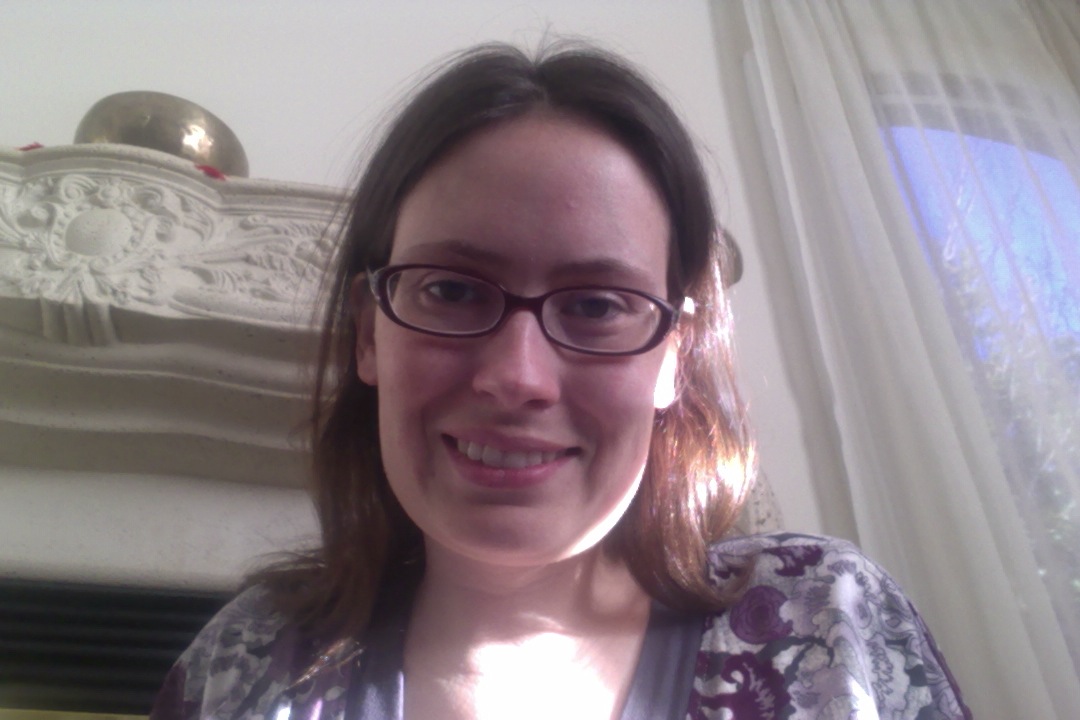
I can even smile when I have the flu. Now there's talent for you. :)

I can even smile when I have the flu. Now there’s talent for you. 

Sometimes conditioning runs so deep that we don’t realize what we’re doing, even when we’re working very hard to be mindful. I write in this blog about a lot of things I still struggle with. I’m still a perfectionist. I’m still sometimes a people pleaser. I tell you that your emotions are okay, but I don’t always believe that for myself. When something happens that is upsetting for me, my first instinct is to pretend everything is okay.

Once upon a time, it was extremely important that I be good at acting in a very specific way. One that didn’t go over well in drama class.

That story is over now. But I still smile sometimes when I’m sad.