Feeds:
Posts
Comments

Archive for the ‘Life’ Category

I started watching the first season of The Vampire Diaries on Monday night. I could say it was for research purposes, to see what’s going on in YA high school land and vampire land right now (in which case Glee is also research). But really I just wanted to watch a silly show that wasn’t taking itself too seriously after receiving bad dental news. Who knew that it would inspire my next blog post?

The first episode establishes the teenage protagonist of the series, Elena, who is starting a new year of high school only a few months after her parents were killed in a tragic accident. We see her getting ready in the morning, telling herself that she’ll no longer be “the sad girl”. And later on, she complains how everyone is asking her “How are you?” when really they don’t care and just want her to be fine. She spends the day lying because, of course, four months after losing her parents, she’s not fine. She’s pretty far away from fine.

A lot of that first episode was bad in a funny way (some of it, I suspect, on purpose). But I keep thinking about that moment of complete truth, because the writers completely nailed the “How are you?” detail. That simple question had the same effect on me. It took me quite awhile to accept its usage as a social nicety and standard greeting rather than the question it purports to be.

Offering this greeting to a grieving person is like jabbing a sore muscle to see if it still hurts…only it’s somebody else’s sore muscle being poked. It’s a reminder that no, you’re actually not doing fine at all, and not only that, but you are now expected to lie about it and pretend everything’s just peachy. That kind of pretending, unfortunately, takes energy, and energy is in fairly short supply when you feel like your chest is going to split open from missing the one you lost. In addition, it causes you to feel like you should be as together as you’re claiming. After awhile, you learn to dread the question.

Another variant of the problem is the person who asks you how you are constantly, like you’re going to explode into a million pieces any second now. (Or, as shown during the episode, the fake, over-concerned, and pitying rendition.) The true answer probably hasn’t changed in the last day or two, but sometimes it’s nice, even necessary, to take a break from the wellspring of grief for the comfort of normalcy. Overasking shatters any possibility of creating moments and experiences of relative peace.

So should we avoid saying “How are you?” altogether? I don’t think so, but wouldn’t it be interesting if we began meaning it as a question again, instead of allowing it to remain just a form? And perhaps thought more about appropriate times to ask it and how to listen in a nonjudgmental way? Then, instead of lying, a grieving person could honor their own difficult feelings and feel more supported by the outside world. Heck, I’m not grieving right now and I’d still like to be asked how I’m really doing. But many people never ask.

Here’s how I’m doing. I’m tired. I’ve been having a hard time this last several months. I’ve been under a lot of stress and in a fair amount of pain. Sometimes I feel completely overwhelmed. But I’m also determined, and I’m completely in love with life. So I’m hanging in and appreciating the good things even more than usual, especially the people who I love (and the dog, I can’t forget her). And I’m looking forward to change.

How are you?

Read Full Post »

Since I wrote my essay on ambiversion last summer, I’ve been thinking about the introvert-extrovert continuum a great deal. Perhaps even more so because that essay is by far the most popular one on this site and continues to draw in a fair amount of search traffic. This makes me think I’m not the only person who cares about such things.

What have I been thinking? I’ve been embracing my identity as an introvert, actually. I’ve spent most of my life unconsciously believing that being an introvert is a Bad Thing. Because, you know, those extroverts have all the fun. While I do believe that American culture contributes to this belief, I see no reason why I can’t be as nonconformist about this as I am about other widely held issues.

So here is my official announcement: Being an introvert is AWESOME! I get to have deep and interesting conversations with people, either one-on-one or in small groups. I get to do amazing creative projects that often require heaps of hours by myself, and it doesn’t bother me. I can be perfectly happy and content and charged without having to take the trouble to make sure I have social plans every single free moment of the day. I get to spend lots of time thinking, which means I get to analyze and learn and have plenty of “aha!” moments. And I tend to think more before I speak, which means I have a better chance of being able to support the people I care about (not to mention a better chance of avoiding saying the most stupid things that pop into my head).

Sure, being an introvert means I have to work harder at being assertive. But since I’m not down at the far end of the introversion spectrum, a lot of the more difficult aspects of it don’t bother me. Basically, I’m an introvert who can pass. (Perhaps this is the real definition of an ambivert: Someone who is not so extreme on the spectrum, so they are able to pass for the other if convenient.) This means that often I can enjoy the best of both worlds, and I’m not dodged by people’s perceptions of my introversion.

What I have realized is that being an introvert and lacking social skills are not the same thing. Imagine my surprise at this discovery! Someone can be an introvert and still have excellent social skills (or successfully develop them). Or someone can be an extrovert who has zero social skills. While there may be a certain amount of correlation between extroverts and social ability, it certainly doesn’t seem to exclude these other possibilities.

This became even clearer to me when I took another personality test based on colors (here is a version of it if you love taking personality tests as much as I do). My highest color is blue, which is the social helper type. Yes, I’m a self-esteem builder who gets the most satisfaction from work that allows me help and inspire others and make a difference in their lives. No surprise that I’ve spent most of my adult life being a teacher and writer. It even fits in with this blog of mine, doesn’t it? And yet I’m also an introvert. These two parts of myself are not in conflict. In fact, I believe that being an introvert actually assists me to better understand and inspire others. How’s that for some positive framing?

Here’s my question for you: how does being an introvert or an extrovert help you in your life? And if necessary, can you pass as the other type (be an introvert who appears to be an extrovert or an extrovert who appears to be an introvert)?

Read Full Post »

I read this fascinating article about luck a few weeks ago, but I’ve been saving my discussion of it until after my luck story came out because I love to be thematic.
The article talks about the research of Dr. Richard Wiseman, who conducted a study comparing “lucky” and “unlucky” people. He found that unlucky people tend to miss chance opportunities because they are so focused on specifics of precisely what they’re looking for, whereas lucky people tend to be more aware of what’s actually going on and are open to different outcomes. Basically, his research supports the idea that we make our own luck by noticing and taking advantage of whatever opportunities happen to present themselves.

We’ve all heard this advice in relation to dating. “You’ll find your future boyfriend/girlfriend when you’re least expecting it.” I don’t think the catch phrase actually covers it. Did I expect to meet my future husband at the specific housewarming party where we first talked to each other? No, of course not. (Is there ever a situation in which one does expect such a thing? Unless, of course, it’s a pre-arranged relationship of some sort.) But I also didn’t think it was impossible. I was open to meeting new people and having a new experience, and I went to that party with the hope that I might make some new friends. And I felt I was ready for a romantic relationship should one present itself to me.

Here’s the kicker. You might say I was lucky to meet my husband that night. He might have decided not to attend that housewarming party. Or he might have had a conflict, or received a phone call and left before I arrived. But because I wasn’t attending the party for the sole purpose of looking for a boyfriend, I think we might have met later on anyway. I would have become better friends with the party’s hostess (who later officiated at our wedding), and she would have held another party, or invited friends to go to a group dinner, or whatever, and I would have met my husband then instead. Or I would have become friends with other mutual acquaintances met at that party, leading to the same results.

It’s very easy to think about luck as relating to one specific outcome. What if, instead, we were to think about luck as more of a continuum that depends upon both our choices and our engagement with the world around us? We have to both notice opportunities as they arise and decide to act on them.

I’ll give you another example of how paying attention can work wonders. In college, I did my senior music recital in composition. I didn’t know any undergrads who had done such a thing, but “luckily” for me, I read the Music Major handbook carefully and learned that it was an option for me. Even better, after I received permission for my recital, I allowed other students to pursue the same opportunity because I had proven it was a possibility. Was I lucky? Sure. The composition professors could have decided they didn’t want the hassle of advising an undergrad composer (or been too busy to do so) and found a reason to reject my application. But I also proved the veracity of the quotation about diligence being the mother of good luck. I had formed positive relationships with the relevant faculty members; I had pulled together a decent proposal with a realistic timeline; I had thoroughly researched my major. I would never have been the recipient of this good luck if I hadn’t thought outside of the box (in this case, that all undergrad recitals were given by instrumentalists and vocalists, not composers).

What do you think? Do we create our own luck? Do you consider yourself to be lucky or unlucky (or neither)?

Read Full Post »

Jay Lake recently wrote an intriguing blog post about his theory of problems. To summarize, he states that problems cannot  be compared–that just because his problems (fighting cancer) are very serious, that doesn’t mean that other people’s “less serious” problems don’t matter too. He goes on to say that he still cares about his friends and that sometimes it can be a relief to talk about something besides cancer, even if the something else isn’t all rainbows and butterflies. (There is more interesting discussion in the comments, so you should check it out.)


I am in complete agreement. It is impossible to compare problems or lives, even though people try to do it all the time. It isn’t a contest with all of us competing to see who can have the biggest sob story to tell, who can be busiest and most stressed, who can have their behavior excused because gosh darn it, life hasn’t treated them well. Ultimately, we are each responsible for our own actions regardless of the problems we face. And each of us has the problems we have, and since we can’t literally be in someone else’s head (at least not yet!), we can’t know how our suffering truly compares.

I didn’t always understand this essential fact. I had a tough childhood and adolescence; my mom dying while I was fairly young was just the tip of the iceberg. It was easy to compare myself to others and minimize their problems in my head. “So his parents divorced years ago. That’s not a big deal. Why can’t he just get over it?” I know, I know, I wince to recall it. It’s embarrassing, and my only comfort is that at least I don’t remember usually saying such things out loud. Everyone is deserving of compassion for the hardships in their lives, and problems hit different people in different ways. What may be, for one person, a relatively insignificant event, may be a life-changing catastrophe for someone else.

And honestly, even if it were a competition for who has the worst life, why would you ever want to win such a contest?

Speaking as someone who, for many years, had “worse” problems than many of those around me, I never wanted to shut people down. (Perhaps this is why I had the minimal wisdom to try to keep my mouth shut during my occasional uncharitable moments.) I rarely discussed most of my problems, partly because I dreaded the initial reaction and partly because I didn’t want my experiences to change the way people related to me. I was already isolated enough; I didn’t want further barriers between me and the rest of the world. I wanted whatever normalcy I could get.

It’s a tricky business, because when we know someone is struggling with major problems, we don’t want to burden them with our own concerns, which in comparison seem to middle away into insignificance. But when we aren’t honest about what’s going on with us, when we choose to protect someone instead of share with them, what we’re really doing is pushing them away.

I’m not saying that we shouldn’t strive to be tactful and considerate. If a friend is retching in the toilet, that probably isn’t a great time to start bemoaning an inability to find the perfect juice squeezer. Someone who is ill might very well lack the energy to do certain activities with you. And sometimes there are subjects better left alone for a while. Raving about an amazing romantic relationship to someone who is going through a bitter divorce? Well, maybe not so much. But if you talk to that same friend about problems with your aging parents, it might not burden them so much as build the mutual connection between you. It may give your friend a break from dwelling on her own problems. It may make her feel less alone. Or she may tell you it’s not a good time to talk, and that’s okay too.

In my experience, everyone has problems, even those people who look like they have perfect lives. We all have bad days mixed in with the good, we all have setbacks, we all make mistakes, and we all have to live with the hard parts of being human. But ideally the people with whom we move through life can make the hard parts more bearable and the good times sweeter.

What do you think? Do you find yourself comparing problems? If someone has a really big problem, does that make you feel that you can’t speak freely to them?

Read Full Post »

Thirteen years ago today, my mom died.

Yes, I still keep track.

My mom was fifty years old when she died. I was nineteen. She died of breast cancer. She was first diagnosed with breast cancer when I was sixteen. She was in remission for a while, and then developed a different kind of breast cancer (the nastiest kind) in the same breast. She died about a year and a half after that second diagnosis.

I don’t talk about my mom very much, except to my husband, who never met her. But I think about her. Sometimes I think about her a lot, sometimes less. This year I’ve been thinking about her more than usual.

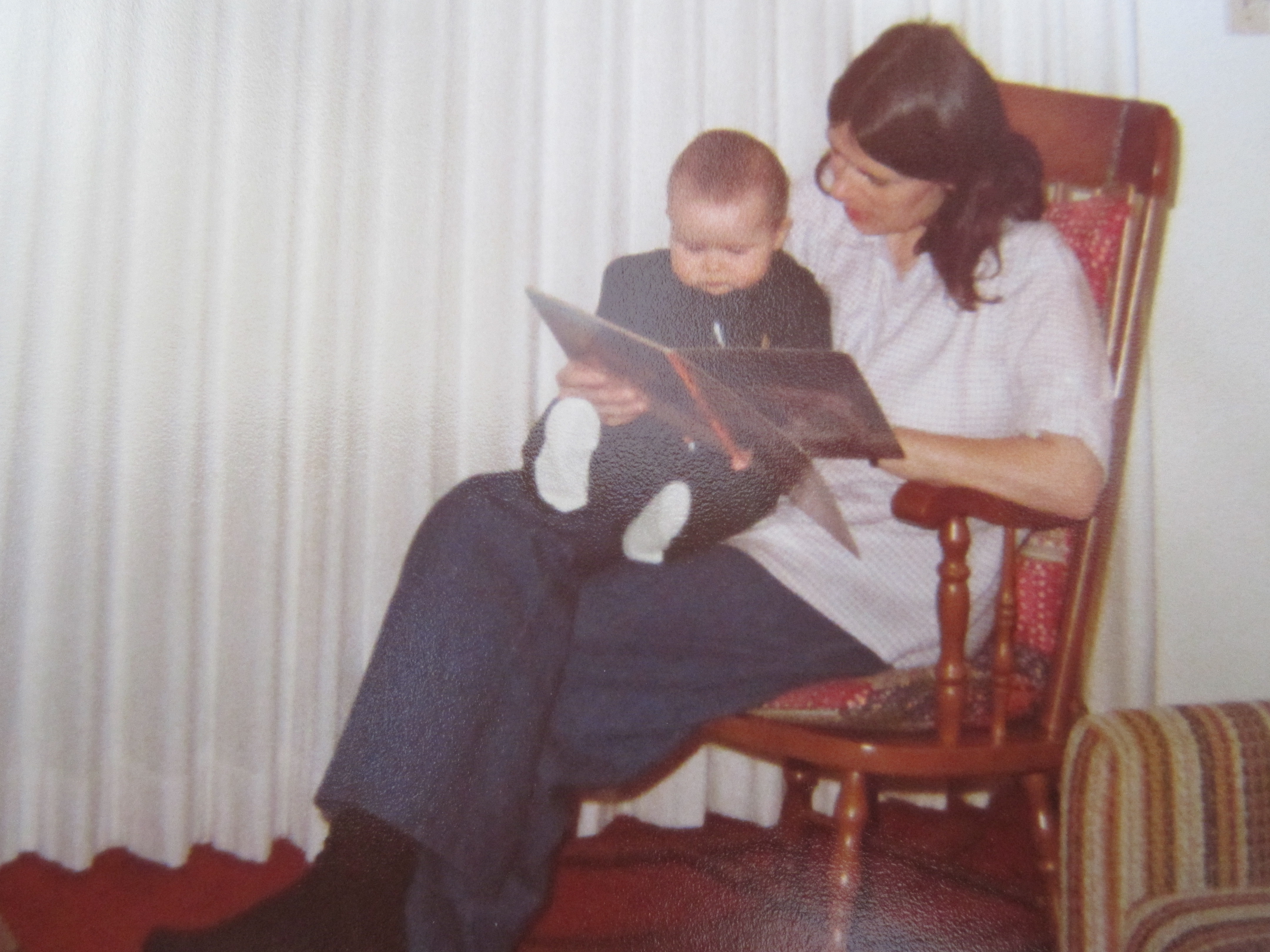
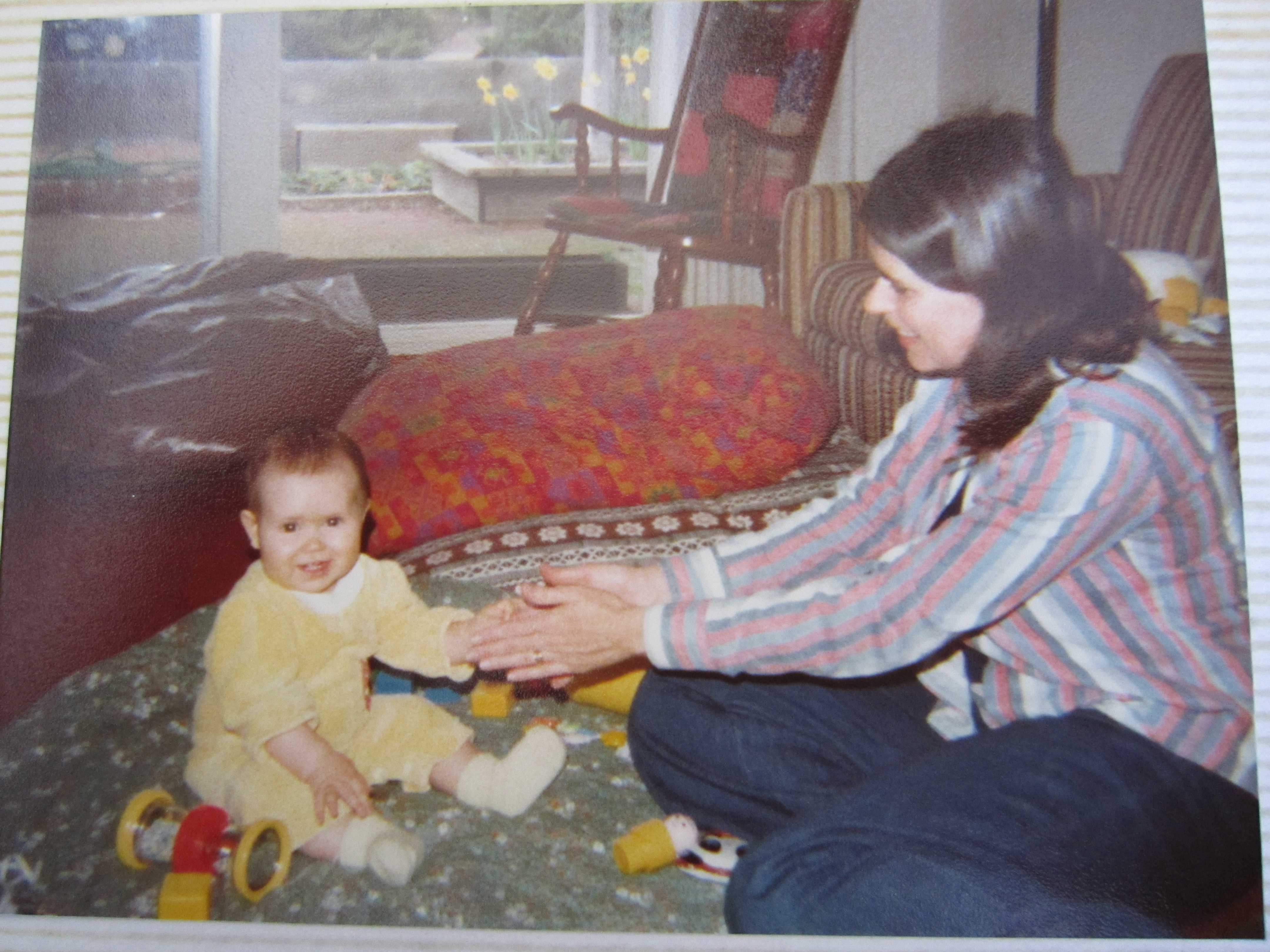
My mom and I

I thought about her when my husband and I made our first lemon meringue pie. I used to help her make the same kind of pie. I thought of her when I saw the large doll house at the Smithsonian because she loved  doll houses and miniatures. I thought of her when I made my first story sale because when no one else believed in me, she did, and I know it wouldn’t have come as a surprise to her. I think of her when I teach the song “Think of Me” from Phantom of the Opera, which I sang at her memorial service and was one of her favorites.

When we have an important relationship with someone, it doesn’t end when they die. Just as we create stories about our lives, we create stories about our relationships, and when the other person dies, we become the only one who can affect that story. But it still continues, and as I get older, I gain new insights into my mom. I wonder how she felt about various aspects of her life. I see things we have in common that I never noticed before.

In many ways, my mom was a very troubled woman. This is the aspect of her that the family has often dwelled upon…when they bring her up at all. But she was also a truly great woman, and this is how I remember her best. She was brave and possessed an infinite well of compassion. She was the best listener I have ever met, and she gave the best hugs. She tried to change herself, and if she didn’t necessarily succeed, she taught me that it is worth the effort. She always had time to read aloud to me, and she took me to the library twice a month without fail. She loved Christmas and little dogs, waterfalls and the ocean, children and long hot showers. She also had horrible fashion sense and an inexplicable love for bad made-for-TV movies. And she loved me with all her heart.

I have a lot I want to say, about death and grief, about society’s sometimes dysfunctional attitude towards these things, about not knowing what to say. Some of these things really need to be said, even if they’re uncomfortable or inconvenient or painful. But today is for my mom. I really miss her. I think I’ll always miss her. And you know, I’m glad of it. I wouldn’t have it any other way. Because I love her as much as she loved me. And we were lucky enough that we both knew that about each other before she died.

Happy April 26th, Mom. I’m still thinking of you.

Read Full Post »

A few weeks ago I was asked to write an essay, and the only requirement was that it should be inspirational. At first I wasn’t too worried: People had told me they found my essays inspirational in the past, so it was obviously something of which I am capable. Then I started to overthink and wonder if I could be inspirational on command. And finally I was given a more narrow topic (kindness) and the rest is history.
In that middle stage of overthinking, I asked myself what I find inspirational. And the first thing I thought of was one of my favorite books, Anne of Green Gables by L.M. Montgomery.
I want to be Anne Shirley (the protagonist) when I grow up. I’ve wanted to be her since the first time I read the book, which I received on my ninth birthday, and I imagine I will always want this. Possibly one of the biggest compliments someone could pay me would be to compare me to Anne. (Not that this will ever happen, since people don’t tend to go around comparing people to fictional characters. Except for Fred from the TV show Angel. I get that comparison a lot.)

Why do I love Anne? She’s wildly imaginative and creative, she’s intelligent and ambitious, and she always has good intentions. But she’s not perfect; she makes mistakes all the time, and she has character flaws that she struggles with (her temper, her vanity, her tendency to look before she leaps, an imagination that is occasionally a little bit too good). Her imperfections make her human, make her someone I can aspire to be. Perhaps L.M. Montgomery included so many faults because of the conventions of that era’s children’s literature to include morality lessons, but to me it never comes across as preaching.

At the beginning of the first book, Anne’s had a really hard life. She’s a poor orphan who has spent all of her life in and out of various dysfunctional foster families and institutions. Her schooling has been irregular, and she hasn’t been treated particularly well. She has every reason in the world to be hard, bitter, distrusting, and unpleasant. No one would blame her if she felt depressed or discouraged. But instead, Anne reframes her own life and takes control of her own story. She uses her imagination to create her own best friends and to make her world more beautiful. She notices and appreciates the little things. She has a warm open heart and the ability to find kindred spirits everywhere she goes, even when the world doesn’t initially appear very friendly. She bravely learns from her mistakes and keeps moving forward. She rises above her initial circumstances and goes on to create a life for herself filled with love, friends, scholarship, and beauty.

Through Anne’s story, we get a glimpse of a better world. One of the recurring plots in the first three novels (those are the ones I’ve read over and over because I can’t quite handle the idea of Anne grown up after college) is how Anne affects the people around her. She meets people who at first glance are difficult and curmudgeonly, and she influences them for good. She has such an open, kind heart herself, and she spreads it to the people with whom she interacts. She charms people with her refreshing sincerity and genuine good will, and she brings out the best in them. In the world of Anne of Green Gables, kindness and good intentions prevail.

I don’t believe that this idealized world is the one we actually live in. But it is the world that I wish we lived in, and my vision of it inspires me to do my little part in bringing it closer to reality. I want to be like Anne, bringing hope and beauty wherever I go and lighting up the world with my presence. I want to emerge from adversity still in touch with the joys of life and determined to learn from my mistakes. I want to inspire others the way Anne (and through her L.M. Montgomery) inspires me.

What’s the first thing to come to mind when you think of inspiration? What are the books or movies, characters or real-life people who drive you forward? What inspirational influences do you think have been especially critical for you?

Read Full Post »

Last week I wrote about some of the symptoms of being a people pleaser, and I promised to share techniques I’ve used to move away from that behavior. I wish I could write an article entitled “How to Become the Happier and More Assertive You in Four Easy Steps,” but the truth of the matter is that it probably won’t be easy, and some of the strategies I’ve used might not work for you. Whenever we set out to change ourselves, especially in such a significant way, we are engaged in the personal equivalent of scaling Mount Everest. Should we set such lofty goals for ourselves? YES! But we also need to pace ourselves, be gentle to ourselves, and expect some setbacks along the way.

I’ve found the following to be helpful:

1. Blogging: Yes, you already know how in love with blogging I am. But there’s a neat side effect that helps with assertiveness. In order to write a decent blog, I have to share my thoughts and opinions on a regular basis. Twice a week, in fact. And people read them. After blogging for over nine months, I’ve gotten a lot more comfortable sharing my thoughts and opinions in person as well. It’s begun to feel natural because I do it so often.

And for those of you saying, “But no one would read my blog,” I would respond that what matters the most about this technique is that you’vre sharing your opinion and you’re making it public. Even if tons of people aren’t reading, they could read anytime in the future. Especially if you link your blog posts to your Facebook and Twitter accounts, which I think you should do. It’s about the practice of entering a certain frame of mind more than it’s about page view numbers.

2. Providing structure: When we know that we are people pleasers, there are certain aspects of our behavior that we can predict. For example, I know that I’m going to struggle to say no in many situations. Especially in situations that regularly repeat themselves, we can create a framework to help us behave in the way we want to behave rather than the way we tend to behave.

Even though I’m a people pleaser, I started a service-oriented business. Can you imagine all the things that could go wrong with that combination? But right from the beginning, I was extremely dedicated to my business policy. I spent a few years tweaking it until it worked the way I wanted it to work, and then I made every client sign the policy before we’d start lessons. That way, whenever I had to say no–and there were many, many such times–I had a template I could fall back on. “I hear that you want x, but I’m afraid that my policy states that I don’t do x.” This also protected me from worry stemming from being overly conscientious and making excuses for my clients, because since they had signed the document, I knew they knew what our agreement was. (Other examples of creating structure might be a weekly scheduled and inviolate “me time” or a strict definition of when a certain task is “finished” to avoid over perfectionism.)

3. Insisting on respect and surrounding ourselves with supportive people:This is a tricky one because as people pleasers, we aren’t very good at this. We want to believe the best of everyone, we want everyone to like us, we want to help everyone because we have such an overflow of empathy, and we attract people who are at best inattentive and at worst may be trying to take advantage of an easy target. Sometimes it is easy for us to believe that everyone lives like this. Well, news flash: They don’t.
Interestingly, what I’ve found is that when I’m able to present myself in a more confident and assertive manner, I stop attracting many of the people who want to take advantage of my niceness (and those I do attract, I tend to recognize more quickly). And I’m able to present myself better when I’m not weighed down by said people. A bit of a Catch-22, isn’t it? We don’t want to let go of our unhealthy relationships because then we’ll be lonely, but until we do, we won’t meet more supportive people, and guess what? We’ll still be lonely.That’s why I use the word “insisting” above. Do you know how many times a week I tell myself, “Amy, you deserve to be treated well” or “Amy, you are interesting and worthy of respect” or “Stop being so hard on yourself, you’re doing the best you can?” Well, it depends on how bad a week I’m having, but it’s usually many, many times. I’m in the process of reprogramming the way my brain responds, so the more repetitions, the better. Eventually I begin to really believe it, and then I find myself arguing with the car salesman who is being rude to me (something I would never have done even a year or two ago). Even though it’s difficult at first, I think aggressive setting of boundaries can be very helpful when people pleasers are trying to create an environment for themselves that involves more mutual respect.

4. Exploring root causes and putting your foot down: Ultimately there is probably a reason (or many reasons) why we are people pleasers. Our behavior had to start somewhere, right? At some point we had to decide (often unconsciously) that being a people pleaser was a good life strategy. Maybe we had an important role model who was a people pleaser. Maybe our people pleasing behavior was rewarded in certain ways (or maybe other behavior was punished). Maybe our contributions were devalued, or perhaps we took society’s “good girl” myth a little (or a lot) too far. If we address our behavior from its root cause, the results can be dramatic. Once we’ve identified the cause, we have a better understanding of our behavior, and from understanding comes empowerment. (Sometimes we’ll do this backwards, acting in an empowered way as we’ve been practicing, and then realizing the root cause from the results. Either way works.)

This is a hard but rewarding journey. Some people in your life won’t be too happy about your growing self-respect. This is sad but inevitable, and will cause conflict (the conflict you may have been avoiding all this time). Other people will be cheering you on the whole way. And you may begin to feel more like the real you, an amazing person who’s just been waiting for a chance to shine.

And now, dear readers, it’s your turn. Any additional strategies or examples you can share? (I love examples because they allow us to visualize possibilities.) I’d love to hear from you!

Edit: I’ve written more about being assertive here.

Read Full Post »

I’ve been working to become more assertive (and less like a doormat) for a long, long time. I think it was in seventh or eighth grade that I realized that my shyness was a problem that would hold me back, and I’ve been peeling various layers from this issue ever since. While it’s true that I used to be an introvert (and maybe I still am, depending on your definition of the term ambivert), introversion hasn’t ultimately been the cause of my problem. Much more pervasive and destructive of my peace of mind and overall happiness has been my tendency to be a people pleaser.

Mac (from the TV show Veronica Mars) shows some signs of being a people pleaser.

This insidious condition shows itself in many guises. At its worst, here are some of the symptoms:

– constant placement of others above yourself, often without much thought or communication. (Please note the word constant. This isn’t the opposite of being selfish so much as it is door mat behavior.)
– constant second guessing of your interactions with others
– being quick to feel guilt
– conflict aversion (desire to avoid making people unhappy/upset/angry)
– allowing people to take advantage of you, OR struggling to prevent this and feeling overly upset as a direct consequence; inability to say no or stand up for yourself
– ease of seeing another person’s point of view and using this skill to make excuses for them
– getting ensnared in one-sided conversations, in which the other person basically delivers a monologue, won’t ask you questions about yourself, and will do their best to divert the conversation back to them at all times
– perfectionism; a lingering worry that if you fail to be perfect, people will no longer like you
– a sense of isolation; feeling that nobody cares

Early Willow

Early Willow (circa Seasons 1-3) is definitely a people pleaser to watch out for.

Just to be clear, this list is no longer an accurate description of my state of mind. I’ve had twenty years to improve, after all, and I’m nothing if not dogged. (Some people think stubbornness is a bad thing. Does not compute. It’s one of my most useful traits.) But these are the sorts of things I have to guard against because I might fall into one or more of them if I’m not paying attention or am otherwise not at my best (ie sick, tired, worried, discouraged, etc.).

These are the social responses I was raised to have, compounded by female gender expectations to “be nice”. Unfortunately, they are not particularly effective if one wants to have a happy life that isn’t completely overrun by anxiety. They are also not helpful if one wants to be treated with care and respect. (Sad to say, there are plenty of people out there who will treat others with disrespect unless doing so has personal consequences–consequences that people pleasers are often ill-equipped to give.)

I’m writing about this problem because I know there are many people out there who struggle with one or more items on my list. And yet so often we don’t talk about it, and sometimes we even pressure each other to conform more to societal expectations of the unhealthy roles we play. (Have you ever looked up general interpersonal advice on the internet? It can get pretty scary.)

Next week I’m going to write about some of the thoughts and strategies, especially those I’ve discovered more recently, that have helped me break out of the people pleaser mold. In the meantime, can anyone think of any fictional characters who fall into people pleaser territory? Have any questions or experiences you want to share? Comment below!

Read Full Post »

In the book about plot I’m reading (20 Master Plots, by Ronald Tobias), Mr. Tobias talks about how plot and structure in fiction differ from real life. In real life, he says, there are not the same links of causation. Life is chaotic and sometimes (even often), things occur because of chance and wild coincidence (whereas in fiction, it’s really hard to get away with coincidence and generally denotes sloppy plotting). Some loose ends never get wrapped up in real life, we never know the true “ending”, and much of what happens seems to be without meaning and never gets explained. The Absurdists try to reflect this random reality in their literature: Camus and Kafka are two well-known writers who do this well. (And incidentally, you know who else identifies as an Absurdist? Joss Whedon. An explanation for Puppet Angel, perhaps.)

From the TV show Angel

Theodora Goss, who has a beautiful blog, has a slightly different view: “Happiness is the ability to create satisfying stories about reality. To find the stories that fulfill you, that allow you to achieve what you desire. That fill you with joy. Because reality is, to a certain extent, our perception of it. Achieving what you desire may also involve altering reality itself, changing your circumstance.”

I’m inclined to agree with her. The power of storytelling is making order from chaos and meaning from seemingly unrelated events. But stories don’t merely reside in our books and entertainments. We are constantly telling ourselves our own stories, and in so doing, we are cementing certain events into memory and into part of who we are. By doing this, we construct a reality that no longer appears quite so random and out of control.

We are in the continuous process of creating ourselves. “I’m the person who did xyz. I’m the person to whom this happened. I’m the person who spends my time in this way. This is what is important to me.” That’s why I’m always harping about the importance of priorities. Because priorities are a way of expressing deep truths about ourselves and making our most important desires into reality.

Humans as a species are fascinated by the quest for meaning. This desire for meaning is reflected in many aspects of our culture: in our art, our religions, the Enlightenment and our fervor for science, and our ease of slipping into diametric thinking (black and white, good and evil). We spend our lives trying to make sense of our childhoods, the people around us, and the huge life-altering events that intrude into our sense of order (war, natural disaster, illness and death, wide-scale oppression and resistance). We ask, why are things the way they are? How does the universe work? In what direction is human civilization heading? Or, more personally, why doesn’t So-and-so like me? What is my purpose in life? What will make me happy?

We have to be very careful with the stories we tell ourselves, the movies in our minds. (You can thank Miss Saigon for that pretty turn of phrase.) If we tell ourselves negative stories or harshly self-critical stories, these stories will eventually manifest themselves, often in self-limiting behaviors and self-fulfilling prophecies of gloom and unhappiness. If, on the other hand, we tell ourselves that we’re geniuses who can do no wrong, we can become out of touch with the humanity around us and struggle to find compassion for others.

On their own, our lives do not fit together neatly into a perfect puzzle of reality. We create the frame of reference from which we can understand ourselves and the world around us. We make our own explanations and our own meaning. What this means, I believe, is that ultimately we choose the slant of our lives until we die. Are we empowered? Can we make change? Or are we victims or characters in a tragedy, or are we taking an active role in life? Can we find the good in our situation and encourage it to grow? Or is everything about life difficult and glaring and out to get us?

In the movie Holiday, the old screenwriter Arthur tells his friend Iris that she should be “the leading lady” of her own life, but for some reason she is behaving “like the best friend.” We each have that choice in the stories we tell ourselves. Are we the hero of our tale, or are we relegating ourselves to a supporting role?

Be the hero. Be the protagonist. Be the person who acts instead of the person who is acted upon. We are all leading ladies and men. And we each get the privilege of creating the stories of our lives.

Read Full Post »

Today I have a guest post, Why Kindness Matters, at my friend and colleague Marilag’s blog. (Yes, I was very busy last week writing all these posts.) I really enjoyed writing this post because Marilag requested that I speak about kindness, which gave me the chance to really think about it and appreciate all the kindness in my life. Thank you, Marilag!

I’m also pleased to announce that I sold another short story. “Luck Be a Lady” will be published by Crossed Genres in their Luck issue, which I believe will come out sometime in May. So if you’ve been curious to read some of my fiction, you don’t have much longer to wait!

Read Full Post »

« Newer Posts - Older Posts »