Feeds:
Posts
Comments

Archive for the ‘Life’ Category

I’m back in novel immersion at this point, as I push to finish revisions, and my head is full of my characters and their plot arcs and a plot hole that’s going to be annoying to fix. It is hard to pull myself out of that world and back into this one.

So I’m going to talk about liminal spaces because when I’m having trouble leaving my fictional universe, that’s what I think is going on. I’m existing in a liminal space, partly in the world of the novel that my imagination has forced into being, and partly in the world in which I have blog post deadlines and dinner to make and errands to run.

Let’s talk about the word liminal. It wasn’t strongly in my radar until I read Farah Mendlesohn’s interesting Rhetorics of Fantasy a few years ago. She divides the fantastic into four categories, and one of those is the liminal. In liminal fantasy, she posits, “the magic hovers in the corner of our eye.” An example of this category is Joan Aiken’s Armitage family stories, which I enjoyed reading quite a lot.

But liminal means a lot more than a category in fantastic literature. Liminal is about being in between, about being in transition, about being both and neither at the same time. In anthropology, Wikipedia helpfully tells us, liminality refers to “the quality of ambiguity or disorientation that occurs in the middle stage of rituals, when participants no longer hold their pre-ritual status but have not yet begun the transition to the status they will hold when the ritual is complete. During a ritual’s liminal stage, participants “stand at the threshold” between their previous way of structuring their identity, time, or community, and a new way, which the ritual establishes.”

Being in a liminal space is uneasy, uncomfortable, possibly awkward. Standing at the threshold is not without its dangers.
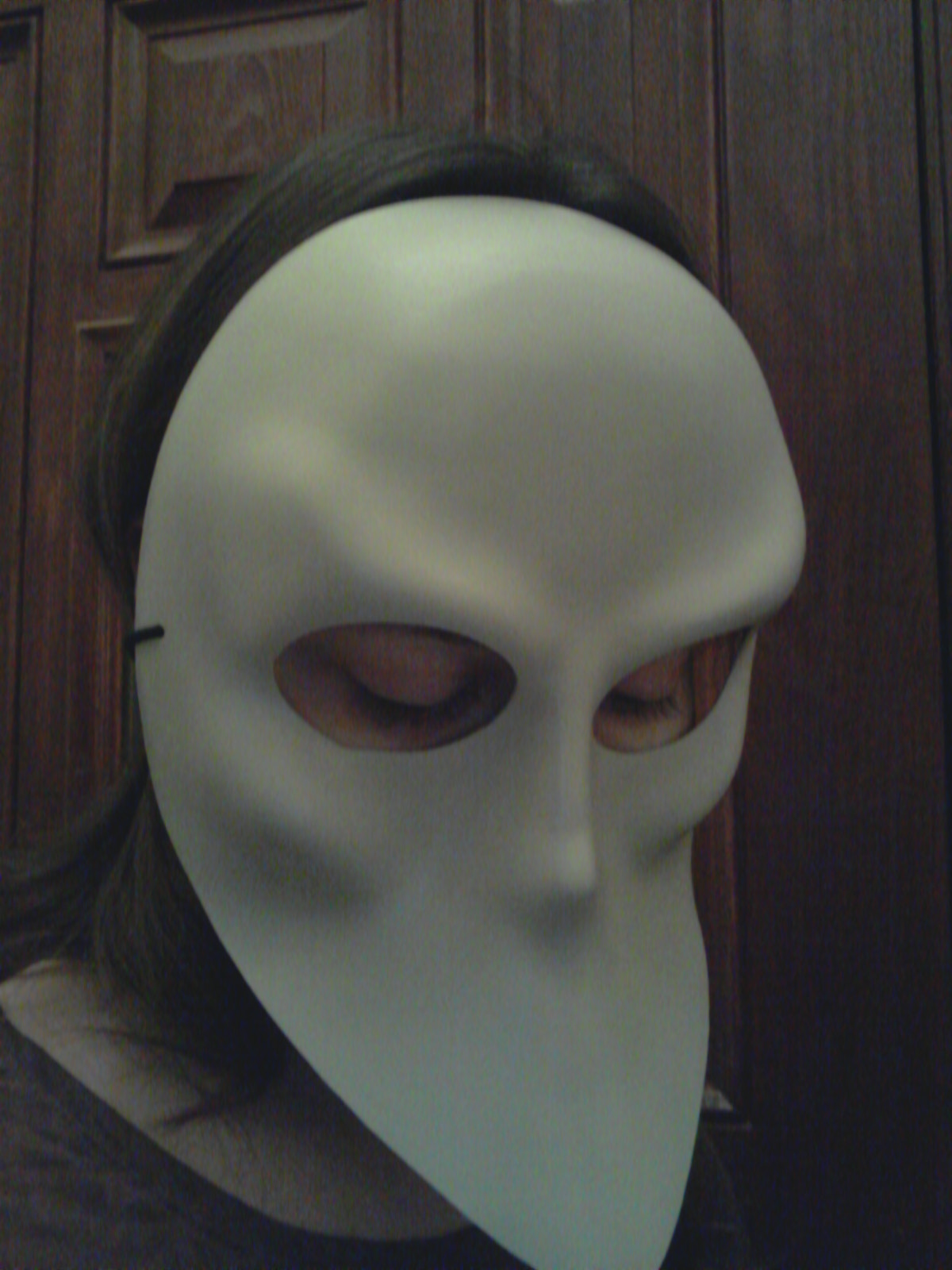
Audience or specter?

I went to see Sleep No More while I was in New York, and one of the things this performance art piece does quite well is create a sense of liminality for its participants. Are we an audience, or are we spectres? Are we invisible, or are we obstructions? There is nowhere I am supposed to go, and yet am I where I am supposed to be? There is a narrative being created, and yet there is no narrative visible.

Traveling can also create a liminal experience. I can be both in a place and not of a place. If I travel to several countries in quick succession, I can wake up in the morning uncertain about where I am, what language is used here, what currency. There is a clash between what I know from my world and what I experience in this new place.

Schrodinger’s cat is both alive and dead, and literature about dying talks about it as a liminal state between life and death. In fact, liminal states exist in most major transitions in life. Coming of age stories often rely heavily on the uncertainty and turmoil of the liminal state between childhood and adulthood. Waiting can be involved in liminal states, too: waiting for the results of the pregnancy test, waiting to hear what colleges have accepted you, waiting for the answer to your question, waiting for the hurricane to hit. And what about that strange state between waking and sleeping?

Liminal spaces are challenging, and yet they can also offer freedom. The spaces in between offer us opportunities to recreate ourselves, to see the world with fresh eyes, and to drill deeper into the experience of being human. When we’re no longer sure who we are or what labels we’re claiming, we have room to explore who we want to be.

And critically, when we are standing in the shifting sands of liminal space, we are sometimes able to see more clearly what is important to us and what we want our priorities to be.

Read Full Post »

I stumbled across an interview with Brene Brown (whose TED talk I mentioned last week), and at the end she says if she was going to found a museum, she would call it “a Museum of Epic Failure.” At which point I instantly emailed a link to the article to my friend and said, “This is the title of my next blog post!”

Photo by the National Museum of American History Smithsonian Institute

We have such strange ideas about failure and success. I meet people again and again who assume that, having failed at something once, it makes sense to automatically give up and not try again. They wonder at the fact that I have written THREE novels, even though none of them are yet published. They make comments that call into question the entire premise of one of my failures, as if I have now automatically learned better.

Sure, sometimes a failure, and the lessons we learn by failing, cause us to change directions. Sometimes we decide we’re better suited to doing something different, or we’ve found a new passion to pursue. Sometimes our viewpoint has changed so that we no longer want the same things we wanted before. But failure can also mean that the next time we try, we’ll apply what we’ve learned this time around and do better.

Meanwhile, when we stop doing something we’ve been successful at in some form or another, people get confused and tell us it’s “too bad.” And if they like us (aka social success), they tell us to “never change.” There’s this idea that once success has been achieved, we need to hold onto it tightly while avoiding change at all costs.

This is an example of black and white thinking at its finest, where success is positive and good and to be cherished, while failure is negative and bad and to be avoided.

What is often overlooked is the necessity of failure. When we take a risk, it is risky because there is the possibility of failure. If we were one hundred percent sure we’d succeed, it wouldn’t be a risk at all, would it? And so many great successes and helpful learning moments come from the willingness to take a risk and allow ourselves to be vulnerable.

Most great art–be it visual, literary, musical, or theatrical–comes from reaching to see where we can go, from exposing ourselves in the act of creation.

Most great relationships–be they platonic or romantic–come from opening up and being authentic with one another, while not knowing how we’ll be received.

Most great entrepreneurial ventures–be they tech start-ups or service businesses or local merchants–come from taking the leap into the unknown and committing ourselves and our resources to a particular vision.

When we are engaged in these activities and being honest with ourselves, we know we are taking risks. We know we may fail. And it is when we allow ourselves the space to fail (say goodbye to perfectionism!) that we are capable of our best work.

Which is when we realize that failure isn’t inherently bad. It teaches us, it pushes us, it leads down paths we wouldn’t have noticed by ourselves. It makes success, when it comes, more meaningful, even while it keeps us grounded and connected. And when failure comes instead, and we feel flattened by its impact, we can remind ourselves of the alternative: staying safe, cramped, and complacent while being too afraid to really try.

We are each in the process of creating our own personal Museum of Epic Failure. I’ve already collected many interesting exhibits in mine. And each one has helped to shape who I am today.

Even things that are uncomfortable can have reasons to be celebrated. Is there a failure you’ve experienced that you learned something important from or that you’re grateful for now? Feel free to share in the comments.

Read Full Post »

A couple of weeks ago I watched a TED talk by Brene Brown entitled “The Power of Vulnerability.” It’s twenty minutes long, but I highly recommend watching it when you get the chance. Brene Brown is a researcher who spent years studying vulnerability, shame, and human connection, and she shares valuable insights from her work and how it has affected her own life.

I’ve been seeing a common theme coming up this year, and it comes up again in this talk: that connection and well-being come from the inside, that they arise from our own beliefs and attitudes about ourselves.

I saw it in James Altucher’s post about Kamal Ravikant, who was desperately ill and miserable until he turned things around for himself and ended up writing a short book about the experience. His secret? He told himself that he loved himself a billion and one times.

I saw it in the reading I was doing about attachment styles. Apparently people with a healthy attachment style tend to assume that their needs will be met. And guess what? More often than not, their needs are met, one way or another. Part of this is probably because they are asking for what they need, and part of it is because they are attracting other people who are okay meeting some of these needs. The fact that they assume their needs are okay and will be met shows a greater sense of self worth.

And now here is Brene Brown, telling us that the one thing separating those people who experience a lot of love and belonging in their lives from those who do not is a sense of worthiness. When we believe that we are worthy of love and connection, when we believe that we are enough just as we are, then we can embrace our vulnerability, find our authenticity, and achieve greater connection.

And in her list of traits that these “heart whole” people have in common, she mentions them having compassion for themselves, because otherwise they are unable to have compassion for other people. This idea relates back to the Nice vs. Kind trap and one of the reasons being a people pleaser ultimately doesn’t work out so well.

At the end of last year, I wrote a post called “You are Worth It,” giving this message in yet another way.

This idea of worthiness circles back around on itself in a feedback loop. Take the recent World Fantasy Convention as an example. I entered into the convention feeling comfortable and like I belonged. Because of that, I was more relaxed, having a better time, and able to be very much Amy. So I could connect more easily with both people I knew and people I was meeting. Then people started joking that I knew everyone (not true, but thank you!), which made me feel like I belonged even more, and so made me connect more. Rinse and repeat.

Very Much Amy

The key point, though, is that the nifty cycle I described started with me. It began with me taking my career seriously and feeling like I belonged in a group of professionals. It began with me taking myself seriously, as a person worthy of respect. Without that, the cycle wouldn’t have had a chance to feed back on itself.

We talk a lot about authenticity: to connect with each other, and in a professional context, to connect with readers. This authenticity comes from the courage to be vulnerable. And make no mistake, it does take courage; this blog has taught me that. And here we find another loop: courage builds feelings of worthiness, and a feeling of self worth increases our courage. 

Let’s be brave together.

Read Full Post »

A few nights ago, I was eating by myself at a standard American restaurant on Broadway. Whenever I eat alone, I make it a point to bring reading material along to make the waiting go by faster (well, really, whenever I go anywhere I like to bring reading material along).

The waitress asked me what I was reading, and I told her, “It’s a memoir by Julia Child.”

She looked at me blankly. “Who’s that?”

“Oh, you know, Julia Child. She’s famous for bringing French cooking to the U.S.” No recognition. “You know that movie Julie and Julia?” Nope.

It left me wondering if I would have recognized Julia Child’s name before I saw the movie. I hope I would have, but I’m not completely sure. But I’m glad I know it now, because her memoir, My Life in France, written with her grandnephew Alex Prud’homme, is so very charming.

Photo by Kaleb Fulgham

The entire time of the hurricane—the lead-up, the storm itself, and the recovery—I was reading this memoir. The personality of Julia Child fairly oozes from the pages. She gushes away about France, about food, about cooking, and her passion is so obvious from her stories. She recounts so many meals she’s enjoyed in the past, course by course.

Her first meal in France, when she was in her mid-thirties, was what set her on the course to becoming a famous chef. I love this fact so much. Because we never know, do we? We never know when we’re going to have an experience, or meet a person, or learn something new, and have a passion ignited within us. It can happen anywhere and anytime; it’s not something that only happens when we are teenagers or freshly adult, it’s not something that has to be planned carefully, or even something that can be anticipated.

I love this idea, too, because it reminds me that all of life is one big adventure. A new subplot could spin off at any time, or a nice bit of character development could take place, or I could begin my grand romance with pumpkin spice chais. Knowing this makes me feel so lucky to be alive.

By the time I finished reading My Life in France, I’d become very fond of Julia Child. I love her personality, her energy, her courage, and her unwillingness to give up. I love how enthusiastic she was, punctuating the text with Yum! and Hooray! and What fun! I love how her passion for food and cooking helped her through the bad times. I love how she spent a lifetime involved in food and cooking and teaching.

And I love some of her philosophy. When she is leaving her country house in France for the last time, do you know what she remembers saying? “I’ve always felt that when I’m done with something I just walk away from it—fin!” She enjoyed what she had to the fullest while she had it, and then let go when it was over. This isn’t a strong point of my own, but I admire her a lot for thinking it, and more importantly, for living it.

All in all, I can’t imagine a better book for me to be reading in the middle of a hurricane.

What about you? What have you been reading lately?

Read Full Post »

As I type this, it is Sunday night in New York City. I am alone in my hotel room on the 33rd floor. And the hurricane is coming this way.

I have prepared as much as I am able. I have water, food, and little LED lights. I have considered the possibility of flying debris breaking the window. I have charged up my Kindle and my iPod. I have changed my flight and talked to hotel reservation clerks.

There is nothing else I can do. So today, taking advantage of the subway that is now no longer running, I visited the Guggenheim and Metropolitan museums. I looked at Kandinsky (my favorite was Small Pleasures) and Monet and Renoir paintings. I saw three gorgeous Fabergé eggs. I talked to a man whose handshake was crushing and could reel off famous quotations the way I can sing musical theater songs.

Inside the Guggenheim today

This has been, in many ways, a year of high uncertainty for me. But this hurricane takes it up another notch, so that now I am uncertain about basics of my physical comfort: is the power going to go out? Will I be able to keep warm with no heat? Did I buy enough supplies? Can I keep myself from going insane in the dark? How long it will last, and when will I be able to leave?

I hate uncertainty. I’m a big planner. Uncertainty tends to make me deeply uncomfortable. So that means I’ve been growing a lot this year, and this hurricane is like a particularly swift kick in the pants to make sure I keep at it.

Here is what I’ve learned about uncertainty. Even though I don’t like it, I can sit with it. I can be kind to myself in the middle of it. I can try to keep myself fed and well-rested so I can deal with it better. Once in a while I can even embrace it and see the potential it represents.

Uncertainty also heightens my appreciation and gratitude for what I do have right now. For having a purpose in life as exciting and fabulous as writing. For the wonderful people with whom I get to spend time. For cute snuggly little dogs who burrow into my side. For warm clothes and cupcakes and beautiful art and performance art that pushes boundaries. For leaves that change color in the autumn. For courage and wisdom and curiosity and kindness and vulnerability. And for the open-hearted generosity that so many people have been showing me.

And you know what? I even feel grateful for being afraid to die. Because that means I have so very much to live for.

I’ll be in the heart of uncertainty for the next few days. I’m even uncertain as to whether there will be another blog post this week. But I hope there will be.

Do you have any thoughts about uncertainty? I’d love to hear them!

ETA Tuesday 12:30am: It appears that the worst of the storm is over where I am. I’m fine, I still have power, and none of the windows broke. Many thanks to all my fine friends who reached out to me while the storm raged.

Read Full Post »

Whatever your feelings might be about Jeff Bezos, according to this article he said something very interesting at a Q&A recently: “He said people who were right a lot of the time were people who often changed their minds. He doesn’t think consistency of thought is a particularly positive trait.”

I love this insight because I change my mind all the time, and I think having some mental flexibility is very important. I’m not talking about fickleness here, as in not following through on commitments and responsibilities, or flip-flopping views for convenient or random reasons.

But changing your mind is a very natural thing to do. Perhaps you’ve had more time to think about an issue, or perhaps you’ve become more educated about it. Maybe something else has happened that has changed an issue’s ramifications. Or maybe you simply woke up one day and realized you were incorrect. It happens.

Photo by H. Kopp Delaney

I’m sure I don’t agree with everything I’ve written on this blog anymore, or have developed a more nuanced view. Often when I sit down to write an essay, I am learning and thinking as I type. And then I learn more from any discussion we have together in the comments. And then I think about it for a while. And then maybe I read something else that plays into all of that in some way. I often understand something better as a result of this process.

The problem with not changing our minds is that this rigidity makes it a lot more likely that we’ll get stuck. We’re less likely to think of creative solutions to our problems or different ways of seeing something. We’re more likely to remain ignorant because we don’t always get enough information right away, but if we can’t change our minds later, we’ll be stuck with whatever opinions we formed without sufficient data. We’re less likely to think for ourselves and more likely to hold onto unexamined beliefs that were instilled in childhood.

How can we live examined lives without being willing to change our minds when necessary? How can we really listen to what the people in our lives are telling us if we won’t allow even the possibility that those words will have impact? How can we live in a constantly changing world without allowing our minds to change along with everything else?

Of course, as with everything in life, finding a balance is necessary. In order to embrace the possibility of changing our minds, we have to put in the time and effort required to weigh different viewpoints and incorporate any additional data we may have learned. Sometimes we will come to the conclusion that we don’t need to change our minds, that our viewpoint is still working just fine for us. And sometimes the arguments presented to us don’t merit much (or any) investigation.

But pure long-term consistency of thought can sometimes show a lack of any actual thinking at all. Personally, I’d rather keep exploring, learning, and asking questions. Changing your mind doesn’t have to feel like failure; instead it can be seen as a victory.

Read Full Post »

I’ve been learning to play the game Go for the past few months. For those unfamiliar, Go is a strategy game that originated in China at least 2,500 years ago. Like many strategy games, it focuses on controlling territory. Its rules are fairly simple, and it has a huge number of possible combinations of moves.

I was sitting in a cafe playing Go yesterday, sipping on my pumpkin spice chai and pushing my brain through the equivalent of a complex gymnastics routine. And as I struggled to choose my next move, I realized how so much of what I was learning on the board could be applied to life.

Photo by Chad Miller

So without further ado, a list of insights inspired by playing Go:

1. When there are a huge number of possibilities, it’s harder to decide what to do next.

2. Sometimes focusing in tightly on one area means you lose sight of the big picture. This can end very badly.

3. Cultivate humility, because there is such a large number of possible mistakes, as a beginner you are bound to make a whole lot of them.

4. Feeling cocky is usually a sign that something is about to go horribly wrong. (If nothing else, it tends to lead to a loss of the necessary focus.)

5. Sometimes you need to play further out than you feel entirely comfortable with.

6. If you get stuck playing a largely defensive game, it is harder to achieve any of your real goals.

7. It’s easy to become distracted, either by something shiny or by your opponent. This also makes achieving your real goals more difficult.

8. Mistakes and experimentation are both necessary in order to learn and improve.

9. The entire board can change very quickly when you are inexperienced. Situational awareness is invaluable.

10. To become a strong player, it’s better to play with and learn from more than one person.

11. You have to find balance between risk and safety and between expanding outwards and consolidating what you already have.

12. Discomfort is a sensation that can be practiced and settled into.

I suspect I’ll be learning a lot more from Go in the coming months. Maybe soon I’ll even graduate to a larger board!

Read Full Post »

I’ve been thinking about non-attachment.

When we discussed Buddhism in high school, I thought non-attachment sounded very sterile, like it encouraged people to not care about anything. This was a misunderstanding on my part, of course. Any religion that talks so much about compassion and loving-kindness isn’t about the not caring. It’s more complicated than that, and it has to do with our relationship with desire.

We are not always going to get everything we want. When we do get one thing we want, then we want something else. Sometimes we get caught in a trap of thinking, if only I had blah blah blah (where blah blah blah can be a certain type of career, a certain type of relationship, a certain level of health, a certain amount of money, etc. etc.), then everything would be perfect. My life would be complete.

But that generally isn’t so. We get a certain amount of money, and then maybe our health goes down the tubes. We get a certain type of career only to realize we really want to go up another tier or do something else altogether. Our health improves, and then maybe a close friend gets sick, or she moves away and then we miss her and busy ourselves thinking, if only I had more friends. We desperately wish for something in the future, but we can’t be sure of the outcome.

And sometimes we simply don’t get what we want at all. We can’t quit that irritating day job. Our family won’t stop making demands on us that we can’t meet. We have a chronic health condition. We get laid off, we don’t get into the program that would have made all the difference, we can’t afford this workshop or that trip or those material goods.

Right this second my back hurts and I want it to stop hurting. Sometime soon I’ll stop typing and do a few stretches and exercises, and it will probably feel a little better. But that won’t last. Over time I can strengthen my back so it feels more better more of the time. But really I want the pain to stop now, and permanently, with no effort. I’m not going to get what I want. These little moments of not getting what we want happen all the time.

Photo by David Boyle

Which is where non-attachment comes in. I think of it as the acceptance of thwarted desire. It’s the awareness that this is our reality, that we want and yet we’re not going to get everything we want. And that it’s okay that this is true. We will want something, and then that wanting will eventually pass. It might take a long time to do so, or it might not. Everything changes, and changes, and changes again. And the more we can be aware of this movement, and even embrace it, the less suffering we will experience.

At least, this is what I’ve been thinking about. Sitting with the feeling of desire, which keeps coming up. Watching it, and the emotions it often comes with, and remembering this is just one moment. I think it helps to be aware of what’s going on and allow ourselves to pay attention to that experience. But if you want a whole list of great suggestions of how to practice and think about non-attachment, read what Lori Deschene has to say about it.

What do you think?


Read Full Post »

“I aspire to eccentricity,” I said recently at a party. “By the time I reach my sixties, I want to claim it completely. I want to be a full-blown eccentric.”

It takes a special kind of strength to claim our eccentricity, to go against social norms and expectations, to wave the weird flag. There’s a subculture in the US, consisting of artistic types, unconventional types, adventurous types, and free spirits, who consider the statement “You’re weird” to be one of the highest compliments. It’s a reclamation of words that cut to the bone on the elementary school playground.

What’s interesting about being a free spirit, or a rebel, or any of these other labels, is that there isn’t one way to do it. We talked a couple of years ago about Hollywood’s depictions of free spirits as spacy, often irresponsible, Bohemian, manic pixie dream girls. But allowing ourselves to fit into these pre-constructed molds is an inherent act of conformity. In order to truly be a free spirit, to claim that eccentricity within, we do ourselves a disservice if we follow the map society hands us. “Here’s what you’re supposed to be if you’re a free spirit.” Ha! When the whole point is to decide for yourself.

We are held back by these maps, by these preconceptions. The well-honed ability of human beings to practice self-deception will never cease to amaze me. I am so good at it, I don’t even realize I’m doing it. It is only when these maps, these boundaries, and these assumptions are challenged that we can begin to truly cultivate ourselves, eccentricities and all. Otherwise, not only do we limit the choices in our stories to a much more narrow band than necessary, but we fail to know ourselves.

Photo by H Koppdelaney

If we look at what lurks underneath this disconnect, we’ll often find fear. Fear of being different. Fear of not being loved. Fear of change. Fear of loss of safety. Fear of having to confront hard truths, of being stuck into the red hot forge until we become malleable enough to be re-shaped and see more clearly.

In order to know ourselves, in order to discover what shape our eccentricities will take, we have to walk into the fear. We have to gently nudge ourselves forward, and we have to experience the pain that comes with seeing that reality does not always conform with our expectations, our beliefs, and our desires. Claiming eccentricity fully means spending our lives exploring, both what it means to be us and how that intersects with the rest of the world. It means ignoring that innate desire to mirror what and who is around us. It means thinking instead of automatically agreeing. It means creating a ripple of discomfort around ourselves, and perhaps learning to defuse it somewhat with humor, charisma, and tact (and sometimes choosing purposefully to let the discomfort stand). It means choosing how we express ourselves.

What we find when we strip ourselves down, layer by layer, is true eccentricity. A lot of people call this authenticity. I think maybe it’s the same thing, only authenticity sounds more noble. It’s simultaneously a loss of innocence and a rebirth of innocence. Nothing is the way it seemed–not society, not the people we know, not even ourselves. (Get stuck here and you achieve bitterness, disillusionment, cynicism.)

Beyond it, though, lies the innocence of being connected to ourselves in the moment. The innocence of “I am.” The innocence of the joy that is generated by living in harmony with who we are.

I made a joke at a party. But this is really what I meant. There’s something a little eccentric about that, don’t you think?

Read Full Post »

I have a new favorite Facebook personage whose page I have liked. He’s a writer named Jonathan Carroll, and he posts all of these amazing quotations and excerpts from his work that tend to be quite insightful and make me happy.

Here’s a quote he shared earlier this week: “It is a great art to laugh at your own misfortune.” – Danish proverb

Photo by Manosij Mukherjee

Remember how I said one mark of emotional resiliency is developing a sense of humor? (I know, I know, I keep going back to that, but I’m just so excited to have a name for one of my interests.) I suspect that an especially helpful part of humor is the ability to laugh at yourself, your life, your world. And when I can’t do that, when I can’t find anything remotely funny, even the tiniest bit that is only tangentially related, well, that’s when I know I’m in for a real emotional wringer.

I was talking to someone about absurdity, and how a sense of absurdity in life can result in a loss of meaning. But I don’t think this has to be the case. Sometimes finding that hint of the absurd is the only way I can find humor in a given situation. Absurdity also makes it easier for me to laugh at myself, as I notice my own foibles and eccentricities. The trick, then, is to notice the absurdity around yourself while not allowing it to erode those ideas, relationships, or things through which you find meaning.

Perhaps we can do this by realizing that so much of everything is absurd if you’re looking at it from a certain perspective, and accepting the absurdity while still seeing the beauty and meaning shining through. (Is this a type of idealism, perhaps? Or optimism?) Look at writing, for example. So many things about writing are absurd. The cultural norms reflected both in and around writing, the prescribed structures of fiction, the putting down words and then deleting them and then putting down more words and then deleting them ad nauseam. The basic idea of fiction, of writing down a story that never happened and never will happen, has an element of absurdity in it–enough, in fact, that some people cannot enjoy fiction because of this (although I do wonder if this reflects on their ability to deal with absurdity in other realms of life as well). What about the idea of becoming immortal through your words, an absurd idea if I ever heard one given the low chances of being one of the few writers whose works are still being read two hundred years later. And don’t even get me started on the absurdities inherent in the business aspects of being a writer, because they are legion.

And yet, writing still has deep meaning for me. I can laugh at it (and I do), and then I sit down and write some more. Absurdity doesn’t erase the importance of writing for me; it is a part of writing, and then there are other aspects of writing that call to me and make the time and energy spent on it seem deeply worthwhile. It’s a similar strangeness to that of concurrently laughing at yourself and taking yourself very seriously.

I wish I had something sage but pithy to say about how to develop the art of laughing at oneself. But the truth is, sometimes it comes easily to me and sometimes it doesn’t. I do find that the more I can gain a wider perspective and the less caught up in perfectionism I am, the easier it gets. So I suppose that’s my insight for today: Look outside of yourself. Allow yourself imperfections. Go ahead and hold yourself to a high standard to begin with, but be gentle when you fall down. Cultivate laughter. And spend time around people who do the same.

What are you laughing about today?

Read Full Post »

« Newer Posts - Older Posts »