Feeds:
Posts
Comments

Posts Tagged ‘happiness’

A friend recently shared an article entitled “The Curse of the Connector.” Its tagline? “It’s easy to never be alone and yet very lonely.” The writer describes a glamorous Gatsby whirlwind of life in his social circle, in which everyone is supposed to always be doing something exciting and “crushing it.” But, he says, “The world desperately needs more “connections” to become true friendships.”

I live in the Silicon Valley, and I’ve experienced the culture the author is talking about. The “crush it” culture exhausts me because, on the surface at least, it seems to focus heavily on appearances. In addition, there is the “always busy” mentality. Meanwhile, we like to speculate on whether social media is making us more lonely. All of these ideas are interconnected, as they relate to the type and depth of connections with which we surround ourselves.

I’m going to rush right by the fact that the first mention about true friends in this article is that they make excellent personal brand consultants. (Really?!? That’s the first thing that comes to mind about friendship? Really?!?) At its heart, this article is about the realization that our lives are better when we have close friends as well as a large number of acquaintances, that friendship isn’t a numbers game or a mere ego boost.

Photo Credit: h.koppdelaney via Compfight cc

Yes, friendship takes time. Yes, it takes work. Yes, sometimes it can be quite difficult to find kindred spirits with whom to be close. Since last year was the Year of Friendship for me, I spent a lot of time thinking about these things, and now I have a few theories about friendship:

The Once a Week Theory: The more often you see somebody, the more likely you are to become close friends. Once a week or more is optimal. Once every other week is adequate. Less than once a month and the friendship probably doesn’t have the time to form right now. (For long distance friendship making, texts, emails, and Skypes can be substituted for in-person time. For established friendships, you can sometimes get by on less, but eventually you won’t be as close.)

It is no coincidence that many of my close friends get together every week for game night. I think of other close friends I’ve made, and there is generally either a concerted effort to see each other regularly, or a steady stream of texts or emails.

The One-on-One Theory: Sure, I can have good times with people at parties or group outings. But for me, a friendship becomes closer when I spend time one-on-one or in small groups (probably no more than four or five). The more one-on-one time I spend with somebody, the more likely we are to become close friends.

The Diminishing Returns Theory: Not everyone is going to be a perfect friend match. Maybe she’s too busy, maybe he’s going through a rough patch, maybe the two of us just didn’t click (or it was a one-sided click). Maybe there’s something in the friendship dynamic that isn’t working too well. It doesn’t mean you aren’t both great people, it just means you’re not going to become close. Happily, there are many more fabulous people out there who might become good friends. It works better to invest time with the people who will invest their time in you and can be part of a balanced and positive friendship. (Yes, friendship can be surprisingly like dating.)

Taylor’s Party Corollary: The closer the friend, the earlier you plan to arrive at their parties. It’s nice when a close friend arrives close to the start time. They can help set up, chat comfortably, hang out before the party picks up speed, or occupy early-arriving acquaintances and help the conversation flow. (Note: I am not good at this. I almost always arrive late to parties.)

How about you? Have any theories of your own about friendship?

Read Full Post »

It’s that time again! Birthday time! My birthday is tomorrow, but I am celebrating all week. Why? Because I can, that’s why. And because I’m happy to be alive. And because I keep thinking of things to do that sound like excellent birthday-related activities. Like playing an epic game of Battlestar Galactica this past weekend, for example. And visiting Ghirardelli Square. And going to a bookstore (any reason is a good reason to do THAT!)

Last year I wrote about Five Happy Things for my birthday, and I think that’s an excellent tradition, so I’m going to do it again.

1. The Academy of Forgetting. Flawed it might be, but it’s also the best and most ambitious thing I’ve ever written. I’m in the middle of an exciting (and at times turbulent) romance with it, and it reminds me of all the best parts of being a writer.

2. The Writing Community. When I went up to Seattle at the last minute this spring, I sent out an e-mail telling local writers I was going to be in town. I expected to spend most of the trip by myself; maybe a couple of people would be able to get together, I told myself. Instead, I got to see so many writer friends, it blew me away. People who went out of their way to spend time with me, help me (especially with the buses), and show me cool aspects of Seattle (the Underground Tour, the Theo Chocolate Factory, the nightlife, the food). And that’s when it hit me down deep: this is what community is. And I am a part of it. How amazing is that?

3. Food. I love food. I was raised on a bland and narrow diet, and ever since I went away to college, I’ve been on a journey of discovery. I am so happy there are spices! And onions! And different types of cuisines from different countries! Heirloom tomatoes exist, how exciting is that! And beets, and baked sweet potatoes, and cherries, and gnocchi, and sushi, and Ethiopian food, and curries, and white hot chocolate, and… You get the picture.

4. My bathtub. My bathtub is a proper big bathtub, like all bathtubs are meant to be. It also has jets, but I never use them. What I like about my bathtub is that I don’t have to bend my knees to fit in it, and I can be submerged in hot water from my neck to my toes. Sheer bliss.

5. Being able to set my own sleep schedule. I do not like going to bed. However, I do like to sleep and feel well rested. Do you see the inherent quandary? Happily I am able to set my own hours, and therefore I am able to stay up late and still get eight hours of sleep. This is a wonderful thing, and I appreciate it on a pretty much daily basis.

I will leave you all with the adorableness that is Nala. This is maybe my favorite photo of her.

You can see some Jack Russell attitude here. Classic Nala.

Read Full Post »

I haven’t been writing recently about being a people pleaser, or becoming more assertive, and other topics like that. You know why? Because it’s hard. It’s hard to change how you react to things. It’s hard to tear your life apart, examine it from every angle, and then slowly put it back together again. I often put pieces on backwards, or they just don’t fit right even though I’m hammering at them for dear life.

But then I read this essay by Penelope Trunk, who is, as you know, one of my favorite bloggers, and I realized I should write about it more. Here is what she had to say:

“It’s hard to know who to take advice from. But my instinct tells me that the best advice comes from the people with the most difficulties. Not in the past. But right now. Because that’s where you want to be: doing something difficult right this moment.”

So yeah. I’m doing something difficult right now, so maybe it is worth talking about, even though it’s dangerous and messy and I don’t have all the answers. I don’t want to give you advice as much as I want to illustrate that people can in fact do this–that people can change themselves, that people can look at themselves and say, I could be a lot happier than I am, and then take positive steps to make it so. Because I meet so many people who seem to think that almost everything is impossible, and that just isn’t true.

Here are two things that happen when you have actually made strides at changing your people pleaser tendencies: people will freak the hell out, and you will realize you have spent most of your life listening to very bad advice.

People will freak out because, even if they are actually decent people (and sadly, some of them aren’t), they are used to you being a doormat. You suddenly deciding you’re not a doormat is vastly inconvenient and confusing. It disrupts the normal patterns of all your relationships. Even the people who are generally supportive of this change will sometimes freak out, because oh my god change and where do they fit into this new picture?

As for the bad advice, it’s amazing how willing many people are to support you making decisions that are outright harmful for you. Society as a whole is quite okay with this notion too. There are two forces at work here. There are the people who are taking advantage of you in some way. It is obviously in their best interest to give you bad advice about continuing to be a doormat with everyone; they have a vested interest in you continuing to drink the Kool-aid. And there are the people who are doormats just like you, who don’t have good advice to give since they are in the same unfortunate position, and who wouldn’t give the good advice anyway because then it might force them to examine their own position, which they don’t want to do because of the chaos that would then ensue in their own lives.

Of course, once you have that lightbulb moment in which you realize how generally absurd most of this advice is (and wouldn’t that make a fun post one of these days?), there is no turning back. You have taken the red pill, and you begin to wonder: why was pleasing these people ever so important in the first place? So instead you sit back and watch them freak out, and you remember that you are worth it. And you keep resisting the gravitation pull of going back to the old comfortable ways that were holding you down.


Read Full Post »

I read a lot of blogs. Some I read regularly, some I occasionally swoop down upon and catch up in a big glut of reading, some I read only once. Many of these blogs are writer blogs, and I’ve seen more than one post about Writer Envy.

What is Writer Envy? It’s that niggling feeling in the pit of your stomach when you hear that Jay Lake averages 2,500 words per hour. It’s the pang you feel when you hear someone’s broken into a market that you’ve been dying to get into. It’s the discouragement of feeling that maybe you’re being left behind as one by one, all your writer friends get agents and publishing deals and more and better sales than you think you are getting.

Does anyone know why we call it green with envy?

Well, guess what? I’m giving you permission to be jealous, whether with Writer Envy or because of your friend’s superior cooking or for any other reason. To envy is to be human. And, it turns out, it can even be good for you. Psychology Today recently ran an article citing a recent study about envy. The results are fascinating: it turns out that feeling the emotion of envy both causes us to focus more on the object of our jealousy and boosts our memories. Basically, jealousy allows us to more efficiently learn and remember how to achieve what we’re jealous of.

Therefore, instead of beating ourselves up when we feel it, we can begin to think of envy as a tool. We can use it to make ourselves better writers (or cooks, or car washers, or underwater basket weavers). We can harness that energy to motivate ourselves instead of to discourage.

Example: Let’s say my friend Beth makes a sale to Greatest Ever Magazine, which is the market that I most want to break into. I can wallow and feel terrible about myself because Greatest Ever Magazine still sends me form rejections. Or, I can use my desires and feeling of jealousy to motivate me. I can read Beth’s story and analyze why I think Greatest Ever Magazine liked it. Perhaps the subject matter is perfect for the market, or perhaps the market prefers upbeat endings like Beth’s. I can figure out the strengths of the story, and then compare it to my own recent work. Perhaps Beth’s story shows excellent use of setting, whereas I have too many under-described, white rooms in my recent work. Or perhaps Beth’s story has a twisty and exciting plot that drives it, while my recent stories have all been character-driven. I can learn from my friend Beth’s success where the weaknesses in my own work are and how I might get started on improving them. Beth might even be willing to share her own insights on Greatest Ever Magazine. Meanwhile, because I am jealous, I’ll be more likely to focus and remember what I’ve figured out.

(This can also work, by the way, with embarrassment. I was so embarrassed that I forgot the names of the two rivers of Mesopotamia in seventh grade social studies that I will probably remember that they are the Tigris and Euphrates for the rest of time.)

Of course, experiencing jealousy doesn’t mean we can’t also feel happy and pleased for a person who has succeeded. And it certainly doesn’t excuse any bad behavior on our parts. However, knowing that our brains are designed to feel jealousy on purpose to give us a better chance of survival can change our outlook. Instead of seeing jealousy as an embarrassing weakness, we can see it as another way to move forward towards our goals.

Read Full Post »

Today is my birthday! I really love birthdays. I look forward to mine for months every year. And this year I’m prepared with a wider than usual selection of birthday books. So think of me lounging in the sun with one of these titles: Naamah’s Blessing, by Jacqueline Carey; The Wanting Seed, by Anthony Burgess; Flashback, by Dan Simmons (his Hyperion series is genius, by the way. Just saying.); or Bumped, by Megan McCafferty. Decisions, decisions!

To celebrate on the blog, I’m writing a birthday edition of five things that make me happy. In this case, I’m choosing five things from the last year.

1. Blog: First things first. This blog turns one year old later this week, sharing a birthday week with me. I thought that starting a serious blog sounded fun, but I had no idea how much I would enjoy it. Not only have I become a better writer as a result of blogging, but the blog gets me writing (and keeps me writing) even when pretty much nothing else can. I love having a platform to share my ideas and philosophies, and I adore that doing something so fun is part of my job. How awesome is that?

2. New Friends: When I think of all the new friends I have met in the last year, it feels almost unreal to me. To make myself even happier, I’m going to fudge and count my Taos Toolbox comrades in this number as well, even though I met them a year and a few weeks ago (although even without fudging, it’s been a truly amazing year in the friend department). I have been honored to meet and spend time with some of the most intelligent, thoughtful, kind, and interesting people this year. And I keep meeting more!

3. First Pro Sale: Yup, have to mention this, a big milestone in my writing career. I can’t wait till this story comes out, hopefully later this year!

4. Husband and Little Dog: Day in and day out, my husband and little Nala are always there for me. They celebrate my successes and they comfort me through the hard and painful times. They make it easy to be happy.

5. Becoming More Me:You guys have seen some of this here on the blog, with me writing about people pleasing and running the Backbone Project. Happily this is something that is happening even more offline than it is online. After years of plugging away at becoming more assertive, it’s finally happening! Granted, I have a lot more work to do, but I’m making fabulous progress.

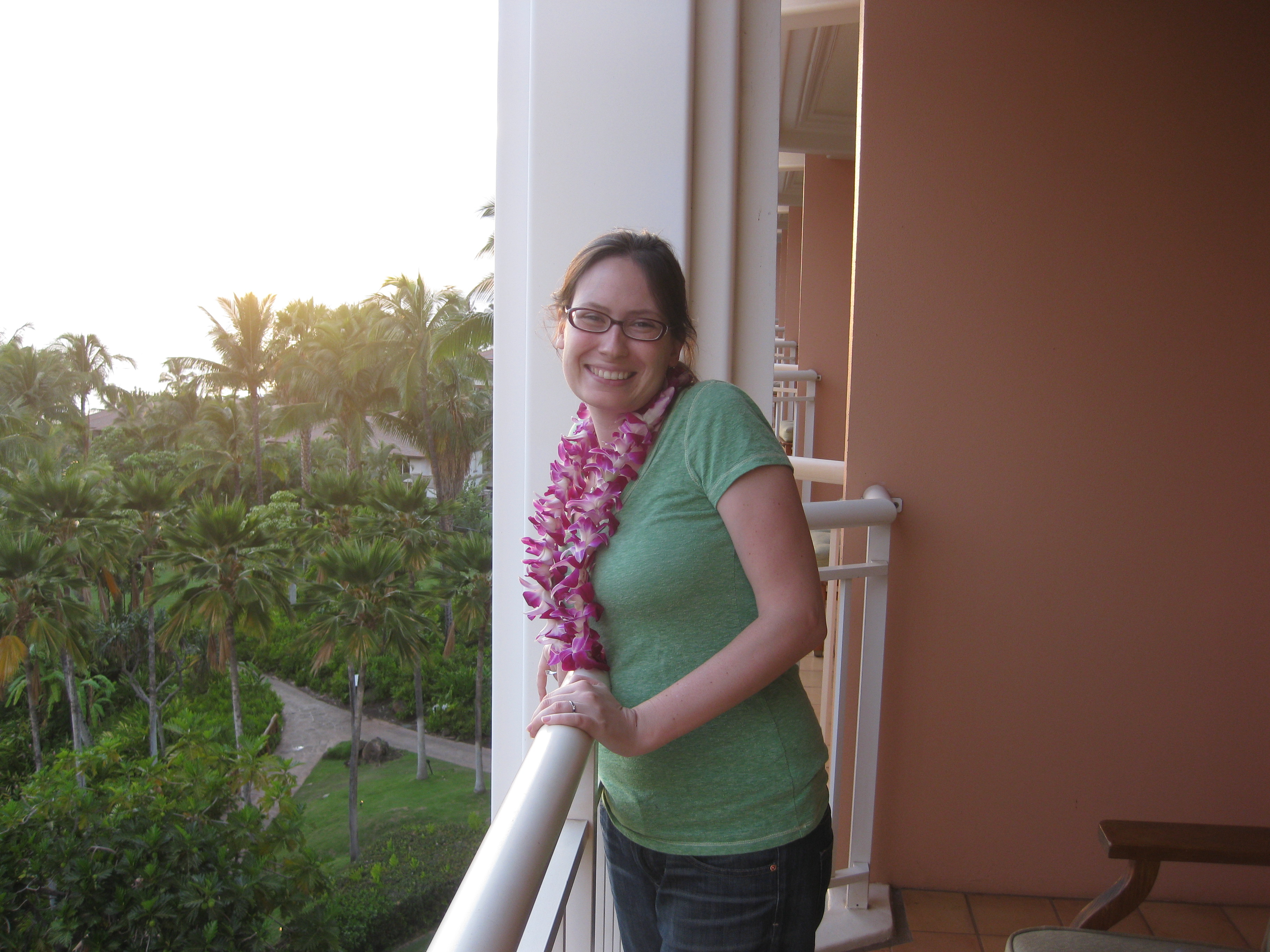
There sure are a lot of photos of me wearing a lei floating around....

So there you have it, five things that make me want to bounce up and down, wear bright colors, and sing while I brush my teeth. Here’s to another year featuring more of the same!

Read Full Post »

My husband found this really fascinating paper entitled “If Money Doesn’t Make You Happy Then You Probably Aren’t Spending It Right.” Since I recently visited the topic of the connection between money and happiness here on this blog, I simply had to devour the entire article. It is, however, quite long, so I am going to choose a few salient points to discuss here.

Photo by Michael Porter

First off, the article says that people with more money aren’t that much happier than people with less, but that they are generally more satisfied. I found this distinction interesting because on first thought, I wouldn’t have thought the two states were really so different. But of course they are. We can have all the stuff we want, we can have the funds to take trips around the world, eat fancy food, and afford other experiences we desire, and be very satisfied that we can do and have all of this. It doesn’t follow, however, that this satisfaction will result in increased happiness, hence the stereotype of the poor little rich girl who has everything money can buy and yet is completely miserable. There are serious problems that have nothing to do with money.

Apparently happiness also depends a lot on our past and future relationship with a given expenditure. Anticipation greatly increases happiness, sometimes more than the actual purchase or experience. I’m going to climb out on a limb here and suggest this has something to do with positive reinforcement, ie I’m excited about my trip to Ashland, I’m thinking about it with excitement, and therefore I’m more likely to approach other aspects of my life in a positive way, which creates a happiness feedback loop. I can definitely experience a stress feedback loop (I’ll be feeling lots of stress and therefore everything seems more overwhelming, even things that would normally be no big deal, creating more stress, etc.), so why not a happiness one as well?

Fond memories of an expenditure will also increase overall happiness, which offers one explanation for why people love to show photos from their past travels and happy occasions. For example, I have wedding pictures and presents scattered throughout my living room that regularly remind me of that event. This is one reason experiences tend to trump material items in the happy-making: we’re more likely to think back to an amazing experience than to an item (to which we have grown more accustomed).

Another point the article brings up is the power of the little things to affect our happiness. The authors suggest making many small purchases instead of a few big purchases. I don’t completely agree with this point because, as we just discussed, often big purchases (trips, weddings, etc.) cause more anticipation and memory, both because we’re excited about them and because it takes longer to save up for a big purchase, increasing the anticipation even further. But scattering smaller purchases throughout our lives (a special coffee drink, a new favorite song or piece of sheet music, a massage, going to a movie) keeps us savoring the texture of life while offering much-needed variety. Of course, appreciating the small things affects happiness whether money is being spent or not, which is part of the beauty of it.

Ultimately what this article leads me to think is something I like to say anyway; namely, that we can contribute to our own happiness through learned strategies, introspection about our priorities, and being present to enjoy both the everyday moments of happiness and the rare, large thunderclaps of happy. Money takes away worries, but it doesn’t automatically bring happiness in their stead. That is something we have to do for ourselves.

What is something little that has made you happy today? For me, I’m wearing a scarf in this fabulous shade of purple that my husband bought for me on our trip to London last year and gave me for Christmas. So I have a warm neck, and every time I look down, I think, “What a great color. What a great husband. What a great trip. Christmas!”

Read Full Post »

« Newer Posts