Feeds:
Posts
Comments

The voting period for your favorite fantasy sidekick is over, and the winner is:

WILLOW from Buffy the Vampire Slayer!

Wicca Genius

Runner-up is Ingoya Montoya, from The Princess Bride.

Channelling through his father's sword

And because he’s cute, even though he only got one vote, I’m also gonna show you Pantalaimon:

I deliberately didn’t tell you who I voted for so I wouldn’t accidentally skew the vote.  However, being a huge Buffy fan, I did in fact vote for Willow, although it was a tough call for me between her, Inigo, and Hermione.  Willow is a tricky one because she had all those problems in season six that make her less than ideal as a sidekick, but when she’s at the top of her game, she’s kick ass enough that she almost crosses the line from sidekick to independent superhero in her own right.  For the win, she’s a character I wouldn’t mind being friends with, and honestly, workplace dynamics are important if you’re going to save the world every day.

Dichotomies are popular partly because they’re catchy and partly because they’re so easy on the brain.  Black vs. white, capitalism vs. socialism, introversion vs. extroversion, right vs. wrong.  Sometimes I wish things were actually this simple, but most of the time I don’t because these comparisons don’t allow any wiggle room or tolerance for difference or adjustment.

So when we talk about quantity vs. quality, both of these attributes contribute to overall well being and success (I’ll save defining “success” for another time).  Is one more important than the other?  I would argue that for many people, one is weaker than the other, and therefore we need to expend more effort and awareness on whichever side is more personally difficult.  Let’s look at some definitions.

Quantity:

  1. Music: number of hours spent practicing and learning new music.  Also preparing music for a performance or audition deadline.
  2. Writing: butt in chair principle; number of hours spent writing and revising, or a daily word count goal.  Also would include having a submission goal of how many markets you submit to per period of time.
  3. Interpersonal: amount of time spent both thinking about what your relationship (and loved one) needs and implementing that, whether by spending more time talking, doing activities, writing emails, cleaning the house, or what-have-you.
  4. Running a business: amount of time spent both on finding and implementing strategies in advertising, marketing, getting your name out there, as well as time spent providing your core service or product and planning special events.  Focused on goals either financial or quantity-based.

These are all great goals, concrete goals, measurable goals.  They require self discipline and commitment to achieve on a regular basis.  Unfortunately, sometimes quantity is not enough.  Standing in the practice room day after day for sixty minute practice sessions that go exactly the same way every time is not usually going to lead to improvement or make a great singer.  Being so obsessed with word count that you can’t afford the time to stop and think how you can use your words more effectively does not make a better writer.  Trying really hard to be a better spouse without being willing to take some personal risks isn’t always effective.

But what happens if we don’t focus on quantity?  Our brilliance is often derailed by lack of organization or dedication.  Projects don’t get finished or maybe don’t even get started.  Businesses fail due to lack of exposure or avoidance of hard financial numbers.  The people we love may feel neglected or friends might characterize you as a flake.  We might sound great when singing but our inability to learn music on time and behave professionally holds us back.

Quality:

  1. Music: choosing one or more technical suggestions to work through during that day’s practice session.  Being willing to try new things even if they feel weird and don’t work right away.  Working on what your teacher brought up during your last lesson and then giving her feedback as to how it’s going in practice.
  2. Writing: choosing subjects/stories that are close to your heart and therefore dangerous.  Taking the time to revise as much as a story needs.  Doing the necessary preparation work (whether that be research, outlining, note taking, character profiles, etc.) that you personally need to write your best story.  Focusing on a particular aspect of craft while writing, even if it slows the work down.
  3. Interpersonal: prioritizing by finding out what makes the most difference to the other person in the relationship.  Getting to the root of any issues between you.  Attempting to see that person without your usual bias and love them unconditionally.  Being honest and open about hard things as well as good ones.
  4. Running a business: Providing individualized service to your clients.  Prioritizing the goal of improving your product or your abilities.  Remembering the people factor in business.  Not cutting every single corner for cost reasons if the quality detriment is high enough.  Focusing on goals of service and satisfied customers.

What happens if we don’t focus on quality?  We work hard for many years and get “stuck” in the same spot, like we’re running in place.  We crank out large volumes of work lacking the spark that will lead to publishing that novel or winning that part during auditions.  Our relationships coast along but don’t necessarily deepen.   The business tends to get a higher than average turnover of clients or customers.  We rush to complete a task without thinking of the meaning behind the task and making sure we do it to their best of our abilities.

Now for me, quality is a lot harder than quantity.  Quantity is easy for somebody like me who has determination, self discipline, and organizational skills in spades.  Quality, on the other hand, is a bit more mystical because it depends on stuff you can’t measure in numbers.  It depends on taking risks.  It doesn’t always conform to plan.  It could end in spectacular failure instead of middling mediocrity.  So for me, I need to put a lot more focus on quality to get myself in balance.

What about you?  What do you need to focus on, quantity or quality?

I’ve just returned home from the LA SCBWI conference with a head swarming with information about writing.  What has stuck to the forefront of my thoughts are two talks by M.T. Anderson, author of such novels as Feed and the two Octavian Nothing novels, among others.

MT had a lot of interesting stuff to say, but what caught my attention the most was what he said about literature, and perhaps by extension, all art.  In a nutshell, he posited that the purpose of literature is to help the reader see the familiar in a different way.  (For those curious about reading more, this is a theory espoused by the Russian formalist school of literary criticism.)  By estranging the reader (for example, through use of language or various literary devices), the author causes the reader to experience the world differently and restores a sense of the unknown to what was before a habitual reaction.

I know how easy it is for me to something for granted and stop seeing what’s right in front of me.  It’s this sort of closed mind that makes it difficult to see from another person’s perspective, to fail to notice what’s going wrong (or right) in our everyday routines, relationships, and desires, to become cemented in attitudes, beliefs, or knowledge that might be inaccurate.  In much the same way as spending time in a foreign culture can shock the system and dislodge rusty thought patterns, so can experiencing art, whether that be through literature, theater, visual art, music, etc.

Following this train of thought, literature can act to help us see the world afresh like children do.  In general, children are a lot more flexible and adaptable than many adults, and they are constantly having brand new experiences.  Assumptions are harder to make without a few decades of experience and collected data to draw upon.  While reading a novel that’s using estrangement to wake us up, we can regain our childlike perspective on the world, both as a place full of wonder and weirdness and as a terrifying mystery in which many things remain unexplained or beyond our understanding.  The curtain of adult security and certainty that gives us the illusion of being safe in a world of rational order is drawn aside to expose the truth: that life is always uncertain, whether you’re two years old or eighty, and that any object, person, or event has several layers of reality beyond the surface.

While this ability to see beyond the surface is certainly useful for artists of all types, I would argue that it is invaluable to anyone who wishes to fully appreciate the human experience.  Art forces us to take notice and stop moving through our daily lives on automatic pilot.  It reminds us of what it was like to be fourteen, or helps us imagine an entire collection of possible lives we might have led (or might still lead).  It shows us the world through someone else’s eyes, someone inherently other because they are not us.  Whether we look at a Dadaist painting that skews common objects and reminds us of universal themes such as the passing of time or read a novel in which language describes a commonplace object in terms we would never have applied, the jolt tickles our brains.  Remember, it says, to really *look* instead of merely knowing.  Remember to breathe in an experience instead of getting too caught in our own heads to notice.  Remember to listen and delve deep.  Live what it is like to be a child, when the world lies before you, scary and stunning and exquisite.

I couldn’t let the science fiction sidekicks have all the fun.  Discerning readers may note certain biases on the part of the poll-taker. 🙂

Let the voting begin!  The poll will remain open for one week.

Tomorrow I head off into the great beyond of Los Angeles to attend SCBWI’s annual summer conference and inundate myself in all things kidlit.  To my knowledge, I know one other person attending.  Happily, this lack of acquaintance doesn’t bother me because I can rest assured in the knowledge that as a group, kidlit writers have to be some of the warmest and supportive people in existence.  I also have the happy past experience of the winter conference to bolster me.  In my experience, starting a conversation with someone with a shared and consuming interest like writing is not generally a difficult accomplishment.

However, this leads me to one of my recent subjects of interest: namely, the art of conversation.  I’m not talking about the skill of small talk, which while useful, isn’t that thrilling for me.  I’m also not talking about the art of debate, which can be interesting, but only if the debaters (or at the very least, me as their audience) aren’t completely and finally wedded to every last detail of their opinions.  No, I’m thinking about the art of interesting conversation.  You know, when you’re talking to someone and you feel you could just keep talking for hours?  Or when someone says something and it actually requires you to (gasp) stop and think?  That kind of conversation.

One of the main barriers I notice to achieving such a level of worded bliss is the question problem, which goes both ways. First and most simply, it’s been my observation that a lot of people don’t ask enough questions.  Questions have interest built-in because they include the supposition that there is more than one possible answer (otherwise, why are you asking?)  They also show a pleasing desire to get to know the conversational partner and place value on said partner’s opinions, which develops rapport.  A well-asked question can be the instigator of a lively discussion in which the people involved might actually learn something, help each other come up with new ideas, or be exposed to a different point of view.  Alternately, questions can encourage a friend to talk about something challenging or exciting in their lives that they might not otherwise have felt comfortable discussing.

On the other side of the equation, people don’t always encourage good questions with their responses.  If I offer an opening question or two and receive only monosyllables or replies designed to shut me down, I am left high and dry without any hooks to continue the conversation or discover what that hidden gem of a question might be.  In the same way, if the answers to questions aren’t approached in a thoughtful manner, it is much less likely that there will be any part of the answer worth pursuing.  And don’t even get me started on the monologue problem.

The ideal conversation requires all people involved to do some heavy lifting.  Without mutual questioning, the talk turns into a parody of an interview.  Without actively listening to your conversational partner’s points, it is difficult to be affected by the conversation or to respond in a genuine and engaged way.  Without the willingness to realize your own knowledge may be limited (or even wrong!) or another point of view might offer valuable ideas and perspectives, what’s going on isn’t a conversation so much as a two-sided internal monologue spoken aloud.

The point of conversation is to both entertain and engage (and possibly to educate, although this one is dangerous as it can lead to pomposity).  This means, among other things, making an effort to keep track of who you’ve told what funny stories in the past.  Or at the very least, for those with poor memories, you can ask your potential audience if you’ve already told them about that time in Cairo, thereby allowing them a graceful exit.  It means asking others for their opinions instead of merely expounding on your own.  It means choosing conversational topics that include all people participating – so for example, maybe you shouldn’t speak too long about a role-playing game with a group that includes one or two people who didn’t play the game, or maybe you shouldn’t have deep technical-speak shop talk with a group that includes someone who isn’t part of your field.  (Yes, I live in Silicon Valley, can you tell?)  This is not to say that you can’t talk about subjects relating to your career and/or passions (my husband and I talk about various writing, scientific, music, and computer-related topics all the time), but it does help to gear them towards a non-specialist audience when appropriate.

I firmly believe that good conversation is an art, and an art that I need to continually consider and practice.  So tell me, dear readers, what do you look for in a satisfying conversation?  What are your favorite conversational moments or pet peeves?  Let’s talk about talking, shall we?

A few weeks ago, I stumbled across this article listing the five common traits of successful artists.  If you’re an artist or love an artist, go read it now.  I promise it is short and worth the time.

I agree with all five points Lori McNee makes: passion, business sense, work ethic, resilience, and support.  We’ve already talked a bit about her fourth point, resilience, when we were discussing disappointment.

Today I want to talk about her fifth trait: having a support system of people who believe in the work.  The longer I am involved in artistic endeavor, the more I realize how important this component can be, if not to “success” than at the very least to my own personal well-being.

There is a special kind of zaniness that many artists have, a weird sort of marriage between egotism and insecurity, self confidence and self doubt, ecstasy and despair.  The roller coaster is a lot easier to ride out when you have people cheering you on from the side … or riding that roller coaster with you.  Getting negative reinforcement, not from critiques of your work (this will hopefully help make you better at your art) but from the mere fact of undertaking the work in the first place, can plunge the artist into the depths of angst.  You might even be convinced to give up.  Having powerful positive forces to help balance this out is essential unless you have an especially thick skin.

I think it’s no accident that I begin work on my most ambitious artistic endeavors when there is someone in my life actively rooting me on.  Beginning serious study of music: my mom.  Applying for and writing a senior recital: my best friend Francine.  Writing a song a week: my friend Jimmy.  And once I started dating my now-husband, I started my musical and then my novels.  I am not convinced I could have accomplished what I have without the support and energy of these fabulous people.  It’s possible I would have done it anyway, but it would have been a lonely path.

Nowadays, I’ve connected so firmly to other writers, in both the speculative and kidlit communities, that I no longer depend on one person.  This is the ideal situation for a number of reasons.

  1. Other writers understand me.  They understand what I’m going through, they understand the different steps of the process, they understand why I’m happy or sad or neurotic.
  2. Some of the writers are ahead of me in their careers and therefore can be turned to for sage advice.  Some of the writers are behind me on the path and I can help them out and pay it forward.
  3. When one person has life happen and doesn’t have time for mutual support, I can easily turn to someone else, and there are no hard feelings.
  4. I can watch and be inspired by others’ successes.
  5. I have opportunities to learn and improve my craft: through conferences and conventions, through workshops, through critique groups and sessions, through reading other people’s works and hearing about other people’s struggles.

I have to put a quick caveat about family and other firmly entrenched nay-sayers.  If your family is actively supportive of your art, hug them extra for me and realize you are extremely lucky.  However, we do not get to choose our biological families, so some of us may find that our choices baffle our relatives.  (This also holds true of certain old friends, random acquaintances, and business associates.)  Ignoring what they say about our passions can be difficult and frustrating, but it just makes having a support system all the more important.  Trying to change someone’s point of view about art (or anything, really) is an uphill battle that will often end in defeat.  Instead, I try to ignore any defeatist messages I hear, and rant about it later to someone who will understand (usually my husband, who has infinite stores of patience for listening to this sort of thing).  Do I shut these people out of my life completely?  No, not usually, and sometimes it’s impossible to do so.  Do I limit my time with them and try to steer the conversation away from potentially damaging remarks?  You betcha.

I’ll even take the assertion of spending time with supportive people one step further.  The more time I spend with people who are creative dynamic thinkers, whether they be artists, entrepreneurs, scientists, or what-have-you, the more energized and inspired I become.  Seeing other people’s accomplishments brings them firmly into my own reality frame.  I hang out with my friend who started his own tech company, or I hear about a high school classmate who started his own nonprofit, or I get sporadic updates from a college friend about the circus troupe he’s touring with, and I see beyond my own limitations of vision.  These people’s lives show me what can be possible, and they inspire me to think big and then figure out how to make the idea a reality.  I strive to be like these friends of mine, someone who can lift people up and have the courage to make bold decisions about life.  This is what I think it means to be a practical free spirit: to dream big and then create and implement a plan to make it happen.

Another reason I really like the Newsweek article on creativity is that it explodes the myth of creativity has some kind of magical, inherent talent that someone either has or doesn’t have.  No, creativity can be learned, creativity can be taught, and creativity can be practiced.

When decoupled from its traditional fused relationship with artistic pursuits, this assertion makes perfect sense.  Thinking creatively is just another way of processing information, and if the human mind can be trained to memorize (and believe me, my brain was resistant to this one), it follows that it could also be trained to work creatively, that is, to combine divergent and convergent thinking into a coherent and well-practiced process.

Artists know this about creativity already, at least subconsciously.  It is why we obsessively practice.  Not only are we practicing our craft and our discipline, but we are also practicing creativity.  I’ll give myself up as an example.  I wanted to write a musical for several years before I sat down to do so.  Why did I wait so long?  Partly because I had no idea what to write about.  I couldn’t think of a single idea that I felt had enough merit to pursue.  I eventually had an idea, sat down, and wrote my musical in 2006-2007.  After a short-ish break, I wrote my first novel in 2008.  It was still hard for me to think of ideas, and I’m not just talking about that one break-out idea that is the best thing I ever thought of.  I had trouble coming up with any ideas, but at least it wasn’t as difficult as thinking up the idea for the musical.  During this time period, if I had a truly good idea, I felt like I had to hoard it, save it away until my writing skills improved enough to do it justice.  I certainly didn’t want to waste a good idea, after all.

It’s been two years since I started writing that first novel, and now I have lists of ideas.  There are so many of them that I’m sloppy and sometimes don’t write them down.  It feels as if there is a never-ending FLOOD of IDEAS pouring from my brain that I will never have time to explore.  I can sit in the bath and come up with two or three ideas that I believe have merit in twenty minutes.  No kidding, I did that last week.  Granted, coming up with novel ideas is still more fraught than thinking up ideas for short stories, because writing a novel is a much bigger investment of time and effort, so I want to be sure I’ve picked an idea that will still appeal to me in three months, or six months, or however long.  But it doesn’t seem to be the insurmountable task that it did only two or three years ago.

Why the radical change?  I think it’s because I’ve been practicing coming up with ideas to the point where it’s not a huge deal anymore.  Ideas don’t seem like rare precious things to hide away; the more I play with them, the more of them are born.  This may also be why there’s this huge disconnect between readers, who always ask where ideas come from, and writers, who get so sick of what seems like an obvious question that they sometimes lapse into snide remarks.  Writers have trained themselves to come up with endless ideas.  Readers who don’t also write have not, so to them it remains a mysterious process.

I don’t want to get into a big brouhaha about the current educational system in the United States, and how it’s not training creativity much at all.  Feel free to rant in the comments if it makes you feel better, but I’m just going to take lack of creativity nurturing in the public schools as a given at present.  Until this can be changed, the onus of teaching children how to think creatively lands squarely on the shoulders of parents.  I don’t have kids so perhaps I’m not the best suited to speak on this topic, but I have spent many years teaching kids, so I’ll have a go anyway.

Creativity Training for Kids:

  1. Avoid over scheduling. I’m serious.  Even if it’s all artistic classes, having constant structure even when at play is not going to foster kids’ opportunities to role-play, play make-believe, make up elaborate fictional worlds, or even develop the ability to entertain themselves.
  2. If a child shows a passion for a certain artistic or creative pursuit, encourage it. If he shows an interest in music, see if you can get him music lessons.  If she shows an interest in building complex buildings with Legos, see if you can provide the materials necessary for really innovative construction ideas.
  3. But don’t force a passion that doesn’t exist. As a long-suffering piano teacher, I can attest that forcing a child to play an instrument they hate is probably not going to encourage them to think creatively, unless they get elaborate in coming up with reasons why they can’t practice.  Instead, the child will develop negative associations with an activity typically associated with creativity, and therefore might ultimately devalue creativity itself.
  4. Allow a child to reason out the answer to her own question. Help her out if she needs it, but let her be an active participant in the process.  Also let the child hear you going through creative problem solving processes out loud, and if he wants to , even let him join in.
  5. Limit time with more passive, less creativity-motivating media. Yes, like TV.  I’m not saying no TV, but spending less time watching TV will give a child more time to do other activities that will engage their creativity.
  6. Read read read. Yeah, I know this one is obvious, but I couldn’t resist.  Read to your child, encourage your child to read to herself, ask your child questions about what he has read and what he thinks happened after the story ended.

Let me know if you have other ideas for how to help kids think creatively.  Also feel free to throw out your ideas of how you stimulate your own creativity.  (If you have no ideas about the latter, check out the blog post I linked to yesterday for a starting point.)

Lo and behold, I announce a themed week about creativity, and one of my favorite bloggers, Justine Musk, comes out with a post all about thinking creatively today.  Ask and ye shall receive?  Go check it out!

Last week, Newsweek ran an article all about creativity.  It’s about how creativity is declining in America, and it also includes a lot of recent research and theories about creativity and learning creativity.  Interesting stuff.  Especially interesting for me, because reading this article really brought my personal misconceptions about creativity into the spotlight.

I was a creative child: I excelled at creative writing in school, I engaged in the sorts of play described in this article as being associated with high creativity on a daily basis, I daydreamed and devoured books whole, I loved composing as well as playing music, etc.  My greatest desire from age seven on was to be a writer – a desire I relinquished once it was made clear to me how impractical a career course this was.

What interests me is that until quite recently, I never valued my own creativity particularly highly.  I valued my intelligence, yes, my organizational skills, my memory, my problem-solving skills, and my analytical and synthesis skills.  But I would have never stated that one of my core strengths was creativity.

Why is this?  Two reasons, I think.  First, I was never taught that creativity was useful for anything except artistic pursuits, ie the arts.  And second, I was taught that the arts as a whole are impractical and therefore the skills associated with them aren’t as valuable as other skills.

That’s a loaded paragraph, isn’t it?  Imagine believing the two assertions made above, and then reading the following from Newsweek’s article:

The necessity of human ingenuity is undisputed. A recent IBM poll of 1,500 CEOs identified creativity as the No. 1 “leadership competency” of the future. Yet it’s not just about sustaining our nation’s economic growth. All around us are matters of national and international importance that are crying out for creative solutions, from saving the Gulf of Mexico to bringing peace to Afghanistan to delivering health care. Such solutions emerge from a healthy marketplace of ideas, sustained by a populace constantly contributing original ideas and receptive to the ideas of others.

The mind boggles as reason number one (creativity is only useful in the arts) is shredded into tiny pieces.  Let’s throw away my faulty understanding and look at my two reasons in this new light, shall we?

  1. Creativity is an extremely useful and adaptive skill that when applied, can lead to innovative and *practical* solutions to an entire host of problems.  Ah ha!  Maybe this is why I excelled at starting and running my own business, or how I found ways to travel around the world on an extremely limited budget, or why coming up with multiple solutions to a small problem seems trivial to me while to others it appears to be a struggle.
  2. Even if one accepts as true that the arts are inherently impractical(1), they are, at the very least, the perfect training ground to foster and train the valuable “leadership competency” of creativity.  Not that there aren’t other ways to train this skill, but the arts are certainly a very obvious path.

I don’t think I’m the only one who used to believe creativity’s practicality was limited.  I remember in college speaking to a creative friend of mine who told me that everyone had told him to enter an advertising firm, because “that’s where creative people go to work if they want to make money.”  At the time, I believed this assertion completely.  The choice as laid out for me was to either enter the arts and eschew a stable future, or sell out and work in advertising.

Think what creative people could accomplish if, instead of being presented with this false dichotomy, they were educated in where their real strengths lie: solving problems, thinking outside of the box, coming up with multiple solutions and combining them for maximum positive effect, analyzing systems to figure out what change would have the most impact.  Starting nonprofits, increasing communication between disparate groups, disseminating powerful ideas that  grow to influence communities, decision makers, and potentially entire societies.  Inventing innovative machines, systems, gadgets, more efficient ways of accomplishing a task.

It’s fine to choose the arts in the face of this knowledge.  I have no regrets about my choice.  But when I’m told that the United States prizes creativity, I have to call foul.  If that’s true, why wasn’t I told what my creativity meant?  Why wasn’t I told what I could accomplish?  Why did no one mention the possibility that I could make the world a better place with my creativity even if I didn’t have an artistic bone in my body?

If there is a creativity “crisis” in this country right now, it’s because creativity as a skill hasn’t been valued nearly enough.

*****

(1.) This idea is founded on one basis only: the reality that a career in the arts can be unstable from a financial perspective.  We see here the shadows of my upbringing telling me the most important criteria for determining an activity’s value is in its money-producing capability (and as a corollary, its relative stability).  Never mind for the moment that I know many working artists who do quite well, or that I myself was able to found a successful business completely based on, you guessed it, the arts.  This also overlooks the possibility, a reality for many, of the day job as a support for serious pursuit of the arts.  Or the choice to pursue the arts due to other intrinsic values, and financial stability be damned.

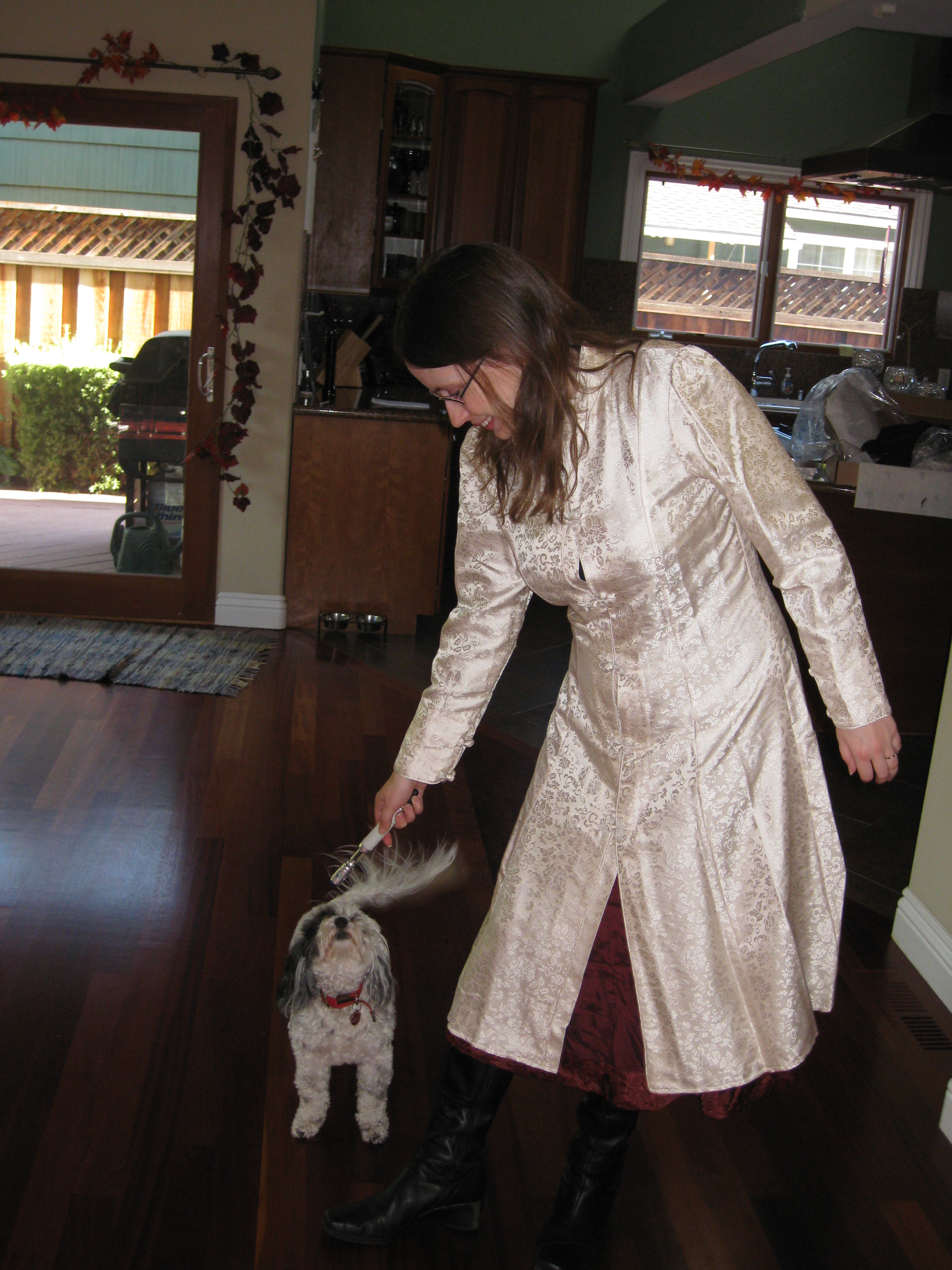
I forgot to mention that I too have a sidekick, therefore launching me into the exalted realms of science fiction, fantasy, and superhero characters.

Her name is Nala the Super Hound, and she follows me around the house.  She shows a particularly ferocious attitude toward the mailman, the Comcast repair guy, and any solicitors foolish enough to brave our door.  She also excels at protecting her pet cow.

I couldn’t ask for a better partner in crime .