Feeds:
Posts
Comments

I often pretend that I’m eighty years old.

When I was eighteen, I went away to college and began studying music. My life wasn’t ideal: my mom was diagnosed with terminal cancer that year, I had wicked insomnia, there were various college dramas to deal with, I had a bum ankle and was constantly sick, I wasn’t always making the progress I wished to make. But I remember very clearly walking home from the music building one spring day. I could see the ocean as I left the building, the sun was out, I was surrounded by beautiful redwood trees, and I was able to spend all my time studying music, which I was truly passionate about. And I thought, “There is nothing I’d rather be doing with my life right now.”

That’s a powerful thought, isn’t it? I decided then that I would try to live as much of my life as possible in the same way, and that is still one of my goals today. There are many things that I was wrong about when I was eighteen, but that wasn’t one of them. One of the ways I can check on myself and see how I’m doing is to pretend that I’m eighty. Whenever I’m making a decision or evaluating something I’m doing, I ask myself: How will I feel about this when I’m eighty? First of all, will I even remember it? (If the answer is no, then it’s probably not all that important, and if nothing else, I can bring down my worry level a notch or two.) If I do this, will I be glad I tried it when I look back at my life? Will I regret passing up this opportunity? Or will I wish I’d played it safer or made a different decision?

I was talking to a former student the other day who has decided not to pursue music professionally, at least for right now. She went to professional school for musical theater for a while and began to hate it, even though she had previously been amazingly passionate about the subject. So now she is studying a different subject. And you know what? Even though she ultimately changed her mind, I think she did the right thing going through the musical theater program. Because if she hadn’t, then when she was eighty, she might have regretted not pursuing her dream. Now she knows that she doesn’t want that kind of life, and she can move forward without regrets.

From photobucket.com by notapooka

According to this article, one of the top regrets of people on their deathbeds is not having followed their dreams. (I highly recommend you read the entire article.) Of course, we can’t always be doing exactly what we want to do. No one wants to sit around recovering from a root canal gone wrong or clean the bathroom or deal with any of a whole host of problems and difficulties that are part of our daily lives. But I think all the unpleasant parts are rendered more manageable if we can find and highlight the aspects of life that are so wonderful to us that they dwarf all else. For me in college, that passion was for music. Nowadays, I find it in my relationships, in writing fiction and this blog, in teaching, in travel. When I’m spending time on any of those things, I get the same feeling, that there is nothing else I’d rather be doing.

Steve Jobs gave a great insight in a Stanford commencement address that I think about a lot:

When I was 17, I read a quote that went something like: “If you live each day as if it was your last, someday you’ll most certainly be right.” It made an impression on me, and since then, for the past 33 years, I have looked in the mirror every morning and asked myself: “If today were the last day of my life, would I want to do what I am about to do today?” And whenever the answer has been “No” for too many days in a row, I know I need to change something.

Remembering that I’ll be dead soon is the most important tool I’ve ever encountered to help me make the big choices in life. Because almost everything — all external expectations, all pride, all fear of embarrassment or failure – these things just fall away in the face of death, leaving only what is truly important. Remembering that you are going to die is the best way I know to avoid the trap of thinking you have something to lose. You are already naked. There is no reason not to follow your heart.

So now I’ll ask you the same questions: if today was the last day of your life, would you want to do what you’re doing? When you’re eighty, how will you feel about the decisions you’re making today?
Yes, this week you get me on Monday and Wednesday instead of the usual Tuesday/Thursday. It’s confusing me, too; I am a creature of habit. However, I want to tell you all about Google+, and I want to tell you about it right now. Because I’m also a creature of impatience.

I’m on the white list for the first users who get to try out Google+, or Google Plus, which is Google’s new social offering. Disclaimer first: my husband is the equivalent of the chief architect for this project, so in no way can I claim to be unbiased. On the other hand, I also really care about social media and tend to have strong opinions about it, so I imagine those will come through regardless. We shall see.

So what is Google+? Besides its poor branding, that is (a + followed by punctuation just doesn’t look right to me). Basically it is a suite of social features. In some ways it is like Facebook; in others, more like Twitter, and then it has features that are all its own. And it’s a work in progress, so it’s quite possible (even very likely) that we’ll be treated to cool new features in the future. It has a feed like Facebook (although it’s called a stream) where you can share status updates, photos, links, etc. It has group video chat (more about that in a bit). It has Sparks, which is a kind of recommendation engine for interesting new content on the web-based on your interests. It has some cell phone features that I won’t be talking about much because I don’t have a smart phone (but they include a group chat function that is basically like a text message except faster and free, and the option to automatically upload photos from your phone to a private folder in your account). You can see some screen shots here.

Downsides:

As of right now, I see two main downsides to Google+. One is the way its stream works. Of course, I don’t know anybody on Google+ right now, so I’m just following a few random people for experimentation purposes. But right now, the stream is not sorted with the most recent post on top. Instead, whenever a status is commented upon, it moves up to the top of your stream. This feature already drives me crazy, and I’m only following three people. Imagine how much worse it could be if I was following the 350 friends I have on Facebook and kept on having the same status messages repeated again and again as people I don’t even know comment. Yeah, not so good. I don’t like it when Facebook tries to mess with my feed with its “Top News” and I don’t like Google messing around with my stream either. I have hopes that they will add an option to change the sorting if you don’t want to deal with this sort of stream spam.

The other main downside is that I don’t know anybody on Google+, which means there’s not really much to do. Once I am given invites to send out, this aspect should improve, but it begs the question: how many of the people I interact with over Facebook or Twitter will join Google+ and be active over there? The services are not compatible in that you cannot port your status messages from Facebook over to Google+ (although to be honest, I hate it when people do that with their Twitter statuses anyway), so it’s a whole new social media platform to deal with. Will enough of my friends want to use both Facebook and Google+, or want to switch over to Google+, that it will be an easy way for me to interact with them? Will this mean I have to spend more time on social media applications (yikes!) or will a balance naturally emerge? (Here is one interesting theory on how the two social media platforms can be used differently.) Only time will tell.

Upsides:

1. Circles: The way you organize your contacts is pretty spiffy. This is the main way right now that Google+ combines Facebook and Twitter…and improves on both. In my experience, Facebook is mostly a walled garden in which you share all of your content with all your friends and no one else, whereas Twitter is a mostly public place where anyone can follow you and read any of your tweets. Google+ allows you to very easily set up multiple modes of interaction instead of having to choose one. (Yes, I know Facebook has group things or something, but I’ve never been able to get them to work, whereas I figured out Google+ in under five minutes.) I am able to follow anyone I want, and don’t need to get a friend request approved. However, I am under no under obligation to follow anyone back. And if I do wish to follow someone back, I can click and drag them into various “circles,” which are absurdly easy to set up. For instance, I can have a circle for close local friends so I can easily check and see who’s free to have dinner with me tonight. And I can have a circle for my family, or my college friends, or whatever I want (the names of the circles are private, too). This is great for writers because we will no longer have to wonder how to use Facebook: do we friend fans, or direct them to our Fan Page? Instead, we can just broadcast certain messages publicly, in which case all our followers will see them, OR we can create a circle for our fans, while still being able to be more personal with our real-life friends. Also, I’ve already created a circle called “Writers” so that if I want to talk craft (or the next big convention), I can show those conversations only to the people who care. (Note that Circles neatly sidesteps most of the drama inherent in Facebook; no more awkward friend requests that you have to ignore, or sudden realizations that someone has de-friended you. Less drama leads to less stress, which makes me happy.)

2. Hang Outs: Hang outs are video chat rooms that can hold up to ten people at one time. They are easy to open, and they notify whoever you specify that you’re available right now to chat (but you can filter this by circle, thereby avoiding the need to chat with anyone you’d rather avoid). I’m really excited by this feature since so many of my friends aren’t local; it sounds like it could be ideal for hanging out with them in a more casual way. Hang outs will also be great for critique groups who aren’t geographically close to one another, and for conducting plot breaks, brainstorming sessions, etc. I’m really hoping to have some Taos Toolbox alumni hang outs once general invitations are available.

3. No text limit in the status update box: Yeah, I know some people love the 140 character limit on Twitter (or the slightly longer one on Facebook), but I’m not one of them. Google+ doesn’t limit you, so if you have a longer idea, you can express it all in one place. I don’t know how often I will actually need this, but it’s one less thing to worry about.

4. Sparks: Sparks, the web content recommendation engine, lets you search for the newest content for your interests, so it’s already fun. But honestly, Sparks is in its infancy. I’m not allowed to tell you more, which sucks, but I’m allowed to say that someday it’s going to be a lot more awesome. I can’t wait.

5. Choice is good: In the past I’ve gotten kind of creeped out by Facebook and some of its policies (notably related to privacy). However, there has been no real alternative; either I can live with it or I can not have my social media toy. I know that Google has had its issues in the past as well (Buzz, anyone?), but choice and competition are generally good things for us, the consumers. And here comes my bias full force, but it has been my impression that Google is generally one of the strongest companies technically, so I’m looking forward to seeing what they are able to do. It is my hope (and my understanding) that the Google+ I’m seeing right now is just the beginning, and that there will be many more features and innovations in the future.

Any questions about my user experience with Google+?  Any thoughts about Google+ in general? Let me know!

ETA: It looks like there’s already an extension for Chrome available that will allow you to cross-post your Google+ posts to Facebook and Twitter. Don’t think there’s any way to do it the other way around…yet!

Today is my birthday! I really love birthdays. I look forward to mine for months every year. And this year I’m prepared with a wider than usual selection of birthday books. So think of me lounging in the sun with one of these titles: Naamah’s Blessing, by Jacqueline Carey; The Wanting Seed, by Anthony Burgess; Flashback, by Dan Simmons (his Hyperion series is genius, by the way. Just saying.); or Bumped, by Megan McCafferty. Decisions, decisions!

To celebrate on the blog, I’m writing a birthday edition of five things that make me happy. In this case, I’m choosing five things from the last year.

1. Blog: First things first. This blog turns one year old later this week, sharing a birthday week with me. I thought that starting a serious blog sounded fun, but I had no idea how much I would enjoy it. Not only have I become a better writer as a result of blogging, but the blog gets me writing (and keeps me writing) even when pretty much nothing else can. I love having a platform to share my ideas and philosophies, and I adore that doing something so fun is part of my job. How awesome is that?

2. New Friends: When I think of all the new friends I have met in the last year, it feels almost unreal to me. To make myself even happier, I’m going to fudge and count my Taos Toolbox comrades in this number as well, even though I met them a year and a few weeks ago (although even without fudging, it’s been a truly amazing year in the friend department). I have been honored to meet and spend time with some of the most intelligent, thoughtful, kind, and interesting people this year. And I keep meeting more!

3. First Pro Sale: Yup, have to mention this, a big milestone in my writing career. I can’t wait till this story comes out, hopefully later this year!

4. Husband and Little Dog: Day in and day out, my husband and little Nala are always there for me. They celebrate my successes and they comfort me through the hard and painful times. They make it easy to be happy.

5. Becoming More Me:You guys have seen some of this here on the blog, with me writing about people pleasing and running the Backbone Project. Happily this is something that is happening even more offline than it is online. After years of plugging away at becoming more assertive, it’s finally happening! Granted, I have a lot more work to do, but I’m making fabulous progress.

There sure are a lot of photos of me wearing a lei floating around....

So there you have it, five things that make me want to bounce up and down, wear bright colors, and sing while I brush my teeth. Here’s to another year featuring more of the same!

My Ideal Critique

Many of you will remember my first backbone post in which I gave my own take on how critiques can go wrong. Now, I think that critiques can sometimes be an extremely helpful tool for writers, so I’d like to talk about my ideal critique. Before I begin, though, I’d like to emphasize that all writers are different. Thus, my idea of an ideal critique and your idea of an ideal critique may in fact be radically different. I’m not saying that my ideas are the only right ideas. There are several different styles of learning, so it follows that there are probably several helpful ways of critiquing. The trick is to figure out which one works for you. If what works for you is ignoring everything I’m about to say, more power to you!

For me, critiques are all about learning. When I’m receiving a critique, I’m doing so in order to learn more about writing and to improve my writing abilities. While it is lovely when critiques end up making my story stronger, that is not my primary motivation for seeking critiques. Instead, my goal is to continue to improve by gaining insight into what works and what doesn’t work. When I’m giving a critique, I’m doing the same thing: trying to teach the writer in question by pointing out what worked and didn’t work for me as a reader.

One thing I am not trying to learn from critiques is how to deal with rejection. I understand that others feel differently, but honestly, I get plenty of practice dealing with rejection by…getting rejected. There is no shortage of editors and agents happy to help me out in this regard, except with them, there is always at least the chance that they will instead decide to help advance my career and/or give me monies! Another thing I’m not looking for in critiques is warm and fuzzy validation that everything I write is awesome. If everything I wrote was awesome, I’d be getting warm and fuzzy validation from my fans, who would be–guess what!–paying monies to read my work. Yes, I know, again with the monies. Notice a trend?

I look at critique as a learning process between colleagues; therefore, my main focus is on how I can help the other writer, and this focus informs my delivery. My husband tells me that people get promoted into higher tiers of management partially because of their ability to deliver bad news. Delivering bad news well is hard! And yet this is, I believe, an essential skill in giving a good critique because almost every critique is going to include the bad news that our work isn’t perfect (and it might even be hanging together precariously with paper clips and duct tape).

Here are some guiding principles that I try to think about as I critique:

1. Mention the positives as well as the negatives. It is so tempting not to do this, and instead just focus on what’s broken. Sometimes, honestly, it’s hard to even think of any positives. But not only does this leave the writer more receptive to thinking about any criticism, it also shows the writer what she’s doing right, what she shouldn’t mess with, and what her strengths are (that she can showcase and allow to shine in future work).
2. Discuss what doesn’t work in a matter-of-fact and positive manner. Example A: “I can’t believe you used all those adverbs. There were just adverbs adverbs adverbs flying all over the place. Get rid of those goddamned adverbs, okay? It was just so bad how you used all those adverbs.” Example B: “I noticed you used a lot of adverbs. I’d suggest going back through and deciding which of them you actually need.” Example A makes people feel bad and stupid and discourages experimentation. But if you’re not experimenting as a writer and taking risks, how are you ever going to get better? (Note I am not actually advocating vast amounts of experimentation with adverbs in particular.) Example B or something similar is what I prefer.
3. State your points in a clear and concise manner. So often I hear people speak at length about one point of criticism that they could have easily expressed in a few sentences. In a verbal critique, using loads of examples to make your point is not required. Instead, mark them on the hard copy of the manuscript or in track changes, and summarize when you’re speaking. The writer can always ask questions later if something is not clear.
4. Use ditto freely. Another thing I hear a lot is several critiquers waxing long about the same point, one after the other. There is no need to do this. Instead, just say, “I ditto Katherine that the beginning seemed slow” and move on. My Taos crew were experts at doing just this, and it was amazing how much it sped critiques along…as did the two-minute time limit per person.
5. Decide what key points you wish to make verbally ahead of time. Prepare for the critique as you would for a lesson. (Can you see my teacher background here?) Consider typing up a summary sheet of your critique that you can give to the writer afterwards. I know a few writers who are masterful at doing this, and I always look forward to receiving critiques from them.
6. Help the writer by talking about their story, not yours. We all have the types of stories we like to read, and the types of stories we like to write. These types might not be the same for other writers! (I know, it’s shocking, but there it is.) Give feedback and suggestions while keeping in touch with the story you think the writer was trying to tell instead of figuring out what story you would be telling. The second rarely provides a useful learning experience since it mostly just reflects your own personal taste.
7. Critique with an eye towards making clear the promise and/or vision of the story. Benjamin Rosenbaum said something very intelligent in the comments of my critique backbone post. “I think detailed, specific positive critiques — not just cheerleading, but analysis of what worked — are actually more useful than negative ones which focus on what’s not working. Both are useful, but in the end you want to revise towards a vision, not away from problems. Doing the latter will result in a dead story — all rough corners smoothed away, with what’s left being something no one would object to, but no one is excited about either.” What he said. If we as critiquers can help the writer hone his vision, then we’ll leave him excited, both to potentially revise this story and to write in general.
8. Be encouraging. There is no reason for a writer to leave a critique feeling like a swollen and bloody rat. Honestly, I don’t care how bad the piece might have been. If a writer is regularly working and improving, there is something to be encouraging about, whatever the flaws. I’m not saying to lie and say this was the best story you’ve ever read, but a few kind words acknowledging that the writer has worked hard can go a long way. No, editors and agents won’t usually give these words. That’s why it’s even more important that they be given by supportive colleagues.

Of course, this list covers my ideal critique. In practice, I often fall short in execution, but it is what I strive for. I have been lucky enough to receive many fine critiques that have taught me both how to be a better writer and how to critique with an eye towards helping a writer learn instead of tearing them down.

What is your ideal critique? What are your guiding principles when you’re preparing a critique? What about giving a critique do you find the most difficult? Let me know!

Why I Write YA

Ooh, it’s reader question time! I adore good reader questions. Derek asks, “I’m rather curious about the distinction between YA and “regular”/adult fiction writing.  What makes you prefer one over the other?” (He actually asked a couple other really good questions about YA too, but I’m going to save them for another post.) I have blogged about why I like to read YA, but not why I like to write it. One of my first reactions was that I don’t necessarily prefer writing YA to writing adult fiction, but then I thought about it some more, and yeah, I kind of do prefer it. We will pass very quickly over my one attempt at writing an adult novel, which was an unmitigated disaster, and take a look at my short fiction, which I write to sell to so-called “adult” markets. Even so, most of my short stories include characters who are kids, teens, or college-aged. Not all, but most.

I think the reason for this preference is that I love teenagers. A lot of adults look at me kind of funny when I make statements like this (especially if they are parents of teenage children), but there it is. I think teenagers are great. I love teaching teenagers; as a group, they have consistently been my favorite age to teach (and I add preteens into this group, so think ages 11-18 or so).

Teenagers are so inspiring to me. They have most of their lives in front of them, and they genuinely believe they can accomplish great things. Many of them are passionate and smart, ambitious and driven. Sometimes they are complete wrecks, but they haven’t ossified into their wreckitude.  They also haven’t developed the thicker persona that so many adults have, so they feel very, very real. They’re in the thick of trying to figure stuff out, complicated life stuff, and their emotions are flying all over the place, and who knows how it will all end up? Teenagers are exciting.

In a typical conversation with a teenager, they’ll talk about their friends and some recent friend/boy drama, or they’ll talk about school work. They’ll talk about their interests with huge amounts of enthusiasm once they’ve gotten comfortable with you. They’ll talk about their plans and/or dreams for the future, they’ll talk about the problems they’re having with their parents, they’ll talk about prom (or fill-in-the-blank Big Event). They laugh a lot and still know how to be silly. Sometimes they cry too, because they’re not all about keeping up that perfect veneer. Sometimes they’re flaky and irresponsible, but they’re still learning so at least they might not be forever flakes. They literally vibrate with possibility.

Contrast that with adults, with whom I might normally converse about the weather, or health problems, or their crappy jobs, or home improvements, or “what do you do for a living,” and really the only question remaining in my mind is, why don’t more people prefer teenagers since they are obviously so much more interesting? I’m the kind of person who is always changing and afraid of stagnation. I’m not saying I always like change, but I’m fascinated by it and ultimately see it as a positive thing. I get excited when other people are changing too. And pretty much all teenagers are changing, whether they like it or not.

Luckily I know many interesting adults too (and no, I’m not just saying that), but I find the teenage years to be of inherent interest and inherent conflict. And inherent conflict and characters in the throes of change theoretically lead to riveting story; it’s a little more complicated than that, obviously, but it’s one of my strongest reasons for liking to write YA.

What about you? Why do you like to read and/or write in your genre(s) of choice?

Last night I asked my husband what I should write about next for the blog. “If you don’t tell me what to write,” I said, “I’m going to talk about teeth.” He looked horrified and gave me a few topic suggestions. And here I am writing about teeth anyway.

I’ve been trying really hard not to whine about my dental problems too much, which is hard, because I feel this pressing need to whine. Seven months and counting, and right this minute I have a not insignificant toothache from the same tooth that’s been causing the problems all along. I’ve been through two root canals, an onlay, two permanent crowns, and three or four temporary crowns for this one tooth, not to mention gum surgery, several courses of antibiotics and steroids, and countess bite adjustments. It still hurts. And now a new filling on the opposite side of my mouth has decided to act up and hate on anything cold. Eating has become an interesting exercise since I now have two bum teeth on opposite sides of my mouth.

I can question the competence of my dentists all I want, but ultimately they just really really want to save this tooth. They care about saving the tooth more than they care about the pain it is causing me or the subsequent deterioration of my quality of life. My tooth is, after all, irreplaceable; no prosthesis will be as good as the real thing.

It occurs to me as I obsess about my mouth that this is a more universal problem. How do we decide when it’s time to let go of something? I think it’s probably about time for an extraction of my tooth, but without 100% support from the dental establishment, I have hesitated for several months now. I’m kicking myself because maybe all this pain could have ended last December. But how do I decide when it’s time to give up on the tooth?

How do we decide when to give up on anything? What is it that tips us over the edge into deciding a marriage just isn’t going to work? What motivates us to change careers? What is the key information we need to make the call that a business relationship isn’t working out or a person is just never going to treat us respectfully? How do we make the call that “enough is enough” and that something has got to change?

I have a lot of trouble letting go. My stubbornness is an extremely useful trait in many ways, but it can occasionally be inconvenient. What kills me the most is that so often, we’ll never know for sure. We won’t know what would have happened if we’d made a different choice. Maybe if I’d stuck with that relationship for another month or two, that extra time would have made the difference. That’s the insidious whisper that plays inside my head. Maybe if I try one more dental treatment, I’ll get to keep my original tooth. Maybe if I can persevere at a task for a while longer, it will become more rewarding. Maybe maybe maybe.

Or maybe it’s time to make a hard decision and extract that broken molar from its roots, rip the band aid off the skin, take a stand and say, “This is where I draw the line.” There’s giving up and then there’s embracing change; the line between the two is murky but important, because one feels like defeat while the other one can be liberating. A sad and bracing liberation, to be sure, but I’ll take it over straightforward defeat any day.

So tell me: how do YOU make such decisions? When is giving up the right thing to do?

I read two essays relating to feminism last week, and I can’t get them out of my mind. They offer very different perspectives on living in the U.S. as a woman, and how to navigate the sometimes tricky waters that this entails.The first one was an explanation by Zoe Winters of why she doesn’t call herself a feminist. She offers several reasons, among them that feminism brings with it connotations of angry man haters, that feminists look down on women who have chosen to be housewives instead of career women, and that it’s better to look for win-win situations in the workplace–that if a man is unwilling to hire you because you’re a woman, you’re better off working somewhere else anyway.

The second one was by Justine Musk: “‘Well-behaved women seldom make history’: redefining what it means to be bad.”  She talks about the black-and-white choice for women in our society: to be a good girl or a bad girl. She brings up the different standards of behavior for men and for women, comparing Charlie Sheen with Brittany Spears. She discusses how convenient it is when women choose to be “good,” which is possibly another way of saying something I’ve been talking about a lot lately, choosing to be a people pleaser. (I understand that men can be people pleasers too. However, I suspect the pressures and causes might be a bit different for women than for men in our society. Feel free to argue with me in the comments, though.)

For a long time, I didn’t really self identify as a feminist. You could even say that I was a bit wishy-washy on the whole subject, and you wouldn’t be wrong. I thought I was lucky because sexism had never really affected me or my life.

Unfortunately, I wasn’t actually lucky. I was just naive.

I completely bought into the “good girl” thing that Justine was talking about in her article:

“Raising a girl to be ‘nice’,” a therapist – a woman in her sixties, married and with daughters — once remarked to me, “is like sending her out into the world with one hand tied behind her back.””

That nice girl is me. Was me, is perhaps more accurate. Sexism has affected me my entire life, sometimes in profound ways. Our society’s ideas about gender roles have played a role in shaping who I am, whether I like to admit it or not.

I don’t hate men. Actually, I really like men. Some of my very best friends have been and still are men. There have been times in my life when pretty much all my friends have been male. I have also been friends with guys who are obviously sexist. (Unfortunately, the more overtly sexist, the less likely the friendship will last, because ultimately it’s kind of hard to maintain a friendship with someone who is treating you poorly. Wish I had learned this one a lot sooner.) So I guess I’m the kind of feminist who doesn’t hate men and is only occasionally angry? Oh, and thinks being a housewife is a perfectly fine life choice, thank you very much.

I find the idea that I’d be better off finding a win-win situation in the workplace a bit shallow at best, though. I mean, it sounds great in theory, but what if I work in an industry in which I’m going to face discrimination for being a woman regardless of the company or my boss? I was talking to a female engineer the other day, and she told this story that really appalled me about her male co-workers’ behavior. When I told her that I didn’t know if I’d want to deal with that in my workplace, she responded that her company is actually pretty good to its female engineers. And I believe her; it might very well be worse elsewhere. That doesn’t mean that better is particularly great though. But she has to put up with it if she wants to continue being an engineer, and doing it with good grace is preferable for her career prospects.

As a writer dealing with sexism, it really matters what sub-field I’m in. The kidlit community seems to be made up of about 90% women. I have never experienced any noticeable sexism or inappropriate behavior in the kidlit community. Because I, as previously stated, like men, I’ve hung out with many of the men in the community, and they have always been respectful and treated me like any colleague.

The science fiction/fantasy community, on the other hand, is made up of about 40% women. On the plus side, women writers in the field also win about 40% of the major awards, which is great. Unfortunately, I am sometimes treated differently in the community because of my gender. I have heard about sexual harassment problems at conventions, and I have no trouble whatsoever believing them based on my own experiences. And because I am the “nice girl,” more often than not I let it slide. I push through my discomfort and keep right on smiling. This is the current reality of being a female speculative writer (or at least a relatively young and cute one). So should I stop writing science fiction and fantasy and find a more women-friendly environment in another genre? Or just not be part of the community? You have got to be kidding me. That’s not a win-win. It’s a big fat lose if I feel forced to leave a genre that I love.

Like it or not, sexism is a reality most women are forced to deal with (if you haven’t, I’m happy for you, but I also don’t really believe it). Some of us may not recognize that it’s happening. I often don’t recognize it’s happening. I’ve been watching movies all my life, and it’s only recently that I began to notice how gender is so often portrayed in Hollywood. Now that I’m breaking away from being “too nice” or the “good girl,” I find it valuable to try to notice. Sometimes there might be nothing I can do; sometimes I might have to stand there and smile. Sometimes someone might assume that I’m a man-hating hormonal nightmare of a woman if I use the word “feminist” or a bitch if I don’t temporize, soften my opinions, or stay quiet. But if I notice, at least I can make my own decision about how to respond and have a greater understanding of what’s going on around me and how society is encouraging me to have certain behavior patterns.

For me, feminism is not about fighting against men. It’s about fighting against stereotypes and preconceived boxes that are too small to fit who I am. It’s about being able to be taken seriously in the avocation of my choice, whether that be composer or teacher, science fiction or romance writer, engineer or housewife. It’s about taking a stand against having to fit into the definition of “good girl,” a definition I had no part in creating.

Okay, have at it. Is there anything I missed? Do you consider yourself to be a feminist? Why or why not?

While I was definitely kept busy last week with the Backbone Project, I was also hard at work on Theodora Goss’s YA Novel Challenge, which officially began last Wednesday on June 1. I knew going into it that I wasn’t going to start with the actual prose writing by Wednesday because I needed time to plan out the novel first. I am a die-hard outliner; the mere thought of beginning a novel without any idea as to where I’m going fills me with horror. Mind you, I understand that some writers find an outline too constraining, and we all have our own creative processes, but for me, I want to have a clear plan. Maybe it goes with my list-making compulsion, I don’t know.

I’ve been spending the last year learning more about structure as it relates to the novel. I’ve used the basic index card outlining method ever since my first novel, and it’s one of my very favorite parts of the process. I LOVE index cards! So much less pressure than the actual committing words to the page part. At Taos Toolbox last summer, I learned about the three-act structure in more detail (which left me slapping my forehead, I might add). I then devoured Kristen Lamb’s blog series on structure (there are eight parts to this series, although I was unable to find a page that listed all of them together, unfortunately) and was completely fascinated by thinking about story in this new way. And finally, I picked up Blake Snyder’s Save the Cat, which is a book about screenwriting that spends a lot of time on structure, and devoured it in three or four days at the end of May.

Now, I understand that a screenplay for a blockbuster Hollywood movie and a novel are not exactly the same in structure, but they can have a certain amount in common, depending on genre and related concerns. Plus, just as I have an inordinate fondness for index cards, I love organization of all types. I love being organized! It’s such a great feeling. So I decided to try applying some of the things I’ve learned during my outlining process.

My YA novel’s working title is The Academy of Forgetting. Isn’t that evocative? I’m in love with my idea. I first conceived of it back at the SCBWI Winter Conference in January 2010, so it’s been floating in my head for a while. I’d already completed some brainstorming, a basic premise write-up, and some thoughts about characters and various “reveal” moments. Oh, and research, especially about neurobiology (which, by the by, is a crazy and fascinating subject). So last week I printed everything out so I could have it in front of me, and then I got to work on my version of a beat sheet, adapted from the one described in the aforementioned Save the Cat! This beat sheet gives me an idea of the various components of the story that need to happen, and around when they need to happen.

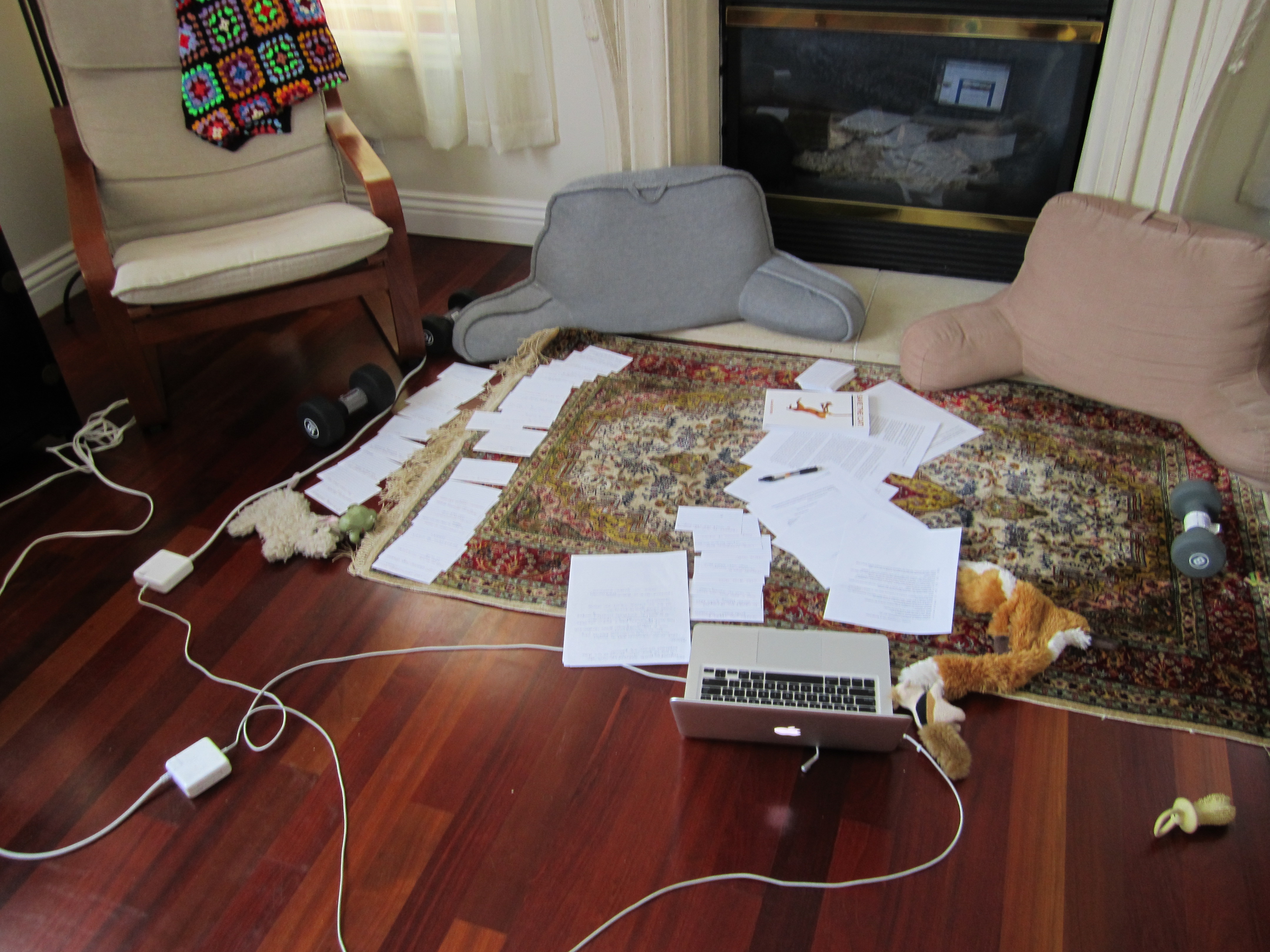
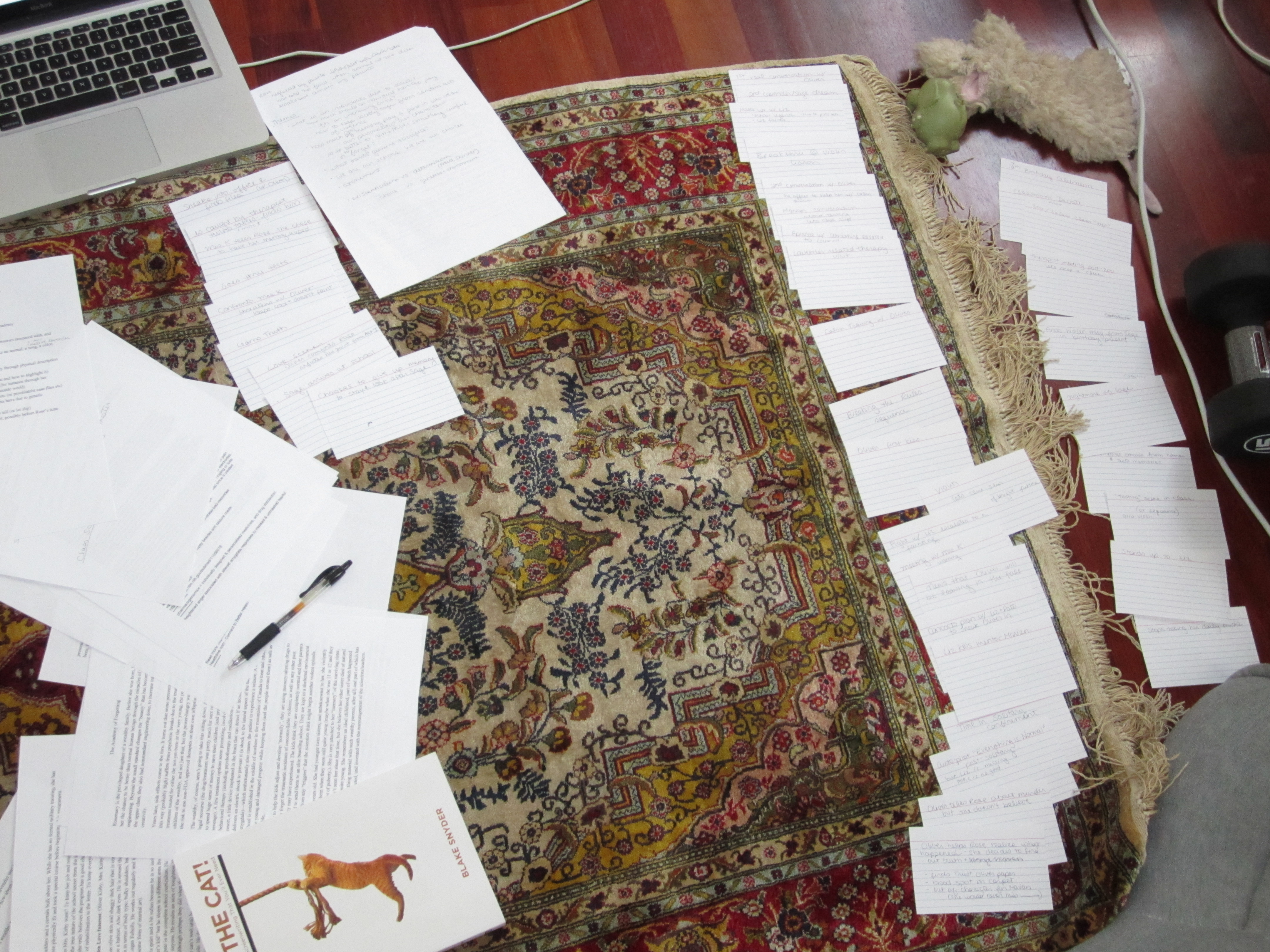
Then I got to break out my beloved index cards and begin to arrange my three acts:

Obviously the proper work environment must include dog toys and weights….

Strangely, I ended up with Act 1 on the far right and Act 3 on the left, which feels backwards, but I decided to go with it.

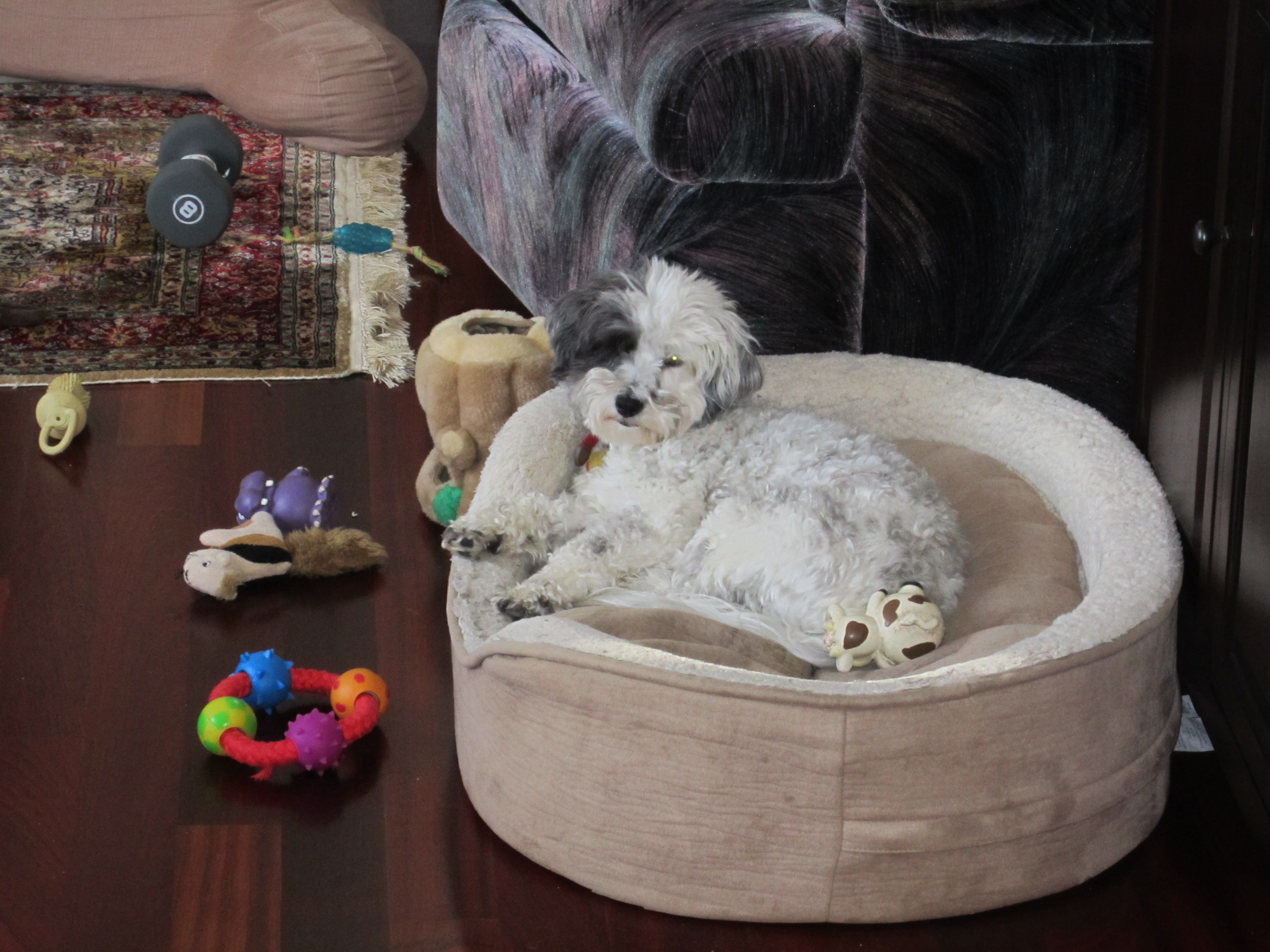
Luckily, I had the services of a prime story consultant, and her favorite toy cow.

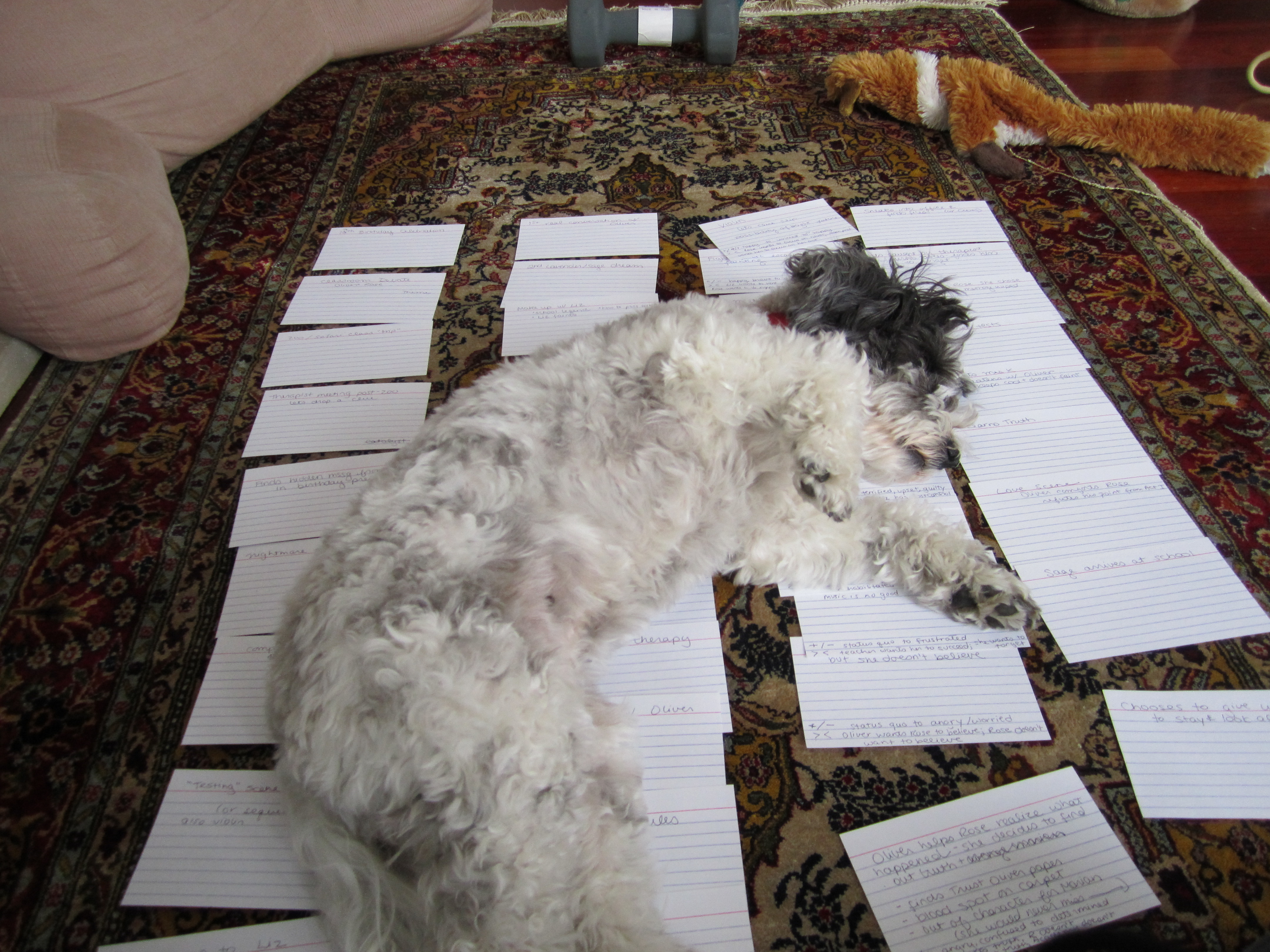
This kept happening once I arranged the acts in their proper order. I’m not sure if she’s so in love with the story that she wants to sprawl all over it, or if she hates it and wants to hide it from view. Maybe she believes in a Zen-like teaching method….

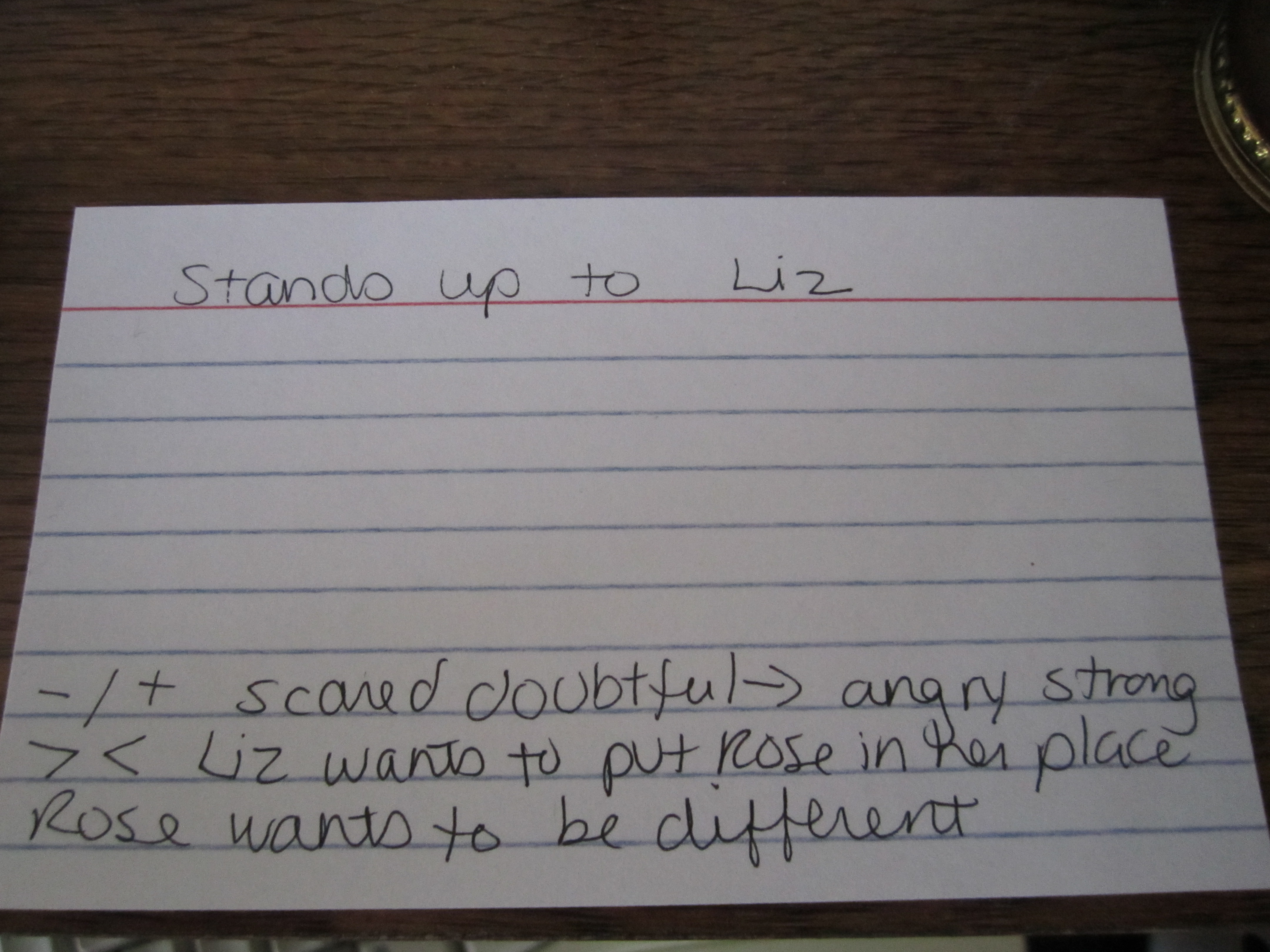
Once I had the novel laid out like this, I began adding two things to each index card: +/- (or -/+) to denote the emotional change for the protagonist in the course of the scene depicted on that index card; and a >< to denote the conflict going on in the scene. So a finished card looks something like this:

I know that conflict description is a bit cryptic (actually, maybe the entire card is cryptic; I chose one that wouldn’t be too spoilerific), but the important thing is that I know what I’m talking about.

Finally, I typed up all of my cards, creating a four-page outline. To this document I added my adapted beat sheet that includes approximate page numbers of when things should maybe happen. And now I have a road map for the book, from which I can feel free to detour wildly if I don’t think it’s working.

What do you think about structure and writing a novel? How extensively do you outline, if at all? What about your process makes you deeply happy, the way index cards make me giddy?

I am happy to present the second Backbone Project link round-up! I highly suggest you check some of these essays out pronto.

Dying Is Not a Crime, by Adam Israel

On Snobbery, by Derek Smootz

Love of Critique, by Kimberly Gould

Backbone Project: Shrink, by Marilag Lubag

Backbone Project: Truth, by Marilag Lubag

Backbone Project: Critiques Are Tools, by Marilag Lubag

I Don’t Wear Shoes, from Speculatometry: The Theoretical Measurement

When Critiques Wound, by Sandra Tayler

Library Cards are for the Birds, by Miranda Suri

I also ran into this: On Taking Criticism, by Mike Brotherton. It touches on similar issues to what I discussed in my You are Not a Weenie if a Critique Makes You Cry article.

Thanks to all of you for participating and writing thought-provoking posts.

When I announced the Backbone Project two weeks ago, I expected to get some practice at writing essays that weren’t terribly conciliatory, at responding to people who disagreed with me, and at addressing subjects that I might normally hesitate to talk about. And I was right, to a point; I did in fact get practice in all of the above. But I learned a lot more than I anticipated.

First off, I learned that Ferrett is right (which probably doesn’t come as much of a surprise to many of you). Here I’ve been spending all this energy softening the expression of my viewpoints and trying my hardest to keep everyone happy, and it turns out that’s not so interesting. People respond more when I’m less nice, less perfection-geared, and less careful, as you can see from the amazing comment threads on all three of the Backbone Project essays.

Also, when people disagree with me or even dislike me, I don’t spontaneously combust into flames. Instead, I have a feeling of strength. There’s something bracingly exciting about saying: This is who I am, and this is where I stand. You don’t have to agree with me, but here I am, like it or not.

In a small, private-ish corner of the internet, I even stirred up a tiny hornet’s nest. Yes, indeed, there were all sorts of strangers saying, among other things, how judgmental and smug I am, how if I’ve had problems with not drinking, it must be because of my attitude (otherwise known as victim blaming, but whatever), and that it is completely not a big deal to not drink. At first, I felt terrible. I should have chosen my words more carefully. I was an awful person, both to write such an essay and to not want to drink in the first place. That second assertion snapped me out of it and instead I felt defensive. They hadn’t read my essay! They definitely hadn’t read the comments following it. They didn’t understand. For awhile, I yo-yoed between the two states.

And then I realized it wasn’t a big deal. The conversation wasn’t even about me. Anybody who no longer liked me or no longer wanted to read my blog probably wasn’t my friend or ideal reader in the first place. “Congratulations,” my husband said. “Having people tear you apart on the internet means you’ve leveled up. You have more influence now.” Oh. Who knew?

Meanwhile, I was busy being educated, and the remaining small rough patch of alienation caused by not drinking alcohol was being healed as I found solidarity in a completely unexpected way. As all of you shared the ways in which you are different, told your stories about being child free or hating to be photographed, not wearing shoes and being vegetarian/vegan, not driving and being polyamorous, I began to feel not so much held apart by my differences as brought closer to all of you who have had similar struggles. Indeed, our differences became something we have in common. I learned so much from all three conversations, and I’m looking forward to many more.

Of course, while my goal for the Backbone Project was to write three essays, in reality the project is ongoing, which is great, because it supports what I’m doing in the rest of my life as well. I’m going to keep trying to avoid the wishy-washy and to write strongly and bravely. I know I won’t always succeed, but my guess is that the more I do it, the better I will become.

And remember, you have until tonight to send me links to your own Backbone Project essays. There have been some really awesome posts going up this last week, and I can’t wait to share them with everybody!