Feeds:
Posts
Comments

Can Blogs Be Art?

I’ve spent a lot of time thinking about art: how art can be defined, what its possible purposes are, what I am trying to accomplish personally as an artist. This exploration began many years ago when I was a student musician: a singer, a songwriter, and a composer.

In my music program, we spent a year on music theory that looks beyond the standard Western tonal palette. Our curriculum began with late 19th century composers like Wagner and Debussy, which I very much enjoyed studying, and then progressed to atonalism, serialism, and other 20th century classical music (including John Cage, Philip Glass, etc.). We also spent a quarter studying 20th century music history.

After I finished this course of study, I went on to take a few composition classes and seminars and began to consider more seriously the question of why. Why do so many cultures include music as an integral component? Why do so many of us like to listen to and/or produce music? What was I trying to achieve with the music I was writing?

The answer, I decided at the time (and it still holds true for me), is communication. Music is a way of communicating to others; of evoking a response, often emotional; of taking something we’re familiar with and translating it into something new, or of exposing us to something new that is outside our own frame of reference. Music can tell a story, something that happens especially frequently in vocal music (my other focus at school) but can also happen in purely instrumental music (listen to Berlioz’s Symphonie Fantastique for an excellent example of programme music). Music can make us feel a certain way: when I’m watching a suspenseful TV show, it’s often the music that makes me jumpy before anything has even happened on-screen. Music can share universal experiences or distill unique experiences in a way that are more relatable. One of the reasons I adore musical theater as much as I do is because it combines the dramatic potentials of theater with the emotional resonance of music, while remaining accessible to a more general audience than opera often does.

Unfortunately a lot of the music composed in academia, the new Classical music of the 20th century, didn’t seem to me to be very accessible at all. In fact, at the time it baffled me because the goal of communication often seemed very absent from it. Indeed, serialism in particular seemed like a game played with numbers that had very little to do with actual sounds at all. I realize now that I wasn’t seeing the complete picture; I believe even the most experimental pieces were trying to communicate. The problem, for me, was that they were communicating with only a select group of people who were educated enough in music to be able to understand them. I was in that group, yes, but what about everyone else? Imagine the equivalent of throwing out an old common language and writing in a new language; you will only be able to communicate with the select group also versed in the new language. So what we are talking about then is the question of audience. If art is communication, then considering a given piece of art’s intended audience becomes very important.

I also approach writing as art, and therefore as an act of communication. But in pursuing that line of thinking, I realized there are many forms that written art can take. We have the obvious: novels, short stories, plays, poems. But we also have the slightly less obvious (at least to me): letters, blogs, Google+/Twitter/Facebook. Am I saying everyone’s Facebook account is art? I’m not sure if I’d go quite that far (although feel free to make a case for it in the comments). I’m saying it can be art; it has the potential to be art. I’ve certainly created art through letters/emails, in which I create an idea, a vision of who I am and what my life story is. And then on the flip side there are the banal and mundane emails that are just a recital of facts or a quick way to make plans.

I’m in love with this great art project, in which a photographer traveled around the country taking photos of people’s refrigerators. I think about this project all the time because I am just blown away by the coolness of it, showing the stories of these random people through one photo. To me, this is art—it turns my assumptions around, it evokes emotion in me, it causes me to see the world around me in a different way.

So then is this blog art? It certainly tries to do those same things. Some of you will think I’m being pretentious by labeling my blog as art, but isn’t it interesting to think about? I like to think of each essay being a small piece of a greater mosaic—I wonder what it will look like when it is complete. I wonder what picture I will have created. I get excited just thinking about it.

What is art? Is it in the eye of the beholder, the creator, or both? Is it about intention or execution? What does art mean to you?
Today is a frazzled sort of day. I’m leaving tomorrow (perhaps even as you’re reading this) to attend SCBWI’s summer conference, and the day before travel, even relatively easy travel, generally features me heatedly checking off to do lists and worrying that I won’t have time to complete everything. I have more travel coming up as well, so if I seem a bit less substantive or even (gasp!) miss a Tuesday or Thursday during the next few weeks, that is why. I am having trouble cohering because I keep getting distracted by the fact that my new “I have mutant teeth” sensitive toothpaste is too big to pass through security, or that I have to remember to pack my battered copy of The Phantom Tollbooth.

In between these logistical reminders to myself, I’ve been thinking a lot about influence–specifically on the influence we have over other people. Some influence we take for granted; if I were to tell you that my husband and I are huge influences on each other, I doubt you would be surprised. But when I think back over my life so far, I can come up with a list of names of people who have had a strong impact on me. Not all of them are related to me. Not all of them did I ever get to know well. Not all of them am I still in touch with today.

Some of these people have no idea of the role they played in my life. They may not even remember me. They are like stealth actors who dropped in to teach me something I really needed to know or show me another way of living before moving on. Some of them even died before I was born.

This is useful to remember when contemplating creating a life that allows us to teach, influence, change the world, increase awareness. We never know who we might reach. We never know when we might say the exactly right thing that gives another person an “aha!” moment. Sometimes we won’t learn of our own impact until years after the fact, or perhaps not even then. Many times we’ll have accidental influence–we’ll have no idea that someone will have taken our casually spoken words to heart. We won’t realize that by hearing about our lives, someone else will decide to do things differently. We just can’t always know. But the not knowing doesn’t mean it isn’t happening.

We all yield influence, whether we’re aware of it or not. So the question becomes not if, but rather what we want our contribution to be. And since we can’t always be aware of it when it’s happening, an even bigger question is this: how do we live our own lives in such a way that we can maximize our positive influence? I don’t know if I have a complete answer to that question yet, but it’s something I plan to think about in the upcoming weeks.

In the meantime, I feel a deep sense of gratitude to the people on my list, both because of what they taught me and because they’ve helped me realize how important every individual can be.

I have the pleasure of announcing that my story “Forever Sixteen” is now up on Daily Science Fiction’s website. I’ve been very excited ever since I sold the story back in March, and I’m thrilled that it’s now available for everyone to read.


The main character is a girl whose aging and development has been arrested so that she remains sixteen years old (if you want to know why, you’ll have to read the story). What would it be like to stay sixteen forever? On the one hand, we live in a society that is obsessed with youth and appearance, so the idea of being able to retain that youth (and implied health) is quite attractive. On the other hand, would you really want to be sixteen for the forseeable future? I didn’t even have huge high school traumas and I’m still not overly enthusiastic at the thought of remaining a perpetual teenager.

Going wider, this premise can be seen as a metaphor illustrating the tension between the desire for stasis and the need for change. We live in a world that is constantly changing, and we’re constantly changing within it. It’s natural for us to want to impose our control on such chaos, to attempt to preserve the status quo. So many of us fear change (and I’m certainly no exception), even when the change is largely positive in nature. And yet, what if that potential for change was taken away from us? What if everything really did stay the same, even our own bodies and the hormone levels coursing through them? As much as I sometimes dread change, this story illustrates one of my true nightmares: the attempt to suspend change.

We’ve all heard the old saw about how the only sure things in life are death and taxes. But whenever I hear that, I always think that in reality, the only sure thing in life is change. Life may trundle along on an even keel  for a while, even for many years, but ultimately something will happen to disrupt its direction.  Sometimes we choose the change; sometimes it chooses us–like death, a natural disaster, or a shift in politics or the economy. Sometimes we have to fight for change, like the protagonist of my story. And sometimes change comes at a high price, at which point we are called upon to decide: how high is too high?

On a more personal note, this story is one of my own favorites. I don’t know if this is true of other writers, but I definitely have the stories I’ve written that are especially meaningful to me and stay close to my heart. Right now I have three of those special stories, and this is one of them (the other two are still looking for homes). The fact that my first pro sale was made with this story in particular makes me feel especially pleased.

So tell me: would you want to stay a teenager forever?

Hungry for Books

Last week my husband and I drove up to Ashland, Oregon to attend their Shakespeare Festival for the first time. I’ve been wanting to attend this festival since high school, and it did not disappoint. Also, it’s good to know that I can watch eight plays in four days without burning out on theater.

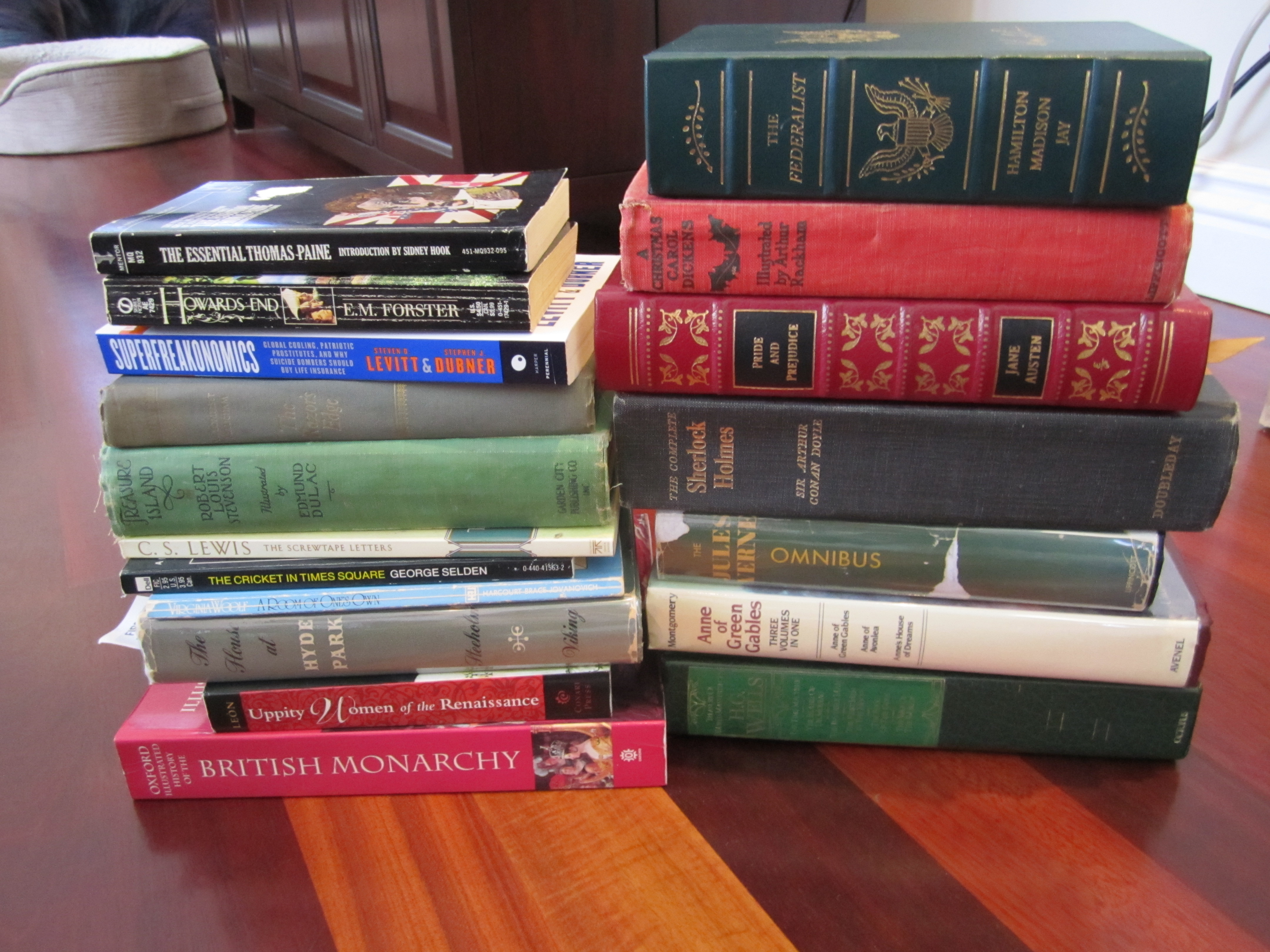
Ashland was a charming place, and my favorite part was the plethora of bookshops that grace the downtown, including at least two “Books and Antiques” shops. Those two shops were my bookstore dream come true. Both of them had old books in bookshelves all over the shop, surrounded by assorted strange items: a brass urn, a large wooden Noah’s ark, aggressively sparkly jewelry, antique scissors complete with scabbard. One of the shops had an entire section devoted to “Banned Books” throughout the ages, and they threw in a free “I read banned books” pin with my purchase. I could have spent hours in those two stores, and the only reason I didn’t spend more time was the danger of buying more books than would fit in the car for the drive home.

There’s something about old books, isn’t there? I don’t usually notice the smell of books, having a notably poor sense of smell, but in a used bookstore even I notice the musky scent of aging paper. And those old hardbacks feel so weighty in the hand, and lacking the slickness of the modern dust jacket, they seem more mysterious–anything could be lurking behind the slightly battered covers. I was reminded that, however much the world may move towards electronic books, and however many of them I will purchase myself, there is something inside me that will always be enchanted by the book as a physical object.

So I decided to share that enchantment with you by showing you photos of my book haul from these two lovely shops.

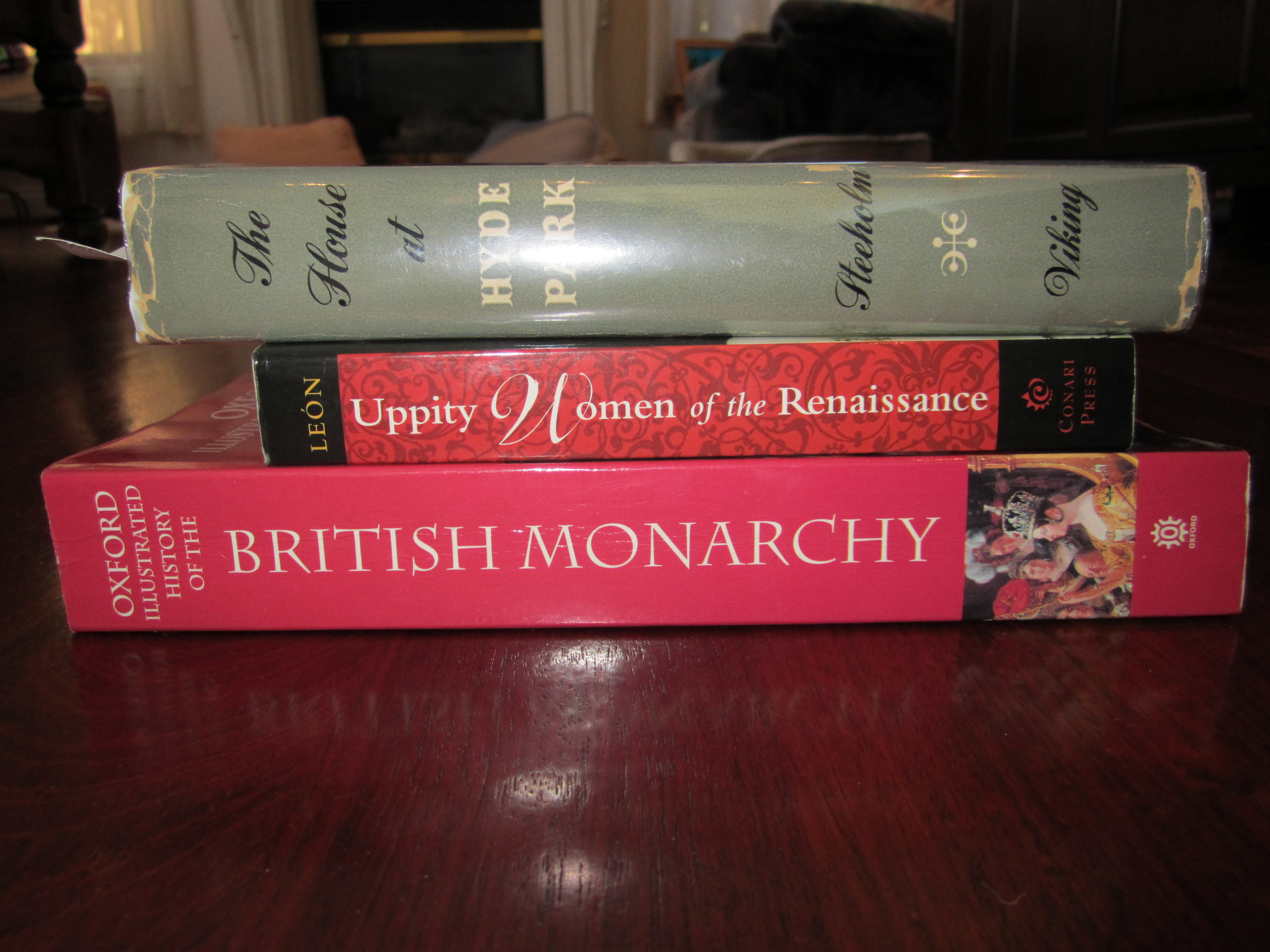
These are my three nonfiction selections. I love English history, and after having just seen Shakespeare’s Henry IV Part 2, I was particularly inspired to get a book on the British Monarchy. Short sketches of famous women in the Renaissance? Equally interesting, with possibilities of awaking some story ideas. The top book is about the home life of Theodore Roosevelt and his family at the turn of the century (19th to 20th), which is a time period I’m quite attached to (think Anne of Green Gables and the Betsy and Tacy books).

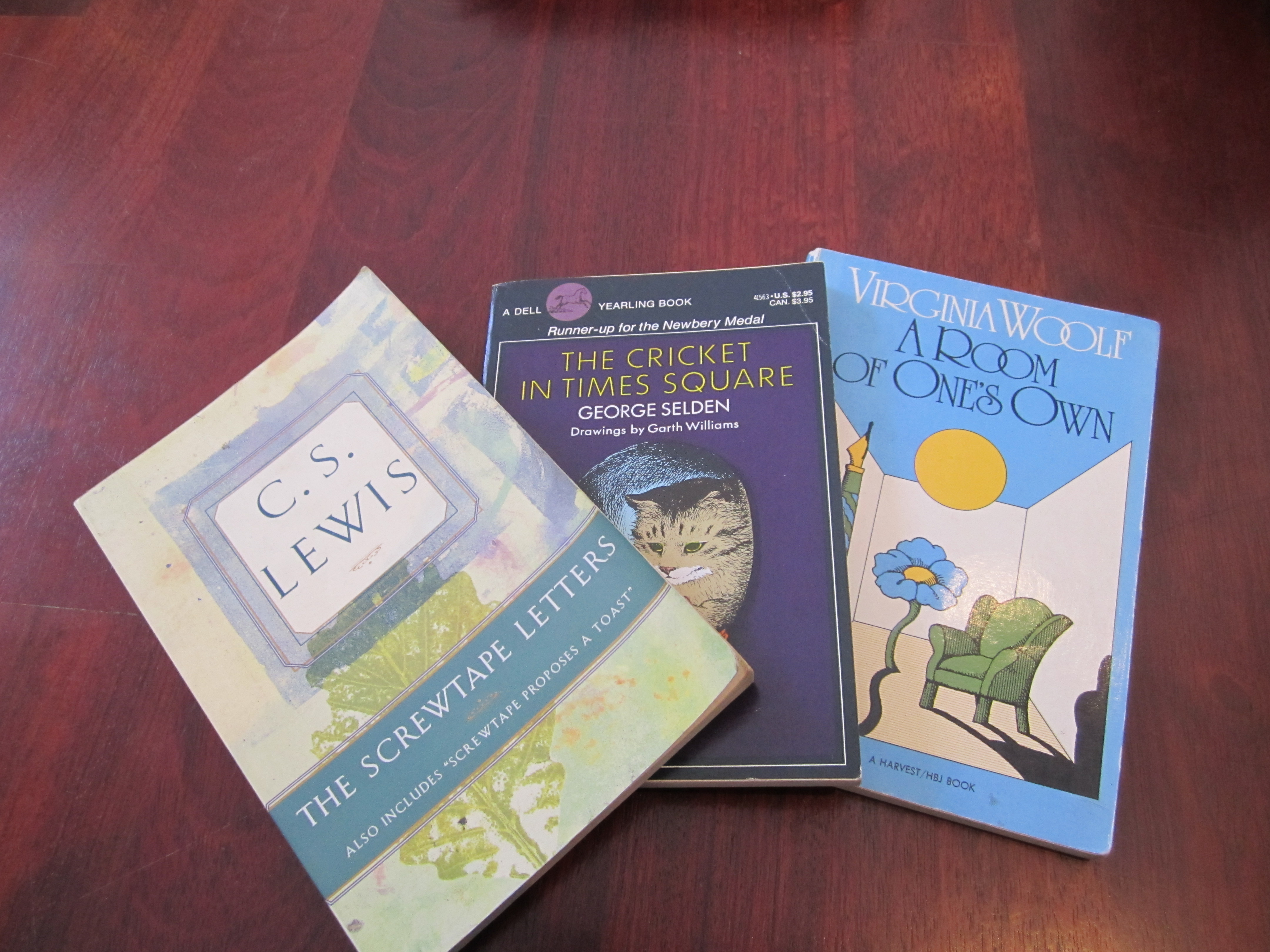
My bouquet of paperbacks. I’ve only previously read the middle one. I really wanted to get Virginia Woolf’s On Being Ill, but neither shop had that one, so I got this one instead.

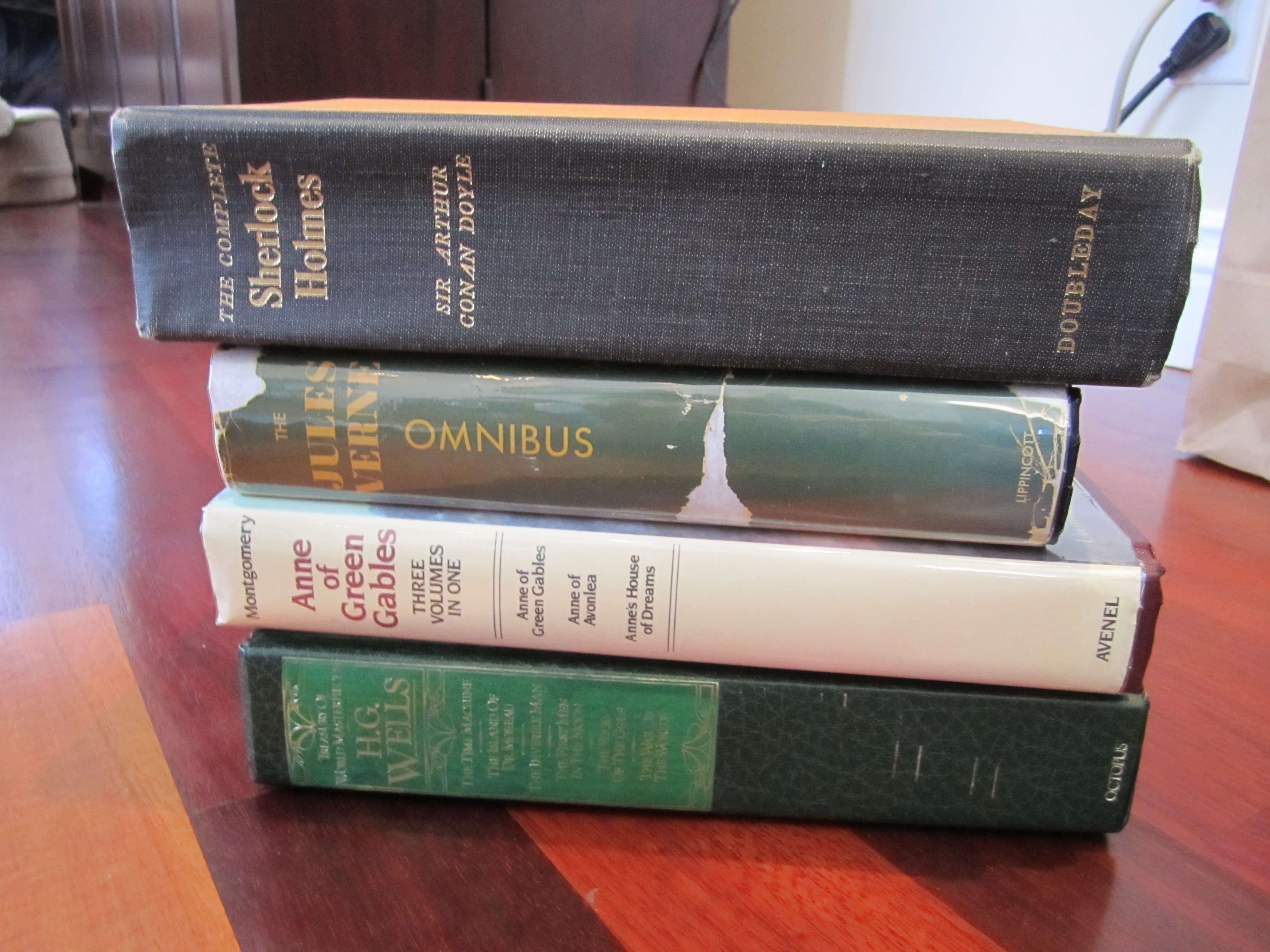
Okay, how exciting is this stack? The H.G. Wells omnibus on the bottom is particularly well made, but all four of these books make me hungry for reading. And my favorite three books of the Anne of Green Gables series all in one volume? I couldn’t resist.

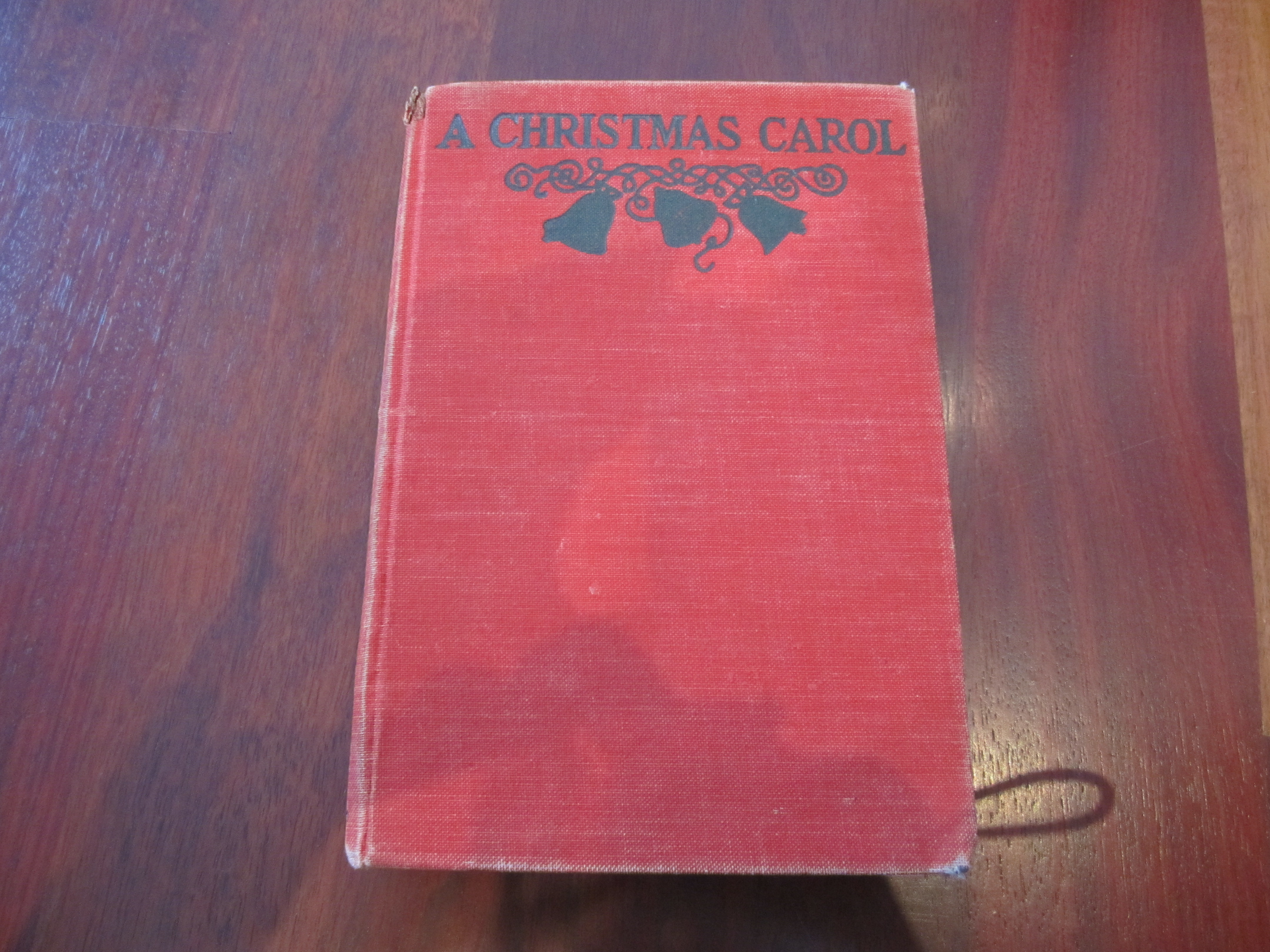
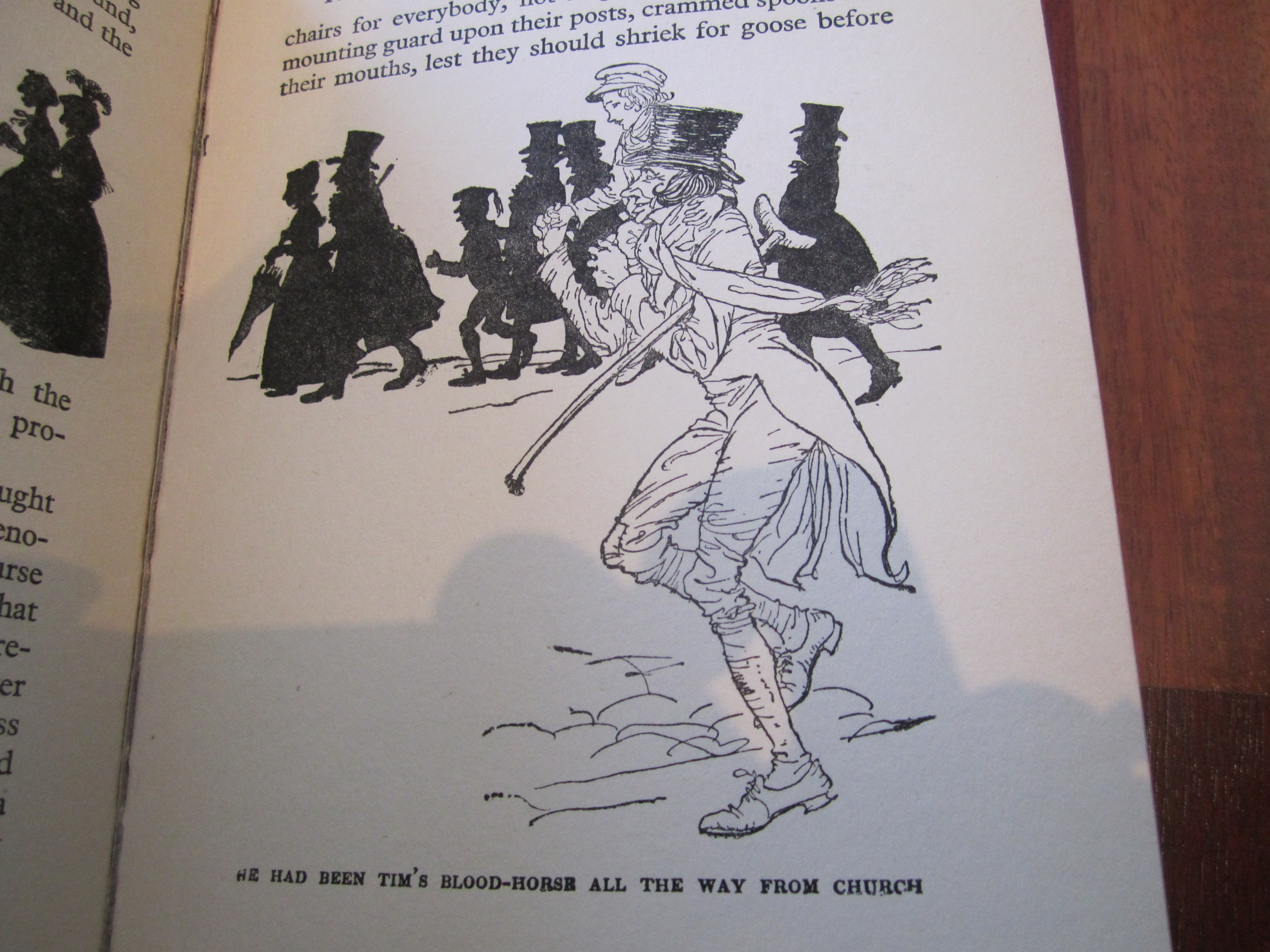
I love this old edition of Dicken’s A Christmas Tale. My husband and I read this story together every December. Look at that art! It reminds me of the old books my mom saved from her childhood.

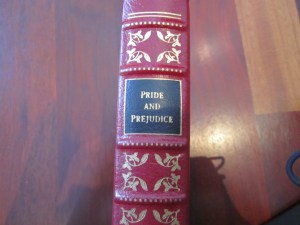
I’ve saved the best for last. I saw this book and I knew I had to have it.

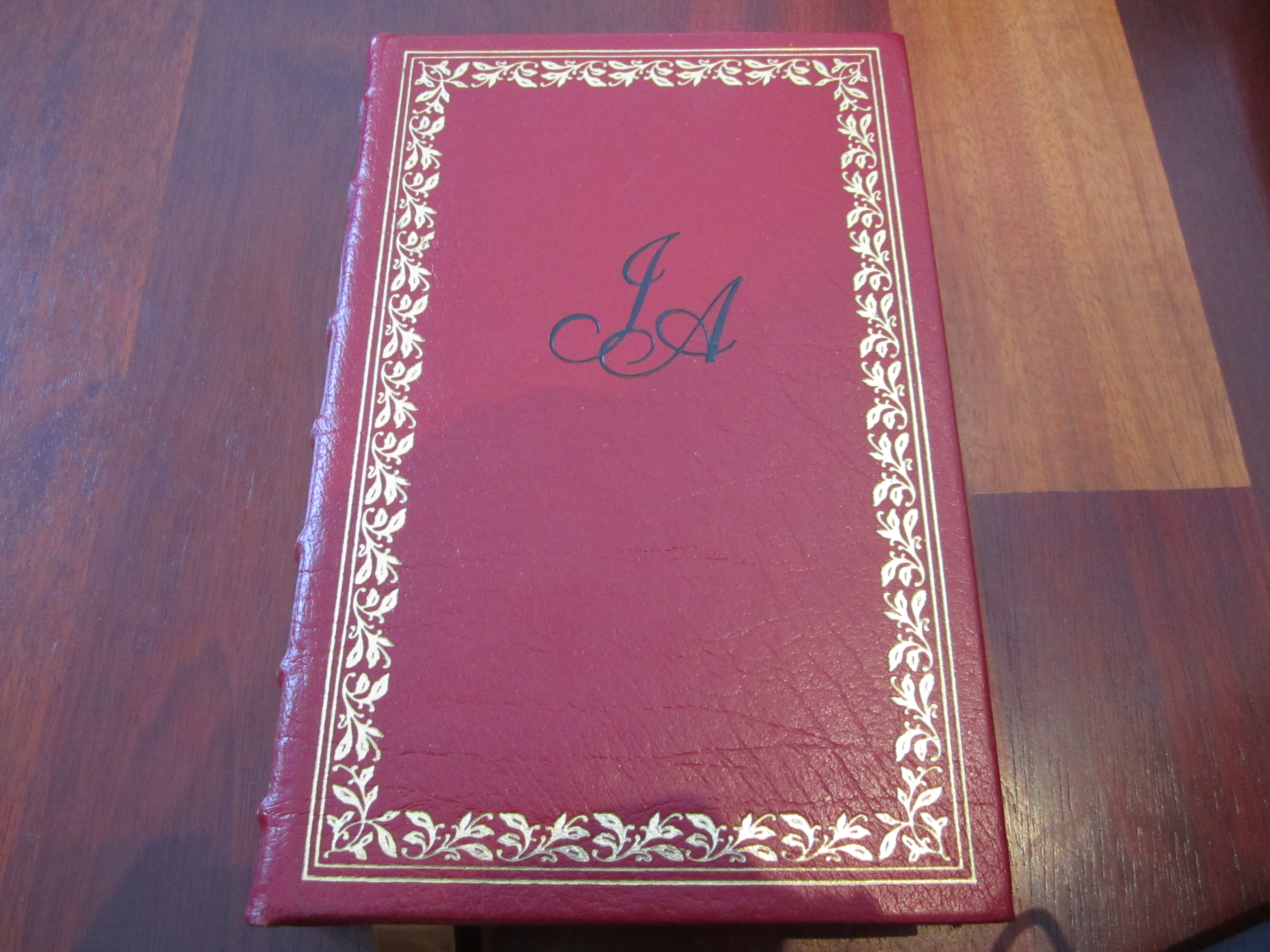
Yes, it is indeed leather-bound. And it has golden gilt on the edges of the pages. I’ve been looking for the perfect edition of Jane Austen’s Pride and Prejudice for quite some time now.

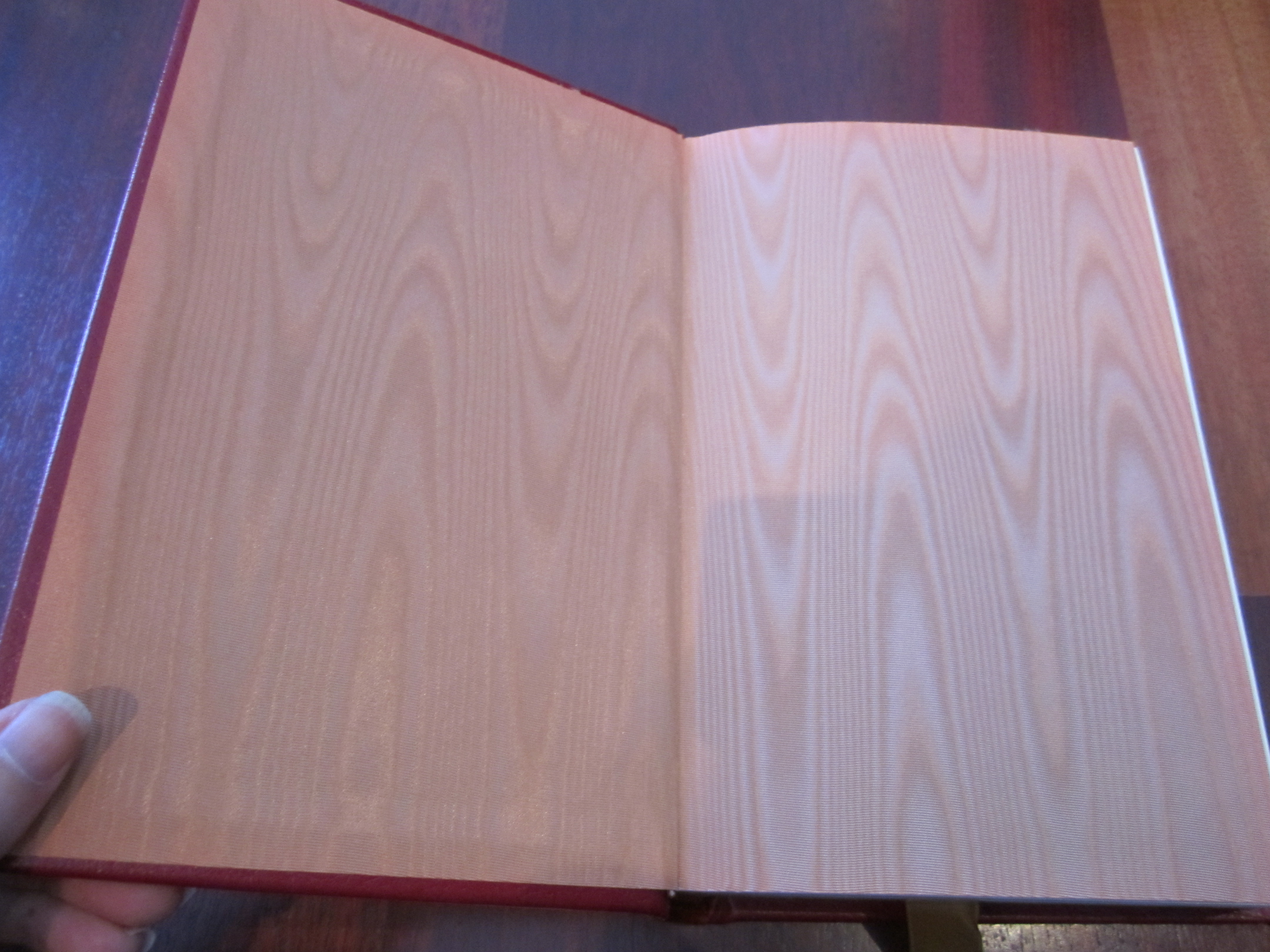
The end papers look even better in person: a shiny, orange gold color with a pleasing texture.

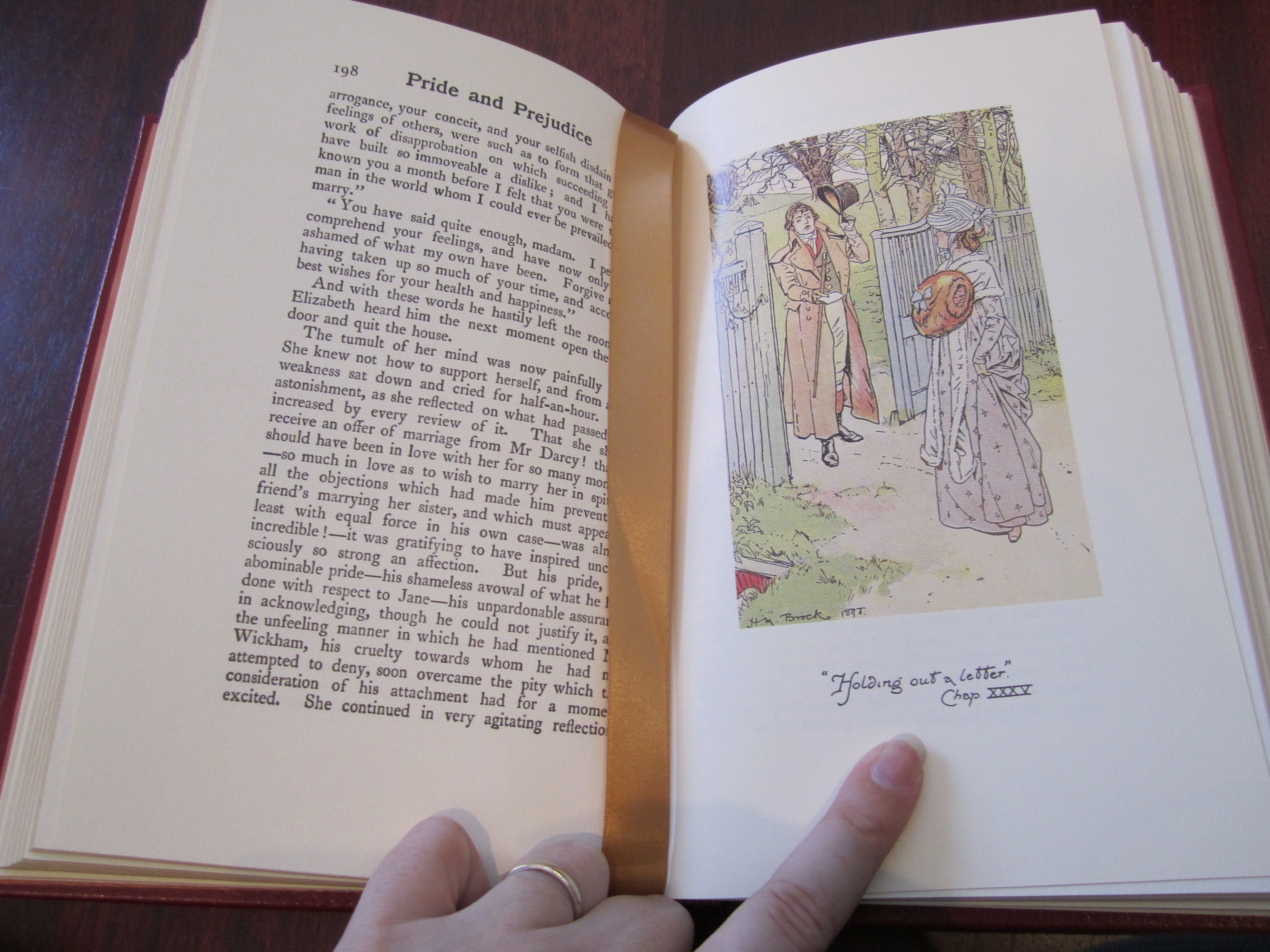
And it is illustrated. And it has a golden ribbon to keep your place as you read. How elegant!

I adore this book with all my heart, both its outer form and the story it tells.

We obtained many, many books in Ashland. I can’t wait to start reading them!

Too bad my to-read pile already takes up several shelves….

Inscrutable Humor

I have spent much of my life insisting that I am not funny.

Which, it turns out, is all a big joke. But one that most people aren’t going to get at all. Because I actually think I’m quite funny. I amuse the hell out of myself on a daily basis.

In contrast, I don’t think a lot of traditionally funny people are very funny at all. You know how people feel this need to tell jokes? As in, they recite a pre-canned joke complete with punch line? I’ll laugh to be polite, but I rarely find them very funny. I can’t tell them myself to save my life. And I won’t remember them at all after a day. Same with sitcoms in which the main source of the funny seems to be people being dumb and getting themselves into big, stressful messes. Although there are exceptions, I mostly feel sad when I watch people being dumb. And I worry about them when things start to go really wrong. Or I just don’t care. But what I don’t do is find it very funny.

Very occasionally, I will find someone who thinks I am completely hilarious. My husband is one of these rare people. I met another one at Taos, a colleague of mine who “doesn’t understand humor.” For someone who doesn’t understand humor, she makes me laugh a whole lot more than almost anybody else I know. I have another local friend who will suddenly bust up laughing at something I said, while the rest of the room looks on in bafflement or doesn’t even notice.
I recently decided to investigate this strange phenomenon, and I reached a startling (for me, anyway) and exciting conclusion. It turns out that I have been practicing the art of dry or deadpan humor for most of my life. Yes, without even knowing it. Another fact I find terribly amusing.

The interesting thing about dry humor is that it takes a certain amount of attention to catch it. If, for example, you’re only half listening to what someone is saying, there’s very little chance of you noticing the little joke they drop in halfway through a conversation. Dry humor is subtle and purposefully lacking in cues. And it happens really fast, which means your wit has to be turned up to full in order to appreciate it before the moment has passed. It also tends to lose its comic value if it has to be explained.

When I deliver one of my little jokes, my vocal inflection often doesn’t change much if at all. Sometimes I myself am unaware that I’m making a joke until it’s already out of my mouth. I have trouble believing, knowing myself as I do, that I keep a completely straight expression. But on the other hand, I spend a lot of time smiling, so how is one to tell the difference between my habitual smile and my sly “I just committed some humor” smile? So again, not a huge red flag. The entire sense of the humor lies in the words I’ve spoken and their context.

The best part of dry humor? I can easily entertain myself. The worst part? When I laugh at other people’s unintentional dry humor, or the absurdity of a situation, and people become worried or offended because they don’t get the joke. Which is why most of the time, I’m laughing on the inside while keeping my deadpan smile firmly in place.

How about you? What do you find funny? Any fellow dry humor aficionados out there?

You may have noticed that I have not mentioned the YA Novel Challenge recently. This is not because I have not been doing it, but because it has been going poorly. And I find that talking too much about something that isn’t working well can be a bit on the depressing side. However, I said I’d blog about it, so here I am.

It is not my discipline that has been failing, although it is always more difficult to work on a project this recalcitrant. I am floundering around a lot with the present tense, which I knew going in would be challenging. The truly crippling problem, however, is that I don’t much care for my protagonist and narrator. I haven’t found her voice. I don’t understand who she is. I can’t feel the way she feels.

I decided to forge ahead to a certain point in the story to see if this problem improved. Surely, I told myself, I will grow to know her. Surely I will begin to hear her voice in my head. And then I can go back when I’ve reached the end and rewrite the first bit to match. No problem.

Only I haven’t found her. She’s still missing in her own story. And I’m far enough along by now that it has turned into a more serious issue.

I don’t know what I’m going to do with this novel. Something has to change. I have been tempted to put in on hold until (and if) I can figure out what that is. So I might do that, and work on some other projects instead. At three in the morning last week, after I’d gotten home from watching the last Harry Potter movie, I had an idea that might help things. It would necessitate starting over from the beginning, but there is at least a chance it could work. So I might try that. Or maybe I’ll come up with another solution to make the book work.

Dealing with this kind of brokenness is part of being a writer, I think. As a newer writer, I don’t always know how to fix it. And I don’t always want to talk about it because at a certain point I have to figure it out for myself. (That is my nice way of saying, please don’t deluge this post with advice.) I hope that working with the pieces gives me more insight into both why stories work and how they fail. None of my creative projects is a complete failure unless I have failed to learn from it.

So you might not hear anymore about the YA novel challenge. Or you might. I make no promises either way. But I’ll still be sitting here, learning to become a better writer. Of that, I am determined.

I have a writer friend who is having a bit of a tough time right now, and I am writing this for you. (You know who you are.)

It is okay, natural, and possibly even healthy that you are having trouble embracing your writer identity right now. Take your time about it–it’s an important identity to get to know. And I’ll let you in on a little secret: your writer identity is like your super hero identity. Yes, I’m serious. Right now you’re learning to find the super hero within.

On the outside, writers may appear like normal human beings. Some of us are frumpy or bad dressers, some of us need haircuts. Many of us wear spectacles. Some of us have unexpected hair colors or holes in our bodies that weren’t there when we were born. Some of us have a clear affinity to steam punk and corsets, others to shapeless T-shirts with geeky slogans on them. A lot of us are introverts, and we can often be found with our noses stuck in a book (or a smart phone, or a Kindle, or…). But all of this is just a facade, a way to divert attention from our secret identities.

All writers are super heroes. We fight ignorance and apathy, loss of wonder and despair. We entertain people who deeply need to be distracted from pain or sickness. We make people think of consequences, both of personal actions and society’s decisions. We remind people of what it is to be human, both the good and the bad, and we inspire people to strive for the best.

Many writers live in the stars. We dream of times past and future, reinterpreting what has happened and twisting together visions of what is to come. We deal in possibilities, in vast heroics and small personal acts of courage, in envisioning worlds that we hope for and fear. We keep the spark of ideas alive, even ideas that aren’t enjoying their time in the public spotlight, so that someday when we need them, they will still be available to us.

We create characters who take the proxy role of mother and father, husband and wife, best friend, diabolical arch-nemesis, and noble mentor. We teach people how to live, how to survive through hard times, and how to die. We serve as society’s mirror and conscience simultaneously.

Sometimes we get tired. Sometimes we fall short. Sometimes we feel like we’re not really super heroes after all, and we don’t belong in the Super Hero League of Awesomeness. Maybe we lack some credentials, or maybe we don’t know the right people, or maybe we’re not good enough yet. Maybe not enough people read our stories or buy our books or follow us on Twitter. We are unsung, unappreciated, without creative mojo. We toil away in our anonymity and obscurity, wondering if what we’re doing even matters.

But oh, my friend, when you ask yourself this question (as I know you will, because we all do), answer with a resounding Yes! It is the lot of a super hero to be handed thankless tasks and toil away with little personal reward. But we continue because of our conviction that it matters; that we can, in our own humble way, make a difference.

We give the world its voice. Don’t let anyone take that away from you.

Last week Theodora Goss wrote a beautiful essay about finding romance in life. I’ve been thinking about it ever since, enough so that I asked a few friends (hi, guys!) what makes something romantic. The consensus was that something was romantic if it was both thoughtful and meaningful, and done by the right person (by which I think we mean, someone to whom you feel romantically inclined to begin with).


Thinking of romance as having to do with romantic love is probably the baseline in American culture (except perhaps for anthropologists, folklorists, and scholars). Certainly that is the definition my friends instantly attached to. Our culture sells us a certain idea (or perhaps group of ideas) of what romantic love should be, and I have heard more than one rant about how these ideals build unrealistic and unhealthy expectations for what to expect in actual relationships. So I really like Theodora’s reminder that romance has many meanings, and her call to embrace the romantic:
I know this probably sounds silly, but why not make your life romantic? Why not surround yourself with things that make you feel like a heroine?
To me, this doesn’t sound silly at all. I am a very romantic person, which I think contributes very materially to my happiness. I don’t go about it in quite the same way as Theodora, perhaps; I find romance in my life more in the people I meet and the situations I face (or even the situations I could potentially face, or the situations I’m merely making up in my mind). I find romance in my surroundings not so much by design (surrounding myself purposefully by things I find romantic) as by accident or general frame of mind.

When I lived in London, I found going grocery shopping to be incredibly romantic. Imagine, grocery shopping, a chore I avoid like the plague here in the States, being romantic. And yet I loved walking through the quiet residential streets and coming up to the main hub of Crouch End. And I loved that I could only buy food for a few days since I had to carry it home. And I loved all of the unfamiliar food items lining the shelves, and discovering my favorites that I would buy week in and week out. It was all an integral part of this amazing adventure I was having.
I can’t keep it up all the time (which is unfortunate), but whenever I remember the romance, my life becomes more interesting. I have to do all these stupid strengthening exercises all the time because my body is cranky. But when I imagine the exercises as part of a training montage, suddenly it becomes a lot more inspiring. When I’m teaching, I’m engaged in the romance of instilling a love of music and helping to grow self-confidence in young people. In my mind my romance with my husband is an epic love story on a par with Wesley and Buttercup in The Princess Bride, only better because I am not vapid like Buttercup. And writing, well, writing has been my ideal of romance since I was seven years old.
This romantic view doesn’t hide all the rough edges. I’m perfectly aware on one level that a lot of life is a slog: to improve at something, I need to repetitively practice over and over again. To have a good relationship I have to keep working at communicating and making decisions together and ‘fessing up to my mistakes. To be a good teacher, I have to encourage repetition with even more patience than I show myself. To travel, I have to deal with discomfort and stress and things going wrong.

But I believe that seeing the romance in these things is what reminds me of how worthwhile they are. I love being the heroine! I love appreciating the romance of life, whether it be big and sweeping or small and easy to overlook (the rose bushes in front of my house are a good example of the latter; I find them so romantic…or else I forget about them completely).

So tell me, what do you find romantic in your life? What makes you swoon? How do you cultivate a romantic life?

I’ve been feeling all organized because last weekend I made a list of topics for my next several posts. And then this morning I read a blog post offering some misguided writing advice. (No, I’m not going to link to it. I’m sure way too many writers read it as is.) Cue complete topic derailment.

I’ve already written about writing advice in the past, but the more I think about it, the more I think this issue isn’t confined to advice about writing. It isn’t even confined to advice about artistic pursuits. Over the years I have certainly received a great deal of advice about basic life topics, some of which has thrown me for a loop and later proven to be completely wrong. (My favorite? “Oh, Amy, you just have delusions of grandeur” in response to me having big artistic dreams. Way to try to ensure they’ll never happen.)

Add to this the undeniable fact that I sometimes give what could be construed as advice right here on this blog, and I feel almost obligated to write the following.

Read, learn, listen to other people’s point of view and feedback. Think about what people say, try out various ideas. Don’t automatically assume you know the one true way to doing anything. But ultimately, DO WHAT YOU WANT TO DO. Do what you need to do (assuming that what you need to do doesn’t involve anything blatantly illegal, of course). And more than that, do what works. Advice, even the more strongly worded variety, is merely a suggestion that we can take or leave according to our own inclination. Even if it’s good advice, we might not be ready to implement it. And if it’s bad advice, we might accidentally harm ourselves or take the plunge into regret that I talked about last week.

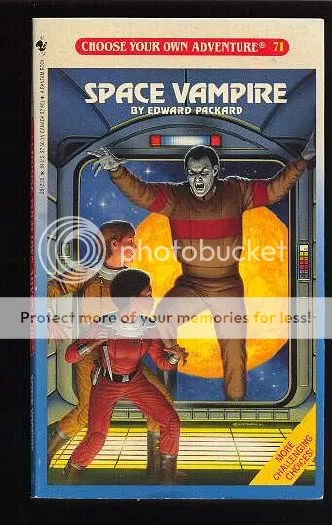
That’s one of the really wonderful things about life. We get to choose our own adventure. Sure, we can’t control everything or even most things, but within our small scope of decision, we act as our own kings and queens.

It’s not such a leap to believe that creative types need to follow their muses and express their personal integrity and vision of the world in their art. But what if we take a step farther and consider ourselves to be art and our lifetimes to be our canvas of expression? The expressions “Follow your heart” and “Follow your gut” are close but incomplete representations of this kind of life. Follow who you are, and even more, follow who you wish to become.

Choosing to live this way can mean leaving a lot of the advice behind. The Backbone Project has really opened my eyes to this. Why do people care whether I drink alcohol or not? Why do they care (especially women!) if I self-identify as a feminist? Why do people want to change my writing process? Often I think the answer is that they don’t actually care about me personally at all. Instead they are seeking to validate their own way of life and their own choices. Instead of following who they are and finding a sense of rightness in that, they need reflection from the outside world to reassure them. Instead of deep and subtle thinking, they allow themselves to fall into the black and white thinking trap: I’m right and you’re wrong. Because this doesn’t work for me, obviously it won’t work for anybody. Something needs to be fixed; you need to be fixed. If I have a big bad problem, that means you must not have any problems at all or else you’re trying to compete with me, but it doesn’t matter because my problem must be the worst. (Or flip it around: if you have a big bad problem, that must mean my own problems aren’t important at all.)

Don’t take my advice about this, though. Think about it, and make up your own mind. Choose your own adventure. Turn your life into art with every choice you make.

It is at times like these that I wish I had a book or movie review blog, or a recipe blog (ha! good one, Amy), or maybe even a tech blog. Then I could write up a topical essay instead of writing about what I’m about to write about. I could satisfy my current introverted yearnings and hide behind the text instead of infusing myself throughout the text. But, into the fray I go!

I want to talk about negativity, and more specifically, about how easily it spreads. Sometimes it feels like we are being hit by a constant bombardment of negativity: complaints, mean comments, subtle put-downs, defensiveness, bare naked insecurity, and reams upon reams of advice (the dreaded “shoulds”). Between our in-person social interactions and the pervasiveness of the internet, it can be hard to escape. All of this negativity becomes like white noise, this constant presence that we sometimes don’t even notice.

One problem with this negativity, aside from the obvious, is how easily it can rub off on us. Negativity is contagious. So when I’m spending time reading updates from writers who are, in various ways, freaking out about their writing in public, I will eventually start freaking out about my own writing without necessarily even realizing why. When I’m reading all this writing advice that appears to lay down rules from Heaven, even if I keep a skeptical mind, I will eventually start second-guessing my own process. If I hear enough complaints about Google+ and why would any normal person choose to use it instead of Facebook (and it’s always instead of, I notice), then I begin to worry about the long-term viability of Google+, even though I’m enjoying it a lot right now.

I get the impression that some people are able to shield themselves from this effect without much thought, but for the rest of us, it takes more care. Sometimes I have to take internet breaks. Right now I severely limit the amount of writing advice I read, especially on blogs, because I find that the advice hurts as often as it helps. I also try to avoid other writers’ word count posts. I make a mental note of the people within my acquaintance who are likely to let loose with the verbal zingers. I try to distance myself (and don’t we all have experience with that, given the amount of bad news we’re exposed to from the media alone?)

It’s a tricky line to walk. On the one hand, everyone needs to complain sometimes. And I certainly want to be supportive to my friends and colleagues. But on the other hand, if my work and/or mood is being materially affected, then something has gone wrong. Perhaps this is a side effect of living in the Information Age, when we are blasted by stronger streams of sharing than was previously possible.

But I confess that when I’m deciding what to share, I try (and granted, sometimes fail) to take this into account. It’s not that we should shy away from discussing the difficult things. Indeed, when a real discussion is taking place, I often feel more connected and less negative. Tackling difficult topics can educate, instigate change, and bring people closer together. Plus I truly believe it is rewarding to pursue authenticity and honesty when possible. But I also think it’s important to ask ourselves how we are affecting others. And if we are sharing with a large stream of people (as we so often do with social media), I think some relevant questions to ask are these: how am I contributing to these people’s lives by what I’m about to say? Am I helping to lift people up or accidentally bringing them down? Am I blasting out a burst of negativity to no purpose? It’s not that we need to represent ourselves as living under a permanent rainbow. But neither do we want to end up sharing life under a perpetual rain cloud.

As you can tell, I’m still grappling with these questions. So tell me, what do you think? How do you protect yourself from other people’s negativity? How do you decide what to share? Where is the line between being honest and spreading negativity?