Feeds:
Posts
Comments

I spent a lot of time talking about writing last week, which meant it was an incredibly happy time for me. It also means I’ve been spending a lot of time thinking about writing, and the process of becoming better at something, and what it really means to engage in and spend your time on the pursuit of mastery.

What I’ve found is this: There is the big picture, the goals/dreams we are pushing ourselves toward. In writing, this might be having a story bought by a certain magazine, or getting an agent, or getting a book deal, or getting into a certain program, or reaching a certain sales goal, or a hundred other goals. These goals can be a positive force in our development, keeping us motivated, focused, and business-minded, as long as we can stay resilient enough to weather the disappointments.

When we achieve one of our goals, we experience a spurt of joy. It is very exciting. If you are me, there might be clapping and bouncing and maniacal cackling. There is a time to savor the achievement.

Similarly, when we fail to achieve one of our goals, we experience a spurt of sadness and disappointment. If you are me, there might be sulking while playing solitaire or making loud “Hmmph!” noises. There is a time to lick wounds and regroup.

If everything in our process is basically working, then either way leads to the same result. The work. The practice. The study. The craft. The art.

Photo by Darwin Bell

The good news is wonderful; the bad news sucks. But what really matters is what happens in between these peaks and valleys. If you’re a writer, you write. If you’re a musician, you play. If you’re a painter, you paint. If you’re a chef, you cook. If you’re an entrepreneur, you come up with and implement ideas. And always, you are working, practicing, and striving to become better.

The bursts of joy and sorrow can be intense, but they don’t last. What does last is our relationship to our calling. The words. The story-telling. The breath. The process.

This is what it means to seek mastery.

There was a running theme to many of my conversations during my week in Seattle. My lovely writer friends and I would be chatting and catching up, and at some point, they’d ask me, “So, what exactly are you doing in Seattle, anyway?” And now that I’ve done this twice, I thought I’d share my own recipe for having a personal writing retreat.

Many of the writing events I know of place an emphasis on giving and receiving critique. This is great, and a lot of value can be had at these events. However, for the past year or so, I have found myself wishing for a different kind of event, where the focus instead lay on the writing. So this March I attended the Rainforest Writers’ Retreat in Washington, which seemed to (and did!) fit the bill.

Unfortunately, the Rainforest Writers’ Retreat is only once a year, so I decided I’d try to have my own retreat in Seattle. It’s fairly simple to arrange: I pick a week, arrange my flight and hotel, and then send out an email to the writer friends I have in the area, letting them know I’ll be in town and available to hang out. I know what I’m going to be working on ahead of time, writing-wise. And that’s it.

The view from my hotel window in Seattle.

Here are the benefits I get from these retreats:

1. Focused time to work, away from all “daily life” kind of distractions. I didn’t think this would make a big difference, but for me, it really has. I simply get more work done in a hotel room than I do when I’m at home. I’m less likely to waste huge chunks of time. And I’m also less likely to allow myself time to wallow in any writerly anxiety about my project I might be feeling.

2. New perspective. In a different place, my thinking becomes slightly more flexible, and so I’m able to see my work slightly differently and embrace new ideas and directions with slightly less resistance.

3. Motivation. Because I have spent the money on the retreat, I feel deeply motivated to make sure the time counts and I get as much work done as is both possible and reasonable. It doesn’t hurt that I’m seeing writer friends the whole time, and I don’t want to have to tell them I’m not getting anything done either.

4. Connection. In some ways, my retreat is like a convention in that I’m surrounded by like-minded writers. But in this case, I get to spend more time with these writers one-on-one and in small groups, which means we get to know each other better.

5. Inspiration. Also like a convention, because I’m spending time with writers, I get to talk a lot about writing and books, and our enthusiasms tend to feed off one another, making me feel more excited and ready to write. And if I need a little extra shot of brain juice, I’m in a big city full of museums, cultural events, and people-watching opportunities.

So far I’ve found these retreats to be a successful experiment, as well as something I look forward to. I hope I can do more of them in the future.

What about you? Do you have an ideal retreat or workshop scenario?

The Want Cycle

I’ve been thinking about non-attachment.

When we discussed Buddhism in high school, I thought non-attachment sounded very sterile, like it encouraged people to not care about anything. This was a misunderstanding on my part, of course. Any religion that talks so much about compassion and loving-kindness isn’t about the not caring. It’s more complicated than that, and it has to do with our relationship with desire.

We are not always going to get everything we want. When we do get one thing we want, then we want something else. Sometimes we get caught in a trap of thinking, if only I had blah blah blah (where blah blah blah can be a certain type of career, a certain type of relationship, a certain level of health, a certain amount of money, etc. etc.), then everything would be perfect. My life would be complete.

But that generally isn’t so. We get a certain amount of money, and then maybe our health goes down the tubes. We get a certain type of career only to realize we really want to go up another tier or do something else altogether. Our health improves, and then maybe a close friend gets sick, or she moves away and then we miss her and busy ourselves thinking, if only I had more friends. We desperately wish for something in the future, but we can’t be sure of the outcome.

And sometimes we simply don’t get what we want at all. We can’t quit that irritating day job. Our family won’t stop making demands on us that we can’t meet. We have a chronic health condition. We get laid off, we don’t get into the program that would have made all the difference, we can’t afford this workshop or that trip or those material goods.

Right this second my back hurts and I want it to stop hurting. Sometime soon I’ll stop typing and do a few stretches and exercises, and it will probably feel a little better. But that won’t last. Over time I can strengthen my back so it feels more better more of the time. But really I want the pain to stop now, and permanently, with no effort. I’m not going to get what I want. These little moments of not getting what we want happen all the time.

Photo by David Boyle

Which is where non-attachment comes in. I think of it as the acceptance of thwarted desire. It’s the awareness that this is our reality, that we want and yet we’re not going to get everything we want. And that it’s okay that this is true. We will want something, and then that wanting will eventually pass. It might take a long time to do so, or it might not. Everything changes, and changes, and changes again. And the more we can be aware of this movement, and even embrace it, the less suffering we will experience.

At least, this is what I’ve been thinking about. Sitting with the feeling of desire, which keeps coming up. Watching it, and the emotions it often comes with, and remembering this is just one moment. I think it helps to be aware of what’s going on and allow ourselves to pay attention to that experience. But if you want a whole list of great suggestions of how to practice and think about non-attachment, read what Lori Deschene has to say about it.

What do you think?


Claiming Eccentricity

“I aspire to eccentricity,” I said recently at a party. “By the time I reach my sixties, I want to claim it completely. I want to be a full-blown eccentric.”

It takes a special kind of strength to claim our eccentricity, to go against social norms and expectations, to wave the weird flag. There’s a subculture in the US, consisting of artistic types, unconventional types, adventurous types, and free spirits, who consider the statement “You’re weird” to be one of the highest compliments. It’s a reclamation of words that cut to the bone on the elementary school playground.

What’s interesting about being a free spirit, or a rebel, or any of these other labels, is that there isn’t one way to do it. We talked a couple of years ago about Hollywood’s depictions of free spirits as spacy, often irresponsible, Bohemian, manic pixie dream girls. But allowing ourselves to fit into these pre-constructed molds is an inherent act of conformity. In order to truly be a free spirit, to claim that eccentricity within, we do ourselves a disservice if we follow the map society hands us. “Here’s what you’re supposed to be if you’re a free spirit.” Ha! When the whole point is to decide for yourself.

We are held back by these maps, by these preconceptions. The well-honed ability of human beings to practice self-deception will never cease to amaze me. I am so good at it, I don’t even realize I’m doing it. It is only when these maps, these boundaries, and these assumptions are challenged that we can begin to truly cultivate ourselves, eccentricities and all. Otherwise, not only do we limit the choices in our stories to a much more narrow band than necessary, but we fail to know ourselves.

Photo by H Koppdelaney

If we look at what lurks underneath this disconnect, we’ll often find fear. Fear of being different. Fear of not being loved. Fear of change. Fear of loss of safety. Fear of having to confront hard truths, of being stuck into the red hot forge until we become malleable enough to be re-shaped and see more clearly.

In order to know ourselves, in order to discover what shape our eccentricities will take, we have to walk into the fear. We have to gently nudge ourselves forward, and we have to experience the pain that comes with seeing that reality does not always conform with our expectations, our beliefs, and our desires. Claiming eccentricity fully means spending our lives exploring, both what it means to be us and how that intersects with the rest of the world. It means ignoring that innate desire to mirror what and who is around us. It means thinking instead of automatically agreeing. It means creating a ripple of discomfort around ourselves, and perhaps learning to defuse it somewhat with humor, charisma, and tact (and sometimes choosing purposefully to let the discomfort stand). It means choosing how we express ourselves.

What we find when we strip ourselves down, layer by layer, is true eccentricity. A lot of people call this authenticity. I think maybe it’s the same thing, only authenticity sounds more noble. It’s simultaneously a loss of innocence and a rebirth of innocence. Nothing is the way it seemed–not society, not the people we know, not even ourselves. (Get stuck here and you achieve bitterness, disillusionment, cynicism.)

Beyond it, though, lies the innocence of being connected to ourselves in the moment. The innocence of “I am.” The innocence of the joy that is generated by living in harmony with who we are.

I made a joke at a party. But this is really what I meant. There’s something a little eccentric about that, don’t you think?

Laughing at Myself

I have a new favorite Facebook personage whose page I have liked. He’s a writer named Jonathan Carroll, and he posts all of these amazing quotations and excerpts from his work that tend to be quite insightful and make me happy.

Here’s a quote he shared earlier this week: “It is a great art to laugh at your own misfortune.” – Danish proverb

Photo by Manosij Mukherjee

Remember how I said one mark of emotional resiliency is developing a sense of humor? (I know, I know, I keep going back to that, but I’m just so excited to have a name for one of my interests.) I suspect that an especially helpful part of humor is the ability to laugh at yourself, your life, your world. And when I can’t do that, when I can’t find anything remotely funny, even the tiniest bit that is only tangentially related, well, that’s when I know I’m in for a real emotional wringer.

I was talking to someone about absurdity, and how a sense of absurdity in life can result in a loss of meaning. But I don’t think this has to be the case. Sometimes finding that hint of the absurd is the only way I can find humor in a given situation. Absurdity also makes it easier for me to laugh at myself, as I notice my own foibles and eccentricities. The trick, then, is to notice the absurdity around yourself while not allowing it to erode those ideas, relationships, or things through which you find meaning.

Perhaps we can do this by realizing that so much of everything is absurd if you’re looking at it from a certain perspective, and accepting the absurdity while still seeing the beauty and meaning shining through. (Is this a type of idealism, perhaps? Or optimism?) Look at writing, for example. So many things about writing are absurd. The cultural norms reflected both in and around writing, the prescribed structures of fiction, the putting down words and then deleting them and then putting down more words and then deleting them ad nauseam. The basic idea of fiction, of writing down a story that never happened and never will happen, has an element of absurdity in it–enough, in fact, that some people cannot enjoy fiction because of this (although I do wonder if this reflects on their ability to deal with absurdity in other realms of life as well). What about the idea of becoming immortal through your words, an absurd idea if I ever heard one given the low chances of being one of the few writers whose works are still being read two hundred years later. And don’t even get me started on the absurdities inherent in the business aspects of being a writer, because they are legion.

And yet, writing still has deep meaning for me. I can laugh at it (and I do), and then I sit down and write some more. Absurdity doesn’t erase the importance of writing for me; it is a part of writing, and then there are other aspects of writing that call to me and make the time and energy spent on it seem deeply worthwhile. It’s a similar strangeness to that of concurrently laughing at yourself and taking yourself very seriously.

I wish I had something sage but pithy to say about how to develop the art of laughing at oneself. But the truth is, sometimes it comes easily to me and sometimes it doesn’t. I do find that the more I can gain a wider perspective and the less caught up in perfectionism I am, the easier it gets. So I suppose that’s my insight for today: Look outside of yourself. Allow yourself imperfections. Go ahead and hold yourself to a high standard to begin with, but be gentle when you fall down. Cultivate laughter. And spend time around people who do the same.

What are you laughing about today?

Homes of the Heart

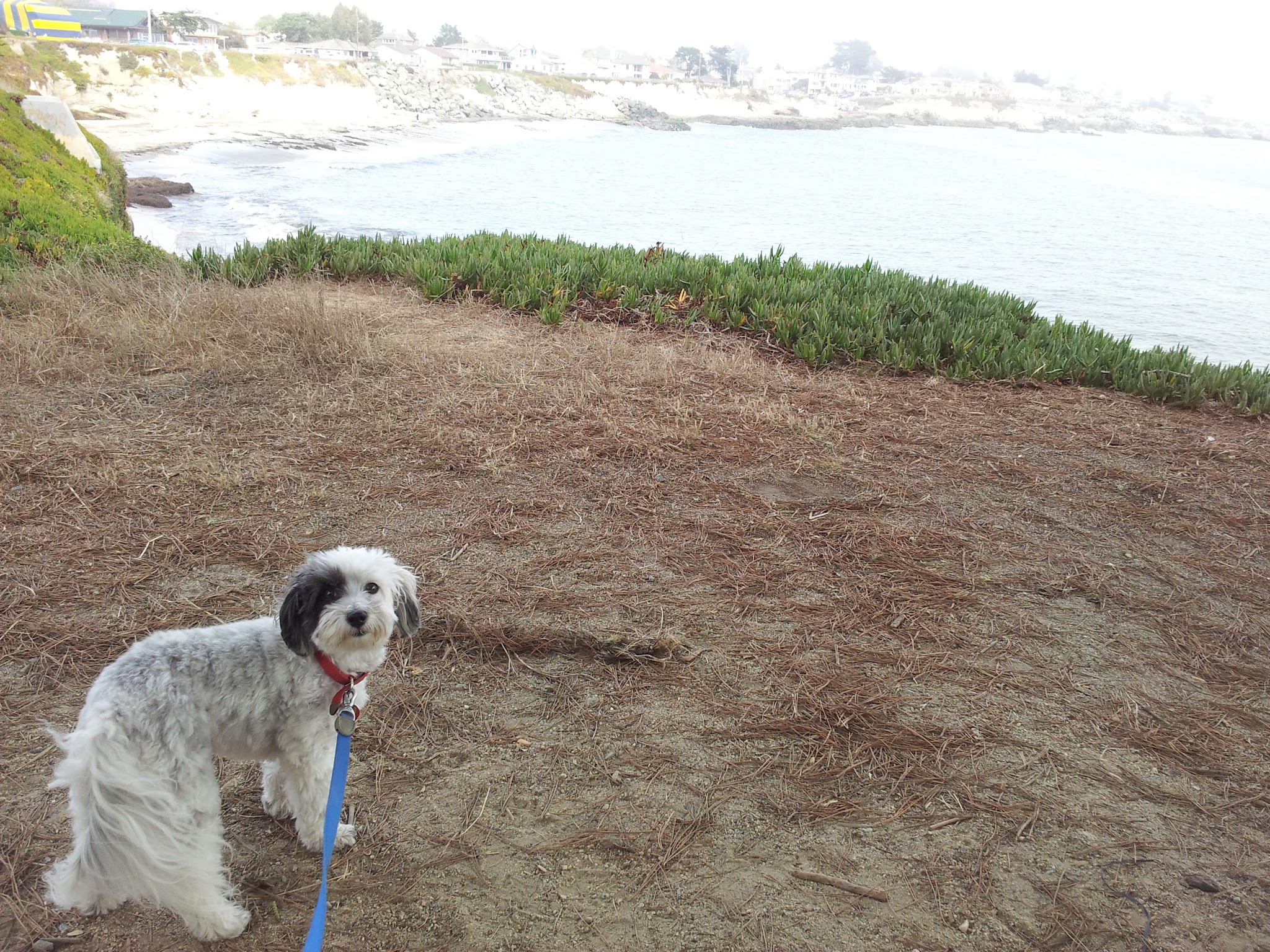
I drove down to Santa Cruz with my dog this weekend. I’m not sure when I had been there last, but I have a sneaking suspicion it was for my birthday last year, which would mean a whopping fifteen months between visits. I felt lighter the minute my car was in the midst of the pine trees that line Highway 17, and by the time I’d reached my favorite view of the ocean, the entire world felt like a better place.

The egregious cute dog picture here.

This got me thinking about the homes of my heart. I have two places I’ve lived in the past that have the same effect on me. I feel happier thinking about them, and when I am actually physically present within them, I feel this strong sense of homecoming. Of rightness. One of them is Santa Cruz, and the other one is London.

That’s not to say that Silicon Valley, where I live now, isn’t my home. I know a lot of people here and have some fabulous friends close enough to see often. I really like the park near my house. I know my way around. I know where to obtain goods and services. I have spent several years of my life here. But it isn’t my heart’s home. I don’t feel joy from simply living here. I feel grateful for the mild weather, but that’s not really the same thing as joy.

Now Santa Cruz, I can tell you what makes it special (even though I do not go down there anywhere near often enough). London, I can talk on and on about why I love it. I wish more people would do that, actually: give me the opportunity for a long London monologue. If we are together and you want to make me happy, bring up London, be ready to listen patiently, and we’ll be all set. But Silicon Valley, well. If you want to be involved with a tech start-up, this is the place to be.

However, I am NOT involved in a tech start-up. (Don’t get me wrong, I’m sure it would be fascinating. But it’s not what I’m doing right now.)

What effect does it have, I’ve been wondering, when you spend so many years not living in one of your heart’s homes? I’ve been here for eleven years this winter, and even the first year, when I lived in San Francisco proper, was not what I’d call an unqualified success (although that might be related to the neighborhood I chose to live in). It must happen to a lot of people, living in a place because of work or family or finances or because that’s just how it worked out, even though it doesn’t resonate with them. Maybe it doesn’t really matter. Your friends and communities are probably more important in the grand scheme of things than your geographical location.

And yet, here in Santa Cruz, I look so much like ME.

But I miss looking out my bedroom window at redwood trees. I miss walking by the ocean. I miss London’s parks and the indifferent sandwiches I’d eat on the omnipresent benches, and I miss taking the Tube down to the Tate Modern on a Sunday afternoon. I miss rambling on the Heath and getting lost beforehand and afterwards, and I miss carrying my A to Zed everywhere I went (although now, I suppose, cell phones have replaced A to Zeds). I miss the late night excursions to the physics building’s merry-go-round and the cheap music concerts and the two pound coins and the inevitable pub and the scarf shops.

I could go back, I suppose, but I think there’s an element to heart’s homes that is related to time and context. I don’t think we can simply return to living in our heart’s homes whenever we feel like it. They might no longer fit exactly right. Sometimes we may be lucky and another right time to live there may come along. Other times we have to discover new ones instead.

Where are your heart’s homes?


One of the traits I mentioned last week that is connected with resilience is perspective, and part of perspective is the ability to find or create meaning. In a conversation about resilience, that meaning is most often crafted around circumstances of difficulty, but really humans are looking everywhere for meaning all the time.

Photo by Patrick Hoesly

James Altucher gives a great example of this in his latest Q&A post, in which someone asks him whether their sadness will ever go away. James’s answer, especially the fourth point of it, is a textbook example of emotional resilience by creating meaning: “When I feel sad… the universe will grieve but then rejoice because it’s learning so much. Then I can rejoice because every pain, every sadness, every moment, is ME, the universe manifest, learning something new.” He believes that every moment of his life is a learning experience for the universe, and therefore his life is infused with meaning. And this helps him deal with feelings of sadness.

A few days after I read this Q&A, I read Karawynn Long’s latest post, “How American culture is causing widespread misery.” She talks about the correlation between a shift in American culture and increasing rates of depression, and offers some suggestions as to what we individually can do about this. It’s really fascinating, especially this part: “As our culture shifted to exalt the benefits of personal choice and individual success, Seligman explains, we were also losing confidence in the larger constructs of society. Previously, he says, Americans lived in “a context of meaning and hope.” When we encountered failure, we could take reassurance from something larger than ourselves: “a belief in the nation, in God, in one’s family, or in a purpose that transcends our lives.” But as Carter noted, in the middle of the twentieth century that reassurance began to disintegrate.”

So with an increasing distrust in government, along with declines in active religious faith and more closely knit (and often geographically close) families, Americans suffered from more depression. In other words, with loss of meaning came decreased emotional resilience.

Of course, we can, and do, find meaning elsewhere, whether or not we believe in God or our families or the government. Personally, I have found a great deal of meaning in teaching, particularly children and teens, and while I’m not teaching at present, I suspect I’ll do it again at some point in the future. I find meaning in my writing, both my fiction (fiction is inherently about creating meaning) and on this blog. I find meaning through the communities I am part of, in the relationships I have formed, and in self transformation. I find meaning through learning more about the world and universe around me, and through shifting perspectives to remember how small I really am, both in scales of size and time.

What we are fighting against is a sense of futility, the thought that nothing we do matters or makes a difference, the urge to coast or settle or fall into a rut. Instead we believe in the butterfly effect. We believe our choices matter, whether that be the choice to recycle that piece of paper or to smile at the clerk at the grocery store or to give a significant amount of money to a charity or Kickstarter. We create meaning by being mindful about the cause and effect of what we do every day.

How do you create meaning in your life?

A couple of weeks ago, I was reading over some of my older blog entries. When I’d finished, I sat back and thought, “Huh. That was actually kind of personal.” At least, more personal than I had remembered.

There’s a place where the personal and the important intersect. And we who blog are then called to make a decision: how important is so important that I can’t stay silent about this? In my case, that means I often end up blogging about issues related to people pleasing and boundaries (and occasionally feminism). I know there are lots of people who grew up in dysfunctional families just like I did, who have similar issues, and I know how helpful it can be to know there are others out there in the world dealing with the same kind of thing you’re dealing with. It’s too important for me to stay silent.

This trade-off was brought strongly to mind during this year’s Worldcon, where I was lucky enough to spend some time with Jay Lake. For those of you who don’t know who he is, Jay is a prolific SF/F writer of some note. He also blogs. For the past few years, he has blogged in an unusually open fashion about his difficulties with cancer. He blogs about disease, about mortality, about what he feels his cancer has stolen from him. He blogs about determination, depression, despair, and joy.

He told me he gets more fan mail from his cancer blog than he does from all his published fiction.

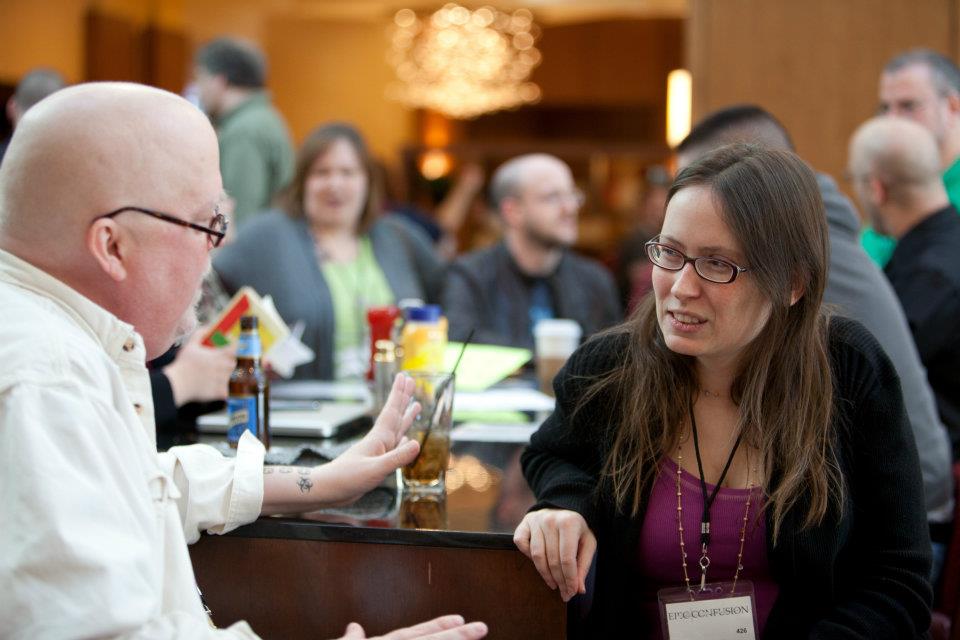
Me and Jay at Epic ConFusion this January. Photo by Al Bogdan.

And he pays a price for being personal. I spent time with him at several points during the convention, and every single time, we were approached by people who expressed their sorrow about his health, or asked about it, or gave him their good wishes that he would recover. On the one hand, it was beautiful to see this outpouring of support from the community.

But I looked at him at one point, late-ish in the evening, after a particularly long stream of generic good wishes, and I thought, “This must get completely exhausting.”

And that is the price. Not everyone will be able to look past the cancer and see the man. Because he has blogged so openly about his disease, he can’t necessarily create a veneer of normalcy for himself when at public events like Worldcon. Part of his public identity is linked to his cancer.

But he pays the price with grace, and I admire him so much for doing so. Because it is too important to stay silent. We need to hear about cancer, about illness, about mortality, and about the physical and emotional struggles that come with these oh-so-human things. Our society tends to have dysfunctional attitudes around illness, around death and dying, around grief and loss, and part of changing those attitudes is talking about these things in a frank and open way. And people who have cancer, people who have other serious illnesses, people who have loved ones who are sick, many of them are helped by Jay’s blog, where by writing authentically about his own personal experience, he puts words to so many other people’s experiences.

So I think about this blog, which is perhaps a bit more personal than I had originally intended. And then I think about Jay. And I’m glad to have written about what I think is important.

I’m in fabulous company.


How To Be Resilient

I’ve written a fair amount about being happy, feeling gratitude, dealing with disappointment, and other related topics over the last two years. But it was only last week that I realized that a lot of what I talk about is actually how to be emotionally resilient.

I’ve been thinking about emotional resilience (although not under that particular label) since I was a kid. I took a good look at the people around me who were dealing with stress and adversity, and who appeared to be miserable most of the time, and I thought, “I don’t want to turn out like them.” Thus began my strong determination to become an emotionally resilient person.

At first my plan was to become resilient to tide me over to the point where my life would no longer have any upsetting bits. Now I realize that second part of my plan is never going to come to pass. Adversity is a part of life, and similar to whack-a-mole, the minute one difficult thing is more or less under control, another one pops up to do its own excited little “look at me” dance. The world is changing around us all the time, and inevitably some of those changes aren’t going to be ones that we want to happen. Health changes, life circumstances change, families change, employment and careers change, accidents happen. I can’t stop these things from changing because nobody can.

However, the first part of my plan, to become as resilient as I could, has been enormously helpful. It’s something I still work on and attempt to improve, and I expect I’ll continue to do so for the rest of my life.

Photo by Tom Magliery

Why is resilience so important? Because it’s something constructive we can do in the face of adversity. It tends to make us happier people. It makes it easier for us to deal with disappointment and rejection, which in my case means I’ve been able to continue working on my writing skills (and my singing skills before that). Resilience is what causes us, in the face of difficult circumstances, to be able to stand up, brush ourselves off, and continue forward. It allows us to hold onto the belief that whatever happens, we will ultimately be okay. It keeps us from becoming bogged down in a never-ending morass of negativity and powerlessness. It helps us live more fully in the present.

Resilience is real strength.

I found an article that describes eight of the attitudes and characteristics that encourage resilience, and I found myself nodding along as I read. It lists the following: emotional awareness, optimism, support, internal locus of control, perseverance, sense of humor, perspective, and spirituality. I’ve written about many of those ideas already on this blog, and I’m sure I’ll continue writing about them.

What about you? What helps you be more resilient? In what areas do you run into trouble?

Nice vs. Kind

I’ve been thinking a lot lately about the difference between being nice and being kind.

I was having a conversation with a friend of mine who also used to be a people pleaser. (There are few things more encouraging than finding and talking to people who used to be people pleasers and now are completely not that way at all.) He told me how he felt that in some ways, in order to change who he was and stop being a people pleaser, he had to swing to the other extreme for a time. But now he was at the place where he was hoping to become kinder and more generous.

A few days later Justine Musk posted her brilliant piece on nice vs. kind that does a great job defining terms, and everything clicked together for me.

Since I know not all of you are going to read her essay, I’ll quickly define the difference. Nice is doing things because you’re supposed to, because you feel you have to, because it’s expected, because you’re being pressured into it in some way, because you don’t feel you have the option to say no. Kind is doing things because you want to: you want to help, you want to be there for someone, you want to give of yourself.

Photo by Martina K

When you’re a people pleaser, when you’re nice all the time, you have trouble telling the difference between nice and kind. And forcing yourself into constant niceness erodes the capacity to be kind. Why? Because you are tired. Because you have nothing left to give.

In order to stop being a people pleaser, you have to start saying no. You have to pay conscious attention to the difference between nice and kind, and it’s difficult, and it takes a lot more energy than it would usually take. And my friend was correct. You swing over to the other side, because you’re saying no to being nice, but you haven’t yet built up your reserves to the point that you can be kind as often as you’d like.

I know because this is where I am right now. I want to be kind. But sometimes I can’t. And sometimes I’m accidentally nice, and sometimes I don’t have the energy NOT to be nice. Because as exhausting as it can be, nice is what I’m used to. Nice is my default setting, and as such, it’s what I tend to fall back on when I’m stressed or tired or in any way not one hundred percent.

Resetting a default, I’m finding, takes a lot of time and patience and mistakes and experimentation.

But I’m making progress. Understanding how kind is different than nice is a part of that progress. I am a lot less nice than I used to be. I say things that people don’t want to hear. I allow people to be uncomfortable instead of automatically smoothing things over. I say no and take care of myself instead.

Nice is something I’m happy to leave behind. Kindness is what I have to look forward to.

What about you? Do you have trouble telling the difference between nice and kind? What kind of balance do you try to strike between kindness and taking care of yourself?