Feeds:
Posts
Comments

Archive for the ‘Writing’ Category

When I was at the World Fantasy Convention this weekend, the subject of my blog came up (the way it does). I was talking about how I normally don’t do the standard convention reports here because I think they can be kind of boring for a wider audience. (Especially if you don’t drop lots of high status primate names, which weirds me out a smidge and also makes me live in fear of forgetting to mention All the Names, even though that is an impossible task.) I said that what I sometimes do instead is write about something I learned at the convention.

So now I have created expectations.

I had a convention strategy this year, which sounds a lot more impressive than it actually is. In years past, I have mainly tried to hit the big literary conventions (WorldCon and World Fantasy, along with SCBWI). But this year I decided I had the time and resources to do more, and I hit a few smaller regional conventions too; in addition to my local FogCon, I attended ConFusion in Detroit, the Rainforest Retreat in Washington, and Readercon in Boston. For those keeping track, that means in the past ten months I’ve attended seven writing events in addition to my two mini-retreats in Seattle.

My thought was that by attending some events outside of my local sphere, I’d get to meet writers who don’t necessarily travel out to the big conventions. This definitely proved to be the case. But another benefit was getting to spend quality time with people at the smaller events, and then being able to reconnect at the big conventions (where I might otherwise have never even met them).

Look! Fire escape! (I don’t know what this photo has to do with this post, either, but work with me here.)

To say that I’m happy with my year of writerly events is an understatement. But I’ve also been thinking about a conversation I had with Nick Mamatas (at Readercon) about conventions. “Why do you go to conventions?” he asked me. It was his opinion that, career-wise, I might as well stay home.

Now we can talk about promotion and networking and showing your face enough times that even the people you haven’t met or have only exchanged a few words with in passing feel like they know you. But Nick might very well be right. And it is certainly true that one can have a career as a writer without attending very many (if any) of these events, especially in the early stages. We can also talk about filling the well of inspiration, but there are more economical ways of doing that too.

No, when it comes right down to it, I attend conventions because I enjoy them. I love seeing my writer friends and making new ones. I like meeting new people. I like talking about books and writing and the publishing industry to my heart’s content. I like geeking out. I enjoy the hustle and bustle, the late nights and the groggy mornings, the packed hotel party rooms and the serendipitous meetings. I value being a part of this kooky, geeky, sometimes really screwed-up, passionate, generous community.

So that’s what I’ve learned, that for me it’s not about dollars and cents and how much exposure I got in exchange for my airfare. There’s nothing wrong with thinking of it that way–indeed, calculating return on investment is an important part of running a business–but for me, attending conventions is more than simply business.

For me, attending conventions means I get to travel while spending time with some of my favorite people. Not a bad deal at all.


Read Full Post »

On Mentors

I spent time with a writer friend the other day who said, in a wistful tone of voice, that she’d like a mentor. “But how do you even get one?” she asked.

This isn’t the first time I’ve heard this lament from a writer, and for a while, I thought getting a mentor sounded pretty amazing. It’s so easy to Hollywood-ize the idea into an inspiring training montage with said mentor, at the end of which, you (pick your poison) write the best book ever! Land a top agent! Get a six-figure publishing contract! Become well-known throughout the land as an amazing plotter/world builder/ace of characterization/wordsmith!

But moving from the realms of fantasy into reality, the first thing that strikes me is that in most fields, mentors expect to be paid. If you’re part of corporate culture, then maybe a higher-up will take you under their wing, but they get paid a salary to do their best work for the company, and one of the things they’re getting paid to do (perhaps not explicitly, but still) is to help fellow employees on lower rungs of the ladder.

In other environments, payment is still the name of the game. For example, I wrote about the differences between developing writers and developing musicians, and one of those differences is that most musicians have mentors helping them along; namely, their teachers. But musicians are giving their teachers money for lessons. The same is true for dance classes, art classes, and martial arts classes. Even Buddhist teachers are typically offered dana (donations) for their time instructing people in spiritual matters. And typically once you stop paying for services, your mentors have less time to help you because most of their time is being given to the people who are helping them pay their bills.

Another issue is that of connection. Not every mentor is right for every person (and this is true whether we’re talking about writing or music or martial arts or any other discipline). I had a well-respected writer read my work a few years back. She has a reputation for taking newer writers under her wing and helping them out, but she didn’t connect with my work, so she didn’t do that for me. This is a good thing. She wouldn’t have been able to help me the way I needed to be helped. She’s helped others of my friends with whom she was a better fit, and I’m really happy for them. But I needed to learn from other people.

Photo by Jose Tellez

At this point I’m not actively seeking a mentor because I feel like I already have several, and I’m finding more all the time. They’re not mentors in the fantasy montage sense of the word, but they help me learn and grow and become a better writer (and isn’t that the point?) I have one friend who I rarely speak to, but whenever I do he inevitably tells me exactly what I need to hear career-wise. I have my plot whisperer, my structure maven, and my YA crew. I have Nancy Kress’s voice in my head reminding me to write in scenes. I have several books on writing that keep me pushing my boundaries. I have a friend who made me think more deeply about first person. I have my blogging writer models. And I have all the writers of all the novels I have ever read.

We find mentors and teachers all the time. They may not fit our preconceptions of who those people should be, how they should act, or what they should look like. But sometimes we just have to pay enough attention to notice that they’re there.

Or else, you know, pay someone money. That works too.

But even then, having a mentor is not a magic bullet, nor a replacement for time, effort, practice, and hard work. They can give you a helpful hand along the way, but what happens from there is up to you.

What has been your experience? Who are your mentors, and how did you find them?

Read Full Post »

My social media book is stalled out right now because of Life, so I’m going to be sharing a few insights on social media for writers here on the blog in the meantime.

One of the most important truths to keep in mind when crafting a social media strategy is this: as writers, most of us are in this for the long haul. We need to pace ourselves so that we can continue to use social media to connect with our audiences over the course of an entire career. We need to find a balance so we don’t impede our own ability to write.

I talk a lot about priorities, and I firmly believe that for most fiction writers, the first priority has to be writing our fiction. Any social media strategy needs to support this goal instead of getting in its way. Otherwise it will prove to be unsustainable over any significant period of time.

So when you are crafting your own personal strategy, keep the following in mind:

1. As writers, we don’t need to do All The Things (or in this case, be on all the sites). Yes, it’s better to be using more than one form of social media. But you don’t need to be active on six or seven different sites. For most of us, that way lies madness (and a severe time crunch). It’s fine to try the newest, hottest thing in social media to see if it has a particular resonance for us, but it’s also fine to drop the services that aren’t pulling their weight. It’s generally better to choose a few places to focus your social media energies, rather than not being able to do a good job anywhere.

2. Assess your time honestly. If you need to manually track your schedule for a while in order to do this, then go ahead and do that. Between day jobs, families, and other commitments, some writers simply don’t have time to regularly blog, for example. Other writers can put aside an hour or so a week for one blog post, and still other writers have time to blog every day. But even very time-crunched writers can squeeze in five minutes most days for Twitter or Facebook. By realistically thinking about the time that is available to you, you can choose which sites to craft the bulk of your strategy around.

3. Choose your ONE top social media priority. Sometimes you’ll be sick, or you’ll have multiple deadlines, or someone close to you will be getting married, or Life. During these times, you might not have the time or energy to use social media as much as you normally do. So choose one social media activity that you’ll try to carry on no matter what’s going on. Only one. Right now, mine is this blog. But you can choose any service you want, depending on your overall strategy. And then when things get hectic or difficult, you can drop everything else and still be maintaining your presence.

What about you? What do you have time for? What sites do you focus on? What is your top social media priority?

Read Full Post »

There was a running theme to many of my conversations during my week in Seattle. My lovely writer friends and I would be chatting and catching up, and at some point, they’d ask me, “So, what exactly are you doing in Seattle, anyway?” And now that I’ve done this twice, I thought I’d share my own recipe for having a personal writing retreat.

Many of the writing events I know of place an emphasis on giving and receiving critique. This is great, and a lot of value can be had at these events. However, for the past year or so, I have found myself wishing for a different kind of event, where the focus instead lay on the writing. So this March I attended the Rainforest Writers’ Retreat in Washington, which seemed to (and did!) fit the bill.

Unfortunately, the Rainforest Writers’ Retreat is only once a year, so I decided I’d try to have my own retreat in Seattle. It’s fairly simple to arrange: I pick a week, arrange my flight and hotel, and then send out an email to the writer friends I have in the area, letting them know I’ll be in town and available to hang out. I know what I’m going to be working on ahead of time, writing-wise. And that’s it.

The view from my hotel window in Seattle.

Here are the benefits I get from these retreats:

1. Focused time to work, away from all “daily life” kind of distractions. I didn’t think this would make a big difference, but for me, it really has. I simply get more work done in a hotel room than I do when I’m at home. I’m less likely to waste huge chunks of time. And I’m also less likely to allow myself time to wallow in any writerly anxiety about my project I might be feeling.

2. New perspective. In a different place, my thinking becomes slightly more flexible, and so I’m able to see my work slightly differently and embrace new ideas and directions with slightly less resistance.

3. Motivation. Because I have spent the money on the retreat, I feel deeply motivated to make sure the time counts and I get as much work done as is both possible and reasonable. It doesn’t hurt that I’m seeing writer friends the whole time, and I don’t want to have to tell them I’m not getting anything done either.

4. Connection. In some ways, my retreat is like a convention in that I’m surrounded by like-minded writers. But in this case, I get to spend more time with these writers one-on-one and in small groups, which means we get to know each other better.

5. Inspiration. Also like a convention, because I’m spending time with writers, I get to talk a lot about writing and books, and our enthusiasms tend to feed off one another, making me feel more excited and ready to write. And if I need a little extra shot of brain juice, I’m in a big city full of museums, cultural events, and people-watching opportunities.

So far I’ve found these retreats to be a successful experiment, as well as something I look forward to. I hope I can do more of them in the future.

What about you? Do you have an ideal retreat or workshop scenario?

Read Full Post »

A couple of weeks ago, I was reading over some of my older blog entries. When I’d finished, I sat back and thought, “Huh. That was actually kind of personal.” At least, more personal than I had remembered.

There’s a place where the personal and the important intersect. And we who blog are then called to make a decision: how important is so important that I can’t stay silent about this? In my case, that means I often end up blogging about issues related to people pleasing and boundaries (and occasionally feminism). I know there are lots of people who grew up in dysfunctional families just like I did, who have similar issues, and I know how helpful it can be to know there are others out there in the world dealing with the same kind of thing you’re dealing with. It’s too important for me to stay silent.

This trade-off was brought strongly to mind during this year’s Worldcon, where I was lucky enough to spend some time with Jay Lake. For those of you who don’t know who he is, Jay is a prolific SF/F writer of some note. He also blogs. For the past few years, he has blogged in an unusually open fashion about his difficulties with cancer. He blogs about disease, about mortality, about what he feels his cancer has stolen from him. He blogs about determination, depression, despair, and joy.

He told me he gets more fan mail from his cancer blog than he does from all his published fiction.

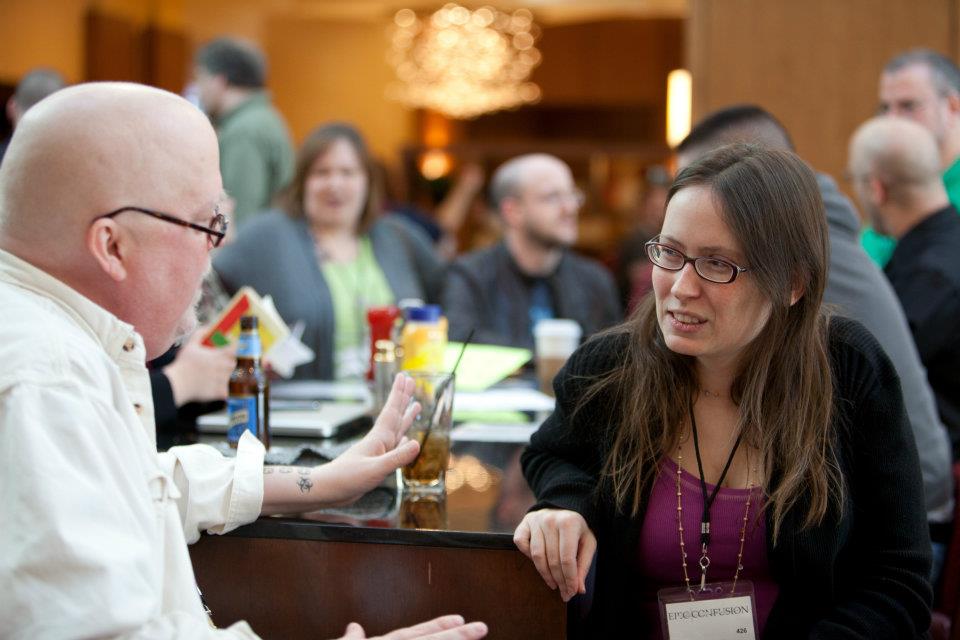
Me and Jay at Epic ConFusion this January. Photo by Al Bogdan.

And he pays a price for being personal. I spent time with him at several points during the convention, and every single time, we were approached by people who expressed their sorrow about his health, or asked about it, or gave him their good wishes that he would recover. On the one hand, it was beautiful to see this outpouring of support from the community.

But I looked at him at one point, late-ish in the evening, after a particularly long stream of generic good wishes, and I thought, “This must get completely exhausting.”

And that is the price. Not everyone will be able to look past the cancer and see the man. Because he has blogged so openly about his disease, he can’t necessarily create a veneer of normalcy for himself when at public events like Worldcon. Part of his public identity is linked to his cancer.

But he pays the price with grace, and I admire him so much for doing so. Because it is too important to stay silent. We need to hear about cancer, about illness, about mortality, and about the physical and emotional struggles that come with these oh-so-human things. Our society tends to have dysfunctional attitudes around illness, around death and dying, around grief and loss, and part of changing those attitudes is talking about these things in a frank and open way. And people who have cancer, people who have other serious illnesses, people who have loved ones who are sick, many of them are helped by Jay’s blog, where by writing authentically about his own personal experience, he puts words to so many other people’s experiences.

So I think about this blog, which is perhaps a bit more personal than I had originally intended. And then I think about Jay. And I’m glad to have written about what I think is important.

I’m in fabulous company.


Read Full Post »

I just got back from L.A. and the annual SCBWI summer writing conference. I got to spend a lot of time with some truly incredible human beings, I got to hear Matthew Kirby be intelligent (if you ever have the opportunity to hear him talk, go!), I got to be inspired and fired up and reminded of a critical component of my own identity.

But I’m going to talk about something that was said at the conference that I disagree with. One of the keynotes given was “The Power of Quiet,” presented by Deborah Underwood. It was a good talk about, among other things, creativity, recent neuroscience research, the usefulness of daydreaming, and the importance of allowing for quiet time in our lives. But… Towards the end, Ms. Underwood basically said (and I’m paraphrasing here) that we don’t owe it to ourselves to make time for quiet, but rather that we owe it to the children who will read our books.

[Insert appropriate noise of pain and frustration here.]

Then today I was linked to an article by Amanda Craig in which she says, “Yet putting yourself last is one of the best things that can happen to a writer.” (This article, by the way, is a great way of inducing rage in yourself as it is one of the more misogynistic and offensive pieces of writing I’ve seen. Happily the commenters seem to agree with me, which does help prop up my hope for humanity.)

Both of these examples reference writers in particular, but I see this idea of selflessness, self sacrifice, and the deprioritization of self care all over the place. Our society propagates it, and while it is a popular idea, it can also be quite harmful. It is tempting to link it to our society’s issues with gender and the role of the female as the nurturing caregiver who puts everyone in front of herself, but actually I believe it’s a universal message that simply sometimes differs in presentation depending on gender.

This is not an idea I can support. Yes, it is good to be kind and treat each other well. It is good to help others. It is good to fulfill your responsibilities. Sometimes you have to compromise or put other people’s needs ahead of your own, particularly if you have children. Sometimes you have to juggle priorities and put important personal ones on the back burner for a while. Life happens.

But having needs is not only okay, it’s human. We all have needs. It is not necessary to put ourselves last in order to be virtuous or good writers or good family members or good citizens. It is not necessary to give ourselves permission to do something good for ourselves (and in this example, good for our careers as well) only because it might help other people down the line. It is not necessary to value ourselves so little. It’s as if we’re afraid that by giving ourselves permission to take care of ourselves, the ugly Selfish Monster will burst out of our foreheads and wreak havoc on the world.

Well, guess what? It takes a lot more for the Selfish Monster to show itself.

Putting yourself last is NOT the best thing that can happen to a writer. It keeps you from writing. It keeps you from feeding your creativity and inspiration. It keeps you weighed down on the floor instead of being able to fly. It encourages you to make poor business decisions. It keeps you from taking care of yourself, which means that stress and bad health are going to take their tolls…both on you and–shocking, I know–on your writing.

Give yourself permission to fly.

Putting yourself last is not the best thing that can happen to ANYONE. Sometimes it happens. But think about it. Putting yourself last literally means you’re putting the needs of every person you know, and society at large, and probably also random groups of strangers, in front of your own. All the time. How long is it possible to survive this way? Why do we valorize behavior that leads to unhealthy perfectionism, people pleasing behavior, and nervous breakdowns? How can you be the best possible version of you, which is on its own a huge service to the world, if you’re treating yourself so badly?

Someday I hope I’ll have the opportunity to give my own speech on this subject. But in the meantime, take care of yourselves. Cherish yourselves. Respect yourselves. Not just because you’re doing worthwhile, noble work (although that is awesome), but because you allow yourself, your life, and your experiences to have their own inherent and deeply personal value.

Please believe you’re worth it.

Read Full Post »

In the wake of the sexual harassment at Readercon that is being discussed all over the internet, (and there is a petition you can sign if you wish to object to the Board’s handling of the case), I’ve been thinking a lot about sexual harassment. I’ve written about it a bit before, and I want to call up one of the comments that old post received, from Cyndi:

“As another post said, life isn’t fair. Get over it. Live your life, your way, and stop looking for ways to claim you’ve been oppressed/denied/overlooked. We all have been, in one way or another.”

What, you may ask, did I say in the post to elicit such a response? Was I whining or crying or talking about how unfair life is? Um, no. I wrote a calm and reasoned essay talking about what it meant to me to be a feminist, and bringing up, among other points, the existence of sexual harassment that women experience in their professional lives. Which, apparently, we are all supposed to just get over.

In fact, we’re not even allowed to talk about sexual harassment without being dismissed or being told that we’re looking for “special” treatment. Because apparently having one’s sexual and physical boundaries be repeatedly violated is par for the course, and we should lie down and take it without a murmur.

And then we wonder why feminists are sometimes angry.

Genevieve Valentine was incredibly brave, both in reporting the harassing incidents to the Readercon board and in publicizing what was happening. Both of these actions are ones that many women will choose not to do, for many reasons. Because we don’t want to be any trouble or cause a fuss. Because it is embarrassing. Because we might not be taken seriously or be believed. Because it might have future repercussions to our careers or to our very safety. Because we don’t want more confrontation with the person who has harassed us. Because we don’t want it to have happened.

But it IS happening. And it is not expecting special treatment or playing the victim card to bring it up, to talk about it, to ask that one’s basic expectations of safety while attending a convention be met. Not only was Genevieve Valentine harassed, but the same man who harassed her had previously harassed another woman to the point where she no longer felt comfortable volunteering. There was the infamous series of incidents at World Fantasy in 2011. I myself had an uncomfortable incident occur at Worldcon in Reno last year, which–guess what?–I did not report. And that is not the first such incident I’ve personally experienced in the field, either.

I firmly believe that this is not a problem for only the people who are harassed, but rather a problem that faces our entire community. And on a larger scale, a problem that faces our society. Because when we look the other way, when we say that this behavior isn’t so bad, then we are perpetuating the problem. When someone says, “Oh, but this has never happened to me,” that person is saying that because they haven’t experienced something personally, that means–what? That it’s never happened? That it’s not really a problem? That they don’t want to be bothered with dealing with something they aren’t forced to deal with?

Unfortunately, some of us don’t have a choice as to whether we’re going to deal with harassment.

Another quote from that old post of mine, this one from Jessica:

“Life isn’t fair, period. Only we can decide how to navigate through it & when we say we believe in equality perhaps we should consider what that word really means because it takes countless selfless acts & the removal of one’s own selfish needs to see what’s truly needed for a greater good.”

It sounds like she is saying that sexism in the workplace is needed for the greater good, and objecting to sexism and harassment is therefore selfish. And I’m sorry, I generally try to be respectful, but that is one of the stupidest ideas I have ever heard. It is not selfish to not want to be treated badly. It is not selfish to want to feel physically safe while working, whether at an office or at a convention. It is not selfish to want to feel physically safe period. It is not necessary for women to be selfless and allow men to paw them and make sexual jokes at the woman’s expense. Please. Next thing I’ll be hearing is that it’s selfish for a woman to not want to be raped…especially if she is wearing a low-cut top and a short skirt. Oh, wait. People say that kind of stupid thing, too.

Talking about the problem is the first step. I don’t know what the next steps look like. But I know that saying “get over it” isn’t one of them.

I’d love to hear from you: your experiences (at the workplace or not, as a writer or not, from any gender because I’m very aware that it’s not just women who get harassed), your thoughts about sexual harassment and the Readercon debacle in particular, etc. I am going to be wielding a particularly hefty mallet in the comments section for this post, because I want this to be a safe place for discussion of a difficult issue.

Read Full Post »

More publishing news! It’s been a busy summer. This time my contemporary fantasy story “The Dreamtime” appears online at Buzzy Magazine.

“The Dreamtime” is one of my older stories. I wrote it in the spring of 2010, and it was the story I submitted to Taos Toolbox for the first week critiques. Yes, I got fifteen critiques on this story during that first week at Taos, and almost everyone agreed on one thing: a crucial scene was missing. Yes, missing.

If anyone was looking for a testimonial on the effectiveness of Taos Toolbox as a workshop, I think I can honestly say I would never have sold this story without the revisions I did as a result of attending. I actually ended up adding two major scenes and one very short interlude, as well as deleting (well, combining with another, really) a scene. And the story is much better for all these changes.

Photo by Paul Bica

This story is also an illustration of the important role of persistence in being a writer. I finished the above revisions later that same summer, and as you see, the story is appearing two years later. It was purchased almost a year and a half after I started sending it out to markets. In fact, I was almost ready to give up and put it away for good, but I hated to do that since I still felt I could stand by it as a story. And then along came the new market Buzzy Magazine, paying pro rates and having an editorial focus that made me think “The Dreamtime” might be a good fit. I guess the editors agreed!

As for the story seed, I started out by thinking of the dreamtime as a metaphor for those moments when you begin thinking about someone in your past who you would really rather not think about. And yet there they are, waving at you from your own thoughts. But what if these people could do something similar of their own volition? A psychic phone call, if you will? From this idea was born the character of Mariah, still hung up on a crazy ex-love with the power to roam her dreams. In this way, this story is a twisted kind of love story that shows the emotional aftermath of a relationship gone wrong.

Some of my Taos classmates had trouble believing that a woman would find a man like O’Malley to be attractive since he is arrogant, dismissive, bullying, expects her to do what he wants. I have to respectfully disagree. Of course relationships like this exist in the real world. And even though these relationships are dysfunctional, that doesn’t mean it isn’t difficult for the parties involved to disentangle themselves. Love doesn’t disappear so easily. The question in my mind isn’t whether such relationships exist but rather whether the individuals involved (in this case, Mariah) can develop the personal strength to move on.

I hope you enjoy!

Read Full Post »

My flash science fiction story Man on the Moon Day is now available on Daily Science Fiction’s website. Hooray! (Make sure you press the “Display Entire Story” button so you don’t miss out on the end.)

For those of you who don’t know what flash fiction is, it is super short fiction. The word limits vary, but in my own mind, I usually define flash fiction as stories of 1000 words or less. Other people say flash fiction is even shorter than that.

I wrote Man on the Moon Day for a contest of the Codex Writers’ Group called Weekend Warrior. The idea is that every weekend for five weeks, the participants are provided with a few prompts to choose from, and must write a story of 750 words or less. Then everyone reads everyone else’s stories and rates them all from 1 to 10 and provides brief comments (a sentence or two).

For me, this contest was a great education in flash fiction, a form of fiction I hadn’t been very familiar with before. I participated in three of the weeks (one weekend I was in Detroit for ConFusion, and the last weekend I was just tired and very steeped in Novel). My first two stories…well, they weren’t very good. And then I wrote Man on the Moon Day, edited it based on contest feedback (it’s now 850 words long instead of 750), and sent it into Daily Science Fiction. Thirty-five days later I received the e-mail saying they wanted to buy it.

This story challenged me in two particular ways (well, besides the challenge of learning to write at a much shorter length, which was hard enough!). First, I was playing with a protagonist who…well, she’s fairly bitter, and many readers did not find her particularly likeable. I actually enjoy writing about protagonists who aren’t likeable but with whom I still have some sympathetic connection, and I figured, if I couldn’t play with that in such a short form, when could I get away with it? The structure of the story doesn’t help this either, as it is just one moment in time in what I consider to be the denouement of the entire story. Showing more of the story would, most likely, have helped to build more sympathy for the main character. So it was definitely a risk to take and doesn’t work for all readers. Indeed, many of the readers on Codex adamantly didn’t like this story.

The second challenge was one of theme and how this story plays into the “great space explorer” trope of science fiction. Because the story should be about the spouse who travels off into the great beyond and founds a colony on the moon…shouldn’t it? Well, I didn’t think so. In this case, I thought it was more interesting to explore what (or in this case, who) the explorer leaves behind and ask the question, at what cost? I’m not trying to make value judgments here about the cost as much as present the question to the reader so they can answer it for themselves. At the same time, the story may cause some readers to question traditional gender roles and how gender privilege sometimes asserts itself into relationships. It certainly caused me to think about that, even though I didn’t originally intend to write a story about that issue.

So this is a story that very much challenged me, as both a writer and a human being, and I hope it will challenge some of you as well.

Meanwhile, if you are wondering why a Wednesday post, it is because I will be on a plane for most of Thursday. I’ll be at Readercon outside of Boston this weekend, my first time at this particular con. I have a group Codex reading on Friday at 12pm in Room NH, at which I’ll be reading this story (it is, after all, a Codex success story). The rest of the time, I’ll be gorging on exciting panels and interesting conversation. If you are going to be there as well, I’d love to say hello!

Read Full Post »

My blog, the Practical Free Spirit, turns two this week. On Saturday, June 30th, to be exact. This is my 223rd post. I just read my first post, Originality: Having Something to Say. I didn’t know what to expect, but it’s not so bad. It sounds like me two years ago, which isn’t, after all, so much different from me now.

Would you like some more data? I’ve taken time off for vacation a few times, but other than that, I reliably post twice a week. I’ve never failed to post when I was planning to do so, although I’ve come close once or twice. The blog gets an average of 105 comments per month (thank you for joining the conversation!). Probably about half of those comments are from me, although I’ve been falling a bit behind in the past few months.

The highest traffic month in the blog’s life was April 2012. The most popular post is What is a Free Spirit?, which is apparently more of a pressing question than I would think. (Thank you, Google Search.) Other popular subjects include those I was afraid to write about, introversion, and cool Star Wars pictures. I am still on a quest to bring some much-deserved cuteness fame to Nala because what good is having a blog if you can’t occasionally cute-bomb your long-suffering readership?

Storm troopers create new lives for themselves fighting crime.

I don’t know much about my readers, actually, except the ones who comment. I wish I knew more. I wonder about you sometimes. It’s a strange sort of intimacy we have because I suspect there’s a significant part of me that you can get to know pretty well if you read regularly. Not the entire me, of course, but an important part. I talk about what I care about here (really, there’s no point in me writing a 500-word essay about something I don’t care about). I talk about what I’ve been thinking about. I link to the most interesting articles I’ve read. Once in a while I get teary-eyed while I’m writing one of these posts because it matters so much to me.

I read articles about what I “should” be doing with the blog, and then I ignore a lot of what I read, because we are friends, you and I. And a lot of those shoulds sound sleazy or cheap or fake to me, and I can’t bear to do them. Not to the blog, which has taken on a life of its own. It depends on me, after all; I breathe life into it. I am responsible for it. Before I started, it didn’t ever occur to me to think of a blog as a living entity, and perhaps many blogs aren’t. But this one–well, it just might be.

I am going to ask for a birthday present now, for me or for the blog, or for both of us. Satisfy my curiosity, leave a comment, and tell me about yourself. Who are you? What do you like about this blog? What do you wish I’d do more or less of? What are you glad that I don’t do (and you hope I never start)? What subjects do I talk about that give you a burst of satisfaction?

I would really like to know whatever you’d like to tell me.

Read Full Post »

« Newer Posts - Older Posts »