Feeds:
Posts
Comments

Archive for the ‘Writing’ Category

I read two essays relating to feminism last week, and I can’t get them out of my mind. They offer very different perspectives on living in the U.S. as a woman, and how to navigate the sometimes tricky waters that this entails.The first one was an explanation by Zoe Winters of why she doesn’t call herself a feminist. She offers several reasons, among them that feminism brings with it connotations of angry man haters, that feminists look down on women who have chosen to be housewives instead of career women, and that it’s better to look for win-win situations in the workplace–that if a man is unwilling to hire you because you’re a woman, you’re better off working somewhere else anyway.

The second one was by Justine Musk: “‘Well-behaved women seldom make history’: redefining what it means to be bad.”  She talks about the black-and-white choice for women in our society: to be a good girl or a bad girl. She brings up the different standards of behavior for men and for women, comparing Charlie Sheen with Brittany Spears. She discusses how convenient it is when women choose to be “good,” which is possibly another way of saying something I’ve been talking about a lot lately, choosing to be a people pleaser. (I understand that men can be people pleasers too. However, I suspect the pressures and causes might be a bit different for women than for men in our society. Feel free to argue with me in the comments, though.)

For a long time, I didn’t really self identify as a feminist. You could even say that I was a bit wishy-washy on the whole subject, and you wouldn’t be wrong. I thought I was lucky because sexism had never really affected me or my life.

Unfortunately, I wasn’t actually lucky. I was just naive.

I completely bought into the “good girl” thing that Justine was talking about in her article:

“Raising a girl to be ‘nice’,” a therapist – a woman in her sixties, married and with daughters — once remarked to me, “is like sending her out into the world with one hand tied behind her back.””

That nice girl is me. Was me, is perhaps more accurate. Sexism has affected me my entire life, sometimes in profound ways. Our society’s ideas about gender roles have played a role in shaping who I am, whether I like to admit it or not.

I don’t hate men. Actually, I really like men. Some of my very best friends have been and still are men. There have been times in my life when pretty much all my friends have been male. I have also been friends with guys who are obviously sexist. (Unfortunately, the more overtly sexist, the less likely the friendship will last, because ultimately it’s kind of hard to maintain a friendship with someone who is treating you poorly. Wish I had learned this one a lot sooner.) So I guess I’m the kind of feminist who doesn’t hate men and is only occasionally angry? Oh, and thinks being a housewife is a perfectly fine life choice, thank you very much.

I find the idea that I’d be better off finding a win-win situation in the workplace a bit shallow at best, though. I mean, it sounds great in theory, but what if I work in an industry in which I’m going to face discrimination for being a woman regardless of the company or my boss? I was talking to a female engineer the other day, and she told this story that really appalled me about her male co-workers’ behavior. When I told her that I didn’t know if I’d want to deal with that in my workplace, she responded that her company is actually pretty good to its female engineers. And I believe her; it might very well be worse elsewhere. That doesn’t mean that better is particularly great though. But she has to put up with it if she wants to continue being an engineer, and doing it with good grace is preferable for her career prospects.

As a writer dealing with sexism, it really matters what sub-field I’m in. The kidlit community seems to be made up of about 90% women. I have never experienced any noticeable sexism or inappropriate behavior in the kidlit community. Because I, as previously stated, like men, I’ve hung out with many of the men in the community, and they have always been respectful and treated me like any colleague.

The science fiction/fantasy community, on the other hand, is made up of about 40% women. On the plus side, women writers in the field also win about 40% of the major awards, which is great. Unfortunately, I am sometimes treated differently in the community because of my gender. I have heard about sexual harassment problems at conventions, and I have no trouble whatsoever believing them based on my own experiences. And because I am the “nice girl,” more often than not I let it slide. I push through my discomfort and keep right on smiling. This is the current reality of being a female speculative writer (or at least a relatively young and cute one). So should I stop writing science fiction and fantasy and find a more women-friendly environment in another genre? Or just not be part of the community? You have got to be kidding me. That’s not a win-win. It’s a big fat lose if I feel forced to leave a genre that I love.

Like it or not, sexism is a reality most women are forced to deal with (if you haven’t, I’m happy for you, but I also don’t really believe it). Some of us may not recognize that it’s happening. I often don’t recognize it’s happening. I’ve been watching movies all my life, and it’s only recently that I began to notice how gender is so often portrayed in Hollywood. Now that I’m breaking away from being “too nice” or the “good girl,” I find it valuable to try to notice. Sometimes there might be nothing I can do; sometimes I might have to stand there and smile. Sometimes someone might assume that I’m a man-hating hormonal nightmare of a woman if I use the word “feminist” or a bitch if I don’t temporize, soften my opinions, or stay quiet. But if I notice, at least I can make my own decision about how to respond and have a greater understanding of what’s going on around me and how society is encouraging me to have certain behavior patterns.

For me, feminism is not about fighting against men. It’s about fighting against stereotypes and preconceived boxes that are too small to fit who I am. It’s about being able to be taken seriously in the avocation of my choice, whether that be composer or teacher, science fiction or romance writer, engineer or housewife. It’s about taking a stand against having to fit into the definition of “good girl,” a definition I had no part in creating.

Okay, have at it. Is there anything I missed? Do you consider yourself to be a feminist? Why or why not?
Read Full Post »

While I was definitely kept busy last week with the Backbone Project, I was also hard at work on Theodora Goss’s YA Novel Challenge, which officially began last Wednesday on June 1. I knew going into it that I wasn’t going to start with the actual prose writing by Wednesday because I needed time to plan out the novel first. I am a die-hard outliner; the mere thought of beginning a novel without any idea as to where I’m going fills me with horror. Mind you, I understand that some writers find an outline too constraining, and we all have our own creative processes, but for me, I want to have a clear plan. Maybe it goes with my list-making compulsion, I don’t know.

I’ve been spending the last year learning more about structure as it relates to the novel. I’ve used the basic index card outlining method ever since my first novel, and it’s one of my very favorite parts of the process. I LOVE index cards! So much less pressure than the actual committing words to the page part. At Taos Toolbox last summer, I learned about the three-act structure in more detail (which left me slapping my forehead, I might add). I then devoured Kristen Lamb’s blog series on structure (there are eight parts to this series, although I was unable to find a page that listed all of them together, unfortunately) and was completely fascinated by thinking about story in this new way. And finally, I picked up Blake Snyder’s Save the Cat, which is a book about screenwriting that spends a lot of time on structure, and devoured it in three or four days at the end of May.

Now, I understand that a screenplay for a blockbuster Hollywood movie and a novel are not exactly the same in structure, but they can have a certain amount in common, depending on genre and related concerns. Plus, just as I have an inordinate fondness for index cards, I love organization of all types. I love being organized! It’s such a great feeling. So I decided to try applying some of the things I’ve learned during my outlining process.

My YA novel’s working title is The Academy of Forgetting. Isn’t that evocative? I’m in love with my idea. I first conceived of it back at the SCBWI Winter Conference in January 2010, so it’s been floating in my head for a while. I’d already completed some brainstorming, a basic premise write-up, and some thoughts about characters and various “reveal” moments. Oh, and research, especially about neurobiology (which, by the by, is a crazy and fascinating subject). So last week I printed everything out so I could have it in front of me, and then I got to work on my version of a beat sheet, adapted from the one described in the aforementioned Save the Cat! This beat sheet gives me an idea of the various components of the story that need to happen, and around when they need to happen.

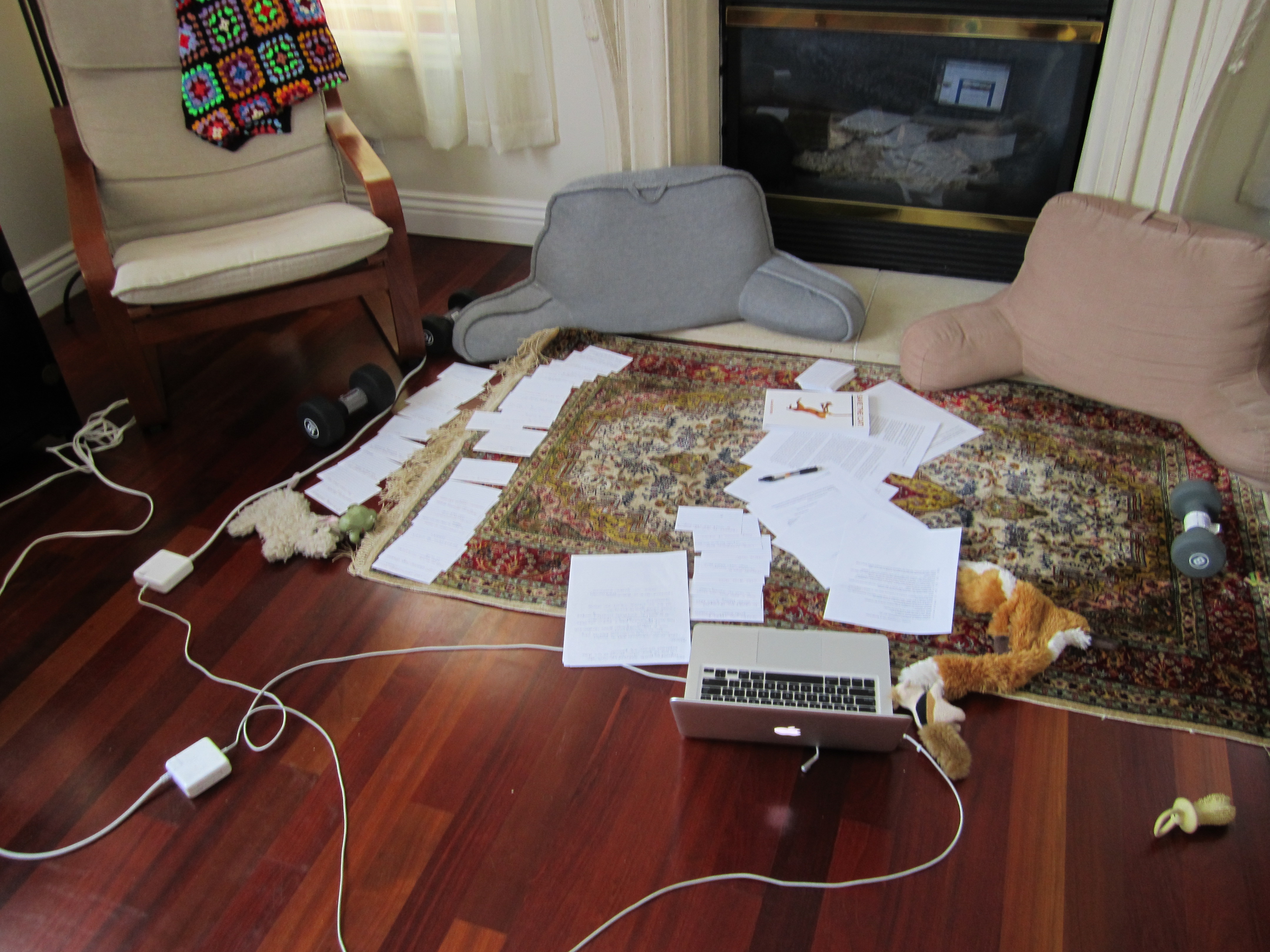
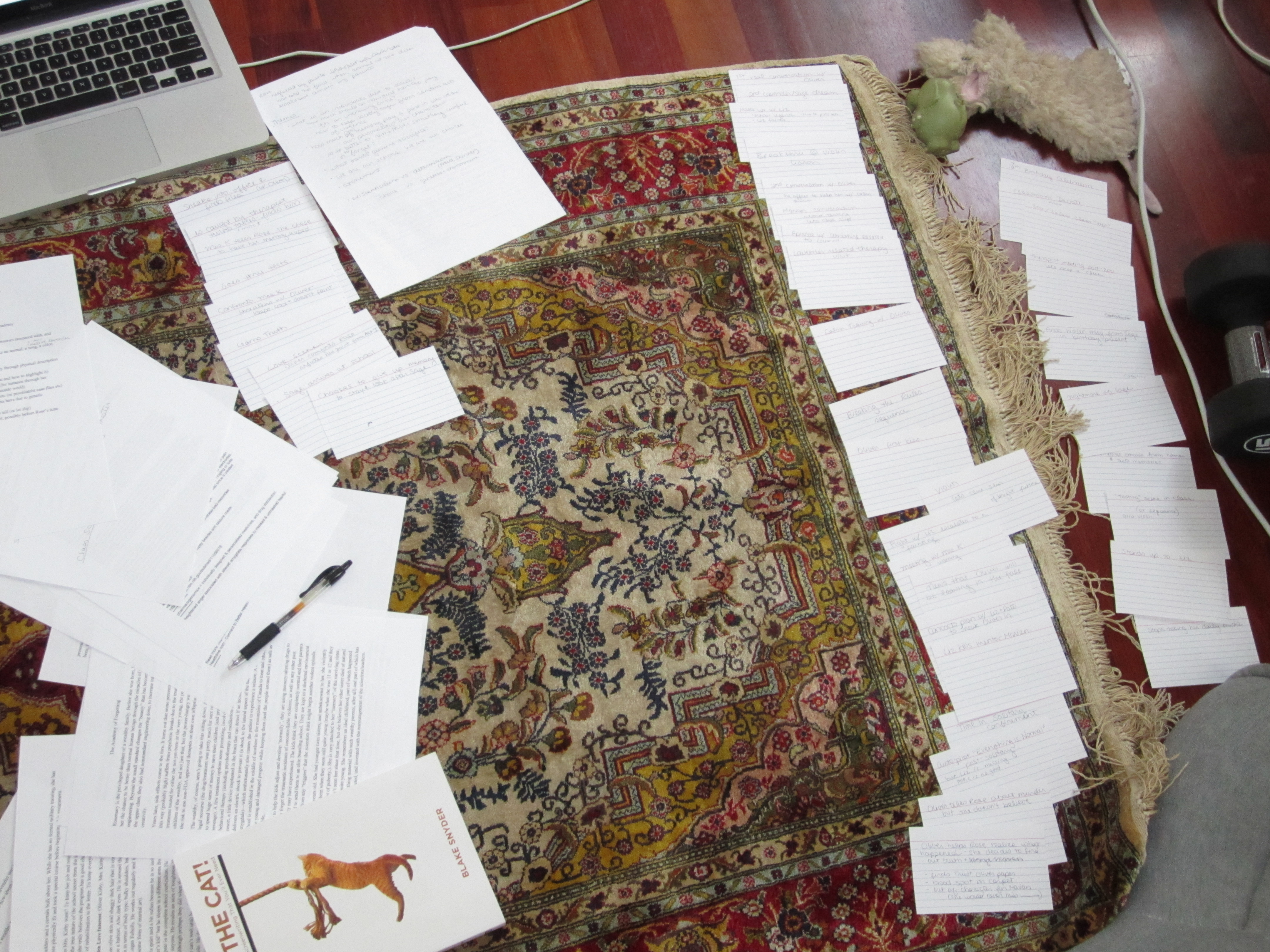
Then I got to break out my beloved index cards and begin to arrange my three acts:

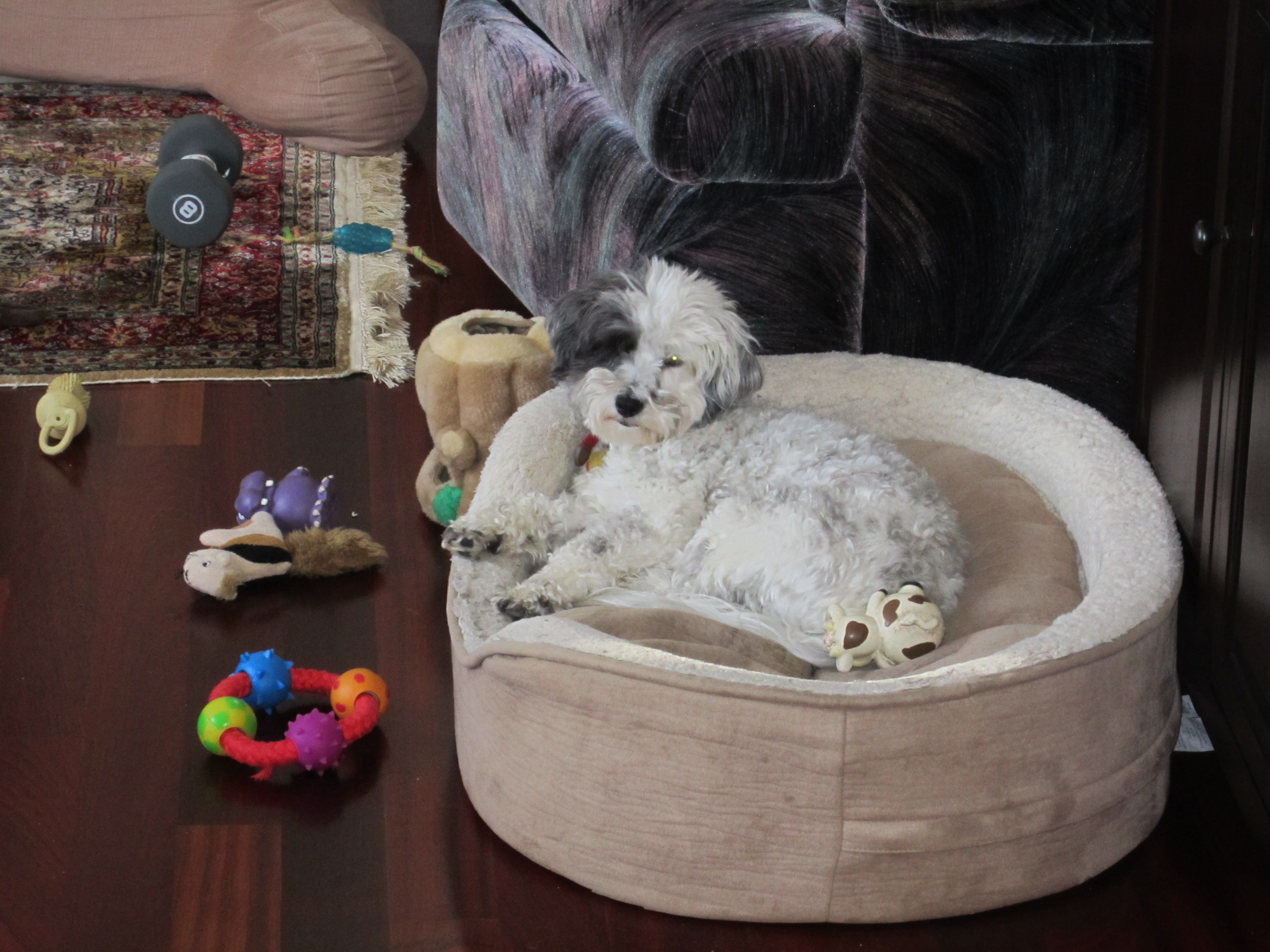
Obviously the proper work environment must include dog toys and weights….

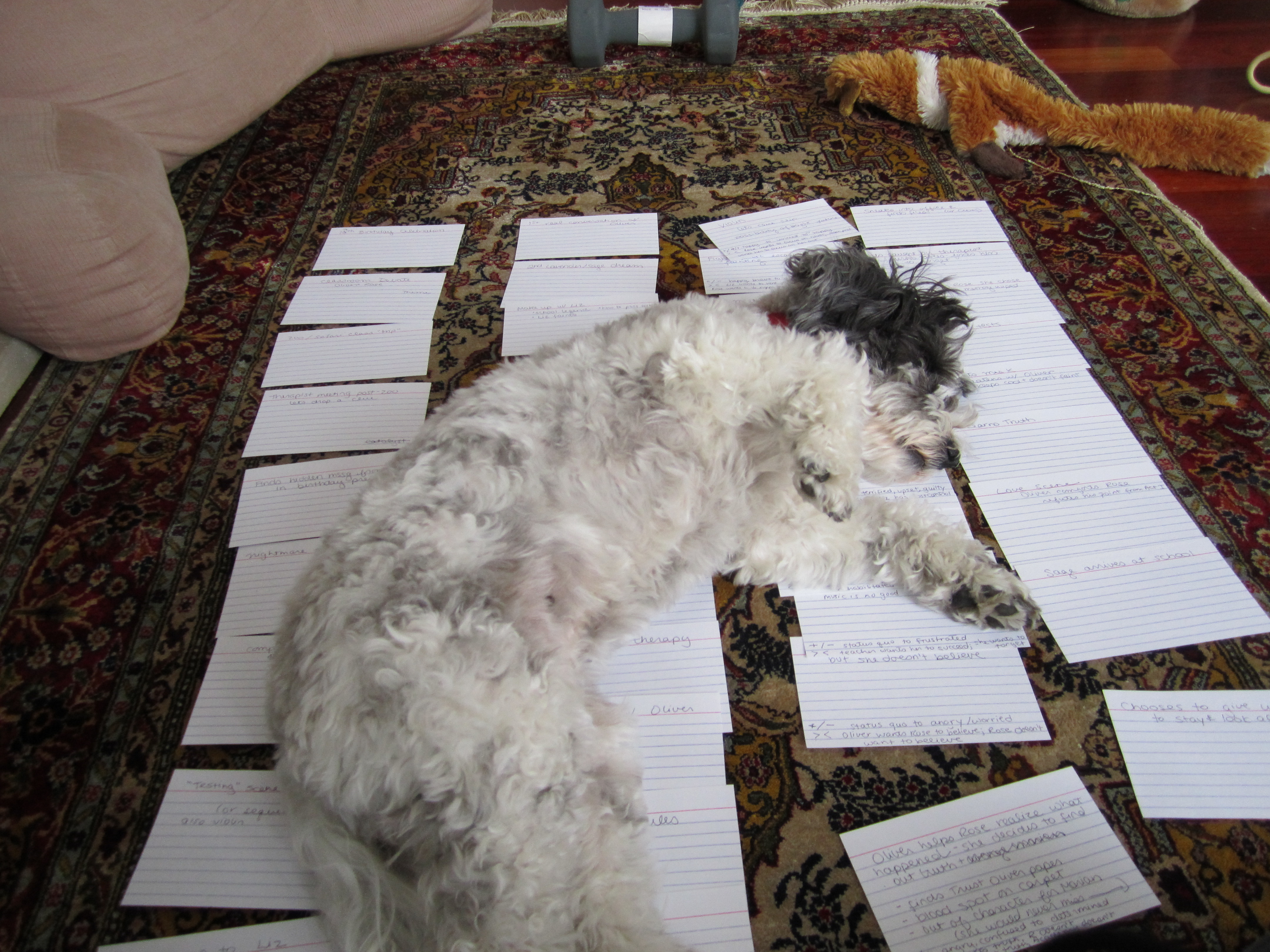
Strangely, I ended up with Act 1 on the far right and Act 3 on the left, which feels backwards, but I decided to go with it.

Luckily, I had the services of a prime story consultant, and her favorite toy cow.

This kept happening once I arranged the acts in their proper order. I’m not sure if she’s so in love with the story that she wants to sprawl all over it, or if she hates it and wants to hide it from view. Maybe she believes in a Zen-like teaching method….

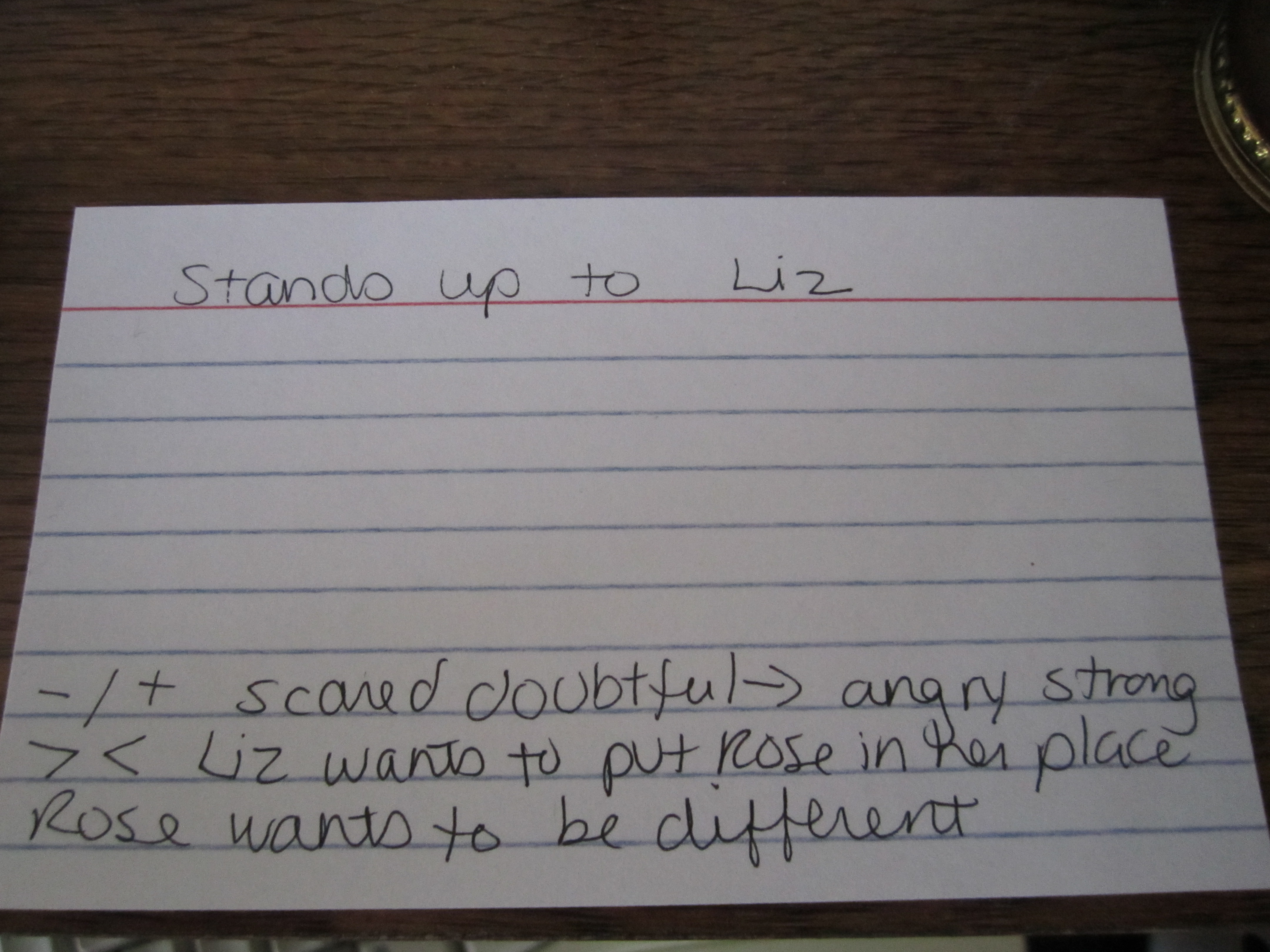
Once I had the novel laid out like this, I began adding two things to each index card: +/- (or -/+) to denote the emotional change for the protagonist in the course of the scene depicted on that index card; and a >< to denote the conflict going on in the scene. So a finished card looks something like this:

I know that conflict description is a bit cryptic (actually, maybe the entire card is cryptic; I chose one that wouldn’t be too spoilerific), but the important thing is that I know what I’m talking about.

Finally, I typed up all of my cards, creating a four-page outline. To this document I added my adapted beat sheet that includes approximate page numbers of when things should maybe happen. And now I have a road map for the book, from which I can feel free to detour wildly if I don’t think it’s working.

What do you think about structure and writing a novel? How extensively do you outline, if at all? What about your process makes you deeply happy, the way index cards make me giddy?

Read Full Post »

Wow.

I have to say, I thought my backbone project idea was pretty nifty, but I had no idea what an outpouring of support I would receive from all of you wonderful people. I’ve already learned a great deal as well, even though I’m not even halfway done. Thank you all, with some extra special thanks to Ferrett for giving me the idea in the first place.

I’ve already visited some of the blog posts that others have written as part of this project, but Kimberly had the great idea of putting together a list of the links so that they’re easy for everyone to find. I thought about putting the list on the sidebar, but I never look at blog sidebars, so instead I’m going to put together a few posts linking to other Backbone Project participants.

Here’s how to get involved! First, go ahead and write a blog post. It can be a post about the project, it can be a non-wishy washy project post like the ones I’m trying to write, or it can be a response to someone else’s project post (preferably disagreeing in some way). Once you’ve published your Project Backbone post (or posts, feel free to do more than one like I am), email the link(s) to me at practicalfreespirt@gmail.com with “Project Backbone” in the subject line. I’ll be publishing a list with your links on the next two Wednesdays, bright and early (meaning, get those links to me by late afternoon Tuesday to be safe). And if you are a twitter person, you can also use the hashtag #backboneproject to label your blog post announcement.

And what is this about another challenge? Why, yes! Apparently it’s in the air. Theodora Goss is organizing a summer YA Novel Challenge, and I’ve decided to join in the fun. (Perhaps some of you will decide to do it as well!) Here are the rules, which are very flexible and meant to be changed:

1. The challenge will run June 1st to August 31st.
2. The goal of the challenge is to write or revise a YA novel, or part of a YA novel.
3. To meet that goal, set smaller goals for yourself: words per day, pages revised per week, etc.
4. If you would like, blog about your progress. Remember that failure is as important as success.
5. Anyone can join or leave the challenge at any time. It’s always OK to start or stop.

I’m going to be starting my next YA novel for this challenge. I don’t expect to finish by the end of August, as I have some travel planned this summer that will interfere with writing, but I’m hoping to get a good start and then some.

And I’m planning to try to blog about it as well. I’m not sure how that will work, to be honest. I hate word count posts, so I’m definitely not going to do that, and I’m not big on sharing excerpts from works-in-progress either. Maybe I’ll share things about my successes and failures. Maybe I’ll go off on a tangent and wax philosophical about related topics. Or maybe I’ll decide blogging about it is just plain boring (or stressful, or both) and stop. I don’t know, but I’m looking forward to finding out.

Until then, have a wonderful Memorial Day weekend!

Read Full Post »

As you can imagine, I’ve been giving a lot of thought to the subject of my first Backbone Project post. I’ve decided to take on a writing-related topic (I’ll try to pick a more general interest topic next week for the non-writing inclined), and I chose this one specifically because I expect many writers to disagree with my take on it. So, onwards into the fray! (And yes, my stomach is doing lopsided cartwheels, thanks for asking.)

When I first ventured into my various writing communities, I was regaled by the sanctity of the critique. How to become a better writer? The answer seemed to be to get critiqued. A lot. Really, as much as possible. Any writer who was truly serious about their craft would join a critique group. Or two, or even three or more. Not to mention purchasing critiques from the pros at conferences and for charity, attending workshops that consisted at least partially of critiques, etc. And then post-critique, the writer was expected to exhaustively compile all that criticism and somehow use it to patch together the remaining shreds of story (occasionally there might be more than shreds remaining, a cause for joyous celebration).

I am not being conciliatory when I say that I have learned a lot as a writer from the critiques I have received. It is plain fact. And I am very grateful to everyone who has taken the time to help me learn. But another important fact that I never seem to read about anywhere in the cult of the critique is this: All critiques are NOT created equal. Not by a long shot. And what we as writers are told to do with critiques is not always what works. I have learned this from painful, critiqued-out-of-my-mind experience. In fact, I have gone months without much productivity because of the backlash from a bad critique. I don’t think this makes me a weenie. I think it makes me human; it’s natural to get discouraged from nonconstructive critiques, especially when you are a relative beginner. I mean, do I tell my beginning voice students in detail exactly how they suck at singing, complete with subtle (or not-so-subtle) disparagement, and then have their peers tell them the same thing? Um, no. That would be insane. And yet…

Here is what I have learned about critiques:

FICTION: You can expect a fair, unbiased critique.
REALITY: Some people will always hate what you do (even if you are awesome) because they just don’t dig your style. Some people will get set off by a random, unpredictable aspect of your story and be completely unable to get over it enough to say anything helpful. Some people will read your story in a sloppy manner and give you a half-assed critique. Some people just don’t know how to critique, period.

FICTION: If you’re upset after a critique, you just need to toughen up and take it. After all, you need a thick skin to succeed as a writer.
REALITY: Some critiques are harsh in a constructive way. Some critiques are harsh in a non-constructive way. Some critiques are just plain mean-spirited. Learn to deal with the first of these. The other two? Consider not getting critiqued by these people again or…

FICTION: Take all critiques into thoughtful consideration.
REALITY: Some critiques you can pretty much ignore. That’s not to say you shouldn’t listen while they’re being given, but after a while you can tell which critiques are completely irrelevant to any learning or revising you might be doing.

FICTION: You need critiques to become better as a writer.
REALITY: There are many ways to become better as a writer. The critique is merely one helpful tool among many. After all, there were still great writers before the current fad for critique.

FICTION: You should implement all suggestions given in a good critique.
REALITY: You should listen to the issues a good critiquer is having, and figure out what you, the writer, want to do about it. Often critiquers try to completely retell your story for you (although I wouldn’t personally call this a good critique). In that case, you need to work backwards to figure out what actually wasn’t working for them, and then change it in your own way. And only if you want to.

FICTION: A critique should always be followed by a revision.
REALITY: As long as you’ve learned something from a critique, it doesn’t matter what you do afterwards. Sometimes you need to revise to complete the learning. Sometimes you want to revise. Sometimes you want to chuck the story into the fire and never think of it again. Sometimes you nod, say hmm, and make a few small changes before submitting. Sometimes, if you’re Dean Wesley Smith, you submit the story before the critique so you’re not tempted to revise the life out of your story. (And oh yes, it is so possible to revise your story to death.)

FICTION: If a person is a “pro” or just has a few more credits than you, their word is God in the critique department.
REALITY: I wish. Some pros are amazing teachers and critiquers. Others, not so much. Some people with more credits than you will have amazingly helpful things to tell you about your work. Others will not. Some readers who know nothing about writing will have insights that are equally useful. And some will not. You get the picture.

FICTION: You should be involved in as much critiquing as possible.
REALITY: If you get too involved in critiquing, it might interfere with finding time to do the actual writing. And most of us ultimately want to be WRITERS, not critiquers. Right? Otherwise why would we be putting ourselves through all this?

FICTION: If you can’t handle a critique, you shouldn’t be a writer.
REALITY: If you can’t handle rejection and revision requests from professional editors and agents (who you are doing business with), then you’re going to have some trouble. If you can’t handle the occasional critique (or even the more than occasional critique), maybe something else is going on.

FICTION: Critique trumps all!
REALITY: It’s more important to manage your writing life in whatever way works for you. And if your way is not exactly the same as everyone else’s way, that’s okay. We’re artists, after all. We’re supposed to be different.

Okay, have at it! Disagree with me (or tell me how you’ve been secretly thinking the same thing). I’m going in for more dental torture this morning (if we ever meet in person and you want to see me cry, mention dentistry), but I’ll be commenting with gusto (and pain-induced bravado) later today.

Read Full Post »

I have some news that I’m so excited about that I’m moving my regular Tuesday post to Monday so I can tell you sooner.First off, this is my one hundredth post on The Practical Free Spirit. Believe me, I am basking in my feeling of accomplishment.But not as much as I am basking in the feeling of being published! My short story “Luck Be a Lady” has gone live at Crossed Genres. Yes, you could read it right this very minute. And it’s free. I know, the excitement never ceases.

For those of you keeping track, yes, this story is actually my second sale, but due to the vagaries of publishing, it is my first story to be publicly available.

As those of you familiar with musical theater have already recognized, I got my title from the song “Luck Be a Lady” in the musical Guys and Dolls. And that’s where my idea for the story started too.

The theme this month in Crossed Genres is luck, and after immediately flashing on the song, I began to think about the popularity of personifying Luck. In western culture, the prevailing image is of a sexy woman, often with a long cigarette holder, a fur shrug, and/or wearing a tight and revealing red dress.

This reminded me of some Piers Anthony books I read in high school. I realize that perhaps I’m not supposed to admit to reading Anthony in a public forum, but his books took up at least a shelf at my local library, and the fourteen-year-old me really enjoyed his Incarnations of Immortality series. (I can’t have been the only one to read these books, right? Right?) The basic idea of the series was that all of these abstract concepts were personified by these beings (at least some of whom began as human) who had specific super powers. So you had the character of Death, and the characters of the three Fates, and an Earth Mother character, and I think maybe there was the character of War. You get the idea. So I combined the idea of the song with the idea of this series and created my seed idea of my protagonist, Lady Luck. And anyone with those sorts of powers, I figured, would be guaranteed to receive a certain number of complaints….

One of the other characters in the story is the personification of Diligence. She’s become the adoptive mother of Lady Luck. Why Diligence? I stumbled upon a quotation credited to Benjamin Franklin: “Diligence is the mother of good luck.” And I had to use it. Especially because the contrast of personalities between someone representing luck and someone representing diligence was sure to create some interesting interactions in the course of the story.

Anyway, I hope you have time to check it out, and I hope it entertains you as much as it did me while I was writing it.

Read Full Post »

In the book about plot I’m reading (20 Master Plots, by Ronald Tobias), Mr. Tobias talks about how plot and structure in fiction differ from real life. In real life, he says, there are not the same links of causation. Life is chaotic and sometimes (even often), things occur because of chance and wild coincidence (whereas in fiction, it’s really hard to get away with coincidence and generally denotes sloppy plotting). Some loose ends never get wrapped up in real life, we never know the true “ending”, and much of what happens seems to be without meaning and never gets explained. The Absurdists try to reflect this random reality in their literature: Camus and Kafka are two well-known writers who do this well. (And incidentally, you know who else identifies as an Absurdist? Joss Whedon. An explanation for Puppet Angel, perhaps.)

From the TV show Angel

Theodora Goss, who has a beautiful blog, has a slightly different view: “Happiness is the ability to create satisfying stories about reality. To find the stories that fulfill you, that allow you to achieve what you desire. That fill you with joy. Because reality is, to a certain extent, our perception of it. Achieving what you desire may also involve altering reality itself, changing your circumstance.”

I’m inclined to agree with her. The power of storytelling is making order from chaos and meaning from seemingly unrelated events. But stories don’t merely reside in our books and entertainments. We are constantly telling ourselves our own stories, and in so doing, we are cementing certain events into memory and into part of who we are. By doing this, we construct a reality that no longer appears quite so random and out of control.

We are in the continuous process of creating ourselves. “I’m the person who did xyz. I’m the person to whom this happened. I’m the person who spends my time in this way. This is what is important to me.” That’s why I’m always harping about the importance of priorities. Because priorities are a way of expressing deep truths about ourselves and making our most important desires into reality.

Humans as a species are fascinated by the quest for meaning. This desire for meaning is reflected in many aspects of our culture: in our art, our religions, the Enlightenment and our fervor for science, and our ease of slipping into diametric thinking (black and white, good and evil). We spend our lives trying to make sense of our childhoods, the people around us, and the huge life-altering events that intrude into our sense of order (war, natural disaster, illness and death, wide-scale oppression and resistance). We ask, why are things the way they are? How does the universe work? In what direction is human civilization heading? Or, more personally, why doesn’t So-and-so like me? What is my purpose in life? What will make me happy?

We have to be very careful with the stories we tell ourselves, the movies in our minds. (You can thank Miss Saigon for that pretty turn of phrase.) If we tell ourselves negative stories or harshly self-critical stories, these stories will eventually manifest themselves, often in self-limiting behaviors and self-fulfilling prophecies of gloom and unhappiness. If, on the other hand, we tell ourselves that we’re geniuses who can do no wrong, we can become out of touch with the humanity around us and struggle to find compassion for others.

On their own, our lives do not fit together neatly into a perfect puzzle of reality. We create the frame of reference from which we can understand ourselves and the world around us. We make our own explanations and our own meaning. What this means, I believe, is that ultimately we choose the slant of our lives until we die. Are we empowered? Can we make change? Or are we victims or characters in a tragedy, or are we taking an active role in life? Can we find the good in our situation and encourage it to grow? Or is everything about life difficult and glaring and out to get us?

In the movie Holiday, the old screenwriter Arthur tells his friend Iris that she should be “the leading lady” of her own life, but for some reason she is behaving “like the best friend.” We each have that choice in the stories we tell ourselves. Are we the hero of our tale, or are we relegating ourselves to a supporting role?

Be the hero. Be the protagonist. Be the person who acts instead of the person who is acted upon. We are all leading ladies and men. And we each get the privilege of creating the stories of our lives.

Read Full Post »

Today I have a guest post, Why Kindness Matters, at my friend and colleague Marilag’s blog. (Yes, I was very busy last week writing all these posts.) I really enjoyed writing this post because Marilag requested that I speak about kindness, which gave me the chance to really think about it and appreciate all the kindness in my life. Thank you, Marilag!

I’m also pleased to announce that I sold another short story. “Luck Be a Lady” will be published by Crossed Genres in their Luck issue, which I believe will come out sometime in May. So if you’ve been curious to read some of my fiction, you don’t have much longer to wait!

Read Full Post »

I have a guest post over at Cole Drewes’s blog today. It is entitled Writer’s Block: Amusing Myth or Grim Reality. Go ahead and check it out, and let me know if you believe in writer’s block or not.

Also, here is a picture of a cute little dog. Just because.

Read Full Post »

When I read about self publishing, I notice that it’s often being lumped together (ie all self publishing is the same). But of course, the truth of the situation is much more complicated. I decided to make a list (I love lists!) of some less obvious, more creative ways that a writer can use self publishing to further a career.
  1. Out-of-print back list: okay, this isn’t particularly creative, but it’s the most obvious no-drawbacks use of self publishing today.
  2. Short story anthology, using (mostly) previously published works: I think this would be especially good to do if you have a novel coming out soon (or that has recently come out). Numbers show that short stories and their anthologies don’t sell as well as novels, but fans of a novel already out might very well be interested. Of course, even without a novel out, this could still be useful. (A few writers I love are talking about doing this, and I can’t wait to have all their stories in the same place.)
  3. Short stories (previously published or NOT) that tie into the world of a novel you have out (or that is about to come out): Novelettes and novellas that tie in would also fall into this category. Of course, it may be better to offer some of this content for free on your website to draw readers in. The question is, are you using the stories to draw readers in, or to profit from your already-established reader base? Doing both is probably the best of all.
  4. Continuing a series that has been cancelled by its publisher: This is a win for a writer who wants to finish their larger-scope project and the readers who want to find out what happens. One thing to consider, however, is how available the first book(s) of the series are. Are they still in print? Is the publisher offering them as e-books? At a non-prohibitive price?
  5. Writing for a niche or non-obvious market: Some books cannot be sold to big publishing because they simply don’t have a big enough proven audience. This has more to do with business than with quality (although obviously it’s possible that it’s about both). My favorite example is novels set in college. These are often a hard sell because current YA is not set in college, period (with a few exceptions). Sometimes these college books can be sold as mainstream lit or chick lit, but often not. It’s hard to know where to shelve them in a bookstore, and it’s hard to find them. Yet there is obviously an audience for books set in college (I know this because I love them myself and am always on the lookout for more. Diana Peterfreund’s Secret Society books, anyone?) There are other examples of niches like this in fiction, and even more in nonfiction.
  6. Having novels come out both from big houses AND self-publishing: This is an interesting strategy for faster writers, which potentially allows the writer to profit from the upsides of both traditional and self-pub at the same time. It also solves the problem of prolific writers. Honestly, when I read this article, I cringed, because it feels like writers who happen to be fast and have a good work ethic are being penalized. (Note: not all writers, or even first timers, have the long wait discussed in this article.) Of course, this is only an option if the writer doesn’t have a non-compete clause with the big house or is willing to use a pen name (if it’s a secret pen name, several of the advantages of this set-up will be wasted; an “open secret” pen name may or may not go against contract. I have no idea what most contracts specify in this regard).

Have any other creative ideas about how to use self publishing? Thoughts about the pros and cons of the ones I’ve listed above? Let me know!

Read Full Post »

“Anyone can write popular fiction… You just tell a story that everyone likes.”

Does this quote make anyone else’s blood boil? This type of talk makes me want to be alternately scathing, snarky, and pitying. I got it from an essay by Kat Howard, about her chance parking lot encounter with some fellow who made light of her post doc position in medieval and speculative literature.

I know I’m preaching to the choir here, and that most (if not all) of my readers understand how truly challenging and difficult it is to write a novel, whether it be mainstream or genre, adult or children’s, an epic tome or a light-hearted romp. And I don’t want to get into the genre/literary question, so let’s please not go there.

Instead, I’m going to break down this statement. Anyone can write popular fiction, can they? Let’s take a look.

Writing Fiction — Lifestyle — What It Takes

1. Hours upon hours of sitting by yourself doing the writing. Not to mention the research. Not to mention the revisions. Not to mention the nit-picky copy editing.
2. Avoiding the lure of Facebook, Twitter, Wikipedia, Farmville, MMORPGs, Solitaire, Minesweeper, etc. so you can actually do said writing.
3. Carving the time out of your already busy life, in which you’re also expected to have a day job, take care of your family, clean and do chores, and deal with life’s multiple disasters and time sinks.
4. Smiling and nodding when people say patronizing things to you. Explaining kindly and gently that building a writing career takes a long time, and no, it won’t make you rich. Alternately, getting into a lot of arguments.
5. Thinking about your story in the shower, while walking the dog, while doing the above-mentioned cooking and cleaning, while driving from point A to point B, and while you should be sleeping.
6. In your copious spare time (ha!), reading tons and tons of books, both in and out of your genre. Not to mention your nonfiction research materials.
7. Dealing on a daily basis with rejection and maintaining a positive upbeat attitude, a can-do spirit, and continued forward thinking to the next project.
8. Reading unpublished work from other writers of roughly your same level (at least in theory), learning how to both give and receive critiques

Writing Fiction — Craft — Required Understanding

1. Characters. This includes understanding every character in your book, knowing their back story, knowing their mannerisms and how they speak (word choice, etc.), knowing what they would know, knowing their motivations (what they want) and making sure you’re consistent about it. You need to keep your POV consistent over the course of the book, whatever you decide (first, close third, omniscient, etc.) Your protagonist needs to be sympathetic in some way. He/she/it needs to be a driving force in the novel, not a passive character who is only acted upon. Also your protagonist and probably other characters as well need a moving and well executed character arc, in which they grow and change and react to events and are different by the end of the novel.
2. Plot. This includes knowing how to structure a novel, making sure there is interesting conflict, making sure the stakes are periodically raised and the conflict builds over the course of the novel, knowing what your main narrative engine is, as well as keeping track of subplots and planning the correct number of them. Also the plot needs to hold together and make sense (no plot holes, please), you need to know the purpose of and conflict in each scene. You’ve got to keep the pace up (make stuff explode or whatever) or it will get too boring. This would also include making sure the continuity is sound and that the scenes happen in the correct order. You must make sure you create a hook at the beginning to draw the reader into the novel, and you aim for achieving emotional resonance and a certain closure at the end of the novel (unless it’s in a series, in which case you’re busy thinking about the overall series arc as well as the novel arc as well as deciding whether the novel needs to stand on its own or not).
3. World building. This is understanding how your world works. This includes the magic system, which needs to have rules and costs; geography, especially of a secondary world or another planet; economy; political system; social structure and mores; religion; technology level as well as any invented tech; magical creatures and/or aliens and how they differ from humans; and various existing infrastructure. Then once you’ve created your world, you have to get it across in the novel without over-utilizing info dumps or slowing down the pace.
4. Prose. This is being able to use the English language passably well, which is surprisingly difficult, even for native speakers. This includes knowing as many grammar rules as you can cram into your brain and then knowing when to break them. Points to remember include the following: eschew adverbs and speech tags other than “said” and “asked” and minimize speech tags in general. Vary sentence structure. Try really, really hard not to overwrite or use too many adjectives for your really shiny setting. Remember that you do have to say something about the setting, though. Try not to overuse words such as “that” or “really” or the “to be” verb. Use active verbs, but not too many weird verbs or it’s distracting. Spelling skills also help as spellcheck won’t catch all your mistakes.

Writing Popular Fiction that Everyone Likes — Good luck.

1. In order to make your fiction popular, you have to sell it. Unfortunately, being able to sell something is not necessarily the same skill set as being able to create something.
2. Ability to write and deliver pitches, queries, synopses, and basic summaries of your book that will make random people on the street want to read it instead of getting on with their lives. Also organizational ability to keep track of it all, including short story submissions, workshop/conference deadlines, and market research.
3. Social media and promotion! Blogging, tweeting, Facebooking, keeping up-to-date on the latest trends, recording a podcast. Being interviewed for blogs, radio programs, and podcasts. Writing guest posts, being active on forums, making a book trailer, always presenting your best possible face to the public. School visits, public readings, convention and conference appearances.
4. Being lucky enough to write in line with the current zeitgeist and have your novel come out before it ends.
5. Having your publisher decide that your novel is SO AWESOME that they’re going to pour big marketing dollars into its production and promotion. Getting good bookstore placement. Getting into many bookstores at all. Having your cover not suck. Getting big names to blurb the novel. (Please note that many of these things are outside the writer’s control.)

What did I miss? Feel free to kvetch below. Even being incomplete, I think my list makes it clear that writing a novel is never easy, and writing a really good novel is even harder than that. I rest my case.

Read Full Post »

« Newer Posts - Older Posts »