Feeds:
Posts
Comments

Archive for the ‘Personal Development’ Category

At this time of year, I always feel like I’m straddling the flow of time. Half of myself is looking backwards and evaluating what has gone on before, while the other half is looking forward to what the next year may hold for me. I don’t make New Year’s resolutions per say because I prefer a continuous evaluation process, but thinking in terms of units of time can be helpful when trying to look at the bigger picture of my life.

So, without further ado, here are a few reflections on 2011 and few wishes for the year to come.
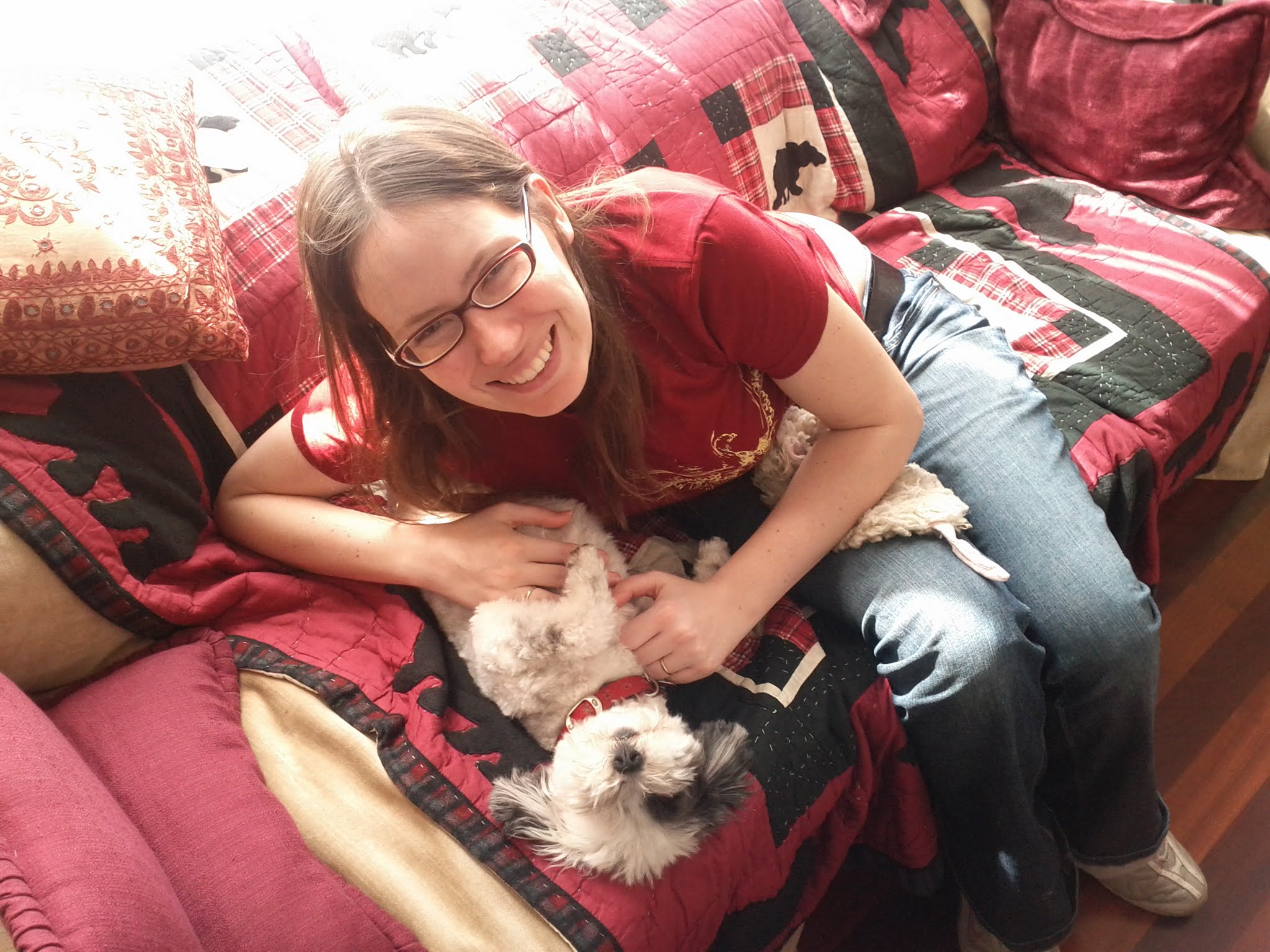
Cute little Nala and me

Writing:

2011 was an exciting year because it was the first year I had something published, thus realizing a dream I have cherished since I was seven years old. Hooray! In fact, I had three short stories published this year, one of them to a pro market. I was also able to join SFWA as an associate member.

My wish for 2012 is that I am able to use the lessons I learned this year to increase both my productivity and my enjoyment in writing. (Being greedy, I also wish for more sales.)

Health:

The first half of 2011 was dominated by crazy dental problems. While that silly crown still often aches, the level of pain has subsided to the realms of the tolerable. I also had more ankle problems. But on the plus side, my knees continued to improve in a most pleasing fashion. I also began to eat more healthily, trying to limit my consumption of saturated fats in particular, and have done fairly well with it (although not when traveling. Eating healthily when traveling is ridiculously hard).

My wish for 2012 is to keep growing stronger so I have less overall aches and pains, and to continue following my moderate diet.

Travel:

2011 was the first year in a long time that I didn’t leave the country. Various health concerns dampened my travel ambition somewhat, and I mostly stayed close to home. My favorite trip of the year was my first time in Washington D.C. in March. I would definitely return there for a follow-up visit someday. We also attended the Shakespeare Festival in Ashland, Oregon, visited Disneyland with friends, and relaxed over Thanksgiving at our favorite Maui vacation spot.

I was able to attend five writing conferences and conventions, two local and three an easy traveling distance: Potlatch, FogCon, SCBWI LA, WorldCon, and World Fantasy. I particularly enjoyed attending the inaugural FogCon and moderating my first two panels, and catching up with my wonderful writer friends (and making new ones) at the larger conventions was fabulous as usual.

My wish for 2012 is to leave the United States. We’re thinking either Japan or certain favorite Western European locations…

Personal Growth:

I wrote about the two most important lessons I’ve learned this year last week. I feel like I’ve made a fair amount of progress on the people pleaser front and have developed a stronger backbone. I’m more likely to stand up for myself and less likely to take responsibility for everyone else. So, yay!

My wish for 2012 is to continue tackling my vicious perfectionist streak and to do further work towards trusting myself and my abilities. I’d also like to be able to reach out more to other people.

Happy upcoming New Year, dear readers! What are your wishes for 2012?


Read Full Post »

Some of my astute readers might have noticed that I initiated a massive life re-haul and personality shift this year. I have written a fair amount about being a people pleaser, developing a backbone, and being a perfectionist because these were things that were on my mind. I decided, somewhere in the haze of extreme tooth pain, that I needed to change, and I set about doing just that.

I’m still in the middle of it. It has already been completely worth it.

It is one of the hardest things I’ve done.

Here is what I have learned: You have to respect yourself. You have to believe that you are worth it. And you have to do whatever it takes to convince yourself you are worth it, even if it means muttering silly mantras to yourself and being glad you work at home so no one suspects you are crazy.

I have spent my entire life believing that if only I was good enough (oh, hey perfectionism), people would love me, respect me, and treat me well. I really wish this were the case, but I was flat-out wrong. The truth is, if you are willing to let something happen, the odds are that it will happen. If you are willing to tolerate being lied to, then people will lie to you. If you are willing to let people ignore you, then they will. If you don’t take a stand against bad behavior towards yourself, then that bad behavior will continue. The world doesn’t give you a voice, you have to demand it.

And in order to demand the respect you deserve, you have to give it to yourself first. You have to believe you are worth it.

Photo by Anita Hart

This self-respect is not the same as thinking you are perfect and infallible and can’t possibly make a mistake. Therein lies another problem (oh, hey narcissism). And it doesn’t preclude feeling compassion for people, even (and especially) the ones who are in the middle of making your life difficult.

What self-respect does give you is the ability to empower yourself. It gives you the choice of surrounding yourself with people who will lift you up instead of pulling you down. It gives you the chance to speak up. It gives you permission to refuse to take on every single problem as your own, when so many of them aren’t really yours at all. It gives you the strength to confront the parts of yourself that you don’t like. It gives you the space to say “No.”

No, I am not your bitch. But thanks for asking.

Remember that you are worth it. That is what I have learned this year.

Read Full Post »

1. It is not as common as it once was to spend your entire career working at one company, or even in one career. Therefore most of my parents’ career advice was completely useless.

2. Bodies are complicated, and often doctors don’t know what’s wrong. So sometimes you have to get creative and proactive in seeking out information, alternatives, and talented people who can help you.

3. A large number of acquaintances is not necessarily going to be as satisfying as a small number of people to whom you can reveal your true self.

4. If your significant other is not meeting one of your core needs and shows no inclination of doing so in the future, it is okay (even necessary) to break up with them.

5. So much of life boils down to communication. Unfortunately, many people are incredibly bad at it.

6. Thinking you might not be good enough is not a good enough reason to decide not to do something.

7. The people who are judgmental about your life choices are generally not the people you want to spend time with, anyway. And it’s impossible to make every person in the entire world like you.

8. Be on the lookout for those who are taking away your agency. The easiest way to have your choices taken away from you is if you never even realize you had a choice in the first place.

9. Fake it until you make it is a cheesy-sounding piece of advice that is actually true. Corollary: Your major is not as important as you think. (Except when it is.)

10. Be fanatical about taking care of your teeth, flossing, and visiting the dentist regularly. And use a mouth guard if there’s even a chance you’re grinding your teeth at night…the unsexiness of such a device be damned!

What do you know now that you wish you’d learned earlier?

Read Full Post »

What subjects do you avoid? What don’t you like to admit? What topics do you not talk about because they feel somehow inappropriate?

Theodora Goss’s recent blog post Telling the Truthis an excellent and thought-provoking essay well worth a read: “And this got me thinking about all the things we don’t talk about,” she says. “There are so many of them!”I think a lot about all the things we don’t talk about. In fact, that was one of the reasons I wanted to start a blog, because I wanted to have a platform from which to speak about some of these things. But of course, I still carefully write around so many of these things of which we never speak.

I recently spoke to a friend of mine who revealed that he used to have crushes on girls starting in third grade. He had never told anyone else about this because he was embarrassed because he thought it was out of the ordinary. Can you imagine? I had crushes in elementary school, and some people in my classes even had “boyfriends” and “girlfriends” (although of course it meant something slightly different back then). But you know what? I never talked about my crushes. And apparently no one else talked about them to my friend either, so he’s spent all this time secretly thinking that he’s different, that something was wrong with him, because he failed to pick up the social cues that would have informed him that crushes aren’t so unusual after all.

I wonder how many things we are all secretly embarrassed about or ashamed of that are, in reality, very common. Only we never find this out because we’re all busy feeling like outsiders together.

I think many of us are ashamed of failure, like Dora says in her essay. I know I am, and being a perfectionist doesn’t help out with this. And yet, failure is essential for those of us with ambitious dreams. Most people don’t succeed with huge dreams right away. I listened to an interview with Seth Godin the other day in which he bemoaned how afraid so many people are of failure. This fear holds us back. It makes us unwilling to take the risks we need to take to learn, to grow, and to achieve something truly great. And yet, even though I understand the need for failure intellectually, it doesn’t take away the fear.

But on the other hand, the more I fail, the more I know that I am living an interesting and daring life. Failure is taking your life and seeing what you can wring from it instead of coasting along and choosing the safest route. Failure is pursuing lofty goals and pushing back against the fear. Failure is exposing yourself to the world and teaching yourself to believe in the you of possibilities instead of the you of limitations. Failure is the strength to believe in yourself so much that you can rise above your worries (or the reality) of what other people think about you.

Failure is saying, “This is my life, and I’m going to make every inch of it mine.”
Maybe if we can reclaim failure, it won’t be so scary after all. Or at least maybe it can become a badge of courage instead of one of shame.

Read Full Post »

When I was entering the job market in my early twenties, I tried to be proactive and prepare for the inevitable interview process. The hypothetical question that all the articles told me I had to be ready for that freaked me out the most was the perennial: What is your greatest weakness? I still hate this question. I mean, there you are, trying your best to sell yourself in a high pressure situation and then you’re forced to talk about your less than ideal points? Plus, according to said interview advice, what you were really supposed to do was choose a “weakness” that you could spin as a positive, meaning that the entire exchange was just an elaborate test of whether or not you could bullshit effectively. Ugh. Anyhow, I chose perfectionism as my flaw, which was one of the examples used on the internet as a good choice. Because perfectionism (I thought) shows that you are actually very diligent, hardworking, detail oriented, and competent.

I never got asked that question in an interview.

Which is just as well, because after having spent years and years of my life as a recovering perfectionist, I can say with authority that the negatives far outweigh any positives. And if I had answered the way I’d planned to anyone with insight into human character, it might very well have cost me the job.

Nothing and no one living is always perfect. (Photo by jfh686 on flickr)

Not convinced? Let me draw your attention to some perfectionism highlights:

1. Freeze/block: Yes, perfectionism can cause things like writer’s block. I know because to this day it gives me trouble while I’m writing. Once a perfectionist realizes there is no way to get a given job done perfectly, it becomes oh so very difficult to do that job at all. At least, if we actually care about the job at all. The less we care, the easier it is to avoid the freeze.

2. Inefficiency: Unless the perfectionist’s target IS efficiency, of course. Because it’s so hard for us to leave something alone and actually call it done. If we just made another little tweak…or a hundred. If we only had time to start over. You’d better hope your perfectionist is feeling perfectionistic about deadlines, or it’s all over. (Happily, I am in fact a perfectionist about deadlines, so at least I get to finish, whether I like it or not.)

3. Stress: If you aren’t a perfectionist yourself, just imagine a world in which everything you are even tangentially involved with has to be perfect and go exactly as planned. And if it’s not perfect, you have failed and it is All. Your Fault. And if it doesn’t go as planned, then life is ruined. And if only you could be a little better, maybe all the problems in the universe would disappear. Doesn’t that sound like fun? Yeah, I’ll get right on that.

4. Obliviousness, otherwise known as self denigration: Because perfectionists hold ourselves to such impossible standards, we often fail to notice, or give ourselves appropriate credit for, the awesome things we may accomplish. We may not notice positive character traits, and if we do, we think they’re no big deal. If we achieve something big, we focus on what we didn’t achieve yet, something we failed at, or explain why it isn’t important: Well, but I’ve only made one pro sale. Well, but I’ve only sold one novel. Well, but I was only able to succeed at x because I failed so spectacularly at y. Well, but I’m not that intelligent because I don’t have a PhD/don’t have a deep understanding of quantum mechanics/don’t speak six different languages fluently.

So yes, all is not fun bright times in perfectionism world. While perfectionism does often create driven personalities who go on to achieve great things, I think there are ways of being driven and ambitious without being quite so hard on ourselves. One of my favorite parts of The West Wing was when President Bartlett had dealt with a problem, often less than perfectly, often when there were no good solutions or easy answers. He’d always turn right around and say, “What next?” What next allows us to focus on what we can do instead of dwelling on our inability to be perfect.

Any other perfectionists out there? Any strategies you use to help you work through it? Any aspects you find especially difficult? I’d love to hear from you.

Read Full Post »

This week I have a Neil Patrick Harris quote stuck in my head:
“I feel like it’s important to have three lives. Your professional life, your personal life, and your private life.”
He goes on to talk about how these lives relate to the entertainment industry in particular, but while I think the distinction may be more relevant for public figures (including many artists), I was struck by how the same could be said of all of us.

The professional life: This is our most public face, the life in which we are focused on our career and the image we want to project to the general population. We live this life when we’re at the office, at professional events (although these sometimes blur into the personal and private), and doing public tasks associated with our roles. For instance, a mom attending a PTA meeting, a writer sending a query, and a businessperson attending a party for the primary purpose of networking could be said to be living their professional lives.

The personal life: This is still often a public part of our lives, but it is focused on a life outside of jobs, careers, and professional-related goals. This life includes such things as friendships, relationships, family, and hobbies, although only to a certain depth. It might also involve your religion (particularly if you attend church, thereby making your practice more public) and certain groups or communities you may belong to (while others of these will be private). Information (non-work-related) that you feel comfortable divulging in casual conversation with an acquaintance probably lands in this sphere. What you post on Facebook or Google+ often also falls into this category, unless you’ve made the decision to use these tools for strictly professional purposes.

The personal life can be an important component of professional relationships. We are often expected to have hobbies and interests so we appear well-rounded, for instance; there is also the stereotypical example from the ‘50s of the ambitious young man who is expected to get married (and perhaps even start a family) in order to receive the coveted promotion. The personal life plays a key role in the new trend of authenticity–allowing your audience inside your life so they gain the impression of really knowing you.

The private life: Most people do not want this life to be public. It includes the deeper aspects of relationships and friendships, facets of ourselves that we think we will be judged for, and certain stories from our pasts. If there is some part of your life that you do not generally speak of, or only to a carefully chosen few, that falls into your private life.

Everyone has different comfort levels and therefore different boundaries that constitute the private life, but we have certain societal norms for what we tend to share and what we don’t. When someone doesn’t share these norms or has parts of the private life come unexpectedly to light, the result is often scandal and/or controversy: for example, when Penelope Trunk tweeted that she was at a business meeting and in the middle of a miscarriage, or when a politician’s unconventional sex life becomes headline news.

The secret life: According to Kim Stanley Robinson in his novel Galileo’s Dream, we have seven secret lives as well:

“We all have seven secret lives. The life of excretion; the world of inappropriate sexual fantasies; our real hopes; our terror of death; our experience of shame; the world of pain; and our dreams. No one else ever knows these lives.”
I would add another to these secret lives: the unique experience of being the person we are. No one else can completely understand what it is to be Amy, just as no one can completely understand what it is to be you. Empathy can help us in our quest for understanding, but it falls short of complete experience.
Can you divide your own life into these parts? Where do their boundaries fall for you?

Read Full Post »

« Newer Posts