Feeds:
Posts
Comments

Archive for the ‘Personal Development’ Category

My friend posted a link to “Writing — for health and happiness?” a few days ago with a funny comment about how people use Facebook as therapy. The article talks about the therapeutic benefits of writing down thoughts and feelings and explores whether doing so online gives the same benefits as private writing. It also hints at a few obvious drawbacks to talking about traumatic experiences publicly, although it doesn’t explore that issue in depth.

But what I found most interesting about it had nothing to do with the internet: “…People who had had an early traumatic sexual experience were more likely to suffer health problems later in life… Prof Pennebaker said he realised it was because that experience was a secret.”

Secrets cause stress. Secrets cause health problems. Secrets can quite literally kill you (and I’m not talking about like in those “solve a murder every week” detective shows, either).

A big secret feels like it’s gnawing into you from the inside out. It’s always there, waiting for your fragile moments to twist you into knots. It works on you, changing who you are and how you see the world. It grows bigger and bigger the longer you wait, ever more impossible to talk about. It saps your happiness and mental well-being. And it causes physical consequences.

That’s why I talk again and again about the importance of having connections with other people. Writing about a secret will take away some of its power, and so will talking with a trustworthy someone. It doesn’t matter so much who it is, as long as that person knows how to be supportive: your family, your friends, your SO, your therapist.

Secrets left untold become all-consuming, but once they are out in the open, they return to their original sizes. And sometimes the act of keeping them can trap us, keeping us from facing the reality of a situation. That doesn’t mean they aren’t still hard and painful and traumatic. But some of their significance comes from the act of keeping them secret, and that part of the emotional load can be dropped.

I think this is part of why I always feel so confused when people say happiness isn’t something that can be improved upon. Secrets actively cause emotional unhappiness, and we can make the choice to tell them and work through them. Secrets lead to poor health, which also causes unhappiness (chronic pain, anyone?), and we can change our health risks by keeping a journal or finding even one person to talk to, online or off.

Sadly, I can’t have a discussion about secrets without adding this caveat: personal safety comes first. And telling secrets can sometimes jeopardize that. In such cases, you might need to seek professional help in order to keep yourself safe.

Telling secrets is hard. Writing down the truth is hard. Finding someone you can really trust is hard. Deciding to change is hard. And it might take a long time. But none of that changes the fact that keeping secrets is unhealthy.

Whereas finding a way to tell a secret might just save your life.

Read Full Post »

I talk about creating change a lot, and I want to be clear about what I’m talking about. Making a change in our lives is not necessarily about happiness. I mean, it can be, but that is not the only reason to change. And even if the end goal is happiness, the process of change itself is not conducive to increased happiness; it’s too difficult and stressful for that.

So why change, then? We may wish to change to create more meaning for ourselves and our lives. We may wish to tell a different story with our lives than the one we find ourselves in. We may be thirsty for challenge or new experiences. We may be on a quest to become healthier or more empowered or more mindful. Or we may sense that we are being pushed down below our natural happiness setting and wish to change the circumstances causing this.

A lot of people are looking for something. We may be looking for happiness, or we may be looking for comfort or satisfaction or excitement. We may be looking for answers to questions that echo down the years of our lives. We may be looking for something larger than ourselves.

Photo Credit: h.koppdelaney via Compfight cc

At the World Domination Summit, Donald Miller, a memoirist, spoke about the psychiatrist Viktor Frankl, who wrote the bestselling book Man’s Search for Meaning. Dr. Frankl was a Holocaust survivor, and he worked professionally with Holocaust survivors. For him, life was all about creating meaning, even in the face of horrific circumstances.

According to Mr. Miller, Dr. Frankl believed three things mattered in creating a meaningful life:

1. Having a meaningful project that helps the world in some way (note this doesn’t have to be a paying project)

2. Having personal connections with other people, whether that be family, a significant other, friends, and/or a community

3. Having a redemptive perspective on suffering; aka finding the meaning in suffering, feeling one is achieving something through one’s suffering, choosing how to respond to suffering, etc.

This is some of the best advice on how to live life that I have ever heard. It’s so practical. It doesn’t wince away from the tough realities that sometimes face us. And it crystallizes my thoughts about my own life. It’s not happiness I’m seeking, not really. It’s meaning. It’s the ability to have a life that matters to me, and one in which I’ll be okay even in the darkest of times.

“Life is never made unbearable by circumstances, but only by lack of meaning and purpose.” – Viktor Frankl

Maybe the happiness research is correct, and there isn’t very much we can do to affect our own personal happiness levels (although gratitude and mindfulness practice seem to help). But if we are most concerned with meaning, then that hardly matters. We don’t have to be the happiest people on the planet in order to create meaningful lives. We simply have to decide that meaning is important to us and make choices that reflect that belief.

A project that matters. Being brave, finding the silver lining, and experiencing gratitude even through bad experiences. Love.

Yes. These are the building blocks of the life I want to live.

Read Full Post »

“…Pursuing an artistic career gives you permission to divorce your sense of self-worth from the economic marketplace.” – Rahul Kanakia

I was raised in a household that tied together self-worth, the value of any given activity, and finances. Being able to be financially independent was seen as the pinnacle of achievement. Education was important, but primarily as a means to an end, the end being making money. (Why my maintaining a 4.0 grade point average was so important therefore becomes a bit of a mystery, since my family couldn’t afford to send me to a prestigious university, student loans were frowned upon, and being able to get all A’s has very little to do with earning money outside of school. But I digress.)

I remember the revelation my senior year of high school when I met a musician who made ends meet with a variety of accompaniment gigs and modeling for art students. I had no idea that was a choice people could make: that money, instead of being the entire goal, could merely be the means to an end, the end in this case of being an artist. My whole conception of what my life could be changed.

But even so, the insidious feeling that the financial returns of an activity and its worth were linked persisted. In my father’s eyes, I didn’t feel like my music was terribly important until it became my means of supporting myself. I was forbidden from even considering pursuing a BM (Bachelor of Music) in college instead of a BA in case it affected my future job prospects.  (As it turns out, it wouldn’t have made any difference.) I always had doubts as to whether I was a real musician until I opened up my music studio and it became successful.

Photo Credit: StGrundy via Compfight cc

Of course, that was all very silly. Being a musician is much more about attitude than it is about money. Many musicians never make any money at all through their music. Similarly, being a writer is more a state of mind than anything else. It has to do with discipline and dedication, time spent and patience to practice, and the personal importance of it. The identity of being a writer has very little to do with money.

At this point, I have, as Rahul puts it, divorced my sense of self-worth from the economic marketplace. I am grateful that I was taught the skills to be financially responsible, but I don’t believe who I am and how I feel about myself should have anything to do with where my money comes from or how much money I have.

Ultimately, attaching our self worth to anything outside of ourselves is a risky business. The kind of self esteem that endures through the ups and downs of life comes from inside. The outside will disrupt it, of course, but so often that interference turns out to be only noise.

Being an artist is useful not so much for finding a substitute to tie to self worth (a recipe for unhappiness in the tumultuous world of rejections, revisions, and critics). Instead, being an artist can inspire us to ask questions that allow us to make different choices about our relationships with ourselves.

What is your relationship with money? How much does it affect how you feel about yourself?

Read Full Post »

I spent last weekend at the World Domination Summit in Portland, Oregon. The theme of the conference is how to live a remarkable life in a conventional world.

I could write so many essays about things I learned this weekend (and maybe I will in the future). But right now I want to share some moments of transformation.

As some of my long-time readers know, I’ve been struggling with a lot of physical problems the last few years. I hurt both my knees in the spring of 2009, and they never completely recovered. I’ve also repeatedly injured my left ankle. At the height of these injuries, I was unable to walk a single city block.

But by far the worst parts of my injuries are the activities I’ve had to give up. Nowadays I have to tailor my travel very carefully around my limitations. I’ve spent the last four years being unable to hike, an activity I’ve been doing since I learned to walk. And for the most part, I’ve had to give up dancing.

I began to dance in a summer theater program when I was around eleven, and I was horrible at it. I was awkward, uncoordinated, as inflexible as could be, and had trouble even figuring out if I was turning right or left. But I learned that summer that I could like something even though I wasn’t good at it.

I continued to dance. I learned to dance through the musicals I performed in. I spent months learning how to do the time step (tap). In college, I took some jazz dance classes, swing classes, and salsa classes. But it was in London that I completely fell in love with dance. I took a weekly Five Rhythms (R) dance class, which is a kind of freestyle meditative dance, and I couldn’t get enough.

When I dance, it stops mattering what I look like, or how good or bad a dancer I am. All that matters is the beat and my body moving and the energy I’m sharing with those dancing around me. Everything else falls away, and I feel so much closer to the essentials of what matters to me.

And then I couldn’t dance any more. I had to be careful. I had to be cautious. I had to avoid pain and allow space for the healing that was so incredibly slow. I couldn’t put  much weight on my ankle, and what if I bent it the wrong way? What if I pushed myself too far and undid whatever progress I had made? More than four years passed in this way.

This weekend I gave up on being careful. I let go of safe. Such a large part of my injuries was related to stress and tight muscles and losing a part of myself. And I’ve been working so hard to make the necessary changes to heal.

This weekend it was time.

Me with some new WDS friends at the closing party. Photo by Armosa Studios.

I danced. At first it was hard, awkward with my left ankle in a brace. I couldn’t remember how to move. I don’t have the right muscles anymore. The few times I’ve allowed myself to dance in the past few years, I’ve been so very careful. But this time I didn’t stop myself. I paid attention to my body and experimented at the opening party, and then Sunday night at the closing party, I let myself go. I danced three hours straight with only brief breaks. Once I had started, I never wanted to stop.

I’m somewhere in that crowd, dancing with all my might! Photo by Armosa Studios.

I spent many years not feeling like I could be myself. No longer being able to dance was a symptom of that feeling. I was trapped in a prison of impossible expectations, both outer and inner. The world felt like a dangerous place.

When people tell or show us that we don’t matter, we begin to believe it. Until we consciously choose NOT to believe it.

I danced at the World Domination Summit to celebrate the experience of being myself, in all its facets: the brilliance and the mistakes, the joys and the pains, the successes and the failures. Lately I’ve often felt like I’m waiting, that something new is right around the bend if I can only hold out that long.

But something new isn’t coming. Something new is already here.

Read Full Post »

My post about my friend who throws away books generated a fair bit of controversy a couple of weeks ago. I was really happy to hear from so many people who love books a lot, just as I do. But I was also a bit surprised by how upset some people were, to the point that one person even said that he couldn’t be friends with someone who threw books away.

I guess we all have our hot topic buttons, but I can’t imagine throwing Rahul under the bus because he has a different perception than me (and one he has thought about, to boot). Most of my friendships can survive more than one difference of opinion, particularly one that doesn’t affect me directly (regular and overt sexist behavior, for example, would be another kettle of fish).

Anyway, I’m talking about this because I’m going to share a profound Rahul Kanakia quotation from Facebook: “The only major decision that life offers is: Should I look for something better, even though it means endangering what I have?

Photo Credit: timtom.ch via Compfight cc

(I mean, seriously, how could I not be friends with someone who randomly posts status messages like that on Facebook?)

I’ve been trying to think of a major decision that doesn’t involve the choice of perhaps losing or changing what you already have, and I’m drawing a blank. Change involves endangering the status quo. Sometimes when we’re involved with change, we’re pretty sure we’re going to end up better off because of it; other times, we’re simply guessing. We don’t know, and that’s where some of the pain of change comes in: letting go of something to make room for something else that might not be any better (or, even worse, might be not as good).

Also, if looking for something better doesn’t endanger what you already have in any way, then it’s not a very hard decision.

I suppose there is sometimes a follow-up decision, which is this: you’ve already decided on the change, but you have to choose between several options. In this case, instead of endangering what you already have, you’re trying to make the optimal decision for yourself. We see this when high school seniors are deciding what college to attend, in multiple job offer situations, when going house shopping. The more options there are, the more decision paralysis sets in. But you’ve already made the initial decision to look for something different (by getting more education, purchasing a house, searching for a job, etc.).

Should I look for something better and accept the risk? It’s a question worth asking. Often the answer is no. The risk isn’t worth it. The hypothetical better isn’t worth it. But sometimes the answer is yes.

Good fiction asks this question a lot. Sure, sometimes the main character is railroaded by events, but the most interesting fiction gives the protagonist some agency. As readers we enjoy when the stakes are high and the protagonist has more to lose, because then this decision becomes really interesting.

Do I act, even though by acting I risk losing what I care about? Do I try, even though I could fail and never get back to where I am now? Do I change, even though the changes will have unforeseen consequences?

These questions, I think, are a deep part of what it is to be human.

Read Full Post »

I have a friend who occasionally requests blog posts, and her ideas are always so good. It’s actually quite a talent to come up with good topic ideas. I know because sometimes I’m completely stumped, and I ask someone what I should write about, and they can never come up with anything good either. So obviously from now on I should ask Danielle.

This time she asked me to write about intention. (See what I mean? That is exactly the kind of thing I write about.)

Intention can be one of the most powerful tools at our disposal. It’s good for change, for achievement, for opening ourselves up to possibility. It’s a way of resetting old beliefs, world views, and limiting thoughts that might or might not have had a good reason to exist in the past but are definitely holding us back now.

Photo Credit: CarbonNYC via Compfight cc

Of course, in order to work, intention has to be an active process. Take my intention at the beginning of last year: I wanted to have more friends, so I set the intention to be open to new friendships. From that intention, I decided on concrete priorities and actions. If I told myself, “It would be nice to have more friends” and then proceeded to sit on my couch every night and not talk to anybody, then nothing would have happened. Instead, I accepted invitations, I invited people to do stuff, I traveled to various events, I texted and wrote emails, I sometimes went out even when I didn’t exactly feel like it, I practiced healthy boundary setting. In short, I put in a lot of effort.

I find that when I set an intention, it helps me better focus on what I need to do next. In the case of socializing, it means I’m paying attention and making or inviting that overture of friendship. Maybe it was there all along, but I’m much more likely to notice it and make that little extra effort required. In the case of writing, it means I keep plugging away, even if that means only doing a little work each day. I remember that I want to live a literary life and it informs the choices I make on a daily basis.

Our intentions join together to form our vision, both of who we want to be and what we want our lives to look like. Vision is an interesting thing because I think we have to believe completely in our vision for ourselves at the same time as we doubt and question it. It’s like reading a novel, being completely immersed in the world of these characters and events while simultaneously knowing that it’s fiction.

I believe completely in my vision for myself. I also think it might not happen. But I do believe it could happen, and perhaps that’s the important distinction–the belief in what’s possible and the willingness to commit ourselves to finding out.

What intention(s) have you set for yourself recently?

Read Full Post »

Occasionally I read an article that makes me really excited because it puts an idea or concept so elegantly into words that even if I’ve thought about the topic many times before, I feel like I’ve made a brand new discovery. This happened a couple of days ago when I read Toni Bernhard’s “Why Judging People Makes Us Happy.”

In the article, she explains the distinction between discernment and judgment:

“Discernment means perceiving the way things are, period. Judgment is what we add to discernment when we make a comparison (implicit or explicit) between how things or people are and how we think they ought to be. So, in judgment, there’s an element of dissatisfaction with the way things are and a desire to have things be the way we want them to be.”

When I was younger, I wanted so badly to be nonjudgmental that I often didn’t even allow myself to practice discernment. This had results about as unfortunate as you might expect.

When I started allowing myself to have opinions again, I had no idea what to do with them. Plus I’d been storing them up for quite some time. I felt like I was having judgmental thoughts left and right.

That’s why I like the idea of discernment, the middle ground of seeing the truth of what’s going on around you. Discernment doesn’t require excuse-making (for ourselves or for anybody else). It also doesn’t require us to change anything (or wish anybody would change). What it does allow for is seeing a situation as it is unfolding, for seeing how other people are acting and reacting, and for noticing how what’s going on is affecting our own states, whether that be emotionally or physically.

Discernment gives us data, the data of what actually is as opposed to wishes about what could be. Once we have data, then we can make good decisions for ourselves as to what actions we wish to take and what boundaries we might want to set. Without data, it’s hard to figure out the best way to take care of ourselves.

Let’s say I have a friend, and I notice that every time we’re together, he’s talking in a negative way. At that point I can pay attention to how that’s affecting me: Am I tired after we hang out? Do I feel more negative myself? What emotions am I feeling? Do I brush off the negativity fairly easily or does it linger for the rest of the day?

Maybe it doesn’t affect me very strongly, and I feel compassionate towards my friend because I know he’s having a hard time, in which case I don’t have to do anything at all. Or maybe I’m feeling drained or some other way that I don’t like feeling, and I realize I only want to spend time with my friend when I have a certain amount of energy. Maybe some other stuff is going on in the friendship too, and I decide I need some distance. Or maybe I have a conversation about it with my friend. All of these choices are fine, and they simply depend on the dynamics of that particular friendship.

Discernment and then action move us away from the blame game. Instead of thoughts of “it’s her fault, and why does she have to be that way?”, we move to “what do I need to do to take care of myself?” Taking care of ourselves is something we can act upon, and doing so allows us to have more compassion for those around us.

What do you think? Do you agree with Toni Bernhard’s definition of discernment vs. judgment?

Read Full Post »

In my ongoing quest to stop being a perfectionist and instead just be a human being, I have found the following strategies to be useful.

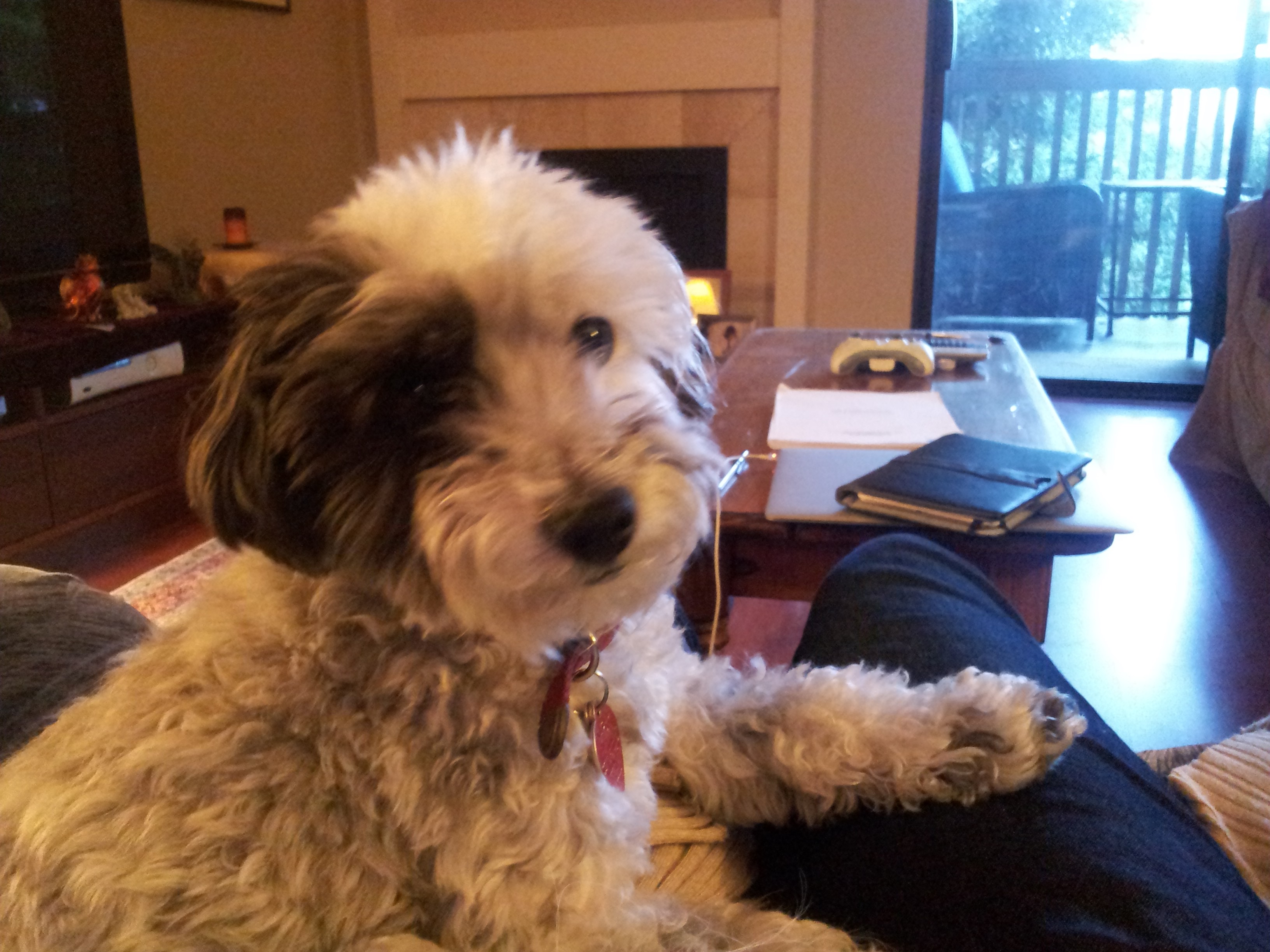
1. Get a dog. Dogs don’t care if you’re perfect; they only care that you love them.

Portrait of a Devoted Doggie

2. Reframe the idea of perfection. Decide it is impossible, or decide it encompasses more than a single rigid definition, or go all philosophical and decide that imperfection is perfect in its own way.

3. Spend time around people who appreciate your natural strengths.

4. Spend time around people who are okay when you falter.

5. In fact, spend lots of energy finding awesome people with whom to surround yourself. This helps with all sorts of things if you are paying attention.

6. Distinguish between situations in which you must present yourself professionally at all costs and those (often in your personal life) in which you have some more leeway.

7. For the latter, force yourself to be honest. Especially when you really don’t want to admit that you need help or that you’re having a rough time.

8. Accept that not all people are going to understand or believe your honesty. Change your response to this from a panicked “I must seek their approval at all costs” to a shrug. Be grateful for those who are supportive. (And if none of those exist in your life yet, go back to number 5 and try some more. They are out there.)

9. Remember that you are one person and that therefore you cannot do all the things. Even if other people want you to. Even if you want to.

10. Realize you can’t control everything, and that perfection doesn’t automatically equal happiness.

11. Actually, not only does perfection not equal happiness, it sometimes equals stress, burn-out, dysfunctional relationships, isolation, and despair. Remind yourself of its downsides when you’re having trouble letting go.

12. Embrace the cheesiness and tell yourself you love yourself. Tell this to yourself even more when you think you’ve fallen short.

Read Full Post »

Photo Credit: chiaralily via Compfight cc

The scene: A spring afternoon on a concrete patio with metal tables and chairs, close to the train tracks. A slight breeze keeps me worried that I should have brought more than my thin sweater, worried enough that I order a hot drink in spite of the sunny weather. A large dog lays with his head between his paws, gazing with eyes big enough that many of his actions automatically become characterized as mournful even though that’s not his personality at all.

My friend is telling me about a conversation she had with a customer service representative over the phone. After explaining recent events and how they pertained to the issue in discussion, the woman told her, “Don’t worry, now you’re getting the chance to start over.”

I say, “Don’t we all start over at one point or another?”

***

I have thrown away a bowl full of leaden gingerbread dough. I have discarded ten thousand words and started a novel from scratch (and felt grateful it was only that many). I have graduated, I have moved, I have ended relationships, rekindled relationships, started relationships. I have obtained employment, lost employment, quit, and changed careers. I have opened and closed a business. I have walked out of a lobby at a convention and sat for twenty minutes in my hotel room before coming back out and starting again. I have spent months recovering from physical injuries, only to re-injure myself and go back to the beginning of the process. I have rebooted my computer, my phone, huge strands of my life.

So I guess you could say I start over a lot.

***

A friend of mine moved recently, and in the process, she got rid of a ton of stuff. She hardly has any books left (she mostly reads electronically these days), most of her kitchen cabinets are empty, she’s getting rid of big pieces of furniture. I thought to myself, “Wow. This is the way to start over.”

By contrast, when I start over, I tend to carry everything with me: my experiences, my memories, my baggage, and physical mementos from the past. It’s certainly the bulkier way to go. But there is no one right way to start over. There is the way that feels right at the time.

My kitchen cabinets are full. But I do have an empty bookshelf.

***

The title of this post suggests that I’m going to offer up advice or maybe a list of ten bullet points summing up the process of starting over. But this time I don’t have a list for you.

Starting over is hard. A lot of that is because of the fear that often comes with it, the fear and the not knowing and the what if game. And starting over is stressful. If you look at the Holmes and Rahe Stress Scale, you’ll see that almost all of the most stressful events in life have to do with change: beginnings, endings, and starting over.

So really when we’re talking about how to start over, we’re also talking about how to be kind to ourselves and how to be resilient and how to deal with stress.

When have you started over?

Read Full Post »

I am tired of apologizing.

Expressing empathy and sympathy? I’m all over that. But I’ve spent way too much of my energy apologizing for things that have nothing to do with me.

And you know what? I’m not sorry.

  • I’m not sorry that I may have different priorities than other people .
  • I’m not sorry that I have things I want and things I need.
  • I’m not sorry that I want to be treated with respect and consideration.
  • I’m not sorry for the life choices I’ve made, even if people don’t agree with them or understand them.
  • I’m not sorry that I don’t want to discuss my financial situation with strangers.
  • I’m not sorry that I have a different sleep schedule from the norm.
  • I’m not sorry that the ways in which I spend my time are not obvious.
  • I’m not sorry that I notice and sometimes point out sexism and misogyny in media.
  • I’m not sorry for my own opinion and assessment of myself.
  • I’m not sorry when I choose to say no.
  • I’m not sorry that I can’t be perfect.
  • I’m not sorry when I refuse to take on other people’s issues willy nilly.
  • I’m not sorry for the existence of my emotions.
  • I’m not sorry for standing up for myself.
  • I’m not sorry for communicating.
  • I’m not sorry for being complicated.
  • I’m not sorry that we don’t have every single thing about ourselves in common.
  • I’m not sorry when people won’t take care of themselves. I feel sad about it, because I know how bad that feels, but I am not responsible for the choices they make and the pain they put themselves through.

This is what it looks like to not be a people pleaser. You start apologizing a lot less frequently. Instead you communicate, and you compromise, and you take responsibility for yourself and your actions, and you surround yourself with people who are willing and able to take responsibility for themselves and their actions, and when you screw up on occasion, you apologize and make amends, and everything works out a whole lot better.

Stop apologizing for yourself. Start living instead.

Read Full Post »

« Newer Posts - Older Posts »