Feeds:
Posts
Comments

Archive for the ‘Arts’ Category

One of the things I love best about being a writer is the wonderful necessity of feeding my muse.

Don’t get me wrong; I do my very best not to follow my Muse’s fickle whims. I try to write a prescribed amount of words regularly. I try not to start new projects if it will mean leaving an already started project unfinished. I force myself to write when I don’t feel like it.

But that doesn’t mean my brain doesn’t need feeding while I’m engaging regularly in the creative process. In fact, it can be positively voracious. And the more I feed it, the happier my writing process tends to be.

Favorite Ways to Feed the Muse:

1. Travel. Yes, I know, I am constantly singing the praises of travel, but I am hard pressed to think of anything that delivers a bigger punch of Muse deliciousness. New places and cultures, new experiences, new people, the beauty of nature, art treasures, learning about history, eating amazing and sometimes strange foods–travel has it all.

2. Doing something I haven’t done before. Because we don’t need to travel far from home to have new experiences, whether that be going to a new place in the area or trying a different restaurant or taking a different route for your daily walk/jog. In a couple of weeks, I have tickets to go see my first magic show, and even if it’s on the cheesy side, I am fascinated to be having this experience. (Plus, I get to wear a cocktail dress. Double win!)

3. Going to museums. Because at most museums, I learn something new or see something beautiful or experience something different (see #1). Next on my list? The Disney museum in San Francisco.

4. Experiencing story outside of my own writing. This can be anything from novels to movies, TV series to theater, role-playing games to video games. Sometimes I need to read a certain kind of novel, and other times I really need a different vehicle to experience story. Lately I’ve been reading a lot of plays. Good, bad, or wildly uneven, it’s all grist for the mill.

5. Finding another creative outlet. Even though my current focus is on writing, I feel so lucky to have spent so much of my life practicing and studying to be a musician. Sometimes there is nothing my brain needs as much as becoming entirely focused on something creative but DIFFERENT. Very very different. A quick thirty minute voice practice session and I can come at a writing problem in an entirely different way. Which is similar to

6. Moving the body. Exercising, dancing, taking a walk around the block, or jumping up and down for twenty seconds, all of these activities pull us back into our physical bodies and give our brains a chance to work on a subconscious level.

7. Talking to people. The more interesting people we surround ourselves with, the more likely our social time will prove to be inspirational. You never know when an off-hand comment from a friend will trigger a thought that turns into a blog post, the perfect telling detail, or a solution to a tricksy plot problem.

What our your favorite ways to feed your muse?

Read Full Post »

I’d been wanting to write that post on forgiveness I published last week for a long time. But I kept punting it for other ideas because I was afraid to write about it. I was convinced the ENTIRE WORLD would disagree with me and be horribly upset that I didn’t think of forgiveness as something that can be forced, and somehow this would be an awful thing for me.

The longer I write for this blog, though, the more I realize that really, the world doesn’t care. Most people will never read my essay on forgiveness. And most of the people who did read my essay recognized something in it that resonated with them. So when I think the entire world will disagree, that is some bizarre thought process I am better off ignoring.

My friend Ferrett wrote some excellent blogging advice, where one of his main points was: “No, Seriously. Haters Are Going to Hate.” As a blogger or someone who is interested in maintaining a public example, this will inevitably be an issue at some point. Ferrett says that once you become sufficiently popular, there will always be people who hate you, and he’s completely right. It is amazingly hard to be sufficiently wishy washy to keep everyone happy. I don’t even know if it’s possible, although I suspect it isn’t. There will always be people out there disagreeing loudly, people looking for an argument, or people wanting to tear other people down.

Photo Credit: HeyThereSpaceman. via Compfight cc

For example, it is always amazing to me how angry people have gotten over my essay about intelligent women. They are upset because they don’t think women can possibly be as intelligent as men (seriously, what century are we living in?) or because they don’t think smart women ever encounter anything I mention so therefore I must be old and bitter (because only old and bitter people can engage with ideas about sexism?) or because of course all intelligent people must make loads of money because that’s the way intelligence should be measured in our society (I guess most artists and academics are just pretty stupid since they don’t prioritize making large amounts of money). But what is more interesting to me than the actual arguments is the amount of anger expressed because there are different opinions in the world. Opinions, it seems, can be very scary things.

But as strange as it seems to me that people can get so worked up over my six hundred word essays, this doesn’t change the fact that the world is largely indifferent. And in fact, as a writer, if my words cause anyone to feel angry or scared or hopeful or inspired or any emotion at all, then that means I’ve done my job. In the grand scheme of things, obscurity is more an artist’s enemy than controversy, however safe the obscurity might feel and however challenging the controversy might be. (And of course, how challenging the controversy feels will vary wildly from person to person.)

I think part of becoming an artist is learning to be comfortable with controversy. Not because it is bound to be necessary, but because part of an artist’s job is to express their perception of the truth. And if you are afraid of what the world is going to think about your truth, then maybe you won’t dig as deep as you can and maybe you won’t take the risks you need to take and maybe you’ll choose the easy way instead of the raw way. Creating art is a commitment to your own vision of reality.

So I wrote that essay on forgiveness anyway, even though it scared me. I was scared to write The Academy of Forgetting. I’m about to start a new novel, and even though I’m excited about it, I occasionally feel sudden spasms of anxiety when I think about sitting down and typing “Chapter 1.” I feel a tightness in my stomach and a sudden strong desire to do anything else.

But I’m glad I feel the fear. It’s like a compass, letting me know I’m going the right direction. It means I’m not taking the easy way. It means I’m challenging myself, and my writing is better because of it.

Read Full Post »

But first, it’s the time of year when science fiction and fantasy writers begin to mention award season. I’ll make this short and sweet.

I am in my second (and final) year of eligibility for the Campbell Award for best new writer in science fiction and fantasy. You can vote for this award if you are voting for the Hugos. Here is my list of publications to date. I’m happy to send you a copy of anything on that list–just shoot me an email at practicalfreespirit@gmail.com

Also for the Hugos, I can be nominated in the Fan Writer category for my writing on this blog. I recently updated my Best of Blog page to include some blog posts from 2012. And if you’re looking for other people to nominate, I recommend checking out Theodora Goss and Ferrett Steinmetz, both of whom have strong blogs relevant to fandom and our community.

I had four short stories published last year, all of which can be nominated for the Nebulas and the Hugos. The complete list is here, but in my opinion the strongest one is Daddy’s Girl.

And now, for something completely different.

I have something new I’m really excited about. It’s a vlog called The Lizzie Bennet Diaries, and one of its executive producers is Hank Green of Vlogbrothers fame (he vlogs with his brother, writer John Green).

This vlog combines modern media and storytelling in a way that is special. Its conceit? It’s a modern-day adaptation of Pride and Prejudice. The main vlog belongs to Lizzie (aka Elizabeth) Bennet, who starts it with her friend Charlotte as a project for her communications masters. We are slowly introduced to the concerns and people of Lizzie’s world, and the acting and writing are both quite strong.

The audience can watch only these main videos and have a great time. However, for those who want more, it’s out there to find. Lizzie’s little sister Lydia starts her own vlog. Charlotte’s little sister Maria does a short series of videos as well. Each of the characters in the vlog has their own Twitter handle, and they tweet at each other and with the audience. (Unfortunately, whoever’s in charge of the Twitter accounts doesn’t understand the technicalities of how Twitter works so the responses aren’t threaded to each other in a way that is easy to read. Still very cool, though.) One of the characters (Jane) has a semi-active Tumblr account. There’s even a fake website of the company Lizzie is about to go visit for an independent study project next week.

Lizzie and Charlotte, dressed up as Lizzie’s parents

I’m fascinated by how the story is being updated to modern times. For example, the proposal of Mr. Collins to Lizzie isn’t exactly what it was in the book, even while it remains true to the spirit. There are plenty of references to catch for those who love Pride and Prejudice. I particularly love how so far the videos are very effective at highlighting the flaws in Lizzie’s character. But even for those who aren’t so into the book, this is a fascinating experiment of a different way of storytelling using a combination of video, websites, and social media.

I don’t know how I avoided hearing about this for so long, but now that I’m all caught up, I’m looking forward to experiencing the serial feel going forward. Another thing I really like about this vlog is how each episode feels complete in itself even while maintaining suspense and forward momentum. When I watch my other favorite web series, The Guild, I am often frustrated by how short each episode seems and how I feel like I’m constantly left hanging (maybe I got spoiled by getting to watch the first five seasons after they were completed, making them more like five movies). In contrast, each episode of The Lizzie Bennet Diaries has its own mini-arc that leaves me feeling satisfied.

I would love love love to be involved in the writing and/or producing of a project like this. Truly fabulous storytelling.

What media are you geeking out over right now?

Read Full Post »

Today I’m going to talk some more about books. What bliss!

Nonfiction:

At Home: A Short History of Private Life, by Bill Bryson
I wrote about this book here. Bill Bryson is talented at keeping me amused, what can I say?

How to Suppress Women’s Writing, by Joanna Russ
As a female writer, I found this book particularly fascinating. This book was published in 1983, but it certainly seems relevant today. I remember a certain comment on my post earlier this year about intelligent women, making the argument that women aren’t as intelligent as men because they haven’t created as many masterpieces–in literature, in music, in the visual arts. (Don’t bother looking for that comment, by the way. I deleted it. Life is too short for such stupidity.) If you are interested in why it seems that less of the literary canon was created by women, this book will help answer that question for you.

My Life in France, by Julia Child and Alex Prud’homme
I wrote about this book here. This book’s joy comes from the irrepressible personality of Julia Child. I don’t read a lot of memoir, but maybe I should.

Adult Fiction:

The Cloud Roads, by Martha Wells. Fantasy
Anyone who writes a book with somewhat dragon-like characters that doesn’t cause me to throw it across the rooms deserves a lot of credit. The plot is fun here, but what I really liked in this secondary world fantasy was the world building and learning more about the society of said dragon-like creatures. We learn about it through an outsider of the society, which makes the unfolding discovery seem natural.

The Beekeeper’s Apprentice, by Laurie R. King. Historical mystery
I asked Facebook for a recommendation for a mystery that had an eccentric woman genius as the detective, in the same mold as Hercule Poirot or Sherlock Holmes. One of my friends came through for me by recommending this book, the first of a series, about the female protegé of Sherlock Holmes. I’ve read several of these books, and I plan to read more. Mary Russell is a great character, and in addition to the mysteries, I love reading about her scholarship in religious history, which adds an extra dimension and depth to these books.

The Testament of Jesse Lamb, by Jane Rogers. Science fiction
Reading this book gave me a breakthrough on point of view for my own novel, The Academy of Forgetting, so I love it for that. I also like its slow pacing and build, its use of language, and its taking a familiar science fictional problem of fertility and making it intimate and deeply personal. (This book is also interesting because it was marketed as adult fiction, but it features a teenaged first-person protagonist. I’m guessing they chose to market it as adult because of the style.)

The House of Mirth, by Edith Wharton. Literary
This book took me awhile to read, and I was in love with it the entire time. It’s set in 1890s New York high society and has echoes of Jane Austen’s novels of manners, although this book contains a more overt social critique. In Austen, her heroines are forced to operate within the rules and strictures of society, but they are able to harness these rules into providing a “happy” ending for themselves, whereas this novel shows the tension between these rules and a woman’s desires and potential happiness, highlighting the society’s damaging attitudes about women and the price that is paid to follow society’s confining rules. So very fascinating. I’m also completely intrigued by Edith Wharton now. My thanks to Rahul Kanakia for the recommendation.

vN, by Madeline Ashby. Science fiction
I can sum up my enjoyment of this novel in one word: Robots! Robots are awesome, and the robots in this novel are no exception. The ending was a bit … strange, but overall, quick pacing, high stakes, and a fun plot made this novel quite entertaining.

Washington Square, by Henry James. Literary
I also have to thank Rahul for telling me about this novel (which means I should really tell you to go follow his blog, where he talks about all these fabulous books). What’s interesting about this book is that it’s about all these really awful people, and it draws viciously accurate portraits of their personalities. We also get to see the effects of living and dealing with really awful people on the heroine, Catherine, who is sadly not awful herself (she’d probably do better in that environment if she was). A well-done family drama, set in 1880s New York.

Shadow of the Wind, by Carlos Ruiz Zafon. Historical mystery w/ magical realism elements
I don’t really know the genre of this book. Also I have apparently been living under a rock because this book was really popular when it came out, but I only heard about it when my friend Bill Schafer mentioned it to me this year. And finally, I am reading this novel right now and am only halfway through, and I generally don’t recommend books until I finish them, because what if the ending doesn’t land? So we’re engaging in some risk-taking here. But it’s such a beautiful book so far that I feel it belongs on this list. I mean, it starts out with the “Cemetery of Forgotten Books.” What’s not to love about that? As a writer, I’m finding what Zafon is doing with first person POV (well, mostly 1st person) to be very interesting. As a reader, I am simply enchanted by the story and characters. Some poking around on the internet tells me that many people talk about it mainly as a mystery set in post-war Barcelona (which is such a rich setting, by the by), but I’ve been reading this as very much magical realism. The flirtation with the fantastic in this book is one of the parts that intrigues me the most.

All right, hit me with your own favorite reads of the year. I always like hearing about books that have made an impression. And if you have your own year-end book list, feel free to link to it as well.

Read Full Post »

It’s that exciting time when I review the list of books I’ve read this year and share some of my favorites. Basically this is an excuse for me to talk about books I love, which is a particularly enjoyable activity. So enjoyable, in fact, that this year I’m going to write two lists: one of the Middle Grade and Young Adult books that I loved, and one of the adult books I loved.

Yes, it was a very good reading year, and I can’t narrow down any further than that.

Today I’m sharing my top list of YA and MG novels I’ve read for the first time in the last year. And it’s such a good list, it makes me happy just to contemplate it.

Honorable Mentions:

Legend, by Marie Lu. YA dystopia
Entertaining adventure story.

Daughter of Smoke and Bone, by Laini Taylor. YA fantasy
Very evocative writing, strong settings, enjoyable sense of wonder. I’m not generally a fan of long flashbacks, though.

My Top Ten:

The Skull of Truth, by Bruce Coville. MG fantasy
I heard Bruce Coville speak at a SCBWI conference, which motivated me to try his books. This one is probably my favorite so far. Clean, engaging writing, a fun plot, and I adore the skull character so much.

Chime, by Franny Billingsley. YA fantasy
What stands out in my memory about this novel is its unique voice and its strong sense of setting. Haunting.

Black Heart, by Holly Black. YA fantasy
The third book of a trilogy that always ends up on my year’s best lists. Holly Black brings her story to a close in a satisfying way, and the magic system continues to enchant me.

The Perks of Being a Wallflower, by Stephen Chbosky. YA contemporary
I read this for a book club, and I’m so glad I did. It’s a novel told in a series of letters sent to a stranger, and we get a deep look into the protagonist’s head and heart, cracks and all. It’s one of the best books I’ve read at catching the deep confusion of being a teenager.

Bitterblue, by Kristin Cashore . YA fantasy
This is a complex, layered novel about the recovery from trauma, both of a nation and of a teenaged girl. It doesn’t rush or skirt away from the hard questions.

Every Day, by David Levithan. YA fantasy
The writing is good, but what makes this novel is its central conceit: that every day, the main character (who is genderless) moves into a different person’s body. Fascinating exploration of identity, morality, and love.

The Fault in Our Stars, by John Green. YA contemporary
I wrote about this novel here. I am not the only person who thinks this book is brilliant.

Looking for Alaska, by John Green. YA contemporary
Oh, John Green. This book is also brilliant. The voice, the characters, the themes, the setting. This is a book that rips your heart out and makes you wiser because of it.

The Girl Who Circumnavigated Fairyland in a Ship of Her Own Making, by Catherynne Valente. MG fantasy
This book is both beautiful and clever. It reminds me a bit of the Oz books in terms of its narrative style (omniscient) and sense of wonder, but with more modern sensibilities and better plotting. And it really is so insightful and clever, with a heroine that I want to spend lots of time with. (In fact, I have the next book in the series, it’s a minor miracle I haven’t read it yet.)

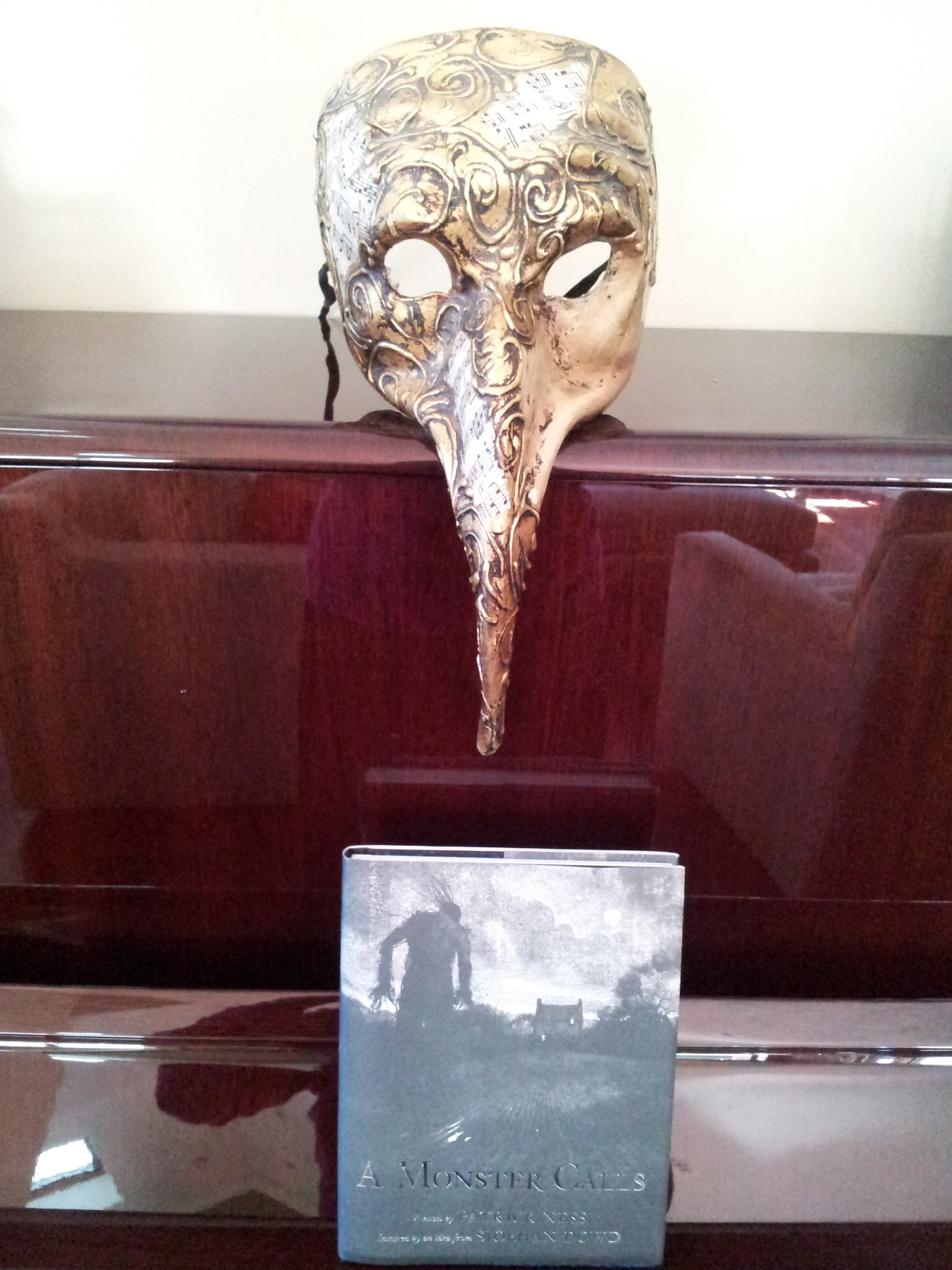
A Monster Calls and mask
A Monster Calls, by Patrick Ness. MG…contemporary w/ fantasy elements? You decide.
This book broke my heart. It delivered my most powerful emotional reading experience of the year. It uses the fantastic as metaphor in truly masterful fashion. You want to read the physical version of this book, not the electronic one, because of the beautiful artwork that really adds to the story.

What were your favorite YA and MG books you read this year?


Read Full Post »

I stumbled across an interview with Brene Brown (whose TED talk I mentioned last week), and at the end she says if she was going to found a museum, she would call it “a Museum of Epic Failure.” At which point I instantly emailed a link to the article to my friend and said, “This is the title of my next blog post!”

Photo by the National Museum of American History Smithsonian Institute

We have such strange ideas about failure and success. I meet people again and again who assume that, having failed at something once, it makes sense to automatically give up and not try again. They wonder at the fact that I have written THREE novels, even though none of them are yet published. They make comments that call into question the entire premise of one of my failures, as if I have now automatically learned better.

Sure, sometimes a failure, and the lessons we learn by failing, cause us to change directions. Sometimes we decide we’re better suited to doing something different, or we’ve found a new passion to pursue. Sometimes our viewpoint has changed so that we no longer want the same things we wanted before. But failure can also mean that the next time we try, we’ll apply what we’ve learned this time around and do better.

Meanwhile, when we stop doing something we’ve been successful at in some form or another, people get confused and tell us it’s “too bad.” And if they like us (aka social success), they tell us to “never change.” There’s this idea that once success has been achieved, we need to hold onto it tightly while avoiding change at all costs.

This is an example of black and white thinking at its finest, where success is positive and good and to be cherished, while failure is negative and bad and to be avoided.

What is often overlooked is the necessity of failure. When we take a risk, it is risky because there is the possibility of failure. If we were one hundred percent sure we’d succeed, it wouldn’t be a risk at all, would it? And so many great successes and helpful learning moments come from the willingness to take a risk and allow ourselves to be vulnerable.

Most great art–be it visual, literary, musical, or theatrical–comes from reaching to see where we can go, from exposing ourselves in the act of creation.

Most great relationships–be they platonic or romantic–come from opening up and being authentic with one another, while not knowing how we’ll be received.

Most great entrepreneurial ventures–be they tech start-ups or service businesses or local merchants–come from taking the leap into the unknown and committing ourselves and our resources to a particular vision.

When we are engaged in these activities and being honest with ourselves, we know we are taking risks. We know we may fail. And it is when we allow ourselves the space to fail (say goodbye to perfectionism!) that we are capable of our best work.

Which is when we realize that failure isn’t inherently bad. It teaches us, it pushes us, it leads down paths we wouldn’t have noticed by ourselves. It makes success, when it comes, more meaningful, even while it keeps us grounded and connected. And when failure comes instead, and we feel flattened by its impact, we can remind ourselves of the alternative: staying safe, cramped, and complacent while being too afraid to really try.

We are each in the process of creating our own personal Museum of Epic Failure. I’ve already collected many interesting exhibits in mine. And each one has helped to shape who I am today.

Even things that are uncomfortable can have reasons to be celebrated. Is there a failure you’ve experienced that you learned something important from or that you’re grateful for now? Feel free to share in the comments.

Read Full Post »

On Mentors

I spent time with a writer friend the other day who said, in a wistful tone of voice, that she’d like a mentor. “But how do you even get one?” she asked.

This isn’t the first time I’ve heard this lament from a writer, and for a while, I thought getting a mentor sounded pretty amazing. It’s so easy to Hollywood-ize the idea into an inspiring training montage with said mentor, at the end of which, you (pick your poison) write the best book ever! Land a top agent! Get a six-figure publishing contract! Become well-known throughout the land as an amazing plotter/world builder/ace of characterization/wordsmith!

But moving from the realms of fantasy into reality, the first thing that strikes me is that in most fields, mentors expect to be paid. If you’re part of corporate culture, then maybe a higher-up will take you under their wing, but they get paid a salary to do their best work for the company, and one of the things they’re getting paid to do (perhaps not explicitly, but still) is to help fellow employees on lower rungs of the ladder.

In other environments, payment is still the name of the game. For example, I wrote about the differences between developing writers and developing musicians, and one of those differences is that most musicians have mentors helping them along; namely, their teachers. But musicians are giving their teachers money for lessons. The same is true for dance classes, art classes, and martial arts classes. Even Buddhist teachers are typically offered dana (donations) for their time instructing people in spiritual matters. And typically once you stop paying for services, your mentors have less time to help you because most of their time is being given to the people who are helping them pay their bills.

Another issue is that of connection. Not every mentor is right for every person (and this is true whether we’re talking about writing or music or martial arts or any other discipline). I had a well-respected writer read my work a few years back. She has a reputation for taking newer writers under her wing and helping them out, but she didn’t connect with my work, so she didn’t do that for me. This is a good thing. She wouldn’t have been able to help me the way I needed to be helped. She’s helped others of my friends with whom she was a better fit, and I’m really happy for them. But I needed to learn from other people.

Photo by Jose Tellez

At this point I’m not actively seeking a mentor because I feel like I already have several, and I’m finding more all the time. They’re not mentors in the fantasy montage sense of the word, but they help me learn and grow and become a better writer (and isn’t that the point?) I have one friend who I rarely speak to, but whenever I do he inevitably tells me exactly what I need to hear career-wise. I have my plot whisperer, my structure maven, and my YA crew. I have Nancy Kress’s voice in my head reminding me to write in scenes. I have several books on writing that keep me pushing my boundaries. I have a friend who made me think more deeply about first person. I have my blogging writer models. And I have all the writers of all the novels I have ever read.

We find mentors and teachers all the time. They may not fit our preconceptions of who those people should be, how they should act, or what they should look like. But sometimes we just have to pay enough attention to notice that they’re there.

Or else, you know, pay someone money. That works too.

But even then, having a mentor is not a magic bullet, nor a replacement for time, effort, practice, and hard work. They can give you a helpful hand along the way, but what happens from there is up to you.

What has been your experience? Who are your mentors, and how did you find them?

Read Full Post »

More publishing news! It’s been a busy summer. This time my contemporary fantasy story “The Dreamtime” appears online at Buzzy Magazine.

“The Dreamtime” is one of my older stories. I wrote it in the spring of 2010, and it was the story I submitted to Taos Toolbox for the first week critiques. Yes, I got fifteen critiques on this story during that first week at Taos, and almost everyone agreed on one thing: a crucial scene was missing. Yes, missing.

If anyone was looking for a testimonial on the effectiveness of Taos Toolbox as a workshop, I think I can honestly say I would never have sold this story without the revisions I did as a result of attending. I actually ended up adding two major scenes and one very short interlude, as well as deleting (well, combining with another, really) a scene. And the story is much better for all these changes.

Photo by Paul Bica

This story is also an illustration of the important role of persistence in being a writer. I finished the above revisions later that same summer, and as you see, the story is appearing two years later. It was purchased almost a year and a half after I started sending it out to markets. In fact, I was almost ready to give up and put it away for good, but I hated to do that since I still felt I could stand by it as a story. And then along came the new market Buzzy Magazine, paying pro rates and having an editorial focus that made me think “The Dreamtime” might be a good fit. I guess the editors agreed!

As for the story seed, I started out by thinking of the dreamtime as a metaphor for those moments when you begin thinking about someone in your past who you would really rather not think about. And yet there they are, waving at you from your own thoughts. But what if these people could do something similar of their own volition? A psychic phone call, if you will? From this idea was born the character of Mariah, still hung up on a crazy ex-love with the power to roam her dreams. In this way, this story is a twisted kind of love story that shows the emotional aftermath of a relationship gone wrong.

Some of my Taos classmates had trouble believing that a woman would find a man like O’Malley to be attractive since he is arrogant, dismissive, bullying, expects her to do what he wants. I have to respectfully disagree. Of course relationships like this exist in the real world. And even though these relationships are dysfunctional, that doesn’t mean it isn’t difficult for the parties involved to disentangle themselves. Love doesn’t disappear so easily. The question in my mind isn’t whether such relationships exist but rather whether the individuals involved (in this case, Mariah) can develop the personal strength to move on.

I hope you enjoy!

Read Full Post »

Exciting news! For those of you who don’t follow me via social media, you may not know that my science fiction story “Daddy’s Girl” appears in this month’s issue of Redstone Science Fiction.

This publication is especially bounce-worthy for a number of reasons. First off, this sale was the one that qualified me to join SFWA (Science Fiction and Fantasy Writers of America) as a full member. Secondly, while this isn’t the first science fiction story I sold, it is the first one to be published where everyone can read it. And it has shown me that I can write stories set in an awesome space setting and sell them, which is a particularly happy thing to know.

I discovered this story’s seed while I was working on a bigger world building project. I was considering writing a YA novel with a space setting, so I sat down to figure out how my milieu would work. At a certain point I pulled my husband in to get answers to all my burning scientific questions (the immense perk of being a writer with a physics PhD and lifelong space enthusiast at my disposal).

We were talking about water, and the difficulties of procuring water in space. And he said something like, “Oh, you could just mine comets for their ice and haul it back in.”

Comets are beautiful.

Mind you, this was a completely tangential issue to anything having to do with the novel I was considering. But my imagination was instantly captured by the idea of an ice ship and the spacers who lived in it, constantly chasing after comets to bring back that oh-so-valuable resource, ice. (I have since learned, from Bill Bryson’s At Home, that there used to be an important market for ice in the past as well, pre-modern refrigerator and especially for shipping/transport issues, but I wasn’t thinking about this at the time.)

So I decided to write a short story to explore my ice ship idea further. At which point I found my character Lolly’s voice, began to understand her story, and was completely hooked.

For those of you interested in process, I wrote this story fairly quickly, did a quick revision and sanity check with my husband, and sent it off to my friend (and frequent commenter) E.F. Kelley to take a look. He identified an important scene that was missing (thanks again, Eric!), I added the scene while revising again, and then sent it off to market. I did one final revision pass before sending the story to Redstone in order to fall within their 4,000-word maximum length limit. (It had previously hovered just a few hundred words above that number, and I’m very happy to have tightened it further.)

Interestingly to me, the whole process was fairly painless, as has been the case with most (all?) of the stories I’ve sold, although certainly not the case for all the stories I have written. I imagine there is a lesson in this fact.

I hope you enjoy!

Read Full Post »

Today I have a really special treat for you. I’ve interviewed Adam Baker, the producer of the documentary I’m Fine, Thanks, which was one of the Kickstarter projects I highlighted on Tuesday. I was really excited to do this interview because the subject of the documentary, complacency, is so in line with what I talk about here on the Practical Free Spirit: priority setting, having adventures, being willing to take risks, and living an examined life.

So without further ado, here is the conversation Baker and I had:

What originally drew you to the topic of complacency in modern life?

My own story! Haha.

My wife and I were living that exact life that we discuss and talk about in the movie. We were doing o.k., but we weren’t doing what really made us come alive.

We made choices based on what we should do – or were supposed to do – and not really what was in line with our values.

In one of your blog posts, you said that two of the interviews made you cry. Will you tell us which two?

Well, at least two! But I’m sure I know the ones I was talking about then.
The first was Jonathan Fields’ interview. And that was twice. The first time was during an emotional story he told about 9/11 – and the second was when he told a different story about his daughter (I could relate as a parent).

The second interview was Victoria from Austin, TX. She’s a successful attorney who finds herself stuck between her career, wanting to stay at home with her young daughter, and her overwhelming debt from law school. The weight of her decisions was heavy for all of us in the room (you’ll have to wait and see it). 🙂

What are some ways in which we can combat complacency in our lives?

We found two common things amongst those that had successfully fought this problem:
  • They changed WHO they surrounded themselves with. The spent less time with people who brought them down and more with time with people who inspired and lifted them up. It was really that simple.
  • They started to become comfortable being able to fail. I don’t mean they LIKED failing. Or even tried to fail. But they were o.k. with that being part of the process. Often, the desire NOT to fail was what kept people trapped for decades!

Why do you think so many people are struggling with this issue right now?

It’s so easy to get caught up in the default life path. It’s encouraged and safe. It’s comfortable. So we all fall into that pattern.

It’s far easier to live someone else’s plan for your life – rather than to create your own plan. Creating your own plan is tough – REALLY tough.

But all the people we talked to said one thing – it was worth it!

What has been the hardest part of the process of making this documentary for you?

The sheer amount of work.

We spent 16-18 hour days on production while on the road. And, honestly, post production has almost been that crazy, as well!

We gave ourselves an incredibly short time frame – I’m sure we’ll be happy once it’s over – but during the process it can be stressful!

How did what you learned through making this film change you or the way you want to live your life?

It re-fortified my belief in what I’ve been trying to do for the last few years.

I’ve been working towards a more intentional life – but always have ups and downs. It’s the meaningful projects like this that remind me to stay the course!

What can people do if they’re interested in supporting this movie?

First, watch the Kickstarter trailer. (Amy interjects to add: Check it out! It’s a kick ass trailer.)

Second, if they feel compelled – back the project on Kickstarter (for as little as $5) – which gets you a download of the movie. We have many more levels for you to back, but kept it very affordable to help share with as many people as possible.

By supporting the Kickstarter, you ensure that this story can get out into the world. If we’re successful we’ll be able to share this with tens of thousands more people!

Lastly, just spread the word. Whether you can back the project or not – sharing the trailer and the campaign with your family and friends means a lot!

We’re on pace to become one of the most backed projects on Kickstarter (total number of people supporting us) – which is amazing!

Thank you, Baker, for taking the time to talk to us about your film. I can’t wait to see it! And I can pretty much guarantee I’ll be referencing this interview again, especially those excellent points on how to combat complacency.

Read Full Post »

« Newer Posts - Older Posts »