I couldn’t let the science fiction sidekicks have all the fun. Discerning readers may note certain biases on the part of the poll-taker. 🙂
Let the voting begin! The poll will remain open for one week.
Posted in Polls, Science fiction and fantasy, tagged fantasy on July 30, 2010| 6 Comments »
Posted in Life, Society, tagged community, conversation on July 28, 2010| 4 Comments »
Tomorrow I head off into the great beyond of Los Angeles to attend SCBWI’s annual summer conference and inundate myself in all things kidlit. To my knowledge, I know one other person attending. Happily, this lack of acquaintance doesn’t bother me because I can rest assured in the knowledge that as a group, kidlit writers have to be some of the warmest and supportive people in existence. I also have the happy past experience of the winter conference to bolster me. In my experience, starting a conversation with someone with a shared and consuming interest like writing is not generally a difficult accomplishment.
However, this leads me to one of my recent subjects of interest: namely, the art of conversation. I’m not talking about the skill of small talk, which while useful, isn’t that thrilling for me. I’m also not talking about the art of debate, which can be interesting, but only if the debaters (or at the very least, me as their audience) aren’t completely and finally wedded to every last detail of their opinions. No, I’m thinking about the art of interesting conversation. You know, when you’re talking to someone and you feel you could just keep talking for hours? Or when someone says something and it actually requires you to (gasp) stop and think? That kind of conversation.
One of the main barriers I notice to achieving such a level of worded bliss is the question problem, which goes both ways. First and most simply, it’s been my observation that a lot of people don’t ask enough questions. Questions have interest built-in because they include the supposition that there is more than one possible answer (otherwise, why are you asking?) They also show a pleasing desire to get to know the conversational partner and place value on said partner’s opinions, which develops rapport. A well-asked question can be the instigator of a lively discussion in which the people involved might actually learn something, help each other come up with new ideas, or be exposed to a different point of view. Alternately, questions can encourage a friend to talk about something challenging or exciting in their lives that they might not otherwise have felt comfortable discussing.
On the other side of the equation, people don’t always encourage good questions with their responses. If I offer an opening question or two and receive only monosyllables or replies designed to shut me down, I am left high and dry without any hooks to continue the conversation or discover what that hidden gem of a question might be. In the same way, if the answers to questions aren’t approached in a thoughtful manner, it is much less likely that there will be any part of the answer worth pursuing. And don’t even get me started on the monologue problem.
The ideal conversation requires all people involved to do some heavy lifting. Without mutual questioning, the talk turns into a parody of an interview. Without actively listening to your conversational partner’s points, it is difficult to be affected by the conversation or to respond in a genuine and engaged way. Without the willingness to realize your own knowledge may be limited (or even wrong!) or another point of view might offer valuable ideas and perspectives, what’s going on isn’t a conversation so much as a two-sided internal monologue spoken aloud.
The point of conversation is to both entertain and engage (and possibly to educate, although this one is dangerous as it can lead to pomposity). This means, among other things, making an effort to keep track of who you’ve told what funny stories in the past. Or at the very least, for those with poor memories, you can ask your potential audience if you’ve already told them about that time in Cairo, thereby allowing them a graceful exit. It means asking others for their opinions instead of merely expounding on your own. It means choosing conversational topics that include all people participating – so for example, maybe you shouldn’t speak too long about a role-playing game with a group that includes one or two people who didn’t play the game, or maybe you shouldn’t have deep technical-speak shop talk with a group that includes someone who isn’t part of your field. (Yes, I live in Silicon Valley, can you tell?) This is not to say that you can’t talk about subjects relating to your career and/or passions (my husband and I talk about various writing, scientific, music, and computer-related topics all the time), but it does help to gear them towards a non-specialist audience when appropriate.
I firmly believe that good conversation is an art, and an art that I need to continually consider and practice. So tell me, dear readers, what do you look for in a satisfying conversation? What are your favorite conversational moments or pet peeves? Let’s talk about talking, shall we?
Posted in Arts, Life, tagged artist, community, support on July 26, 2010| 1 Comment »
A few weeks ago, I stumbled across this article listing the five common traits of successful artists. If you’re an artist or love an artist, go read it now. I promise it is short and worth the time.
I agree with all five points Lori McNee makes: passion, business sense, work ethic, resilience, and support. We’ve already talked a bit about her fourth point, resilience, when we were discussing disappointment.
Today I want to talk about her fifth trait: having a support system of people who believe in the work. The longer I am involved in artistic endeavor, the more I realize how important this component can be, if not to “success” than at the very least to my own personal well-being.
There is a special kind of zaniness that many artists have, a weird sort of marriage between egotism and insecurity, self confidence and self doubt, ecstasy and despair. The roller coaster is a lot easier to ride out when you have people cheering you on from the side … or riding that roller coaster with you. Getting negative reinforcement, not from critiques of your work (this will hopefully help make you better at your art) but from the mere fact of undertaking the work in the first place, can plunge the artist into the depths of angst. You might even be convinced to give up. Having powerful positive forces to help balance this out is essential unless you have an especially thick skin.
I think it’s no accident that I begin work on my most ambitious artistic endeavors when there is someone in my life actively rooting me on. Beginning serious study of music: my mom. Applying for and writing a senior recital: my best friend Francine. Writing a song a week: my friend Jimmy. And once I started dating my now-husband, I started my musical and then my novels. I am not convinced I could have accomplished what I have without the support and energy of these fabulous people. It’s possible I would have done it anyway, but it would have been a lonely path.
Nowadays, I’ve connected so firmly to other writers, in both the speculative and kidlit communities, that I no longer depend on one person. This is the ideal situation for a number of reasons.
I have to put a quick caveat about family and other firmly entrenched nay-sayers. If your family is actively supportive of your art, hug them extra for me and realize you are extremely lucky. However, we do not get to choose our biological families, so some of us may find that our choices baffle our relatives. (This also holds true of certain old friends, random acquaintances, and business associates.) Ignoring what they say about our passions can be difficult and frustrating, but it just makes having a support system all the more important. Trying to change someone’s point of view about art (or anything, really) is an uphill battle that will often end in defeat. Instead, I try to ignore any defeatist messages I hear, and rant about it later to someone who will understand (usually my husband, who has infinite stores of patience for listening to this sort of thing). Do I shut these people out of my life completely? No, not usually, and sometimes it’s impossible to do so. Do I limit my time with them and try to steer the conversation away from potentially damaging remarks? You betcha.
I’ll even take the assertion of spending time with supportive people one step further. The more time I spend with people who are creative dynamic thinkers, whether they be artists, entrepreneurs, scientists, or what-have-you, the more energized and inspired I become. Seeing other people’s accomplishments brings them firmly into my own reality frame. I hang out with my friend who started his own tech company, or I hear about a high school classmate who started his own nonprofit, or I get sporadic updates from a college friend about the circus troupe he’s touring with, and I see beyond my own limitations of vision. These people’s lives show me what can be possible, and they inspire me to think big and then figure out how to make the idea a reality. I strive to be like these friends of mine, someone who can lift people up and have the courage to make bold decisions about life. This is what I think it means to be a practical free spirit: to dream big and then create and implement a plan to make it happen.
Posted in Arts, Life, Music, Writing, tagged creativity, ideas on July 21, 2010| 2 Comments »
Another reason I really like the Newsweek article on creativity is that it explodes the myth of creativity has some kind of magical, inherent talent that someone either has or doesn’t have. No, creativity can be learned, creativity can be taught, and creativity can be practiced.
When decoupled from its traditional fused relationship with artistic pursuits, this assertion makes perfect sense. Thinking creatively is just another way of processing information, and if the human mind can be trained to memorize (and believe me, my brain was resistant to this one), it follows that it could also be trained to work creatively, that is, to combine divergent and convergent thinking into a coherent and well-practiced process.
Artists know this about creativity already, at least subconsciously. It is why we obsessively practice. Not only are we practicing our craft and our discipline, but we are also practicing creativity. I’ll give myself up as an example. I wanted to write a musical for several years before I sat down to do so. Why did I wait so long? Partly because I had no idea what to write about. I couldn’t think of a single idea that I felt had enough merit to pursue. I eventually had an idea, sat down, and wrote my musical in 2006-2007. After a short-ish break, I wrote my first novel in 2008. It was still hard for me to think of ideas, and I’m not just talking about that one break-out idea that is the best thing I ever thought of. I had trouble coming up with any ideas, but at least it wasn’t as difficult as thinking up the idea for the musical. During this time period, if I had a truly good idea, I felt like I had to hoard it, save it away until my writing skills improved enough to do it justice. I certainly didn’t want to waste a good idea, after all.
It’s been two years since I started writing that first novel, and now I have lists of ideas. There are so many of them that I’m sloppy and sometimes don’t write them down. It feels as if there is a never-ending FLOOD of IDEAS pouring from my brain that I will never have time to explore. I can sit in the bath and come up with two or three ideas that I believe have merit in twenty minutes. No kidding, I did that last week. Granted, coming up with novel ideas is still more fraught than thinking up ideas for short stories, because writing a novel is a much bigger investment of time and effort, so I want to be sure I’ve picked an idea that will still appeal to me in three months, or six months, or however long. But it doesn’t seem to be the insurmountable task that it did only two or three years ago.
Why the radical change? I think it’s because I’ve been practicing coming up with ideas to the point where it’s not a huge deal anymore. Ideas don’t seem like rare precious things to hide away; the more I play with them, the more of them are born. This may also be why there’s this huge disconnect between readers, who always ask where ideas come from, and writers, who get so sick of what seems like an obvious question that they sometimes lapse into snide remarks. Writers have trained themselves to come up with endless ideas. Readers who don’t also write have not, so to them it remains a mysterious process.
I don’t want to get into a big brouhaha about the current educational system in the United States, and how it’s not training creativity much at all. Feel free to rant in the comments if it makes you feel better, but I’m just going to take lack of creativity nurturing in the public schools as a given at present. Until this can be changed, the onus of teaching children how to think creatively lands squarely on the shoulders of parents. I don’t have kids so perhaps I’m not the best suited to speak on this topic, but I have spent many years teaching kids, so I’ll have a go anyway.
Creativity Training for Kids:
Let me know if you have other ideas for how to help kids think creatively. Also feel free to throw out your ideas of how you stimulate your own creativity. (If you have no ideas about the latter, check out the blog post I linked to yesterday for a starting point.)
Posted in Arts, Society, Writing, tagged creativity on July 20, 2010| 1 Comment »
Lo and behold, I announce a themed week about creativity, and one of my favorite bloggers, Justine Musk, comes out with a post all about thinking creatively today. Ask and ye shall receive? Go check it out!
Posted in Arts, Life, Society, tagged creativity on July 19, 2010| 11 Comments »
Last week, Newsweek ran an article all about creativity. It’s about how creativity is declining in America, and it also includes a lot of recent research and theories about creativity and learning creativity. Interesting stuff. Especially interesting for me, because reading this article really brought my personal misconceptions about creativity into the spotlight.
I was a creative child: I excelled at creative writing in school, I engaged in the sorts of play described in this article as being associated with high creativity on a daily basis, I daydreamed and devoured books whole, I loved composing as well as playing music, etc. My greatest desire from age seven on was to be a writer – a desire I relinquished once it was made clear to me how impractical a career course this was.
What interests me is that until quite recently, I never valued my own creativity particularly highly. I valued my intelligence, yes, my organizational skills, my memory, my problem-solving skills, and my analytical and synthesis skills. But I would have never stated that one of my core strengths was creativity.
Why is this? Two reasons, I think. First, I was never taught that creativity was useful for anything except artistic pursuits, ie the arts. And second, I was taught that the arts as a whole are impractical and therefore the skills associated with them aren’t as valuable as other skills.
That’s a loaded paragraph, isn’t it? Imagine believing the two assertions made above, and then reading the following from Newsweek’s article:
The necessity of human ingenuity is undisputed. A recent IBM poll of 1,500 CEOs identified creativity as the No. 1 “leadership competency” of the future. Yet it’s not just about sustaining our nation’s economic growth. All around us are matters of national and international importance that are crying out for creative solutions, from saving the Gulf of Mexico to bringing peace to Afghanistan to delivering health care. Such solutions emerge from a healthy marketplace of ideas, sustained by a populace constantly contributing original ideas and receptive to the ideas of others.
The mind boggles as reason number one (creativity is only useful in the arts) is shredded into tiny pieces. Let’s throw away my faulty understanding and look at my two reasons in this new light, shall we?
I don’t think I’m the only one who used to believe creativity’s practicality was limited. I remember in college speaking to a creative friend of mine who told me that everyone had told him to enter an advertising firm, because “that’s where creative people go to work if they want to make money.” At the time, I believed this assertion completely. The choice as laid out for me was to either enter the arts and eschew a stable future, or sell out and work in advertising.
Think what creative people could accomplish if, instead of being presented with this false dichotomy, they were educated in where their real strengths lie: solving problems, thinking outside of the box, coming up with multiple solutions and combining them for maximum positive effect, analyzing systems to figure out what change would have the most impact. Starting nonprofits, increasing communication between disparate groups, disseminating powerful ideas that grow to influence communities, decision makers, and potentially entire societies. Inventing innovative machines, systems, gadgets, more efficient ways of accomplishing a task.
It’s fine to choose the arts in the face of this knowledge. I have no regrets about my choice. But when I’m told that the United States prizes creativity, I have to call foul. If that’s true, why wasn’t I told what my creativity meant? Why wasn’t I told what I could accomplish? Why did no one mention the possibility that I could make the world a better place with my creativity even if I didn’t have an artistic bone in my body?
If there is a creativity “crisis” in this country right now, it’s because creativity as a skill hasn’t been valued nearly enough.
*****
(1.) This idea is founded on one basis only: the reality that a career in the arts can be unstable from a financial perspective. We see here the shadows of my upbringing telling me the most important criteria for determining an activity’s value is in its money-producing capability (and as a corollary, its relative stability). Never mind for the moment that I know many working artists who do quite well, or that I myself was able to found a successful business completely based on, you guessed it, the arts. This also overlooks the possibility, a reality for many, of the day job as a support for serious pursuit of the arts. Or the choice to pursue the arts due to other intrinsic values, and financial stability be damned.
Posted in Life, tagged Nala on July 16, 2010| 6 Comments »
I forgot to mention that I too have a sidekick, therefore launching me into the exalted realms of science fiction, fantasy, and superhero characters.
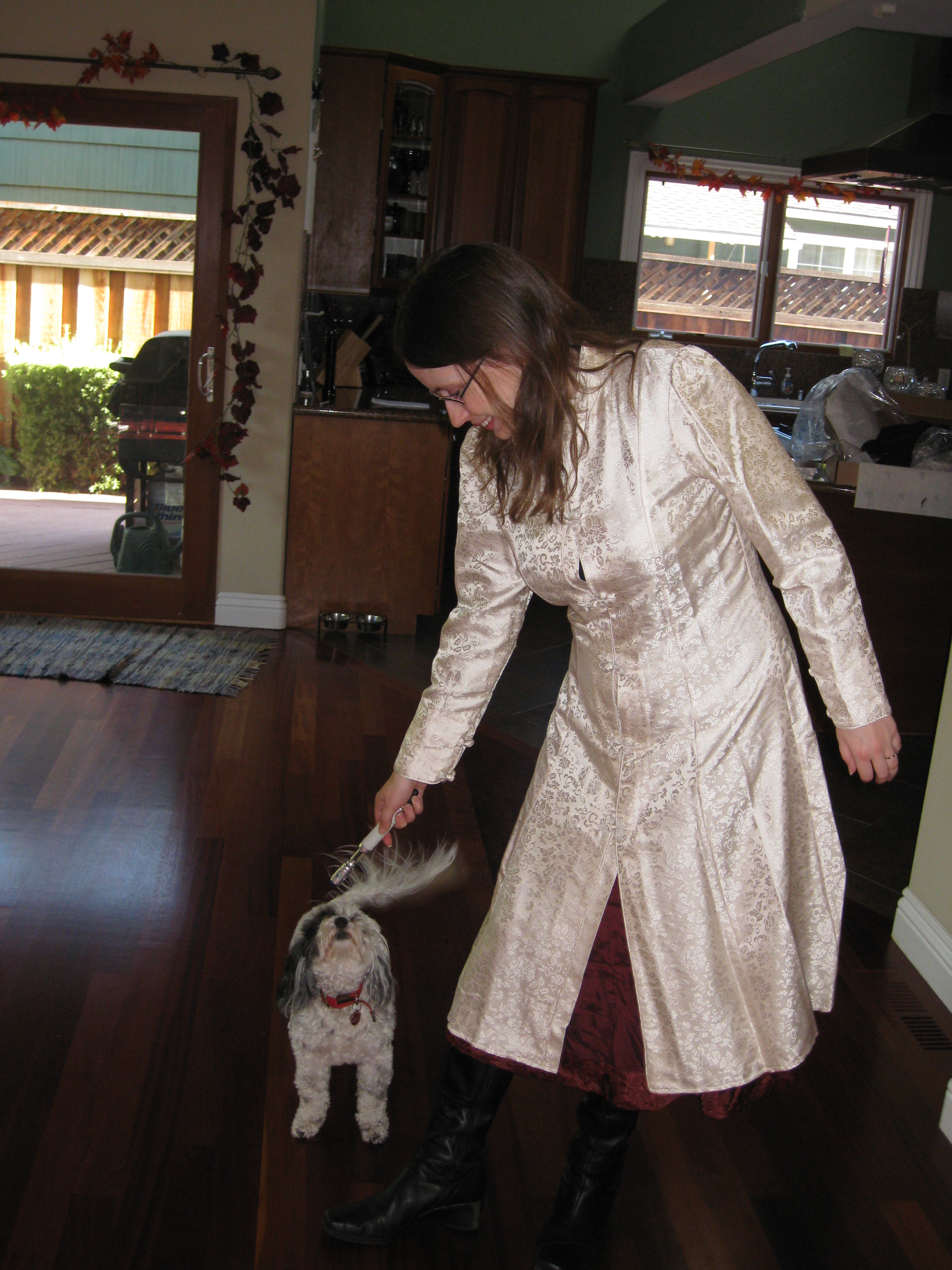
Her name is Nala the Super Hound, and she follows me around the house. She shows a particularly ferocious attitude toward the mailman, the Comcast repair guy, and any solicitors foolish enough to brave our door. She also excels at protecting her pet cow.
 I couldn’t ask for a better partner in crime .
Posted in Polls, Science fiction and fantasy, tagged Firefly, science fiction, Star Trek, Star Wars on July 16, 2010| 3 Comments »
The poll is closed, and the winner is….
ZOE from Firefly!

And no, I’m sure that has absolutely nothing to do with this blogger’s stated preference for Zoe, but rather reflects the amazing taste of my readership.
Runner up: Spock

Which one do you like better, the old or new? I think Leonard Nimoy is too classic to resist.
And, finally, neither Chewbacca nor his Spaceballs counterpart Barf got any votes. Given that my private prediction was that Chewbacca would win (well, either Chewbacca or Spock), I feel just a little bit silly. But here’s a photo anyway, mostly because I’ll take any excuse to post something Star Wars-related.

And that’s your bit of Friday silliness before the much-needed weekend. Next week, I’m planning a series of posts on creativity, so stop on by!
Posted in Science fiction and fantasy, Writing, tagged fantasy, POV, stereotypes, writing on July 14, 2010| 25 Comments »
Mark Charan Newton recently wrote a blog post entitled “Getting Women”. His provocative title caused me to click through and read what he had to say. He talks about having awareness while writing female characters in fantasy, and how he improved at avoiding stereotypes and portraying more realistic female characters in his latest novel. Having not read this novel, however, I am left without concrete examples of *how* he succeeded. Hence my own post with a similarly eye-catching title.
I’m going to talk about a recent example from my writing life. For one of my latest stories, I chose to write it in a first person male POV. This is, in fact, the first time I’ve attempted such a thing in my writing. I adore first person, but up until now, I have always chosen a female voice. Part of this was because I felt more confident that I could get a female voice correct, and part of it, I’ll admit, was my desire to read more stories in the adult science fiction/fantasy genre told from the POV of a woman. Write what you want to read, and all that. (Interesting side note: At Taos Toolbox this year, we had six women students and eight male students. For our first week submissions, we had ten mainly male POV stories/chapters and four female POVs. All four female POVs were written by female students. Food for thought, that.)
But for this particular story, I really wanted a male POV, and it had to be in first person. I was somewhat apprehensive about giving it a try. I decided, in order to avoid complete creative blockage, to not obsess too much about the “maleness” on my first draft. I would do as I usually do and try to inhabit my character’s mind (similar to Method acting), but beyond that, I’d fix any voice problems in a later draft and rely on my writing group to catch the things I couldn’t catch myself.
My writing group critiqued the story last Friday, and I was surprised at how few issues of male vs. female voice they brought up. There were a few, notably a mention of a “champagne pink silk dress” (apparently, men aren’t aware of the color champagne pink. Who knew?) But overall, only a few changes of that nature needed to be made. So apparently my technique of trying to get into the head of my specific character, as opposed to thinking “what would a man say” every five words, worked out mostly okay this time.
Of course, I think what Mark might have been talking about in his blog post is the prevalence of female stereotypes in fantasy. Fantasy readers get to see several cardboard classes of female character: bad-ass in leather, damsel in distress, someone’s wife/mother/daughter/sister who only exists to be angelic and pure or bad and slutty, or be rescued or to show our hero isn’t completely socially maladjusted. The list goes on and on.
Here’s my question: can you think of any stereotyped male character types in fantasy that you find equally boring and/or offensive? Comment below and let me know!
Posted in Life, Society, tagged beauty, feminism on July 12, 2010| 27 Comments »
I’m in the mood to open a can of worms today, so here we go.
I spent the morning at my local eye doctor/eye glasses shop, getting an exam and picking out new frames. It was painless process this time around, which was a pleasant surprise. Picking new glasses frames is the ultimate fashion choice since your glasses are the one thing you’ll always be wearing no matter what (well, except in the pool or in bed), so the choice can be a daunting one. This time, I only deliberated for around twenty minutes, a personal best. It didn’t seem like a big deal.
I remember a time when it was a huge deal because I was hugely self-conscious about my glasses. This was partly teenage and young adult appearance angst, but the outside world gave me no help whatsoever. I lost count of the number of times I was wearing contacts to perform in a show and some well-meaning but horribly insensitive person told me how much better I looked without glasses or passed along some inane comment about how it was too bad I usually hid my eyes. Please note at the time I had no choice whatsoever about wearing the glasses: contacts irritated my eyes so badly I’d be popping them in and out of my bright red eyes all day long, and this was before Lasik was available.
It was worse in college when one of my best friends told me how much better I’d look without them to “desensitize” me from other people’s rude comments. Or when another “friend” said I could never rate above average in appearance because the glasses took away so many beauty points. Or later on, when I was a young twenty-something dating and men would, and I kid you not, reach over and *take off* my glasses, without even asking, before commenting on my beauty. A few years ago, I even had a massage therapist, while performing what was supposed to be a relaxing massage, tell me that I should really consider ditching the glasses because I looked so good without them. Um, backhanded compliment much?
I’m telling you this not to whinge about my past trauma but to make a point: that as a woman, I was constantly bombarded by messages, from individuals as well as from the media, telling me that I could not look beautiful if I wore glasses. The very best I could hope for was a “sexy librarian” sort of look, which, after being subjected to years of being blasted by peoples’ negative opinions about glasses, honestly didn’t make this girl jump up and down for joy.
Since the idea of beauty is socially constructed, maybe these messages were, in their way, correct . Maybe I can never be beautiful in the way that everyone wanted me to be. (And here’s another question: why did so many people seem so invested in me looking a certain way, anyway?) But I don’t buy this imposed estrangement between me and beauty. Today, even though I have more choices (better, more comfortable contact lenses, possibility of corrective eye surgery), I wear my glasses without self-consciousness. They are a part of who I am. Personally, I think I’m just as beautiful with or without some stylish plastic on my face, in the same way that I’m just as intelligent either way. And people making random negative comments on my appearance are not only incorrect, but also rude and therefore do not deserve my attention.
So the next time you find yourself about to comment on how a woman’s glasses affect her beauty, try to see past how you think she’s “supposed” to look and appreciate instead how she does look. Maybe even notice how her eyeglasses enhance her natural features. All of us bespectacled women will love you for it.
 The Practical Free Spirit