Feeds:
Posts
Comments

Posts Tagged ‘priorities’

I have devoted my life to the pursuit of excellence. The Greeks called this areté, striving for excellence, living up to the best of one’s potential, and facing challenges with courage and persistence. I wanted to be the best student. I wanted to become a skilled singer. I wanted to travel around the world. I wanted to be an effective teacher. And now I want to be a masterful writer.

Areté has been one of the driving forces of my life. I care about people and relationships, I care about my health (only because I can’t get away with being indifferent to it), and I care about excellence. That’s not to say I don’t have other interests, passions, and concerns, but these three things I think about every single day.

Here’s the thing about mastery: it tends to be all-consuming. It requires commitment to make your practice one of the highest priorities in your life. It requires patience and fortitude while you struggle to improve. It requires the willingness to be bad (especially when starting out) and the strength to fail.

J.S. Bach--an undisputed master of musical composition.

Mastery takes time. It’s not easy to achieve, and anyone who tells you otherwise doesn’t know what they’re talking about (or they’re looking for a snappy headline that will drive page views or book sales). I used to have voice students come in for lessons, expecting to become fabulous singers with a month or two of lessons (and barely any time outside of that devoted to practicing). Guess what? They never became fabulous singers. They learned some basics, and that’s as far as they went. (Strangely, parents understand this about their kids and usually (although not always) insist on more commitment. Adults were by far the most egregious in terms of thinking singing would be an easy skill to acquire.) Sure, some of my students could skate by on their natural skills for a while, only to eventually arrive at the realization that if they wanted serious chops, they’d have to put the effort in.

Mastery takes focus. I’ve always hated it when people ask me what my hobbies are. The question triggers me to think about how I spent my time. For years, the real answer was: I sing in different genres. I play the piano. I love to sight-read. I compose and write songs. I adore musical theater. I think about educational theories and new ways to help my students learn. I think about the psychology of singing.

Nowadays, I write and I read. I analyze and research and think and learn. I go to bookstores and conventions and signings. It’s not that I have no interests outside of writing, but I have to dig deeper to unearth them for casual conversation, and I have a tendency to relate my other interests to writing in one way or another. Have a bad experience? Well, it will be useful for my writing sometime down the line. Like RPGs or theater? Well, they let me study different ways to structure stories. Travel? Broadens my horizons and lets me envision worlds outside my daily one.

Mastery takes diligence. I love this example of Steve Martin. He devoted himself to learning how to perform live comedy and play the banjo. Then he changed over to making movies. Then he changed over to writing fiction. Then he began to focus some more on the banjo again (and won a Grammy for his efforts). The article (which you should go read because it is super interesting) posits that his success is due in no small part to his practice of diligence.

Commitment. Time. Focus. Diligence. And the dream of someday being able to accomplish what you can only imagine right now.
Read Full Post »

I don’t really like pain, and I don’t like to feel uncomfortable. Sometimes I daydream about my ideal life, when I have fixed all my problems, have everything I want, and am exactly where I want to be in my career.I will never achieve that ideal life. And thank goodness, because if I did I’d be bored stiff…in which case I would have a problem, wouldn’t I?

Seth Godin published an insightful post last week entitled “Trading in your pain,” in which he outlines two common problems we can have due to our relationship with pain.

The first is the “if only” syndrome. We think if only something (fill in the blank) happens, then everything will be great and we won’t feel pain/discomfort/ uncertainty anymore. If only I meet the right person. If only I buy the right house. If only I remodel. If only I get an agent. If only I sell my first novel. If only my sales figures exceed a certain golden number. If only I win this award or make that bestseller list. If only I get this promotion. If only I was better or had more or …

That’s not generally the way things work, though. Whatever “if only” you’re hoping for (and I’m holding out for several myself), even if it happens, it will open the way to new challenges, new problems, new if only’s, and new pain as you strive. That’s okay. It doesn’t mean you’re not doing well. It doesn’t mean you’re not good enough. It’s just life.

The second is the “fear of change” syndrome. We sometimes become comfortable with a certain flavor of pain or discomfort, and we hold onto it really tightly so we won’t have to deal with another, unknown flavor instead. We become frozen. Stagnant. Afraid of success and the new problems success will bring us. Afraid of a different failure mode and how that will make us feel.

Behind the GateWriters who don’t write are having this second problem. They are used to dealing with the failure mode of “I suck because I’m not writing” and don’t want to address whatever issues might come up if they actually did write: “I suck because I’m not selling” or “I suck because I’m not selling enough” or “I suck because now I have to make business decisions” or whatever.

But I see this problem everywhere, not just in writers. We make ourselves at home with a certain problem, and settle in for keeps. And in the process, we get stuck. We can’t move on; we can’t grow.

Our identity and our personal narrative become entwined with our pain. I’m the girl whose mother died when I was only nineteen. That’s not who I am anymore. It is, however, who I could have been. It is who I was for a period of years. And then I let go and moved on. Instead I’m the girl who loved her mother very much.

Pain can be your friend. It will be lurking nearby for your entire life, and that’s okay. It means you’re alive, and it reminds you that you care what happens. It can push you forward instead of holding you still. It can give you focus instead of causing you to scatter. It can make our priorities clear to us.

If you could shed one “if only” or do one thing that makes you frightened, what would it be?

Read Full Post »

At this time of year, I always feel like I’m straddling the flow of time. Half of myself is looking backwards and evaluating what has gone on before, while the other half is looking forward to what the next year may hold for me. I don’t make New Year’s resolutions per say because I prefer a continuous evaluation process, but thinking in terms of units of time can be helpful when trying to look at the bigger picture of my life.

So, without further ado, here are a few reflections on 2011 and few wishes for the year to come.

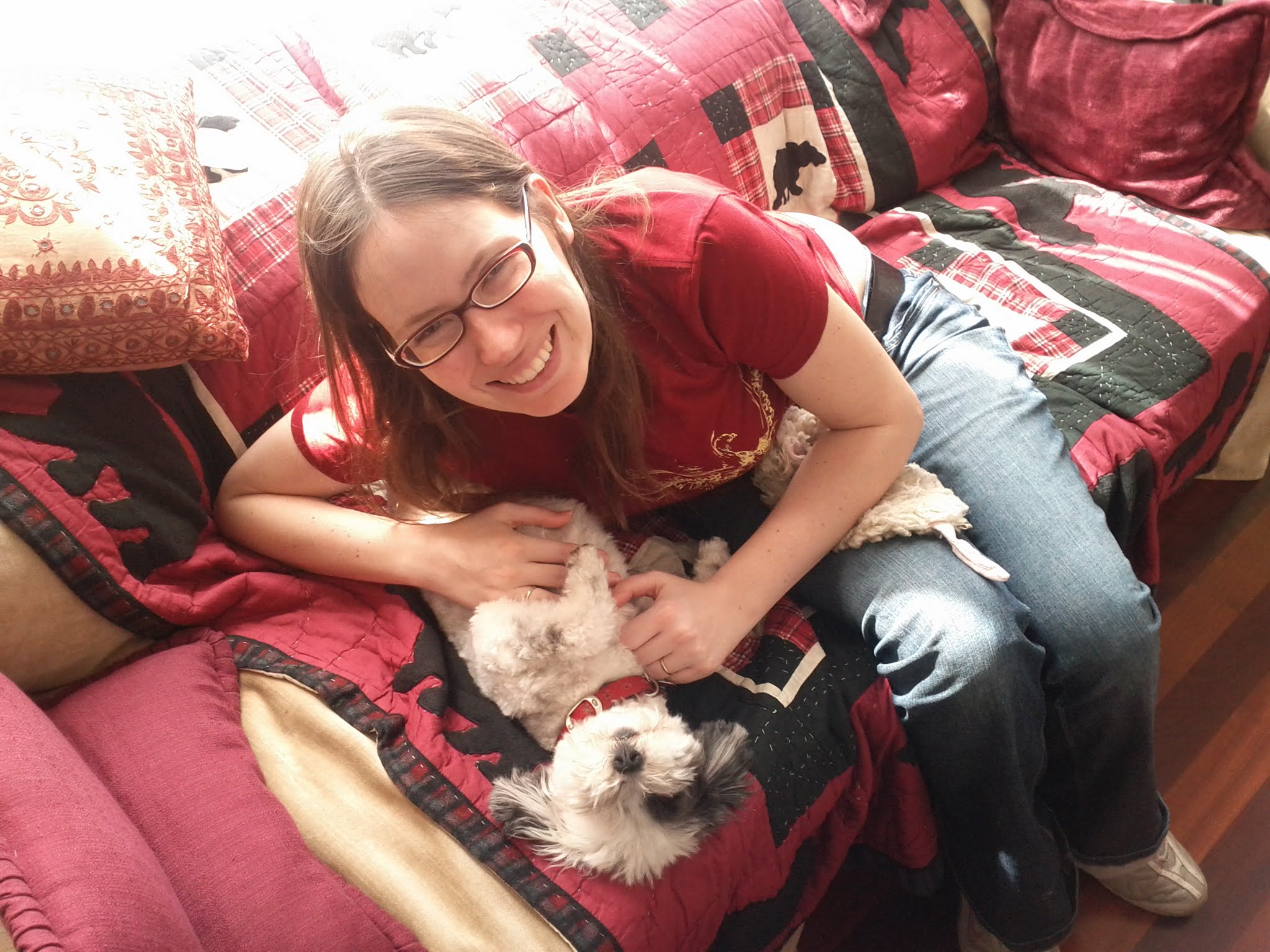
Cute little Nala and me

Writing:

2011 was an exciting year because it was the first year I had something published, thus realizing a dream I have cherished since I was seven years old. Hooray! In fact, I had three short stories published this year, one of them to a pro market. I was also able to join SFWA as an associate member.

My wish for 2012 is that I am able to use the lessons I learned this year to increase both my productivity and my enjoyment in writing. (Being greedy, I also wish for more sales.)

Health:

The first half of 2011 was dominated by crazy dental problems. While that silly crown still often aches, the level of pain has subsided to the realms of the tolerable. I also had more ankle problems. But on the plus side, my knees continued to improve in a most pleasing fashion. I also began to eat more healthily, trying to limit my consumption of saturated fats in particular, and have done fairly well with it (although not when traveling. Eating healthily when traveling is ridiculously hard).

My wish for 2012 is to keep growing stronger so I have less overall aches and pains, and to continue following my moderate diet.

Travel:

2011 was the first year in a long time that I didn’t leave the country. Various health concerns dampened my travel ambition somewhat, and I mostly stayed close to home. My favorite trip of the year was my first time in Washington D.C. in March. I would definitely return there for a follow-up visit someday. We also attended the Shakespeare Festival in Ashland, Oregon, visited Disneyland with friends, and relaxed over Thanksgiving at our favorite Maui vacation spot.

I was able to attend five writing conferences and conventions, two local and three an easy traveling distance: Potlatch, FogCon, SCBWI LA, WorldCon, and World Fantasy. I particularly enjoyed attending the inaugural FogCon and moderating my first two panels, and catching up with my wonderful writer friends (and making new ones) at the larger conventions was fabulous as usual.

My wish for 2012 is to leave the United States. We’re thinking either Japan or certain favorite Western European locations…

Personal Growth:

I wrote about the two most important lessons I’ve learned this year last week. I feel like I’ve made a fair amount of progress on the people pleaser front and have developed a stronger backbone. I’m more likely to stand up for myself and less likely to take responsibility for everyone else. So, yay!

My wish for 2012 is to continue tackling my vicious perfectionist streak and to do further work towards trusting myself and my abilities. I’d also like to be able to reach out more to other people.

Happy upcoming New Year, dear readers! What are your wishes for 2012?


Read Full Post »

Gather ye rose-buds while ye may;
Old Time is still a-flying;
And this same flower that smiles today,
Tomorrow will be dying.
~Robert Herrick

Regular readers of this blog know that I often espouse a carpe diem philosophy. I talk about seizing the day, doing what you want to do, following your dreams and sculpting them into reality. But how does time fit into the equation of this free spirit paradise?

I wish I believed that we could decide to follow our dreams today, and that tomorrow those dreams would be a reality. Or that we could decide to change ourselves today and be completely different people tomorrow. Or even that we could make absolute statements about what an hour of any given experience might be worth. But so often, that is not the way that the world works.

Let’s say I decide I want to be a fine pianist, maybe even an exceptional one. Whether or not we subscribe to the popular notion of 10,000 hours of practice to master a new skill, I don’t think any of us would argue that it would take time, energy, and commitment to learn to play the piano. First we have to learn the fundamentals: how to read music, how to feel and count rhythm, mastering new vocabulary, how to move our fingers on the keys, etc. Then we have to learn ever more complicated pieces, build up muscle memory and finger dexterity, and discover the difference between rote playing and artistic playing. It takes years to become a very fine pianist, and even more to become exceptional. So how do we reconcile these years of effort with seizing the day?

I think the answer is that we have to find pleasure in the daily tasks. While we might not enjoy drilling scales, we might find satisfaction in mastering them. And as a reward, we may allow ourselves to practice Schubert, whom we absolutely adore playing. The idea behind living life to its fullest is not that every day has to be a potpourri of incident and excitement (the people who want this are probably not going to be found practicing piano ten hours a day). It’s that you are spending at least a portion of every day on activities in which you are invested (you know, in between taking a shower and playing Angry Birds).

Time is not the absolute it sometimes appears to be, and some things cannot be rushed through. Forgiveness takes time. Building a relationship takes time. Figuring out what we want takes time. Getting to know ourselves takes time. Becoming skilled takes time. Making change takes time. Sometimes a long time. And we face judgment for not accomplishing these sorts of difficult tasks fast enough. But which is more valuable–doing something right or saving time? Saving time is not always the answer.

Since my mother died, I’ve had people tell me that they’re sure I’d give anything for even just another hour of her company. On the surface, this sounds like a no-brainer, especially since I was very close to my mom. But even this statement ends up being superficial. My mom spent her last week mostly unconscious and obviously in horrible pain and discomfort. Would I give anything for another hour in that week? No; in fact, I’d give a lot to avoid another hour in that week. It follows that the quality of the time is as important as the quantity. There are moments I had with my mom that I wouldn’t trade for days with her.

Our society tends to teach us to value more time, save time, and avoid wasting time. But sometimes less time is more. Some tasks cannot be rushed through. Sometimes seizing the day means slowing down and doing what is needed. Should we put off our dreams indefinitely? I don’t think so, but we also shouldn’t expect them to come true without investing time and effort into them.

In what dream are you putting your time?

Read Full Post »

I often pretend that I’m eighty years old.

When I was eighteen, I went away to college and began studying music. My life wasn’t ideal: my mom was diagnosed with terminal cancer that year, I had wicked insomnia, there were various college dramas to deal with, I had a bum ankle and was constantly sick, I wasn’t always making the progress I wished to make. But I remember very clearly walking home from the music building one spring day. I could see the ocean as I left the building, the sun was out, I was surrounded by beautiful redwood trees, and I was able to spend all my time studying music, which I was truly passionate about. And I thought, “There is nothing I’d rather be doing with my life right now.”

That’s a powerful thought, isn’t it? I decided then that I would try to live as much of my life as possible in the same way, and that is still one of my goals today. There are many things that I was wrong about when I was eighteen, but that wasn’t one of them. One of the ways I can check on myself and see how I’m doing is to pretend that I’m eighty. Whenever I’m making a decision or evaluating something I’m doing, I ask myself: How will I feel about this when I’m eighty? First of all, will I even remember it? (If the answer is no, then it’s probably not all that important, and if nothing else, I can bring down my worry level a notch or two.) If I do this, will I be glad I tried it when I look back at my life? Will I regret passing up this opportunity? Or will I wish I’d played it safer or made a different decision?

I was talking to a former student the other day who has decided not to pursue music professionally, at least for right now. She went to professional school for musical theater for a while and began to hate it, even though she had previously been amazingly passionate about the subject. So now she is studying a different subject. And you know what? Even though she ultimately changed her mind, I think she did the right thing going through the musical theater program. Because if she hadn’t, then when she was eighty, she might have regretted not pursuing her dream. Now she knows that she doesn’t want that kind of life, and she can move forward without regrets.

From photobucket.com by notapooka

According to this article, one of the top regrets of people on their deathbeds is not having followed their dreams. (I highly recommend you read the entire article.) Of course, we can’t always be doing exactly what we want to do. No one wants to sit around recovering from a root canal gone wrong or clean the bathroom or deal with any of a whole host of problems and difficulties that are part of our daily lives. But I think all the unpleasant parts are rendered more manageable if we can find and highlight the aspects of life that are so wonderful to us that they dwarf all else. For me in college, that passion was for music. Nowadays, I find it in my relationships, in writing fiction and this blog, in teaching, in travel. When I’m spending time on any of those things, I get the same feeling, that there is nothing else I’d rather be doing.

Steve Jobs gave a great insight in a Stanford commencement address that I think about a lot:

When I was 17, I read a quote that went something like: “If you live each day as if it was your last, someday you’ll most certainly be right.” It made an impression on me, and since then, for the past 33 years, I have looked in the mirror every morning and asked myself: “If today were the last day of my life, would I want to do what I am about to do today?” And whenever the answer has been “No” for too many days in a row, I know I need to change something.

Remembering that I’ll be dead soon is the most important tool I’ve ever encountered to help me make the big choices in life. Because almost everything — all external expectations, all pride, all fear of embarrassment or failure – these things just fall away in the face of death, leaving only what is truly important. Remembering that you are going to die is the best way I know to avoid the trap of thinking you have something to lose. You are already naked. There is no reason not to follow your heart.

So now I’ll ask you the same questions: if today was the last day of your life, would you want to do what you’re doing? When you’re eighty, how will you feel about the decisions you’re making today?

Read Full Post »

My husband found this really fascinating paper entitled “If Money Doesn’t Make You Happy Then You Probably Aren’t Spending It Right.” Since I recently visited the topic of the connection between money and happiness here on this blog, I simply had to devour the entire article. It is, however, quite long, so I am going to choose a few salient points to discuss here.

Photo by Michael Porter

First off, the article says that people with more money aren’t that much happier than people with less, but that they are generally more satisfied. I found this distinction interesting because on first thought, I wouldn’t have thought the two states were really so different. But of course they are. We can have all the stuff we want, we can have the funds to take trips around the world, eat fancy food, and afford other experiences we desire, and be very satisfied that we can do and have all of this. It doesn’t follow, however, that this satisfaction will result in increased happiness, hence the stereotype of the poor little rich girl who has everything money can buy and yet is completely miserable. There are serious problems that have nothing to do with money.

Apparently happiness also depends a lot on our past and future relationship with a given expenditure. Anticipation greatly increases happiness, sometimes more than the actual purchase or experience. I’m going to climb out on a limb here and suggest this has something to do with positive reinforcement, ie I’m excited about my trip to Ashland, I’m thinking about it with excitement, and therefore I’m more likely to approach other aspects of my life in a positive way, which creates a happiness feedback loop. I can definitely experience a stress feedback loop (I’ll be feeling lots of stress and therefore everything seems more overwhelming, even things that would normally be no big deal, creating more stress, etc.), so why not a happiness one as well?

Fond memories of an expenditure will also increase overall happiness, which offers one explanation for why people love to show photos from their past travels and happy occasions. For example, I have wedding pictures and presents scattered throughout my living room that regularly remind me of that event. This is one reason experiences tend to trump material items in the happy-making: we’re more likely to think back to an amazing experience than to an item (to which we have grown more accustomed).

Another point the article brings up is the power of the little things to affect our happiness. The authors suggest making many small purchases instead of a few big purchases. I don’t completely agree with this point because, as we just discussed, often big purchases (trips, weddings, etc.) cause more anticipation and memory, both because we’re excited about them and because it takes longer to save up for a big purchase, increasing the anticipation even further. But scattering smaller purchases throughout our lives (a special coffee drink, a new favorite song or piece of sheet music, a massage, going to a movie) keeps us savoring the texture of life while offering much-needed variety. Of course, appreciating the small things affects happiness whether money is being spent or not, which is part of the beauty of it.

Ultimately what this article leads me to think is something I like to say anyway; namely, that we can contribute to our own happiness through learned strategies, introspection about our priorities, and being present to enjoy both the everyday moments of happiness and the rare, large thunderclaps of happy. Money takes away worries, but it doesn’t automatically bring happiness in their stead. That is something we have to do for ourselves.

What is something little that has made you happy today? For me, I’m wearing a scarf in this fabulous shade of purple that my husband bought for me on our trip to London last year and gave me for Christmas. So I have a warm neck, and every time I look down, I think, “What a great color. What a great husband. What a great trip. Christmas!”

Read Full Post »

In the book about plot I’m reading (20 Master Plots, by Ronald Tobias), Mr. Tobias talks about how plot and structure in fiction differ from real life. In real life, he says, there are not the same links of causation. Life is chaotic and sometimes (even often), things occur because of chance and wild coincidence (whereas in fiction, it’s really hard to get away with coincidence and generally denotes sloppy plotting). Some loose ends never get wrapped up in real life, we never know the true “ending”, and much of what happens seems to be without meaning and never gets explained. The Absurdists try to reflect this random reality in their literature: Camus and Kafka are two well-known writers who do this well. (And incidentally, you know who else identifies as an Absurdist? Joss Whedon. An explanation for Puppet Angel, perhaps.)

From the TV show Angel

Theodora Goss, who has a beautiful blog, has a slightly different view: “Happiness is the ability to create satisfying stories about reality. To find the stories that fulfill you, that allow you to achieve what you desire. That fill you with joy. Because reality is, to a certain extent, our perception of it. Achieving what you desire may also involve altering reality itself, changing your circumstance.”

I’m inclined to agree with her. The power of storytelling is making order from chaos and meaning from seemingly unrelated events. But stories don’t merely reside in our books and entertainments. We are constantly telling ourselves our own stories, and in so doing, we are cementing certain events into memory and into part of who we are. By doing this, we construct a reality that no longer appears quite so random and out of control.

We are in the continuous process of creating ourselves. “I’m the person who did xyz. I’m the person to whom this happened. I’m the person who spends my time in this way. This is what is important to me.” That’s why I’m always harping about the importance of priorities. Because priorities are a way of expressing deep truths about ourselves and making our most important desires into reality.

Humans as a species are fascinated by the quest for meaning. This desire for meaning is reflected in many aspects of our culture: in our art, our religions, the Enlightenment and our fervor for science, and our ease of slipping into diametric thinking (black and white, good and evil). We spend our lives trying to make sense of our childhoods, the people around us, and the huge life-altering events that intrude into our sense of order (war, natural disaster, illness and death, wide-scale oppression and resistance). We ask, why are things the way they are? How does the universe work? In what direction is human civilization heading? Or, more personally, why doesn’t So-and-so like me? What is my purpose in life? What will make me happy?

We have to be very careful with the stories we tell ourselves, the movies in our minds. (You can thank Miss Saigon for that pretty turn of phrase.) If we tell ourselves negative stories or harshly self-critical stories, these stories will eventually manifest themselves, often in self-limiting behaviors and self-fulfilling prophecies of gloom and unhappiness. If, on the other hand, we tell ourselves that we’re geniuses who can do no wrong, we can become out of touch with the humanity around us and struggle to find compassion for others.

On their own, our lives do not fit together neatly into a perfect puzzle of reality. We create the frame of reference from which we can understand ourselves and the world around us. We make our own explanations and our own meaning. What this means, I believe, is that ultimately we choose the slant of our lives until we die. Are we empowered? Can we make change? Or are we victims or characters in a tragedy, or are we taking an active role in life? Can we find the good in our situation and encourage it to grow? Or is everything about life difficult and glaring and out to get us?

In the movie Holiday, the old screenwriter Arthur tells his friend Iris that she should be “the leading lady” of her own life, but for some reason she is behaving “like the best friend.” We each have that choice in the stories we tell ourselves. Are we the hero of our tale, or are we relegating ourselves to a supporting role?

Be the hero. Be the protagonist. Be the person who acts instead of the person who is acted upon. We are all leading ladies and men. And we each get the privilege of creating the stories of our lives.

Read Full Post »

Photo by Werner Kunz

I attended a birthday party a couple of weeks ago, and I had a conversation that’s become stuck in my mind. I was talking to a friend who was foregoing travel for a period of time (maybe a couple of years) in order to save up for a car he really wants. He said something like, “I always prefer spending money on things instead of experiences because I can keep on having great experiences with material objects for a long period of time.”

This statement caused me to begin questioning the culture of consumerism and my own relationship with the materialistic world. If questioned, I would have answered the exact opposite of my friend, that I prefer to spend money on experiences because those experiences will make me happier and more engaged in my life as a whole. There’s even research supporting my viewpoint.

But it’s not that simple, is it? I like material things as well as anyone else. My husband and I own a house, and we just purchased a new car since my old one (a ‘95 Corolla) has become finicky in its old age. Plus I have my three consumer weaknesses: books, sheet music, and clothes & jewelry. Hence the main storage problems in my house are bookshelf space and closet space.

I remember when I was starting my studio business, and I had to strictly prioritize my budget to make my earnings stretch. I allowed myself to buy sheet music (within reason) because I used it in my business. I only bought books on special occasions (thank goodness for libraries), and pretty much only mass market paperbacks even then. I did go clothes shopping, but I was careful to visit stores like Mervyn’s, Target, and Ross, where my money would go a lot farther.

In return for this thrift, I allowed myself experiences that I desperately wanted. I always allowed myself gas money if I wanted to drive somewhere to visit friends or enjoy a particular sight. I’d occasionally splurge on a dinner out with friends. And I’d save everything else for my annual trip abroad—the experience of travel and seeing other cultures was my highest priority. Sometimes I wished I could buy “pretty” things, but more often I worried about unexpected medical expenses taking away my travel budget. Experience trumped all.

One year, however, after I had received some gift money, I splurged and bought the complete set of Buffy the Vampire Slayer DVDs. I was so excited about this purchase, and I don’t even know how many times I’ve watched those DVDs—over and over, and I’m sure I’ll be watching them many more times in the future. So I understand what my friend meant about material objects giving lasting pleasure. What about a good piano? Does that count as a material object or do we purchase what a piano represents: the experience of making music? And driving in an expensive car (like my friend wants) is a completely different experience than driving my rattling old Corolla.

I wonder how often when we’re spending money on something material, what we’re really buying is the experience the object represents. I think I’d personally still prioritize straight-up experience expenses over more object-oriented ones: a night at the theater, a delicious meal, being able to spend time with non-local friends, traveling around the world. But perhaps my friend and I aren’t so different in our thought processes after all.

In which case, here’s the lesson I’m taking away from this: if I am making a purchase, I will try to remember to stop and consider what experience a given object represents, and then decide whether it is an experience that I truly want and that the object will actually deliver.

Objects are never going to be what makes me the happiest, however. My husband, my dog, my friends, intellectual stimulation and challenge, music and stories—these are the most important to me.

Which do you prefer—spending money on experiences or physical objects? Care to share a particularly memorable experience or purchase? I’m all ears.

Read Full Post »

Last week we talked about thinking of writing as a business, which includes educating ourselves about the industry and making informed choices. Today I want to talk about something that keeps us from making clear-headed business decisions. 

Desperation.

Desperation rears its ugly head for most writers, often (although not exclusively) toward the beginning of a career. We want so badly to be published, to be chosen, to have public validation that we aren’t wasting our time. We want to get our words and stories to the public. We want to be able to tell our friends and acquaintances, “Why, yes, I have an agent now. And Big Publisher XYZ wants to buy my novel.” Or “Why, yes, my indie-published novel is on the Kindle Best-seller List now, thanks for asking.” We want to know that we’re moving forward with our craft and not staying stuck in a hellish holding pattern. We want we want we want.

Some amount of ambition and desire for success is healthy. It might keep us on a daily writing schedule or encourage us to continue sending out those queries. It might motivate us to improve our craft or take a workshop. But it’s so easy to cross from these helpful impulses into the dark side of desperation.

The danger of entering that desperate place is that our decision-making process becomes impaired. Instead of making practical, well-reasoned decisions, we’re suddenly willing to do almost anything to see our work in print. We’ll sign with an agent even though we either haven’t done thorough research on the agent’s history or have a bad feeling about the working relationship. We’ll sign a publishing contract even though it offers poor terms. We’ll rush into self-publishing our novel electronically without enlisting first readers and/or editors to help us make the book the best it can be. We’ll say something best left unsaid on the social media of our choice because we’re so stressed/insecure/jealous/upset that we just can’t help ourselves.

Acting from a place of desperation is the opposite of acting from empowerment. It doesn’t matter whether you’re dealing with a traditional publishing structure or taking the indie path. In either case, desperation will lead to poor decisions (unless you’re very, very lucky). Desperation will tempt you to devalue yourself and your work and believe me, you don’t want to go down that path.

So what is a poor writer to do? Stop. Breathe. Try to convince yourself that you’re not in a race and you don’t have to hurry to the detriment of everything else. Avoid comparing yourself to other writers who are doing everything better, faster, with more shiny. Avoid it like the plague. Postpone any big decisions until you can talk yourself into a calmer state of mind.

And remember you’re not alone. I think writer desperation is very common, but we don’t always talk about it. I am writing this to tell you that I have felt it, I have been there, and I might very well be there again. All of the doubt and the waiting and the anxiety and the rejection and the lack of understanding–it SUCKS. Of course we sometimes feel desperate. But we don’t have to give the desperation the power to take over our lives. We can feel it and then keep going, keep trying, keep believing in ourselves. And we can do our best to make our business decisions based on the facts and our priorities instead of on a crazy-making emotional state.

Does anyone else ever experience writer desperation? Have any good tips on how to avoid it or deal with it once it’s happening? Please share!

Read Full Post »

When I decided a few years ago that I was going to get serious about my writing, I knew I was going to be writing novels. Novels were, after all, the bulk of what I read. I sat down and wrote a novel to prove to myself that I was capable of doing it.

That’s when I actually became serious about writing. I knew I had the discipline, I knew writing was something I enjoyed and found satisfying. And I fell in with a genre critique group and said to myself, “Oh, I’m supposed to be writing short stories too. Sure, I’ll give it a try. After the novel, how hard could it be?”

Cue the laugh track. Yes, I was being stupid, but I figured out my own stupidity soon enough. I wrote a short story, and it was very hard. So much worldbuilding for so small a project! It drove me nuts. And then I had to rewrite the story, and rewrite the story, and it didn’t matter how much I rewrote this stupid story, because it was never going to work.

Over the course of the next year, I wrote more stories (although perhaps not as many as I should have). At some point I got the bright idea that I should also be reading short stories. (I know. Genius at work here.) That entire year, I hated writing short stories. I actively disliked it. I wasn’t even sure why I was doing it (probably stubbornness). I told myself that short stories didn’t matter anyway, because obviously I was meant to write novels.

Then I finally worked on a story that I enjoyed writing (probably not coincidentally, the one I just sold). I thought to myself, “Maybe short stories aren’t so bad. I mean, they’re annoying, but they have their good points.” I wrote more short stories.

Yesterday I found myself thinking, “You know, even if I got a book deal right now,” — for the record, this is impossible as I have nothing out on submission, but a girl likes to dream — “I’d still want to keep writing short stories.” I stopped and realized what I had just said, and shook my head at myself.

Why am I telling you this rather long story? Because so often we pigeonhole ourselves. Sometimes this can be useful to keep focus and make sure we’re prioritizing our goals, but sometimes we accidentally limit ourselves instead.

It’s especially easy to limit ourselves when we start something new and, surprise surprise, we’re not very good at it. It’s so easy to say, “I don’t like this anyway” or “This is too hard” or “I’m going to do shiny thing z instead.” I’ve seen this over and over as a music teacher. A lot of students thought they wanted to learn how to sing, but once they realized that singing is difficult, that it requires hard work and practice and dedication and failure, many of them would drop out. (Especially adults. It always seemed especially surprising to the adults.) A lot of my children students didn’t enjoy practicing the piano because it was hard and they weren’t very good. If they stuck with it for awhile, though, and were able to pass a certain threshold of competence, all of a sudden playing the piano became much more pleasurable.

I think a lot of pursuits are like this. When we’re starting out and don’t have many skills, it kind of sucks. But then as we start to improve, it gets more and more interesting and exciting. Remembering this helps us keep trying when we’re still in the stage of unpleasantness.

Has anyone else had an experience like mine? Care to share?

Read Full Post »

« Newer Posts - Older Posts »