Feeds:
Posts
Comments

Posts Tagged ‘priorities’

I was talking to an old friend this weekend about the meaning of life. You know, the way you do. It wasn’t even ridiculously late at night, and we didn’t take the morbid side path that’s usually an option in such conversations. The next day I happened to read Theodora Goss’s “Feeling Alive,” and so here we are, delving back into one of my favorite topics.

One of Dora’s main points is that there is the Frankl theory about meaning (projects, connections with people, and attitude) and then there is the Campbell theory that it’s more important to have the feeling of being alive than to know the meaning of life. (Does this make anyone else think of Sondheim’s song “Being Alive?”)

While there is an overlap between these two, many of the little things in life that I appreciate so much fall into the “Feeling Alive” category. Feeling alive can be a very physical experience, even hedonistic, whether we’re talking about having an amazing foodie experience or jumping out of an airplane or traveling around the world. Waking up after a good night’s sleep, sitting in the sun, hiking in the hills: all of these experiences remind me that I’m alive.

Photo Credit: Spencer Finnley via Compfight cc

And then there’s art, which in my experience falls squarely into both categories. Because art makes me feel more alive AND it is often through art (both creating and appreciating) that I find my own meaning. And I think those things that do fall into both categories have particular resonance for many of us.

What I don’t think is that every category like this is going to have the same resonance for everyone. And I also reject the notion that there is only way to find meaning for all of us. Finding meaning through art isn’t going to be right for everyone. Finding meaning through having kids and raising a family isn’t going to be right for everyone. Finding meaning through saving lives isn’t going to be right for everyone. (For example, I am sadly way too squeamish to ever have made it through medical school.)

But when we find something (whatever that something is) that works concurrently to make us discover our meaning and feel more alive in the process, then we’re onto something important.

I feel lucky because from a young age I realized art and meaning were intimately connected for me. For a long time I envied other people who had practical aspirations and knew what career they were going to pursue, especially when the career in question had a relatively straightforward path to success. Art isn’t like that. Art isn’t usually straightforward, and art is never a sure thing. But art has always been my personal pathway to fulfillment, and now I realize how precious that really is.

I’m saying art instead of writing because I was a musician before I started writing seriously, and my connection to my music felt much the same. I had a short period of time in my 20s in which I wasn’t engaged in any art whatsoever, and even though I’ve lived through much harder times, that period of time stands out in my memory for its relative bleakness. I realize now that is because that has been the only time I’ve been without much connection to meaning. I just kind of did things to do them, with most of the passion leached from them. Without my meaning, I also felt less alive overall. It was an eye-opening experience for me, and one I’m not eager to repeat.

What did I learn from it? That art makes me happy to wake up in the morning. Art inspires me and challenges me and keeps me from getting bored. As long as my relationship with art continues, I have meaning built into my life. It is a very intimate experience, one that both encompasses outside influences and all the people I’ve met and one that excludes them because the art goes on with or without them.

Which do you think is more important: finding meaning in life or feeling alive? Or are they linked, as they are for me?
Read Full Post »

“You can’t ever know in advance. Big decisions require faith.”

– from S., by J.J. Abrams and Doug Dorst

Today I decided where I’m going to live for the next year.

I’ve had to move many times in my life, and as I look for a place, what I’m always waiting for is a certain feeling. It’s a sense of rightness, a sense of “Yes, this is my home.”

There’s nothing mystical about this feeling. I think it happens when enough aspects of a place line up with what I want. I think carefully about I want ahead of time too: how much I’m willing to spend, what features are absolutely non-negotiable (pet-friendly, space for my piano), what features are exciting bonuses (walk-in closets, lots of light).

When I see enough of what I’m looking for, when all the little details filter through my brain, the feeling begins to wash over me. It’s a vision of a future where I can imagine myself being happy and safe, where I can imagine Nala being her usual happy doggie self, where I can see myself writing and making music and being surrounded by friends.

The most important part of home.

The most important part of home.

The build-up to this decision takes forever. Not only do I have to seriously think about what I want, I have to do lots of research, go see a bunch of places, and adjust my expectations according to what’s available. But the decision itself is easy. I just know. I’d decided to take my next home by the end of my tour. All that was left to figure out was the details.

Big decisions can be so overwhelming, because we can’t know. We can’t know how it’s going to work out. We can’t know for sure if we have all the information we need to make the best decision. We can simply try our best to learn the relevant facts and then take the leap.

When I look back, it’s amazing how many of the decisions I’m most happy with in retrospect are ones about which I just knew.

I just knew Nala was my dog.

I just knew I wanted to be a writer.

I just knew I wanted to go to school at UC Santa Cruz.

I’ve just known when I’ve met several of my friends that they were people I wanted to be in my life.

I just knew which writing project to work on right now.

That’s not to say these decisions didn’t also involve dithering. That’s not to say I had no doubts. I dither; it’s part of my process.

But when it came time to commit one way or another, I just knew. And that knowledge gave me the courage to take the necessary leap.

Looking back on your life, when have you just known?

Read Full Post »

I’ve been noticing lately how often anticipated regret plays a role in the decision-making process.

Regret can be a helpful emotion, however unpleasant it might be. After all, it is when we feel regret that we might take a closer look at ourselves and our priorities and decide if there are any changes we want to make. Regret can potentially push us to improve ourselves and our situations.

But making decisions to try to avoid regret in the future is a recipe for self-limitation, as is discussed by Jeremy Dean in his post The Power of Regret to Shape Our Future:

“Anticipated regret is such a powerful emotion that it can cause us to avoid risk, lower our expectations, steer us towards the familiar and away from new, interesting experiences.”

I’m in the middle of making a major decision myself, and I notice my fear of regret coming into play big time. I have three basic choices, and whenever I think of any of the three, my first thought is about the potential regret I’ll feel in the future. Unfortunately, this is more a recipe for paralysis than it is a viable decision-making strategy. Not surprisingly, the decision I perceive as the least risky in the long term is also the one that is the most boring and playing-it-safe.

Photo Credit: YanivG via Compfight cc

What’s particularly interesting to me is that I’ve made a lot of decisions in the past, and I actively regret very few of them. Even the ones I do wish I’d made differently aren’t black and white: they usually did give me some benefit, even if only that of more knowledge. But when considering feeling regret in the future, I don’t have the gift of hindsight to see both sides, so I’m much more likely to be caught in the trap of only considering the negatives of regret while forgetting the potential positives that haven’t had a chance to happen yet.

It’s also easy to overestimate how unpleasant and lasting the worst case will be. We think we are shielding ourselves from the harm of having something so negative come to pass, when in reality we are exaggerating in our eagerness to avoid a regretful result. This too can distort our decision-making process and dissuade us from taking risks.

I don’t know what decision I’m going to make for myself, but I hope I can keep fears of future regret on the back burner while I’m making it. When I shove those fears aside, I realize how lucky I am to have more than one option, all of which have a decent chance of making me happy.

Read Full Post »

On Tuesday, Robert Jackson Bennett and I started following each other on Twitter, and we chatted a bit, the way two writers on Twitter are wont to do. He mentioned that he wanted to write a blog post about his anxieties about death at some point, and I encouraged him to do so in spite of his reluctance. In fact, I said if he wrote the post, I would write about it too.

I kind of didn’t think he would do it. But he wrote this beautiful post, which is very much worth your time.

So. Here we are. And I have to keep a promise to write about death.

I’ve been afraid of death since I was eleven years old. At that time, my mom was clinically depressed, and she was suicidal. Death, I understood, could come at any time, and it was very, very real. All of my questions about death, all of my uncertainties, came with the very high stakes of immediate relevancy.

I hear that teenagers have this period of time in their development when they think they’re invincible. I never had that. I knew I could die. I knew life was an appallingly fragile thing, and I knew tomorrow might devastate me, leaving a hollow scream where my heart had once been. I knew tomorrow might never come.

I knew there was nothing I could do about it. I tried anyway, of course. I watched for signs of imminent doom. I learned to read people. I was inconveniently present. I sang “Candle on the Water” over and over. I never let my mom leave the house or go to sleep without telling her I loved her. It wasn’t enough. It was never enough. But it was all I could do.

When you live like that for long enough, it changes you. By the time my mom died of cancer eight years later, I had formed an intimate relationship with death and uncertainty. And one way this anxiety about death manifests itself is in my relationship with time.

You see, I never feel like I have enough time. Surprisingly enough, this hasn’t resulted in me being a workaholic or dashing around an overscheduled life. What it does mean is that I’m very aware of the passing of time, and I care about doing what’s important to me right now, or as soon as possible to right now.

It also means I hate wasting time doing things I don’t think are important. I don’t like running errands. I am the worst carpool participant I know because I calculate exactly how much longer I’ll be driving instead of already being at an event or doing the next thing I want to do. I don’t like how long it takes to clean my house or brush my teeth or cook my food. I get very restless when I’m waiting. Meanwhile, I am perfectly happy spending hours talking to a friend or walking around with my dog or practicing singing or writing or teaching a student or sitting on a plane so I can see or experience something amazing. I am either approaching infinite levels of patience or else I’m struggling to find any patience at all.

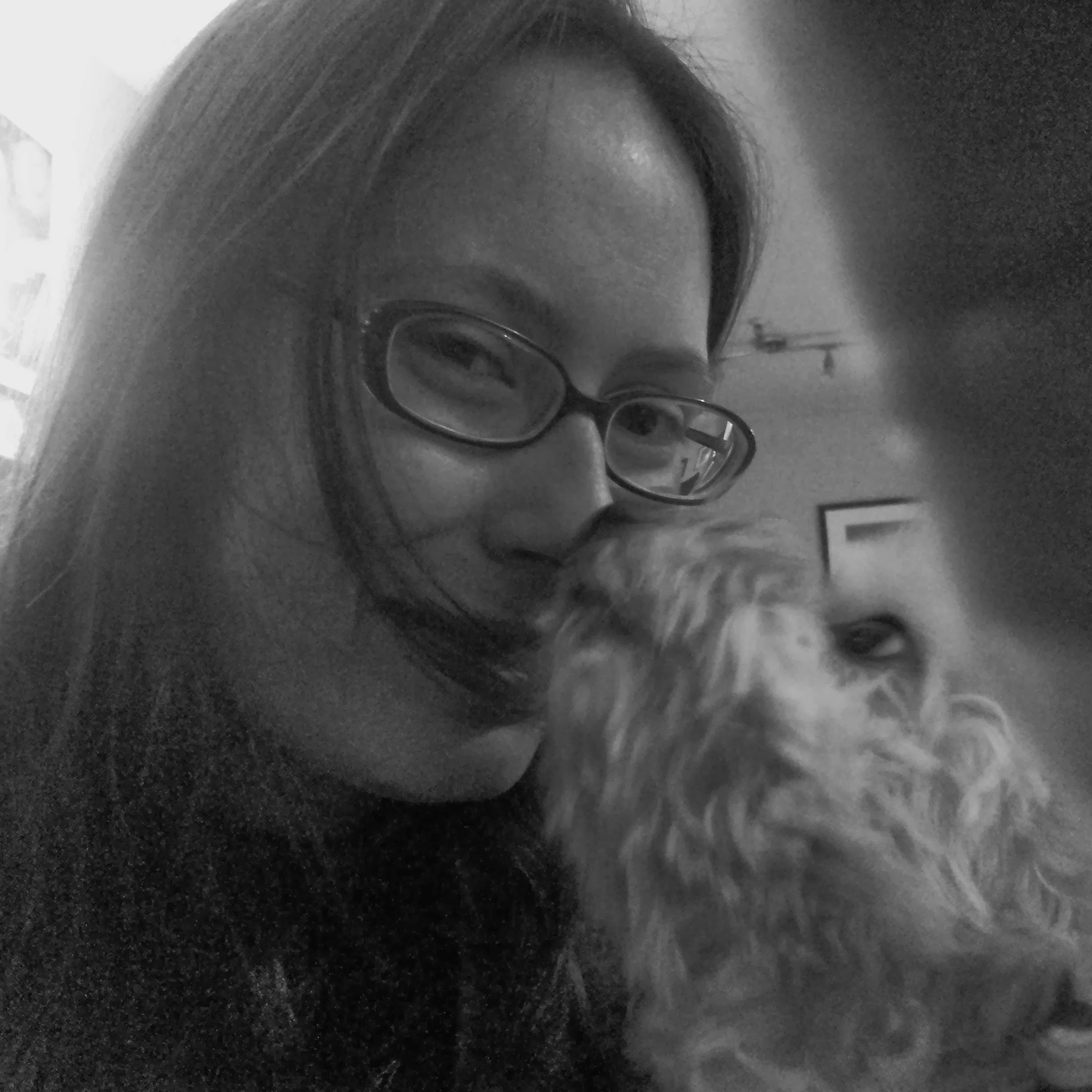
Amy and Nala

I know in my gut there will never be enough time. I love the world so much, how could there be? I will never have enough time snuggling with Nala, and I will never have enough time to write all the books I want to write, and I will never have enough time to learn all the things I’d like to learn. I won’t have enough time to meet all the people I’d love to meet, and I won’t have enough time to see all the places I’d love to see.

And most painfully, I won’t have enough time with the people I love. They will all die too soon for me, no matter the circumstances. And I will die too soon to love them as much as I want to love them. And all of us will be wiped away, our lives and loves and stories forgotten.

What, then, is left? How do I deal with this anxiety around death?

I love with everything inside of myself, even if my heart breaks repeatedly. I notice what is precious to me, and I hold it close. I celebrate being alive right now, and I celebrate that you’re alive too. I grieve when you leave because I refuse to downplay your significance in my heart. I laugh and I play and I work and I do things that scare me. It all matters to me, and when it doesn’t matter to me, I ask myself what I need to change so my life will become more in line with what I care about.

Robert Jackson Bennett said: “Maybe this is what I think the human condition is: shrieking and raging at the universe to pay attention, begging it to understand that this matters, and hearing silence.”

I’ve been hearing that silence since I was eleven years old. Bad things happen, and they change how you see the world, and you know it’s happening and you don’t want it to happen and then it happens anyway. And you can never return to that place of innocence that you never appreciated until you lost it.

But we still have choices. We can choose to be ruled by our fears, or we can cultivate bravery. We can give up, or we can work for what we care about. We can be silent, or we can tell our stories. We can close down, or we can open up.

If the universe answers with silence, so be it. We don’t need the universe to tell us what matters. We already know.

Death is always there, lurking in its otherwise deserted corner. Every moment it stays there is a victory. Every achievement I make, every milestone I reach, every hug I give and every connection I strengthen. Every breath I draw, every story I tell, every place I visit, every song I sing, every day I make the smallest bit brighter for another person. Every time I look into your eyes and we have a moment of truly seeing the other person standing there. They are all victories, and they all matter.

I am afraid to die, but I am so lucky to have this chance to live.

Read Full Post »

Now that I’m back home from ConFusion, and after talking a bit about impostor syndrome, a few of you might be wondering how my panels went.

Short answer: I had a great time!

Longer answer: Once I was at the convention, any nerves I had melted magically away. I had been afraid I’d be that panelist who sits there silently while everyone else talks, but that didn’t happen. I always had a lot to say, and most of the panels went by very quickly. Plus I had the great fortune to share the panels with a lot of intelligent and well-spoken people, talking about subjects that I am very interested in.

My favorite panel was “What Does Rejection Mean?” Not surprisingly, I can talk about the psychology of being a writer (or more generally, being an artist) all day long, and I also really liked what my fellow panelists had to say. I moderated three of the five panels, having only prepped to moderate one of them. I’m a planner so the idea of moderating on the fly is one that filled me with a certain horror, but as it turned out, I was able to improvise without too much difficulty.

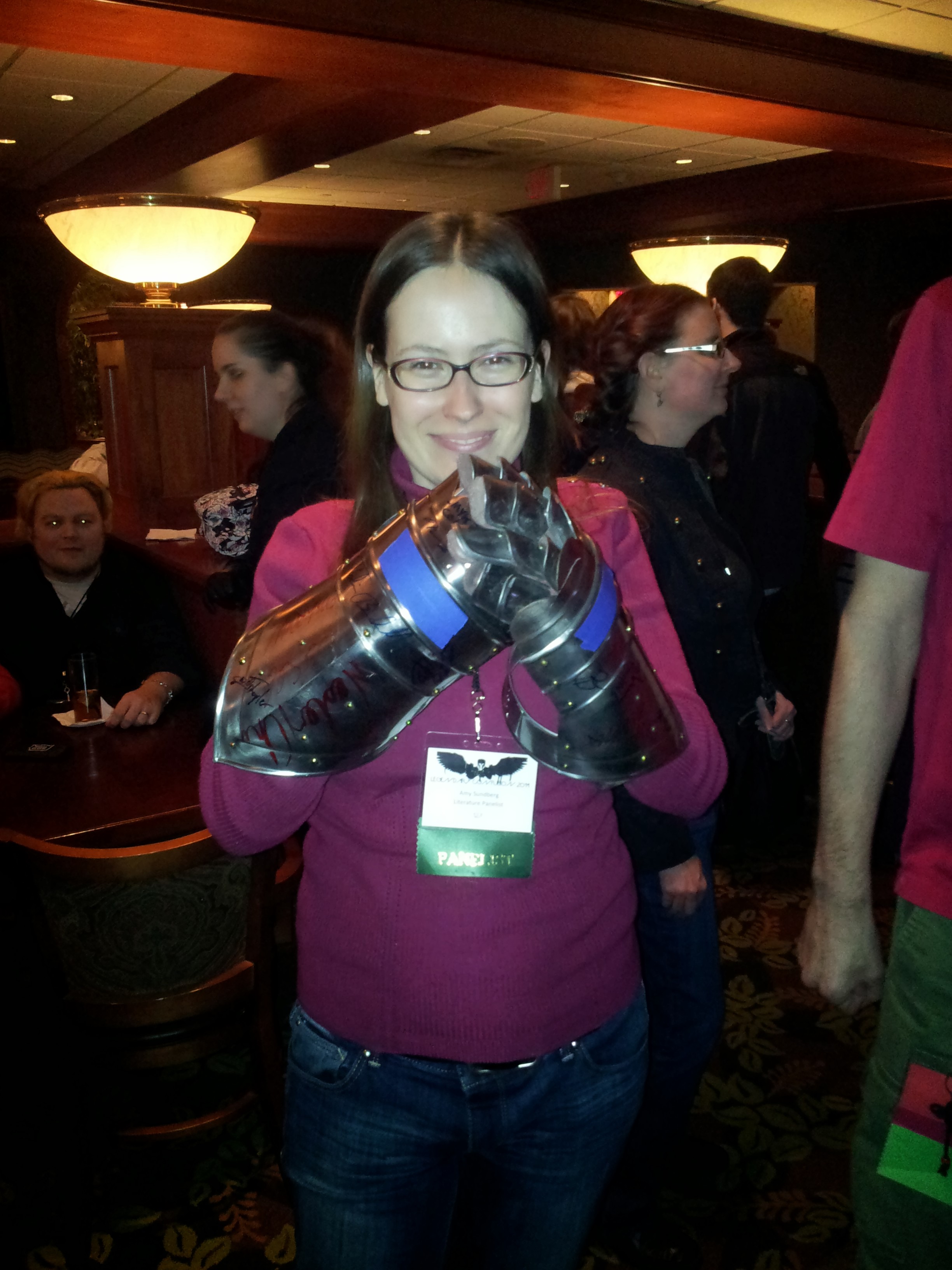
Getting ready for battle

Getting ready for battle

I decided a couple of months ago to set myself a few goals that I could have confidence in my ability to complete while definitely still stretching myself. So many of my goals are long in duration, very challenging, and involve a lot of me stumbling around and making mistakes. This is necessary; I am ambitious. But sometimes it’s good to balance all the striving with achievement I know I can reach quickly if I commit myself to it. Participating on these panels at ConFusion was one of those short-term achievable goals, and it was a welcome change to try something that made me nervous but that I knew I had the skills to do. (I have another of these goals coming up in a few weeks, so more about that soon!)

More generally, I always have a great time at ConFusion, and this year was no exception. I was struck by how much value I receive when I have the opportunity to spend time with my fellow writers, whether they’re just starting out, have been around a few years like I have, or are at more advanced stages of their careers.

I’d been feeling a bit bummed out ever since my last novel fell apart, operating under a cloud of discouragement. I didn’t let this feeling stop me from planning my next novel project or continuing to query agents, but it’s been there, and it hasn’t been pleasant. For lack of a better way to describe it, I haven’t been feeling writerly. ConFusion reminded me of who I am and what I’m trying to accomplish, and talking to other writers about our projects and our processes has given me a renewed sense of focus.

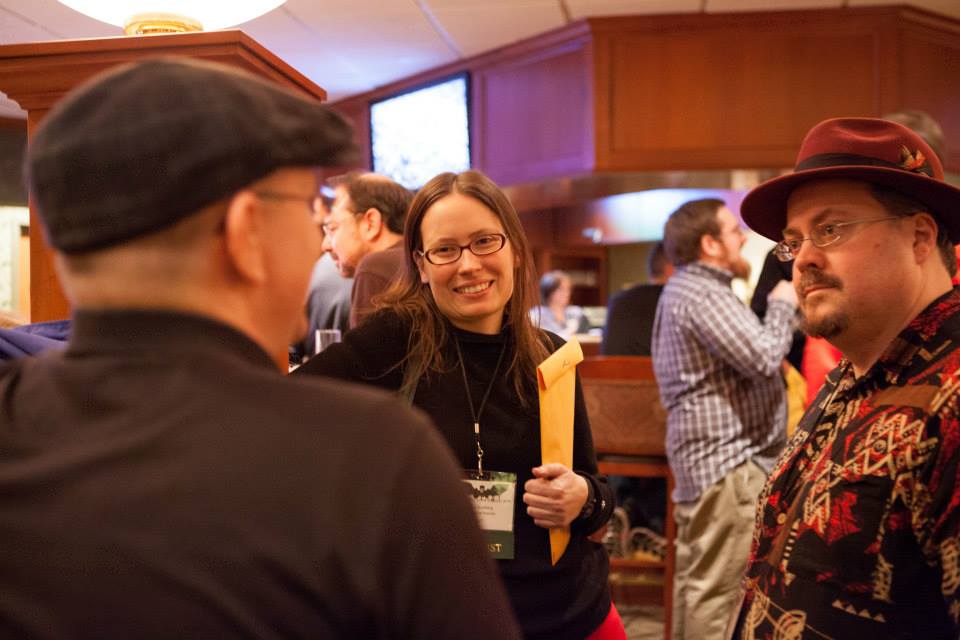
Being writerly at the ConFusion barcon. Photo by Al Bogdan

Being writerly at the ConFusion barcon. Photo by Al Bogdan, 2014

More generally, I’ve been thinking of how important my writer community is to me. As a consequence, I’m bumping a Seattle visit up the priority list this year and considering the possibility of scheduling some Skype writer dates. Too much creative isolation does not a happy Amy make.

All in all, it was a very successful and productive weekend.

Read Full Post »

I saw a quotation some time ago on Facebook, and I’ve been thinking about it ever since. I’d decided to blog about it for my first post of 2014. Then a week or two ago, it popped up again, shared by someone different, a sign of the resonance of the idea.

“I am not what happened to me. I am what I choose to become.” -Carl Jung

I don’t believe that we can unilaterally leave our pasts behind us. We carry them with us, whether we’re aware of it or not, whether we want to or not, no matter how far we travel. The past happened, and we can either deny that fact and muddle along in blindness, or we can work towards knowledge and acceptance. What happens to us does change us.

But.

We still have choices. We get to choose who we’re going to strive to become. We get to choose how we’re going to move forward. We can choose to let our pasts define us OR we can choose to define ourselves on our own terms.

Photo Credit: h.koppdelaney via Compfight cc

I used to be afraid that my experiences would cause me to close myself off, that I would become bitter and jaded. But because I was aware of that possibility and decided I didn’t want it for myself, I worked hard to ensure it didn’t happen. I got to choose which way to send myself. And now, more than a decade later, I might occasionally experience a touch of cynicism, but that’s it. No overwhelming bitterness, no hatred of the world, and in some ways I’m more open than I’ve ever been.

We can’t always control what happens in our lives. We can’t control the decisions of others. But we can make choices about how we’re going to act and what we’re going to try to focus on. We can’t always prevent unproductive thoughts, but we can notice that we’re having the unproductive thoughts, recognize them for what they are, and deliberately replace them with more helpful thoughts.

The past has given us wounds and wisdom. It has given us strength and scars. And now every moment is an opportunity to use that wisdom and honor those scars and take control of our personal stories.

I’ll leave you with another quotation that feels right for this year:

“There is one thing which gives radiance to everything. It is the idea of something around the corner.” – G.K. Chesterton

May you all have beauty around your next corner, as well as the mindfulness to enjoy the radiance before you reach it.

Read Full Post »

New Year’s Eve.

I’ve been waiting for this day for what feels like a very long time.

If 2012 was a year of internal change for me, then 2013 was the year of actually making that change happen. A year of logistics. A year of stress and uncertainty. A year of trial and error. Sometimes lots of errors. Learning isn’t always a graceful process.

It was a hard year. But I did what most needed to be done. I tried out some paths I wish I hadn’t taken, and was tempted by more that I wish I hadn’t been tempted by, and had more difficulty making different choices than I wish I had to experience. But in the end, I made those different choices. That is what really matters.

As a result, I’m moving into 2014 with my life perhaps as clean as it has ever been. Not spotless, no, and frankly, I don’t think it ever will be. But clean, with plenty of space. I’m no longer squashed into the corner. It’s a good feeling, and it brings with it the happiness from having accomplished something.

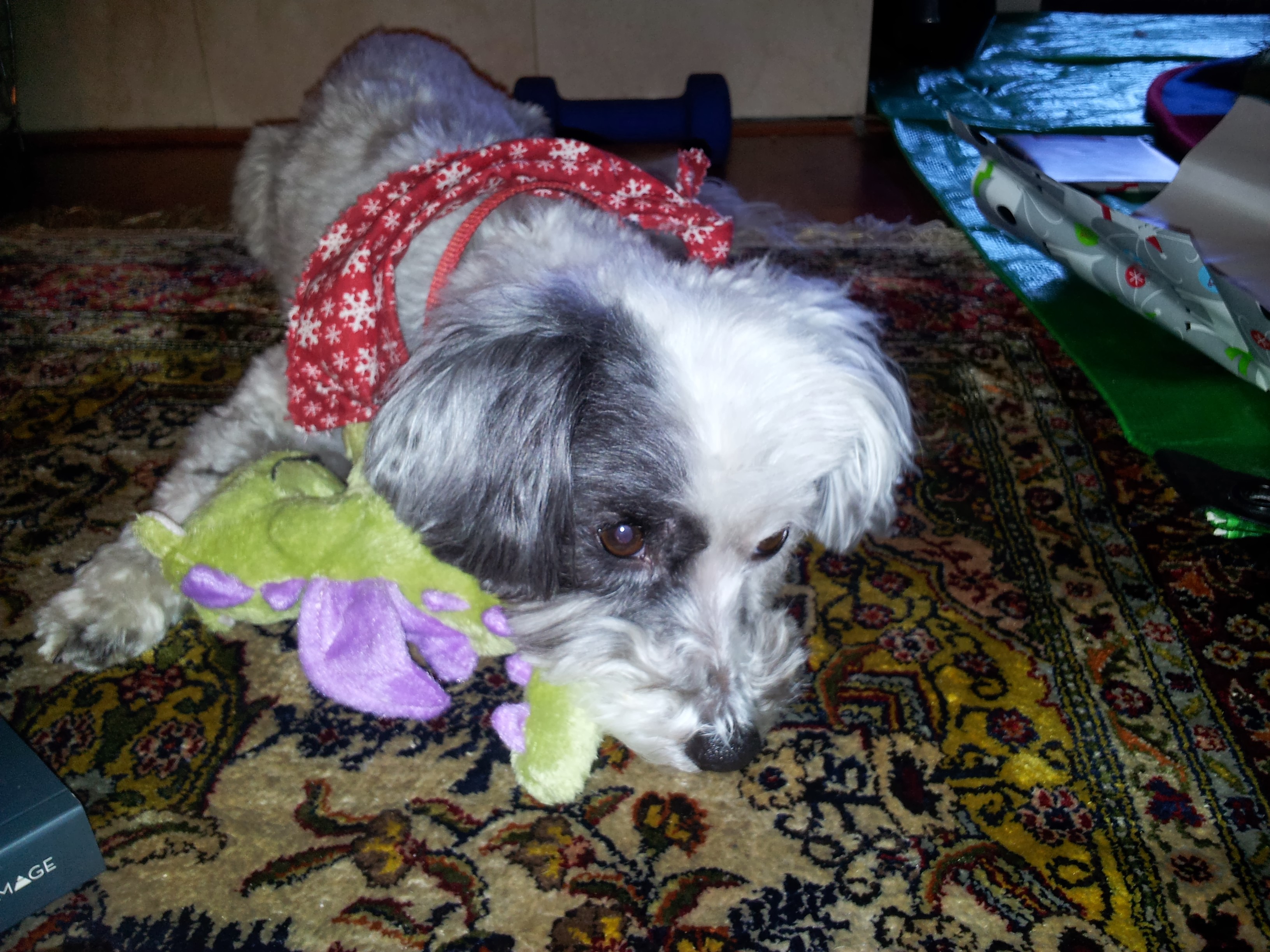
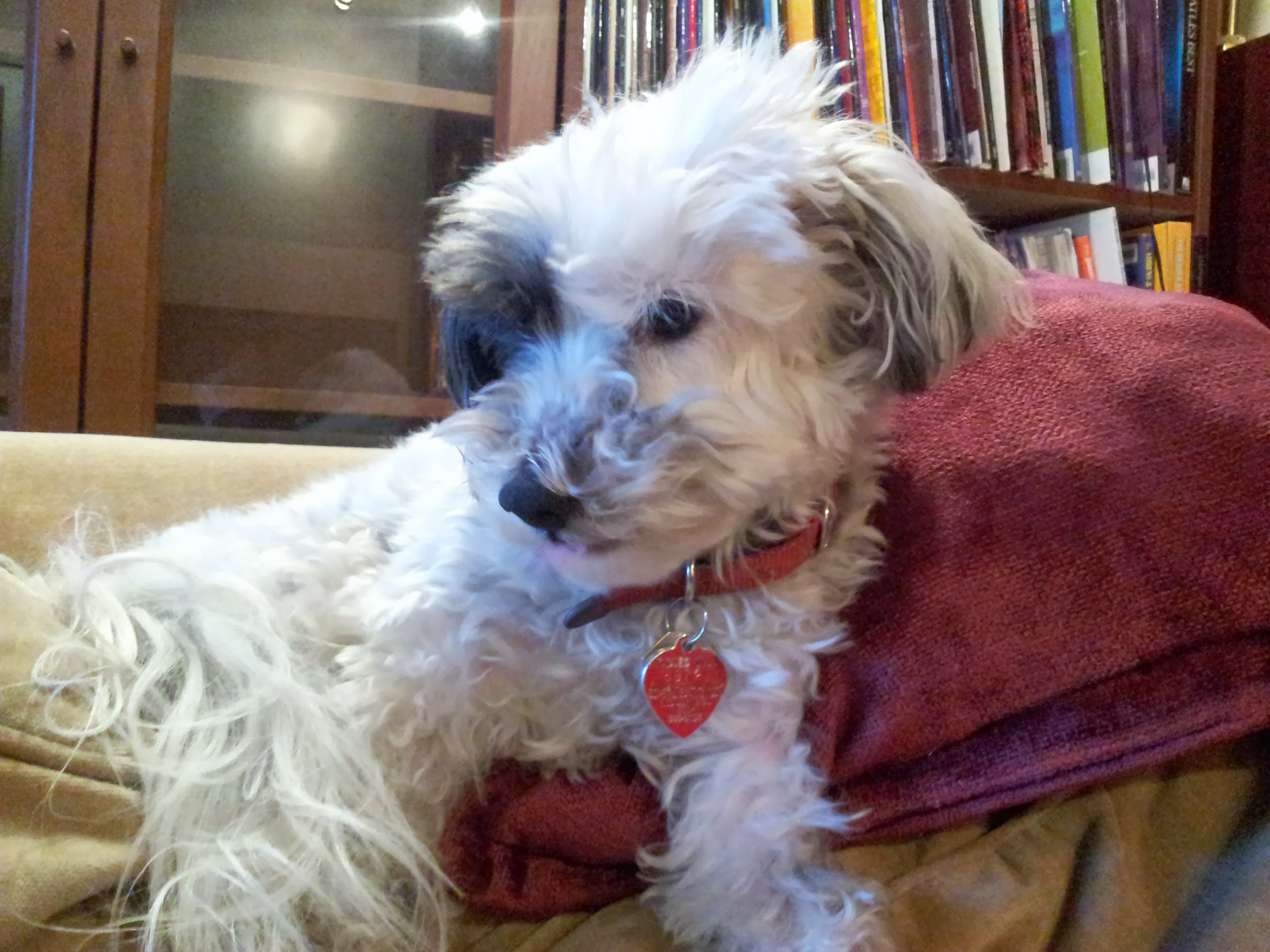
Nala is excited for 2014, too.

Nala is excited for 2014, too. Especially now that she has TWO dragon squeaky toys.

In 2013, I:

  • Received several partial and full requests from agents for Academy

  • Completed a fairly sizable rewrite of Academy

  • Wrote 75% of a science fiction novel that I ultimately determined wasn’t working as it was

  • Began conceptualizing the next novel on my slate

  • Attended five writing events and one World Domination conference

  • Continued regularly blogging (WordPress tells me there were 95 posts this year)

  • Moved

  • Traveled to France!

  • Read 50 books and 16 plays

  • Played several games of BSG, several sessions of Spirit of the Century, and a short Exalted reunion campaign

  • Made new friends and became closer to old friends

  • Went to several plays and musicals and attended a fabulous New Works festival

In 2014, I hope to:

  • Continue to query Academy until I reach my target number of queries

  • Write my next novel

  • Put that novel through a few revision cycles

  • Continue my blogging here

  • Attend at least five writing events (ConFusion, the Rainforest Writing Retreat, FOGcon, the Nebulas, and WFC)

  • Either travel to London for a dose of my favorite city and Worldcon, or travel somewhere else exciting (I’d really like to go to NYC this spring, for example, to see a bunch of new shows coming out. Or Iceland. Or Harry Potter World. Or Japan. Or have a lovely Seattle writing retreat. Or go to some other conventions. Or who knows!)

  • Spend lots of quality time with my friends. See non-local friends I haven’t gotten to see in too long. Make new friends.

  • Strengthen my pesky left ankle

  • Go to a few local museums (the Tech, the Exploratorium, the California Academy of Sciences, the Walt Disney Museum)

  • Throw a party or two

  • Get back into singing shape

  • Continue having adventures

What do you want to do next year? Have any goals or hopes?

Here’s to a wonderful 2014!

Read Full Post »

I love Christmas, the Winter Solstice, and the end of the year because it’s a time that can be filled with joy and gratitude and renewal. It is the darkest time of year for those of us in the northern hemisphere, and we hold onto the knowledge that things change, that the world around us is  in constant motion, as are we. We think with hope of longer, warmer days and the blooming of spring.

But sometimes the holidays can be quite challenging. For many, it can be a time of loneliness, missing people who are not here or not being involved in the hustle and bustle of the masses. We might be confronted with people and patterns that are difficult for us to deal with gracefully. We might be overscheduled, overcommitted, or overburdened with expectations, either our own or other people’s. We might be tired from the year that’s ending.

I’ve come up with a list of tips for my own personal sanity this year, and I’m going to share them with you. Your mileage, as always, may vary.

1. Prioritize and let go. Let go of as much as you can. Figure out what is truly important to you, and be flexible about everything else. This might include letting go of what other people might want from you, too.

2. Treat yourself. For me, this often means yummy consumables: pumpkin spice chai, hot cider, cookies, ice cream, holiday treats. For others, this might mean a massage or a trip to the library or window shopping or playing a video game.

3. Give yourself time. If you’re really busy, maybe this is five minutes at the end of the day to sit and do nothing. Maybe it’s time to take a bubble bath or time to take a walk or time to watch a favorite movie. For me this year, it’s time to read, and it’s truly blissful.

4. Let yourself feel how you feel. There can be so many shoulds, especially around the holidays when you “should” be perfectly happy and want to do all the things. But give yourself space to feel sad or lonely or angry or anxious or whatever emotion comes up. It’s fine to have a multilayered experience. It’s fine if the holidays are hard.

5. Make health a priority. Do your best to get enough sleep, to eat healthy foods, and to exercise to the best of your ability. (With a healing ankle, that means a five minute walk for me, but hey! Five minutes are five minutes.) Wash your hands. Stretch. Dress warmly if it’s cold outside.

6. Reach out to your people. Take the initiative to make plans that make you feel happy and safe. If you’re not able to spend the holidays physically with your people, remind yourself of their existence. Text, call, comment on Facebook. Surround yourself, either physically or virtually, with people who you like and who like you.

7. Hold onto hope. The future is full of possibilities.

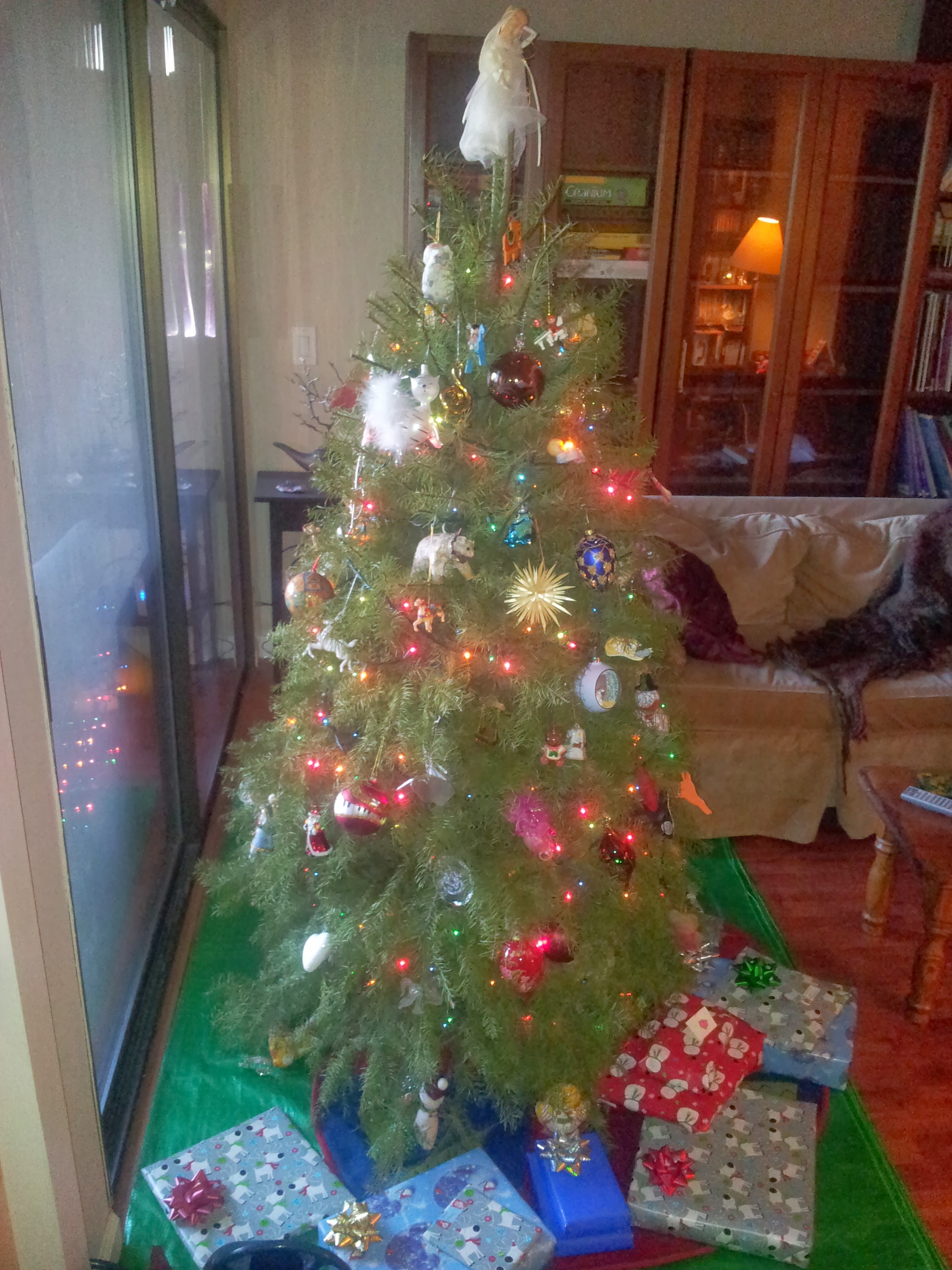
This year's TREE. :)

This year’s TREE. 🙂

I hope you all have a peaceful and happy End of Year. But if that isn’t your experience, that’s just fine too. The wheel keeps turning, and the days keep going by. 2014 will be here soon enough.

Read Full Post »

Once in a while, I wish I wanted to be an accountant.

In this alternate reality, my life is quite simple. I am a good accountant, diligent, dedicated, and detail-oriented. I probably work too much, and this fact probably occasionally causes a little bit of angst, but I’m probably mostly too busy to think about it.

I do the standard things society has taught me to value. I consume. I nest. I go to the gym several times a week, or else I jog. I follow the most popular TV shows. Maybe I even follow a sport. I am a somewhat brainy accountant, so I bet I read a newspaper, although probably not quite as often as I secretly feel I should to be up on current events.

I have an actual cleaning schedule for chores around my house. I cook balanced, healthful meals, and I freeze leftovers for later. My furniture mostly matches, and I don’t need a ridiculous amount of wall space for eight plus bookshelves and a piano.

I wear slacks on a regular basis, or maybe even smart blouse and skirt outfits, and pointy-toed heels have magically become not a torture punishment to wear. Also, I am not allergic to almost all perfumes. I remember to get my hair cut at regular intervals. I might actually wear makeup almost every day, and I wouldn’t be caught dead outside without sunscreen on.

I go to happy hours on a regular basis. I drink wine with dinner. I host formal dinner parties. The last book I read was Shades of Gray because all my friends told me I had to read it. I receive women’s magazines in the mail. I send out Christmas cards to everyone I’ve ever known, every year, without fail. And I remember to call them holiday cards.

My edges are all rounded off.

***

I am not that woman. She only exists in my mind, an amalgam of television ads and eighties sitcom wives and Good Housekeeping covers and mostly overlooked comments and the fifties sensibilities my parents were raised in. Add in the power woman of the workplace with oversized shoulder pads and the collective obsession with female appearance and a good dose of social norms and common hobbies and belief systems that allow us all to coexist with less friction than otherwise.

And there she is, this imaginary woman. Her life isn’t actually simple at all; it sounds quite challenging to be good at everything she is good at, and to keep on top of everything she keeps on top of. Add in a family and a house, and I wonder if she has any time for herself at all. Maybe she is also unlike me in that she doesn’t become a shell of herself on less than eight (seven, absolute minimum) hours of sleep.

What does seem simple about her, though, is that she is exactly what society has told me I should be.

***

I am who I am, and I live the life I have chosen, and most of the time, I am not just fine with that, but grateful. I mean, yes, I should wear sunscreen more often. And perhaps there would be a kind of comfort in living the life that seven-year-old me was led to expect. But even seven-year-old me wasn’t on board with that life because that’s the year I both started studying the piano and decided I wanted to be a writer. Being a serious artist didn’t ever really fit into the picture I was given.

(Not to say you can’t be a serious artist and also be an amazing cook or be good at keeping the house clean or wear killer blouse and skirt outfits or watch basketball or read three papers a day or be an accountant. People can, and they do. They’re creating their own amazing pictures.)

***

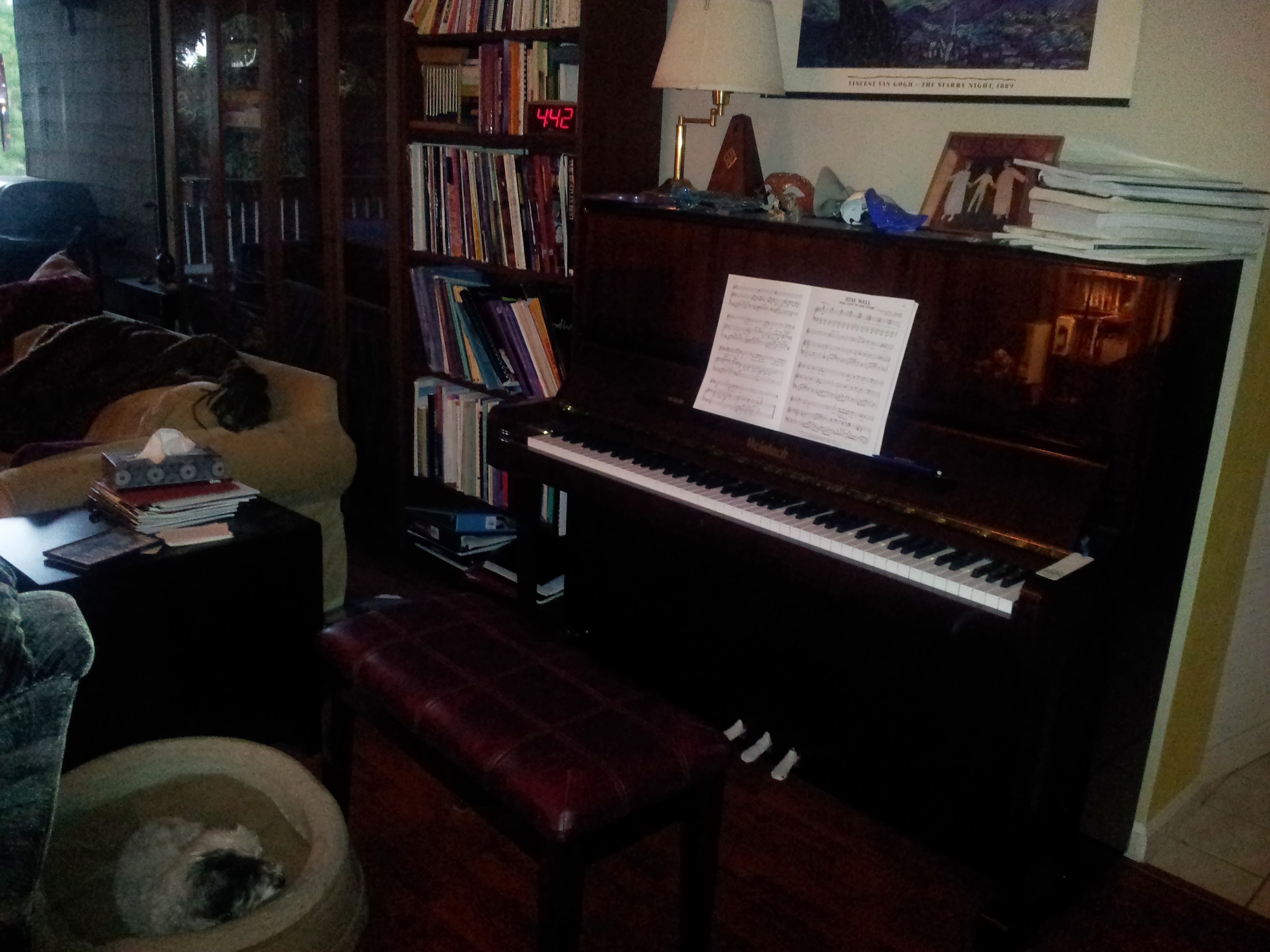
Here is where I spend most of my time.

Here is where I spend most of my time.

Here is my picture:

My apartment is filled with books: YA and science fiction and literature and fantasy and travel guides and research materials and sheet music. I can’t imagine living without a piano. The little white dog lies curled up by my chair. I probably need to vacuum.

When I go to happy hours (maybe once a year), I go for the cheap food. I will probably never drink wine with dinner. I have friends over for board games and role-playing games instead of dinner parties, and sometimes I bake brownies for them. I eat out a lot, and I eat frozen dinners a lot of the rest of the time.

I’m wearing jeans, a sparkly sweater, and no makeup. I spend most of my days reading and writing and thinking. I’ve been trying to make more time for practicing music. I love to read novels. I am horrible about sending anything to anyone via post. I’m not athletic and I never go to the gym, but I do love walking my dog and soaking in the world around me. I don’t know the right way to clean a variety of stains, and I don’t know how to use a sewing machine, but I do know how to sew on a button.

I wear glasses, and I have a weird sense of humor, and I’ve never had a traditional salaried job. I like the Vampire Diaries, but I am more than half a season behind on it, and right now I’m rewatching The Gilmore Girls because I like watching Lorelai create her own picture for herself, plus hers includes the really nice blouse and skirt outfits. I daydream about London and New York and Seattle, and Disneyland is still one of my favorite places on the planet.

I try to figure out what it is I actually care about, as opposed to what I’m told I should care about. Sometimes these things are the same, and sometimes they aren’t. Making the distinction can be difficult.

***

What is your picture?

Read Full Post »

I made a hard decision on Friday.

I decided to abandon my current novel-in-progress.

Currently at 61,000 words in length, this novel represents a large amount of my time and effort. It is about 75% completed.

It is also not working. And I don’t mean that in a rough-drafts-suck kind of way, but in a there-are-several-deep-systemic-problems-here-and-most-of-this-needs-to-be-thrown-out kind of way. So I am putting it aside. Maybe at some point I’ll know how to fix these deep systemic problems and I’ll return to the project. Or maybe I won’t. It’s hard to say.

Scott Adams had a good point in his widely shared article about failure: that there are people who focus on goals and people who focus on systems, and it is the people who focus on systems who tend to do better.

Don’t get me wrong; I think having goals is important. I’m a planner, and goals help structure planning. But ultimately, we want to have goals that support our system. When the goal no longer supports the system, it is time to change the goal.

My system is to be continuously improving myself as a writer while looking for opportunities to advance my career. My goal was to complete this novel. When I started the novel, the goal was in line with the system, but that is no longer the case. Being aware of the broken aspects of the novel, at this point I’ve been going through the motions, which isn’t teaching me all that much. (If I didn’t know how to finish projects, or if I felt I could learn a lot about endings by finishing, this might not be the case. But neither of those applies this time.) And finishing a novel this broken won’t do anything for my career except take time I could be using elsewhere.

That’s not to say I haven’t learned a lot from this project because oh wow, have I ever. I’ll take all of that knowledge and experience with me to the next project, where I’ll put it to good use. But sometimes it’s important to be able to figure out when to cut your losses and walk away. My own personal tendency is to hang on too long. This is another opportunity to practice not doing that.

If you’re wondering how I’m feeling, well, I just put 61,000 words into a drawer, which is not the most pleasant experience ever. But at the same time, I do feel good about this decision. I am excited to have more time to work on other projects that I believe in. I’m happy to be moving forward.

Failure is hard, but it’s also necessary when we’re trying to push our limits and become better. So this is not a horribly discouraging thing. I’d feel a lot worse if I no longer believed in my system, but I do. Nothing fundamental has changed. I’m just moving on to the next stepping stone.

What is your system? Are your goals in line with it? How do you feel about failure?

Read Full Post »

« Newer Posts - Older Posts »