Feeds:
Posts
Comments

Posts Tagged ‘Amy Sundberg’

When I was getting divorced, I read a piece of advice that has stuck with me ever since.

“A ten never marries a one.” Apparently a divorce lawyer delivered this line to Penelope Trunk, and then she blogged about it, and then years later I stumbled across it, and now it is burned into my brain.

*

A ten never marries a one. Let’s break this statement down, shall we? I don’t know what the divorce lawyer meant by it, but to me, this statement has nothing to do with actual numbers or a ranking system (ugh). It has nothing to do with particular traits or talents or some idea that people marry others who are exactly the same as they are.

No, to me, it simply means this: a relationship is made up of two people, and both people contribute to it. So when we look at a dysfunctional relationship, both people are contributing to the dysfunction. This does not excuse certain behaviors. It is not a value judgment, and it is not a statement of blame (although it can feel like one). It is simply a recognition that a dynamic takes two people to exist.

It is a harsh truth, and I took it to heart. In fact, I recall repeating it at inopportune moments to friends trying to console me. (Sorry, friends.) But while it might be painful, it is also a truth that restores agency. In being willing to take some responsibility, we can explore how we might act differently in the future.

And that is what I did. I asked myself some tough questions. I looked deep inside myself, and I tried not to flinch. In particular, I looked for my behaviors that were preventing me from getting what I wanted, and I looked for the cracks and old wounds that contributed to those behaviors. And then I began the slow process of trying to change.

This is incredibly tricky to do. Partly, this is because humans love our patterns, and we fall very easily into dynamics that feel comfortable. Mind you, they may not make us happy or help us fulfill our long-term goals. There is comfort in familiarity, even if it is a miserable comfort. As a result, we tend to repeat ourselves again and again.

And even if we’re watching for our patterns, they are not always obvious. Sometimes things can look very different on the surface, only to end up rubbing against the same old wound underneath.

*

So, this is a hard thing I’ve been working on. Totally possible, but also challenging. And I’ve learned a couple of things about myself during the process:

I learned it’s important that I know what I need. This means I had to figure out what it is I actually need versus what I thought I might need but it turned out wasn’t all that important. And I had to learn to accept what I need instead of feeling like I should be constantly apologizing for it.

I learned it’s important to be picky. I set out with the goal of being as picky as possible because I knew in the past I hadn’t been picky enough. My hope was by deliberately trying to be picky, I’d balance things out and come closer to the center on this spectrum. And also, you know, that maybe this would give me the necessary time and space to find someone who would actually meet a bunch of my needs.

I learned it’s important to be willing to walk away. I will probably always hate walking away. I will probably always hate even the idea of walking away. But what matters is not how I feel about it, but that I know I can and will do it if and when it becomes necessary.  

I learned it’s important to be happy on my own. And it’s important to believe I am a ten for myself, even if I have a lot of doubts about that. In other words, it’s important to believe you are worth it.

*
20150820_153647

So what has come of all this work, you might be asking. Last you heard from me, back a couple of months ago, I was talking about dating fatigue. I was, truth be told, feeling like dating was kind of a waste of my time.

Well, life, it has been changing once more. And on Thursday, I’ll tell you the story of how I met my current boyfriend.


Read Full Post »

Sometimes it can be scary to want things.

I just read an Ask Polly advice column, and the whole thing is pretty interesting, but here is the passage I want to look at today:

You don’t know what to do about it, so instead of throwing a fit or walking out the door, you become someone who exists in the margins, someone who can tuck herself into the background and make do with whatever leftovers come her way.

The problem is, that kind of passivity tends to bleed out over the rest of your life. You are willing to wait and see where you’ll live, and wait and see whether you’ll ever have kids, and wait and see if you’ll ever find a better job, until eventually you forget that you have control over these outcomes and everything else in your life.”

This kind of passivity is also a way to avoid commitment, to avoid figuring out what you actually want. What you want enough to really invest in it. What you want enough to risk sacrifice for it. What you want even though you might not get it.

In the last few years, you all watched me go through the decision of where I wanted to live. Before, I felt like I’d just ended up living in the Bay Area. It wasn’t so much that I’d made an active choice to live here as that life events pushed me toward it and I hadn’t resisted. So then, for me, part of learning who I am and what I want was really looking at where I was living and deciding if it was what I actually wanted.

And I have to say, while going through that process wasn’t the most fun ever, I am much more satisfied with my life having come out on the other side with an actual well-thought-out decision. Yes, I want to be here. Yes, I am committed to making certain sacrifices in order to stay. And sure, at some point those sacrifices might be too high and I might change my mind, but even if I leave at some point in the future, it feels good to know what I want right now.

Photo Credit: Shenghung Lin via Compfight cc

Photo Credit: Shenghung Lin via Compfight cc

Part of the reason I am writing this now is because it can be easy to fall into passivity. Especially for a recovering people pleaser. It can be easy to wait and see, all the while hoping for the best. And it’s not always wrong to do that, that’s not what I’m saying. Optimism can be a beautiful attitude to adopt. But sometimes it can also allow you to hide from certain realities and steer you away from being fully yourself.

So right now I am trying to embrace the experience of wanting things in active ways. It is terrifying, because once embraced, it makes it feel like I have so much more to lose. I feel vulnerable. And I realize the wanting means I have to take risks. I have to write things I don’t know if I can write. I have to do things I don’t know if I can do. I have to be myself even when that might lead to the necessity of letting go.

I write about this kind of stuff all the time. I write about it because I think it’s important to talk about it, and I also write about it because it is hard for me. Here on the blog it is easier to be clear. It is easier to take an idea and distill it down and develop an understanding of it. And then I carry these ideas out into the world, which is a murky, messy place at the best of times. I get confused, and sometimes I get frightened. Sometimes my ideas don’t seem so easy to implement anymore, and sometimes I forget what I actually think. But even so, I’m better off with these gems of ideas in my pocket, and I hope you are too.

So then, here is today’s gem: Sometimes it can be scary to want things. But that is who I want to be: a person who wants things and goes after them even when it’s scary and hard. A person who will choose risking failure rather than hanging out in passivity.

This isn’t always the person I will be. It certainly isn’t always the person I have been. But it’s the person towards whom I can aim.

Yes, I want things, with all my heart. Let’s see what happens next.

Read Full Post »

Because I am a writer, it will probably come as no surprise to learn words are very important to me.

As such, it’s been something of a struggle for me to clearly delineate the difference between actions and words, and to make personal choices accordingly. For me, words tend to carry more weight than is helpful, and actions less than they deserve.

That’s not to say words aren’t still important. Indeed, some time ago I dated one gentleman who indulged in almost zero Words of Affirmation (we are all familiar with the Five Love Languages, yes?), a situation that was, as it turned out, intolerable to me. Words do carry a certain amount of weight and are also intrinsic parts of many actions.

However, I have observed that it is much easier to adjust words away from the actual truth of a situation than it is to adjust actions. Meaning, actions tend to be a more reliable gauge of what’s actually going on and a more accurate reflection of a person’s feelings and priorities. I’ve been reading Robert McKee’s Story for the past week, and he emphasizes again and again that deep character is revealed through conflict; that pressure is placed on a character, forcing her to act, and it is in that action that the viewer/reader learns who she truly is. It’s not what the character says that matters, but what she does.

Photo Credit: Dean Hochman via Compfight cc

Photo Credit: Dean Hochman via Compfight cc

This is not a new insight for me; in fact, I’ve written about it before. But it’s been getting easier to apply it in my actual life, and I think the feedback loop that is causing this improvement is interesting. It works like this: as I’m surrounded more and more by action and behavior that is respectful and positive and affirming, the instances when action and behavior is not acceptable stick out a lot more clearly. Basically, my baseline has shifted.

This shift has resulted in several differences. For one thing, I am much more capable of identifying unhealthy situations and acting on this information. I am more able to clearly state when I’m not okay with something when I think that is the right thing to do. And I am able to figure out what it is I need in order to take care of myself in a more timely and efficient way. All of this means that smaller issues are less likely to spiral and grow into bigger ones. Which is pretty great, even if at the time it doesn’t feel all that wonderful.

I am even able to notice much more quickly when these kinds of circumstances begin to push me down an unproductive thought path. “Oh no, this person isn’t going to like me,” I think. But then, an hour later, “Wait a second. Maybe it’s okay if this person doesn’t like me. My job isn’t to make sure everyone likes me. My job is to set boundaries to keep myself healthy while doing my best to remain compassionate. Right.”

All of this, incidentally, supports being more compassionate. I tend not to associate firm decisive action with being compassionate, especially when said action involves saying no or otherwise disappointing someone. But I think I’m wrong in this. Modeling healthy behavior is ultimately a net win for all parties, as it nips issues in the bud that might have otherwise stretched out into longer periods of suffering for everyone. It sometimes allows for the potential for the relationship to heal and grow stronger. And since you are taking care of yourself, you are opening up more emotional space for noticing what the other person is going through and genuinely feeling for them, even if (and this is often the case) there is nothing much you can do about it.

Words are still important to me. But so often it is the associated actions that make all the difference.

Read Full Post »

I was getting ready for bed on Monday night, flossing and brushing my teeth, when suddenly I looked in the mirror. I stared at my face, and I said, “Wait a second. Amy, what are you doing?”

And I blinked and looked myself in the eye, and several layers of exhaustion and doubt and fear and overwhelm sloughed off, and I said, “Oh yeah. Right, then. Back on track.”

Because in that moment, I remembered who I am.

20150716_185427

*

I’ve been thinking a lot about identity recently: what is essential to identity, of what layers it is comprised, how malleable it is, why some people are able to hold onto some core of who they are throughout their lives while others are not.

And I realized that an essential part of change, for me, is re-crafting personal identity. External circumstances can and do change, sometimes because of a deliberate decision we’ve made and sometimes not. Sometimes our lives change because of other people’s decisions, or because of the accumulation of lots of tiny decisions we’ve made mostly unawares, or because of pure happenstance.

But I think the change that matters most, or certainly that is the most interesting to me personally, is the change of self. And while identity can change based on external events, it certainly doesn’t always do so. And sometimes external circumstances can change from the inside out, based on changes of the self.

And then there’s the common temporary changes, such as most New Year’s resolutions, that end in backslides and no long-term change whatsoever.

One of the ways to hold onto change, then, is to craft that change into your personal identity, into how you see yourself, into who you are. For example, I am a person who is confident in her abilities. Or, I am person who cares about eating healthily. Or, I am a person who is kind to others. Or, I am a person who goes out of his way to be generous.

We can incorporate these beliefs into our identities through repeatedly engaging in thought patterns and behaviors that support them. If I go dancing one to three times a week for six months, then it is easy enough to include “I am a dancer” in my self-identity. If I am steadily working on writing projects, then “I am a writer” comes easily as well.

And the same holds true of traits. For example, I decided I wanted to be more confident. So I told myself over and over again that I loved myself, even though it felt like one of the stupidest things ever. And I gave myself pep talks. And I encouraged myself to stand with my hands behind my back in a confident pose, especially when I felt the most nervous. And I made the deliberate choice to surround myself with people who boosted my confidence. And I experimented with acting confidently even when I didn’t feel that way to see what happened. And I did all these things for years. Literally.

*

The test comes in times of stress. Now, invariably when I am faced with a challenge, I think to myself, “Wait. What would I do now in this situation? I have been practicing for this!”

So I’ve been tested these last few stressful weeks. And because I’ve practiced so much, I was pretty pleased with how I was doing. But even so, that much deliberate action during stress was taking its toll, in that I was getting more. and. more. tired. And as I got more tired, my confidence was decreasing. And doing the things I wanted to do and reacting the way I wanted to react was getting more and more difficult. And I was feeling more and more pull from my old identity and from old ways of thinking.

Until that moment at the mirror. Because what I felt wasn’t disappointment or anger or fear. It was confusion.

Wait a second, I thought. This isn’t who I am. I am perfectly capable of coming up with good plans and following through on them. I don’t have to feel threatened; I know I’m enough. I don’t have to feel frightened because I know I can see this through for myself. I can write this fucking book. I can take this fucking risk. I can live this fucking life.

Once you’ve built your personal identity to be strong and true, sometimes all it takes is one moment to remember who you’ve become.

Read Full Post »

On Emotion

“Feel, feel, I say — feel for all you’re worth, and even if it half kills you, for that is the only way to live.”  – Henry James

Last weekend I was at the Disney museum, and there was an exhibit of random stuff Walt Disney collected during his lifetime. In one of the cases was a few rooms of miniatures: small to-scale furniture and household items and dishes and all that kind of stuff.

And suddenly I was swept away by grief.

My mom collected miniatures. It was something the two of us did together during the hard years. It was something good, something to look forward to.

Anyway, my first reaction was, you’ve got to be kidding me. Why? Why do I have to be feeling this grief right now? It’s been SEVENTEEN years.

Actually, that was also my second reaction, and possibly my third.

The next day I tearfully discussed it with a friend, and he gently pointed out how much stress I’ve been under lately. So that at least partially answers the why question. My toe hurts. I miss dancing. I’m stressed out by a few writing projects right now. I’m upset that Jimmy died, and I miss some of my friends. I am taking risks that make me uncomfortable. I am trying to do self care, but I’m having trouble keeping up.

And grief doesn’t play by normal schedules.

So, this is what I’ve got for you today, this Henry James quotation. I really admire Henry James. He was an incredibly skilled writer and astute observer of human nature. Washington Square is possibly on my list of favorite novels of all time.

I think this is a good reminder. Feel for all you’re worth. Even if it’s grief for someone lost long ago. Even if it’s discouragement over setbacks. Even if it’s fear of what the future might bring.

These feelings, they mean we’re fully engaged in our lives. And that, all by itself, means a hell of a lot.

Nala is adorable

Read Full Post »

I have not had an easy life.

I lived through significant trauma in my adolescence. I had to deal with some serious shit. When I tell people the highlights of that part of my history, they don’t know what to say. It’s okay. I don’t know what to say either. I tend to downplay it, because sometimes it seems like the only redemptive part of the story is that I survived basically intact to tell it.

That kind of prolonged trauma reverberates through the years. I have made unfortunate choices based on the dysfunction I learned as a teenager. I have health problems now because of the stress of the past. My brain developed differently than it might otherwise have done, leaving me, for example, with the tendency of being hypervigilant. I have trouble convincing myself being hypervigilant isn’t a useful and basically good thing (it isn’t, it really isn’t, but it still seems so very practical).

I have had to teach myself what having a safe and happy and functional life looks like. And I have had to draw some hard lines I never wanted to draw and make some difficult choices I never wanted to make.

I am also incredibly fucking privileged.

I am a white, heterosexual, attractive, thin, intelligent woman. I was raised middle class in California in one of the richest counties in one of the richest countries in the world. I received a college education without accruing huge amounts of debt. I know how to speak, how to dress, how to behave in order to receive better treatment.

People are not randomly afraid of me. People are more likely to give me the benefit of the doubt. People are more likely to assume positive things about me. People are more likely to return my smiles. People are more likely to give me opportunities. People are more likely to assume I’m competent and that my work will be good. People are more likely to offer me assistance. I have access to better medical care, to better dental care, to resources that mean I have a lot more choices and control of my life.

I am oozing in privilege.

I have had a hard life.

These two statements are not incompatible.

What I see so often in conversations about privilege is this insistence on “I.” We all want empathy. We all want to be heard and recognized. We all want acknowledgment of our suffering. And, you know, Buddha said life is suffering, and there’s more than enough of it to go around.

This desire for empathy is normal. It is supremely human. And we all deserve it.

Photo Credit: Herr Olsen via Compfight cc

Photo Credit: Herr Olsen via Compfight cc

But. It is possible to receive empathy and give empathy to ourselves while also recognizing our privilege. It is possible to gently remind ourselves that actually, not everything is about us and our particular concerns. That our pain and our problems do not always need to get time in the spotlight, that sometimes other people’s problems and pain needs the exposure, the airtime, the discussion, the push for change, more. That injustice, oppression, lack of privilege, these are systemic issues that are woven into the very fabric of our society, and changing these things, it is a long slow painful process that necessarily shifts the focus from individual problems to societal problems. That even if we have valid points, if part of the purpose or result of those valid points is to shift the focus back to us, that is not always a net win.

I have had a hard life.

I am extremely privileged.

These statements are both true.

Read Full Post »

Dating as a feminist has been … eye-opening.

When I began dating, I didn’t really think about this being a sticking point. I didn’t see myself as being particularly noteworthy in my opinions about sexism. I was happy to pay for myself or be treated (as long as I could tell what was happening). I didn’t mind having doors held open for me (especially with a sprain, this is actually super helpful). I didn’t even mind having car doors opened for me, even if it does feel a little bit silly. After all, we all still know I am capable of opening the car door myself, right? Right?

But I was wrong. Dating as a feminist has been different. And I have stopped dating more than one person at least partially because of their beliefs, attitudes, and statements about gender.

Photo Credit: armigeress via Compfight cc

Photo Credit: armigeress via Compfight cc


The first time I stopped dating someone because of this, I cried while delivering the news. I cried partly because I was having trouble believing it was actually happening, that this was a reason that had actually come up in my life. But I felt very strongly that it would be hypocritical of me to date this person, given my own feminist beliefs. I was also concerned it would affect my attitudes about my writing career, that I would internalize these sexists ideas I was hearing and they would make me less ambitious, less capable, and less confident.

I learned to never explicitly state that sexist attitudes were a reason for discontinuing dating. (Yeah, I had to learn this through experience. Oops. Trust me, this mistake wasn’t pretty.)

And I learned that a certain degree of sexism is a deal breaker for me.

Really, dealing with sexism is hard enough as it is. It is so easy to internalize all the messages we are receiving from media, from society, from our peers. And the little things do matter.

For example, I heard a sexist remark over the weekend, and I knew at the time it was sexist. And even still, I found myself revisiting it the next day and feeling anxiety as to how I personally fit into the scheme of the joke. At which point I had to remind myself it was sexist and that if anybody was thinking about me in that way, it was somebody about whose opinion I wouldn’t care anyway.

So much effort, because of one stupid off-hand “joke.” Meanwhile, none of the guys who heard this joke had to think about it the next day and talk themselves out of worrying that it applied to them. And this was actually a better outcome than it would have been if I hadn’t noticed and if I’d unconsciously incorporated it into my opinion of myself. This kind of cognitive load is largely invisible, but it can add up to become quite significant.

Now, imagine you’re dating someone who has a lot of unexamined sexist beliefs and who makes a lot of these kinds of jokes and generalizations and is unable to check routine mansplaining (I know a lot of you hate this word, but I don’t have another one that means what I want to say, so we’ll go with it for now). How much cognitive load would it take to avoid internalizing these self-limiting beliefs? And how many would slip through without notice?

Sometimes people laugh at my post about how I think shared interests don’t matter that much in dating. And it’s true I was supporting a rather extreme point of view. Of course it’s nice to share interests with your partner. Of course it’s nice to have fun stuff to do together.

But the longer I’ve been dating, the more convinced I’ve become about what matters more to me. Kindness, honest and clear communication, respect and compassion for each other as we are, not as we wish we were. And how can someone who sees me as a mystery or thinks women are “crazy” or doesn’t trust my basic competence truly respect me? How can they see who I am?

And why would I want to spend a lot of time with someone who listens to and shares ideas that tear me down, that make who I’m allowed to be smaller and more limited, and thinks they’re an amusing joke?

Once you discover respect for yourself, you begin to demand respect from the people around you. This is an important part of dating. And it is also part of what being a feminist means to me.

Read Full Post »

Six Months

I am writing this on Wednesday, and today is the six-month anniversary of the day I started dancing again. Many weeks ago, I put this date into my day planner along with a note to write about it.

Then I sprained my toe, and I haven’t danced for three weeks. But I decided I’d still write this post.

Then last night a colleague of mine who I really liked and admired died. So it’s been a hard day. I thought about not writing anything at all. I thought, how could I write about something as happy as dancing on a day like today?

I thought, why am I so upset? I haven’t seen this colleague of mine for years and years. But I am. I am upset. We do not need to be in regular contact with people in order for them to be important to us. We do not need to be close to people in order for them to have impact on us.

And then I thought, I will write about dancing anyway, because this friend of mine, Jimmy, he was a comedian and an actor and a director and a drama teacher, and he was one of those people who seemed so fully alive and so fully committed to and passionate about what he was doing. So it feels apropos for me to be writing today about something about which I feel passionate.

I haven’t danced for three weeks, and I feel a bit sulky about it. I really, really miss it. I think all the time about when I’ll be able to dance again, and every week, I think, well, not this week, because my toe still really hurts, but maybe next week. I can’t wait till I’m all healed up and ready to go.

But here’s what is incredible to me. Before six months ago, I hardly ever danced. And before a few years ago, I didn’t even have the option of dancing. No dancing. None. Ever.

How my life has changed.

How I have loved the last six months. Even the last three weeks of that, because even though I can’t dance right this minute, I know I will be dancing. It’s only a matter of time.

I feel like dancing has changed me, and during this last period of time of enforced non-dancing, this has been interesting to watch. Because now that I’m not dancing, it could change back, right?

But it doesn’t feel that way. It feels like dancing hasn’t merely changed the way I exercise, or the strength of my muscles, or my priorities in terms of my schedule. It feels like dancing has changed something inside of me. To have a physical means of expression, and one for which I don’t place huge amounts of pressure on myself to be perfect, has grounded me in a way I didn’t expect.

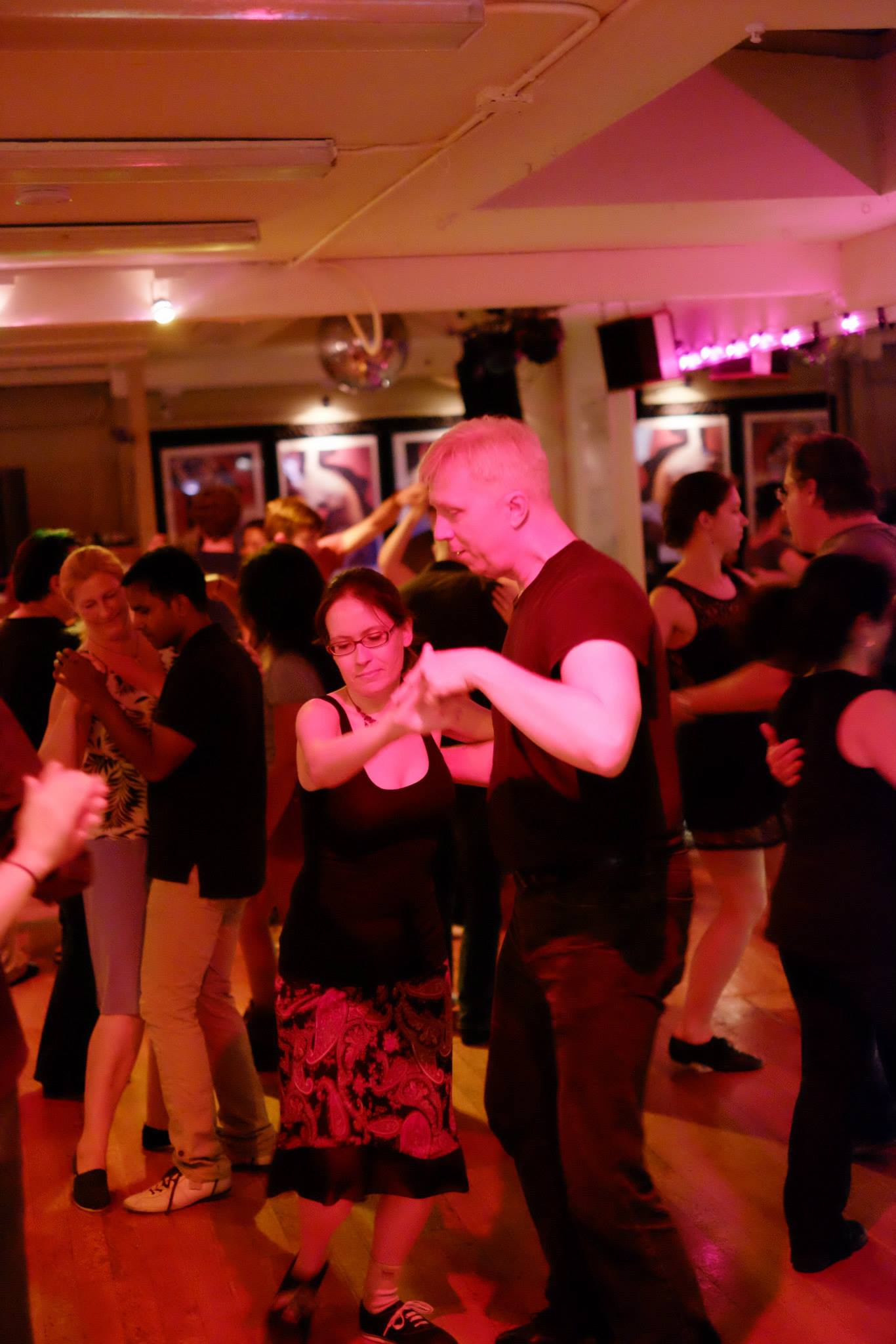
Photo by Richard Seely.

Photo by Richard Seely.

And then there’s the joy. I am so happy when I’m dancing, I feel like my happiness must be shining out of me like a beacon. I am happy thinking about going dancing ahead of time, and I’m happy after going dancing, while I’m driving home to good music and then eating my instant oatmeal (brown sugar and maple flavored, of course). And I am the happiest of all when I’m in the flow of the dance, buoyed by good music, connected to my partner, and experiencing the joy of a moving creation.

When I am dancing, there is nothing else in the world I’d rather be doing. And having that space to be so devoted and focused is extremely precious.

So on this, the six-month anniversary of rediscovering this joy, I hope for much more dancing in my future. I wish I could dance this week. For myself, to celebrate this milestone, and also for Jimmy. Thanks for showing us how to live with gratitude and passion, my friend. You are an inspiration.

Read Full Post »

I remember the first holiday when I had nowhere to go.

I was twenty-two years old. I had just graduated from college, and in a few weeks I was moving to London. It was Christmastime. It would have been the last Christmas in my childhood home, as the plan was to sell the house sometime the next year. Would have been, because my dad and his girlfriend decided to go on a romantic getaway for Christmas instead. I made plans to spend Christmas with my boyfriend and his family. But then we broke up like a week beforehand.

And I had nowhere to go.

*

I read an essay in the New York Times last week that hit me hard in the gut. Life: An Unspooling, it was called. The writer, Rachel Louise Snyder, was writing about loneliness:

“I imagine myself alone in ways other people are not…. People who know where they’ll go on holidays and with whom and for how long. People with plans. With extended family they complain about, but then spend the most important days of the year with.”

I imagine myself alone in ways other people are not. There’s the rub, isn’t it? We have these ideas in our minds, maybe even expectations, about how things are, about how things should be, about the way other people live their lives. We feel the rawness of the intersection of how we imagine other people live and how our own lives fall short of this ideal. And all of these mental gymnastics make the loneliness ache that much more acutely.

And then there’s that feeling of free fall. Because there are most important days of the year, however arbitrary they may be, and to have nowhere to go for them–to lack that comfortable sense of belonging–it is hard. And knowing there are many people who also lack that certainty about those important days doesn’t lessen the loneliness of it.

Those of us who know this reality have to create anchors in other ways. And there is no instruction manual on how to accomplish this.

*

I read this essay in the Times, and then I got in my car and drove to the movies to see Mr. Holmes with one of my close friends.

Oh, Mr. Holmes. The movie is a meditation on loneliness. Every character is lonely in his or her own way, alienated in his or her own way, and the loneliness we see is profound. Alienation between father and son, between mother and child, between two best friends, between husband and wife, between oneself and one’s aging and failing body. People who fail to understand one another, who let each other down in terrible ways. Who feel like they do not belong.

Oh, this movie. I love it, I hate it, thinking about it now makes me want to cry, the ending is sublime. I want to find my own field somewhere and a bunch of big white rocks (even as I was watching, I thought to myself, where in the world does one obtain rocks like those).  I want to remember the people who are not here anymore. The people whose absence still speaks. The people who, in their own ways, have taught me about loneliness, all unknowing.

*

This last Christmas I did my best to let go. It was actually a very good Christmas. I spent Christmas Eve and Christmas Day with two of my favorite people, and I looked through the year’s photobook for the first time, and I spent time with Nala, and I ate well, and I Skyped with my sister.

Tree Day, however, I spent alone.

Tree Day, for me, is perhaps of an equivalent importance to Christmas Day itself. It is the first Saturday of December. It is the day I go pick out a tree and bring it home and string up the lights and decorate it. It tends to smoosh out into two days and sometimes even more.

For last Tree Day, I thought about asking around and trying to find someone who would go with me, someone who would help me carry the tree in from the car, someone who would decorate with me and perhaps even listen to the occasional memory ignited by one of the many old ornaments in my collection. I thought about it, and it was an exhausting thought, and so I just went by myself and hoped for the best, and then a neighbor I didn’t know helped me carry the tree into the apartment, and everything worked out.

I was happy because my anchor held. I could do it on my own. I could let go, and I wasn’t deeply unhappy about it. I was just a tiny bit unhappy. And I was still able to create the beauty I wished to see.

It looks like fairies live here.

It looks like fairies live here.

But I was also sad. Because I knew–because I know–that I will always want that. I will always want people I belong to and who belong to me. I will always want one or more people who will of course spend Tree Day with me because it is one of my Most Important Days. I will always want a place to be.

It’s okay. It’s okay that I will always want this and I won’t always get it. But it is also sad.

*

I want you to know the only reason I can publish this piece is that I’m not feeling particularly lonely right now.

Also, the holidays are still a safe distance away. I won’t start to feel a hollow pit of dread until at least October.

I hope you won’t feel sorry for me. I hope, instead, that you will experience some kind of resonance, reading this. That you will think of your own way of being lonely, whatever that looks like, and that perhaps its edge will be slightly dulled hearing about one of my ways. That you will gain a greater appreciation for the place you have to be, or that you will find courage in not having that place, in knowing that the not having is workable and that it doesn’t mean there’s anything wrong with you.

That perhaps we can continue to understand each other better, you and I.

*

I spend a lot of time feeling deep gratitude towards the people who give me less obvious places to go.

I don’t know if these people know what they’re giving me. Every invitation, whether accepted or not, I gather them up and they become part of that all-important anchor. They help me remember my place in the world.

I did not have to spend Mother’s Day alone. I did not have to spend Christmas alone. I did not have to spend Thanksgiving alone. There is no price that can be put on things like this.

That Christmas, back when I was twenty-two, it had a happy ending. One of my best friends from college invited me into her home. Her entire family welcomed me and included me in all the festivities. To this day, I think about the generosity and warmth they showed me, and I tear up, and it changes how I see the world.

They didn’t have to offer me a place to go. But they did.

It meant everything to me. It still does.

Read Full Post »

One of my most popular posts is one I wrote back in September of 2012, entitled “Nice vs. Kind.” And this week I received a note about it from a person I recently met, so I thought it would be interesting to provide an update to you all.

In the post, I talked about the distinction I perceived between being nice and being kind, and I talked about how, while I was making the shift, it could sometimes be difficult for me to be kind at all, because then I’d just fall right back into being nice instead, which was something I was trying to change.

What I neglected to say was it was also difficult to be kind because I was so angry from the decades of not getting most of my needs met and receiving repeated messages of how unimportant I was. In other words, I had to learn to be kind to myself before being able to easily be kind to other people too.

Fast forward almost three years, and it has definitely become easier for me. I’ve created a kind of checklist for dealing with situations that feel fraught and involve setting boundaries. (Because honestly, the rest of the time, it’s not very hard for me to be kind.) This thought process has become mostly habitual at this point.

Photo Credit: a.drian via Compfight cc

Photo Credit: a.drian via Compfight cc

Step 1: Figure out what I need/want.

If I really don’t care, then I get to be laid back, which is lovely.

If I don’t know, then I usually need some time. I’ve gotten better at simply saying I don’t know and getting the time I need to figure things out. Sometimes, when I’m really confused or emotional, I also need to talk things over with one or more friends to understand what it is I really need.

Step 2: Be clear and firm.

Step 3: Be kind.

Steps 2 and 3 are in that order for a reason. They reflect my priority, which is to be clear and firm FIRST, and kind SECOND. This helps prevent me from accidentally falling into niceness and wishy-washy-ness. It also reminds me not to soften or change what I need in order to be nicer, which is pretty much always an idea that crosses my mind at some point. (The Step 1 checking in with friends part is pretty helpful for this too, as it helps me not be too nice to begin with and builds in some accountability.)

I should note that if for some reason Step 3 is not possible, that doesn’t give an automatic pass to being UNkind. In general it is possible to be clear and firm without decimating someone in the process. To me, the main drawback of not being able to engage with Step 3 is it can feel a bit…robotic, but if that’s what necessary to express myself clearly and firmly, well, it’s not so bad. And luckily it doesn’t come up very often.

I should also note that following these steps doesn’t instantly solve all my interpersonal problems. The fact is, if someone wants something and I decide I don’t want to give that thing, then sometimes no amount of clarity or firmness or kindness is going to change the fact that the person isn’t going to be happy.

Still, each of these qualities serves its purpose. I practice clarity so I can get my actual point across with, I hope, fewer misunderstandings. I practice firmness so I’m less likely to have to revisit the same conversation and issue repeatedly or have someone try to change my mind. And the kindness? I believe it is ultimately helpful to the other person, and also, it’s simply the way I want to be.

“Be firm but kind, Amy.” This is the advice that runs through my head now. It isn’t foolproof, but it helps me remember how I want to be.

Read Full Post »

« Newer Posts - Older Posts »