Feeds:
Posts
Comments

Posts Tagged ‘Amy Sundberg’

My flash science fiction story Man on the Moon Day is now available on Daily Science Fiction’s website. Hooray! (Make sure you press the “Display Entire Story” button so you don’t miss out on the end.)

For those of you who don’t know what flash fiction is, it is super short fiction. The word limits vary, but in my own mind, I usually define flash fiction as stories of 1000 words or less. Other people say flash fiction is even shorter than that.

I wrote Man on the Moon Day for a contest of the Codex Writers’ Group called Weekend Warrior. The idea is that every weekend for five weeks, the participants are provided with a few prompts to choose from, and must write a story of 750 words or less. Then everyone reads everyone else’s stories and rates them all from 1 to 10 and provides brief comments (a sentence or two).

For me, this contest was a great education in flash fiction, a form of fiction I hadn’t been very familiar with before. I participated in three of the weeks (one weekend I was in Detroit for ConFusion, and the last weekend I was just tired and very steeped in Novel). My first two stories…well, they weren’t very good. And then I wrote Man on the Moon Day, edited it based on contest feedback (it’s now 850 words long instead of 750), and sent it into Daily Science Fiction. Thirty-five days later I received the e-mail saying they wanted to buy it.

This story challenged me in two particular ways (well, besides the challenge of learning to write at a much shorter length, which was hard enough!). First, I was playing with a protagonist who…well, she’s fairly bitter, and many readers did not find her particularly likeable. I actually enjoy writing about protagonists who aren’t likeable but with whom I still have some sympathetic connection, and I figured, if I couldn’t play with that in such a short form, when could I get away with it? The structure of the story doesn’t help this either, as it is just one moment in time in what I consider to be the denouement of the entire story. Showing more of the story would, most likely, have helped to build more sympathy for the main character. So it was definitely a risk to take and doesn’t work for all readers. Indeed, many of the readers on Codex adamantly didn’t like this story.

The second challenge was one of theme and how this story plays into the “great space explorer” trope of science fiction. Because the story should be about the spouse who travels off into the great beyond and founds a colony on the moon…shouldn’t it? Well, I didn’t think so. In this case, I thought it was more interesting to explore what (or in this case, who) the explorer leaves behind and ask the question, at what cost? I’m not trying to make value judgments here about the cost as much as present the question to the reader so they can answer it for themselves. At the same time, the story may cause some readers to question traditional gender roles and how gender privilege sometimes asserts itself into relationships. It certainly caused me to think about that, even though I didn’t originally intend to write a story about that issue.

So this is a story that very much challenged me, as both a writer and a human being, and I hope it will challenge some of you as well.

Meanwhile, if you are wondering why a Wednesday post, it is because I will be on a plane for most of Thursday. I’ll be at Readercon outside of Boston this weekend, my first time at this particular con. I have a group Codex reading on Friday at 12pm in Room NH, at which I’ll be reading this story (it is, after all, a Codex success story). The rest of the time, I’ll be gorging on exciting panels and interesting conversation. If you are going to be there as well, I’d love to say hello!

Read Full Post »

A couple of recent articles about what to say and not to say to chronically ill people reminded me of an essay I’ve been wanting to write for a long time: an essay about what to say and not to say to grieving people.

This is not that essay.

Instead I’ve been thinking a lot about the fundamental difficulties in communication. Those articles I linked to have excellent advice for how to support people who are ill, and yet… implementing that advice is no easy matter. It can be hard to be supportive, and it can be hard to be supported.

One way to be supportive

I’d love to think that having gone through the experience of losing my own mother would make me some kind of expert when it comes to grief. But it hasn’t. I still find myself at a loss for words. I still don’t always know the best way to support someone experiencing grief. Because people are different, and they need different things.

The reason I wanted to write that essay is because of some profoundly stupid and upsetting things people said to me about losing my mother (both during and afterwards). But I recognize that some of those things that grated against my raw skin would have been comforting to others. So if you don’t know a person extremely well, how do you know? How do you know what they need to hear? The answer is, you don’t. You do your best to be thoughtful and caring, and you listen in hopes of hearing what they need.

Of course, some responses are simply a bad idea. Pushing our religions and religious ideas onto others who don’t share them in a time of grief is shockingly dense. Comparing one grieving person with another one unfavorably is also completely out. (Julie lost her mom last year and is doing great, so why are you such a mess? Ugh.) Continuing a conversation normally as if we didn’t just hear someone tell us about a recent loss? Completely inappropriate. (And yes, these are all responses I received personally.)

But beyond that, some people want alone time, while other people never want to be alone. Sometimes it’s nice to pretend like everything’s okay, and sometimes another minute of pretending seems completely insupportable. Sometimes people will want to talk about it, sometimes they’ll want to cry, and sometimes they’ll want to play video games. Some people will want to talk religion, some will be experiencing grave doubts, and some will simply want to avoid the subject as much as possible. And the relationship between the grieving and the dead will be different in each case as well. But somehow in the aftermath of death we forget this and make assumptions that aren’t always correct.

Our society teaches us to tiptoe around grief. What this often means is a flood of well wishes right after the death of a loved one, followed by…resounding silence. No one knows if they’re supposed to pretend nothing is wrong or if they’re supposed to inquire after you. People don’t know how best to support you. Those who grieve are not always encouraged to figure out what they need or communicate those needs to others. Sometimes they are too upset to have any hope of doing so.

Because this is not that essay, I don’t have any nice, neat conclusions for you. I don’t have definitive answers or a list of ten things you should do to help your friend who is grieving. What I try (and sometimes fail) to do myself is to be compassionate, remember that the other person is not me, and pay attention. I don’t feel like it is enough, but it’s all I’ve got.

If you’ve ever lost a loved one, what kind of support did you need/want? What things did people say to you that were particularly helpful (or unhelpful)?

Read Full Post »

A month or so ago, Mike Allegra was kind enough to nominate me for a Versatile Blogger Award. Which was like an extra special birthday present for the blog. Thank you, Mike!

Mike blogs himself, of course (hence the award). He is a children’s writer too. And he tells very amusing personal anecdotes in a casual and funny style.

Anyhow, I thought this would be a great time to highlight a few other blogs that are in my own reader that I’ve been enjoying lately.

  1. The Book Smugglers: I’ve been enjoying the Book Smugglers for a long time now. They are my favorite book review blog, and their general tastes fit so well with mine it’s almost spooky. They tend to review YA (and some MG as well) and adult SF/F, as well as a little historical and romance on the side. I don’t agree with every single one of their reviews, but they are always thought-provoking and well-reasoned. I learn both about books I’d like to read and more about writing at the same time. I especially love their “On The Smugglers’ Radar” feature every Saturday about upcoming titles.
  1. Blotter Paper: This is the blog of my writer friend Rahul Kanakia. He writes speculative fiction (and has been published in places of note like Clarkesworld, IGMS, and Redstone) and is about to move across the country to begin an MFA program. He writes a lot about the books he reads, which is interesting because he has very eclectic tastes, so I feel like reading about his reading broadens my own horizons. And he is an astute observer of society as well.
  1. Altucher Confidential: This is a bigger blog about personal development, and it amuses me because James’ personality comes out full force in everything he writes. I don’t always agree with him…in fact, I often don’t agree with him. But his world view is interesting and occasionally he says something that really resonates with me.
  1. Letters From Titan: Racheline Martese writes interesting analysis of pop culture and symbolism in pop culture. Her essays about the TV show Glee have possibly prolonged my viewership of said show, that’s how interesting I think they are. Really, my only wish is that she’d write more.
  1. Captain Awkward: This is my absolute favorite new discovery; even its name snaps with awesome. This blog is an advice column that actually dispenses advice I can usually get behind. (I know, right? Who would have thought that was even possible?) Captain Awkward encourages people to get a backbone, say no when appropriate, get their needs met, and improve their communication skills. I love this blog with all the blog love in my heart.

How about you? Got any favorite blogs you’d like to recommend? I’m always looking for new ones to check out.

Read Full Post »

I had a topic all ready to write about today, but I’m throwing it out the window, and instead I’m going to talk about the recent New York Times editorial “The Busy Trap” that people have been sharing like crazy. Sometimes extremely busy people, which is giving the entire conversation an extra dose of (unintentional?) humor.

I am actually very torn by the idea of the culture of busyness that apparently is not just a Silicon Valley thing (although I can’t pretend to be very surprised it also lives in places like Manhattan). First off, the whole conversation automatically comes from a place of privilege–people who can choose whether or not to be busy because they have time that is not taken up with working to support their families or working insane hours so they will not be fired (and I’m sure there are other examples you can think of).

That being said, it’s still an interesting cultural phenomenon for many of those in the middle class. I’ve certainly seen it countless times here in the Bay Area. And on the one hand, I’m impressed by the busy (which is, after all, partly the point), while on the other hand, it irritates me to no end.

Busy busy.

Sometimes, after all, the busy is really cool. I admire people who have decided to embrace their passions, or go out and change the world, or meet tons of fascinating people, or travel around the world. Their social calendars sound exciting, and when you ask them, at the occasional party, what they’ve been up to, they always have something to say beyond, “Eh. I work. And then I don’t work.” There is a certain energy some of these people have that can be quite intoxicating, as they catapult from event to event and obligation to hobby. And I’m really happy for them and encourage them to follow their dreams.

But on the flip side, it’s hard to become Friends with a capital F with these busy people. Because all those activities take time, and it has to come from somewhere. And when you try to get together and have to schedule a month ahead…to have dinner…and there’s not even kids or babysitters or anything involved…and this happens every time you try to schedule…well, it becomes an obstacle. And it is difficult to build intimacy with local friends who you are not able to see once a month or so, at least during some formative period at the beginning of the friendship (honestly I’d say every other week, but Silicon Valley has forced me to adapt my expectations).

I am not busy. Not like that. I have my weeks that go off the rails, and I travel a fair amount, but here is my secret. I like not being busy. I like having time when I’m sitting around thinking. I like having lazy Sundays when I sleep in, take my dog to the park, read a novel, and maybe go out for sushi in the evening. I like having time to write this blog. I like having time to notice what’s going on around me, and I like silence, and I like days when I have nothing scheduled. And sometimes at parties, all I have to say is, “Well, I’ve been writing.”

Not to give you the wrong idea. I still have stuff I have to get done, obligations to meet, appointments to keep, projects going full swing. I vigilantly guard my writing time, even when I’m invited to do fun stuff. But it’s a very different pace. It is definitely a privilege.

And I have the time to appreciate that.

Read Full Post »

My blog, the Practical Free Spirit, turns two this week. On Saturday, June 30th, to be exact. This is my 223rd post. I just read my first post, Originality: Having Something to Say. I didn’t know what to expect, but it’s not so bad. It sounds like me two years ago, which isn’t, after all, so much different from me now.

Would you like some more data? I’ve taken time off for vacation a few times, but other than that, I reliably post twice a week. I’ve never failed to post when I was planning to do so, although I’ve come close once or twice. The blog gets an average of 105 comments per month (thank you for joining the conversation!). Probably about half of those comments are from me, although I’ve been falling a bit behind in the past few months.

The highest traffic month in the blog’s life was April 2012. The most popular post is What is a Free Spirit?, which is apparently more of a pressing question than I would think. (Thank you, Google Search.) Other popular subjects include those I was afraid to write about, introversion, and cool Star Wars pictures. I am still on a quest to bring some much-deserved cuteness fame to Nala because what good is having a blog if you can’t occasionally cute-bomb your long-suffering readership?

Storm troopers create new lives for themselves fighting crime.

I don’t know much about my readers, actually, except the ones who comment. I wish I knew more. I wonder about you sometimes. It’s a strange sort of intimacy we have because I suspect there’s a significant part of me that you can get to know pretty well if you read regularly. Not the entire me, of course, but an important part. I talk about what I care about here (really, there’s no point in me writing a 500-word essay about something I don’t care about). I talk about what I’ve been thinking about. I link to the most interesting articles I’ve read. Once in a while I get teary-eyed while I’m writing one of these posts because it matters so much to me.

I read articles about what I “should” be doing with the blog, and then I ignore a lot of what I read, because we are friends, you and I. And a lot of those shoulds sound sleazy or cheap or fake to me, and I can’t bear to do them. Not to the blog, which has taken on a life of its own. It depends on me, after all; I breathe life into it. I am responsible for it. Before I started, it didn’t ever occur to me to think of a blog as a living entity, and perhaps many blogs aren’t. But this one–well, it just might be.

I am going to ask for a birthday present now, for me or for the blog, or for both of us. Satisfy my curiosity, leave a comment, and tell me about yourself. Who are you? What do you like about this blog? What do you wish I’d do more or less of? What are you glad that I don’t do (and you hope I never start)? What subjects do I talk about that give you a burst of satisfaction?

I would really like to know whatever you’d like to tell me.

Read Full Post »

It’s that time again! Birthday time! My birthday is tomorrow, but I am celebrating all week. Why? Because I can, that’s why. And because I’m happy to be alive. And because I keep thinking of things to do that sound like excellent birthday-related activities. Like playing an epic game of Battlestar Galactica this past weekend, for example. And visiting Ghirardelli Square. And going to a bookstore (any reason is a good reason to do THAT!)

Last year I wrote about Five Happy Things for my birthday, and I think that’s an excellent tradition, so I’m going to do it again.

1. The Academy of Forgetting. Flawed it might be, but it’s also the best and most ambitious thing I’ve ever written. I’m in the middle of an exciting (and at times turbulent) romance with it, and it reminds me of all the best parts of being a writer.

2. The Writing Community. When I went up to Seattle at the last minute this spring, I sent out an e-mail telling local writers I was going to be in town. I expected to spend most of the trip by myself; maybe a couple of people would be able to get together, I told myself. Instead, I got to see so many writer friends, it blew me away. People who went out of their way to spend time with me, help me (especially with the buses), and show me cool aspects of Seattle (the Underground Tour, the Theo Chocolate Factory, the nightlife, the food). And that’s when it hit me down deep: this is what community is. And I am a part of it. How amazing is that?

3. Food. I love food. I was raised on a bland and narrow diet, and ever since I went away to college, I’ve been on a journey of discovery. I am so happy there are spices! And onions! And different types of cuisines from different countries! Heirloom tomatoes exist, how exciting is that! And beets, and baked sweet potatoes, and cherries, and gnocchi, and sushi, and Ethiopian food, and curries, and white hot chocolate, and… You get the picture.

4. My bathtub. My bathtub is a proper big bathtub, like all bathtubs are meant to be. It also has jets, but I never use them. What I like about my bathtub is that I don’t have to bend my knees to fit in it, and I can be submerged in hot water from my neck to my toes. Sheer bliss.

5. Being able to set my own sleep schedule. I do not like going to bed. However, I do like to sleep and feel well rested. Do you see the inherent quandary? Happily I am able to set my own hours, and therefore I am able to stay up late and still get eight hours of sleep. This is a wonderful thing, and I appreciate it on a pretty much daily basis.

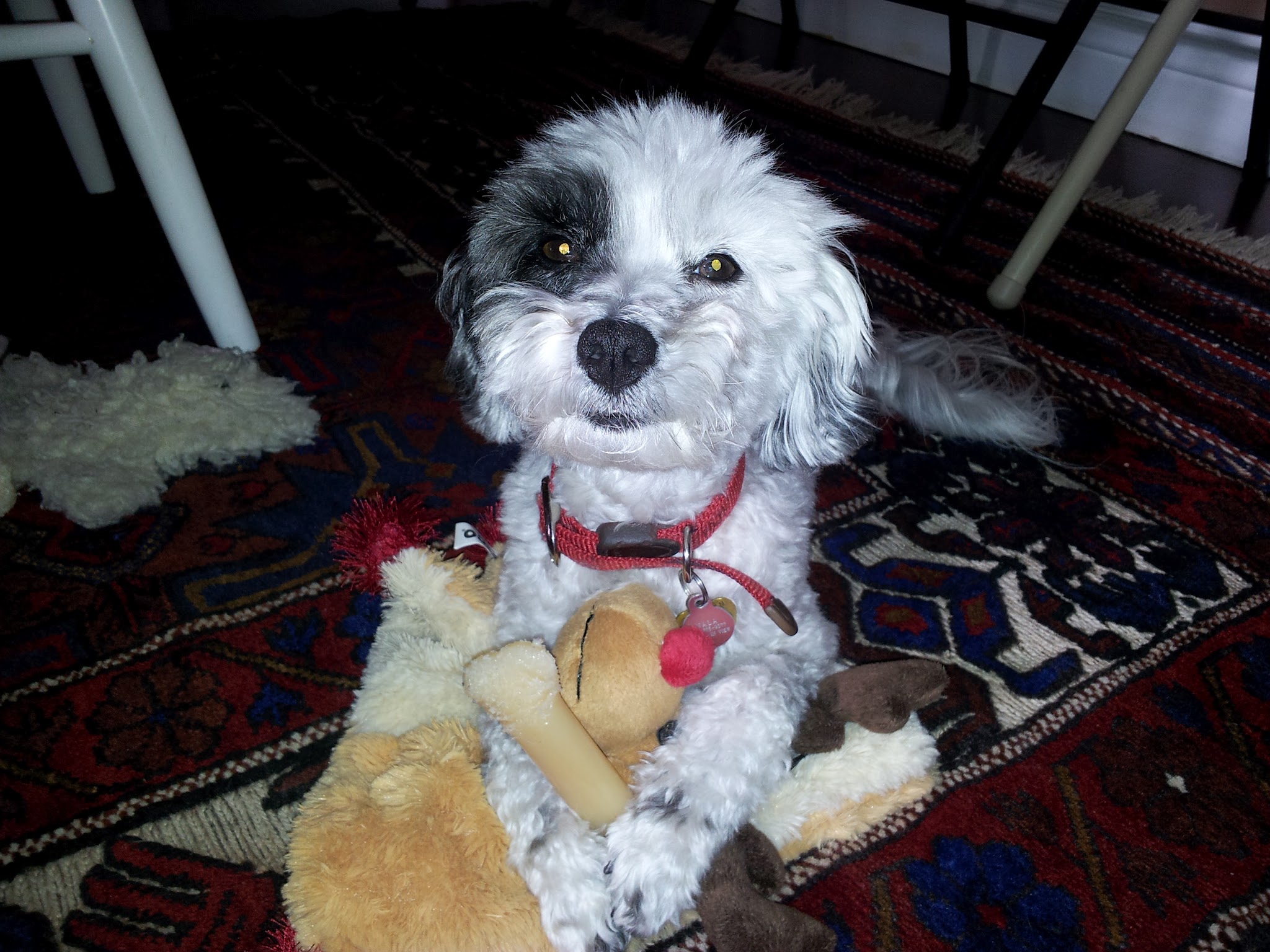
I will leave you all with the adorableness that is Nala. This is maybe my favorite photo of her.

You can see some Jack Russell attitude here. Classic Nala.

Read Full Post »

“So how’s the revising going, Amy?” you might well ask.

Do not be alarmed if your question is greeted with me pulling contorted faces and making strange, growling noises. But never fear; my joy in being asked about what I spend most of my waking hours thinking about will outweigh my need to do an interpretative dance to express my varied ambivalence, sheer joy, and “what was I thinking?” reactions to my current revision process.

To catch you up: At the end of April, I went to Seattle. (Did I already tell you this? I can’t remember.) Bolstered by the excellent company of my comrades-in-arms for many adventures and meals in Seattle, I resisted the urge to play tourist 100% of my time and instead read through the rough draft of my novel The Academy of Forgetting. I took copious notes, rewrote sections, and tried to make sure it was more or less coherent. Then I sent it to my most trusted novel first reader for an opinion.

The magic of revision…oh, who am I kidding? I am totally using this as an excuse to use Trey Ratcliff’s awesome Walt Disney World photo on my blog.

A week later, Daniel sent me his critique, which ran almost 4,500 words long. This was obviously not going to be a small revision pass.

So for the last month, I’ve been thinking. I haven’t wanted to dive headlong into revisions because these changes are complex enough that there is a fair amount to be figured out ahead of time. Plus a few weeks were mostly lost to injury (but oh boy, did I have a lot of time to think) and then I went on vacation, and you know. Life. But I am about ready to start writing new words and begin the simultaneously delicate and destructive task of fixing this book. The prospect fills me with both excitement and dread.

Let me give you an example of one of the changes I’ve been thinking about. There’s a plot twist at the end of the book. It is, in my opinion, a fun plot twist, and one that I looked forward to revealing the entire time I was writing the first draft. Daniel suggested that the twist doesn’t work as it currently stands. It’s not foreshadowed amply enough, for one, but he also suggested the book might be stronger if I completely cut the twist.

So now I have to decide: keep the twist or cut the twist? At first I thought I’d cut it. But then I realized that if I cut it, I’d also be cutting a key bit of information about the narrator and the narrative, which would, in my opinion, take away a large bit of the narrative depth. So then I thought, well, what if I keep it and make these foreshadowing changes, etc.? And I thought about that possibility for a while, but something felt slightly off. And then I had an exciting idea for how I can cut the twist but retain the key insight into the narrative, and I was bouncing up and down in my chair. But then I realized this idea brings up a whole new problem in terms of the plot and how I can make it work…. And on it goes.

I love the revision process because it’s challenging and interesting and convoluted and requires thinking about many things at the same time. But while I think it’s one of the most exciting things ever, it looks like me sitting in a chair and staring into space, with perhaps the occasional spurt of typing or scribbling sentences in my notebook. The writing life is often glamorous in a completely invisible way.

So that’s what I’m doing: getting ready to start a new draft, trying to resist biting my fingernails at the thought that I might demolish something that I actually needed intact, or that I might keep something that turns out to be just an old eyesore. Either of these would be fine in an isolated case, of course, but they can add up so quickly into a manuscript that simply does not work. And I’d like to make this manuscript work, if I can.

Read Full Post »

Let’s talk about failing.

Remember Adam Baker, producer of the documentary I’m Fine, Thanks? (The movie, incidentally, has now reached its funding goals, hooray!) He had this to say about how people overcome falling into complacency:

“They started to become comfortable being able to fail. I don’t mean they LIKED failing. Or even tried to fail. But they were o.k. with that being part of the process. Often, the desire NOT to fail was what kept people trapped for decades!”

How often do we hold ourselves back because we’re afraid to fail? Maybe people won’t like our final product (or us, heaven forbid). Maybe people will say no to us. Maybe people won’t buy our book, or listen to our songs, or even know we exist, even when we’ve given it our best shot. Maybe we’ll sound stupid. Maybe we’ll realize a major flaw only after our idea/plan/creative work has already been made public. Maybe maybe maybe.

So in order to protect ourselves from all those maybes, those things that might happen in the future, we fail before we even start, by not allowing ourselves to start (or finish). In this way we can preserve some illusion of perfection, of possibility, of “I could have done this if I’d really wanted to.” Some of us have been taught that failure is an unacceptable and unendurable sort of experience, and thus, we protect ourselves from the imagined agony it will cause.

Except. Failure only has the power over us that we grant it. Failure only causes us agonies if we allow it to do so. When we reframe failure to be okay, to be a learning experience, perhaps even a way of being able to tell that we’re saying yes to our own potential, then it loses its power to wound so deeply.

Even in the hero’s journey, the hero fails before succeeding.

“Boldness is genius.” I read this post by Sarah Peck recently, and it suits my current frame of mind (I even gave a spirited live reading of it, which I wish I had video of so we could laugh about it together). I’ve been trying to be more bold lately. And you know what has mostly happened?

I’ve failed. A lot more than usual. Things have fallen through. People have told me no. Vast quantities of uncertainty have wrapped their tendrils throughout my life. I’ve miscalculated the risks involved. I’ve been disappointed and frustrated. Sometimes I have a sensation not unlike banging my head repeatedly against a hard object.

But you know what? Failure? It’s not so bad. I haven’t disintegrated into a pile of green goo. My sense of self worth still exists. Sure, I don’t particularly enjoy being disappointed or frustrated, but I’m pretty sure I’d feel those emotions no matter what, and this way I’m not giving them power over me in the same way. I feel frustrated? Let’s try something new, take a break from whatever is getting under my skin. I feel disappointed? I’ll only dwell on it until I try the next thing. And if I’m being bold, that means I’m trying the next new thing a lot sooner.

The idea that failure always equals disaster is just plain wrong. Boldness IS genius. Comfort with failure unlocks many doors. And allowing ourselves to separate from all those crippling maybes is freedom.

How are you going to be bold this week?

Read Full Post »

Exciting news! For those of you who don’t follow me via social media, you may not know that my science fiction story “Daddy’s Girl” appears in this month’s issue of Redstone Science Fiction.

This publication is especially bounce-worthy for a number of reasons. First off, this sale was the one that qualified me to join SFWA (Science Fiction and Fantasy Writers of America) as a full member. Secondly, while this isn’t the first science fiction story I sold, it is the first one to be published where everyone can read it. And it has shown me that I can write stories set in an awesome space setting and sell them, which is a particularly happy thing to know.

I discovered this story’s seed while I was working on a bigger world building project. I was considering writing a YA novel with a space setting, so I sat down to figure out how my milieu would work. At a certain point I pulled my husband in to get answers to all my burning scientific questions (the immense perk of being a writer with a physics PhD and lifelong space enthusiast at my disposal).

We were talking about water, and the difficulties of procuring water in space. And he said something like, “Oh, you could just mine comets for their ice and haul it back in.”

Comets are beautiful.

Mind you, this was a completely tangential issue to anything having to do with the novel I was considering. But my imagination was instantly captured by the idea of an ice ship and the spacers who lived in it, constantly chasing after comets to bring back that oh-so-valuable resource, ice. (I have since learned, from Bill Bryson’s At Home, that there used to be an important market for ice in the past as well, pre-modern refrigerator and especially for shipping/transport issues, but I wasn’t thinking about this at the time.)

So I decided to write a short story to explore my ice ship idea further. At which point I found my character Lolly’s voice, began to understand her story, and was completely hooked.

For those of you interested in process, I wrote this story fairly quickly, did a quick revision and sanity check with my husband, and sent it off to my friend (and frequent commenter) E.F. Kelley to take a look. He identified an important scene that was missing (thanks again, Eric!), I added the scene while revising again, and then sent it off to market. I did one final revision pass before sending the story to Redstone in order to fall within their 4,000-word maximum length limit. (It had previously hovered just a few hundred words above that number, and I’m very happy to have tightened it further.)

Interestingly to me, the whole process was fairly painless, as has been the case with most (all?) of the stories I’ve sold, although certainly not the case for all the stories I have written. I imagine there is a lesson in this fact.

I hope you enjoy!

Read Full Post »

“I spend way too much time worrying about whether I’m okay enough for people.” – An anonymous friend

Right now I’m feeling angry. I’m angry that it can be so easy to feel the way my friend feels right now. I’m angry because I’ve felt that way before. I’m angry because now I understand how many people encouraged me to feel that way.

Jim Hines published a brilliant blog post yesterday about boundaries. Please please please, if you have ever liked anything I’ve written on this blog, go read what he has to say. Go right now. I’m serious. Go even if that means you won’t finish reading this.

No. No no no no no.

I grew up being taught, both implicitly and explicitly, that it wasn’t okay for me to say no. I drew a few lines in the sand, but now it pains me to think of how few, and how much inner turmoil I suffered to stand up for them.

A bit more than a year and a half ago, a person I was close to finally pushed me too far. And I started saying no, the way I wish I had done many years before.

This person tried to punish me for saying no. He didn’t want there to be a problem, so he simply ignored it. He pressured me to pretend everything was fine, to be okay with what had happened, to once more make a huge sacrifice for his own convenience. He sent me manipulative emails and the most passive aggressive birthday card imaginable. He took something he knew I cared about and tried to use it to force me to see him against my will.

I only talked about this as it was happening to a few people. Because I believed that not only did this person think it was not okay for me to say no, but that everyone else–society as a whole–would agree with him. I still think that’s true to a certain extent. Many people are not okay with the idea of boundaries, that we have the right to decide what we will and will not do in relation to other people. I’m sure many people would tell me to suck it up, to be the nice girl, the good girl, and preach the power of forgiveness. Even though they aren’t even involved in any way, they would tell me to go back to being a doormat. (Why? Why does me having power have to threaten the entire world order? I have no idea.)

As an old friend of mine used to say, that’s bullshit. I no longer want anybody in my life who is not okay with me saying no. Full stop. I have drawn my line in the sand and this time it runs all the way down to the earth’s core.

It is okay to say no. Even when people react with anger, hurt, and pique, it is okay to say no. Even if it means people will no longer like you, it’s okay to say no. (These are not the people who will love and cherish you and have your back and support you through good times and bad in any case.) It is okay to take care of yourself, and you deserve to be surrounded by people who will support you in doing that.

Never let anyone tell you differently.

Read Full Post »

« Newer Posts - Older Posts »