Feeds:
Posts
Comments

I have loved musical theater since I was a little girl obsessed with watching movies such as The Wizard of Oz, The Sound of Music, Mary Poppins, and Annie over and over.  I watched those movies so often that I memorized the accompanying commercials.  I’ve studied musicals seriously over the intervening years, as a vocalist and performer, as a composer, as a critical audience member, and as a musical director.

I’ve noticed that my associations with musical theater are very different from those of many people I encounter.  I often don’t mention my interest, and when I do, it’s even odds whether my companion’s eyes will glaze over, or he’ll try to change the subject, or worst of all, she’ll make a derisive comment.  About musical theater.  To ME.  Musical theater has gotten a bad rap, and ignorance is rampant about much that moves and interests me about musicals.

Not every musical is an Oklahoma!, with energetic grinning and almost insanely enthusiastic dance numbers that consist of singing about the weather (and once you’re aware of the historic connotations of Oklahoma!, it’s a lot easier to take the aggressive cheerfulness).  Not every musical is a puff piece of finely spun sugar that melts in your mouth, leaving nothing of meaning behind.  Not every musical is overwrought rock opera from the 80s.  Not that I have anything against any of these types of musicals.  I enjoy and am interested in musical theater of all shades.  But.

Not all musical theater is created equal.

My very favorite type of musical theater may or may not feature any dancing.  It often consists of a fairly small cast.  There may or may not be fancy lighting or other technical derring-do; in my musicals of choice, the spectacle of the experience is not the point of focus.  I tend to adore musicals that have something to say and say it with passion.  I look for deep characterization and a satisfying narrative arc.  I want lyrics that are both clever and true, and music that drives home the themes of the piece.  My goal is to take something away after the show that has nothing to do with a snatch of a tune to hum for the next month.

Musicals are a form of performance art, and like the best theater, are capable of teaching us about ourselves and the world around us.  They make us feel, they make us question, and they make us wonder.  My favorite musicals will linger with me for months, or in many cases, my entire life.  Yes, musicals do feature characters who spontaneously burst into song (unless it’s through-sung like opera), but if done well, the music can harness the emotions of the character and present them in a visceral and memorable fashion.  If done by a master, the music can actually both cause and illustrate character development.

This post is the beginning of a series I plan to write and publish every Tuesday for the next month or so, discussing each of my favorite modern musicals (I currently have four), all of which were written and produced in the 1990s and 2000s.  I’ll be talking a small amount about the music and lyrics, but my main focus is going to be on the narrative and thematic ambitions of each piece.

For now, if you’re a musical theater buff, what shows are your favorites?  And if you’re not, what is your general impression of musicals?  Do you like Buffy’s “Once More With Feeling” or “Dr. Horrible’s Sing-a-long Blog”, or are all musicals equally anathema to you?  Weigh in and let me know!

Thank You

As this year draws to a close, I’d like to thank you, my wonderful readers, for allowing my words to live on in your minds.

I’d also like to thank all the wonderful new friends I have made this year: in particular, the friends that I’ve met through SCBWI (District 14, Asilomar, LA), through Taos Toolbox, and at World Fantasy.  You have made a huge positive difference in my life, and for that I am very grateful indeed.

May we meet again in 2011 and beyond.

Blog Retrospective 2010

It’s time for the end-of-the-year blog retrospective, which in this case covers the last six months.  I’m going to pull out a few posts that I think particularly deserve attention.

Most Popular Posts:

Introvert vs. Extrovert: A False Dichotomy?

My third ever post is still ranked #1, which (perhaps?) goes to show how fascinated people are with all things relating to personality.

It’s All About Priorities

Stop making excuses and follow your dreams.

Dealing with Disappointment

Inspired by a friend’s question, we talked about all things related to disappointment and what we do to cope.

A Few of My Personal Favorites:

How to Try to be Happy

I was just telling a friend about the “Five Things” technique yesterday.  And I still do it myself pretty much every night before I go to sleep.

Pre-professionals: the Difference between Musicians and Writers

I’ve been seeing a fair number of articles lately on how indie musicians and writers have a lot of issues in common, but this essay focuses on what I perceived as the differences.

Your Dreams are not Mine

We don’t all have to want the same things.

Six Impossible Things Before Breakfast, or How to Have an Exciting Life

This is the essay I started the blog to write.  No kidding.

Gratitude Upon Marrying a Fellow Geek

Yeah, I’m a little bit smoopy, what can I say?

I have some exciting ideas for the blog in the works for next year, which I’m looking forward to sharing with you all!  And as always, if there’s anything you’d like to hear me talk about, I’d love to know.

Christmas Memories

For me, Christmas inspires many memories.  It reminds me of my childhood, it reminds me of the changes through the years, and it reminds me of my mom, who was a big Christmas fan.  I was the one who was given all the old family decorations because of the simple fact that I’m the only one who really cares about Christmas anymore.  I’ve  been lugging several boxes worth of Christmas memories from apartment to apartment since I moved back from the UK.

My favorite objects of memory are the tree ornaments.  I can remember which ones were gifts, which ones I bought myself over the years and where, which ones are relics of childhood.  I’m going to share a few with you right now.

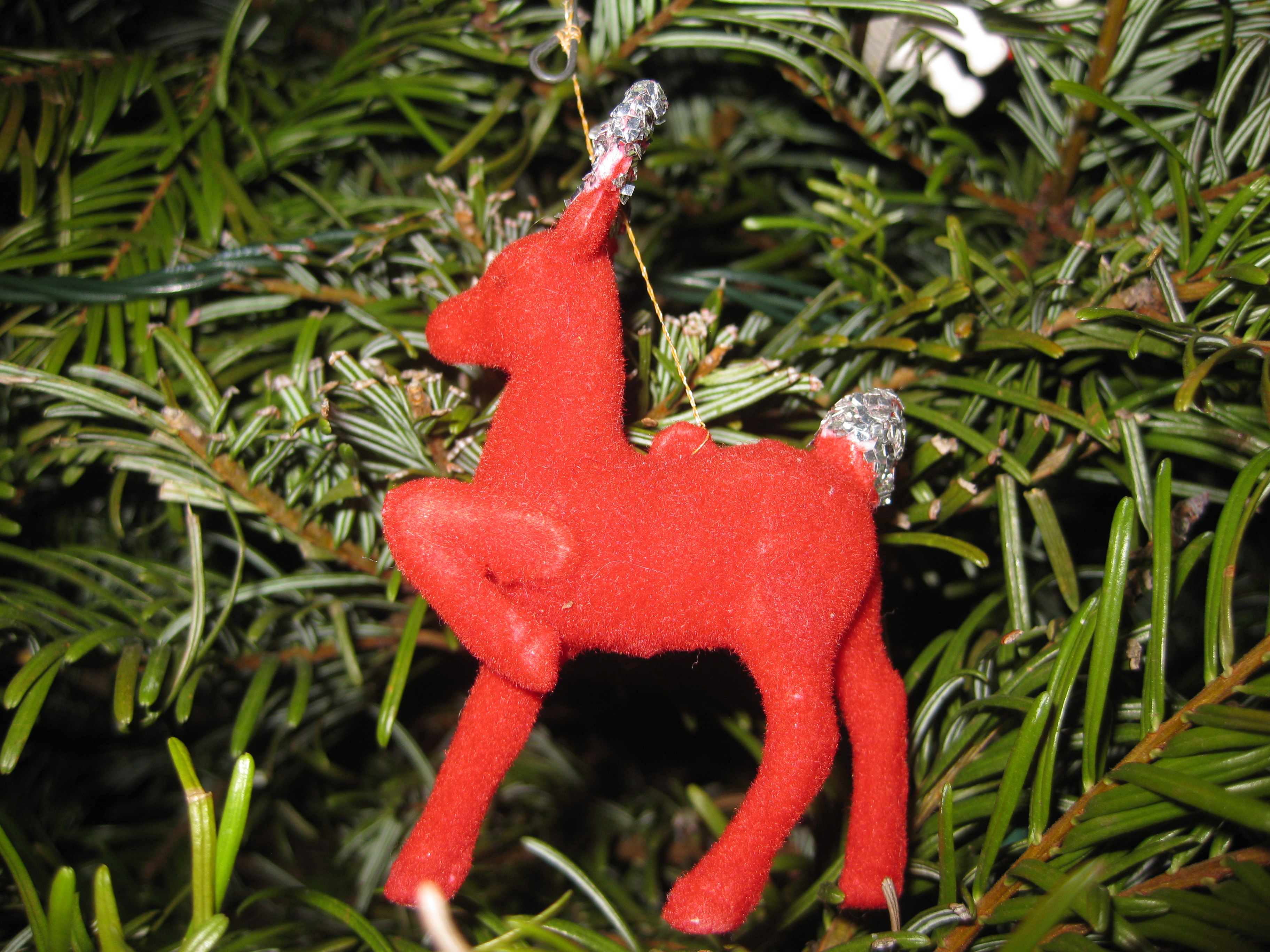
This is probably the oldest ornament I have.  It was my mom’s when she was a little girl and was likely obtained sometime in the earlier 1950’s.

These two were my favorite ornaments in childhood.  The Rudolph was made by my mom from felt and sequins and other stuff, I think from a kit.  The swing hangs from a long thread and was always the most carefully placed ornament on the tree because it needed an especially big gap.

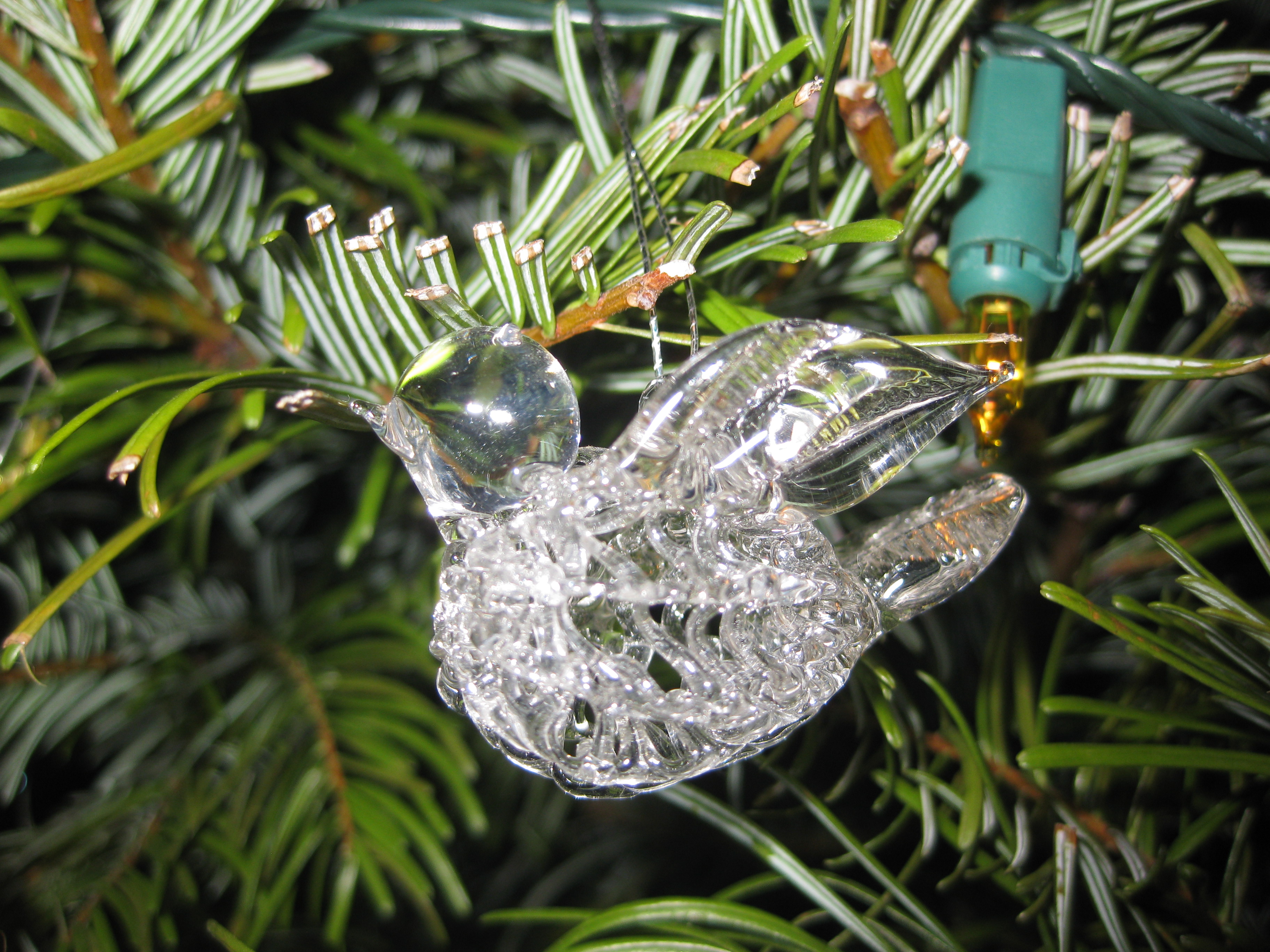
This was one of the first gifts I bought for my mom with my own money and my own choice.  I was so excited and proud to be giving her something I thought was so beautiful.


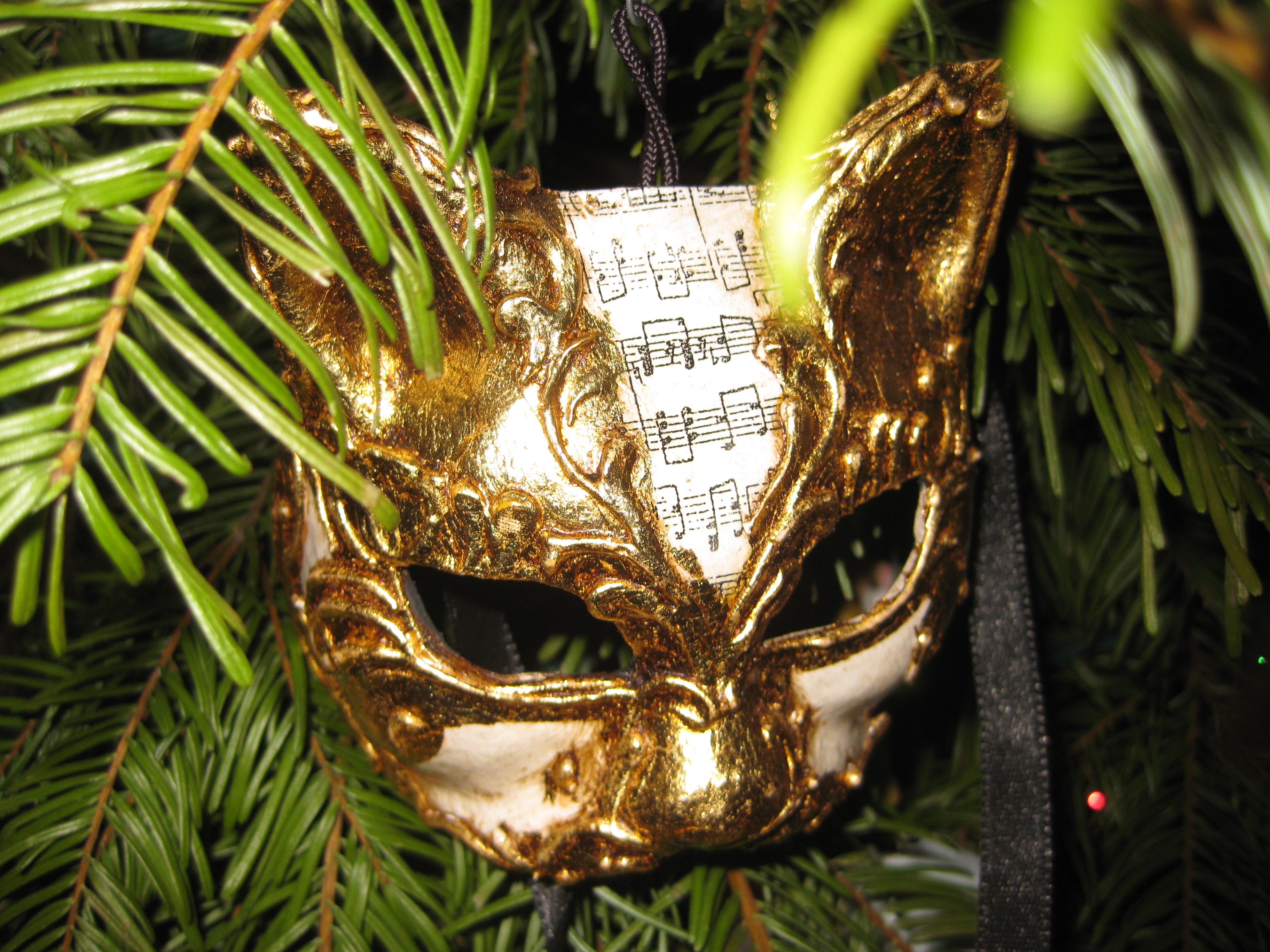
Here are three ornaments that we got this year.  You can see my affinity for cats (in spite of an unfortunate allergy) and dogs.  And the cat mask with the music notes is a particularly fabulous combination.

Do any of you have holiday decorations that help you hold onto memories you care about?

The Glass is Half Full

I was attending my husband’s company holiday party a few weeks ago when one of his co-workers came up to me and said, “Hey, I read your blog!”  This was, as you might imagine, a small moment of joy for me.  She went on to say something to the effect of, “Wow, you’re really optimistic.”

She was right, of course.  I am definitely of the optimistic persuasion, as I trust you may have noticed.  I hadn’t realized that optimism was such a distinguishing trait for me, though, until hearing about it from the outside.  So I’ve been spending a lot of time pondering the nature of optimism.

Part of it may well be disposition.  Optimism comes naturally to me.  I’ve said before that my neutral state, if nothing much good or bad is going on, tends to be set on the positive side.  Little things make me inordinately happy.  I get an e-mail from a friend and I’m already smiling.  My dog does something cute and I’m happy.  I think about the gingerbread cookie I’m going to have for lunch and I’m filled with anticipation all morning long.

Then comes the filtering.  We all do it, although some of us are better at it than others.  Filtering is the reason there can be horrible catastrophes somewhere else and we can continue through our day as if we don’t know that somewhere else people are dying in misery.  Filtering is forgetting or distracting yourself or not really listening.  Filtering is auto-pilot and prioritizing.  It can be enormously helpful or greatly hurtful.  I’m not always so talented at the filtering, which is why I sometimes have to take breaks and go months at a time without looking at a newspaper.

Once we’re done filtering, then we’re left to deal with whatever is left.  And Wesley wasn’t lying in The Princess Bride when he told Buttercup that life is pain.   At certain points all of us are called upon to deal with illness, with injury, with disappointment, with grinding monotony.  We experience setbacks, we make mistakes, and people don’t always treat us as well as they should.  We worry about our loved ones, our finances, current affairs.  When I was a kid we all worried about nuclear apocalypse.  Now we’re terrified of an environmental apocalypse instead.  If we look for something wrong or painful or scary, we’re sure to find it.

At this point, at least for those of us who don’t filter so well, we have two choices.  We can let the negativity pull us down and learn to expect the worst.  Pessimism is a coping mechanism, nothing more.  If we routinely expect the worst, we can protect ourselves from disappointment because we didn’t think anything good was likely to happen anyway.  It’s a thought process meant to cushion the blows of life.  The problem with it is that it also tends to keep us confined into a little box in which nothing much is possible.  It encourages us to be resigned instead of to strive.

Our other choice is optimism – to take what we find and make the best of it.  Just like pessimism, this is a coping mechanism.  It is the choice, in the face of the dark, to strive for better, which illustrates the inherent belief that things can be better.  Someone treats us badly, and we try to understand why so we can learn from their mistakes and become better people ourselves.  We get a rejection and we double our efforts to improve.  We see problems in the world and we start from the assumption that maybe something can be done to alleviate them, that maybe there’s even something we can do personally that might help a little bit.  It’s believing that the little things, like telling someone to have a nice day and meaning it, or complimenting someone on a job well done, will add up to make a difference in the world around us.

Sometimes when I am faced with a particularly daunting truth, I am a pessimist.  Sometimes I get tired and wonder if I’m making any progress.  I worry that I’m not making even a small difference.  I don’t know how I can possibly surmount what I see in front of me.  For those of us who either can’t or won’t filter, it is easy to become daunted and overwhelmed.  But as much as I can, I try to choose optimism because when I do, I’m happier.  I’d rather live a life infused with meaning.  I’d rather have the bittersweet comfort of hope.  I’d rather make the gamble that the little things sometimes matter after all.

The Cowardly Lion


The one thing I’ve always known about courage is that you don’t need to be brave unless you’re afraid.  If jumping out of an airplane is no big deal for you, then it doesn’t take courage to strap on your parachute and leap.  It’s just something cool that you’re doing.  But if you’re terrified of jumping and keep imagining your terrible and bloody death when you reach the ground, well, then you have something to be brave about.

What I’ve been less clear about is what courage really is and where it comes from.  I do so many things I’m afraid of because I don’t feel like I have a choice.  Take shots, for instance.  I’m really scared of shots, especially the Tetanus shot, but I dutifully go in and receive said shot when I need it.  In fact, I’m probably more dutiful about receiving it on schedule than someone who is less afraid of it.  But is it courage if I don’t have a choice?

I’ve been having a lot of problems with my back tooth over the past several weeks, and last weekend my injury came to a head.  I woke up in the middle of the night in simply excruciating pain.  It was hard for me to breathe, and involuntary tears streamed down my face.  My heart rate accelerated and my chest felt like it would explode.  So much pain to be caused by such a small part of my body.  In those moments, my nerve completely broke.  I would have done anything to make the pain stop.

The pain eventually receded, the Ibuprofen kicked in, my nerve came back, and there I was refusing to take the Codeine I’d been prescribed.  But that moment of sheer panic and helplessness made me realize something.

Courage is the choices we make every day.  Courage is my conscious decision to go to the doctor’s office and get that stupid Tetanus shot even though I know my arm’s going to hurt for the next week or two.  Courage is going to get a root canal instead of letting the infection spread.  Courage is allowing myself to fall in love again after suffering from a broken heart.  Courage is saying what I really think instead of being bland and inoffensive and nice.  Courage is doing what I want to do even when I know people will be mean or insensitive about it and I’m going to care that they don’t understand.

When I’m about to force myself through something scary, I sometimes forget that I do have a choice.  I’ve just already made it.

Today I have a guest post up over at the Parking Lot Confessional, wherein I discuss how having the courage to experiment can help you with your singing or your writing … or really any artistic discipline you might be pursuing.  Go ahead and check it out, and feel free to leave a comment over there as well.

*****

I also have follow-up news on a previous post, regarding “Bob” who was preparing to have risky heart surgery.  My friend informs me that post-surgery Bob is doing well, which is truly fabulous news.

*****

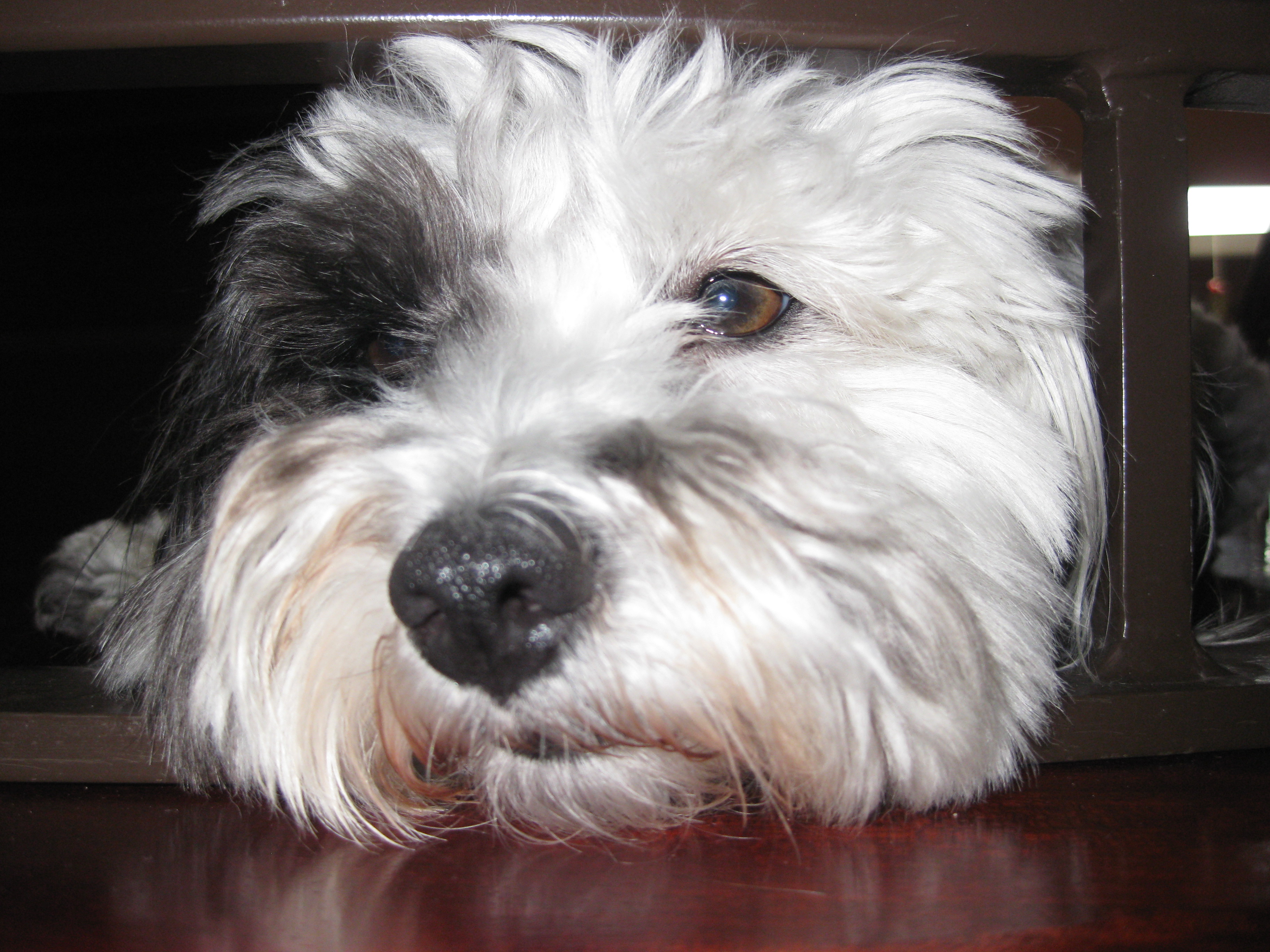
Finally, have a photo of Nala the Hound and her gigantic head:

Nala the Hound

The Price of Art

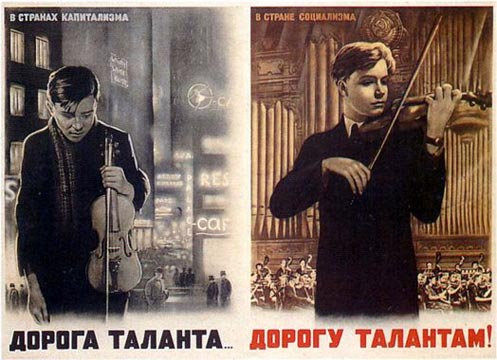
The Tate Modern currently has an exhibition of Soviet era propaganda posters.  I spent a lot of time looking at them, but here is the one that sticks the most in my mind:

"Road to Talent"

On the left, we are shown a (presumably) talented violinist in the U.S., cold, poor, and hungry, wandering the streets at night and being unable to make a living from his music.  On the right, we see a similar violinist in the U.S.S.R., his skills being properly nurtured by the state, elegantly dressed, performing with an orchestra.  Of course, what the poster doesn’t show are any of the drawbacks of the state-sponsored system. 

My husband told me this poster wasn’t so far off the mark.  Many Soviet-trained musicians immigrated to Israel and it was common to see these world-class musicians busking on the streets.  There were simply not enough orchestra seats in the country to accommodate all of the incoming talent.

This got me thinking about the price we pay, as artists, for our art.  When does the price become too high?  Although in some ways the Soviet Union was ideal for artists, many were stifled: denied religious, sexual, or political freedom, not allowed to manage their own careers, censored.  For some musicians, it was obviously better to be busking in Israel than having a glamorous concert career back home.

Here is the U.S. the price for artists is very different.  There is the money/time trade-off: do you get a day job for money and then run low on time, or do you take the time for your art and embrace possible financial insecurity?  Can you achieve the dream of being successful enough to have both time and money?  Or can you find a compromise between the two like I did?  There is the rejection price: lots of hard work, often for years, with very little recognition or reward beyond that of the creation itself.  There is the voice of public opinion, wondering at the value of what you do, telling you that you’re wasting your time, confused as to why it’s taking you so long to become “famous”.  There is the pedestal-pit price of everyone either telling you how what you do is impossible (“I could never sing”) or how what you do is so simple (“I’ve always thought I could write a book”), to the point that it becomes hard to explain that art is rarely either impossible or simple, consisting mostly of a lot of hard work.

American artists complain about all these prices a lot, and that’s fine.  We’re letting off steam so we can go back and focus on our work.  Or we’re commiserating with one another.  Or we’re educating the public and trying to change the necessary prices.  But overall, I think we’re lucky.  I can write a book including controversial interpretations of American history or compose an opera on the evils of capitalism, and I won’t be thrown in jail.   I can believe what I want and talk about it ad nauseam on my publicly accessible blog.

Sure, the price can still become quite a hardship sometimes.  But we all have a choice about what priorities we’ll set, and we can even change our minds later on if it’s not working out the way we hoped.  I’ll choose the life of that violinist wandering around in the dark every time.  The confusion in the dark makes the art even more valuable in my eyes.

My friend Sean Craven recently wrote an essay about practice.  (Has anyone not heard of Ericsson’s 10,000 hours of practice makes an expert theory?)  The entire essay is interesting, but what particularly struck me was this section:

But I have noticed not just in myself, but in most of the serious beginning writers I know, a sense of stern duty, of feeling that we must steel ourselves for the rigors to come. Writing these days feels like a polar expedition, where we expect to lose a finger or nose to frostbite in the process of starving to death while surrounded by bears.

I laughed out loud in recognition, of both myself and many of my writer friends.  In the last few months, I’ve lost contact with that touchstone of living an artistic life: remembering that I love what I do, and making sure I continue to love it.

It’s so easy to become concentrated on the duty aspects of learning a craft.  I must practice this many hours per week, or I must meet this minimum daily word count.  I must write x number of short stories, or add x number of songs to my repertoire.  I must work diligently on mastering a, b, and c issues that I know are holding me back from being the artist I want to be.  I need to submit or audition more, write better and faster, keep up with Writer K who seems to be achieving SO MUCH MORE than me in the same period of time.  And maybe I should consider attending another workshop or masterclass.

It’s not that these goals are inherently wrong or bad (except possibly for keeping up with Writer K, which is a slippery slope filled with disappointment).  But when your brain is filled with the ear-splitting chorus of duty, sometimes it becomes hard to remember why you started in the first place.  In other words, once a beloved hobby transitions into being “work”, how do we keep the fire going?

I faced a similar transition when I moved from office work to teaching music.  I worried that by making my living with music, I might lose my love for it.  This fear proved to be  unfounded because:

1. Teaching music was infinitely better than the office work I had previously been doing.

2. I really like teaching and working with kids and teens.

3. I really do love music and singing and particularly musical theater that much.

4. Finally, and I think this point is crucial, my job was to spread a passion for music, so I was constantly reminding myself of how cool and amazing music was and pointing out these elements to others.

I had to make some small adjustments to keep myself going: I transitioned away from teaching how to sing pop music, for example, because it began boring me to tears.  And my job was certainly not free of duty, not by a long shot.  But when I closed my studio this summer, I still loved music, singing, and musical theater just as much as when I started.  Thinking about this now, I realize I achieved no small feat in keeping my passion alive.

It is my belief that I love writing, fiction, and narrative just as much as I love singing and musical theater.  I’m just so weighed down by duty that I forget to think about the positive, and unlike at my studio, one of my principle duties isn’t to show how amazing writing can be.  On the contrary, I sometimes feel a certain amount of grumbling is required just so people understand that I’m actually working at all.

So I’m going to be trying out a little experiment for the next few weeks.  When I sit down to list my five happy things, I’m going to add something to the end: reminding myself of concrete reasons why I love to write.  My hope is that this exercise will allow me to enjoy writing more thoroughly, not because it’s an item on my to-do list but for the sheer joy of it.  When I stop and think, it doesn’t take me long to realize what a privilege it is for me to have artistic and challenging work.  I’m officially giving myself the time to remember.

1. Being in a foreign country, even one in which they speak my native language, forces me to see.  It shines a light on the world around me, but even more important, it opens myself up.  Whatever I’ve been trying to ignore, whatever I’ve been trying to leave behind me unexamined, well, there it is.  I return to the U.S. a different person from when I left.

2. The day we leave, we decide to get a cab after all because it’s raining, and slogging to the Tube with all the luggage and the wet only to squeeze into the steaming commute-time train sounds distinctly unappealing.  Plus I barely slept the night before.  Our cab driver talks to us the entire drive to the airport.  He is worried about the foreign embassy workers who won’t pay their parking tickets.  It’s mostly the Arabs, he says.  He’s been to Florida and Disney World, and he wonders if California is the same.  It’s not, I say.  Then it begins to snow in light swirling flakes.

3. It’s maybe one in the morning as I enter the large square room laid bare by its strong fluorescent lighting.  I instantly want to back out and run the other direction, but I’m an adult now and I have to deal with things like this.  I sit in the dentist’s chair in the otherwise bare room, noting how there is absolutely no high-tech equipment in sight.  No, wait, there’s a box that looks like a machine of some kind.  Until I realize it’s an old PC vintage 1998.  Not reassuring.  The assistant, wearing baggy white clothes that remind me of the gangster rapper wannabes at my high school, looks like he’s not more than eighteen.  He tells me, without knowing anything about my case, that it will either be a root canal or an extraction.  I laugh nervously and try to make a joke, only to realize that he is completely serious.  Those are the two things that happen in this room.  The dentist holds the X-ray up to the light, does a bunch of fast talking, tries to make me feel stupid and small, but luckily I’m too stubborn for that.  No way do I need a root canal in the middle of the night with old instruments and two assistants who cover themselves from head to foot with plastic bags.  I wonder about the sanitation.  I leave.  My cheek doesn’t swell up horribly the way he said it would if I didn’t get treated, so I feel pretty good about that decision.

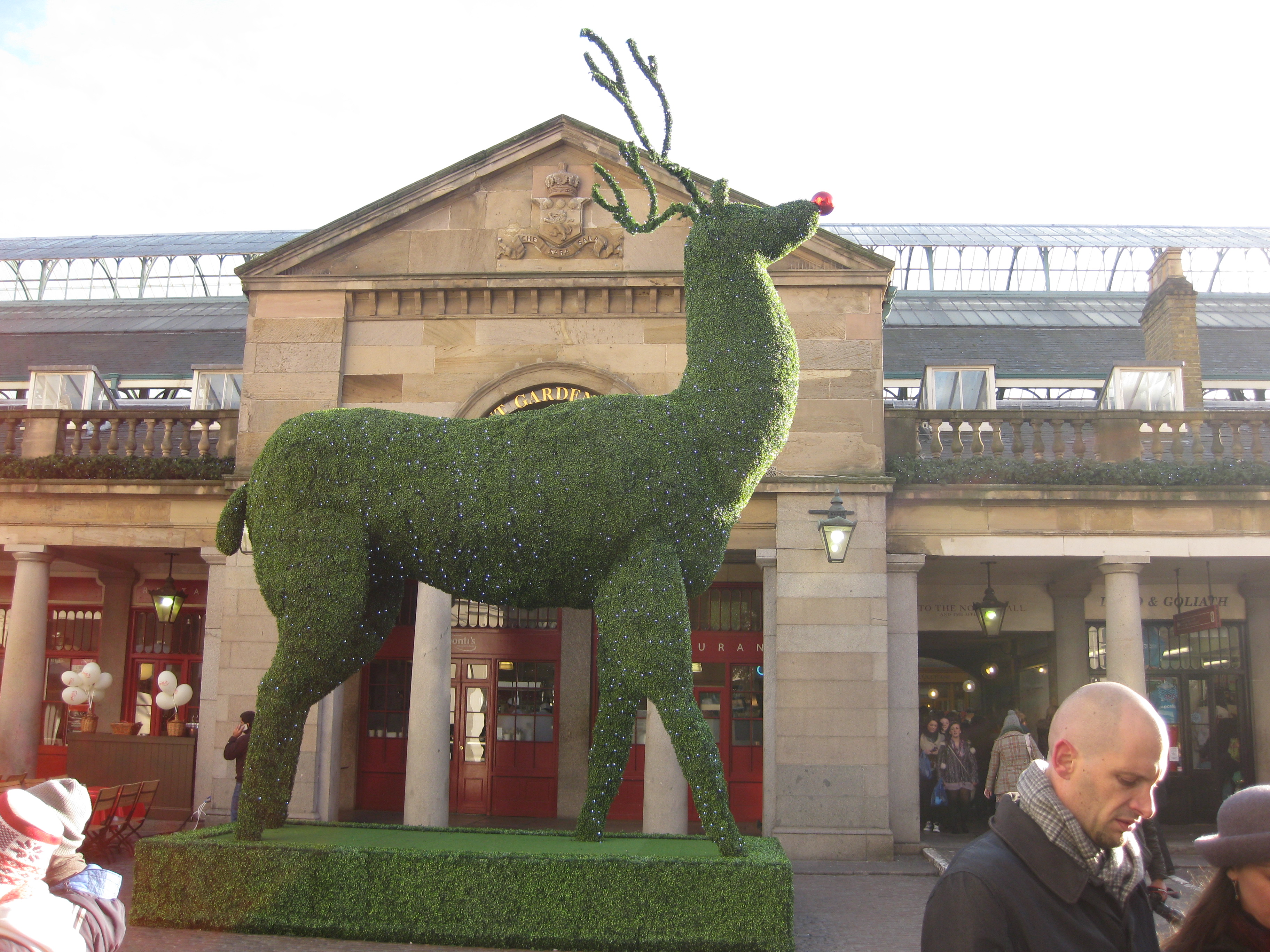
4. Shiny twinkle lights adorn every shopping area in London.  Oxford Street is a steady stream of shoppers, already laden with paper bags on every arm, prominently emblazoned with big brand names that even I have heard of.  A sidewalk vendor sells crepes.  We stop and I have my favorite, with apricot jam.  My leather gloves are covered with stickiness by the time I am finished.  Shiny red ornaments, grotesquely over-sized, hang from the ceiling at the Covent Garden market, and a large green reindeer, two to three times as tall as me, stands to one side with a red ornament nose.

5. Thanksgiving night, we are going to the theater.  We stop off at a nearby pub and both order fish and chips.  I eat my chips with gallons of ketchup.  It feels like just another night but I’m okay with that.  I’ve been doing the “five things that make me happy” exercise pretty faithfully lately, so I’m very aware of just how much I have to be thankful for.  Back home I will have pie and think Thanksgiving thoughts.  I just have to decide between pumpkin and cherry.