Feeds:
Posts
Comments

I stumbled across Brenda Cooper revisiting her predictions for 2011, and my interest was completely captured. “What a fun game!” I thought. “Maybe I should make some predictions myself for 2012.” Then I thought again. “But many of my predictions will end up being wrong.” The unimaginable horror of that idea paraded through my brain.

So of course, now I have to write 2012 predictions to take my first good whack at my perfectionism this year. And not only that, but I am going to write them quickly, without obsessive researching, and I’m going to write them boldly without resorting to wishy-washiness.  Are you ready?

Publishing

  • E-books will continue to gain share in the marketplace. Based on the huge amount of Kindles that sold this December, I’m going to say that by the end of 2012, we’re going to see e-books up to 35% of the market…at least.
  • Publishers will hold firm at a 25% net royalty for electronic sales…except for the biggest author names.
  • A couple of major name authors will strike out on their own and release titles themselves. Because they are big names, they will easily be able to continue commanding shelf space at B&N.
  • Publishers will begin (or continue?) to commit more resources to building stronger relationships with readers (more aggressively building their email lists, for example) and developing brand recognition for their publishing imprints apart from author names. (This one, I am afraid, might be overly optimistic, but I can’t help myself!)
  • There will be no definitive answer in the traditional vs. self-pub debate. Some writers will go all in one way or another and be super judgmental of anyone doing something different. The smartest writers will do both. There will continue to be a stigma, although not nearly as strong as it was even a few years ago, against self-published work by writers who haven’t already been traditionally published. Interestingly, there will be no stigma against those writers who raise money for projects using crowd-sourcing platforms like Kickstarter. (Maybe because Kickstarter mainly works for those writers who already have an established fan base?)

Current Affairs

  • There will be the usual hoop-la of a US election year. Romney will win the Republican nomination, and Obama will win the election, but it will be a hard fight. Voter apathy will be more of a problem than it was in 2008.
  • The Euro will still exist as a currency at the end of 2012. No promises for 2013, though!
  • Some major shit will go down in Egypt this year, what with elections expected in the next six months. The military won’t let go of power easily.
  • Syria’s government will collapse by the end of the year.
  • The economic turmoil in the EU and the political turmoil in the Middle East won’t do the US economy any favors. Oil prices will go up. Volatility in the stock market will continue. I don’t expect unemployment rates to improve substantially (although I’d be very happy to be wrong).
  • My husband says the cinema industry will begin to tank this year, but I disagree. I actually think 2012 will be better than 2011 in terms of box office sales. The foreign markets for movies will continue to be robust.
  • Social media sites will try to collect ever more information about their users. Some people will continue, inexplicably, to think that they should overshare mundane data with their “friends.” Facebook, Google+, and Twitter will all continue to exist healthily at the end of the year. Klout, on the other hand, will have lost its klout in most circles due to both its basic dullness and its arbitrary algorithms (how I can lose or gain influence over 1000 people in the course of a single day is beyond me).
  • Houses will begin to become “smarter,” both due to Kinect technology and chips that talk to each other over WiFi and Bluetooth.
  • Scientists will push stem cell research farther this year, and will succeed in regenerating a more complicated organ (they’ve already done bladders and tracheae).
  • There will still be no flying cars or Asimov-esque robots in general use (and no, I don’t count the Roomba).

Care to play along? What predictions can you make about 2012?

Blog Retrospective 2011

It’s been a good year here at the Practical Free Spirit. I’ve garnered much enjoyment from writing for this blog, and as I gain more experience, the essays often come easier. I’m becoming clearer about what I care about writing about, and I’ve had some great conversations with many of you.

In terms of traffic, the blog is growing slowly but steadily. I’m happy to say that December 2011 has recently become the highest-traffic month in the blog’s history. It’s a satisfying way to close out the year.

Photo by Ray Wewerka

The Backbone Project:

This summer I ran the very successful backbone project, in which I committed to writing three essays on subjects about which I was nervous to write. Not only did I get some much needed practice in being assertive and brave, but I got to hear about so many people’s experiences and opinions, all of which enriched my own. All of the backbone project posts landed in the list of top 10 read posts this year.

The Backbone Project: Help Me Become Less Wishy-Washy
You are not a Weenie if a Critique Makes You Cry
Where is my Geek Cred?
The Teetotaler Manifesto, or Why I Don’t Drink

Most Popular Posts:

Being an Introvert is Awesome!

Like it or not, people in our society are very worried about being introverts, due to the false association between introversion and lack of social skills.

Loneliness and Social Media

The popularity of this article makes me realize that this is another issue that many people are concerned about. Does social media connect us more or make us feel more isolated?

Living Free From Regret

This one is mostly popular because of the awesome photo, but the message is inspiring too.

10 Things I Wish I’d Known 10 Years Ago

This recent post has the distinction of being the second most read post ever on the site on the day of its publication.

My Personal Favorites:

Writers are Super Heroes

This essay gives me an extra dose of “go get them” energy when I need it.

Problem Competition: Who is Worse Off?

How comparing our problems pushes us farther apart instead of bringing us together.

Will You Change the World?

I hope the answer is yes!

The Stories of Our Lives

“We are all leading ladies and men. And we each get the privilege of creating the stories of our lives.”

All together, it’s been a great year. Here’s to another year of interesting thoughts and engaging conversations!

New Year Wishes

At this time of year, I always feel like I’m straddling the flow of time. Half of myself is looking backwards and evaluating what has gone on before, while the other half is looking forward to what the next year may hold for me. I don’t make New Year’s resolutions per say because I prefer a continuous evaluation process, but thinking in terms of units of time can be helpful when trying to look at the bigger picture of my life.

So, without further ado, here are a few reflections on 2011 and few wishes for the year to come.

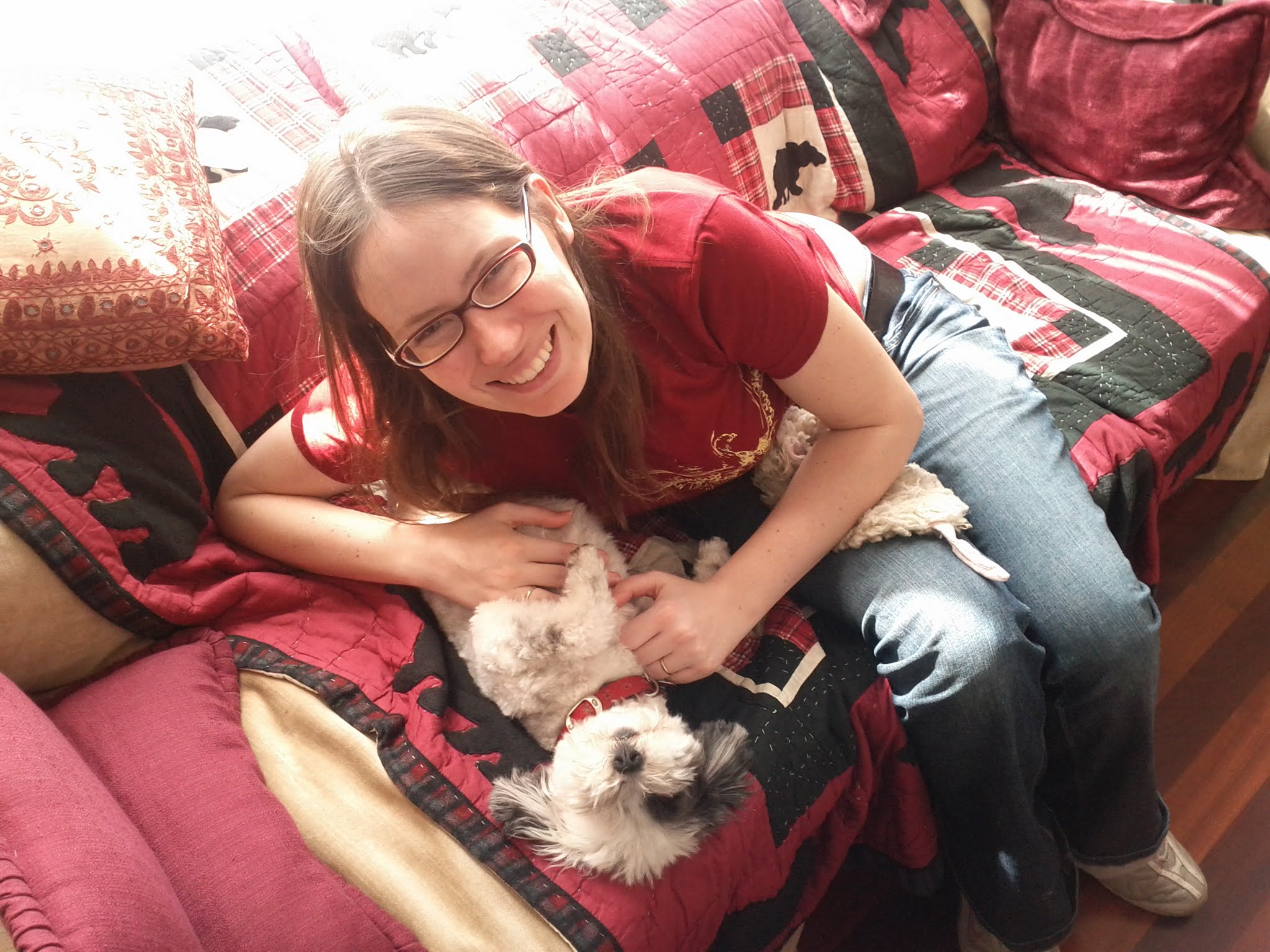
Cute little Nala and me

Writing:

2011 was an exciting year because it was the first year I had something published, thus realizing a dream I have cherished since I was seven years old. Hooray! In fact, I had three short stories published this year, one of them to a pro market. I was also able to join SFWA as an associate member.

My wish for 2012 is that I am able to use the lessons I learned this year to increase both my productivity and my enjoyment in writing. (Being greedy, I also wish for more sales.)

Health:

The first half of 2011 was dominated by crazy dental problems. While that silly crown still often aches, the level of pain has subsided to the realms of the tolerable. I also had more ankle problems. But on the plus side, my knees continued to improve in a most pleasing fashion. I also began to eat more healthily, trying to limit my consumption of saturated fats in particular, and have done fairly well with it (although not when traveling. Eating healthily when traveling is ridiculously hard).

My wish for 2012 is to keep growing stronger so I have less overall aches and pains, and to continue following my moderate diet.

Travel:

2011 was the first year in a long time that I didn’t leave the country. Various health concerns dampened my travel ambition somewhat, and I mostly stayed close to home. My favorite trip of the year was my first time in Washington D.C. in March. I would definitely return there for a follow-up visit someday. We also attended the Shakespeare Festival in Ashland, Oregon, visited Disneyland with friends, and relaxed over Thanksgiving at our favorite Maui vacation spot.

I was able to attend five writing conferences and conventions, two local and three an easy traveling distance: Potlatch, FogCon, SCBWI LA, WorldCon, and World Fantasy. I particularly enjoyed attending the inaugural FogCon and moderating my first two panels, and catching up with my wonderful writer friends (and making new ones) at the larger conventions was fabulous as usual.

My wish for 2012 is to leave the United States. We’re thinking either Japan or certain favorite Western European locations…

Personal Growth:

I wrote about the two most important lessons I’ve learned this year last week. I feel like I’ve made a fair amount of progress on the people pleaser front and have developed a stronger backbone. I’m more likely to stand up for myself and less likely to take responsibility for everyone else. So, yay!

My wish for 2012 is to continue tackling my vicious perfectionist streak and to do further work towards trusting myself and my abilities. I’d also like to be able to reach out more to other people.

Happy upcoming New Year, dear readers! What are your wishes for 2012?


Some of my astute readers might have noticed that I initiated a massive life re-haul and personality shift this year. I have written a fair amount about being a people pleaser, developing a backbone, and being a perfectionist because these were things that were on my mind. I decided, somewhere in the haze of extreme tooth pain, that I needed to change, and I set about doing just that.

I’m still in the middle of it. It has already been completely worth it.

It is one of the hardest things I’ve done.

Here is what I have learned: You have to respect yourself. You have to believe that you are worth it. And you have to do whatever it takes to convince yourself you are worth it, even if it means muttering silly mantras to yourself and being glad you work at home so no one suspects you are crazy.

I have spent my entire life believing that if only I was good enough (oh, hey perfectionism), people would love me, respect me, and treat me well. I really wish this were the case, but I was flat-out wrong. The truth is, if you are willing to let something happen, the odds are that it will happen. If you are willing to tolerate being lied to, then people will lie to you. If you are willing to let people ignore you, then they will. If you don’t take a stand against bad behavior towards yourself, then that bad behavior will continue. The world doesn’t give you a voice, you have to demand it.

And in order to demand the respect you deserve, you have to give it to yourself first. You have to believe you are worth it.

Photo by Anita Hart

This self-respect is not the same as thinking you are perfect and infallible and can’t possibly make a mistake. Therein lies another problem (oh, hey narcissism). And it doesn’t preclude feeling compassion for people, even (and especially) the ones who are in the middle of making your life difficult.

What self-respect does give you is the ability to empower yourself. It gives you the choice of surrounding yourself with people who will lift you up instead of pulling you down. It gives you the chance to speak up. It gives you permission to refuse to take on every single problem as your own, when so many of them aren’t really yours at all. It gives you the strength to confront the parts of yourself that you don’t like. It gives you the space to say “No.”

No, I am not your bitch. But thanks for asking.

Remember that you are worth it. That is what I have learned this year.

I love the end of the year. Not only do I adore Christmas (it is my favorite holiday), but I like that it’s cold and it gets dark early, both of which encourage me to snuggle up indoors and reflect upon the year that is coming to a close. I plan to spend a lot of time in the next two weeks doing just that, and this week I’m going to write about the two lessons I learned this year that were most helpful to me.

I’ve been struggling with my writing for most of the year–not, thank goodness, with my nonfiction writing, so the blog hasn’t suffered unduly, but with my fiction. I have spent A LOT of time thinking about why I’m struggling and trying various strategies to make the writing work better for me. Most of those strategies failed. But in the last few weeks, I’ve finally found one that feels right.

I was reading snippets from Ray Bradbury’s Zen in the Art of Writing when I had my Aha! moment. He gives this three-fold advice to writers: Work, relax, and don’t think. Work I felt I understood, so I began turning around the other two steps in my head. What would it look like if I relaxed while I was writing? What would it be like to stop thinking so frantically? What if I stopped trying to avoid all the objectionable components of writing, stopped being obsessed with not making any of the obvious and embarrassing mistakes? What would happen if I gave myself permission to write what I wanted to write? In short, what would happen if I trusted myself as a writer and gave myself free rein?

Photo by Paul Moody

I am cerebral sort of person, so it’s difficult for me to even imagine not thinking, but I’m also stubborn and I was determined to give it a try. I sat down and spent the next week and a half writing a short story without censoring myself. I looked forward to working on it, and the words came more easily. I even voluntarily worked on it on the weekend. Here was the joy I had somehow misplaced for so much of the year. When I finished it, I felt a sense of completion. Whether or not I had written something good, I had written something I felt connected to and could take satisfaction from.

I gave the story to my husband, my faithful first reader, without telling him I had been trying anything different. When he finished reading, he told me it was the best thing I’ve ever written.

In creative work, I think it’s important to strive. I believe in working to learn and improve, in tackling difficult themes and uncooperative characters, in experimenting to learn your craft (whatever it might be) to the best of your abilities. But what I didn’t realize until now is that there is a point when I have to let go. I have to trust that my writing knowledge will be there for me. I have to stop second-guessing every decision I make. I have to believe in my vision and voice as an artist.

And it turns out, I do have my own voice. It’s been there all this time, waiting for me to be willing to listen.

Relax. Don’t think. Trust yourself.

What lessons pertaining to your work, artistic or otherwise, did you learn this year?

1. It is not as common as it once was to spend your entire career working at one company, or even in one career. Therefore most of my parents’ career advice was completely useless.

2. Bodies are complicated, and often doctors don’t know what’s wrong. So sometimes you have to get creative and proactive in seeking out information, alternatives, and talented people who can help you.

3. A large number of acquaintances is not necessarily going to be as satisfying as a small number of people to whom you can reveal your true self.

4. If your significant other is not meeting one of your core needs and shows no inclination of doing so in the future, it is okay (even necessary) to break up with them.

5. So much of life boils down to communication. Unfortunately, many people are incredibly bad at it.

6. Thinking you might not be good enough is not a good enough reason to decide not to do something.

7. The people who are judgmental about your life choices are generally not the people you want to spend time with, anyway. And it’s impossible to make every person in the entire world like you.

8. Be on the lookout for those who are taking away your agency. The easiest way to have your choices taken away from you is if you never even realize you had a choice in the first place.

9. Fake it until you make it is a cheesy-sounding piece of advice that is actually true. Corollary: Your major is not as important as you think. (Except when it is.)

10. Be fanatical about taking care of your teeth, flossing, and visiting the dentist regularly. And use a mouth guard if there’s even a chance you’re grinding your teeth at night…the unsexiness of such a device be damned!

What do you know now that you wish you’d learned earlier?

My Top 10 Reads of 2011

As the year draws to a close, my attention turns to the list of books I have read this year. I’ve been keeping track for the last three years, and I’m surprised at how much pleasure this small habit gives me. I only write down the books I have finished, which eliminates many books every year, nonfiction taking an especially big hit since I often read selections from nonfiction books instead of reading them from beginning to end. Re-reads count, as do beta reads for novelist friends. Short stories and novelettes do not count unless they are in a collection, but novellas sometimes do…if I remember to include them.

Looking over my list for 2011 as of today, I’ve selected my ten favorite new-to-me reads thus far this year. It’s been a fantasy-heavy year for me, in stark contrast to my list of favorites of 2009, which was very science fiction-heavy. Maybe next year I can find more of a balance.

I did read several YA dystopias this year, but upon reflection I am unable to include any of them on my “Best of” list this year. While some of them were entertaining, none of them hold up particularly well in my memory, and almost all of them suffer from some flaw or another that makes me hesitate to recommend them. I haven’t read all the recent YA dystopias that have received good buzz yet (I’ve heard good things about Blood Red Road and Legend, for example), so it’s my hope that I missed a few gems that I’ll catch up on next year.

Favorite YA Novels:

1. Where She Went, by Gayle Forman. Contemporary YA
This is the sequel to If I Stay. It is told from the point of view of a young rock star who is trying to come to terms with his life and his decisions. The two main characters are both passionate about music, which possibly explains why I particularly like it.

2. Red Glove, by Holly Black. YA contemporary fantasy
This is book 2 in the Curse Workers series, and it does not stand alone. I’ve been really enjoying this series; the world building is strong and the books have their own distinctive voice that make them both enjoyable and memorable.

3. Anna and the French Kiss, by Stephanie Perkins. YA contemporary romance
A romance set in a boarding school in Paris. The plot isn’t the strong point here, but the protag Anna’s voice is likeable, distinctive, and feels very very real.
4. The Girl of Fire and Thorns, by Rae Carson. YA epic fantasy
This is by far the best YA novel I read this year. The worldbuilding, voice, plot, characters: all of them worked for me. It reminds me a bit of old Robin McKinley a la The Blue Sword, but definitely tells a story all its own.

Favorite Adult Fantasy Novels:

5. The Broken Kingdoms and The Kingdom of the Gods, by N.K. Jemisin
The last two books of her trilogy, these books do (more or less) stand alone. This is epic fantasy written straight for my own personal taste. I think I particularly love these books because they are NOT set in Ye Olde Medieval Europe only sanitized; the setting feels real and true to itself, and the characters aren’t cookie cutters either. Plus I love the books’ cosmology so much, and I enjoyed the last book in particular, told from the POV of one of my favorite of her gods.

6. Among Others, by Jo Walton. Contemporary-ish Fantasy (set in the 1970s)
You might have to be an SF/F fan to truly appreciate this book (although that being said, plenty of its references did not hit the mark with me). This book takes place after the big show-down of the plot, so can be seen as a novel-length denouement (although of course it is more than that) and it unfolds itself leisurely and with great character depth. The end didn’t work for me, but even so, it was one of my best reads of the year.

7. The Map of Time, by Felix J. Palma. SF(?)
I suppose this novel is technically science fiction, since it involves time travel, but it read more like fantasy to me. A spellbinding yarn that weaves in and out of itself in a few (to me, at least) unexpected ways, this historical fantasy/sf/whatever-it-is charmed me, especially in the sections involving the author H.G. Wells.

8. Zoo City, by Lauren Beukes. Contemporary Fantasy
It’s the worldbuilding of this novel that makes it stand out, set in modern South Africa exploring the consequences of one little addition of fantasy/magic to the world we know now. This novel moves at a furious clip, and occasionally the plot suffers from this, but it’s worth the read to be immersed in this fascinating world.

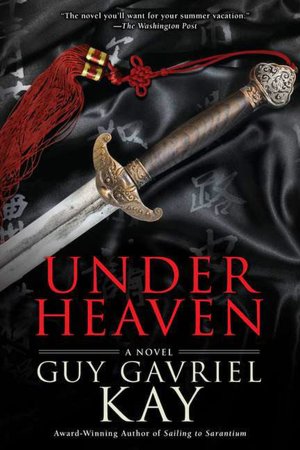
9. Under Heaven, by Guy Gavriel Kay. Historical Fantasy
10. The Lions of Al-Rassad, by Guy Gavriel Kay. Historical Fantasy
What is most noteworthy about my reading year is that I discovered the beautiful prose of Guy Gavriel Kay. I have to be in a certain mood to read him, but when I am, there is absolutely nothing better.

What books did you read this year that you particularly enjoyed? Please let me know so I can add them to my reading list!

Last night I couldn’t stream Netflix through the Xbox like I usually do because Microsoft’s servers were down. So instead my husband suggested we watch When Harry Met Sally, since I’d been talking about it being a good holiday movie while at a certain wedding a few weeks ago.

While watching it, I realized that this movie, more than any other, is responsible for many of my early ideas of what adulthood was going to be like. It came out in 1989, so I’m imagining it reached the free cable preview weekends (my only real source for movies at the time) a few years after that, and I remember watching it more than once in high school. And while I spent lots of time consuming every Robin Hood movie I could get my hands on, watching Star Wars Episode IV whenever I got sick, and sighing with my best friend over Dirty Dancing, When Harry Met Sally struck me as being more like what real life was actually going to be.

Here is what it taught me:

1. Everyone you know will have a professional sounding job: attorney, journalist, political consultant (I had to ask my husband last night what that actually meant). These jobs will cause them no angst whatsoever and were obviously easy for them to both choose and succeed at.

2.However, everyone will actually spend most of their time and energy dealing with their crazy love lives, having lunch with their girlfriends, and hogging the batting cages from small boys. Also going to baseball games, reading self-help books, and attending many parties.

3. On New Year’s Eve, everyone goes to posh parties at big venues with lots of people they don’t know. Otherwise it doesn’t count.

4. People will often host small and slightly awkward parties at their apartments, where everyone divides up into two teams and plays Pictionary. And they always have an easel set up with a really big pad of paper to make it more awesome. (WHY has this not happened to me in adulthood? WHY?)

5. Never let a friend set you up because blind dates always end badly.

6. Adults are not afraid to do zany and embarrassing things, like sing Oklahoma! at the Sharper Image or have public fake orgasms. (This is particularly true of theater people, but alas, the movie neglected to educate me on that fact.)

7. It is okay to toss barely-used Kleenex around the room when you are very upset.

8. Men might be idiots about love sometimes, but in the end they will come to their senses and sweep you off your feet with an appropriate grand gesture and speech combo. (This is what most romantic comedies teach us, but I’ve found real life to be a vast disappointment in comparison, since most people I know do not seem to have the inclination to actually plan and execute grand gestures.)

9. A man who is married will never leave his wife for you. (Thanks to Carrie Fisher for the running gag teaching this valuable life lesson.)

10. When you move in with somebody, be on your guard for their equivalent to the Roy Rogers wheel wagon coffee table, and make sure you’ve stipulated that it’s not going to be part of the move ahead of time, thus avoiding an embarrassing fight in front of all your friends who are helping you.

What movie most shaped your ideas about what being an adult was going to be like?

What subjects do you avoid? What don’t you like to admit? What topics do you not talk about because they feel somehow inappropriate?

Theodora Goss’s recent blog post Telling the Truthis an excellent and thought-provoking essay well worth a read: “And this got me thinking about all the things we don’t talk about,” she says. “There are so many of them!”I think a lot about all the things we don’t talk about. In fact, that was one of the reasons I wanted to start a blog, because I wanted to have a platform from which to speak about some of these things. But of course, I still carefully write around so many of these things of which we never speak.

I recently spoke to a friend of mine who revealed that he used to have crushes on girls starting in third grade. He had never told anyone else about this because he was embarrassed because he thought it was out of the ordinary. Can you imagine? I had crushes in elementary school, and some people in my classes even had “boyfriends” and “girlfriends” (although of course it meant something slightly different back then). But you know what? I never talked about my crushes. And apparently no one else talked about them to my friend either, so he’s spent all this time secretly thinking that he’s different, that something was wrong with him, because he failed to pick up the social cues that would have informed him that crushes aren’t so unusual after all.

I wonder how many things we are all secretly embarrassed about or ashamed of that are, in reality, very common. Only we never find this out because we’re all busy feeling like outsiders together.

I think many of us are ashamed of failure, like Dora says in her essay. I know I am, and being a perfectionist doesn’t help out with this. And yet, failure is essential for those of us with ambitious dreams. Most people don’t succeed with huge dreams right away. I listened to an interview with Seth Godin the other day in which he bemoaned how afraid so many people are of failure. This fear holds us back. It makes us unwilling to take the risks we need to take to learn, to grow, and to achieve something truly great. And yet, even though I understand the need for failure intellectually, it doesn’t take away the fear.

But on the other hand, the more I fail, the more I know that I am living an interesting and daring life. Failure is taking your life and seeing what you can wring from it instead of coasting along and choosing the safest route. Failure is pursuing lofty goals and pushing back against the fear. Failure is exposing yourself to the world and teaching yourself to believe in the you of possibilities instead of the you of limitations. Failure is the strength to believe in yourself so much that you can rise above your worries (or the reality) of what other people think about you.

Failure is saying, “This is my life, and I’m going to make every inch of it mine.”
Maybe if we can reclaim failure, it won’t be so scary after all. Or at least maybe it can become a badge of courage instead of one of shame.

A friend of mine wrote me awhile back and asked me if I could write a post about resources for the YA writer. I’ll admit, I was stymied. In spite of the fact that I began writing in the YA genre, and as such it is my first true literary love, I realized I didn’t know nearly the number of resources that I could spout if he had asked the same question about speculative fiction. There is SCBWI, of course, the teenlitauthors yahoo group (although it tends to get a bit bogged down with congratulations and personal news), and Vera Kay’s Blueboards (where I’ve rarely been active). I’m sure there must be how-to-do-it books on YA (mustn’t there?), but I’ve never read them. Likewise, there must be various relevant blogs, but the few truly YA-focused ones I used to read are rarely if ever updated anymore.

Meanwhile, YA continues to be hot, hot, hot, even while agents and editors are cautioning writers that there is a glut of YA, and maybe writing some quality MG wouldn’t be a bad idea right around now. They say this at conferences, in any case, but I’m still hearing stories of agents recommending that their actual clients write YA, even if they’ve gotten their start in writing for adults. (Which incidentally tends to make me cringe. I understand intellectually that there is more money for fiction writers in YA, and the sales might be easier to make due to the aforementioned hotness, so it makes sense from a business perspective. But I’d like to think there’s more to writing YA than just good business sense; that it’s the end result of receiving a calling, of having some kind of affinity to teenagers, of what kind of stories a writer deeply desires to tell. I’m not saying a writer can’t write both YA and adult fiction–I do that myself. I just want it to be a case of good business uniting with a true interest in writing for teens. But I digress.)

I could write another whole post on the differences between the speculative and YA communities from where I sit (and maybe I will), but the fact remains that I don’t have a treasure trove of resources to share. Instead I will give three pieces of advice (which you can take or leave), advice that unfortunately does not offer any shortcuts but has helped me learn more about YA in the last three years than anything else.

READ YA. Read a lot of it. Read MODERN YA written and published in the last ten or so years (at least some of which has been published in the last three years) so you know what’s going on now instead of what was going on when you were a kid (trust me, unless you’re close to being a teenager yourself, it is different now). Read some MG (Middle grade) so that you understand the difference through examples instead of relying only on my handy-dandy list. Read different genres of YA; you might only be interested in writing science fiction YA, but read at least a few paranormal, fantasy, and contemporary novels as well. Read a few of the really “girly” book series so you know what’s going on there. Read the blockbusters of the field. I don’t care if you don’t like Twilight; if you want to write YA, you should read it anyway (at least the first one) so you can understand what about it tapped into the zeitgeist of the time and understand the ripples it generated (and still generates). Likewise, you should read The Hunger Games, and even though much of it is MG (in my opinion), you should read at least some of the Harry Potter books. Then go read some obscure titles no one has heard of.

STEEP YOURSELF IN TEEN-NESS. If you haven’t spent any in-person time with teens since you were a teenager yourself, it’s time to change that. I don’t care how–you can hang out with a family member, volunteer, teach a class, offer to mentor a teen writer. If all else fails, you can scout out where the local teens hang out after school, go there, and shamelessly eavesdrop. You can watch TV shows and movies targeted at teens (just NOT during your writing time, please): Buffy the Vampire Slayer is old school but still helpful, and lately I’ve been spending time watching Veronica Mars, Glee, The Vampire Diaries, and Gossip Girl (and I’m sure there are others). I don’t watch these shows thinking they are necessarily a realistic representation of teenage life, but to watch for more widespread trends: how do relationships/hook-ups work now? how do teens use technology? what are the latest fashion trends and the current slang? how do the characters speak to each other? what issues tap into today’s teen experience that might be a little different from your own teenage years? Sure, if you’re writing a far future dystopic novel, today’s slang might not be so relevant, but it’s still important to try to understand how your readers see themselves now.

REMEMBER WHAT IT WAS LIKE. Not just the clichés, and not from a superior, “now I’m a wise and mature adult” perspective. How can you understand as deeply if you’re looking down at someone? No, exercise that empathy muscle and try to remember how you actually felt: the frustration of not having complete power over your life, even if you were spending a lot of time watching adults royally screw up; the surging hormones and confusion when trying to deal with lust and affairs of the heart; the uncertainty of not knowing exactly who you were and how you fit into the larger world (or perhaps bending self perception of who you were to fit into a fantasy); the endemic unfairness; the world-crushing importance of everything going on in your life; the huge milestones bearing down on you, one after another (and whether you looked on them with excitement, horror, or a co-mingling of the two). And then remember that all of the above plays out differently for different people, both in terms of which ones are relevant to each person and what’s going on inside versus the show they’re putting on for the outside.

That’s all I’ve got. If you know of any YA resources I didn’t mention, please give them a shout-out below. Also, if you think all a modern YA writer needs to read is the juvenile Heinlein oeuvre, tell me that too because then we can have a truly epic argument.