Feeds:
Posts
Comments

“Fear is the mind-killer.
Fear is the little-death that brings total obliteration.”

Dune, by Frank Herbert

I am afraid of so many things.

I am afraid of death, my own and others’. I am afraid of incompletion. I am afraid of bad health. I am afraid one day I’ll try to get out of bed and my knees will hurt so badly I won’t be able to leave the room. I am afraid I’ll crack more teeth and end up subsisting on gruel; forever, because most of my fears don’t allow room for the possibility of change. That’s what makes them extra scary.

I am afraid of being deeply alone. I am afraid I will discover a massive regret too late to do anything about it. I am afraid I’ll go crazy. I am afraid I will lose my sight or my hearing. I am afraid I’ll be attacked by a giant swarm of angry wasps. I am afraid of pain and grief and loss. I am afraid of the necessity of being brave.

I am afraid to fail. I am even more afraid to fail over and over and over.

Last week I had a particular scenario in my head that was causing me large amounts of worry (something that hadn’t even happened yet). This weekend, I read a blog post that talked about another person who was in a similar scenario, and how she was crippled with worry. The way it was written up, my first instinct was to think, oh, that’s silly, she’s not so badly off. It took a couple more beats for me to realize that meant my hypothetical wasn’t so bad either.

Because Frank Herbert got it right. Fear makes us stupid. It clouds our judgment. It squeezes us so we can’t breathe, can’t reason, can’t accept what’s happening. It transports us to fictional futures and makes them real in our minds, even though those futures may never become true in reality. It causes us to give up or settle or take the easy answer, even if it’s not the best answer.

Of course, we put ourselves in danger anyway. We become police officers and firefighters. We join the military. We bare our souls as artists, even while we’re embracing rejection. We fight to save lives. We deal with the up-and-down uncertainties of being entrepreneurs. We give away our hearts. We jump from airplanes, walk home in the dark, and swim deep underwater. We sing challenging arias in Italian in front of other people. Risk-taking is woven into the fabric of living.

Fear is difficult. Sometimes we face it and emerge stronger. Sometimes we become paralyzed and cannot move past it. Sometimes we don’t even realize what it is that we’re really afraid of.

I am afraid of so many things. All I can do is remind myself that in this present moment, I am okay. And if I am ever faced with a killer swarm of furious wasps, I’ll deal with that then.

What are you afraid of?

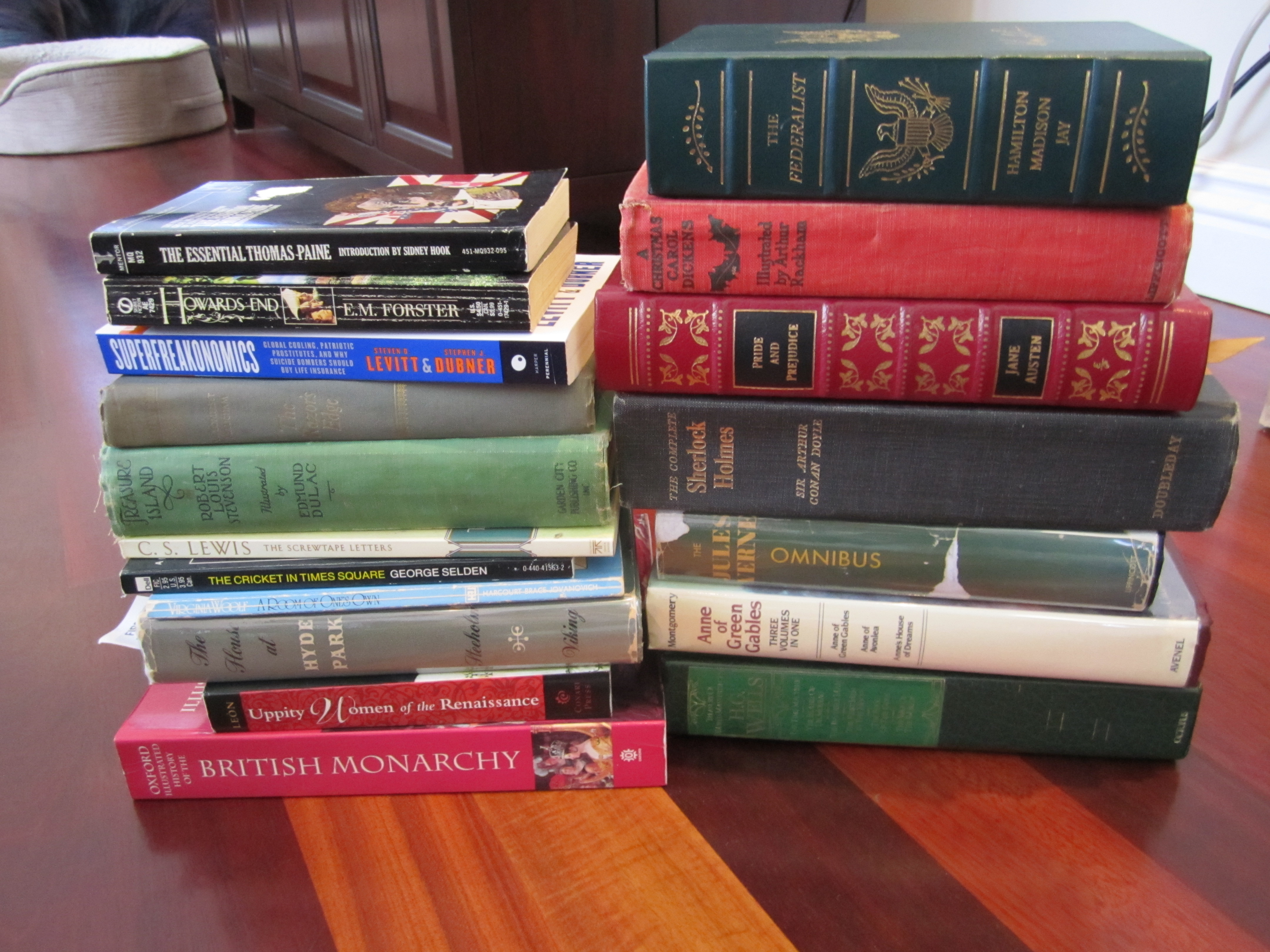
Book worm: a person who cannot imagine an existence without reading.

It just occurred to me the other day that most people are not book worms. I mean, I know that most American adults do not read that many books; in 2007 the media had fun complaining about how 27% of Americans hadn’t read a book in the last year, and looking at that same study, of the remaining 73% of people who did read, 25% of them had only read 1-3 books in the past year.

Sometimes numbers take a while to sink into my brain. But I met someone at a party recently who announced, “I don’t read.” I appreciated his bluntness: no excuse making, no pretending. And I realized these hypothetical people who don’t read (or don’t read much) actually exist. They are all around me, all of the time! My lifestyle, in which books have always featured prominently, is not the way everyone I know lives. What an epiphany to have, right?

I love reading. I feel physically hungry to read more good books. When I purchased William Shakespeare’s complete works for the Kindle, I almost started crying because I can now carry all of Shakespeare’s words wherever I go. I cannot contemplate a life in which I don’t have time to read; my brain cannot even compute the possibility.

Photo by Eneas de Troya

You know you’re a book worm when:

1. You worry when you leave your house and don’t have a book with you.
2. The idea of having hundreds of books on a portable device reduces you to tears of joy.
3. Libraries and bookstores are the most amazing places on the planet because you can experience physical proximity to so many books at once.
4. The idea of having your bedroom lined with bookshelves gives you a cozy feeling.
5. When you think of being stranded on a desert island, your first concern is what books you would choose to have with you (and how you’d survive if you didn’t have any books at all).
6. One of the best parts of planning a vacation is choosing the books you’ll take with you.
7. You buy a special book for your birthday each year so you know you’re guaranteed to have a pleasant day.
8. You know every section of wall in your home that could be used for more bookshelf space in the future. Book storage is one of the most important uses of your home.
9. You have trouble getting rid of books, even duplicates.
10. When called upon to choose between reading a good book and doing another activity, it is a really tough choice. (Or it’s an easy choice; of course you’d rather stay home and read.)
11. Your favorite gift to receive is a gift certificate to buy more books.
12. It is hard to leave a library or bookstore without a large stack of books.


13. You are pretty much always in the middle of at least one book.
14. Your most important criteria when purchasing a purse/bag is how big a book it will fit (the winners are the ones that will accommodate hardcovers).
15. You want to live forever because otherwise, think of all the books you’ll miss!

I love being a book worm. It brings me so much joy. What about you? Are you a book worm? Do any of the above behaviors sound like you too?

When I was in Seattle, I bought a vampire T-shirt. It’s a flattering light blue, nice soft cotton, and on the front there’s a picture of a woman, her mouth surrounded by red blood. It is my new favorite T-shirt, even more so than the Star Wars one of Princess Leia saying, “Don’t call me princess” or my classic Buffy the Vampire Slayer shirt. (Although thinking about those two T-shirts also makes me pretty happy.)

In a way, my new vampire T-shirt is like Max’s monster costume from Where the Wild Things Are. I wonder if I like it for the same reason he liked to dress as a monster. Wearing it is both embracing the monstrous nature of life–the violence, the cruelty, the confusion and uncertainty, the inevitability of death, whether you are ready for it or not–and embracing the reflection of the monster that lives inside.

Because we are all monsters in some way, aren’t we? We all have some fragments of a dark side, and some of us have full-on Darth Vader scale issues. Nobody wants to be “nice” all the time, and indeed, as I have been discovering, being nice can have decided drawbacks. Being nice can turn out to be not so nice after all; even such an innocuous-sounding desire can have hidden depths.

We’re fascinated with that monster inside, though. Look at the popularity of Dexter. I have not actually seen Dexter, so I can’t talk specifics, but it is a show featuring a serial killer as its anti-hero protagonist. Oh, but it’s okay, because he’s a serial killer with a moral code. Um…yeah. I guess we believe our morals can keep the monster on a leash. I guess we want to believe that the end justifies the means.

At the same time, we need that monster. It gives us courage and strength, and it allows us to come to grips with strong and sometimes overwhelming emotions: anger, fear, grief. It gives us a feeling of power, of control. In the case of the vampire woman on my T-shirt, it hints at something unsuspected: you might have thought I was powerless, she says, but now that my mouth is ringed with blood, perhaps you have different ideas of who I am and of what I am capable. If we are dressed in the guise of a monster, then we can see ourselves as the empowered individual instead of the victim. We can act instead of being acted upon.

When I was a kid, I had a stuffed animal monster called an Oof. It had yellow eyes, a beaver tail, and horns. It sat on the top of my bookshelf and watched over me while I slept, and I loved it. Because some monsters are loveable: Cookie Monster, Roald Dahl’s the BFG, Sulley from Monsters Inc., even Patrick Ness’s The Monster Calls (which is one of the most devastating, true, and perfect books I have ever read). A monster can sometimes show greater compassion than everyone else. A monster can sit with you and be okay with who you are, even when who you are is messy and complicated and not the way you’re supposed to be.

We all live with monsters. When we’re lucky, we then get to come home to our bedrooms where our suppers are still piping hot. Thank you, Maurice Sendak, for the truth you told.

What do you think about monsters? Do you have a favorite kind? Do you have something you like to wear that’s like my vampire shirt or Max’s monster costume?

My short story “The Box in my Pocket” has recently come out in the anthology Fantastic Stories of the Imagination, which is available as a paperback and an e-book. Here it is directly at Amazon (paperback and Kindle e-book) and B&N (for the Nook).

I wrote this story in January of 2011.  I remember thinking of the story seed, writing the first line, and then the story had its hooks in me. I put aside the novel project I was supposed to be working on in order to write this story instead. (And given that I usually become quite single-minded during my novel writing time, this is saying something.)

Yes, that is my name on the cover. 🙂

This story is one of the most personal I have written to date.  The point of view character is a teenage girl who is losing her mother to cancer. This character is not me, but the situation is one with which I am intimately familiar. Well, except for the fantastical element, of course. That part didn’t happen to me. Really.

Normally I shy away from writing anything too autobiographical. Bits of me will inevitably worm their way into the words I write and the telling details I choose; I am never completely separate from my work. But early in my writing days, I found myself defending characters’ behavior in a story I had written, saying, “But this actually happened exactly like this.” It didn’t matter, of course. It didn’t work in the story. Real life doesn’t always translate well into fiction. People don’t always behave in “believable” ways. So now I don’t tend to write with real circumstances in mind.

I do not, however, avoid writing about the emotional truths I have experienced. “The Box in my Pocket” is one emotional truth of what it feels like to lose a mother at a relatively young age. It deals with the dual themes of death and memory, both of which I find myself addressing in my fiction repeatedly; my fascination with them never seems to fade. It asks the questions, how do we deal with loss, and how do we finally let go (or do we hold on forever, and at what price)?

As for the anthology itself, Warren Lapine is its editor, and it includes stories by Mike Resnick, Harlan Ellison, Sharon Lee and Steve Miller, Kelly McCullough, Barry Longyear, and many other writers, so I am in extremely good company.


People like to find a scapegoat.

Recent articles link the rise of loneliness in modern society with the use of social media, and although I have explored the idea before, I have become less convinced. Isn’t it convenient that we can blame technology, that behemoth with which we traditionally have an uneasy relationship, for the lack of connection we might feel? And yet, even if, as some figures suggest, Americans are now lonelier and have fewer confidants than in the past, there is still little data to show this trend is being caused by social media.

I agree with Dr. Grohol, who states: “[Using social media] doesn’t stop me from having those in-depth, face-to-face conversations, or put them off. I’m under no illusion (or delusion) that having a social networking circle of hundreds or thousands makes me more social.”

Instead, what social media allows us to do is maintain, in unprecedented volume and frequency, our weak ties. What is a weak tie? Someone who we don’t know very well, an acquaintance, if you will. By fostering so many weak ties, we are able to continue to expand our social networks and have potential reach to larger numbers of people, many of whom we will never directly meet or communicate with.

Obviously this is a major boon when we are, say, trying to sell something or build a reputation for ourselves or looking for a different job. But it can also be valuable because of the different insights and opinions we are exposed to, the potential actual friends we might meet, and the recommendations we might receive. Not to mention the benefits of being able to keep in touch, however superficially, with friends and family who live far away.

However, it’s not hard to see how social media might appear to make us lonely, especially if used as a kind of social substitute that it isn’t. If I am already feeling lonely and then I hop onto Facebook, the odds that spending half an hour reading my “friends’” status messages will make me feel any better are fairly low. But I have noticed a certain irrational expectation in myself that seeing all those photos and clicking “Like” a few times will magically pick up my spirits. Note to future self: that doesn’t work! Go out and see someone instead.

It’s interesting to watch ourselves learning how to deal with so many weak ties at once, a feat about which we are only now gaining experience. I like to think of social media as a party: a few of your really good friends are there, which is especially awesome. Then there’s those people who you’ve been seeing at these parties for years, and that’s the only time you talk to them. And there’s the newcomers, the people you don’t know so well but it’s interesting to chat with them for a few minutes. Except this is happening all the time on your computer, not just for three or four hours at a scheduled event.

And just like at a party, most people are trying to present their best selves. Many of them will keep their dirty laundry and deeper troubles mostly under wraps. A few of them might have embarrassingly public meltdowns. We’re surprised when  the perfect married couple announces their impending divorce, when that vibrant woman turns out to have been suffering from a life-threatening disease, when bits and pieces of messy life burst unavoidably out into public view.

And social media is very much the same. We are presented with a smooth and managed facade, and sometimes we forget the facade does not always reflect what’s going on under the surface. All those people in your social media networks who have perfect lives with adorable children and exciting jobs and exotic vacations? Maybe her child vomited all over the living room this morning, or that exciting company is going through a round of layoffs, or that exotic vacation meant forty-eight hours of pure, unadulterated suffering from food poisoning. Some people show this underbelly of their lives, but many choose not to. It’s the way weak ties work. And as depressing as all this seeming perfection can occasionally be, we mostly find it depressing because we are not used to weak ties; we haven’t internalized the knowledge that these public statuses are only a small percentage of the whole. We believe, often without question, the stories people choose to tell about themselves.

The societal shift we are experiencing is certainly not without its difficulties. But social media, and the internet as a whole, are just technological tools like all other such tools. Sometimes we use them skillfully, and sometimes we don’t. Sometimes we lack the understanding of how such tools work or for what they work best. Sometimes we’re not very interested in trying them out at all.

But I suspect loneliness arises much more from our physical environments and the strong ties that we either have or don’t have with other people. Strong ties that are fostered by face-to-face interaction, video chat, phone calls, and the exchange of letters and emails. Blaming a tool meant for developing weak ties for any trouble with strong ties seems misguided at best.

What do you think? Do you have less in-person conversations or strong ties because of the advent of social media? Have you been able to develop strong ties as well as weak ties through a social media service? How much does face-to-face time matter in your close relationships?

When I was in high school, I was very jealous of my classmates who already knew what they were going to do with their lives.

My father knew from childhood he wanted to be a scientist. He went straight from college to a PhD program in chemistry, and from there worked for a total of two or three companies. He worked at the same company for my entire childhood. My mother went straight from college to earning her teaching credential. She quit teaching when she became pregnant with my older sister.

I knew from age seven that I wanted to be a writer. In my clarity I was following in my dad’s footsteps, right? Only not so much. Imagine my alarm, at age ten or eleven, when I somehow began to think I wasn’t allowed to be a writer. Did my parents tell me this? I don’t remember. All I remember is that I knew I couldn’t be a writer because it wasn’t practical and I wouldn’t be able to earn money by doing it, and then I wouldn’t be able to afford the asthma medication I took daily. I was really upset until I soothed myself with the thought that I could always become a librarian.

From this point on, I didn’t feel like I knew what I wanted to be. I didn’t want to be a lawyer or a doctor. I wasn’t so sure about being a classroom teacher. I didn’t want to be a scientist. All of the exciting-sounding jobs in books were, I discovered, also impractical. So I decided to become a musician.

I know. I don’t know what I was thinking, but I’m so grateful I thought it anyway.

Photo by M.G. Kafkas

There’s a common line of thinking: “Follow your passion.” I don’t think this is bad advice, but I think it’s incomplete. I would say, follow your passion, BUT:

  • It may be hard to figure out what your passion is. Not everyone is born knowing in their bones what they want to do. And if you grow up exposed to limited career and life options, you might need to go digging to even become aware of the possibilities.
  • You may not be able to make a living following your passion. But you may have to try it to discover whether this is true or not. And the results may surprise you.
  • You might be able to make a living, but you might also have to compromise on your lifestyle. Some people don’t want to do this. Either choice is completely valid.
  • You may be perfectly happy not feeling passionate about your career. This doesn’t mean you can’t follow your passion anyway. I knew a dental receptionist who went sky diving every weekend because that was her true passion. I know writers who get up early or stay up late to squeeze in writing time. I know musicians who participate in community theater or play in bands by night.
  • Some people have more than one passion. So if you follow one and it doesn’t work out, you might want to fish around in your brain and see if you can discover another one.

There is no one right way to follow our passions. There are an infinite number of ways, and our job is to figure out which way we will follow right now.

How do you follow your passion in your life?

It’s the end of April, April 26th, to be exact, and as always on this day, my thoughts are with my mom.

Her death at age fifty really brought home to me the reality of mortality. All things must end. We have a finite amount of time. It made me realize how important it is to prioritize, to make things happen now because there might not be a later, to fight against becoming stuck in a daily routine if it makes me unhappy.

Her death taught me the importance of shaking things up.

You want to know the truth? I don’t like shaking things up. It’s scary and uncomfortable. There tends to be a fair amount of risk involved, as well as failure and disappointment. It can be hard to decide when to shake and when to let things settle.

But when in doubt, I’d usually rather shake. I remember the finite life span of human beings. I remember my mom’s unhappiness, and how she couldn’t shake things up to make her life better. And then it was too late.


Could I be a writer if I didn’t believe in shaking things up? Could I be a blogger? I don’t know. I’m guessing I couldn’t be a blogger because blogs tend to shake things up. Any blogger worth her salt will have to occasionally offer up an opinion, and people will disagree. Shake, shake, shake. And without that extra push to make life happen for myself, would I have found the courage to spend so much time writing? To attempt a novel? To send stories out to be rejected? All these choices shake things up.

I worry when people my age (thirties) tell me how much they want to travel, but they haven’t been anywhere. I want to say, I hope you’re not serious. I hope travel isn’t actually that important to you. I hope it’s a nice dream that provides a pleasant thought diversion. Or else I hope you’re just being polite, like me when I say how amazing it would be to learn to knit (I don’t actually care if I learn to knit or not). Because otherwise, what if it never happens? What if you never shake things up enough to make it happen?

This is why priorities matter so much. So we can decide when it’s important to shake and when we can take a break, be laid back, and let things sort themselves out. It’s like my experience with Las Vegas. I live a short flight away from Vegas. People I know are going to Vegas all the time. It’s never been a real priority of mine to go to Vegas, so I sat back and figured it would happen when it happened. I chose not to shake things up.

And guess what? I’ve still never been to Vegas.

So in a way, today is about remembering my mom AND remembering the power of shaking things up. I don’t want to be a people pleaser anymore? Then bam, I’ll learn more about it, I’ll push myself to change, I’ll ruffle some feathers. I want to be a writer? Then bam, I’ll take risks with my writing, I’ll go out there and meet people in my industry, I’ll leave myself vulnerable, and I’ll commit myself fully even knowing failure waits right around the corner.

Hi, Mom. This earthquake is for you.

Someone made a rather plaintive comment in this Google+ conversation, and it’s been stuck in my mind ever since: “So, again, what is the point of being smart if it does nothing for you? If you really are so smart, why can’t you get what you want?”

There are so many myths floating around about being smart and what that might mean. Even defining “smart” is full of pitfalls. I realized when I tackled the subject of intelligence a few weeks ago that it was a bit taboo, but I didn’t realize the full extent of it until I was reading other people’s reactions. So of course I had to write a follow-up.

A Few Intelligence Myths Exploded:

1. What is the point of being smart? There is no intrinsic point. It is not something you choose for yourself, just as you can’t choose to be naturally athletic or flexible or have perfect pitch (although I keep hearing rumors there are ways to train this) or be gifted with languages. There are things you can do to take advantage of any of these things (hard work and training), but not everyone will choose to use these skills or have the opportunities to do so. In the same vein, recent studies suggest it is quite possible to train yourself to be smarter if you are interested in doing so.

2. Smart people can get what they want. Ha! I wish. I don’t know if any studies have been done on this subject, but I haven’t read anything about how smart people are so much more happy than less smart people. Plus, what if a smart person wants something that requires additional skills besides just being smart (and most accomplishments do require additional skills)? And what if said smart person doesn’t have the right additional skills and fails (for whatever reason) to develop them? Or what if the smart person in question is on track to get what she wants and then is deterred by any of a host of reasons, including ill health (either hers or a loved one’s), economic realities, or her background? Or what if the smart person does get what she wants and it just doesn’t look like the societal norm?

3. Smart people look down on those who they perceive as less smart. First off, I mentioned before that many genius-level people (and perhaps particularly women) suffer from impostor syndrome, meaning they don’t believe they are as smart as they are. Secondly, I also mentioned the Dunning-Kruger effect  and the false consensus effect back in March: the idea that people who are above average (including having above average intelligence) tend to assume everyone is just the same as they are unless presented with quite explicit proof to the contrary, thereby often underestimating their own intelligence. How all these people who don’t even realize how intelligent they really are can be looking down on everyone else is beyond me.

Secondly, even if they do realize they are intelligent, that still doesn’t mean they feel superior. Sure, there are a few people who do, but just because you are smart does not mean you are automatically arrogant and non-appreciative of other people’s abilities. Which leads me to my next point…

4. A specific kind of intelligence is more important than anything else. Um, no. There are many kinds of intelligence, and basic IQ test-measured smarts are no more useful than a host of other mental attributes. These include emotional intelligence, charisma, experience, wisdom, empathy and insight, kindness, courage, determination, a strong work ethic, and leadership skills. For example, if a very intelligent person wants to complete a difficult project but is not willing to work hard to do so, they probably won’t do as well as someone who isn’t quite as intelligent but is willing to work her ass off. Ultimately what matters about our lives is what we choose to do with them, not whatever set of attributes we start out with. Intelligent people who realize the truth of this aren’t likely to be very arrogant at all.

Any other intelligence myths you can think of? (Besides the whole “women aren’t as intelligent” thing we already talked about.) I’d love to hear from you.

I am happy to report that a week ago today, I finished the rough draft of my latest novel, The Academy of Forgetting. It clocks in at a little less than 77,000 words, which is ideal for a YA novel with a speculative element, and gives me a little breathing room in both directions as far as final length is concerned.

Some of you may remember that I started this novel as part of Theodora Goss’s YA Novel Challenge last summer. I wrote the outline, banged my head against the beginning, and stopped after having written 10,000 words. In retrospect, I believe I wasn’t ready to write the book: my skills weren’t quite at the right level, my concept of the setting and main character weren’t clear enough in my own mind, and some of my ideas regarding the plotting of the beginning of the book needed to be rethought.

This photo makes me want to read my own book by candlelight. Or really just any book.

I started again this January. I threw out the 10,000 words. I kept most of the outline but made some key alterations. I began writing in first person past tense instead of first person present tense, and I conceived of a narrative structure that was very exciting to me. I had some different ideas about the tone I wanted to start with as well. With all these changes, the novel began to form itself in my mind in a new way. And three months later, I have a complete first draft. I am so relieved to have finished!

This novel is definitely the most complicated of the three I’ve completed to date. It’s a psychological thriller with a vastly unreliable narrator that plays around with memory, so it had to be quite twisty and involved by its nature. I really don’t think I could have written it pre-Taos Toolbox, which is a testament to the excellent teaching of Walter Jon Williams and Nancy Kress.

So what happens next? Revise, revise, revise. I’m going to do my own pass first, addressing all the notes I took while writing it, replacing brackets with actual decisions, and adding a soupcon of description along the way (I tend to go too light on description). At the same time I’ll be writing my own scene and chapter summaries for future reference. Then I’ll send it to my amazing friend Daniel, who is the ultimate plot whisperer. And I’ll revise it again. And then I’ll send it to more amazing writer friends. And I’ll revise it again. At some point I’ll write a query letter (which, if I do it well enough, will be somewhat similar to the copy on the back of a book) and a synopsis (which I really detest doing). The whole process will take several months.

But this week, I’m resting and enjoying the feeling of satisfaction that accompanies typing the words “The End.”

Okay, no, not really. What I really want to do is talk about ambition and different definitions of success.

I talk a lot about priorities, and ultimately our priorities hinge on our own personal definitions of success. In order to set priorities that work for you, you have to know what you want. Sometimes this directive becomes more complicated than it sounds.

We have ideas imbedded by our culture as to what constitutes success, and there are different degrees of success as well. Money, power, recognition, advancement, and a stable career are all possibilities we recognize and mark as successful. In the personal realm, success is often associated with being a spouse, a parent, and a homeowner.

Of course, we can hit our own personal mark of success without ever having a lot of money, or a lot of power in the business world, or the same steady job for twenty-five years. Success is subjective. Our definitions of it change over time. And yet, we are often influenced by the cultural ethos of what success means.

Dr. Horrible has his own unique definition of success...

Ambition gets all twisted up in these definitions as well. When we are going for what we want, pursuing our own success, then we are being ambitious, but we often limit our thinking about ambition to apply only to career-related goals.

For me, success has never been so much about money as it has been about being able to spend my time on things I find valuable and fulfilling. This is why I have, in the past, chosen time to do what I choose over more money. Some of the things I find valuable and fulfilling involve the outside world: teaching, for example, and helping people. Some creative endeavors might or might not reach the outside world. And some things I find of real inherent value even though they are just for me.

We as a culture also tend to buy into the idea that success will cause happiness. Sometimes this works out; when we figure out what will actually make us happy and prioritize accordingly, happiness and success can come hand in hand. But sometimes we assume success will bring us happiness without figuring out what would make us happy in the first place, only to suffer a rude awakening and realize we’re caught in a cycle of always wanting more: if only I had a bigger house, if only I made senior VP, if only I made #1 on the NYT bestseller list. Finding happiness within achievement without getting trapped in what we haven’t yet achieved can be an uneasy balance.

There are no right answers here; we have to make individual decisions about what’s important and how to define success for ourselves. We have to discover what it is that brings us happiness and personal satisfaction. And if the answer doesn’t meet the cultural norm, then we have to decide what we care about more: following the marked, tried-and-true road map to find success in other people’s eyes or venturing off the beaten path and making our own way. Either choice comes with its own difficulties.

What does success mean to you? Do you consider yourself to be ambitious?