Feeds:
Posts
Comments

I’m back from Chicago and Worldcon and what proved to be quite a whirlwind experience. I’m also sick. Alas, using hand sanitizer and taking Vitamin C and eating fruit wasn’t enough to keep this particular miserable virus at bay. And I’m sick enough that my brain is somewhat foggy. So I’m going to table the topic I had planned to write about (which deserves my fully functional brain) and give you some snippets instead.

– I met a lot of people at Worldcon and spent most of my time socializing. And one thing that I find continually fascinating is how everybody has their own story. Some people wear their stories on their sleeves. Other people keep their interactions entirely surface to the point that it’s easy to forget they have  stories at all. And some people gradually reveal their stories to you, one layer at a time. But they’re always there: the goals and dreams, the insecurities, the setbacks and old wounds, the history, the personality quirks, and the bedrock of character.

– Many people seem to have a lot of social anxiety around convention going. There was a lot of talk about various kinds of social nervousness, as well as more than one person talking about trying to let go of worrying about what they might be missing. (“Just enjoy the con you’re at” was the chief advice being bandied about.)

I don’t have any particular insight to share about this because, as it turns out, these are not my particular problems. I tend to get nervous before a con, and sometimes I have a short period of nerves upon first arrival (although even this seems to be lessening more and more), but once I dive in, I’m pretty much fine. And I hardly ever worry about what I might be missing because what’s the point? Besides, I’m usually having a fine time doing whatever it is I’m already doing. This makes me think that perhaps some people have very different goals for their cons than I do.

That’s not to say I don’t have any problems at a con. I worry about when and what I’ll eat (because sometimes food just doesn’t happen, and sometimes I end up subsisting on French fries). I worry about my body holding up through so much standing and walking and lack of sleep. I feel sad that I don’t have as much time as I would like with many of these fabulous people I’m surrounded by. Sometimes I’m too tired to have the conversations I want to have. And sometimes I’ve had enough superficial chit chat and really want a more substantial conversation than what I’m getting. But so far, at least, I’ve found that these are workable problems.
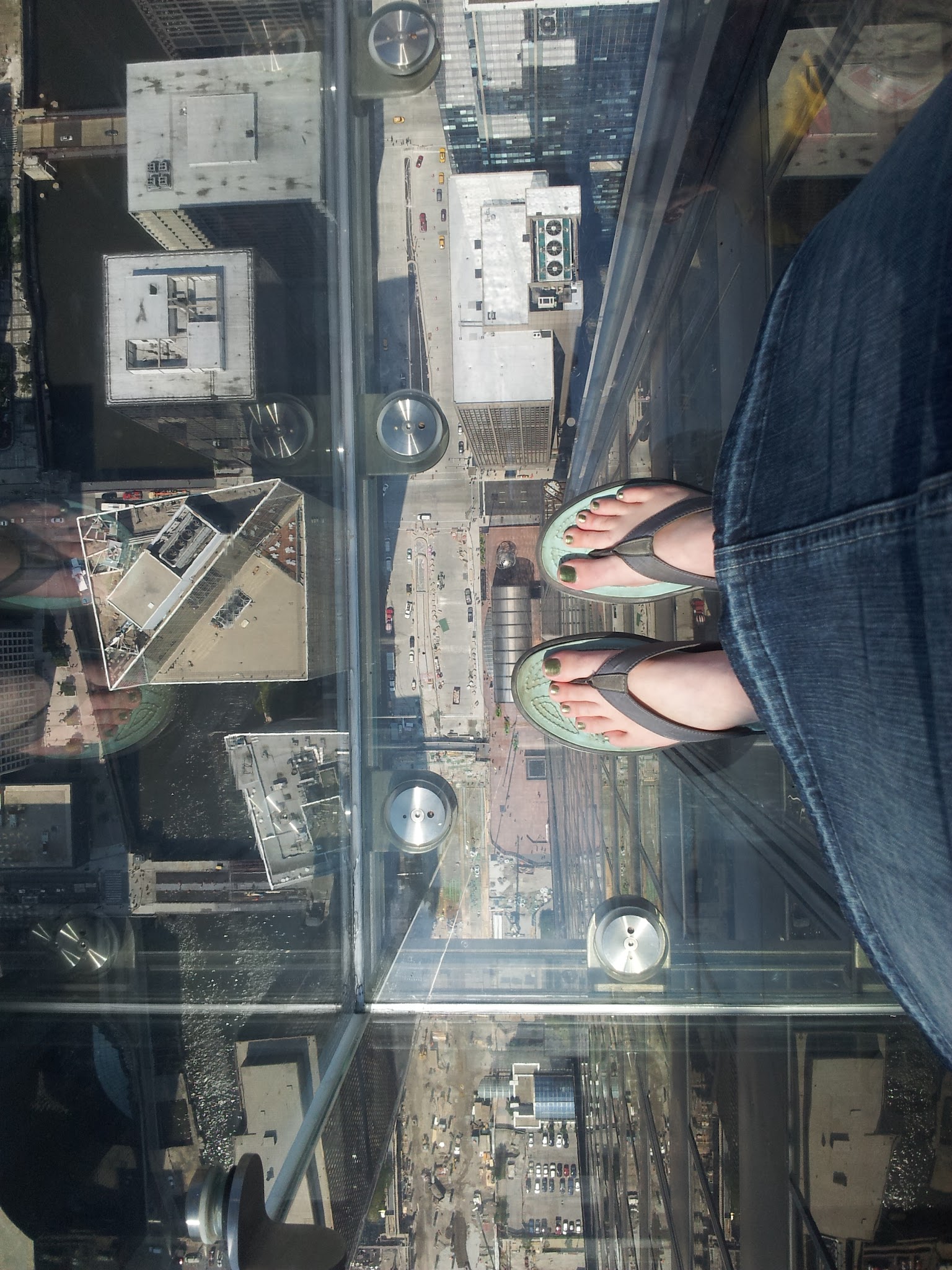
My feet over Chicago.

– I really like Chicago. I love the varied architecture of the buildings downtown, and I love the beauty of the lake. The Art Institute was a real treat, and the pizza was intense.

– My sprained foot got hurt on an overcrowded elevator one evening, which resulted in a fair amount of pain (and possibly some tears, but don’t tell anyone). I was really struck by the generosity of spirit from the people around me. Let me tell you, I was taken care of. Before I knew it (and I certainly didn’t have the presence of mind to make any of this happen myself), I was sitting down with my foot elevated, I had ice in a ziplock bag, I had taken Ibuprofen, I had tissues to dry my eyes, and I was being diverted by kind people talking to me while not expecting me to provide a coherent response. Later, a few friends went to dinner with me in the hotel to save me extra walking, and other friends were visibly concerned, sympathetic, and willing to help. My heartfelt thanks go out to everyone who contributed in turning what could have been a catastrophic event into a demonstration of kindness and thoughtfulness.

– Now I want to sleep for a week. Possibly two.

I read this essay by A.V. Flox about leisure last week, and it lit up a lamp inside my brain:

“There is something very wrong with defining yourself by your work and achievements, it drives people to a point where the most important goal is the acquisition of things instead of the enjoyment of things. And for what? You should work — don’t get me wrong. But work so you can enjoy. Don’t make achievement a substitute for living.”

I love leisure. I love lazy mornings and lazy afternoons. I love spending the day buried in a book or three. I love finding an interesting person and talking to them for hours about everything and nothing. I love losing track of time, not in a stressful, “now I’m going to be late” kind of way, but in a “it doesn’t really matter because I’m not missing something pressing, and isn’t this delightful?” kind of way. I love meandering through cities and towns and parks, and stopping for ice cream or crepes or lemonade.

I also love noticing pleasure. The pleasure in a fine day of the ideal temperature. The pleasure of running your hand through the soft fur of a little dog or cat. The pleasure of food, the pleasure of fresh air, the pleasure of a warm hand in mine. When I think about being happy, I often think about those things that give me especial pleasure: Disneyland. Christmas. Little dogs. Ice cream. Magical conversations at 1 in the morning.

Photo by John Althouse Cohen

I agree with A.V. that American culture does not encourage the cultivation of leisure. I too have known the driven person who is scheduled within an inch of her life or who can’t bear to spend half the day doing nothing much. Sometimes, of course, one can’t afford the luxury of leisure. But often it doesn’t seem to be encouraged even if one has the time. It is not looked upon kindly.

I call your attention to the virtue associated with rising early. I do not rise early. I get up later than the majority of people, and I stay up later. I understand that I am fortunate to be able to dictate my own hours, and I know this might not always be case. But in the meantime why shouldn’t I do as I like? And yet some people react to my late wake up time as if it is a personal affront or an illustration of laziness. Why? Is it perhaps a reaction against the perceived leisure that comes with being able to follow one’s own internal rhythms of sleeping and waking?

And yet living for enjoyment is such an effective way to be happier. When I am writing to achieve, I feel stress and worry and come out of the present moment. When I write because of the pleasure it gives me, I feel as if I could continue writing for the rest of my life. When I have an unpleasant day and then I sit down to a bowl of ice cream or a game of backgammon, I am able to renew my positive energy and truly believe that tomorrow will be a different day, even while I’m discovering what there is to appreciate about today.

Do I regret that the two hours I meant to be spending playing Go with a friend on Saturday turned into four? No. Do I regret the sleep I’ve lost having conversations about how to live and how to die and what we’re afraid of and what we wish for? Never. Do I look back on my times wandering the cities of the world and wish I could have spent that time more focused on achievement? Not once. Connection, inspiration, exploration, introspection, the exchange of ideas–these all give me immense pleasure.

These times are the jewels of my life.

###

And speaking of jewels, I’ll be collecting some more at Worldcon in Chicago this week. As usual, feel free to come say hi to me if you’re planning to attend; I love meeting new people. And I’ll be taking a break from the blog while I’m traveling, so I’ll see you here again on September 6th.


“Only those who truly love and who are truly strong can sustain their lives as a dream. You dwell in your own enchantment. Life throws stones at you, but your love and your dream change those stones into the flowers of discovery… People like you are unknowing transformers of things, protected by your own fairy-tale, by love.”

— Ben Okri (Thanks to Theodora Goss for bringing this quotation to my attention.)

I love this idea, of sustaining life as a dream. Dora rightly stated that this is what artists do, but it is what all of us can do, if we so choose. It is what I would like to do, and I think my (limited) ability to do it is part of the best of me.

Of course, most of the time I don’t think of my life as a dream, or a fairy tale, or an adventure. I forget. I get caught up in my to do list, the daily minutiae, my worries and little dramas. One of the reasons I loved living in London so much was that being removed from the very familiar helped remind me of life as a dream. But here in my life right now it is much harder to stay connected to my own fairy tale.

So as I think about the not-so-distant future, I am asking myself: If I was running my own fairy tale (which I pretty much am), what would I do? Where would I go? How can I help myself develop my own personal world of enchantment?

Photo by Frank Wuestefeld

Transformation is a powerful magic. I half-joke about hating change, and of course the reason I hate it is because of the price. As any budding fantasy writer knows, all magic has a price; all magic systems must have drawbacks in order to compensate for the sometimes insanely powerful effects magic can gift to its user. In our world, the price is often pain and discomfort.

The trick, I think, is to turn that pain, that profound sense of displacement, into a fairy tale. To give the pain meaning, if you will. Part of that is finding the petals amongst the stones, the good that comes from the bad, the silver lining, the twist of happiness hiding at the heart of bitterness. Part of that is surrounding yourself with reminders of enchantment. And part of that is being aware of the story as you live it, to become a lucid dreamer of life.

Ben Okri is right. To stay in the dream takes enormous strength, and openness, and willingness to pay the pain price. It is not for everyone.

But for those of us who aspire to dwell there, it is its own reward.

My favorite movie is Star Wars. Star Wars: A New Hope, to be precise. I chose this favorite movie at some point during high school, and it stuck.

Now, some people will argue that The Empire Strikes Back is a superior movie, and I don’t disagree with this. However, high school me had a copy of Star Wars on VHS (without commercials, even, which was a big score) that I could watch over and over again. High school me did not have a copy of The Empire Strikes Back. (And when I eventually got one, it DID have commercials.) So Star Wars has the nostalgia win there. Also, The Empire Strikes Back has that cliffhanger ending, which means you don’t get a complete viewing experience unless you then watch Return of the Jedi, and Return of the Jedi is definitely NOT my favorite movie. Whereas Star Wars has a complete story arc contained in its two hours.

Star Wars has a lot of things going for it. Light sabers. Comic relief droids. Space ships. The neat blue lines that signal a jump to lightspeed. A kick ass princess with a sharp tongue (although alas, she is the only female character, which I consider to be one of the movie’s worst flaws). A walking carpet. An iconic bad guy who can be identified by sound, not just sight. High stakes. Guts, glory, and scoundrels.

The iconic villain also has a very recognizable silhouette.

But the reason Star Wars is my favorite movie? The emotions it evokes in me and the way I feel after I watch it. When Luke succeeds against all odds, blowing up the Deathstar and saving the entire Rebel Alliance, it reminds me of what is possible. It pumps me up and makes me feel ready to tackle my own life, my own goals, and my own problems. This feeling was valuable back when I was eleven and has continued to be inspiring ever since.

I love that Luke is just some guy, and nobody really thinks he has what it takes to make such a difference. (Well, no one except Obi Wan, anyway.) But through hard work (we don’t get to see it, but it’s implied that he’s spent large amounts of time on flying and target practice before the movie starts), courage, and belief in himself, he is able to rise above other people’s expectations of him and do his true best.

We all receive negative messages about our capabilities at some point. There are always the naysayers who think (and sometimes tell us) that we don’t have what it takes to accomplish our goals. Sometimes the loudest naysayer of all is inside our own heads. What I love about Star Wars is that it reminds me to ignore these naysayers. It reminds me that I won’t know my capabilities unless I fully commit. It encourages me to dream and strive and achieve my own personal best.

What about you? What movie inspires you? What movie makes you feel like you can take on the world?

Sometimes my world feels very small.

I’ve been spending a lot of time in my house for the last three months, waiting for my foot to heal. The truth is, I usually spend a lot of time in my house, but there’s a difference between doing it by choice and doing it by necessity. When staying in by necessity, the entire structure seems to shrink and squeeze, and free time that would normally seem pleasant and relaxing slows down into something resembling tedium.

And then there’s the physical energy that has no real outlet, leaving my mind restless. I’m ready for action that my body cannot perform.

The most critical part of this kind of long-term healing isn’t the regularity of icing, or elevating, or taking Ibuprofen. It’s mood management. It’s keeping the spirits up so I don’t fall into a funk or give up in despair or become deeply depressed. It’s focusing on what I can do instead of what I can’t do. It’s dealing with the stress of constantly having to ask for help, and then doing without the help I can’t bring myself to ask for. And it’s letting go of the times when I make my physical limitations known and people ignore them and I wonder how many more days of healing this has added to the final recovery.

It’s also cherishing the moments when people help me take care of myself. When people sit down to talk to me instead of making snide comments about how sitting is bad for your health. When people give up a chair for me. When they go out of their way to drop me off right in front of our destination so I don’t have to walk as far. When they slow down their pace to match mine. When they think of an activity I can do to alleviate the sameness of my days.

We don’t talk much about what it’s like to have a slow-healing or chronic injury, do we? After all, I don’t want to be defined by my limitations. Even as I type this, I’m thinking about how there’s going to be somebody out there who thinks I’m whining or how so many other people are worse off (problem comparing for the win!) or who just isn’t going to get it. Because somehow whining has become equivalent to talking about things that are hard. So then we just don’t talk about it; it’s easier to be silent.

But this is my reality. And it feels a little strange not to talk about it.

What really helps with mood management is reminding myself that, however small my world might feel right now, it is actually big and rich and varied and dynamic. Sometimes I do this by imagining what I’d like to do in the future: travel to China, go to the Walt Disney Museum and the Academy of Sciences, go walk by the ocean, travel to London, travel to Morocco, travel travel travel. Make it to the park with my dog, even though it is a very, very long block away.

Little dogs are also very helpful for mood management. 🙂

Sometimes, though, thinking about the future doesn’t help because it feels like I’m never going to get there. So then I think about how I can enrich my life right now. I romanticize the idea of living a life of the mind. I take adventures and learn what it’s like to be other people through fiction: books, movies, TV shows. I write. I read about economics or neuroscience or Mars or feminism. I sing. I learn how to play new games. I enter into interesting conversations. I feel grateful for all the interesting people in the world who help to keep me entertained and engaged.

What about you? What do you do to manage your mood when times are tough? Have you ever experienced an illness or injury that you had to overcome? I’d love to hear your stories.

A Common Mistake

All people are the same, and all people are different.

I think sometimes we tend to get into trouble when we forget one (or both) of these statements. Holding both of these ideas in mind at the same time definitely exercises our ability to doublethink, but they are not as mutually exclusive as they might first sound.

Photo by Leo Reynolds

All people are the same.

We are born, we grow older, we die. We get hungry, tired, hot and cold. We feel pain, both physical and emotional.

We want. We want to be loved, we want to obtain safety. We want to stop feeling scared and uncomfortable. We want meaning, whether that be through myth, religion, stories, or science. (Or all of the above.) Some of us want stuff, some of us want intangibles, but most of us want something. And what we think we want and what we actually want is only sometimes the same.

All people are different.

We come from different backgrounds, geographical locations, religious beliefs. We have different bodies, different skin colors, different hair, and different health problems. We have different eccentricities, idiosyncracies, passions, likes and dislikes, loves and hates. We’re skilled and unskilled at different things. Our brains don’t all work exactly the same way either.

We have different memories, even of the same event. We have different ways of communicating. We have different opinions, different eating habits, different ways of conducting relationships. We have different needs and different desires and different ways of expressing ourselves. We have different tastes in style and pets and child-rearing and financial management and music and transportation.

We have different stories, different baggage, and different wounds. All of which lead to different life choices, some of which work for us and some of which don’t.

We are simultaneously the same and different.

When we forget we are the same, we may feel alienated or isolated. We may turn another person or group of people into the Other. We may think we’re better than everyone else, or that we’re not worth the air we’re breathing.

When we forget we are different, we may impose our own life choices on other people. We may become visibly judgmental. We may make inaccurate assumptions and stifle other people’s voices. We may forget there are other points of view.

There is a universality to the human experience, but the details are always different–sometimes very different and sometimes only a little different. We try to understand each other with mixed success. And we forget the following important truth.

You are not me. But we are both human together.


We don’t always live in a way that’s consistent with the things we know to be true.

I wrote this sentence on Monday when I was writing Tuesday’s blog post about making yourself a priority. It was the best sentence I wrote that day, but it didn’t fit the post, so I set it aside to use today instead. Take a minute and think about it.

We don’t always live in a way that’s consistent with the things we know to be true.

There are all kinds of reasons for this, of course. Maybe we’re being socially pressured to conform or live in a certain way. Maybe the truth is too painful to deal with. Maybe the truth calls into question our core beliefs, values, and what we hold dear. Maybe it has become so obscured we’re not even sure what it is. Maybe we’ve decided to bury the truth because it seemed necessary or because we were trying to be kind or because that was the only way we could see to move forward.

Life is messy, and sometimes truth and reality become misaligned.

I offer no judgments here. We’ve all done this, we’ll all probably do it again, and perhaps we’re doing it right now. We do it because we receive some kind of value in return. Something that we might really need.

But such a disconnect can also become malignant. It can worm its way inside of you, insatiable and bold, and it can hollow you out into an echoing emptiness. It can silence your voice. It can dull your vision. It can leave you in a dizzying state of confusion.

There is power to be found in the place where truth and reality intersect. The kind of power that creatives tap into to create the art that grabs you by the shoulders, kicks you in the gut, and never lets go. The kind of power for you as an individual to use to create a life story filled with meaning. It is not always a comfortable place, this intersection, but it is healing and challenging and ultimately uplifting.

This meeting place, where you live your truth, is where you can be the most authentic you. That you may not always be perfect or nice or happy or popular or responsible.

But that you is so blindingly beautiful all the same.

I just got back from L.A. and the annual SCBWI summer writing conference. I got to spend a lot of time with some truly incredible human beings, I got to hear Matthew Kirby be intelligent (if you ever have the opportunity to hear him talk, go!), I got to be inspired and fired up and reminded of a critical component of my own identity.

But I’m going to talk about something that was said at the conference that I disagree with. One of the keynotes given was “The Power of Quiet,” presented by Deborah Underwood. It was a good talk about, among other things, creativity, recent neuroscience research, the usefulness of daydreaming, and the importance of allowing for quiet time in our lives. But… Towards the end, Ms. Underwood basically said (and I’m paraphrasing here) that we don’t owe it to ourselves to make time for quiet, but rather that we owe it to the children who will read our books.

[Insert appropriate noise of pain and frustration here.]

Then today I was linked to an article by Amanda Craig in which she says, “Yet putting yourself last is one of the best things that can happen to a writer.” (This article, by the way, is a great way of inducing rage in yourself as it is one of the more misogynistic and offensive pieces of writing I’ve seen. Happily the commenters seem to agree with me, which does help prop up my hope for humanity.)

Both of these examples reference writers in particular, but I see this idea of selflessness, self sacrifice, and the deprioritization of self care all over the place. Our society propagates it, and while it is a popular idea, it can also be quite harmful. It is tempting to link it to our society’s issues with gender and the role of the female as the nurturing caregiver who puts everyone in front of herself, but actually I believe it’s a universal message that simply sometimes differs in presentation depending on gender.

This is not an idea I can support. Yes, it is good to be kind and treat each other well. It is good to help others. It is good to fulfill your responsibilities. Sometimes you have to compromise or put other people’s needs ahead of your own, particularly if you have children. Sometimes you have to juggle priorities and put important personal ones on the back burner for a while. Life happens.

But having needs is not only okay, it’s human. We all have needs. It is not necessary to put ourselves last in order to be virtuous or good writers or good family members or good citizens. It is not necessary to give ourselves permission to do something good for ourselves (and in this example, good for our careers as well) only because it might help other people down the line. It is not necessary to value ourselves so little. It’s as if we’re afraid that by giving ourselves permission to take care of ourselves, the ugly Selfish Monster will burst out of our foreheads and wreak havoc on the world.

Well, guess what? It takes a lot more for the Selfish Monster to show itself.

Putting yourself last is NOT the best thing that can happen to a writer. It keeps you from writing. It keeps you from feeding your creativity and inspiration. It keeps you weighed down on the floor instead of being able to fly. It encourages you to make poor business decisions. It keeps you from taking care of yourself, which means that stress and bad health are going to take their tolls…both on you and–shocking, I know–on your writing.

Give yourself permission to fly.

Putting yourself last is not the best thing that can happen to ANYONE. Sometimes it happens. But think about it. Putting yourself last literally means you’re putting the needs of every person you know, and society at large, and probably also random groups of strangers, in front of your own. All the time. How long is it possible to survive this way? Why do we valorize behavior that leads to unhealthy perfectionism, people pleasing behavior, and nervous breakdowns? How can you be the best possible version of you, which is on its own a huge service to the world, if you’re treating yourself so badly?

Someday I hope I’ll have the opportunity to give my own speech on this subject. But in the meantime, take care of yourselves. Cherish yourselves. Respect yourselves. Not just because you’re doing worthwhile, noble work (although that is awesome), but because you allow yourself, your life, and your experiences to have their own inherent and deeply personal value.

Please believe you’re worth it.

Dear Library,

I can’t remember the first time I stepped through your doors. In fact, my first time probably involved being carried, too young to walk. I didn’t realize then that I was visiting one of my lifetime homes.

What I do remember is visiting you without fail every other Saturday afternoon. Library Saturday, one of the high points of the week. I remember exploring the high stacks of the children’s section, what we might call Middle Grade today. My mom would linger by the new releases section, trying to pick out titles she thought I’d like, while I flung myself into the great sea of books.

Maud Hart Lovelace’s Betsy and Tacy books, Donald J. Sobol’s Encyclopedia Brown books, Frank Baum’s Wizard of Oz books. I checked out the first two Lord of the Rings books but not the third, and then nearly died waiting for the next Saturday to get the third…but it was too late, the magic was lost, and I never finished. The Mary Poppins books, getting T.B. White and T.H. White mixed up, and then I discovered E. Nesbit and the Mrs. Piggle-Wiggle books and Zilpha Keatley Snyder (oh, Below the Root).

I unearthed Beauty by Robin McKinley from your shelves, and it became my first long-lasting favorite book. I found the Pierces, Tamora Pierce and Meredith Ann Pierce, and devoured them. And when I needed a sure thing, I’d wander over to the other side of the room and choose a fat collection of fairy tales: one of the colored Fairy books, perhaps, or a collection of Grimm.

And then I graduated to Upstairs where the adult fiction lived, an endless stream of Piers Anthony and Anne McCaffrey and Andre Norton and Victoria Holt.

Photo by Thomas Hawk

Some of my happiest hours were spent browsing underneath your roof. I started my own little library at home, but it didn’t matter too much that I couldn’t afford all the books I wanted because I could always visit you and find something new to read that would transport me to a magical place. That would teach me what the world could be, what my place might be in it, and how to live.

And your guardians! The wise folk who spend their days roaming your halls and helping make your knowledge more accessible. They smiled at me when I checked out the maximum twelve books every time. I couldn’t help thinking that by spending so much time there, they were absorbing the essence of the place, a situation I deeply envied. Because who wouldn’t want to spend their time surrounded by books?

Oh, Library, I love you so. You are always there waiting for me, willing to give me the brain food I crave. You, with your multiple locations and quiet reading areas and musty smell and old books that have worn edges and yellowed pages and have been touched by who knows how many pairs of hands. You, who offer knowledge and adventure and magic and possibilities to anyone who enters. You, who played such a large role in who I am today and who I will become tomorrow.

I love you, Library. You will always hold a special place in my heart.

Your admirer, and perhaps even (do I presume too much?) your daughter,
Amy

In the wake of the sexual harassment at Readercon that is being discussed all over the internet, (and there is a petition you can sign if you wish to object to the Board’s handling of the case), I’ve been thinking a lot about sexual harassment. I’ve written about it a bit before, and I want to call up one of the comments that old post received, from Cyndi:

“As another post said, life isn’t fair. Get over it. Live your life, your way, and stop looking for ways to claim you’ve been oppressed/denied/overlooked. We all have been, in one way or another.”

What, you may ask, did I say in the post to elicit such a response? Was I whining or crying or talking about how unfair life is? Um, no. I wrote a calm and reasoned essay talking about what it meant to me to be a feminist, and bringing up, among other points, the existence of sexual harassment that women experience in their professional lives. Which, apparently, we are all supposed to just get over.

In fact, we’re not even allowed to talk about sexual harassment without being dismissed or being told that we’re looking for “special” treatment. Because apparently having one’s sexual and physical boundaries be repeatedly violated is par for the course, and we should lie down and take it without a murmur.

And then we wonder why feminists are sometimes angry.

Genevieve Valentine was incredibly brave, both in reporting the harassing incidents to the Readercon board and in publicizing what was happening. Both of these actions are ones that many women will choose not to do, for many reasons. Because we don’t want to be any trouble or cause a fuss. Because it is embarrassing. Because we might not be taken seriously or be believed. Because it might have future repercussions to our careers or to our very safety. Because we don’t want more confrontation with the person who has harassed us. Because we don’t want it to have happened.

But it IS happening. And it is not expecting special treatment or playing the victim card to bring it up, to talk about it, to ask that one’s basic expectations of safety while attending a convention be met. Not only was Genevieve Valentine harassed, but the same man who harassed her had previously harassed another woman to the point where she no longer felt comfortable volunteering. There was the infamous series of incidents at World Fantasy in 2011. I myself had an uncomfortable incident occur at Worldcon in Reno last year, which–guess what?–I did not report. And that is not the first such incident I’ve personally experienced in the field, either.

I firmly believe that this is not a problem for only the people who are harassed, but rather a problem that faces our entire community. And on a larger scale, a problem that faces our society. Because when we look the other way, when we say that this behavior isn’t so bad, then we are perpetuating the problem. When someone says, “Oh, but this has never happened to me,” that person is saying that because they haven’t experienced something personally, that means–what? That it’s never happened? That it’s not really a problem? That they don’t want to be bothered with dealing with something they aren’t forced to deal with?

Unfortunately, some of us don’t have a choice as to whether we’re going to deal with harassment.

Another quote from that old post of mine, this one from Jessica:

“Life isn’t fair, period. Only we can decide how to navigate through it & when we say we believe in equality perhaps we should consider what that word really means because it takes countless selfless acts & the removal of one’s own selfish needs to see what’s truly needed for a greater good.”

It sounds like she is saying that sexism in the workplace is needed for the greater good, and objecting to sexism and harassment is therefore selfish. And I’m sorry, I generally try to be respectful, but that is one of the stupidest ideas I have ever heard. It is not selfish to not want to be treated badly. It is not selfish to want to feel physically safe while working, whether at an office or at a convention. It is not selfish to want to feel physically safe period. It is not necessary for women to be selfless and allow men to paw them and make sexual jokes at the woman’s expense. Please. Next thing I’ll be hearing is that it’s selfish for a woman to not want to be raped…especially if she is wearing a low-cut top and a short skirt. Oh, wait. People say that kind of stupid thing, too.

Talking about the problem is the first step. I don’t know what the next steps look like. But I know that saying “get over it” isn’t one of them.

I’d love to hear from you: your experiences (at the workplace or not, as a writer or not, from any gender because I’m very aware that it’s not just women who get harassed), your thoughts about sexual harassment and the Readercon debacle in particular, etc. I am going to be wielding a particularly hefty mallet in the comments section for this post, because I want this to be a safe place for discussion of a difficult issue.