Feeds:
Posts
Comments

Archive for the ‘Society’ Category

The theme of the week: the increased access to information that technology has granted us and how that has changed our lives in a real and fascinating way.

On Tuesday night I went to the first of a new salon series. (I will interrupt to say I’m so excited this is a thing right now! I’m all over the idea of regular salons.) One of the talks was about Didier compiling the encyclopedia, and how subversive it was to make all of this knowledge available to anyone who could read.

When I was a kid, my family made the investment of buying the World Book series of encyclopedias. They were royal blue, heavy (especially the popular letters), and took up two shelves in the hutch in the dining area. Every year the World Book people would send us an additional slim volume with all updates designated essential for that year, and then we would go through and put stickers in the main volumes so we’d know about the updates.

Stack of encyclopedias. Photo Credit: Horia Varlan via Compfight cc

The World Books were a big deal. Now I didn’t have to use the encyclopedias in the library anymore! Or at least not exclusively. If I wanted to know something, I could look it up right at home. Whenever a question arose, the only options were to use reference books (either that you were lucky enough to own or obtained from the library) or to ask someone you knew and hope they knew the answer. This was not a system that encouraged constant questioning (at least without a certain level of frustration involved), and yet, it was a great improvement from the time before encyclopedias, the time before more widespread literacy, and the time before the printing press.

Now we have the technological wonder that is the internet: the search engine, perhaps our most successful AI project to date, along with Wikipedia and platforms that make publishing and information curation simpler. I look up several things every day. Today I watched a video to find out what a burning house sounded like, I looked up photos of Mediterranean-style mansions, I watched clips about the upcoming Game of Thrones season and the upcoming Veronica Mars movie, I read some updates on the economy, and I looked at many real estate listings, including user reviews of apartment complexes. So much information at the tip of my fingers. (It’s almost enough to make me salivate.)

I was talking to a friend about travel, and this increased access to data has changed the way we do that, too. When I was in France this summer, every place I stayed offered free Wi-Fi that I could access with my iPad. It took fairly extreme discipline for me to avoid the Internet in the face of this accessibility. (While I succeeded at the spirit of my goal for the most part, eschewing email and Facebook, I did look up rail timetables, attraction information, and local restaurants.) My friend took a trip on which he didn’t bring a smart phone but a camera phone, on which he had stored photos of maps and key guidebook pages, so he didn’t have to struggle with folding and unfolding a map on random street corners. I can now travel with more books than I could possibly read while only having to haul around my Kindle.

The Information Age doesn’t always feel very flashy. For one thing, we’re already used to it, and for another, it doesn’t have the movie shine of flying cars or transporters or living in space. But when I think of the evolution of the dissemination of human thought–from the development of language and then writing, to the invention of paper and later the printing press, to the projects of assembling human knowledge in museums and libraries and encyclopedias, to the rise of computing, digital data storage, the internet, portable devices, and the Cloud, with so many other steps in between–the Information Age seems truly amazing. I’m very excited to be alive to see (and benefit from) this most recent chapter of technological change.

And I’m thrilled that I’m encouraged to ask even more questions.

Read Full Post »

I only realized in the past week or so that yes, on the whole, I prefer TV shows to movies.

This is a strange about-face for me to make. I was the roommate who, in freshman year of college, fought hard to prevent having the TV in the living room. I came from a household where we watched TV pretty much every night, usually for 3-4 hours, and I was sick of it. I became sick of it before I went away to college, and I’d hide out in the back room practicing music by the hour, reading lots of books, and whiling away my remaining time playing backgammon and Hearts with a computer AI.

But now, I find when I get to choose between a TV show and a movie, I am more likely to select a TV show.

I prefer TV shows for the same reason I prefer novels. I am what I call a character reader; I get pulled through a story because I am invested in the characters’ lives and development. World building I only care about if it is so off as to be distracting. Plot I care about more. But it is the characters who breathe life into the experience for me. And TV shows allow a lot more space for character development than most movies

But perhaps more importantly, I was listing my favorite shows and found that all of them feature either a female lead character or ensemble casts with plenty of female characters. Which is something that can be hard to find in the movies, which too often have the token female character or the two female characters who never even talk to each other. (Thank you, Bechdel test, for helping me systematically notice this.)

In fact, these days I tend to choose not to watch TV shows that have a male lead character as opposed to an ensemble cast. (The exception to this is Sherlock. My love for Sherlock Holmes is greater than my irritation at the low numbers of female characters in the show.)  I was never interested in Dexter or Breaking Bad. A serial killer who the audience is supposed to be okay with because he chooses his victims carefully? A teacher who is a drug dealer and brings his student and family with him on his downhill plummet? Ugh. Both of these shows have their merits, from what I hear, but they are unappealing to me. Plus in the current culture, neither of those characters, anti-heroes at their finest, could have been female, simply because they aren’t likeable enough in their conception. Ugh again.

No, instead I have an endearing love for Buffy the Vampire Slayer. (Not so much love for Angel.) I enjoy the ensemble casts of Battlestar Galactica and Game of Thrones. (Yes, GoT women tend to conform to types, but at least they exist as main characters, and their stories, horror and all, are illustrative of what it’s like to lack power and agency due to gender and the different ways they are forced to strive for power in spite of their genders simply in order to survive.) I rewatch Veronica Mars and Gilmore Girls. I watched every episode of Gossip Girl, and I’m catching up on Vampire Diaries.

Murray Close/Lionsgate Publicity Jennifer Lawrence as Katniss Everdeen.

Are these shows perfect? Not by a long shot. But at least I get to watch women doing stuff and being a real part of the story. Perhaps with the box office successes of Catching Fire and Gravity, I’ll get to watch more women doing stuff in the movies too. Maybe they can even do stuff together. Maybe Frozen did well enough that next time, I’ll get to watch a female snowperson sidekick/comic relief, without any sexist jokes being involved.

And in the meantime, I’ll be sitting on my couch watching Buffy.

Read Full Post »

Once in a while, I wish I wanted to be an accountant.

In this alternate reality, my life is quite simple. I am a good accountant, diligent, dedicated, and detail-oriented. I probably work too much, and this fact probably occasionally causes a little bit of angst, but I’m probably mostly too busy to think about it.

I do the standard things society has taught me to value. I consume. I nest. I go to the gym several times a week, or else I jog. I follow the most popular TV shows. Maybe I even follow a sport. I am a somewhat brainy accountant, so I bet I read a newspaper, although probably not quite as often as I secretly feel I should to be up on current events.

I have an actual cleaning schedule for chores around my house. I cook balanced, healthful meals, and I freeze leftovers for later. My furniture mostly matches, and I don’t need a ridiculous amount of wall space for eight plus bookshelves and a piano.

I wear slacks on a regular basis, or maybe even smart blouse and skirt outfits, and pointy-toed heels have magically become not a torture punishment to wear. Also, I am not allergic to almost all perfumes. I remember to get my hair cut at regular intervals. I might actually wear makeup almost every day, and I wouldn’t be caught dead outside without sunscreen on.

I go to happy hours on a regular basis. I drink wine with dinner. I host formal dinner parties. The last book I read was Shades of Gray because all my friends told me I had to read it. I receive women’s magazines in the mail. I send out Christmas cards to everyone I’ve ever known, every year, without fail. And I remember to call them holiday cards.

My edges are all rounded off.

***

I am not that woman. She only exists in my mind, an amalgam of television ads and eighties sitcom wives and Good Housekeeping covers and mostly overlooked comments and the fifties sensibilities my parents were raised in. Add in the power woman of the workplace with oversized shoulder pads and the collective obsession with female appearance and a good dose of social norms and common hobbies and belief systems that allow us all to coexist with less friction than otherwise.

And there she is, this imaginary woman. Her life isn’t actually simple at all; it sounds quite challenging to be good at everything she is good at, and to keep on top of everything she keeps on top of. Add in a family and a house, and I wonder if she has any time for herself at all. Maybe she is also unlike me in that she doesn’t become a shell of herself on less than eight (seven, absolute minimum) hours of sleep.

What does seem simple about her, though, is that she is exactly what society has told me I should be.

***

I am who I am, and I live the life I have chosen, and most of the time, I am not just fine with that, but grateful. I mean, yes, I should wear sunscreen more often. And perhaps there would be a kind of comfort in living the life that seven-year-old me was led to expect. But even seven-year-old me wasn’t on board with that life because that’s the year I both started studying the piano and decided I wanted to be a writer. Being a serious artist didn’t ever really fit into the picture I was given.

(Not to say you can’t be a serious artist and also be an amazing cook or be good at keeping the house clean or wear killer blouse and skirt outfits or watch basketball or read three papers a day or be an accountant. People can, and they do. They’re creating their own amazing pictures.)

***

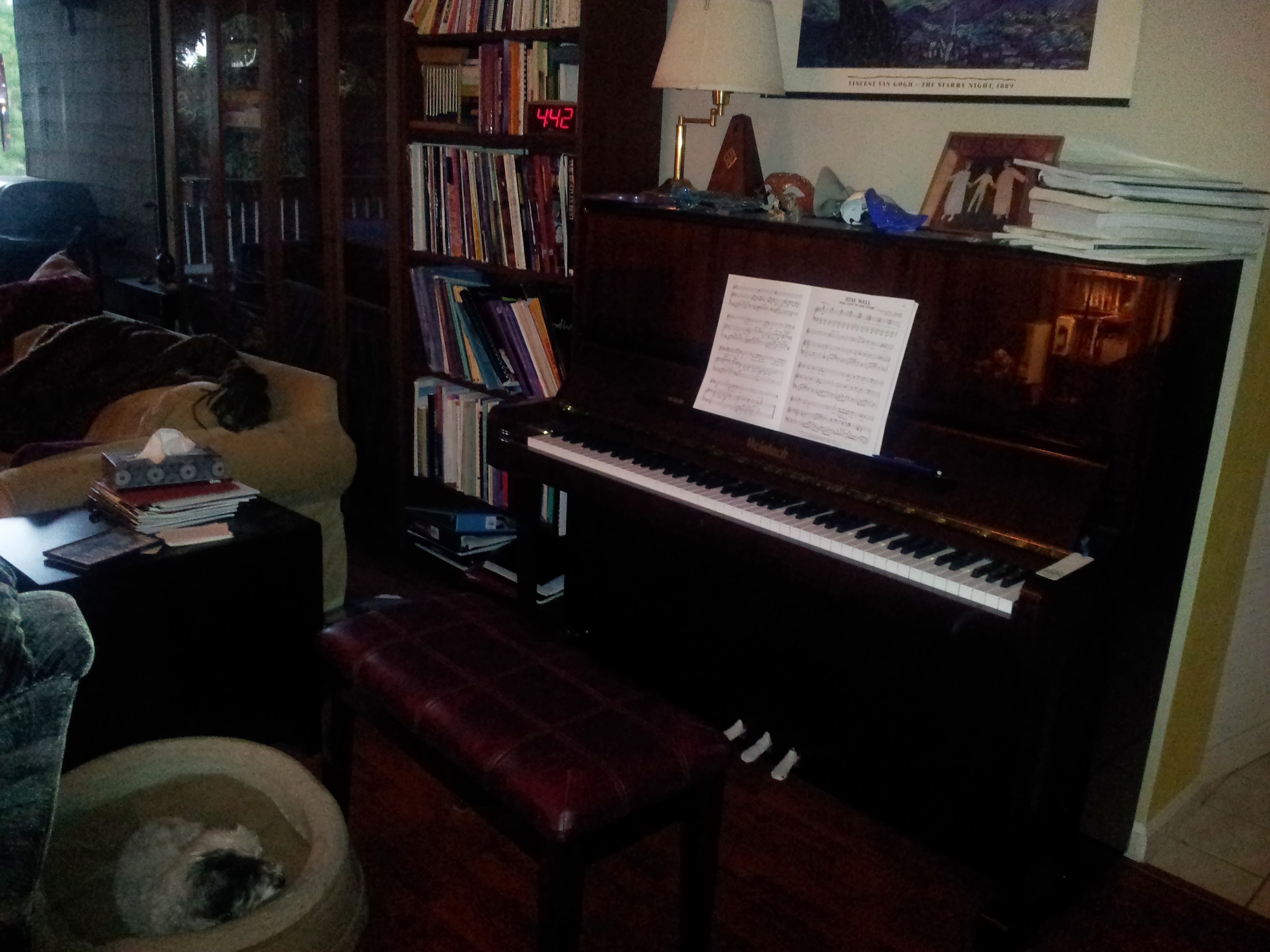
Here is where I spend most of my time.

Here is where I spend most of my time.

Here is my picture:

My apartment is filled with books: YA and science fiction and literature and fantasy and travel guides and research materials and sheet music. I can’t imagine living without a piano. The little white dog lies curled up by my chair. I probably need to vacuum.

When I go to happy hours (maybe once a year), I go for the cheap food. I will probably never drink wine with dinner. I have friends over for board games and role-playing games instead of dinner parties, and sometimes I bake brownies for them. I eat out a lot, and I eat frozen dinners a lot of the rest of the time.

I’m wearing jeans, a sparkly sweater, and no makeup. I spend most of my days reading and writing and thinking. I’ve been trying to make more time for practicing music. I love to read novels. I am horrible about sending anything to anyone via post. I’m not athletic and I never go to the gym, but I do love walking my dog and soaking in the world around me. I don’t know the right way to clean a variety of stains, and I don’t know how to use a sewing machine, but I do know how to sew on a button.

I wear glasses, and I have a weird sense of humor, and I’ve never had a traditional salaried job. I like the Vampire Diaries, but I am more than half a season behind on it, and right now I’m rewatching The Gilmore Girls because I like watching Lorelai create her own picture for herself, plus hers includes the really nice blouse and skirt outfits. I daydream about London and New York and Seattle, and Disneyland is still one of my favorite places on the planet.

I try to figure out what it is I actually care about, as opposed to what I’m told I should care about. Sometimes these things are the same, and sometimes they aren’t. Making the distinction can be difficult.

***

What is your picture?

Read Full Post »

I wrote last spring about clothing as a representation of identity. There’s an interesting dialogue going on now about clothing and other status symbols as they relate to class in the United States, begun by the essay “The Logic of Stupid Poor People” by Tressie McMillan-Cottom. Of course, this is not about exploring identity through appearance and presentation, as I was talking about, and much more about what it means to be able to carry off different signals of class and education through appropriate attire, speech patterns, and the like. This is a world in which whether you wear a cotton tank top or a silk shell under your blouse can mean the difference between being hired and being dismissed as not right for the job, regardless of any other qualifications.

This summer Theodora Goss wrote about the Lady Code:

“So dressing, for a woman, is a complicated affair. When you look into your closet in the morning — and even before that, when you buy your clothes in a store or online — you are making a choice about what you want to communicate. You are speaking in a coded language.”

This is, I think, why I am so interested in clothes, because I do see them as a means of communication. I didn’t learn the lady code or any of this sort of communication at home; my mom was completely not interested in matters of clothing or personal appearance. So I’ve had to learn it gradually as an adult, and I remember how much I still don’t know when I read some of Theodora’s posts. I don’t know the right kind of dress to wear to the ballet. I didn’t know that professional women don’t wear nail polish. For that matter, I didn’t realize the important distinction between a silk shell and a cotton tank top.

I’m fascinated that this coded language exists. Some people are unaware of it; some people don’t care about it (although when that is the case, it is usually because they are in a position in which they don’t have to care). Some people have trouble saying what they’d like to with it, either because they don’t know the language well enough or because they don’t have the financial wherewithal. That’s why historically if you were going to be introduced into society, you’d usually have some kind of sponsor, someone who could teach you all the intricacies you’d need to know to send the right message with your appearance and behavior.

John Scalzi talks about his go-to clothing choices (Levis, polo shirt, casual brown shoes) and how they represent “the basic uniform for a middle-class male.” Where I live, in the Silicon Valley, even a polo shirt for a man represents a certain amount of effort. Some men here tend to deliberately ignore style, which is a code in and of itself. Wearing random ill-fitting blue jeans and a free swag T-shirt from your company of employment? Probably a software engineer. Getting to wear those clothes is one of the perks of that position, at least if you’re a guy. I see that uniform less often on women around here, and even when I do see it, the clothing items tend to have a better fit, but I’m not close enough to the industry to say whether this is true across the board or not. I’ve also seen software engineers have to spruce up their wardrobes when they’re after certain promotions; they need their clothes to say something slightly different at that point. (But not too different. It’s a fine line.)

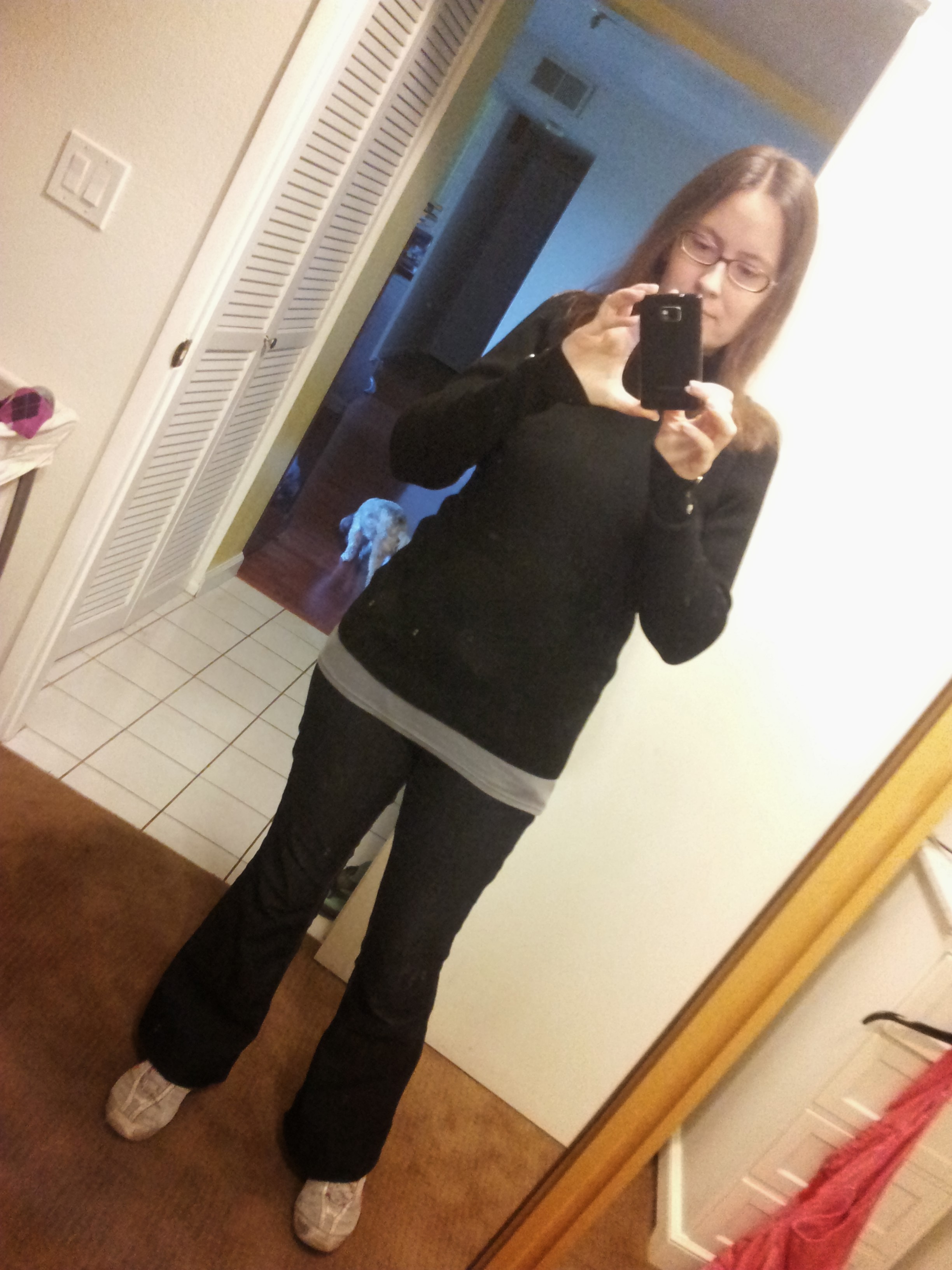
Look closely to see the little dog in this photo....

Look closely to see the little dog in this photo….

Today I’m wearing a black turtleneck sweater with metallic detailing, a ribbed blue shirt that peeks out from the bottom of the sweater, and stylish blue jeans. I’m wearing sneakers because I was out walking the dog this morning, but I’ll probably change shoes before I go out tonight. I’m not wearing any makeup, and I deliberately have a low maintenance hair cut. No jewelry today, although I’d add a necklace if I wanted to try harder.

All of those facts mean something in the coded language of dress and appearance. What are you wearing today? What messages do you think you’re sending? (And if you’re wearing a Halloween costume, I want to hear about that too, and especially what you think your choice of costume says about you.)


Read Full Post »

I really like James Altucher’s blog. I disagree with him some of the time, but he usually makes me think, whether I agree or not, and I appreciate that. Of course, one of the challenges in reading his blog is ignoring his heightened rhetoric. (Heightened rhetoric is great for blog traffic, but it makes ideas harder to talk about.)

My friend pointed me to the recent James Altucher post “How to be a Slave.” Its main point is that if you work for someone else, you’re trapped and getting a bad deal: you’re losing all this money you could be making in the company’s overhead and paying your boss’s salary, and then also you have to sit through boring sexual harassment seminars and dress a certain way and act a certain way. So you should go work for yourself and be free.

But it’s not that simple. First off, there is a trade-off working for a company vs. working for ourselves, and it depends on our individual personalities and circumstances which one we’ll be more comfortable with.

Working for yourself or the Man? (Photo Credit: Alan Cleaver via Compfight cc)

If you work full-time for a company, you often get paid time off (vacation, holidays, sick days) and access to cheaper and sometimes better health insurance. This is part of your compensation package, so yes, you’re paying for it, but it’s nice to have vacation days and good health insurance, so it might be compensation that you want. If you receive a salary, you know about how much money you’ll make this year. On the other hand, there’s also the possibility you could be laid off. You have an imposed structure to work within, which some people find quite appealing. Overall, people at companies are perhaps less self-directed, but the amount of self direction depends from job to job and company to company.

If you work for yourself, you do not get paid for time you don’t work, and health insurance is more of a problem (although we’re all crossing fingers it will get better in January). Basically you have to earn more money to make up for the alternate compensation methods you’re not receiving. You have complete control of your time, but this can be a double-edged sword. The amount of money you’ll make in a year tends to be more variable. You can’t be laid off, but your business might do poorly. My favorite part of working for myself is that ultimately, the decision-making is up to me. But some people don’t like calling all the shots; it can be a lot of responsibility.

In addition, it is simply not true that if you work for yourself, you automatically can spend all your time the way you like or dress the way you like or treat people like crap because they’re the opposite sex from you. It is true that you can avoid a certain amount of red tape, wasted time and money, and procedures that are inefficient and ineffective. But many people who work for themselves have clients/customers, and in order to be successful, they have to cater to these clients. I couldn’t dress like a slob as a music teacher, or no one would have hired me. I had to do tasks I didn’t enjoy to keep the business running healthily. I always tried to be polite, respectful, and professional in all my interactions with my students. If I hadn’t done these things, my business would have failed. Sure, I had more choice, and that was fabulous. I didn’t have to deal with policies that had no purpose. But I still didn’t have the leeway to consistently make poor decisions.

The irony is that even though I disagree with many of the arguments in that article, I have done what it suggests. I have never had a full-time salaried position. I like being in control of my time. I like working for myself.

But what I would like to suggest is that different people need and want different things. Some people will thrive working for a company, and there’s nothing wrong with that. Other people will do better working for themselves, and there’s nothing wrong with that either. Some people will go back and forth between the two. If you’re miserable, by all means change things up.

But if it doesn’t work for you, you don’t have to live somebody else’s dream. You get to create your own.

Read Full Post »

A sex columnist and a children’s book writer went out on a first date. The conversation flowed, the chemistry was palpable…but ultimately the children’s book writer decided there couldn’t be a second date. He was afraid his dating a sex columnist wouldn’t work for his career. True story.

I thought of this story again when I read Penelope Trunk’s recent post about being honest about who you are at work, in the context of Jason Collins’ coming out story in Sports Illustrated: “The more you hide, the harder it is to find a job that’s right for you.”

I think a lot about the post I wrote about the distinctions of public, personal, and private, especially when I’m talking to people about social media strategy. Because in order to be genuine, in order to connect with people in a deeper way, it’s often necessary to share some of the personal. But figuring out what’s personal and what’s private isn’t easy. And when the career you love and your private life (or alternate for-money career, as is the case for many artists) don’t quite mesh together, it’s hard to reconcile. Hence the children’s book writer making the tough decision not to date a woman in whom he was interested in order to avoid a later dilemma.

Our society is in the middle of a shift involving the availability of information and the level of connectedness between us. I met a book editor last month who complained about how often his writer Facebook friends posted about their politics and how much this bothered him. A decade ago, this wasn’t an issue. It’s so much easier to avoid talking much politics when you’re going out for drinks with your editor than it is to avoid posting about anything remotely politically every day. And even if you talked about politics over those drinks, that conversation has a different contextual place for both you and the editor than it does in a social media feed.

So we find ourselves wrestling with two related problems: having less control overall over the information the world can access about us, and having more of a platform from which to release our own information about ourselves, which means we have to decide what to say (and what not to say). In addition, we have to deal with the implications of all this information floating around (or the potential of it to be released) to our careers, to our loved ones, to our complicated social landscapes, and in terms of ethics.

Our lives as open books. Photo Credit: Honou via Compfight cc

These issues are exacerbated for artists because of our society’s collective difficulty in considering works of art as something apart from their creators. This is when we begin to see parents objecting to a children’s book because its author is not seen to be of sufficient moral character. I also know people who don’t want to go see the Ender’s Game movie this fall not because they object to any of the material they think they’ll see but because they don’t want to give money to Orson Scott Card. Certainly as content consumers we have every right to decide what art we will and won’t consume, but it is interesting watching the trends towards making that decision based on the creator instead of the work. Why is this change taking place? Because more information about these artists is generally available (both from themselves and from outside sources).

As privacy becomes less possible and we have less control over accessible personal information, it will become increasingly important to use our platforms to tell our own stories about ourselves. As Justine Musk says, “If you don’t tell your story, someone else tells it for you.”

It is going to become harder and harder to hide. Sometimes we might be able to make decisions like that children’s book writer and keep things simpler for ourselves. But other times, what’s at stake will be too important. And perhaps it’s at that point when having the platform and ability to communicate in your own way becomes the most important.

Read Full Post »

Well. It’s the end of April, and as always at this time of year, my thoughts are with my mom. But instead of talking more about her, I’d like to talk about how our society deals with the issues of dying, death, and grief.

I was in college when my mom was diagnosed with an aggressive strain of breast cancer and later given a terminal diagnosis (meaning this cancer was going to kill her). I was struggling with what was going on, and most of my peers couldn’t really relate to my problems, so I decided I wanted to join a support group. I was on a college campus, so how hard could it be to find one?

There was no support group on campus. There was no support group in the Santa Cruz area. I found a grief support group at a local hospital, but I was only allowed to begin attending once my mom had died. No support was deemed necessary for dealing with the traumas associated with watching someone die slowly, apparently.

Eventually I gave up. I didn’t have a counselor on campus to talk to. I didn’t receive any support. About five months after my mom died, my voice teacher, who was as close to a mentor as I had in college, was berating me for not having it together as much as a fellow student whose mom had also died. As you might imagine, this didn’t exactly do wonders for my morale. Grieving, I learned then, was not acceptable, even though I was functional and doing all the basic things I needed to be doing (going to class, completing my assignments, feeding myself, etc.).

don't speak

This is all bullshit. When people have loved ones diagnosed with terminal illnesses, they need support during the time before death. That time is just incredibly wretched. Bad news streamed into my life in a steady torrent, and watching my mom suffer while I was completely helpless to do anything about it squeezed my heart in an unforgiving grip. The uncertainty of when hung over everything else, a promise of future misery.

Grief doesn’t have a timeline. Grief doesn’t disappear overnight, or in a month, or in five months, or in years. And grief affects people differently. When someone is dealing with something like this, processes to get support should be made simple, not complex and unclear and obviously involving much jumping through hoops. Instead people have unrealistic expectations and they simply don’t want to talk about it.

Grief takes the time it takes. Sometimes it crashes into your life and all you can do is try to hold on. Other times it creeps in stealthily, quietly, and you wonder what’s wrong with you and why you don’t feel more than you do. Years may pass and suddenly it jumps out at you when you least expect it. And it gets mixed in with all sorts of emotional experiences: fear, anger, relief, shock, numbness, hysteria, throwing yourself into your work, the ache of emptiness, recklessness, hopelessness, a gnawing sensation of searching for something.

There is no way to sugarcoat the truth. Having a loved one diagnosed with a terminal illness really sucks. Losing someone you love really sucks. Being reminded of your own mortality really sucks. And dealing with our society’s stupidity about these things makes it suck even more. After all, everyone dies at some point–why does it have to be a subject shrouded in silence?

And this doesn’t even get into the way our society treats those who are seriously ill and/or dying. Luckily we have people like Jay Lake documenting both the ways our society gets it wrong, and his experiences dealing with cancer.

We can do better.

Read Full Post »

People will try to take your voice away.

They will try to make you shut up if you are different than them, if you have a different opinion than them, if you are engaging with an idea that makes them uncomfortable, if you are a woman, if you are below a certain age or above a certain age, if you have a darker skin color, if you are gay, if you belong to a different religious or political group, if the things you believe to be important are not the same things that they believe to be important.

People will try to take your voice away.

They will mock you, harass you, and make fun of you and what you are trying to say. They will tell you that women are inherently not as smart, talented, important, or fill in the blank as men. They will ask you why you have to think the way you think, why you have to ask the questions you’re asking, why you have to pick everything apart. Leave well enough alone, they tell you. You’re reading too much into it, they say. Be grateful for what you have. As if gratitude for the good requires a blanket of silence. (Anyone who tells you that you should be grateful has an agenda, and it’s not one that involves being particularly kind to you.) They will say that you are whining or bitchy or too negative.

People will try to take your voice away.

They will reward you for your silence. They will reward you for smiling, for agreeing, for not bringing it up, for being the nice one or the good one. You will get to avoid conflict and uncomfortable silence (until you start to realize that uncomfortable silence is not really all that bad a price to pay in order to refuse to be smothered). You will feel like one of the group, you might even be able to pretend that these people are your friends. (Except real friends will not try to pressure you into silence. They might change the subject or say they prefer not to discuss a specific topic, but they won’t try to make you feel small. And if they slip up, they will apologize.)

People will try to take your voice away.

They will feign ignorance, or maybe they genuinely will not understand how toxic they are being. They will be doing it for your own good. They will mean well. They won’t even notice. They will do some nice things for you, and you won’t realize your voice has died down to an inaudible whisper. Eventually you will internalize their voices and be harsh with yourself for doing positive activities like engaging in critical thinking. Their attempts to keep you quiet will become your own attempts to silence yourself.

People will try to take your voice away. But you don’t have to let them. You can keep talking, keep writing, keep singing, keep questioning, keep engaging, keep thinking, keep pushing out of your comfort zone. You can keep asking why: Why does the new Dove ad campaign make you uncomfortable? Why are you being criticized for doing something you didn’t do? Why do you like what you like and dislike what you dislike?

In both singing and writing, finding your voice is so important. Once you’ve found it, cherish the discovery and don’t let anyone take it away from you.

Read Full Post »

“I think it takes a great deal of courage to be one of the people who tries to change the world in some way — I’ve heard too many people say that they’re not trying to change the world, that they’re just trying to entertain (particularly in their writing). But that’s the point of that? If you’re not trying to change the world, what are you doing, and why? I mean, doesn’t the world need changing?”

-Theodora Goss, Magical Women

We are taught to believe that changing the world is difficult, if not impossible. Changing the world, we are led to understand, is something people wish to do in their youths, and at some magical point, we will grow up, realize it’s impossible to create change, and give up our childish idealism.

But we artists, we’re all about changing the world. (And all of us have the capability for being artists inside of us, whether or not we’re creating art professionally.) In fact, art is so much about creating change, about communication, about shedding a different light on a subject, that it seems disingenuous to insist that the only purpose of any given piece of art is entertainment. This is simply not the case the vast majority of the time.

Take the wildly popular Broadway musical The Book of Mormon, for example. It’s by and large a fluffy, crowd-pleasing musical with fairly unexceptional music and a big sense of humor. It pokes fun at the Mormon church with practically every lyric. At first glance it isn’t obviously world-changing. And yet. By the end, the audience is given the impression that while those Mormons are funny folks with lots of hilarious traditions and a bit of hypocrisy thrown in for good measure, they’re basically just like everyone else, good people trying to do good in the world. And I’m sure some audience members have left at the end of the night of theater with a different opinion of the Church of Latter Day Saints than when they walked in.

Photo Credit: an untrained eye via Compfight cc

Now, it might be true that we do not intend change or anything deeper in our work than a romping adventure yarn. We might be unaware of some of the messages we are sending with our stories, our characters, and our imagery. But so many of the choices involved in artistic work either support the status quo or disrupt it. We are changing the way people see the world, even if it’s unconscious on all sides. If we write a series of novels with all active men characters and all passive women characters, then we’re helping to shape our readers’ ideas about gender. If we write and perform songs that glorify hate crimes, then we’re helping our listeners form ideas about what constitutes acceptable behavior.

We are taught that we don’t have power, and sometimes it’s easier to believe that and thus avoid taking responsibility. But the truth is, so many of us have the power to change minds and hearts. And sometimes the most important minds and hearts to change are our own.

Read Full Post »

Very soon after I decided that I wanted to be a YA writer, I learned the following “truth:” that girls will read novels with both male and female protagonists, but boys will only read novels with male protagonists. So if you want the widest crossover, you write a boy protagonist, and if you write a girl protagonist, that means you’re mostly writing for a female audience.

Then I heard the oft repeated story about how J.K. Rowling decided to use her initials as her author name so that the readers would not know she was a woman. And I heard about how YA was dominated by women writers, sometimes as though this were a bad thing.

Then I heard a couple of male writers who I respect talking about the problem of there not being enough boy books in YA. Later on, I heard about what a problem it was that there were too many female protagonists and “girl books” in modern YA.

Shall I define “boy book” for you? A boy book probably has a male protagonist. It features action and adventure and is quick paced. It probably doesn’t have much if any romance. The language and structure might also be more straightforward and simple, since one of the main reasons having YA boy books is supposed to be important is to encourage reluctant boy readers to read.

A “girl book,” by contrast, probably has a female protagonist. It may have action and adventure and be quick paced. It almost certainly includes a romantic element. It might focus more heavily on social interactions and relationships in general, as well as issues of social status (because of course, men aren’t interested in status at all. Ha!). There might also be a stronger focus on emotions. The language and structure run the gambit between simple and complex.

I’m not going to mince words: these truths about boy readers, the YA genre, and boy and girl books are harmful and sometimes flat-out false. If boys won’t read books with girl protagonists, especially by the time they are teenagers, this is not a good reason to write and publish fewer books with girl protagonists. This is a red flag that something is wrong with the message our society is sending to these boys.

Often this argument gets lost in the rush to emphasize the importance of boys learning to read. It’s fine to perpetuate this “truth” of boys being unwilling to read anything not entirely male-centered, the unstated message goes, as long as we can wheedle them to read anything at all. And this is how sexist thinking gets passed on to the next generation.

Obviously boys learning to read is important. It’s important that everyone learn to read. And it’s also important that we throw away outdated and harmful ideas about gender and stop teaching boys that girls and anything related to girls are somehow shameful or uninteresting or embarrassing. THESE CAN BOTH BE IMPORTANT AT THE SAME TIME. Revolutionary idea, I know.

If YA did have such a predominance of female protagonists, I’d be happy, given all the messages female teens receive to the contrary, that there was at least one place where they could experience other females being front and center, having agency and their own individual identities. But it is not necessarily even true that YA has more female protagonists than male. According to this study, 49% of YA protagonists are male. 49%. And only 36% of YA protagonists are female. (15% have protagonists of both genders.)

You know what else isn’t true? That YA is dominated by women writers. The same study found that 56% of YA writers were women, which is hardly an overwhelming majority.

When we talk about female protagonists in YA books as if they’re somehow a bad thing, we’re strengthening harmful stereotypes. When we believe boys won’t read books with female protagonists, we’re sending them the message that they shouldn’t want to, or that there’s some kind of problem with reading these so-called “girl books.”

The Feminist Batwoman wrote a fabulous essay called “Boys Don’t Read Girl Books and Other Lies My Society Told Me.” She ran a successful experiment exposing her little brother to novels about girls as well as boys, and she has this to say about boys not reading books with girl protagonists: “My outlandish theory is that if boys aren’t belittled for reading books about girls, if they’re not taught that girls are lesser, if they’re not teased about cooties, if we don’t teach them to fear the feminine… they’d probably like more “girl” stuff.”

We need to stop talking about boy books and girl books as if this is some kind of important and valid distinction. We need to wake up and realize that 56% of YA writers being women does not mean that women dominate the genre. And we need to think long enough to realize that if girls are happily reading novels with protagonists of both genders, there’s no reason we can’t work towards encouraging boys to do the same. Plenty of boys already do.

For a long time I took these assumptions about YA and YA readers for granted. I’m guessing I’m not the only one. Therefore, if you think this is an important and interesting issue, I encourage you to share this essay or start a conversation with your friends and colleagues. Let’s challenge what everyone knows and find out what lies underneath, shall we?

Read Full Post »

« Newer Posts - Older Posts »