Feeds:
Posts
Comments

Archive for the ‘Personal Development’ Category

Here’s a new word I learned recently. I found it on Jonathan Carroll’s Facebook page, and he found it on this neat Tumblr. As is often the case for me, I’m not completely sure how to pronounce it. But I love it all the same.

Metanoia – the journey of changing one’s mind, heart, self, or way of life

At a party this weekend, someone asked me what I’d been thinking about lately. I was momentarily flummoxed because I’ve been so busy and preoccupied, I don’t feel like I’ve been thinking as much as I normally do. But now, a few days later, I realize the best answer would have been, “I’ve been thinking about metanoia.” Because really, I’ve spent a lot of time thinking about self change over the past few years.

At its heart, metanoia involves crystallizing priorities and learning to know yourself as well as possible. It’s hard to change something when you don’t understand what’s there to begin with. Strangely, it sometimes feels more like remembering than anything else. Remembering who you are, and remembering who you’ve always been. That knowledge becomes the starting point for whatever change you wish to create.
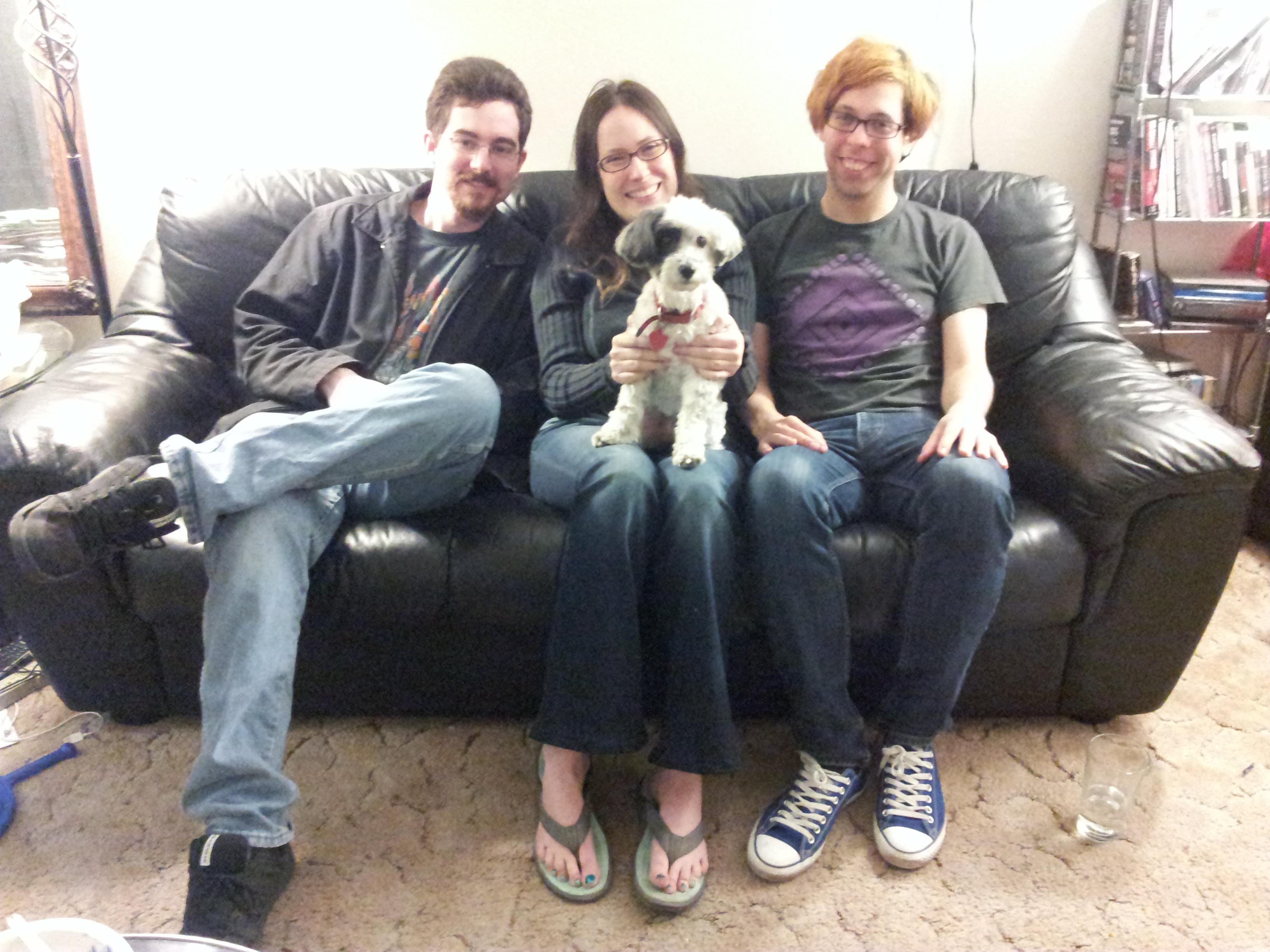
Surrounded by three of my dearest friends, I am very much myself.

Surrounded by three of my dearest friends, I am very much myself.

“Remember who you are.” That was my advice to a friend of mine this weekend, the only words I had to offer. It’s so important, isn’t it? Because without that, we can become so very lost or muddled or distracted. And we worry about what happened before and what is going to happen later and we compare ourselves to other people and measure ourselves against other people’s visions of who we are, instead of remembering that other people have nothing to do with our essential knowledge of ourselves. Good people can help support us while we take the journey, but it’s a discovery we must make on our own.

So metanoia is essentially taking yourself by the hand and saying, “Hello, you. Let’s take a walk down by the stream and lay down on the mossy bank and talk for hours and hours. And I will do my very best to listen carefully to what you have to say. I will listen to the good parts, the parts that make your heart soar and your body sing and your mind dance. And I will listen to the dark parts, the parts that are difficult and scary and secret and that you maybe wish weren’t true. And I will love you for all those parts, even the parts that I want to change, and then together we can decide where we want to go next.”

Remember who you are, my friends. Treat that knowledge like the precious thing it is.

Read Full Post »

You know how people say that as you get older, you stop changing? They see the teens and early twenties as this turbulent time as you explore and establish who you are, and then your identity is set, and you are who you are.

This idea of selfhood has always disturbed me. I have never wanted to become set. I enjoy playing with identity, whether it is through writing characters, wearing clothes and costumes, playing RPGs, or acting on the stage. I like thinking about why I do what I do, and why people in general do what they do, and what influence society and families and past experience has on our emotions and decisions and worldviews.

But recently (and by recently, I mean ten minutes ago), I realized my own relationship with identity is more complex than that. Because I do believe there is an unchanging core of myself, of Amyness, that has existed as far back as I have memory. Just as I can look at old photographs of myself and see my current face in the chubby cheeks of two-year-old Amy, in the gawkiness of nine-year-old Amy, behind the huge glasses of teenaged Amy, so I can feel an ongoing sense of self that has persisted throughout my lifetime.

Yes, the title of this post might be a thinly veiled excuse for a cute dog photo.

Yes, the title of this post might be a thinly veiled excuse for a cute dog photo.

My friend Rahul wrote in one of his excellent essays: “I wonder if individuality is something that deepens in you when you start to live purposefully.” To come at the same idea from a slightly different direction, I think that through life, we can grow in ways that bring out and express our own individuality with greater strength and clarity. And these changes that we can make that allow ourselves to shine out ever brighter, these changes are what I am personally committed to and what I hope will never stop, no matter how old I become.

I have spent the last few years completely dedicated to change. Some of that evolution has been documented here on the blog, most explicitly through my backbone project. What I realize, though, is that I haven’t been changing the core of who I am. That sense of self is my foundation, the part that by never changing allows me to have the strength to challenge myself and my assumptions and make so many other changes. What I have been changing are my attitudes, my behaviors, my reactions, my understanding, and my choices. I have the freedom to change so much because ultimately, I am already so grounded in who Amy is that my core identity can survive through any changes I care to make.

And through all this change, I see the juxtaposition that so many of us struggle with. On the one hand, we want to be the same. We want understanding and empathy and sympathy, we want people to like the same things we like, we want to have that sense of connection that can come from sharing. But simultaneously, we want to be different. We want to rebel, we want to express our individuality, we want to be SPECIAL. And there is a push and pull created between these two opposing desires.

Only they’re not opposing at all. We can be both ordinary and special. We are all the same in some really basic ways. But each of us also has that core of identity that makes us who we are, whether we are consciously aware of it or not, and each core varies ever so slightly from every other core. And each of us has our own slightly different point of view as we travel through life. And this different selfhood and different perspective makes us special even as we are awash in sameness. In a similar way, we can be changing like mad even as we’re always ourselves.

Isn’t it neat the way that works out?

Read Full Post »

“The irony of commitment is that it’s deeply liberating – in work, in play, in love. The act frees you from the tyranny of your internal critic, from the fear that likes to dress itself up and parade around as rational hesitation. To commit is to remove your head as the barrier to your life.” – Anne Morriss

My friend posted this quotation on Facebook the other day, and I’ve been thinking ever since about the relationship between commitment, fear, and change.

Commitment is, in a way, about leaning into the fear. Because once we become wholly committed to something, then we have something to lose in a way we didn’t before, and that can be really freaking scary. And commitment is about change, because even if it doesn’t cause any outward differences, it transforms what’s going on inside our minds and hearts. It alters our personal stories.

To commit fully is to feel naked and exposed. It is to drop any facade of insouciance or nonchalance. It is almost a confession, that this, this is something I’ve chosen to pour my heart, my energy, my time, and my passion into.

Commitment doesn’t come with any guarantees of success. If it did, it wouldn’t be nearly so interesting, so raw, so immersive in that which is vulnerable. But it does, as Anne Morriss says, remove our heads as barriers. It allows us to throw ourselves completely into our lives. It allows us to choose the kind of lives about which we can later sit down and write memoirs.

Photo Credit: thomas_sly via Compfight cc

When I think about my life, I realize that I couldn’t have followed through on the really hard things I’ve done without deep commitment. I couldn’t have gotten my college degree or had a senior recital. I couldn’t have moved to London. I couldn’t have started my own business. I couldn’t have become a writer. I couldn’t have engaged on a personal and emotional level with the people who are important to me. And I couldn’t have changed who I am and how I relate to the world.

All of those things involved risk and the chance of failure. All of them allowed the possibility of someone saying no, of things going wrong, of heartache and disappointment and mistakes, of me wimping out. All of them scared me.

When I arrived in London with my two gigantic suitcases, just out of college and with a freshly broken heart, a friend met me at the airport and helped me get to the place I was staying. And then he left, and I sat there, and I thought, “Oh my god, what have I done?” And then I cried. But the next morning I got out of bed and I left my flat and I explored London. Because I was committed to being there and having the richest experience I could, even though I was lonely and scared and didn’t know what I was doing.

There are so many times when I feel like I don’t know what I’m doing. Commitment helps me lean into the fear and discomfort of that feeling, and do it anyway. If we want to put ourselves out there in the world, if we want to try to do amazing things, I think that kind of commitment is necessary. The commitment gives us the permission we need to really go for it.

Commit and be free. I like that. It’s the kind of complex idea that requires a lot of thought to see the layers of truth it contains.

Read Full Post »

“There’s always been a bit of the Princess archetype in you,” she said. (And she’s totally right; there always has.) “And I thought you had manifested that for yourself, that your life was settled and you had gotten your happily ever after. It wasn’t that I didn’t want to, but I didn’t see you.”

In her talk on vulnerability, Brene Brown says that the word courage comes from the word coeur, French for heart. What is courage? She says it is telling the story of who you are with your whole heart: in other words, allowing yourself to be seen, choosing the authentic. It takes courage to tell our stories. It takes courage to be honest and open. And it takes courage to infuse our artistic work with truth.

Coeur.
Photo Credit: Miriam Cardoso de Souza via Compfight cc

She also mentions the importance of having the courage to be imperfect. And let me tell you something about the Princess archetype. It’s not all bad: it includes a healthy dose of positivity, some chirping birds, romance and adventure. But it also contains no space for imperfection. The Princess in the fairy tales is perfection in essence: she is beautiful and charming, she is talented, she can sing and play music and dance and speak twenty languages, she always knows what to say, she has a sweet disposition, and she never ever feels angry or tired or upset. She can only feel fear when she is in danger as a plot device to allow the prince/knight/fool to rescue her, self-actualize, and win her as a prize. And she is always brave and smiling.

Being the Princess means not being seen for yourself.

I have been the Princess. I have tried to be perfect in every possible way. I have worked to be attractive and charming and to always set people at ease and know the right thing to say.  Whenever I have made a mistake, it has meant falling short of impossible standards. I have tried to please everyone and hate admitting that I need anything at all.

And yet, it has only been through surrendering the Princess archetype that I could begin creating the life that I want. It has only been through searching for people who don’t need me to be that Princess that I could finally be me, with everything that encompasses. It has only been through finding my coeur to begin to tell my story that I could create authentic connections with other people. Being able to see other people and being seen yourself, as it turns out, go hand in hand.

When I think of all those years I was trapped in the tower of Princess-hood, I feel very sad. Now that I’ve rescued myself, I try not to be perfect with appropriate imperfection. I don’t always smile. I am not always brave. I sometimes put my own needs first, and I am allowed to ask for things. There is space for me to have emotions. The world doesn’t end when I can’t always be strong.

It feels very strange to not be a Princess. But also very right.

Read Full Post »

This weekend I got a question on an old post of mine that I thought deserved a longer response. The post is on the topic of the difficulties of being a free spirit, and the commenter asked: “”What do you do when you falter? How do you stay strong in the face of judgement?” Both excellent questions.

What do I do when I falter? And oh wow, do I falter. Most of us do. It’s hard to make unconventional choices, and it takes a fair amount of courage, and sometimes my supply of courage feels like it’s running short. What to do about this indeed?

One answer is to pay attention as much as we can, so at least we have a chance of noticing when we’re faltering. And once we’ve noticed, we can allow ourselves to be gentle about it. It’s fine to feel the fear, the discomfort, the wish that the choices that seem so much easier would be the right choices for us. But we also need to remember the why’s. Why do we like being free-spirited? Why do we prefer considering options instead of making the default choice? Why is this better?

When I falter, I remind myself of my experiences of doing what others expected or wanted rather than what I wanted, and how that usually turned out poorly. I give myself my own personalized pep talk. And because I’m a planner, I develop a plan for getting myself back on track, which might include getting additional support.

Photo Credit: bogenfreund via Compfight cc

Far more difficult in my own experience is staying strong in the face of judgment. Being judged is such a creepy-crawly, uncomfortable experience. And even though it so often is all about the person doing the judging rather than the person being judged, it still feels very personal.

The first place to look is to ourselves. If we encourage our own minds to be judgmental and critical of ourselves, then we’ll feel that same sensation of judgment coming from the outside as well…even if it doesn’t actually exist outside at all. So we need to be kind to ourselves while developing our own sense of worth. The more we believe in ourselves, the more confident we become. And the more confident we become, the less it matters what other people think, and the easier it becomes to remember that their judgments are more about them than about us.

It’s harder when the judgments are coming from people whom we care about: our family and friends. Sometimes their voices become so loud that we internalize them and can hear them criticizing us even when they aren’t present. And because we value their opinions, it can be harder to tell the difference between genuine concern and viewpoints respectfully expressed and more manipulative and painful judgments.

For this, I am a big fan of setting boundaries. When we’re not used to having boundaries, it takes a lot of practice. Really a lot. And not only that, but people can become quite judgmental about the fact that you have boundaries in the first place. But it’s psychologically healthy to have boundaries, and over time they become super effective. You’re allowed to decide what you’re going to do with your life, and you’re allowed to take care of yourself. (I could write entire books about boundaries. In fact, people have, and here’s my favorite.)

So, in summary, here’s what I do when I falter and when I’m having trouble with the judgments of others:

1. Be mindful so I notice what’s going on.
2. Self pep talk, reminder of why what I’m doing is awesome.
3. Get support, make a plan if necessary.
4. Work on increasing self esteem and minimizing my own critical judgments.
5. Set boundaries with other people and take those boundaries really seriously.

What do you think? How do you stay strong in the face of judgment?

Read Full Post »

A few weeks ago I got to have a conversation with a respected Buddhist teacher. I asked him if it ever got discouraging, working with people who are stuck in one place and seemingly unable to dislodge themselves. And I’ve been thinking about his answer ever since.

People change when they want to change, he told me. And if they don’t want to change, there’s nothing else to be done. Even when they do want change, the process is difficult and sometimes the desire alone is not enough. And sometimes people are so caught up in their own stories that they really don’t want to change. They’re comfortable in their suffering.

I know exactly what he meant, because I’ve been comfortable in my suffering in the past. It’s a strange way to think about things because of course, being comfortable in suffering is often vastly uncomfortable. The key is in its relativity: that however uncomfortable the suffering might be, it is less uncomfortable than the alternative. It is less uncomfortable than the prospect of what change might mean.

Photo by Graham.

However, it is not only fear of change that is a driver here. It is also an inability to imagine anything different. It’s so easy for us to become caught up in our worldviews to the point that we don’t remember that other worldviews even exist, much less have the possibility of being equally valid. It’s easy to become blinded to anything outside of our experience. It can be easy to expect the worst, and by expecting it, summon it into our lives. (And we might not even realize we’re doing this, because it might not feel like expecting the worst; it might simply feel like maintaining the status quo.)

We act based on what we know. So when we wish to change, we often must change not only what we are doing but also what we believe to be true. We must question what we believe to be within the range of possibilities for ourselves.

I believe in our capacity to change with an almost desperate fierceness. I have to believe in it that way because I’m right in the middle of it, and it’s hard, and I don’t want to falter in my resolve. I often feel like I’m working five times as hard as usual. This process rinses and repeats, often from the tiniest stimulus: how do I feel? where is that feeling coming from? is there a way I can think about this differently? is this part of the new me or the old me, the new world view or the old one? if it’s the old one, can I let it go? how can I use this to open more to the world?

It is quiet work. For the most part, the outside world remains unaware that it is happening. Sometimes a friend offers me a helpful hand. Sometimes that help is a distraction, the space to laugh at it all, or just the reminder, “Take some downtime, Amy.” Because while it may be quiet work, it is also tiring, making myself new.

But I’ll let you in on a secret. My imagination is working, and I can picture it now: where I want to go. Where I am going. And who I’m going to be. There was always that part of me imagining what I secretly wanted but thought could never happen. Only now I believe in it. That belief makes it almost close enough to touch. (Maybe I’m already touching.)

Whatever it is I’m doing, it’s no longer a comfortable suffering. Instead it’s something that reminds me what it feels like to be alive.

Read Full Post »

While I don’t often make New Year resolutions (except when I do), I like to stop and take stock of my life at the end of the year and set some goals for the year to come. After all, it’s hard to live your life according to your priorities if you don’t know what your priorities are!

amy and nala christmas 2012

Writing:

In 2012, I had several more stories come out, and I qualified to become a full member of SFWA. I also sold my first (and second) science fiction stories. I spent the bulk of the year working on my YA novel The Academy of Forgetting.

My plan for 2013 is to query a large number of agents and complete another YA novel. I’d also like to participate in at least a couple weeks of Codex’s Weekend Warrior (writing flash fiction). And of course, I want to continue to increase my focus, improve my writing skills, and read a lot.

Health:

Well, given that I spent six months waiting for my foot to heal, this year was on the frustrating side. But I was able to stay focused on my writing through it all, which I am very pleased about. My tooth from the drama of 2011 rarely bothers me anymore. And since the fall I’ve definitely been in less overall pain than I have for the last few years.

My wish for 2013 is that I can continue this whole less pain trend. I’d like to begin gradually increasing my strength. What I wish for the most is that I can begin to reintroduce some activities that I love but haven’t been able to do the past few years. Like dancing! And hiking!

Travel:

I wanted to get out of the country in 2012, and that didn’t end up happening. I mean, I went to World Fantasy in Toronto, but given that I pretty much only saw the hotel, I don’t think that really counts. However, I fell in love with Seattle, got to see Chicago for the first time, and faced down a hurricane in New York, so the year wasn’t without its adventures. I attended seven writing events, including three I’d never done before, and had a truly fabulous time.

So my wish for 2013 will be the same as last year’s: that I leave the country. And actually SEE and EXPERIENCE stuff while abroad. I’m considering trying to travel somewhere in Europe pre-World Fantasy in Brighton, which seems the most likely way to make this happen this year. I’ve already mostly planned out which writing events I’ll be attending for the year, although a few remain up in the air.

Personal Growth:

Oh, 2012. I cannot sum it up in one paragraph. I learned a lot, I changed a lot, I made progress towards becoming the person I want to be. My understanding of myself and the world around me is clearer than it’s ever been.

My wish for 2013? To take a loooong vacation. Ha! But seriously, 2013 is going to be a year of external change, when I get to put my clearer understanding into practice. I anticipate a fair amount of trial and error, so that should be … exciting. I’ll build on what I’ve been working on for the past two years, continue to practice my own definition of assertiveness, and look to create good habits so I can conserve energy.

Have any goals for 2013 you’d like to share?

Read Full Post »

I generally don’t do New Year’s resolutions. For me, they conjure up the idea of things people kind of want to do but don’t have the commitment with which to follow through. They have a half-hearted, wistful kind of air that frankly, I find a bit depressing.

That being said, for 2012 I made a resolution. Only I called it an intention to make myself feel better.

What I wanted to do this year was to focus on my friendships. I wanted more friends, and I wanted friends with whom I could discuss the things that are important to me. And I made a specific but modest goal: that by the end of the year, I would have two close friends, at least one of whom lived locally, with whom I felt comfortable being really open.

There were times at the beginning of the year when I felt very discouraged about this goal. I thought I was going to fail. I want to be clear that this had very little to do with the people around me, and very much to do with myself. I knew I had closed myself off in various ways, and that was hard to change. I had to force myself to take uncomfortable risks. I had to be assertive. I had to jettison the “I must always appear fine and happy and perfect” messages I’d been taught in childhood.

And now?

Photo by Ferran Jorda

Now I am surrounded by the most fabulous group of people I could have ever imagined. Each one of them is different, with their own superpowers, their own weaknesses, their own ways of being a part of my life. They have fun with me, they teach me, they comfort me, and they laugh with me. They welcome me with open arms when I visit, and they text and email during hurricanes. They dress up with me for James Bond because I think it’s the best idea ever, and they feed me, and they give me another chance. They encourage my writing and offer to help and give feedback so I can become better. They celebrate with me, and they hug me while I cry. They talk to me, and they listen to me, and we swap advice. They let me into their lives, and I let them into mine. Some of them even laugh at my jokes.

Some of them have been in my life for a long time. Some of them I’ve met recently. Some of them I see all the time. Some of them I rarely get to see. I feel like I’ve known some of them much longer than I actually have.

All of them have something in common: they support me being myself, flaws and all, and they support my vision for my life and who I want to be and the changes I have been making.

I love my friends with all my heart. They make my world brighter and my smile bigger.

No doubt some of them are reading this. I hope they are because it gives me another chance to say thank you. You are awesome, and I’m so glad we get to spend some time in each other’s excellent company.

A piece of common wisdom states that you should surround yourself with the kind of person you want to be. In other words, you want to spend most of your time with people who lift you up instead of bring you down.

Thank you, dear friends, for your lifting. I only hope I can do the same for you.

Read Full Post »

1. Assertiveness is not the same as decisiveness. Some of my friends disagree with me on this one, but I actually feel very strongly about it. Sometimes the most assertive thing to say in a situation is “I don’t know.” Maybe you need more time or more information before you can form an opinion or make a decision. Not being assertive would mean allowing someone else to push you into a decision before you are ready, possibly in the name of “decisiveness.” Assertiveness also doesn’t close the door on changing our minds, which is something else I feel strongly about.

2. Assertiveness is stating your opinion and showing yourself to the world. Even though you might be wrong. Even though you aren’t perfect. Even though people might not care or want to hear what you have to say. Even though everyone won’t agree with you. I think the courage to do this in a strong but balanced way comes from a sense of self worthiness.

3. Assertiveness is asking for what you want/need. Even when doing so is scary. Even when it might make the person you’re talking to think less of you, or not like you, or feel emotions. Maybe especially then.

4. Assertiveness is being okay when someone says no. Which, if you’re asking for what you want on a regular basis, is definitely going to happen. Emotions might happen when someone says no, and that’s fine…as long as you don’t act on them and instead deal with them in a mature way that works for you.

That is one assertive apple. (Photo by Fernando Revilla)

5. Assertiveness is gathering information. Maybe some people aren’t okay with you being assertive. Maybe some people repeatedly say no, don’t do what they say they’re going to do, or behave towards you in ways that you’re not okay with. This sucks. But it’s good to know so you can make decisions based on reality instead of what you wish was true. The kind of fabulous people you want in your life aren’t going to be trampling all over your boundaries all the time like it’s some kind of sport.

6. Assertiveness is allowing other people to have their own feelings and their own issues instead of taking those on as your own. The more I pay attention to this, the more I realize hardly anything that happens is actually about me. It’s about the mood someone else is in, or they’re worried about xyz that has nothing to do with me, or they want something so much they’re not even paying attention to me, or they’re behaving in this bizarre way because of some childhood trauma or the way they were raised or because they’re been compelled to do so by the power of Cthulu. At a certain point, it doesn’t matter why. Our job is to take care of ourselves by asking for what we want, sometimes saying no, and dealing with our own emotions. Our job is not to take on everyone else’s stuff.

7. Assertiveness is embracing the awkward and the uncomfortable. Change is sometimes awkward. Saying no can be awkward. Being honest can be awkward. Being vulnerable can be awkward. Letting someone know how you feel can be uncomfortable. Letting someone know they’ve behaved in an inappropriate way can be uncomfortable. I’ve grown very skilled at making people feel comfortable over the years, which is fabulous when you’re teaching voice lessons. However, assertiveness sometimes requires allowing those awkward moments and uncomfortable silences to happen instead of smoothing them over.

8. Assertiveness is respecting yourself. There is that old truism about how you can only truly help other people after you’ve taken care of yourself. I completely agree with this statement, but I also think it’s a way to dance around the truth so people pleasers might actually listen. That truth? Respecting and caring for yourself is inherently important and valuable. It means you have healthy self esteem and can go rock the world with your own personal brand of awesome.

A year and a half later, and look at the Backbone Project go!

Read Full Post »

I screwed up last week. Multiple times.

Photo by Kate Sumbler.

Here’s what happened. I got really excited about that vulnerability TED talk, which you can probably tell by reading what I’ve written about it. And I decided I wanted to be vulnerable about All the Things…or at least several of the things. So I was pushing myself on multiple fronts at pretty much the same time, which meant two weeks in which so much was going on and so much of it was challenging and emotional exhaustion now.

Apparently this is called a vulnerability hangover, but to me, possibly because I was so enthusiastic, it felt more like a vulnerability OMFG eight car pile-up on the freeway. Fun times.

But there was a strategy behind my madness! Or you know, maybe I’m just incredibly skilled at finding the bright side of the lemonade in that strange-colored cloud over there. But as it turns out, one way of finding out what we most need to work on is to push ourselves to a failure point and then watch what happens. (I don’t necessarily recommend this, by the way; but if it’s happened anyway, you might as well learn something from it, right?)

So as it turns out, my failure point was not being assertive enough. And I didn’t fail at this once, oh no. I failed at it multiple times. Like at least three, and realistically probably more than three. So I know it’s something worth focusing on for the next however-many-months-it-takes. Interestingly, I’ve written an article for this blog entitled “How to Become More Assertive,” but upon re-reading it, I’m not finding it super helpful, so obviously I need to write a new article all about it in the not-too-distant future.

I don’t like writing this. I don’t like telling you how I failed. I procrastinated for a couple of hours before I could make myself type this up. I watch bloggers like Penelope Trunk and James Altucher who let it all hang out and write all about their often spectacular failures, and I’m completely riveted even while I’m thinking to myself, “Wow, I could never do that.” Even now I’m not giving any particulars, which I tell myself is to protect the innocent but in reality is mostly me being a wimp.

But here’s the thing. I want to write about what making change looks like. And change involves taking risks and making mistakes and failing, sometimes repeatedly. It’s not like a training montage in a movie, and it’s not like that moment of realization in novels when the protagonist figures out what is really important. It’s messier than that. And it takes a lot longer than five minutes and seven costume changes.

But it’s part of the process. I keep reading about how the bad and the good go together: how suffering can presage positive change, how failure leads to success, how we embark on the hero’s journey and come back wiser. How before we can rebuild, we have to tear down. Change is certainly interesting and rewarding, but it is not easy.

So I’ll begin thinking about assertiveness. And I’ll fail to be assertive a lot, in a variety of situations, in a myriad of different and creative ways. And gradually I’ll become better at it, and I’ll mess up less often.

This is what change looks like.


Read Full Post »

« Newer Posts - Older Posts »