Feeds:
Posts
Comments

Archive for the ‘Life’ Category

My Own Personal Sidekick

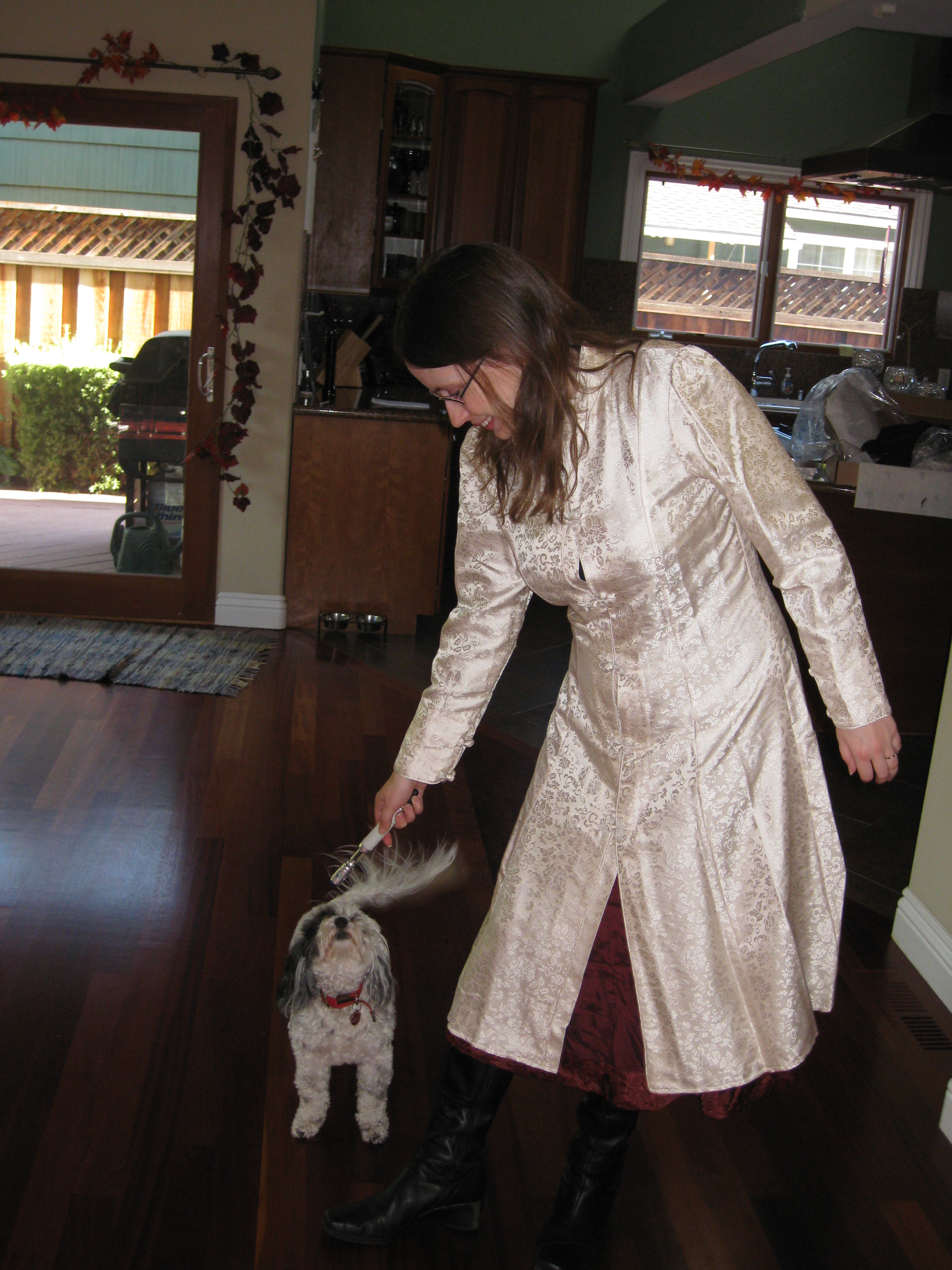
I forgot to mention that I too have a sidekick, therefore launching me into the exalted realms of science fiction, fantasy, and superhero characters.

Her name is Nala the Super Hound, and she follows me around the house.  She shows a particularly ferocious attitude toward the mailman, the Comcast repair guy, and any solicitors foolish enough to brave our door.  She also excels at protecting her pet cow.

I couldn’t ask for a better partner in crime .

Read Full Post »

I’m in the mood to open a can of worms today, so here we go.

I spent the morning at my local eye doctor/eye glasses shop, getting an exam and picking out new frames.  It was painless process this time around, which was a pleasant surprise.  Picking new glasses frames is the ultimate fashion choice since your glasses are the one thing you’ll always be wearing no matter what (well, except in the pool or in bed), so the choice can be a daunting one.  This time, I only deliberated for around twenty minutes, a personal best.  It didn’t seem like a big deal.

I remember a time when it was a huge deal because I was hugely self-conscious about my glasses.  This was partly teenage and young adult appearance angst, but the outside world gave me no help whatsoever.  I lost count of the number of times I was wearing contacts to perform in a show and some well-meaning but horribly insensitive person told me how much better I looked without glasses or passed along some inane comment about how it was too bad I usually hid my eyes.  Please note at the time I had no choice whatsoever about wearing the glasses: contacts irritated my eyes so badly I’d be popping them in and out of my bright red eyes all day long, and this was before Lasik was available.

It was worse in college when one of my best friends told me how much better I’d look without them to “desensitize” me from other people’s rude comments.  Or when another “friend” said I could never rate above average in appearance because the glasses took away so many beauty points.  Or later on, when I was a young twenty-something dating and men would, and I kid you not, reach over and *take off* my glasses, without even asking, before commenting on my beauty.  A few years ago, I even had a massage therapist, while performing what was supposed to be a relaxing massage, tell me that I should really consider ditching the glasses because I looked so good without them.  Um, backhanded compliment much?

I’m telling you this not to whinge about my past trauma but to make a point: that as a woman, I was constantly bombarded by messages, from individuals as well as from the media, telling me that I could not look beautiful if I wore glasses.  The very best I could hope for was a “sexy librarian” sort of look, which, after being subjected to years of being blasted by peoples’ negative opinions about glasses, honestly didn’t make this girl jump up and down for joy.

Since the idea of beauty is socially constructed, maybe these messages were, in their way, correct .  Maybe I can never be beautiful in the way that everyone wanted me to be.  (And here’s another question: why did so many people seem so invested in me looking a certain way, anyway?)  But I don’t buy this imposed estrangement between me and beauty.  Today, even though I have more choices (better, more comfortable contact lenses, possibility of corrective eye surgery), I wear my glasses without self-consciousness.  They are a part of who I am.  Personally, I think I’m just as beautiful with or without some stylish plastic on my face, in the same way that I’m just as intelligent either way.  And people making random negative comments on my appearance are not only incorrect, but also rude and therefore do not deserve my attention.

So the next time you find yourself about to comment on how a woman’s glasses affect her beauty, try to see past how you think she’s “supposed” to look and appreciate instead how she does look.  Maybe even notice how her eyeglasses enhance her natural features.  All of us bespectacled women will love you for it.

Read Full Post »

As a response to my post last week on planning, I was asked to speak more specifically about managing disappointment, and I promised to write this post.  Ever since, I have been simultaneously rubbing my hands together in glee and shaking in my culottes at the prospect of talking about a topic I find so important and difficult.  Disappointment is something that needs to be talked about more – and at the same time, it’s often an uncomfortable place to go in a conversation.  So I’m hoping to open up this blog to talking about it in a nonthreatening way.

First, I have to acknowledge the first advice I’ve heard from many people about disappointment: manage your expectations and create concrete goals that depend on yourself to complete and are therefore more in your control.  So for example, you set a goal to attend ten auditions this season instead of a goal to be cast in a leading part.  This is good advice; if you can shut down disappointment before it even happens, you’ll be a happier person.  But it’s also advice that ignores the deeper emotional heart of the issue, which is that sometimes we’ve planned perfectly well and we’re still plunged into the depths.  Sometimes things go horribly wrong for no reason; sometimes things go horribly wrong for a perfectly good reason.  Sometimes we mess up, make huge mistakes, get our hearts set on something we simply can’t have right now.  It happens, and sweeping these experiences under the rug invalidates the very real suffering they cause.

It’s not just a problem for those following artistic pursuits either.  Relationships go south.  Family behaves in unaccountable ways.  Vacations get canceled.  People move away, or are too busy to see us.  We get passed over during the promotion cycle.  The last episode of Battlestar Galactica was a travesty.  And on and on and on.  More often than not, we pretend to the outside world that none of this is going on.  But it is, trust me.  Disappointment is a fact of life.

So what are some ideas of ways we can deal?

  1. Have a support system, or at least a support person. I tell my husband about almost all of my disappointments.  He quite possibly gets sick of hearing about them, but it makes me feel a whole lot better to know there’s someone on my side no matter what who will urge me to keep going.
  2. Get the disappointment physically out of your body. Scream, cry, take up kickboxing, run around the block, jump up and down, hit your pillow.  In my experience, this becomes more important the bigger the disappointment you are suffering.  If I receive a short story rejection, I just sigh.  That one breath is enough for me to let it go.  If, on the other hand, someone is unkind to me, I might need to rant about it for awhile to get it out of my body.
  3. Allow yourself to feel the disappointment, and then give yourself a treat to acknowledge that you took a risk and made an attempt. This can be sugar, my personal favorite, or something you buy for yourself, but it can also be something simpler that doesn’t cost money or calories: Give yourself an entire evening to read a good book.  Take an outing to the ocean/park/mountains/your favorite scenic destination.  Take a hot bath.  Spend quality time with your pet.  Paint your toenails.  Play your favorite video game.  Play the piano.  Whatever floats your boat.
  4. Embrace your stubbornness. I’m not kidding, and I love this one, having been termed stubborn since I was a small child.  “They” say that the opera singers who succeed are not the ones that are most promising in terms of ability as much as the ones who will persevere through anything.  So embrace this personality trait, and keep it in check by being careful to set realistic goals.
  5. Allow time to pass. I hate this one, because there’s nothing you can do to make it happen except wait.  But the passage of time does have the amazing effect of putting your disappointments into perspective.  In the meantime, you can be proactively working on something else.  Sometimes, as in the case with writing, you can start work on the next story or novel.  Sometimes, as in an ended relationship, you can focus on some other aspect of your life that’s been neglected (ex. start spending more time with your friends, give more time to your hobby of painting/discgolf/fill in the blank, etc.)  Give yourself the reassuring feeling of forward momentum while letting the passage of time work its magic.
  6. Learn from your experience, and use it to help yourself grow. This one is the most important for me personally.  After I’ve suffered a disappointment, I ask myself: How can I do better next time?  What can I practice next that will help me improve?  What could I change in my behavior that might make this go better next time?  Are there warning signs I can look out for that I didn’t recognize this time?  What are my priorities here?  Is there a system I can institute that would solve this kind of problem in the future? (This last one was particularly useful for running a business, let me tell you.)

The reason I think these questions and this period of self-reflection is so important is that it allows me to transform my disappointment into a learning experience I can regard positively.  Sometimes this works even if I didn’t learn a whole lot, just by going through the cause and effect chain.  So when I look back on it, instead of thinking only of how horrible it was, I also think, “But if it weren’t for this happening, I wouldn’t have been able to do _______.”  If I hadn’t written the musical which never got produced, I would never have had the courage to write my first novel.  If I hadn’t worked at a lot of office jobs I didn’t like, I wouldn’t have considered opening my own business.  If I hadn’t learned all those interpersonal relationship skills, I wouldn’t have as happy a marriage now.  If I didn’t get all my stories rejected so often, I wouldn’t be as good a writer.  When something bad happens, which is a marker for disappointment, I try to use its momentum to push myself forward instead of allowing it to hold me back.

All right, I’m going to open the floor.  I’m really interested to hear about disappointments you’ve had and how you’ve overcome them.  Or alternately, you can talk about disappointments you are currently facing and things you might try to deal with them.  Be kind, be courteous, and be real.  And thanks for joining me in talking about such a difficult topic.

Read Full Post »

I’m a big fan of personality tests.  My favorite is the Myers-Briggs Type Indicator.  You know the one that gives you a result with four letters?  Yeah, that one.

Inevitably, when I take one of the Myers-Briggs online tests, I come out about fifty/fifty on the introvert/extrovert scale.  Sometimes I tip slightly over to E (51-52%) and other times I flip over to the same percentage for I.  So which am I?  The one I started out with as a child (definitely I) or the one I worked so hard to change into as a young adult (E)?  Which am I?  So I turn, as usual, to the internet for answers.

First, let’s define our terms.  Strong qualities of an extrovert include: action oriented, importance placed on breadth of knowledge and influence, enjoys frequent interaction with people, recharges from spending time with people, “fades” when alone, thinks as they speak and prefers thinking out ideas through speech instead of in own head, enjoys large social gatherings.  Strong qualities of an introvert include: thought oriented, importance placed on depth of knowledge and influence, enjoys substantial interaction with people, recharges from spending time alone, often prefers solitary activities (not necessarily because of shyness or social awkwardness), more likely to think before speaking, may be more reserved and/or less outspoken.

Wonderful Wikipedia informs me there is a third option: ambiversion, which includes those people who fall in the middle of the extroversion-introversion spectrum.  Ambiverts enjoy social interaction and groups but also value their alone time.  Interestingly, Britannica informs me that most people are ambiverts.  This is where, I suppose, I fall in.  In a lot of ways I fit the introvert mold well, but sometimes I do enjoy groups of people and hashing out ideas with others.  And the easiest way for me to recharge is neither in big groups (this doesn’t work for me at all) or alone time (this works better, but too much unfocused alone time and I will start wallowing).  My favorite way to recharge is with conversation time either one-on-one or in small groups, discussing ideas, thoughts and feelings in a more intimate environment.

Is this typical for ambiverts?  Here the internet fails me; most of the articles on the subject unearthed by a quick Google search don’t seem overly substantial.

And why do I even care?  The internet does help me here, making these possibly wild claims:

“Extroverts make up about 75% of the American population.”

“The American stereotype of success is often associated with the expressive, gregarious, high-energy extrovert, an ideal personality that leaves the introvert with an overwhelming identity crisis.”

“Western culture seems to favor extroverts. Indeed, extroverts seem to always be having a great time! One study found a positive correlation between extroverts and happiness (extroverts appear to be happier than introverts).”

Hmm, no wonder I care!  However, while the majority of Americans may be extroverts (I have no idea of the validity of this statement), I don’t buy this idea of extroverts as the ideal of personality.  Both types have their pros as well as their cons — while the extroverts might have more obvious ones, I would personally rather be in a conversation with someone who thinks before they speak.  And there are loads of famous, successful people on both sides of the spectrum, although interestingly, it is much easier to find lists featuring the introverted ones (yet more evidence of the value judgments being placed on this dichotomy in our culture).

Maybe our society would be a healthier place if we obsessed less about the introvert-extrovert question and spent more time trying to understand each other as individuals and being basically kind to one another.  The Myers-Briggs test is meant, after all, as a tool of self understanding, not another way to bash at your self esteem or feel superior to others.

Now it’s your turn to weigh in: are you an extrovert, introvert, or ambivert?    If you’re an ambivert, how do you recharge?  How important do you find these distinctions?

Read Full Post »

The Value of a Plan

Let’s talk a bit about the practical part of my blog title, shall we?  Being a free spirit is great fun, but a rush of inspiration isn’t often enough to carry an idea to fruition.  At some point, you’ll have to come back down to earth and make a plan.  I love plans, I live on plans, I feel worried if there is no plan.  And yes, if you couldn’t guess, I’m also a maker of lists.  But for those of you who may not be so enamored by the idea of planning, let me tell you some reasons why they’re so wonderful.

1. A plan will give you a way to hold yourself accountable.

Because let’s face it, everyone wants to be lazy sometimes, and if I have a choice between curling up on the couch and watching a cheesy movie and working hard, well, I might occasionally be somewhat tempted to do the former.  Particularly if I’m tired.  Or I don’t feel well.  Or something happened to upset me.  However, if I have a plan to which I’ve committed (either  to myself or to others if I need an extra kick in the pants), I’m a lot more likely to postpone the movie until later and actually get stuff done.

2.  A plan allows you to break your goal down into small, obtainable goals as well as larger-reaching ultimate goals.

If you haven’t run in ten years, having the goal “I want to run ten miles a day” might be completely overwhelming.  But if your goal is to start by running ten minutes, three times a week, it doesn’t seem quite so impossible.  For many large goals, all of your incremental goals will add up to the final product.  Writing a novel is a great example: if I’m writing a 70k young adult novel, and I have a daily word goal of 1000, five days a week, at the end of fourteen weeks, I’ll have a completed rough draft.  Goal met, and I never even had to build up to something.

3. A plan will help keep your motivation high.

Every time you reach one of those smaller goals, it’s like giving yourself a treat.  After awhile, you crave those regular treats; you even expect them to happen.  Having had the positive reinforcement in the past, it becomes easier to buckle down to receive that reward again.

On the other hand, let’s say you have no plan.  You have this exciting idea and work on it for a short time fueled by your enthusiasm.  Then your excitement peters out and the idea sits in the corner, collecting dust.  And make no mistake: you won’t always be excited about your idea, oh no.  At some points you’ll think it’s painfully boring, at others you’ll think it sucks, at others you’ll hate it with all the fiery passion in your being.  With a plan, you might be able to force yourself through the hard times.  Without a plan?  The path of less resistant will look oh so tempting.

Also, there’s been a fair amount of talk in the newspapers in the past year about how willpower is a limited resource.  While it might be possible to increase your own willpower, having a plan will help you prioritize the most important use for the willpower you’ve got for any particular day or week.

4. A plan will help you decide if you’re really serious about your goal.

I am not a crafty person, but I have a lot of crafty friends, many of whom know how to knit.  For awhile, I found myself often saying, “Oh, I wish I knew how to knit, but you know, I couldn’t possibly, I have these wrist issues, I’m not a crafty person” and whatever other excuses I felt like creating.  And of course, these excuses would be followed by protestations that of course I could learn, my friends could teach me, and you can guess the rest.
Finally, I sat down and thought about what it would really take to learn to knit, and realized I had no actual interest in it whatsoever.  I was interested in the results, sure: I’m a scarf fanatic and always want more scarves in different colors, and I want the opportunity to bond with my friends.  But I wasn’t at all interested in the actual process of knitting.  So now I don’t say “I wish I could knit” anymore, which both saves myself the defeatism of thinking of all the reasons I couldn’t possibly, and my friends the irritation of me making knitting about me (when I don’t even do it!) instead of relaxing and appreciating their fine talents.

5.  A plan will help you respect and value yourself and your work, regardless of outcome.

There are some things in life we just can’t control, no matter how kick ass our plans might be.  However, even if you’re not where you want to be right now, having a plan means you can at least be actively working towards your ideal life.  In my experience, having concrete tasks that will help me move towards something I want is a lot more happy-making than sitting alone in a dark room wallowing, “I don’t have what I want.  Why don’t I have what I want?”  Yeah, not very fun.  And even if I don’t reach a certain outcome for a plan, I’ve still shown I was capable of following through and working on a project (whether that be a novel, a weight loss plan, organizing a vacation to Europe, throwing a themed mystery party, or what have you) to its finish.    Completion of a plan gives a lot of personal satisfaction, and it helps build awareness of your capability and personal awesomeness.

Read Full Post »
« Newer Posts