Feeds:
Posts
Comments

Archive for the ‘Life’ Category

I don’t like knowing my limits. In fact, I prefer the opposite: I like believing that I have very few limits, and making this belief as true as possible through sheer force of will. And when I discover that I have limits that won’t budge through will power alone, I try to create a work-around or at the very least find a more positive way to frame it for myself. 

I’m thinking about this right now because it turns out I’ve been fighting off a bacterial infection in my tooth for the past two and a half months. Fighting and losing, I might add. In spite of this, January was one of my more productive months in recent memory. In addition to writing ten essays for this website, I completed almost a third of my new novel-in-progress and wrote two new short stories. At the same time, I was thinking, “This is great, I’m so excited by what I’m doing, but why can’t I do more? Why am I so tired?” Only now do I have the understanding as to why these accomplishments exhausted me quite as much as they did.

So now it’s time for me to focus on taking care of myself, which is requiring a little bit of juggling over in Priority Central. The problem is, I believe that taking care of myself is a high priority, but sometimes it gets lost in the shuffle of other, flashier, more exciting priorities. When confronted with the choice between starting a new project and sitting around resting, I’d rather start the project. Plus I have this built-in Protestant work ethic that starts screaming at the slightest sign of the dread vice Sloth. And we won’t go into a certain pervasive stubborn streak in my nature.

Which is why I’m only stopped in my tracks now, when my tooth aches to the point where I might not mind ripping it out with my own fingers. I can’t keep working at my normal pace because I am physically incapacitated enough that I cannot concentrate. Here it is: I’ve reached my limit.

This week I’m forcing myself to take it easy. I don’t have specific word count goals or project goals. I’m trying to suppress my frustration at being delayed on all of this work that I’m so excited about doing. After all, I’m pretty lucky to be so enthusiastic about my work in the first place, and the excitement will keep. (Hear that, excitement? You are so going to stick around.) I’m going to watch some cheesy movies and TV shows, and I’m going to sleep as much as possible around my schedule of medicines. And I’m going in for more dental work, which is why I’m going to need all this recovery time in the first place.

This is life. I want it to be smooth, but it’s not. It’s bumpy, and it gets in the way of itself all the time. I don’t even get to bank up this being-good-to-myself time because I might need more of it later, depending on what this tooth has to say for itself. I want to stay up late every night and drink every minute in and live my dreams right this second, all the time. I want to be larger than life, but I’m not, at least not as often as I’d like. Sometimes I can’t do much of anything but sit here and wait to feel better and let numerous more knowledgeable people poke at my tooth. That is a limit, yes indeed.

But better to pack as much as possible within those pesky limits than miss out on being alive at all.

Anyone else run into an inconvenient limit lately? Feel free to commiserate below.

Read Full Post »

A few weeks ago I read an essay by one of my favorite bloggers, Penelope Trunk, about how to think outside the box. The entire essay is well worth the read, and I might discuss other aspects of it some other time (yes, that’s how good it is). But for now I’m going to focus on just one brilliant paragraph:“We are all creative. The only thing we really have in this world is the ability to craft a life. One day your life will be over, and we are largely unsure what happens next, but during the time we’re alive, we get to choose what we do. We create a life.”

Crafting our lives is the ultimate form of expressing ourselves, and we all do it, every single one of us. The decisions we make on a daily basis form the shape of our story, both in our own heads and in the outside world. That’s one reason why I’m so big on priorities: your priorities can quite literally determine the direction your life follows. Our priorities are the guiding vision for the complex artistic creation of who we are.  (more…)

Read Full Post »

I have saved Passion for last not only because it is the most recent addition to my list of favorites, but also because it is a difficult musical to explain. It is a difficult musical, period. It challenges its audience to the extent that for some, it is an alienating experience. I know this firsthand because the first time I saw Passion was on DVD many years ago, and my husband hated it. It really pushed his buttons, he hated the characters, he didn’t care one way or another about the music. In fact, it’s the only musical I introduced to him to which I remember him having such a violently negative reaction. 

We went together to see a production of Passion during our recent trip to London – yes, my husband loves me – and it was seeing it live that made me realize what a masterwork it is. My husband didn’t hate it this time around either, although we did have a lively discussion afterwards. The thing with Passion is, it grows on you over time, over multiple listenings/viewings, and through your own life experiences. That first time I saw it, I don’t think I had the necessary insights to understand it in the same way that I understood it this past November. And if I see it again in five or ten years, I fully expect it to be a different experience yet again.

Stephen Sondheim is an amazing composer and an equally dazzling lyricist (in fact, he got his professional start as a lyricist), and those skills are clearly in display in this, one of his latest shows. The score is romantic and lush, the melodies much more memorable than in many of his shows, and the inclusion of martial drum rolls ties nicely into both the show’s themes and even some of its lyrics (“They Hear Drums”). The show features a chorus of male soldiers who comment on the action (and spread gossip), and some of the music overlaps on itself (two people singing at once, for example, but not in a traditional duet) in a way that is almost dream-like … or perhaps crazy (the craziness of romantic love or the craziness of solitude, loneliness, and disappointment, depending, and sometimes a bit of both).

The story centers around a love triangle of sorts. At the apex of the triangle is the Italian soldier Georgio, who is having a passionate love affair with the married Clara. When he is transferred to a provincial outpost (and one at which he is very miserable), they swear to continue their love affair through letters. At his new post, he meets his commanding officer’s sickly cousin Fosca, who is ill, obsessive, depressed, and manipulative. Do you see where the difficulty of this show starts to come in? Especially when I tell you that by the end, Georgio has fallen in love with Fosca and thinks his love affair with Clara meant nothing.

Here is where I see the brilliance in this show. However much we’d like to believe otherwise with our happily-ever-afters and our formula romances, love is messy. It’s unreasonable, it doesn’t play by predictable rules, and it comes at unexpected times and in unexpected forms. And love is shown in high relief as being messy in this show. Through the course of events, Fosca gradually learns how to love unconditionally instead of being trapped in the grasping, needy obsession that she begins with. Georgio as well learns what it means to love unselfishly and to love above all else. He asks Clara to run away with him, and she refuses; while she insists he holds her heart, she is held back by her motherly love for her child. She asks him to wait until her child is older, but ultimately he decides he no longer wants such a carefully arranged, rational relationship. What he wants instead is the no-hold’s-barred passion, both the beauty and the ugliness, that Fosca offers him.  So while this show is something of a tragedy, it’s a happy tragedy because the characters have gotten somewhere and they have learned a deep abiding truth, which perhaps matters more than continuing on indefinitely in their old, miserable ways.

The difficulty is that Fosca is so truly unpleasant and unsympathetic, particularly at the beginning of the show. It subverts our narrative expectations to have Georgio choose her over the beautiful and romantically appropriate Clara. Watching Fosca play her manipulative little games with Georgio fills us with aversion. Personally I believe this makes the ultimate transformation of the characters that much more powerful. And it takes me back to the main point of this essay, which is this: love is messy. And yet even out of a dysfunctional and terrible love can come something beautiful. Relentlessness can show itself as either obsession or an unconditional love that is without price.

The first meeting of Fosca and Georgio:


An example of the manipulation games of Fosca:


A short example of the Soldier’s Chorus:


The end of Georgio and Clara’s relationship:


Georgio revealing he loves Fosca:


And with this post, I finish my series on my favorite musicals. Hope you enjoyed!

Read Full Post »

I have recently been struck by the preponderance of family dysfunction in Western fairy tales and myths. It seems that everywhere I turn, I find another evil mother or unkind sibling. Here are only a sampling of stories involving family strife and betrayal:
  • In Cinderella, she has an unkind stepmother (who I read was the biological mother in some older versions), an absent father, and cruel step/half/full sisters who compete with her for one man.
  • In Thousand Furs/Donkeyskin, the father either tries to or succeeds at raping his daughter the princess.
  • In The White Cat, we have three brothers competing for their father’s throne.
  • In Blockhead Hans, we have older brothers being cruel to their youngest “simple” brother.
  • In Toads and Diamonds, we have an evil “step”mother and sister conspiring against our heroine.
  • In Snow White, we have the evil, jealous stepmother who wants her stepdaughter to be killed. And what about the father? He’s apparently alive and just completely neglectful of his daughter.
  • In Hansel and Gretel, we have the evil wife who wants to get rid of an excess of children.
  • In Beauty and the Beast, we have a father willing to sacrifice his daughter for himself.
  • In the legends of King Arthur, we have the seduction of King Arthur by his half-sister Morgan, and his troubled relationship with his son Mordred.
  • King Lear has its root in British mythology, and shows the unhappy relationship between a king and his three daughters (and jockeying between the three daughters for position, including use of armed force).
  • In Rumpelstiltskin, we have a father willing to sacrifice his daughter to save himself because he lied, and the daughter in her turn carrying on the family tradition by being willing to sacrifice her future child for her own safety.
  • In Rapunzel (or now Disney’s version Tangled), we have the overprotective and narcissistic “mother”, exemplified by the wicked witch who pretends to be a blood relation.
  • Don’t even get me started on those crazy Greek gods and goddesses!

I find this particularly fascinating because I’m used to thinking of family dysfunction as a modern phenomenon that only began to be spoken of in the last few decades, but of course there have been dysfunctional families since the dawn of time. Not only that, but it seems to have been a subject of much interest and anxiety in times past to be featured so prominently in the surviving stories.

This consciousness in fairy tales runs counter to the zeitgeist of the 1950s, which seems to be personified by the TV series title “Father Knows Best” and idealizes maintaining an image as the “perfect family”. No, in fairy tales, the downtrodden member of the family is usually the protagonist of the story, and these heroes and heroines are often shown having adventures and using adversity to help them transform so that they are able to escape their tormenting relations. In other words, they often win. The evil family members in question often meet horrible and gruesome fates, like the step sisters in Cinderella who have their eyes pecked out when attending Cinderella’s wedding, or Snow White’s evil stepmother who is forced to wear iron shoes and dance until she drops dead. Other times our protagonists merely leave their family members far behind as they begin their new lives.

Are these tales truly discussing dysfunctional families or are they merely providing enough hardship and conflict (often in the form of evil family members) to force the protagonists into growing up and coming into their own? Whatever the answer, it’s hard for me to read them now without noticing the implicit moral of distrust of family and reliance on self — maybe with a little help from a magical item or a fairy godmother along the way.

Read Full Post »

When I was a teenager, I enjoyed dreaming big. I wanted to be a novelist, I wanted to work on animated features at Disney, I wanted to write games at Sierra (this was back when they were still doing cool stuff like Quest for Glory, Castle of Dr. Brain, and the King’s Quest series). I wanted to be a singer and actress and perform in musicals, I wanted to write musicals, I wanted to direct musicals. I knew that many of these aspirations were unrealistic and difficult, but I wanted them all anyway.

However, a family member who shall remain nameless said something to me one day, perhaps just an offhand remark, that became fully lodged in my young impressionable brain. “Amy,” the person said, “you have delusions of grandeur.” They might as well have said, “Why try, because the only possible outcome is failure.” Even today, half my lifetime later, whenever I think of trying something daring or risky or simply ambitious, those words go through my mind. “I don’t know if I can do this,” I say to my husband, “because so-and-so said.” And then he has to go through the work of convincing me to do whatever it is anyway.

Photo by Tony Fischer


I was reminded of this when I read Christie Yant’s recent essay, Lessons from the Slushpile: Good vs. Great. She discusses what distinguishes the great stories (and incidentally, the ones that are bought) from the rest, and one of the distinctions she’s made is that truly great stories have something to say. They say something that matters, that makes us as readers think or question or feel. They are ambitious, meant to illuminate as well as entertain.In my limited experience, these kinds of ambitious stories are rare, but it was by finding them that I first learned to appreciate, and later to love, short stories as a form.So why are these stories thin on the ground? Perhaps for one or more of these reasons (and there might well be others):

1. It’s difficult to come up with something to say in the first place.
2. Even if you’ve got something to say, it’s difficult to express it in a clear and original fashion.
3. Writing such a story means that on some level, you’ve got to have delusions of grandeur.

I think I had it right as a teenager. Delusions of grandeur are what allow us to strive, to push ourselves beyond our perceived capabilities, to dive into projects of vast scope. They give us permission to take risks, do things that make us uncomfortable, and ignore those who don’t believe we can do it. Delusions of grandeur are what allow us to become great.

So right now, I’m going to finish up this essay, and then I’m going to sit down and work on a short story that scares the pants off me. It makes me uncomfortable, it kind of makes me want to cry, I’m not quite sure I know where it’s going, and even if I did, I’m pretty sure I don’t want to follow it there. All I can do is believe in its potential, as I believe in my own.

Delusions of grandeur are the necessary caterpillars if we want our words to fly.

Read Full Post »

A few days ago, I read the excellent article “Writing and Mortality” by Rachel Swirsky, and I’ve been thinking about it ever since.  I recommend reading it and coming back here, but since I don’t always do that myself, I’ll summarize. She talks about some advice she read about writing, how if the project you’re working on is not the project you’d be working on if you only had six weeks to live, then it’s the wrong project. Rachel calls foul on this advice, saying that if she had only six weeks, she’d be busy spending time with her loved ones. “Artists,” she says, “aren’t only real artists if they would spend their last few days creating art.” 

I agree with Rachel one hundred percent. Creating art is a high priority for me; in fact, I’ve structured my life around increasing my time to do so. But it’s not my highest priority, and that’s okay. This truth was brought home to me recently when I was suffering from root canal complications.  Mostly I was thinking, “My god, the pain, the pain, please make it stop, I’ll do whatever it takes to stop the pain.”  But when I could focus beyond the immediate suffering, what did I care about the most?  I wanted to spend time with my husband and my little dog, and I wanted to write long e-mails to my best friend.  I’m an ambitious person, but when it came down to it, I wasn’t thinking about my writing anymore.  What mattered to me was the people I love.

Taking a step back, this entire discussion was sparked from a piece of writing advice. I read a lot of writing advice every week.  I even occasionally write some writing advice.  It’s amazing how much helpful information about writing I can learn from the internet (although at this point, a lot of the advice I read is a reminder more than a revelation).

But this advice is not infallible, and it cannot be followed blindly.  Each piece of advice requires consideration, and if you find it doesn’t work well for you, that doesn’t mean you’re wrong or a bad writer or anything else.  It means that advice is not for you, full stop.

People try to give me advice all the time (and not just about writing, either).  Here are some examples of advice I do not take:

1. You should write every day. Yeah, I don’t write every day.  I usually take weekends off, and then I come back to the computer on Monday full of fresh ideas and vigor.  That’s what works for me, for now.
2. You should write what you know. Sorry, I don’t actually live in a world with working magic or a world set in the future, but I still write about them.  (Yes, this advice has deeper connotations that are more helpful, but its phrasing can be misleading.)
3. You should write x words every day. Unfortunately, only I know how many words I can write per day, and this number changes over time and depending on circumstances (like, for instance, a root canal or quitting the day job).
4. You should only submit to pro paying markets. I actually kind of follow this one, but the more I think about it, the more I think it’s silly.  Really I should submit to any markets I feel like submitting to, right?  If I’d be happy seeing my work at a certain publication, then I’ll submit.  If I won’t feel happy or I think the publication is shady in some way, then I won’t submit.  So this advice isn’t for me.
5. You should/shouldn’t outline. Um, really good writers go both ways on this one.  So I’ll do whatever I like, and experiment with both.  (For those wondering, yes, I outline for novels.  For short stories, it really depends.)

I could go on, but you get the idea.  Advice is in the eye of the beholder.  People give advice about what works for them as individuals.  But we are not cookie cutter people, and therefore some of this advice will not work for you.  The trick is to learn what you can, and then adapt that learning to fit your own lifestyle, your own priorities, your own artistic strengths and weaknesses, and your own voice.

I would love it if you would comment with some advice you have read or received (writing advice or otherwise) that doesn’t work for you.  It can even be something that I have said here on the blog (gasp). I can’t wait to see what you all come up with!

Read Full Post »

A Year of Meaning

When I started this blog six months ago, I made a private deal with myself.  “Self,” I said, “it might be very difficult to get a blog started.  Maybe no one will read it for a long time, plus I might run out of things to write about.  Plus I won’t want to write essays when I’m having a bad day.  I’d better make a commitment so that I don’t wimp out on myself.”  I decided not to give up for at least six months.  Any less than that didn’t seem like a real attempt.

Writers are often encouraged to start blogs.  Publicity (blah blah blah) promotion (murph) building a fan base/tribe (blah blah) building discipline (blah de blah) marketing (gack).  Okay, I actually think all those things can be pretty interesting at times, but the truth is that none of them provided the motivation for starting this blog.  They’re just a whole lot of cherries on top.

What I realized back in the spring, when I was first conceptualizing this blog and what I wanted it to be, was that for me, being a writer meant having something to say.  I say “for me” because I’m not sure if this is true for all writers (feel free to chime in and tell me!)   And I realized that with internet technology at the stage it’s in, not being published yet was no excuse for me to be silent.  If I was a real writer, I thought, I’d say what I felt was important to say, publishing contract or no.

Photo by Robin Ducker

Working on this blog has been a transformative experience for me.  It reminds me twice a week that, yes, I want to be the kind of person who has something to say.  It makes me stretch myself in directions I wouldn’t expect because some days I sit down to write and I have to force myself to say something, anything, and I don’t even have an inkling of where to start. And some days I get a comment from one of my readers that makes me realize what I said made a difference to someone, and I feel full to bursting.

Ultimately this blog has turned me into a writer by my definition of the word, and that’s what matters most to me.

So I will be continuing this little experiment for another six-month period.  In conversation, a few people have called this a writer’s blog, and my immediate reaction has been, “What?  No, it’s not a writer’s blog.  I don’t talk a lot about craft (only a little, I swear!) or promote my projects or give you word counts.”  But of course, I’m completely wrong.  This is a writer’s blog by definition because I am a writer, and that fact shapes the conversation here.

I’ve also spent some time worrying about writing on theme.  If you’ve ever read any blogs about blogging, you will have noticed that they always suggest finding a theme and writing to that.  For instance, I could write about creativity and the processes that surround that.  Or I could write about parenting, or I could write about training show dogs.  Or whatever.  Writing on theme gives your audience some idea what to expect from you; it also narrows down your writing options to more manageable proportions and gives you a frame for whatever you decide to talk about.

But since I’m embracing the fact that this is a writer’s blog, I can also play fast and loose with my theme.  So what is this blog about?  It’s about the things that are so important that I want to write about them.  It’s about creativity and art, sure, and it’s about how to live a dream, and it’s about optimism and how to be happier, and it’s about trying to pull together patterns to make the world coalesce in a different way.  Because this is what writers do.  We take a character’s life, full of random chance and mundane moments, and we polish it until it says something.  We create meaning.

So that is what I’m wishing: for 2011 to be, for me and for you, a year in which we can create meaning together.

Read Full Post »

Thank You

As this year draws to a close, I’d like to thank you, my wonderful readers, for allowing my words to live on in your minds.

I’d also like to thank all the wonderful new friends I have made this year: in particular, the friends that I’ve met through SCBWI (District 14, Asilomar, LA), through Taos Toolbox, and at World Fantasy.  You have made a huge positive difference in my life, and for that I am very grateful indeed.

May we meet again in 2011 and beyond.

Read Full Post »

Blog Retrospective 2010

It’s time for the end-of-the-year blog retrospective, which in this case covers the last six months.  I’m going to pull out a few posts that I think particularly deserve attention.

Most Popular Posts:

Introvert vs. Extrovert: A False Dichotomy?

My third ever post is still ranked #1, which (perhaps?) goes to show how fascinated people are with all things relating to personality.

It’s All About Priorities

Stop making excuses and follow your dreams.

Dealing with Disappointment

Inspired by a friend’s question, we talked about all things related to disappointment and what we do to cope.

A Few of My Personal Favorites:

How to Try to be Happy

I was just telling a friend about the “Five Things” technique yesterday.  And I still do it myself pretty much every night before I go to sleep.

Pre-professionals: the Difference between Musicians and Writers

I’ve been seeing a fair number of articles lately on how indie musicians and writers have a lot of issues in common, but this essay focuses on what I perceived as the differences.

Your Dreams are not Mine

We don’t all have to want the same things.

Six Impossible Things Before Breakfast, or How to Have an Exciting Life

This is the essay I started the blog to write.  No kidding.

Gratitude Upon Marrying a Fellow Geek

Yeah, I’m a little bit smoopy, what can I say?

I have some exciting ideas for the blog in the works for next year, which I’m looking forward to sharing with you all!  And as always, if there’s anything you’d like to hear me talk about, I’d love to know.

Read Full Post »

Christmas Memories

For me, Christmas inspires many memories.  It reminds me of my childhood, it reminds me of the changes through the years, and it reminds me of my mom, who was a big Christmas fan.  I was the one who was given all the old family decorations because of the simple fact that I’m the only one who really cares about Christmas anymore.  I’ve  been lugging several boxes worth of Christmas memories from apartment to apartment since I moved back from the UK.

My favorite objects of memory are the tree ornaments.  I can remember which ones were gifts, which ones I bought myself over the years and where, which ones are relics of childhood.  I’m going to share a few with you right now.

This is probably the oldest ornament I have.  It was my mom’s when she was a little girl and was likely obtained sometime in the earlier 1950’s.

These two were my favorite ornaments in childhood.  The Rudolph was made by my mom from felt and sequins and other stuff, I think from a kit.  The swing hangs from a long thread and was always the most carefully placed ornament on the tree because it needed an especially big gap.

This was one of the first gifts I bought for my mom with my own money and my own choice.  I was so excited and proud to be giving her something I thought was so beautiful.


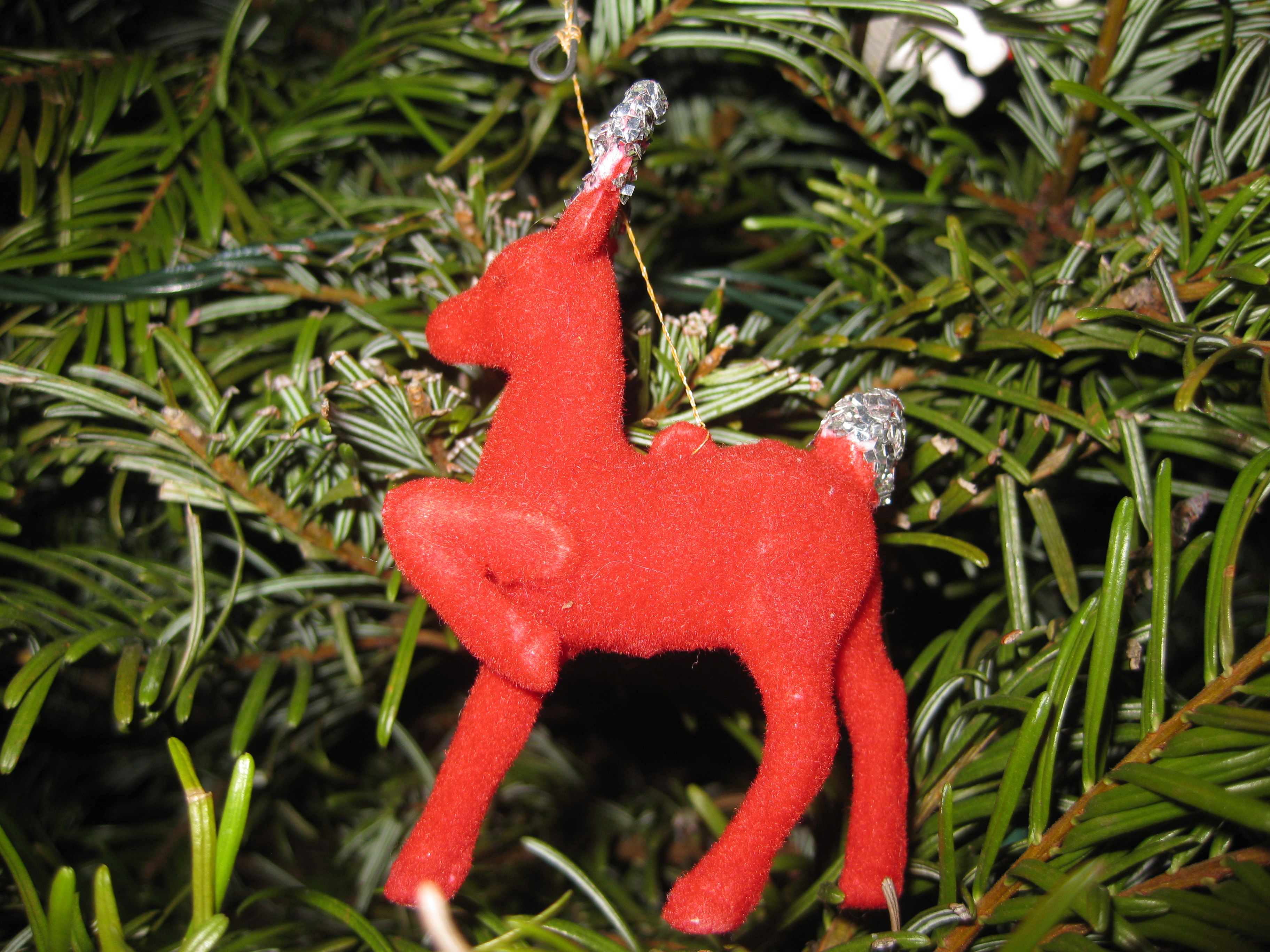
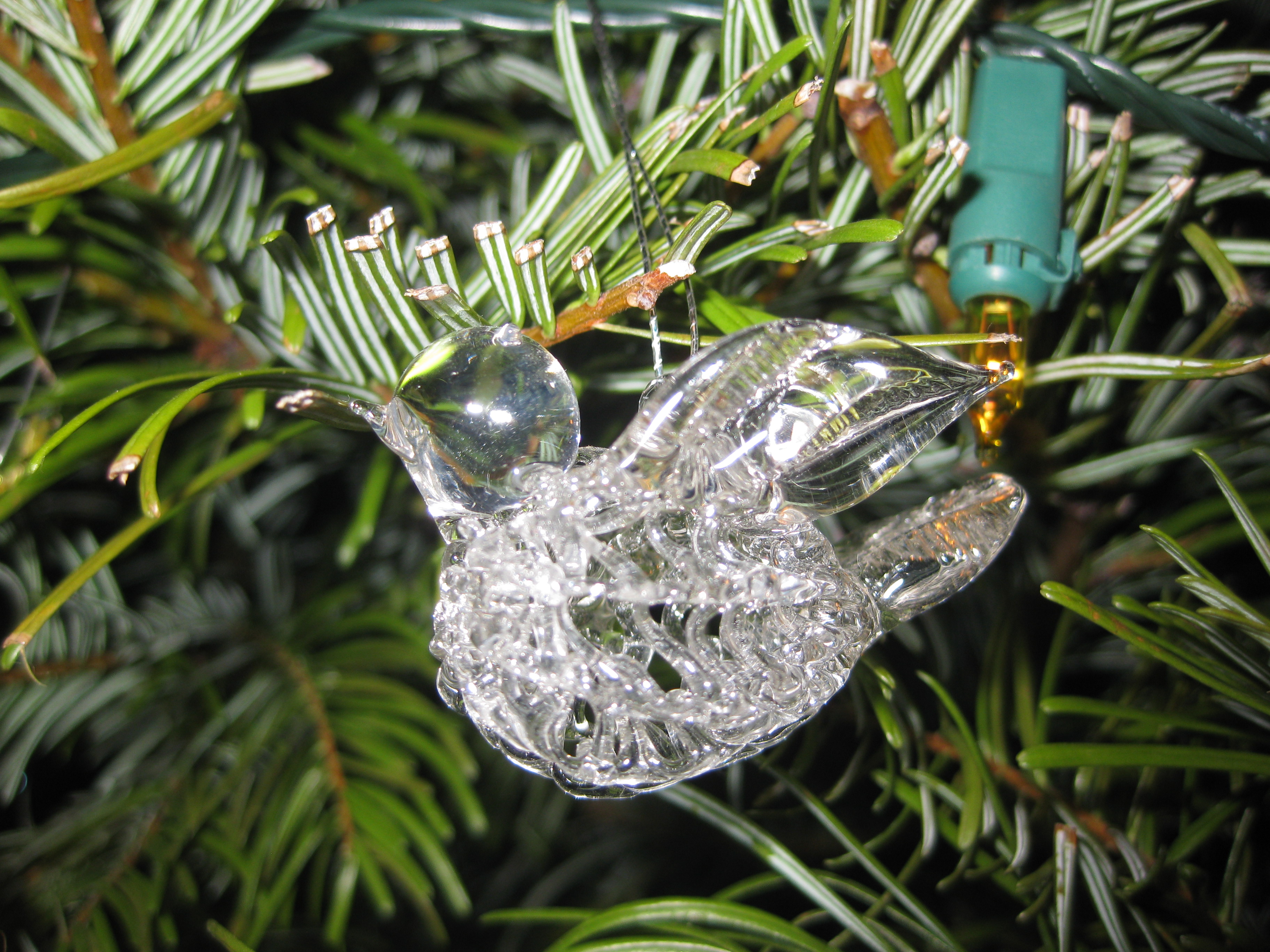
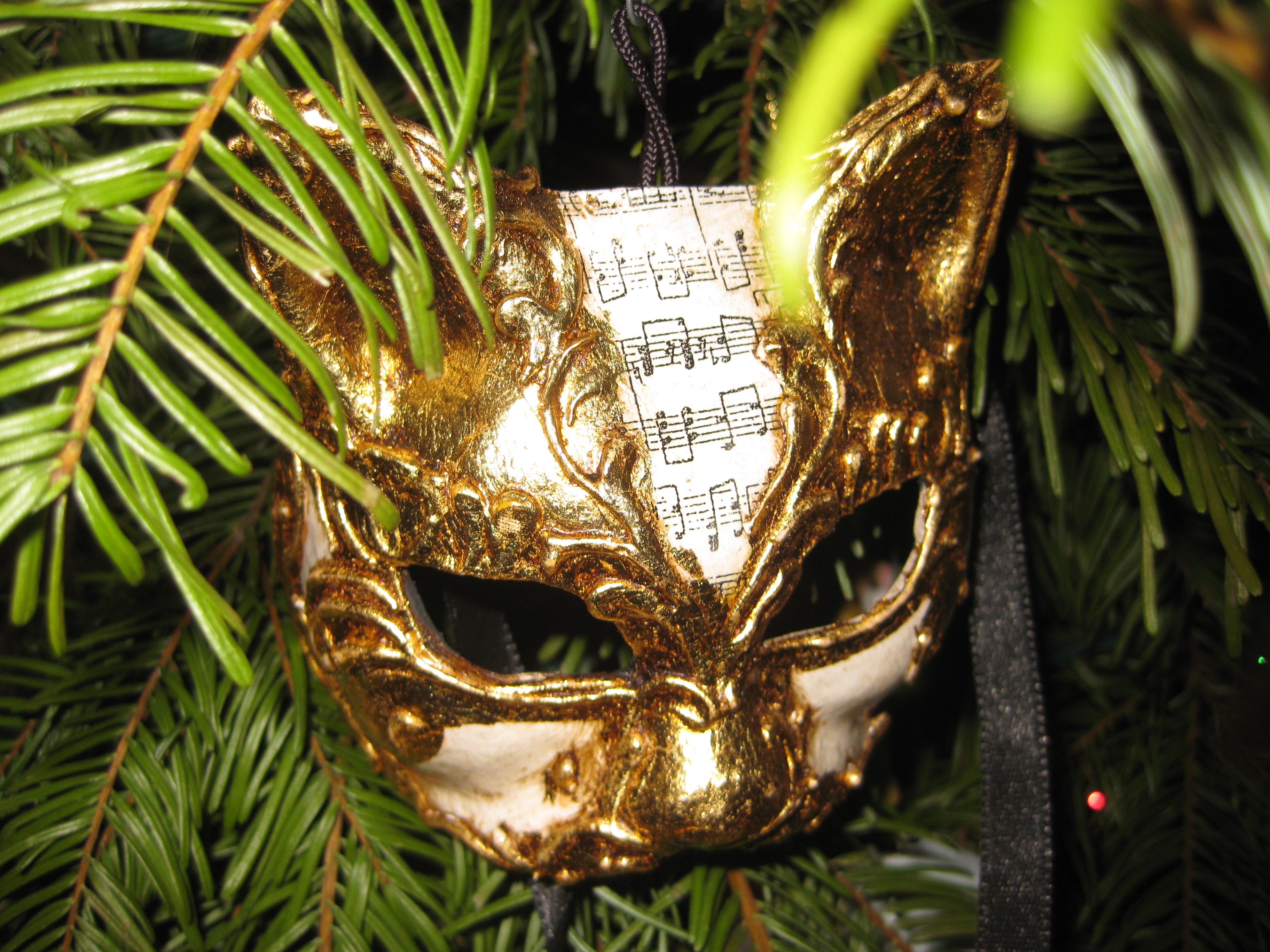
Here are three ornaments that we got this year.  You can see my affinity for cats (in spite of an unfortunate allergy) and dogs.  And the cat mask with the music notes is a particularly fabulous combination.

Do any of you have holiday decorations that help you hold onto memories you care about?

Read Full Post »

« Newer Posts - Older Posts »