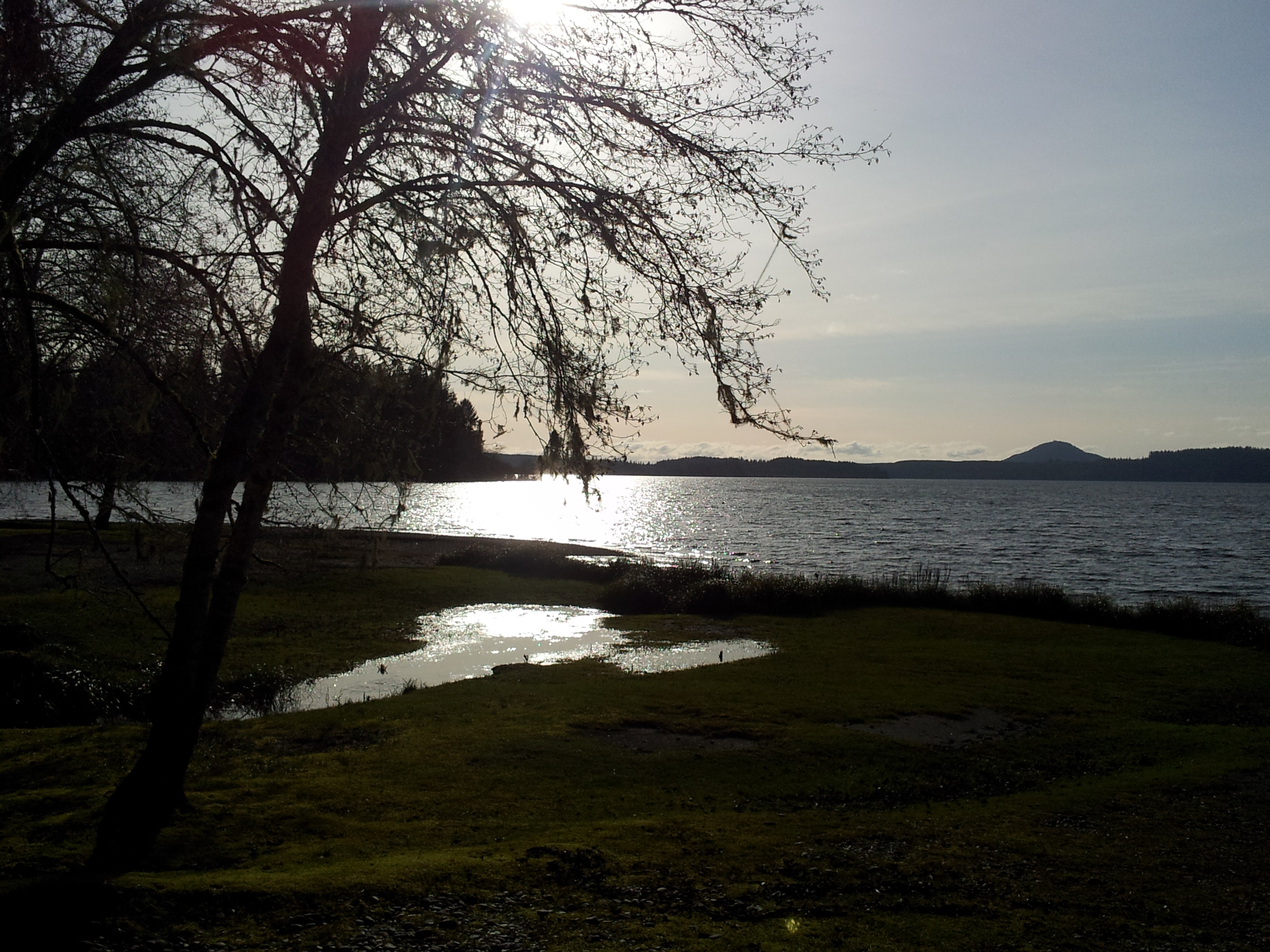
This is where I am today:
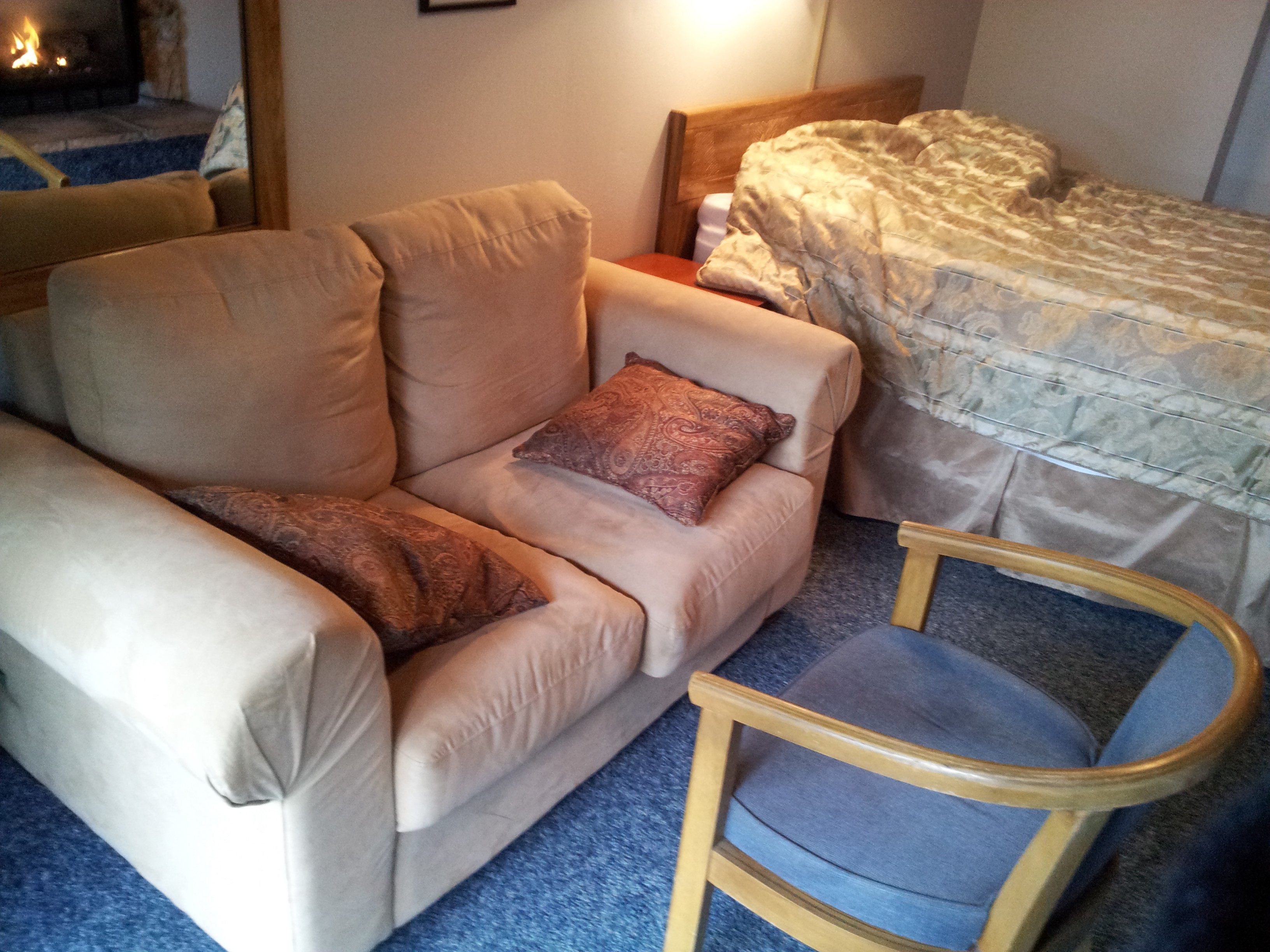
And this is the cabin I’m staying in:
Looks pretty cozy, doesn’t it? I am taking a break from the house-hunting/moving grind to write and spend time with a wonderful group of writers up in Washington.
See you next week!
Posted in Uncategorized on February 27, 2014| 1 Comment »
This is where I am today:
And this is the cabin I’m staying in:
Looks pretty cozy, doesn’t it? I am taking a break from the house-hunting/moving grind to write and spend time with a wonderful group of writers up in Washington.
See you next week!
Posted in Life, tagged Amy Sundberg, decisions, faith, knowledge, priorities on February 25, 2014| Leave a Comment »
“You can’t ever know in advance. Big decisions require faith.”
– from S., by J.J. Abrams and Doug Dorst
Today I decided where I’m going to live for the next year.
I’ve had to move many times in my life, and as I look for a place, what I’m always waiting for is a certain feeling. It’s a sense of rightness, a sense of “Yes, this is my home.”
There’s nothing mystical about this feeling. I think it happens when enough aspects of a place line up with what I want. I think carefully about I want ahead of time too: how much I’m willing to spend, what features are absolutely non-negotiable (pet-friendly, space for my piano), what features are exciting bonuses (walk-in closets, lots of light).
When I see enough of what I’m looking for, when all the little details filter through my brain, the feeling begins to wash over me. It’s a vision of a future where I can imagine myself being happy and safe, where I can imagine Nala being her usual happy doggie self, where I can see myself writing and making music and being surrounded by friends.
The build-up to this decision takes forever. Not only do I have to seriously think about what I want, I have to do lots of research, go see a bunch of places, and adjust my expectations according to what’s available. But the decision itself is easy. I just know. I’d decided to take my next home by the end of my tour. All that was left to figure out was the details.
Big decisions can be so overwhelming, because we can’t know. We can’t know how it’s going to work out. We can’t know for sure if we have all the information we need to make the best decision. We can simply try our best to learn the relevant facts and then take the leap.
When I look back, it’s amazing how many of the decisions I’m most happy with in retrospect are ones about which I just knew.
I just knew Nala was my dog.
I just knew I wanted to be a writer.
I just knew I wanted to go to school at UC Santa Cruz.
I’ve just known when I’ve met several of my friends that they were people I wanted to be in my life.
I just knew which writing project to work on right now.
That’s not to say these decisions didn’t also involve dithering. That’s not to say I had no doubts. I dither; it’s part of my process.
But when it came time to commit one way or another, I just knew. And that knowledge gave me the courage to take the necessary leap.
Looking back on your life, when have you just known?
Posted in Society, tagged Amy Sundberg, encyclopedia, Information Age, knowledge, salons, technology, travel on February 13, 2014| Leave a Comment »
The theme of the week: the increased access to information that technology has granted us and how that has changed our lives in a real and fascinating way.
On Tuesday night I went to the first of a new salon series. (I will interrupt to say I’m so excited this is a thing right now! I’m all over the idea of regular salons.) One of the talks was about Didier compiling the encyclopedia, and how subversive it was to make all of this knowledge available to anyone who could read.
When I was a kid, my family made the investment of buying the World Book series of encyclopedias. They were royal blue, heavy (especially the popular letters), and took up two shelves in the hutch in the dining area. Every year the World Book people would send us an additional slim volume with all updates designated essential for that year, and then we would go through and put stickers in the main volumes so we’d know about the updates.

Stack of encyclopedias. Photo Credit: Horia Varlan via Compfight cc
The World Books were a big deal. Now I didn’t have to use the encyclopedias in the library anymore! Or at least not exclusively. If I wanted to know something, I could look it up right at home. Whenever a question arose, the only options were to use reference books (either that you were lucky enough to own or obtained from the library) or to ask someone you knew and hope they knew the answer. This was not a system that encouraged constant questioning (at least without a certain level of frustration involved), and yet, it was a great improvement from the time before encyclopedias, the time before more widespread literacy, and the time before the printing press.
Now we have the technological wonder that is the internet: the search engine, perhaps our most successful AI project to date, along with Wikipedia and platforms that make publishing and information curation simpler. I look up several things every day. Today I watched a video to find out what a burning house sounded like, I looked up photos of Mediterranean-style mansions, I watched clips about the upcoming Game of Thrones season and the upcoming Veronica Mars movie, I read some updates on the economy, and I looked at many real estate listings, including user reviews of apartment complexes. So much information at the tip of my fingers. (It’s almost enough to make me salivate.)
I was talking to a friend about travel, and this increased access to data has changed the way we do that, too. When I was in France this summer, every place I stayed offered free Wi-Fi that I could access with my iPad. It took fairly extreme discipline for me to avoid the Internet in the face of this accessibility. (While I succeeded at the spirit of my goal for the most part, eschewing email and Facebook, I did look up rail timetables, attraction information, and local restaurants.) My friend took a trip on which he didn’t bring a smart phone but a camera phone, on which he had stored photos of maps and key guidebook pages, so he didn’t have to struggle with folding and unfolding a map on random street corners. I can now travel with more books than I could possibly read while only having to haul around my Kindle.
The Information Age doesn’t always feel very flashy. For one thing, we’re already used to it, and for another, it doesn’t have the movie shine of flying cars or transporters or living in space. But when I think of the evolution of the dissemination of human thought–from the development of language and then writing, to the invention of paper and later the printing press, to the projects of assembling human knowledge in museums and libraries and encyclopedias, to the rise of computing, digital data storage, the internet, portable devices, and the Cloud, with so many other steps in between–the Information Age seems truly amazing. I’m very excited to be alive to see (and benefit from) this most recent chapter of technological change.
And I’m thrilled that I’m encouraged to ask even more questions.
Posted in Life, tagged Amy Sundberg, flexibility, problem solving, willow tree on February 11, 2014| 2 Comments »
“Amy,” he said, “right now you need to be like a willow tree.”
I hate that he’s right, but he is. I need to move (I feel like I just finished moving) and since I got the news, I’ve come up with a huge number of potential solutions to this problem. I still don’t know which one is going to be the winner.
I am an ace at coming up with many possibilities. I didn’t realize until quite recently that this is a skill, and that it isn’t easy for everyone to do this. I can’t really help doing it, that’s how naturally it comes to me. When faced with a problem, my brain churns away and spits out option after option. And then as I gather more data, the options are honed and polished until eventually I pick one and execute it.
It is also a way to live many different lives. I just shared this quotation from Sylvia Plath on Facebook:
“Why can’t I try on different lives, like dresses, to see which one fits me and is most becoming?”
One way to do this, to try on different lives, is to come up with various solutions and then play them out in the mind to see what happens. Another way to do this, of course, is through writing (and reading, for that matter). Perhaps that is why I keep seeing articles saying that reading fiction is good for developing empathy. It gives us the practice of trying on a different life, so when we’re called to try on the life of someone we know, we have more of an idea of how to go about doing such a thing.
It turns out the solution production that my brain loves so much is a highly useful life skill, but like many such skills, it has its downsides. In this case, it makes it hard for me to shut my brain off or be mellow and go with the flow. I am flexible in that I can come up with so many different solutions, but I am not flexible in that the process tends to be quite stressful and on the all-consuming side of things.
So it is useful to be told to be like a willow tree, and it is useful to remind myself that one way or another, my living situation will work itself out. I certainly will be living somewhere come springtime. And while I can’t control the expense or the immense expenditure of time that is moving, I can choose where to spend whatever time and energy I have left over. So that’s something, isn’t it? In any case, it’s what I’ve got.
I may miss a few of my regular posts due to moving shenanigans. I’m going to try as much as possible to keep up my fiction writing schedule, and that might preclude a few blog posts. In addition, my brain is filled up with mundane details about real estate and square footage and the problem that occurs when one combines stairs with pianos, none of which are particularly conducive to interesting blogging unless one has a real estate blog, which I most certainly have no plans to start.
So instead, I will continue thinking about willow trees.
Posted in Life, tagged Amy Sundberg, decision, fear, priorities, regret on February 6, 2014| 2 Comments »
I’ve been noticing lately how often anticipated regret plays a role in the decision-making process.
Regret can be a helpful emotion, however unpleasant it might be. After all, it is when we feel regret that we might take a closer look at ourselves and our priorities and decide if there are any changes we want to make. Regret can potentially push us to improve ourselves and our situations.
But making decisions to try to avoid regret in the future is a recipe for self-limitation, as is discussed by Jeremy Dean in his post The Power of Regret to Shape Our Future:
“Anticipated regret is such a powerful emotion that it can cause us to avoid risk, lower our expectations, steer us towards the familiar and away from new, interesting experiences.”
I’m in the middle of making a major decision myself, and I notice my fear of regret coming into play big time. I have three basic choices, and whenever I think of any of the three, my first thought is about the potential regret I’ll feel in the future. Unfortunately, this is more a recipe for paralysis than it is a viable decision-making strategy. Not surprisingly, the decision I perceive as the least risky in the long term is also the one that is the most boring and playing-it-safe.
What’s particularly interesting to me is that I’ve made a lot of decisions in the past, and I actively regret very few of them. Even the ones I do wish I’d made differently aren’t black and white: they usually did give me some benefit, even if only that of more knowledge. But when considering feeling regret in the future, I don’t have the gift of hindsight to see both sides, so I’m much more likely to be caught in the trap of only considering the negatives of regret while forgetting the potential positives that haven’t had a chance to happen yet.
It’s also easy to overestimate how unpleasant and lasting the worst case will be. We think we are shielding ourselves from the harm of having something so negative come to pass, when in reality we are exaggerating in our eagerness to avoid a regretful result. This too can distort our decision-making process and dissuade us from taking risks.
I don’t know what decision I’m going to make for myself, but I hope I can keep fears of future regret on the back burner while I’m making it. When I shove those fears aside, I realize how lucky I am to have more than one option, all of which have a decent chance of making me happy.
Posted in Arts, Games, tagged Amy Sundberg, creativity, ice breakers, narrative entertainment, party, party games on February 4, 2014| 5 Comments »
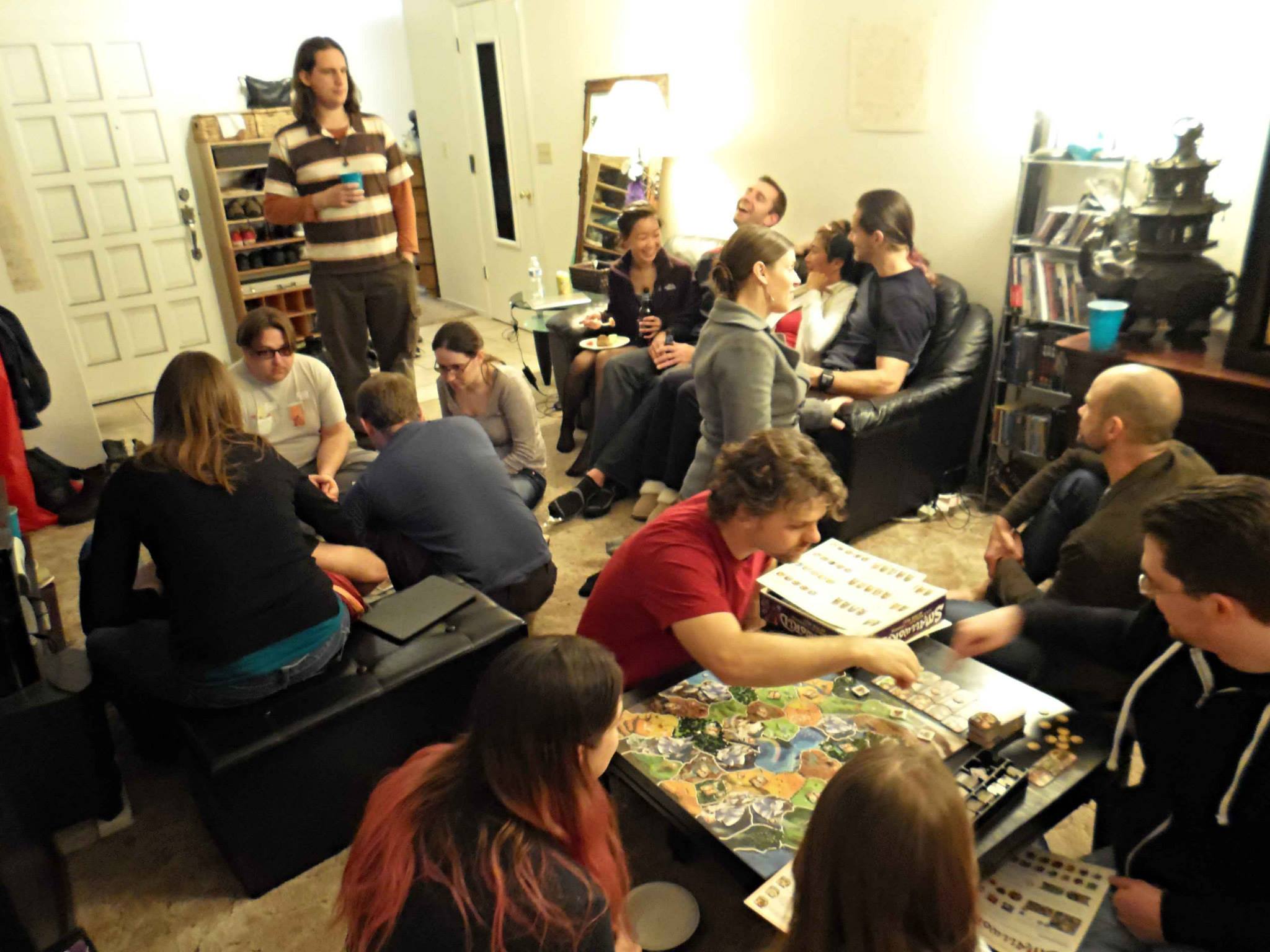
I am happy to report that I did in fact host my party this past weekend, and in spite of a flurry of winter flus and colds, I had plenty of fabulous and creative people in attendance. Challenge met.
I have a great interest in experimenting with social gatherings (otherwise known as parties) and creating different social experiences for people. I’ve been most intrigued by designing parties that encourage mingling, meeting new people, and getting to know slight acquaintances better (as opposed to sticking within already established friend groups and/or the people you came to the party with) and parties that cultivate creativity. (I’m also interested in the idea of fostering deeper connections between people, but I haven’t experimented much with that yet.)
The Albion experiment:
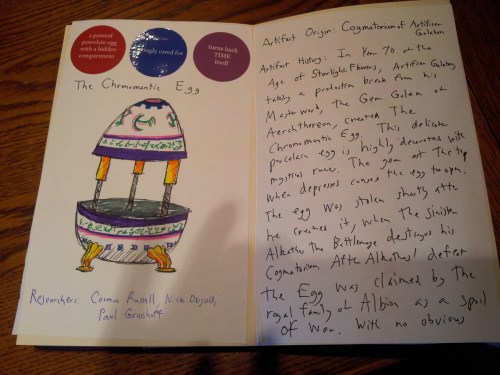
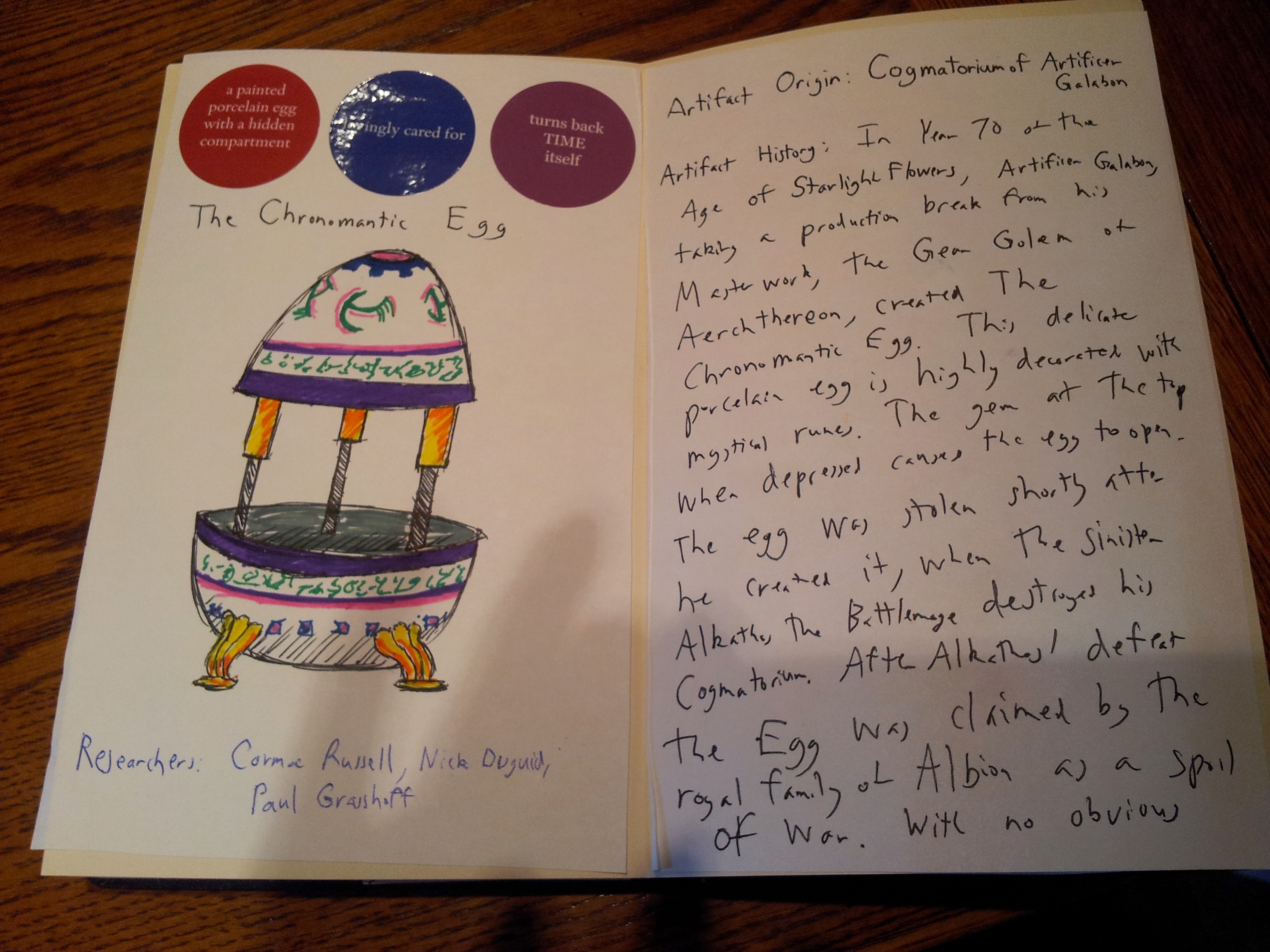
Some months ago I read about Emily Short’s San Tilapian Studies, a “narrative entertainment” for 30-40 players, and I instantly wanted to try it. Check out her post for a detailed description, but in summary, there are three different color stickers, and each person gets two stickers of the same color. One color is an item, one color is a descriptor, and one color is a function. The goal of the game is to put together three stickers, one of each color, into an awesome item (or in the case my game, a magical artifact). Then you put the stickers in a book and add drawings and/or text about it.
I used the rule mechanics almost exactly as stated in the blog post, with one exception: I changed the part about one sticker being a vile forgery, so people could match up both their stickers if desired. I re-themed the game to be high fantasy and titled it “Reclaiming Albion.” The story went that we were all native Albion scholars researching our magical heritage, which had been stamped out centuries before when an evil empire had conquered Albion.
Results and Observations:
I waited an hour after the stated party start time to launch the game; I wanted a critical mass of people present to give more possible match options. Time from the launch of the game until it finished was about three hours, with another half hour for sharing, although most people were not playing for the majority of that time.
After I handed out the stickers, there were a couple of really fast matches, mostly between significant others and tight friend groups. I was a little worried that the game would be over extremely quickly, but after that initial burst, players began to be more picky with their matches and explore options before deciding. The matches also became more difficult with less stickers in play, requiring more exploration. People began to mingle outside of their immediate circles. Did everybody do this? No. But it did give more opportunities for people to approach each other and get to know each other while working together, which was really cool to watch.
Perhaps because my party was smaller (~20 players), there were a couple two-sticker matches that couldn’t find a third sticker that was a good fit. In those cases, I waited a while to make sure a match wouldn’t materialize, and then provided a third sticker that would complete the artifact in a fun way.
Lessons Learned:
1. While this party was certainly more flexible than a standard mystery party, it still mattered that players were present at or near the start time of the game because later on, there were less stickers in circulation. I’d emphasize arriving early-ish in the invitation next time. That being said, for people who didn’t care about playing, arriving later was fine because there was more socializing happening then anyway.
2. I received a few suggestions of changes in implementation that could be interesting to try. One was to hand out four stickers at the beginning of the game instead of two, although I’m not certain about this one, as it would increase the options so hugely at the beginning. Perhaps another way to achieve something similar would be to have two rounds. The other suggestion was to make an explicit rule to encourage more mingling: for example, that everyone is only allowed to collaborate with each person once or that no collaborating is allowed with anyone you came to the party with. I tend to like to have as few rules as possible, but the results of either of these rules would be interesting to observe.
2. I provided paper to glue into the book to avoid a bottleneck of people wanting to draw/write/etc. and having to wait for the book. However, many people wanted to wait for the book anyway. I think perhaps if I had provided fancier paper, people would have been more excited to use it. (That being said, people began to use the paper once they realized how long a wait it was.)
3. I provided many different colors of ballpoint pen, as well as black gel pens and markers. I thought I’d gone way overboard, but people loved having a big selection. Next time I’d be tempted to provide an even larger variety of supplies.
4. At the end of the evening, several players were very eager to share their work and see other people’s work. I don’t know why I didn’t expect this! We sat around in a circle for storytime, when I showed all the illustrations and read the artifacts and text out loud. It was quite entertaining, and it allowed people to share their experiences from the evening.
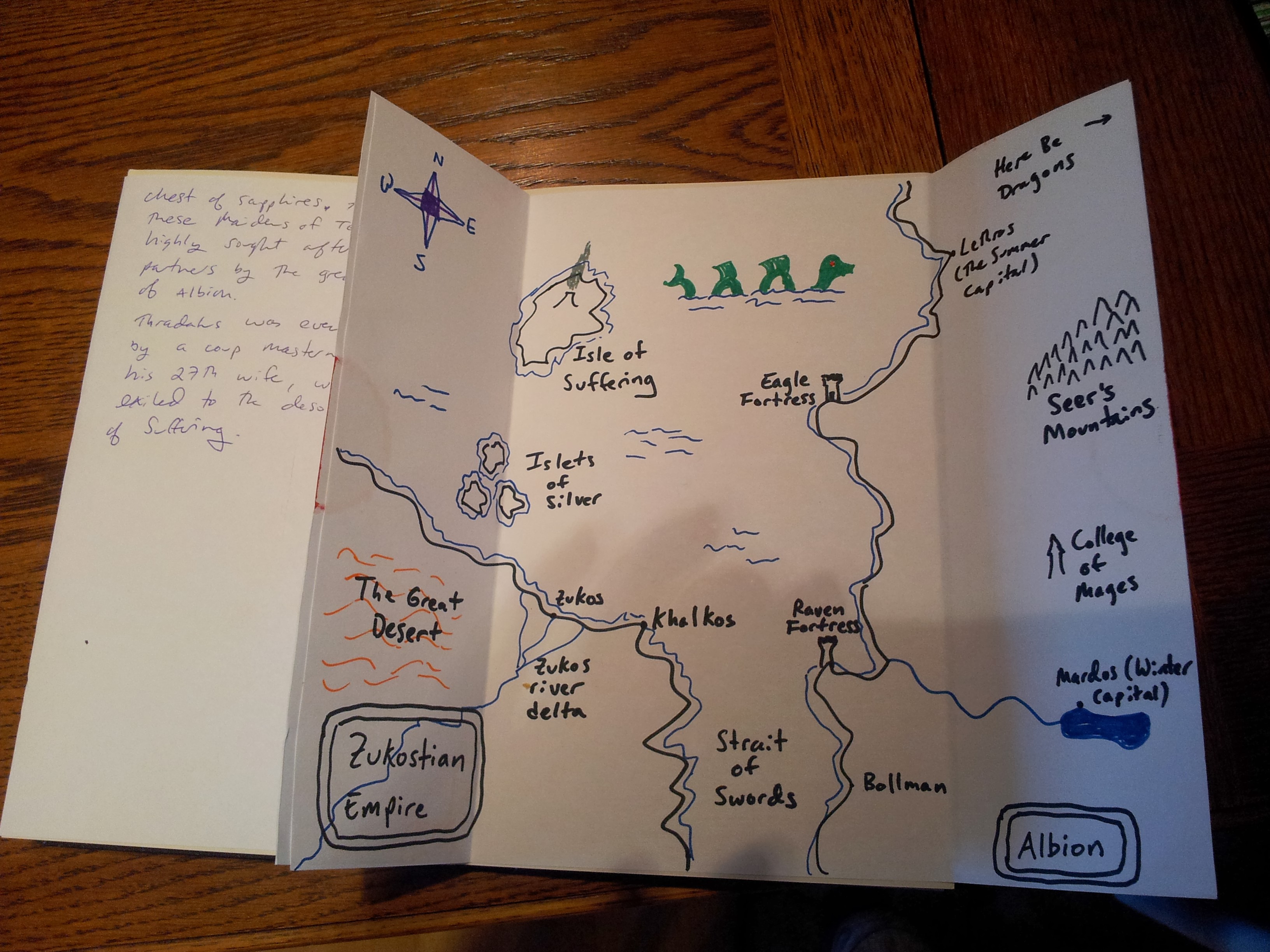
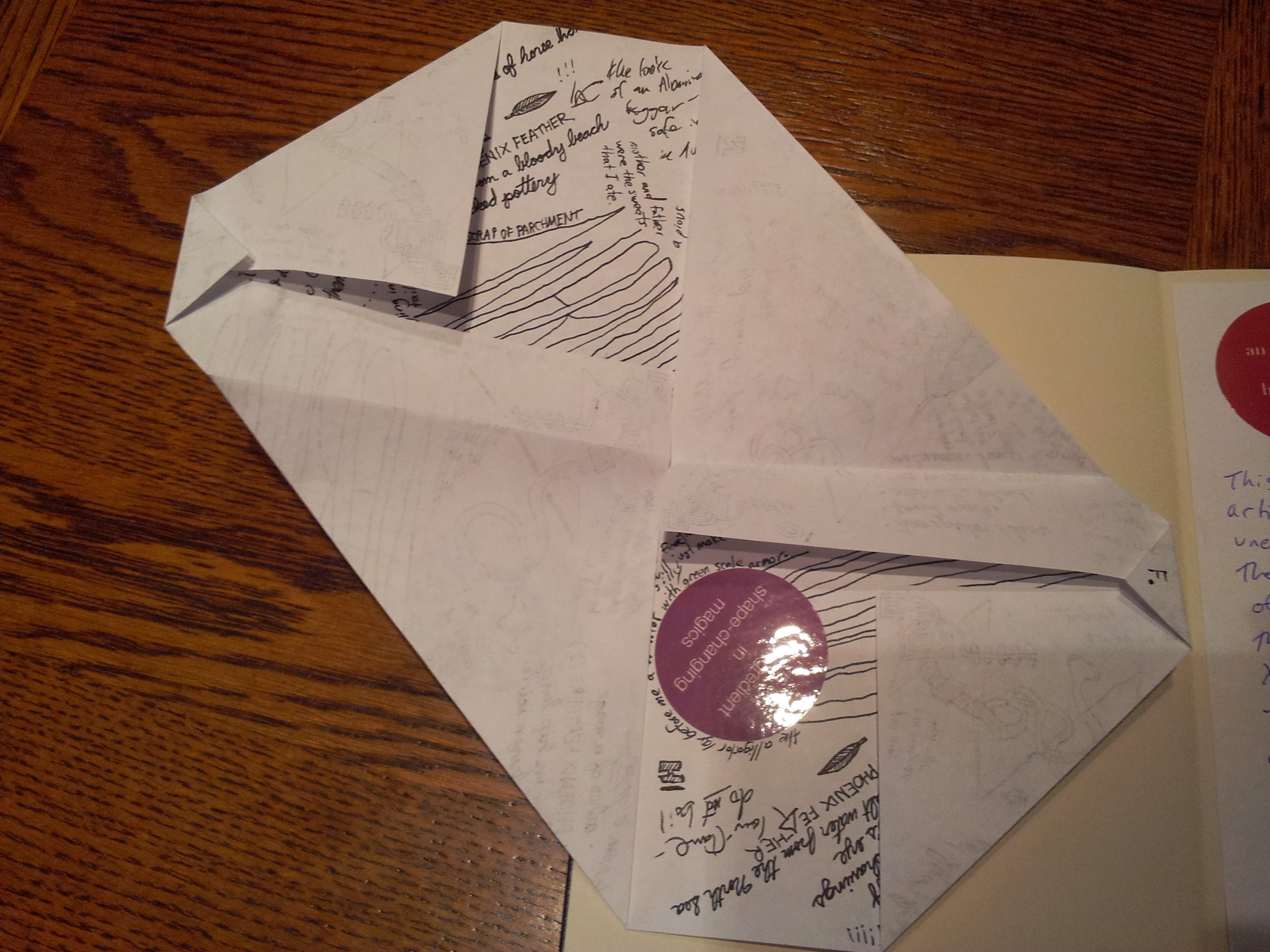
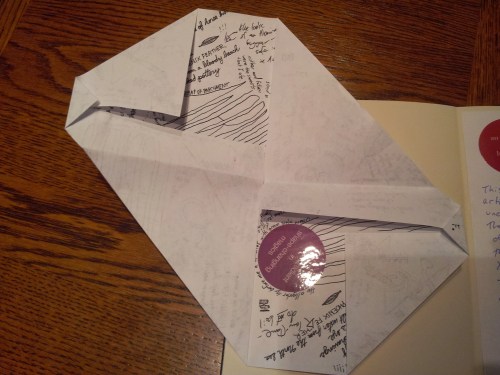
5. I didn’t realize the book would be as amazing as it is. People took the opportunity to be creative and ran with it. Included with the stickers were: many drawings of artifacts; a map of Albion and surrounding areas, complete with broken seal; short stories; a limerick; and magical recipes concealed in a specially folded paper. It made me realize how excited people can get when presented with the chance to be creative together. (This shouldn’t come as a surprise since kids are the same way, but I see it in practice less frequently with adults.) I think having the atmosphere be fairly low pressure helped minimize feelings of self-consciousness as well. (Contrast this with indie RPGs that require improv, which provide very creative experiences but are too stressful for some people.)
All in all, a fun and successful party! And I made enough stickers that I could do another one. I think that re-theming the party could also keep it fresh enough for several parties with many of the same guests. (Or maybe I just think that because I’d love to do a science fiction theme.)