Feeds:
Posts
Comments

Posts Tagged ‘writing’

I don’t really like pain, and I don’t like to feel uncomfortable. Sometimes I daydream about my ideal life, when I have fixed all my problems, have everything I want, and am exactly where I want to be in my career.I will never achieve that ideal life. And thank goodness, because if I did I’d be bored stiff…in which case I would have a problem, wouldn’t I?

Seth Godin published an insightful post last week entitled “Trading in your pain,” in which he outlines two common problems we can have due to our relationship with pain.

The first is the “if only” syndrome. We think if only something (fill in the blank) happens, then everything will be great and we won’t feel pain/discomfort/ uncertainty anymore. If only I meet the right person. If only I buy the right house. If only I remodel. If only I get an agent. If only I sell my first novel. If only my sales figures exceed a certain golden number. If only I win this award or make that bestseller list. If only I get this promotion. If only I was better or had more or …

That’s not generally the way things work, though. Whatever “if only” you’re hoping for (and I’m holding out for several myself), even if it happens, it will open the way to new challenges, new problems, new if only’s, and new pain as you strive. That’s okay. It doesn’t mean you’re not doing well. It doesn’t mean you’re not good enough. It’s just life.

The second is the “fear of change” syndrome. We sometimes become comfortable with a certain flavor of pain or discomfort, and we hold onto it really tightly so we won’t have to deal with another, unknown flavor instead. We become frozen. Stagnant. Afraid of success and the new problems success will bring us. Afraid of a different failure mode and how that will make us feel.

Behind the GateWriters who don’t write are having this second problem. They are used to dealing with the failure mode of “I suck because I’m not writing” and don’t want to address whatever issues might come up if they actually did write: “I suck because I’m not selling” or “I suck because I’m not selling enough” or “I suck because now I have to make business decisions” or whatever.

But I see this problem everywhere, not just in writers. We make ourselves at home with a certain problem, and settle in for keeps. And in the process, we get stuck. We can’t move on; we can’t grow.

Our identity and our personal narrative become entwined with our pain. I’m the girl whose mother died when I was only nineteen. That’s not who I am anymore. It is, however, who I could have been. It is who I was for a period of years. And then I let go and moved on. Instead I’m the girl who loved her mother very much.

Pain can be your friend. It will be lurking nearby for your entire life, and that’s okay. It means you’re alive, and it reminds you that you care what happens. It can push you forward instead of holding you still. It can give you focus instead of causing you to scatter. It can make our priorities clear to us.

If you could shed one “if only” or do one thing that makes you frightened, what would it be?

Read Full Post »

At this time of year, I always feel like I’m straddling the flow of time. Half of myself is looking backwards and evaluating what has gone on before, while the other half is looking forward to what the next year may hold for me. I don’t make New Year’s resolutions per say because I prefer a continuous evaluation process, but thinking in terms of units of time can be helpful when trying to look at the bigger picture of my life.

So, without further ado, here are a few reflections on 2011 and few wishes for the year to come.

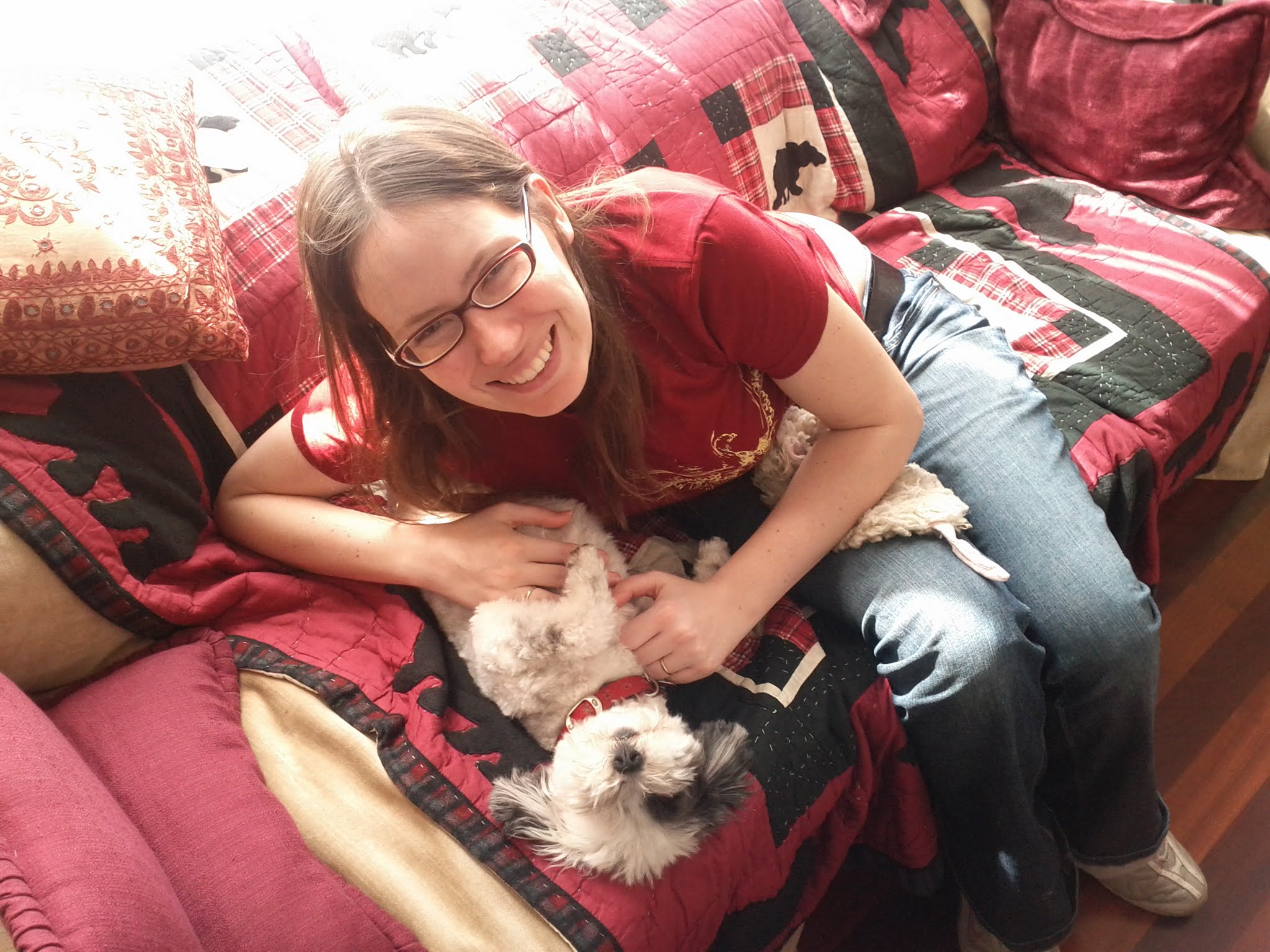
Cute little Nala and me

Writing:

2011 was an exciting year because it was the first year I had something published, thus realizing a dream I have cherished since I was seven years old. Hooray! In fact, I had three short stories published this year, one of them to a pro market. I was also able to join SFWA as an associate member.

My wish for 2012 is that I am able to use the lessons I learned this year to increase both my productivity and my enjoyment in writing. (Being greedy, I also wish for more sales.)

Health:

The first half of 2011 was dominated by crazy dental problems. While that silly crown still often aches, the level of pain has subsided to the realms of the tolerable. I also had more ankle problems. But on the plus side, my knees continued to improve in a most pleasing fashion. I also began to eat more healthily, trying to limit my consumption of saturated fats in particular, and have done fairly well with it (although not when traveling. Eating healthily when traveling is ridiculously hard).

My wish for 2012 is to keep growing stronger so I have less overall aches and pains, and to continue following my moderate diet.

Travel:

2011 was the first year in a long time that I didn’t leave the country. Various health concerns dampened my travel ambition somewhat, and I mostly stayed close to home. My favorite trip of the year was my first time in Washington D.C. in March. I would definitely return there for a follow-up visit someday. We also attended the Shakespeare Festival in Ashland, Oregon, visited Disneyland with friends, and relaxed over Thanksgiving at our favorite Maui vacation spot.

I was able to attend five writing conferences and conventions, two local and three an easy traveling distance: Potlatch, FogCon, SCBWI LA, WorldCon, and World Fantasy. I particularly enjoyed attending the inaugural FogCon and moderating my first two panels, and catching up with my wonderful writer friends (and making new ones) at the larger conventions was fabulous as usual.

My wish for 2012 is to leave the United States. We’re thinking either Japan or certain favorite Western European locations…

Personal Growth:

I wrote about the two most important lessons I’ve learned this year last week. I feel like I’ve made a fair amount of progress on the people pleaser front and have developed a stronger backbone. I’m more likely to stand up for myself and less likely to take responsibility for everyone else. So, yay!

My wish for 2012 is to continue tackling my vicious perfectionist streak and to do further work towards trusting myself and my abilities. I’d also like to be able to reach out more to other people.

Happy upcoming New Year, dear readers! What are your wishes for 2012?


Read Full Post »

I love the end of the year. Not only do I adore Christmas (it is my favorite holiday), but I like that it’s cold and it gets dark early, both of which encourage me to snuggle up indoors and reflect upon the year that is coming to a close. I plan to spend a lot of time in the next two weeks doing just that, and this week I’m going to write about the two lessons I learned this year that were most helpful to me.

I’ve been struggling with my writing for most of the year–not, thank goodness, with my nonfiction writing, so the blog hasn’t suffered unduly, but with my fiction. I have spent A LOT of time thinking about why I’m struggling and trying various strategies to make the writing work better for me. Most of those strategies failed. But in the last few weeks, I’ve finally found one that feels right.

I was reading snippets from Ray Bradbury’s Zen in the Art of Writing when I had my Aha! moment. He gives this three-fold advice to writers: Work, relax, and don’t think. Work I felt I understood, so I began turning around the other two steps in my head. What would it look like if I relaxed while I was writing? What would it be like to stop thinking so frantically? What if I stopped trying to avoid all the objectionable components of writing, stopped being obsessed with not making any of the obvious and embarrassing mistakes? What would happen if I gave myself permission to write what I wanted to write? In short, what would happen if I trusted myself as a writer and gave myself free rein?

Photo by Paul Moody

I am cerebral sort of person, so it’s difficult for me to even imagine not thinking, but I’m also stubborn and I was determined to give it a try. I sat down and spent the next week and a half writing a short story without censoring myself. I looked forward to working on it, and the words came more easily. I even voluntarily worked on it on the weekend. Here was the joy I had somehow misplaced for so much of the year. When I finished it, I felt a sense of completion. Whether or not I had written something good, I had written something I felt connected to and could take satisfaction from.

I gave the story to my husband, my faithful first reader, without telling him I had been trying anything different. When he finished reading, he told me it was the best thing I’ve ever written.

In creative work, I think it’s important to strive. I believe in working to learn and improve, in tackling difficult themes and uncooperative characters, in experimenting to learn your craft (whatever it might be) to the best of your abilities. But what I didn’t realize until now is that there is a point when I have to let go. I have to trust that my writing knowledge will be there for me. I have to stop second-guessing every decision I make. I have to believe in my vision and voice as an artist.

And it turns out, I do have my own voice. It’s been there all this time, waiting for me to be willing to listen.

Relax. Don’t think. Trust yourself.

What lessons pertaining to your work, artistic or otherwise, did you learn this year?

Read Full Post »

A friend of mine wrote me awhile back and asked me if I could write a post about resources for the YA writer. I’ll admit, I was stymied. In spite of the fact that I began writing in the YA genre, and as such it is my first true literary love, I realized I didn’t know nearly the number of resources that I could spout if he had asked the same question about speculative fiction. There is SCBWI, of course, the teenlitauthors yahoo group (although it tends to get a bit bogged down with congratulations and personal news), and Vera Kay’s Blueboards (where I’ve rarely been active). I’m sure there must be how-to-do-it books on YA (mustn’t there?), but I’ve never read them. Likewise, there must be various relevant blogs, but the few truly YA-focused ones I used to read are rarely if ever updated anymore.

Meanwhile, YA continues to be hot, hot, hot, even while agents and editors are cautioning writers that there is a glut of YA, and maybe writing some quality MG wouldn’t be a bad idea right around now. They say this at conferences, in any case, but I’m still hearing stories of agents recommending that their actual clients write YA, even if they’ve gotten their start in writing for adults. (Which incidentally tends to make me cringe. I understand intellectually that there is more money for fiction writers in YA, and the sales might be easier to make due to the aforementioned hotness, so it makes sense from a business perspective. But I’d like to think there’s more to writing YA than just good business sense; that it’s the end result of receiving a calling, of having some kind of affinity to teenagers, of what kind of stories a writer deeply desires to tell. I’m not saying a writer can’t write both YA and adult fiction–I do that myself. I just want it to be a case of good business uniting with a true interest in writing for teens. But I digress.)

I could write another whole post on the differences between the speculative and YA communities from where I sit (and maybe I will), but the fact remains that I don’t have a treasure trove of resources to share. Instead I will give three pieces of advice (which you can take or leave), advice that unfortunately does not offer any shortcuts but has helped me learn more about YA in the last three years than anything else.

READ YA. Read a lot of it. Read MODERN YA written and published in the last ten or so years (at least some of which has been published in the last three years) so you know what’s going on now instead of what was going on when you were a kid (trust me, unless you’re close to being a teenager yourself, it is different now). Read some MG (Middle grade) so that you understand the difference through examples instead of relying only on my handy-dandy list. Read different genres of YA; you might only be interested in writing science fiction YA, but read at least a few paranormal, fantasy, and contemporary novels as well. Read a few of the really “girly” book series so you know what’s going on there. Read the blockbusters of the field. I don’t care if you don’t like Twilight; if you want to write YA, you should read it anyway (at least the first one) so you can understand what about it tapped into the zeitgeist of the time and understand the ripples it generated (and still generates). Likewise, you should read The Hunger Games, and even though much of it is MG (in my opinion), you should read at least some of the Harry Potter books. Then go read some obscure titles no one has heard of.

STEEP YOURSELF IN TEEN-NESS. If you haven’t spent any in-person time with teens since you were a teenager yourself, it’s time to change that. I don’t care how–you can hang out with a family member, volunteer, teach a class, offer to mentor a teen writer. If all else fails, you can scout out where the local teens hang out after school, go there, and shamelessly eavesdrop. You can watch TV shows and movies targeted at teens (just NOT during your writing time, please): Buffy the Vampire Slayer is old school but still helpful, and lately I’ve been spending time watching Veronica Mars, Glee, The Vampire Diaries, and Gossip Girl (and I’m sure there are others). I don’t watch these shows thinking they are necessarily a realistic representation of teenage life, but to watch for more widespread trends: how do relationships/hook-ups work now? how do teens use technology? what are the latest fashion trends and the current slang? how do the characters speak to each other? what issues tap into today’s teen experience that might be a little different from your own teenage years? Sure, if you’re writing a far future dystopic novel, today’s slang might not be so relevant, but it’s still important to try to understand how your readers see themselves now.

REMEMBER WHAT IT WAS LIKE. Not just the clichés, and not from a superior, “now I’m a wise and mature adult” perspective. How can you understand as deeply if you’re looking down at someone? No, exercise that empathy muscle and try to remember how you actually felt: the frustration of not having complete power over your life, even if you were spending a lot of time watching adults royally screw up; the surging hormones and confusion when trying to deal with lust and affairs of the heart; the uncertainty of not knowing exactly who you were and how you fit into the larger world (or perhaps bending self perception of who you were to fit into a fantasy); the endemic unfairness; the world-crushing importance of everything going on in your life; the huge milestones bearing down on you, one after another (and whether you looked on them with excitement, horror, or a co-mingling of the two). And then remember that all of the above plays out differently for different people, both in terms of which ones are relevant to each person and what’s going on inside versus the show they’re putting on for the outside.

That’s all I’ve got. If you know of any YA resources I didn’t mention, please give them a shout-out below. Also, if you think all a modern YA writer needs to read is the juvenile Heinlein oeuvre, tell me that too because then we can have a truly epic argument.

Read Full Post »

Earlier this week we covered Facebook’s new direction, including both the potential large upside for writers and the accompanying privacy concerns. But what about Google+? Where does it fit into this picture? (Disclaimer: my husband, you may remember, works on Google+, so I’m not an uninterested party here. Apparently I also need to tell you explicitly that these are my opinions and not his. So yes, all mine. Especially the brilliant parts.)

Google+ has only been public for a little more than a week, and has only been live at all for the past three months. So we’re still in the very early days, which means there is still a lot of room for conjecture. First, let’s talk about a few differences between Facebook and Google+ (although with all of FB’s recent changes, there are less of them than there were). I was happy to have independent verification that Google+ is not doing the creepy cookie thing that makes me so concerned about Facebook and its privacy. There’s also less chance of accidentally posting information you don’t want posted, which is always nice. With its recent integration of Hangouts (group video chat) with new tools, especially Google Docs and screen views, Google+ lends itself well to collaboration in creative, business, and educational fields (and even recreational). The Google+ stream is not filtered the way Facebook is; you see all the posts being shared with you, although not in straight reverse chronological order as sometimes new comments will make an old post jump back higher in your stream. Google+ has garnered a reputation for hosting more in-depth discussions and conversations and for being a great platform for meeting new people.

I’m reluctant to talk about Google+’s real names policy because I know that many people feel passionately about it and I don’t want this conversation to center only on that. Regarding writers, I will say that I don’t think it’s Google’s aim to penalize those of us who write under pseudonyms. I personally expect that once Google+ has matured a bit more, this policy will lose its relevance, if for no other reason than that Google will find it impossible to enforce such a policy. For writers in particular, as long as your pseudonym looks like a standard American name (ie first and last), the odds are that you won’t have problems. But it is a concern that Google needs to address in some way so that users feel completely comfortable investing in the site.

A baby hedgehog with a lot of potential… (Okay, you’ve got me, I just wanted to include a hedgehog photo.)

Why might writers consider being on Google+ right now?

1. Hatred of Facebook. It happens, and now there’s an alternative for having an online presence that is more conducive for conversation with fans and communities. Twitter can also do this, but it feels more ephemeral in time and is difficult for communicating more complicated ideas or sharing links (since they are truncated and therefore very mysterious). So this may partly depend on your style of communication, and of course, carries the downside of not having the sheer number of users as Facebook.

2. Early adopter status. One of the main benefits of this is getting a head start. Users who are early adopters tend to have large follower counts, both because they’ve been doing it longer and because they are present at the beginning when more people are looking for interesting content for their streams. For example, I have well over 1000 people following me on Google+ after three months, whereas I have friends in the three hundreds on both Facebook and Twitter.

3. If you are an sf/f writer, being active on Google+ right now is a no brainer, because guess what? Your fans make up a large portion of the current user base. Google+ is known to be particularly popular with the high-tech crowd, many of whom enjoy science fiction and fantasy. So the potential for building your fan base is very good. Not to mention that the artist communities (comic book artists, photographers, and writers in particular) are well represented as well–hence why Google+ is great for collaboration and networking.

4. Positioning. Writers want to be in the best place to take advantage of whatever changes may benefit them. Keeping up to date with what’s going on with these social platforms and understanding the basics of how they work means greater speed in adapting and leveraging them to work for you.

What I am most excited about, though, is the huge future potential of Google+. Remember how I said that it is becoming known as a great place to meet new people? Well, guess what the point of having a social media strategy is in the first place. Yes, that’s right: meeting new people in order to build a fan base. On Facebook, the vast majority of my friends are people I’ve met in real life. On Twitter, the vast majority of my followers are newer writers like myself, indie writers, and social media professionals who use words like SEO in their personal descriptions. I certainly have a fair number of writers following me on Google+ as well, but I’m also being followed by lots of..wait for it… normal people! I know, right? Who knew that could happen? And these people are all potential readers who might like my work. Plus, for an added bonus, they’re really interesting to talk to. So while I stand by my assertion that Facebook is great for more established writers due to its larger reach, Google+ is great for writers actively trying to build a fan base before they even have a publishing track record. If you read a lot about social media and writers, you have doubtless read how we’re all supposed to start building a “platform” a few years before our first novel hits the presses. Google+ seems positioned to be a powerful tool to do just that.

With its new search feature that came out last week, Google+ became a tool for discovery. I can now search for posts about subjects I care about on Google+, which is a great way to meet people. With its release of shared circles, in which users can take a screenshot of a current circle and share it with their followers, we’ve been given the means to share groups of people who we know are interested in photography, or current events, or reading, or whatever topic we want, which will also facilitate discovery. My hope is that Google will continue to pursue this line of development and begin to offer more advanced and refined methods of finding other users with similar interests.

Next week I’m planning to discuss ways for writers (or anyone else) to be interesting and discoverable on social media. And then maybe I’ll be able to tear myself away from this topic for long enough to talk about something else.

Read Full Post »

I read a lot of blogs. Some I read regularly, some I occasionally swoop down upon and catch up in a big glut of reading, some I read only once. Many of these blogs are writer blogs, and I’ve seen more than one post about Writer Envy.

What is Writer Envy? It’s that niggling feeling in the pit of your stomach when you hear that Jay Lake averages 2,500 words per hour. It’s the pang you feel when you hear someone’s broken into a market that you’ve been dying to get into. It’s the discouragement of feeling that maybe you’re being left behind as one by one, all your writer friends get agents and publishing deals and more and better sales than you think you are getting.

Does anyone know why we call it green with envy?

Well, guess what? I’m giving you permission to be jealous, whether with Writer Envy or because of your friend’s superior cooking or for any other reason. To envy is to be human. And, it turns out, it can even be good for you. Psychology Today recently ran an article citing a recent study about envy. The results are fascinating: it turns out that feeling the emotion of envy both causes us to focus more on the object of our jealousy and boosts our memories. Basically, jealousy allows us to more efficiently learn and remember how to achieve what we’re jealous of.

Therefore, instead of beating ourselves up when we feel it, we can begin to think of envy as a tool. We can use it to make ourselves better writers (or cooks, or car washers, or underwater basket weavers). We can harness that energy to motivate ourselves instead of to discourage.

Example: Let’s say my friend Beth makes a sale to Greatest Ever Magazine, which is the market that I most want to break into. I can wallow and feel terrible about myself because Greatest Ever Magazine still sends me form rejections. Or, I can use my desires and feeling of jealousy to motivate me. I can read Beth’s story and analyze why I think Greatest Ever Magazine liked it. Perhaps the subject matter is perfect for the market, or perhaps the market prefers upbeat endings like Beth’s. I can figure out the strengths of the story, and then compare it to my own recent work. Perhaps Beth’s story shows excellent use of setting, whereas I have too many under-described, white rooms in my recent work. Or perhaps Beth’s story has a twisty and exciting plot that drives it, while my recent stories have all been character-driven. I can learn from my friend Beth’s success where the weaknesses in my own work are and how I might get started on improving them. Beth might even be willing to share her own insights on Greatest Ever Magazine. Meanwhile, because I am jealous, I’ll be more likely to focus and remember what I’ve figured out.

(This can also work, by the way, with embarrassment. I was so embarrassed that I forgot the names of the two rivers of Mesopotamia in seventh grade social studies that I will probably remember that they are the Tigris and Euphrates for the rest of time.)

Of course, experiencing jealousy doesn’t mean we can’t also feel happy and pleased for a person who has succeeded. And it certainly doesn’t excuse any bad behavior on our parts. However, knowing that our brains are designed to feel jealousy on purpose to give us a better chance of survival can change our outlook. Instead of seeing jealousy as an embarrassing weakness, we can see it as another way to move forward towards our goals.

Read Full Post »

I’m writing this up in my hotel room at the SCBWI conference. I just heard an amazing keynote speech by Bruce Coville, who was in part saying what I said in my blog post last week about influence and never knowing how your actions will affect others. Only he said it in a more articulate and developed way and threw in several musical theater references for good measure.

He also gave many tips for writers, and something he said jarred a useful insight loose in my brain. He talked about the importance of art, craft, and business sense. All in one speech. I’ve been thinking about each of these subjects a great deal, and you’ve seen some of the results of that thinking here on this blog. But the speech gave me some much needed cohesion.

Sometimes I feel like art has become something of a dirty word among many writers. If we’re serious about writing (and oh, are we ever serious), then we discuss craft a great deal. Sometimes we even bite the bullet and talk about business and the industry in ways that are more thoughtful than reactionary and more intelligent than just following the herd. (Sometimes we freak out instead.) We can be inspirational within certain boundaries. But art. Yes, art is a loaded word.

When we hear others speak about art, perhaps we imagine the dilettante artist who never actually writes anything. Or perhaps we think about those who start with a message and try to slap their audience in the face with it. Or perhaps we think of something inaccessible, like the serialist movement in music that I was talking about on Tuesday. The starving artist comes to mind, the irresponsible flake who needs to be talked down from the ledge by the long-suffering editor, the tortured soul who has a room filled with crumpled pieces of paper (see the recent movie Limitless, in which the writer portrayed has nothing to do with reality whatsoever).

And yet, this is not how art needs to be, and this is not how we must define ourselves as artists. Art doesn’t have to mean any of these things. Instead, it is an essential leg in the tripod of the writer.

Here’s how the system works: A good grasp of craft means that we produce sellable and marketable works, which helps our business. It also means that we have the tools at our disposable to create art that works, that really does evoke emotion and help us see the world differently. Craft is essential.

A good grasp of business means that we can get our work out into the world. This facilitates its purpose as art to communicate. It’s also always nice to avoid being screwed and to get paid for our work, which helps us continue both our craft and our art.

An acceptance of our work as art keeps us inspired. It encourages us to keep improving our craft so that we can achieve more through our words, and it challenges us to learn the business side so that we can achieve greater impact.

Lose touch with the business aspect and we cannot support ourselves or get our work out into the world. Lose touch with the craft aspect and we cannot write well enough to be effective. Lose touch with our work as art and we flirt with a sense of futility and forget to take risks.

I tend to neglect the art aspect that reminds me of my purpose and pour all my energy into craft and business. This choice, I tell myself, makes me a serious writer.

But I am wrong. My best work doesn’t happen when I only have two of my cornerstones. It takes place when I remember all three and dare to write bigger. It takes place when I accept that I am a businesswoman, a craftsperson, AND an artist.

Read Full Post »

I have a writer friend who is having a bit of a tough time right now, and I am writing this for you. (You know who you are.)

It is okay, natural, and possibly even healthy that you are having trouble embracing your writer identity right now. Take your time about it–it’s an important identity to get to know. And I’ll let you in on a little secret: your writer identity is like your super hero identity. Yes, I’m serious. Right now you’re learning to find the super hero within.

On the outside, writers may appear like normal human beings. Some of us are frumpy or bad dressers, some of us need haircuts. Many of us wear spectacles. Some of us have unexpected hair colors or holes in our bodies that weren’t there when we were born. Some of us have a clear affinity to steam punk and corsets, others to shapeless T-shirts with geeky slogans on them. A lot of us are introverts, and we can often be found with our noses stuck in a book (or a smart phone, or a Kindle, or…). But all of this is just a facade, a way to divert attention from our secret identities.

All writers are super heroes. We fight ignorance and apathy, loss of wonder and despair. We entertain people who deeply need to be distracted from pain or sickness. We make people think of consequences, both of personal actions and society’s decisions. We remind people of what it is to be human, both the good and the bad, and we inspire people to strive for the best.

Many writers live in the stars. We dream of times past and future, reinterpreting what has happened and twisting together visions of what is to come. We deal in possibilities, in vast heroics and small personal acts of courage, in envisioning worlds that we hope for and fear. We keep the spark of ideas alive, even ideas that aren’t enjoying their time in the public spotlight, so that someday when we need them, they will still be available to us.

We create characters who take the proxy role of mother and father, husband and wife, best friend, diabolical arch-nemesis, and noble mentor. We teach people how to live, how to survive through hard times, and how to die. We serve as society’s mirror and conscience simultaneously.

Sometimes we get tired. Sometimes we fall short. Sometimes we feel like we’re not really super heroes after all, and we don’t belong in the Super Hero League of Awesomeness. Maybe we lack some credentials, or maybe we don’t know the right people, or maybe we’re not good enough yet. Maybe not enough people read our stories or buy our books or follow us on Twitter. We are unsung, unappreciated, without creative mojo. We toil away in our anonymity and obscurity, wondering if what we’re doing even matters.

But oh, my friend, when you ask yourself this question (as I know you will, because we all do), answer with a resounding Yes! It is the lot of a super hero to be handed thankless tasks and toil away with little personal reward. But we continue because of our conviction that it matters; that we can, in our own humble way, make a difference.

We give the world its voice. Don’t let anyone take that away from you.

Read Full Post »

I’ve been feeling all organized because last weekend I made a list of topics for my next several posts. And then this morning I read a blog post offering some misguided writing advice. (No, I’m not going to link to it. I’m sure way too many writers read it as is.) Cue complete topic derailment.

I’ve already written about writing advice in the past, but the more I think about it, the more I think this issue isn’t confined to advice about writing. It isn’t even confined to advice about artistic pursuits. Over the years I have certainly received a great deal of advice about basic life topics, some of which has thrown me for a loop and later proven to be completely wrong. (My favorite? “Oh, Amy, you just have delusions of grandeur” in response to me having big artistic dreams. Way to try to ensure they’ll never happen.)

Add to this the undeniable fact that I sometimes give what could be construed as advice right here on this blog, and I feel almost obligated to write the following.

Read, learn, listen to other people’s point of view and feedback. Think about what people say, try out various ideas. Don’t automatically assume you know the one true way to doing anything. But ultimately, DO WHAT YOU WANT TO DO. Do what you need to do (assuming that what you need to do doesn’t involve anything blatantly illegal, of course). And more than that, do what works. Advice, even the more strongly worded variety, is merely a suggestion that we can take or leave according to our own inclination. Even if it’s good advice, we might not be ready to implement it. And if it’s bad advice, we might accidentally harm ourselves or take the plunge into regret that I talked about last week.

That’s one of the really wonderful things about life. We get to choose our own adventure. Sure, we can’t control everything or even most things, but within our small scope of decision, we act as our own kings and queens.

It’s not such a leap to believe that creative types need to follow their muses and express their personal integrity and vision of the world in their art. But what if we take a step farther and consider ourselves to be art and our lifetimes to be our canvas of expression? The expressions “Follow your heart” and “Follow your gut” are close but incomplete representations of this kind of life. Follow who you are, and even more, follow who you wish to become.

Choosing to live this way can mean leaving a lot of the advice behind. The Backbone Project has really opened my eyes to this. Why do people care whether I drink alcohol or not? Why do they care (especially women!) if I self-identify as a feminist? Why do people want to change my writing process? Often I think the answer is that they don’t actually care about me personally at all. Instead they are seeking to validate their own way of life and their own choices. Instead of following who they are and finding a sense of rightness in that, they need reflection from the outside world to reassure them. Instead of deep and subtle thinking, they allow themselves to fall into the black and white thinking trap: I’m right and you’re wrong. Because this doesn’t work for me, obviously it won’t work for anybody. Something needs to be fixed; you need to be fixed. If I have a big bad problem, that means you must not have any problems at all or else you’re trying to compete with me, but it doesn’t matter because my problem must be the worst. (Or flip it around: if you have a big bad problem, that must mean my own problems aren’t important at all.)

Don’t take my advice about this, though. Think about it, and make up your own mind. Choose your own adventure. Turn your life into art with every choice you make.

Read Full Post »

Yes, this week you get me on Monday and Wednesday instead of the usual Tuesday/Thursday. It’s confusing me, too; I am a creature of habit. However, I want to tell you all about Google+, and I want to tell you about it right now. Because I’m also a creature of impatience.

I’m on the white list for the first users who get to try out Google+, or Google Plus, which is Google’s new social offering. Disclaimer first: my husband is the equivalent of the chief architect for this project, so in no way can I claim to be unbiased. On the other hand, I also really care about social media and tend to have strong opinions about it, so I imagine those will come through regardless. We shall see.

So what is Google+? Besides its poor branding, that is (a + followed by punctuation just doesn’t look right to me). Basically it is a suite of social features. In some ways it is like Facebook; in others, more like Twitter, and then it has features that are all its own. And it’s a work in progress, so it’s quite possible (even very likely) that we’ll be treated to cool new features in the future. It has a feed like Facebook (although it’s called a stream) where you can share status updates, photos, links, etc. It has group video chat (more about that in a bit). It has Sparks, which is a kind of recommendation engine for interesting new content on the web-based on your interests. It has some cell phone features that I won’t be talking about much because I don’t have a smart phone (but they include a group chat function that is basically like a text message except faster and free, and the option to automatically upload photos from your phone to a private folder in your account). You can see some screen shots here.

Downsides:

As of right now, I see two main downsides to Google+. One is the way its stream works. Of course, I don’t know anybody on Google+ right now, so I’m just following a few random people for experimentation purposes. But right now, the stream is not sorted with the most recent post on top. Instead, whenever a status is commented upon, it moves up to the top of your stream. This feature already drives me crazy, and I’m only following three people. Imagine how much worse it could be if I was following the 350 friends I have on Facebook and kept on having the same status messages repeated again and again as people I don’t even know comment. Yeah, not so good. I don’t like it when Facebook tries to mess with my feed with its “Top News” and I don’t like Google messing around with my stream either. I have hopes that they will add an option to change the sorting if you don’t want to deal with this sort of stream spam.

The other main downside is that I don’t know anybody on Google+, which means there’s not really much to do. Once I am given invites to send out, this aspect should improve, but it begs the question: how many of the people I interact with over Facebook or Twitter will join Google+ and be active over there? The services are not compatible in that you cannot port your status messages from Facebook over to Google+ (although to be honest, I hate it when people do that with their Twitter statuses anyway), so it’s a whole new social media platform to deal with. Will enough of my friends want to use both Facebook and Google+, or want to switch over to Google+, that it will be an easy way for me to interact with them? Will this mean I have to spend more time on social media applications (yikes!) or will a balance naturally emerge? (Here is one interesting theory on how the two social media platforms can be used differently.) Only time will tell.

Upsides:

1. Circles: The way you organize your contacts is pretty spiffy. This is the main way right now that Google+ combines Facebook and Twitter…and improves on both. In my experience, Facebook is mostly a walled garden in which you share all of your content with all your friends and no one else, whereas Twitter is a mostly public place where anyone can follow you and read any of your tweets. Google+ allows you to very easily set up multiple modes of interaction instead of having to choose one. (Yes, I know Facebook has group things or something, but I’ve never been able to get them to work, whereas I figured out Google+ in under five minutes.) I am able to follow anyone I want, and don’t need to get a friend request approved. However, I am under no under obligation to follow anyone back. And if I do wish to follow someone back, I can click and drag them into various “circles,” which are absurdly easy to set up. For instance, I can have a circle for close local friends so I can easily check and see who’s free to have dinner with me tonight. And I can have a circle for my family, or my college friends, or whatever I want (the names of the circles are private, too). This is great for writers because we will no longer have to wonder how to use Facebook: do we friend fans, or direct them to our Fan Page? Instead, we can just broadcast certain messages publicly, in which case all our followers will see them, OR we can create a circle for our fans, while still being able to be more personal with our real-life friends. Also, I’ve already created a circle called “Writers” so that if I want to talk craft (or the next big convention), I can show those conversations only to the people who care. (Note that Circles neatly sidesteps most of the drama inherent in Facebook; no more awkward friend requests that you have to ignore, or sudden realizations that someone has de-friended you. Less drama leads to less stress, which makes me happy.)

2. Hang Outs: Hang outs are video chat rooms that can hold up to ten people at one time. They are easy to open, and they notify whoever you specify that you’re available right now to chat (but you can filter this by circle, thereby avoiding the need to chat with anyone you’d rather avoid). I’m really excited by this feature since so many of my friends aren’t local; it sounds like it could be ideal for hanging out with them in a more casual way. Hang outs will also be great for critique groups who aren’t geographically close to one another, and for conducting plot breaks, brainstorming sessions, etc. I’m really hoping to have some Taos Toolbox alumni hang outs once general invitations are available.

3. No text limit in the status update box: Yeah, I know some people love the 140 character limit on Twitter (or the slightly longer one on Facebook), but I’m not one of them. Google+ doesn’t limit you, so if you have a longer idea, you can express it all in one place. I don’t know how often I will actually need this, but it’s one less thing to worry about.

4. Sparks: Sparks, the web content recommendation engine, lets you search for the newest content for your interests, so it’s already fun. But honestly, Sparks is in its infancy. I’m not allowed to tell you more, which sucks, but I’m allowed to say that someday it’s going to be a lot more awesome. I can’t wait.

5. Choice is good: In the past I’ve gotten kind of creeped out by Facebook and some of its policies (notably related to privacy). However, there has been no real alternative; either I can live with it or I can not have my social media toy. I know that Google has had its issues in the past as well (Buzz, anyone?), but choice and competition are generally good things for us, the consumers. And here comes my bias full force, but it has been my impression that Google is generally one of the strongest companies technically, so I’m looking forward to seeing what they are able to do. It is my hope (and my understanding) that the Google+ I’m seeing right now is just the beginning, and that there will be many more features and innovations in the future.

Any questions about my user experience with Google+?  Any thoughts about Google+ in general? Let me know!

ETA: It looks like there’s already an extension for Chrome available that will allow you to cross-post your Google+ posts to Facebook and Twitter. Don’t think there’s any way to do it the other way around…yet!

Read Full Post »
« Newer Posts - Older Posts »