Feeds:
Posts
Comments

Posts Tagged ‘writing’

I’m back from the Rainforest Writers’ Retreat, and what a lovely five days I had! After all the hullaballoo of looking for a place to live, I was even more ready than normal to have time away from my cell phone and the logistics of my life. Whenever stress would intrude (say, from an e-mail from my current landlord), I’d go outside and look at the lake–sometimes rippling in the wind, sometimes a perfect mirror of the clouds overhead–and I’d feel much, much better.

It's hard to look at such beauty and not feel something loosen inside. Photo by Amy Sundberg (me!)

It’s hard to look at such beauty and not feel something loosen inside. Photo by Amy Sundberg (me!)

While my writing focus has been much improved this year compared to last year, I’ve been noticing as February progressed and the house search continued its grim plod that it was gradually worsening. It was taking me longer to get started writing every day, and I was taking more and more breaks. By the time I actually found my soon-to-be home at the beginning of last week, my focus was so shaky I had lowered my daily word count goal. So I went into Rainforest this year worried about my ability to produce.

I’m happy to say I was as productive as I hoped to be, which gave me food for thought. Why, I’ve been wondering, am I so much more productive and focused at Rainforest than at home? And is there any way to replicate any of Rainforest’s effects?

Factors that make Rainforest work so well for my productivity:

1. It’s remote, with no phones or cell reception, and very spotty internet connection. Without much communication from the outside world, it’s much easier to focus.

2. I clear the decks for the trip, which means for the most part I don’t have real world concerns intruding on my time or focus either. (Real concerns can range from daily dog care to doing my taxes to planning this social activity to going to appointments to doing chores.)

3. The word count board builds in accountability to my peers. This works better than an announcement on Twitter would because there’s a more tangible feeling of community and that we’re all in this together. I see people writing constantly, and conversation often revolves around how the writing is going that day.

4. I have extra motivation because of the resources used to take the trip, which ends up giving me the feeling that I’d better make this time count.

5. Because I have lofty (for me) daily word count goals, I tend to engage in less general shilly-shallying while ostensibly writing.

6. My writing day is more structured with meals and activities than it often is at home.

Some of these factors are hard to duplicate at home, most notably #2. I have to spend a certain amount of time each day dealing with life stuff, and sometimes that amount of time is much higher than I would ideally want it to be. So it goes.

Today, though, my first day back writing at home, I experimented with #5, otherwise known as the Shilly-shallying problem. And lo and behold, since I am now less accustomed to shilly-shally after a few days of better writing habits, I was able to cut down a great deal on the procrastinating that can accompany writing. And this on a day when I had a great many stressful life concerns piled up and demanding attention. Key to this, I think, was encouraging the belief that I could write my words in spite of what life was throwing at me, as well as remembering what it felt like to take those concerns and put them off to one side for a while and very deliberately doing that during my writing time.

I’m going to keep playing with that, and soon I’d like to experiment with #6 and see if adding a little more structure might help my productivity as well.

What has helped you become more productive?

Read Full Post »

Some of you will remember that after many tribulations, I decided to leave last year’s novel unfinished, at least in the short term. So a question that I’ve been necessarily invested in is this: What do you do after a failure? How do you move forward?

Luckily for me, I knew exactly what project I wanted to work on next, and I spent several weeks brainstorming, researching, and outlining. But making the leap to actually putting words of the novel on the page took a surprising amount of discipline.

So I was fascinated to read Megan McArdle’s recent article in the Atlantic entitled “Why Writers are the Worst Procrastinators.” While the article ends up waxing on parenting techniques, it also postulates that the reason writers procrastinate so much is because the fear of not meeting a deadline has to become greater than the fear of having the end product suck. Basically, we procrastinate because we’re afraid of failure.

I’ve definitely noticed that I’m more afraid of writing than I usually am. As a consequence, I’m allowing myself longer periods of time to get the writing done (building procrastination time into my schedule, as it were). I’ve also begun listening to music while I write. I’ve always preferred silence while writing, but now I’m trying to distract myself from worrying that the writing won’t go well, and music helps divert my focus from thinking about failure to thinking about the work.

The funny thing is, for all that I’m worried, the writing is actually going just fine. I’m writing a rough draft, so there are going to have to be many revisions, as always. But I finished the first act earlier this week, and so far I feel like I have a good handle on what I’m trying to accomplish. There is none of that feeling of floundering around in the dark that I had with last year’s novel, but instead simply a striving to write to the best of my abilities.

Apparently, this is the way to go, embracing the challenge instead of obsessing over how the end result will turn out. As with so many things in life, staying in the present seems to be a helpful idea to keep in mind.

What to do differently… Photo Credit: Mufidah Kassalias via Compfight cc

So what really happens after a failure? We figure out what went wrong. We decide how we want to go about the next attempt differently. And then we go for it, all the while knowing this could be a failure too, but trying to stay in the present and revel in the process.

Because this could also be the time that everything clicks together and we create something that works.

Read Full Post »

Now that I’m back home from ConFusion, and after talking a bit about impostor syndrome, a few of you might be wondering how my panels went.

Short answer: I had a great time!

Longer answer: Once I was at the convention, any nerves I had melted magically away. I had been afraid I’d be that panelist who sits there silently while everyone else talks, but that didn’t happen. I always had a lot to say, and most of the panels went by very quickly. Plus I had the great fortune to share the panels with a lot of intelligent and well-spoken people, talking about subjects that I am very interested in.

My favorite panel was “What Does Rejection Mean?” Not surprisingly, I can talk about the psychology of being a writer (or more generally, being an artist) all day long, and I also really liked what my fellow panelists had to say. I moderated three of the five panels, having only prepped to moderate one of them. I’m a planner so the idea of moderating on the fly is one that filled me with a certain horror, but as it turned out, I was able to improvise without too much difficulty.

Getting ready for battle

Getting ready for battle

I decided a couple of months ago to set myself a few goals that I could have confidence in my ability to complete while definitely still stretching myself. So many of my goals are long in duration, very challenging, and involve a lot of me stumbling around and making mistakes. This is necessary; I am ambitious. But sometimes it’s good to balance all the striving with achievement I know I can reach quickly if I commit myself to it. Participating on these panels at ConFusion was one of those short-term achievable goals, and it was a welcome change to try something that made me nervous but that I knew I had the skills to do. (I have another of these goals coming up in a few weeks, so more about that soon!)

More generally, I always have a great time at ConFusion, and this year was no exception. I was struck by how much value I receive when I have the opportunity to spend time with my fellow writers, whether they’re just starting out, have been around a few years like I have, or are at more advanced stages of their careers.

I’d been feeling a bit bummed out ever since my last novel fell apart, operating under a cloud of discouragement. I didn’t let this feeling stop me from planning my next novel project or continuing to query agents, but it’s been there, and it hasn’t been pleasant. For lack of a better way to describe it, I haven’t been feeling writerly. ConFusion reminded me of who I am and what I’m trying to accomplish, and talking to other writers about our projects and our processes has given me a renewed sense of focus.

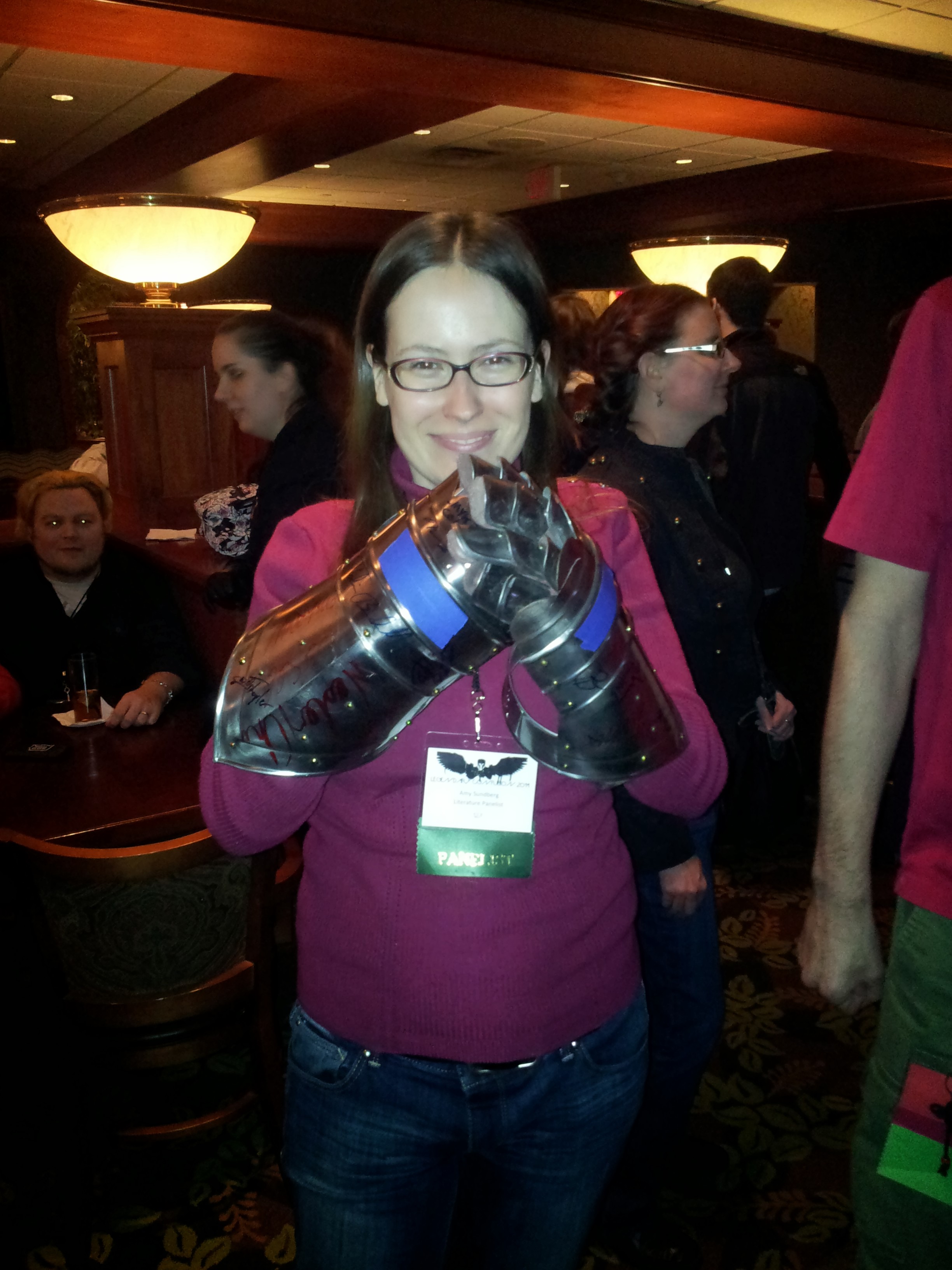
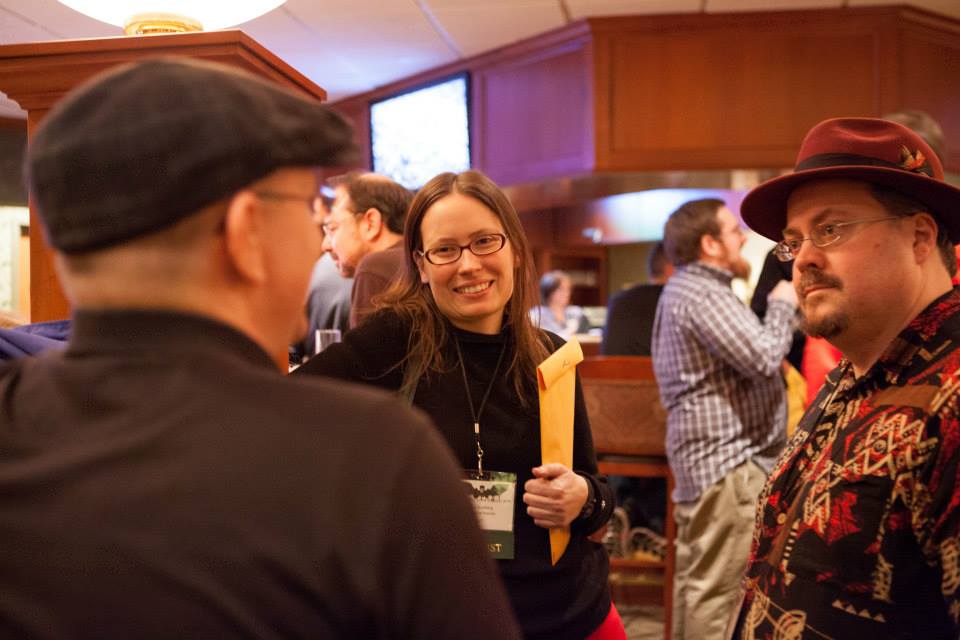
Being writerly at the ConFusion barcon. Photo by Al Bogdan

Being writerly at the ConFusion barcon. Photo by Al Bogdan, 2014

More generally, I’ve been thinking of how important my writer community is to me. As a consequence, I’m bumping a Seattle visit up the priority list this year and considering the possibility of scheduling some Skype writer dates. Too much creative isolation does not a happy Amy make.

All in all, it was a very successful and productive weekend.

Read Full Post »

1.

There’s this article beginning to make the rounds called “My Wife is a Terrible Piano Player.” I’ll confess I didn’t read the whole thing, but I like its main point. When we start doing something new, we’re usually bad at it. The first time I tried to play the piano, I’m sure I sounded like a little kid pounding randomly on a lot of keys. Because in fact, that’s what I was. It took years of time and practice and instruction and effort for me to become a passable pianist.

This makes me think about grit, a word I’ve seen pop up a lot lately. There are several components to grit, it seems, but one of them must be the ability to persevere even when we’re bad at something. Really bad. Wince-worthy bad, our efforts plagued with mistakes, missteps (or misnotes, as the case may be), and misunderstandings.

The first time I play a new board game, I never expect to win. It’s not that I think winning is impossible or that I’m not good at games. But I like to give myself the space to be bad while I’m learning. I want to experiment. I want to be able to make mistakes without embarrassment or disappointment. Isn’t that what learning is all about?

2.

But some people grow discouraged and give up. They don’t give themselves the time they would need to become good at something.

I saw this difficulty as a teacher. It was particularly prevalent with gifted children. They were so used to everything coming easily to them that when something didn’t–like, say, music, which pretty much always requires lots of practice–it was really difficult for them to continue. They grew frustrated. They weren’t used to having to wait to become good.

Music lessons were probably one of the best things those children could have been doing. Because really what they were learning was not only music, but grit.

Photo Credit: Alan Cleaver via Compfight cc

3.

If, then, part of grit is giving ourselves permission to be bad at the beginning of learning something new, then another part of grit is cultivating self-discipline.

Becoming good at something is not always going to be fun. I love singing, but have I loved every minute of becoming a good singer? Have I enjoyed learning every song I’ve ever been assigned, figuring out how to practice effectively when I’m sick, doing the same exercise over and over and over, giving a poor audition? No. I love writing, but have I loved every minute of improving as a writer? Do I love the times when I’m stuck or whenever I realize my world building sucks or the endless revising or the hours upon hours writing personalized agent query letters? No.

If becoming good at something was pure enjoyment, we wouldn’t need much self-discipline. But there are always going to be off days and parts that aren’t very fun and repetition that is so boring you just want to scream at your screen and then go do anything else. And for things that don’t come with automatic structure, we have to provide ourselves with our own motivation and our own goal-setting as well.

Self-discipline, self-motivation, self-direction? All part of grit.

4.

Just in case anybody wants to talk about talent? Forget about it. Grit is more important.

We can argue about whether talent exists. I happen to think it does. But talent without grit is not enough. Grit without talent might be. Talent might give an extra boost, but having that boost makes it less likely you’ll develop the necessary grit. So if you do have talent, that means you have to work even harder.

5.

So the next time you start learning something new and you really, really suck at it, congratulate yourself and give yourself a pat on the back. “Good job for persevering, self,” you can say. “You’re showing some real grit.”

Read Full Post »

New Year’s Eve.

I’ve been waiting for this day for what feels like a very long time.

If 2012 was a year of internal change for me, then 2013 was the year of actually making that change happen. A year of logistics. A year of stress and uncertainty. A year of trial and error. Sometimes lots of errors. Learning isn’t always a graceful process.

It was a hard year. But I did what most needed to be done. I tried out some paths I wish I hadn’t taken, and was tempted by more that I wish I hadn’t been tempted by, and had more difficulty making different choices than I wish I had to experience. But in the end, I made those different choices. That is what really matters.

As a result, I’m moving into 2014 with my life perhaps as clean as it has ever been. Not spotless, no, and frankly, I don’t think it ever will be. But clean, with plenty of space. I’m no longer squashed into the corner. It’s a good feeling, and it brings with it the happiness from having accomplished something.

Nala is excited for 2014, too.

Nala is excited for 2014, too. Especially now that she has TWO dragon squeaky toys.

In 2013, I:

  • Received several partial and full requests from agents for Academy

  • Completed a fairly sizable rewrite of Academy

  • Wrote 75% of a science fiction novel that I ultimately determined wasn’t working as it was

  • Began conceptualizing the next novel on my slate

  • Attended five writing events and one World Domination conference

  • Continued regularly blogging (WordPress tells me there were 95 posts this year)

  • Moved

  • Traveled to France!

  • Read 50 books and 16 plays

  • Played several games of BSG, several sessions of Spirit of the Century, and a short Exalted reunion campaign

  • Made new friends and became closer to old friends

  • Went to several plays and musicals and attended a fabulous New Works festival

In 2014, I hope to:

  • Continue to query Academy until I reach my target number of queries

  • Write my next novel

  • Put that novel through a few revision cycles

  • Continue my blogging here

  • Attend at least five writing events (ConFusion, the Rainforest Writing Retreat, FOGcon, the Nebulas, and WFC)

  • Either travel to London for a dose of my favorite city and Worldcon, or travel somewhere else exciting (I’d really like to go to NYC this spring, for example, to see a bunch of new shows coming out. Or Iceland. Or Harry Potter World. Or Japan. Or have a lovely Seattle writing retreat. Or go to some other conventions. Or who knows!)

  • Spend lots of quality time with my friends. See non-local friends I haven’t gotten to see in too long. Make new friends.

  • Strengthen my pesky left ankle

  • Go to a few local museums (the Tech, the Exploratorium, the California Academy of Sciences, the Walt Disney Museum)

  • Throw a party or two

  • Get back into singing shape

  • Continue having adventures

What do you want to do next year? Have any goals or hopes?

Here’s to a wonderful 2014!

Read Full Post »

I made a hard decision on Friday.

I decided to abandon my current novel-in-progress.

Currently at 61,000 words in length, this novel represents a large amount of my time and effort. It is about 75% completed.

It is also not working. And I don’t mean that in a rough-drafts-suck kind of way, but in a there-are-several-deep-systemic-problems-here-and-most-of-this-needs-to-be-thrown-out kind of way. So I am putting it aside. Maybe at some point I’ll know how to fix these deep systemic problems and I’ll return to the project. Or maybe I won’t. It’s hard to say.

Scott Adams had a good point in his widely shared article about failure: that there are people who focus on goals and people who focus on systems, and it is the people who focus on systems who tend to do better.

Don’t get me wrong; I think having goals is important. I’m a planner, and goals help structure planning. But ultimately, we want to have goals that support our system. When the goal no longer supports the system, it is time to change the goal.

My system is to be continuously improving myself as a writer while looking for opportunities to advance my career. My goal was to complete this novel. When I started the novel, the goal was in line with the system, but that is no longer the case. Being aware of the broken aspects of the novel, at this point I’ve been going through the motions, which isn’t teaching me all that much. (If I didn’t know how to finish projects, or if I felt I could learn a lot about endings by finishing, this might not be the case. But neither of those applies this time.) And finishing a novel this broken won’t do anything for my career except take time I could be using elsewhere.

That’s not to say I haven’t learned a lot from this project because oh wow, have I ever. I’ll take all of that knowledge and experience with me to the next project, where I’ll put it to good use. But sometimes it’s important to be able to figure out when to cut your losses and walk away. My own personal tendency is to hang on too long. This is another opportunity to practice not doing that.

If you’re wondering how I’m feeling, well, I just put 61,000 words into a drawer, which is not the most pleasant experience ever. But at the same time, I do feel good about this decision. I am excited to have more time to work on other projects that I believe in. I’m happy to be moving forward.

Failure is hard, but it’s also necessary when we’re trying to push our limits and become better. So this is not a horribly discouraging thing. I’d feel a lot worse if I no longer believed in my system, but I do. Nothing fundamental has changed. I’m just moving on to the next stepping stone.

What is your system? Are your goals in line with it? How do you feel about failure?

Read Full Post »

Theodora Goss recently wrote one of those lists of what she’s learned in her life. The entire post is worth a read, but I was particularly interested in her #9:

“Your habits create who you are.”

I completely agree with Dora. Our habits are the building blocks of our lives and of our identities. I actually love this truth because while changing habits can be difficult, it is very possible. So that means if we don’t like our lives or identities, we can work towards doing something about that.

Photo Credit: Celestine Chua via Compfight cc

Take the identity of being a writer, for example. (How could I not go there?) Some people are satisfied with the daydream of being a writer, which is fine but unlikely to bring about the reality. But for people who seriously want to claim the writer identity, it’s all about habits. It’s about making the time to write on a regular basis. It’s about making a commitment to finish projects. It’s about revising and reading other people’s work and thinking critically and educating yourself to become better. All those activities can be developed into habits over time.

This works for personality traits to a certain extent, too. We all have our original set points for different traits, and some of us will have to work harder than others to change and maintain those points, or will have limits to where we can move those points. But we can choose to encourage new habits that develop a certain trait. I used to be quite shy when I was younger, but I decided it wasn’t really very fun to be shy. So I practiced meeting people, I practiced inviting people to do things, I said yes to invitations, and I cultivated new hobbies that encouraged me to be social. I still have my shy moments, but now I often look at those moments as a challenge or game that I can try to succeed at as opposed to a miserable experience. And really, most of the time I’m not very shy at all because of the habits I eventually formed. I’ve talked to several other people who have had similar experiences.

And finally, habits even affect the kind of thoughts we have. That’s what Cognitive Behavioral Therapy (CBT) is all about. If we decide we want to be more positive, we can explicitly practice framing our thoughts in more positive ways until it becomes second nature. If we want more self esteem, we can practice thinking kinder thoughts about ourselves until, you’ve got it, those thoughts become second nature (or at least more frequent). Sometimes a lot of how we see the world is affected by our individual thought patterns, which are really just habits of thinking we’ve picked up over time.

When I think about it, I realize how strongly my habits shape my life, from how I spend my time to what and how I think to what my actual expressed priorities are. Of course, habits can arise FROM those priorities as well as shape what those priorities are. I think that’s why I care so much about living an examined life, so I can be more conscious about choosing those priorities and figuring out how to express them rather than have priorities happen TO me.

What habits have you chosen to develop? What habits do you want to change?

Read Full Post »

Today you are reading one of my (relatively) rare writing posts, in which I am mostly going to share intelligent things that other people have said about writing. I admit that I am somewhat motivated by the selfish reason of wanting these articles available in the future for my own easy reference. But I’m also motivated because I’ve been thinking more about short stories lately because I’m critiquing three of them for WorldCon’s writing workshop, which takes place later this week.

First off, Goodreads did a survey on why people stop reading books. I’m fascinated by how many people don’t stop reading in the middle of a book because “as a rule, I like to finish things”: 36.6%! I’m so interested because I stop reading books all the time. I always have so many books in queue that I either should read or want to read that I’ll stop for any number of reasons: I’m not in the right mood, there’s another book I want to read more, the book doesn’t grab me, I can tell it’s not to my taste, etc.

But probably the most interesting number from that survey is that the single biggest reason why people stop reading a novel is because they find it BORING. From what I’ve heard, this is also one of the biggest reasons why slush readers stop reading novels and stories. So if you’re a writer, wanting to learn how to not be boring is a legitimate concern.

Photo Credit: Esellee via Compfight cc

Rahul Kanakia, otherwise known as my favorite blogger, shares some thoughts about the difference between short stories and novels in the boredom department. Rahul was a slush reader for Strange Horizons and now teaches writing to unsuspecting undergrad students at John Hopkins, so he knows that of which he speaks. He talks about having the “So what?” reaction to short stories, which is one I often have as well, and how to work towards inspiring a stronger reaction.

(Incidentally, it’s really interesting to think about the different things that a reader tends to want from a short story vs. from a novel. There definitely seem to be things you can get away with more easily in a novel than a short story, and vice versa.)

Ann Leckie, who edits GigaNotoSaurus, among other things, writes about a problem she often sees in her slush pile: namely, that much of the work she reads is not very original and involve ideas that haven’t been thought all the way through. Which results in what exactly? You guessed it: BORING stories.

Finally, I think anyone involved in narrative storytelling should check out this article, which I first read more than three years ago and still refer back to. (I expect to be referring back to it thirty years from now.) James Van Pelt wrote an outline of a talk he was going to give about writing a great ending. I am such a stickler for stories and novels landing the ending, and this blog post is the best discussion of how to achieve this that I’ve come across so far.

Have you stumbled across any great writing resources or articles lately? Been thinking about any aspect of writing in particular? Feel free to share in the comments!

Read Full Post »

“…Pursuing an artistic career gives you permission to divorce your sense of self-worth from the economic marketplace.” – Rahul Kanakia

I was raised in a household that tied together self-worth, the value of any given activity, and finances. Being able to be financially independent was seen as the pinnacle of achievement. Education was important, but primarily as a means to an end, the end being making money. (Why my maintaining a 4.0 grade point average was so important therefore becomes a bit of a mystery, since my family couldn’t afford to send me to a prestigious university, student loans were frowned upon, and being able to get all A’s has very little to do with earning money outside of school. But I digress.)

I remember the revelation my senior year of high school when I met a musician who made ends meet with a variety of accompaniment gigs and modeling for art students. I had no idea that was a choice people could make: that money, instead of being the entire goal, could merely be the means to an end, the end in this case of being an artist. My whole conception of what my life could be changed.

But even so, the insidious feeling that the financial returns of an activity and its worth were linked persisted. In my father’s eyes, I didn’t feel like my music was terribly important until it became my means of supporting myself. I was forbidden from even considering pursuing a BM (Bachelor of Music) in college instead of a BA in case it affected my future job prospects.  (As it turns out, it wouldn’t have made any difference.) I always had doubts as to whether I was a real musician until I opened up my music studio and it became successful.

Photo Credit: StGrundy via Compfight cc

Of course, that was all very silly. Being a musician is much more about attitude than it is about money. Many musicians never make any money at all through their music. Similarly, being a writer is more a state of mind than anything else. It has to do with discipline and dedication, time spent and patience to practice, and the personal importance of it. The identity of being a writer has very little to do with money.

At this point, I have, as Rahul puts it, divorced my sense of self-worth from the economic marketplace. I am grateful that I was taught the skills to be financially responsible, but I don’t believe who I am and how I feel about myself should have anything to do with where my money comes from or how much money I have.

Ultimately, attaching our self worth to anything outside of ourselves is a risky business. The kind of self esteem that endures through the ups and downs of life comes from inside. The outside will disrupt it, of course, but so often that interference turns out to be only noise.

Being an artist is useful not so much for finding a substitute to tie to self worth (a recipe for unhappiness in the tumultuous world of rejections, revisions, and critics). Instead, being an artist can inspire us to ask questions that allow us to make different choices about our relationships with ourselves.

What is your relationship with money? How much does it affect how you feel about yourself?

Read Full Post »

Hello again! Long time no see.

I spent most of my month’s absence in France, eating delectable cuisine, soaking up sun, exposing myself to different experiences, and reading many, many books. And not once during my three and a half week trip did I check my email or log onto Facebook or read any blogs. (I did look up some travel information and Wikipedia pages on the internet, and that was about it.)

I hadn’t unplugged myself so thoroughly for quite some time, and I found quite a lot of value in it. Space to just be. Time to think about whatever I wanted to think about. Permission to be in my own present moment, whatever that happened to look like. And perhaps most refreshing, a break from most external stress.

Sometimes that’s what we want from vacations: a break from our regular lives and some of our ongoing problems, giving us a chance to recharge. Sometimes this leads to personal epiphanies, and sometimes it leads to a chance to rest. Both are valuable.

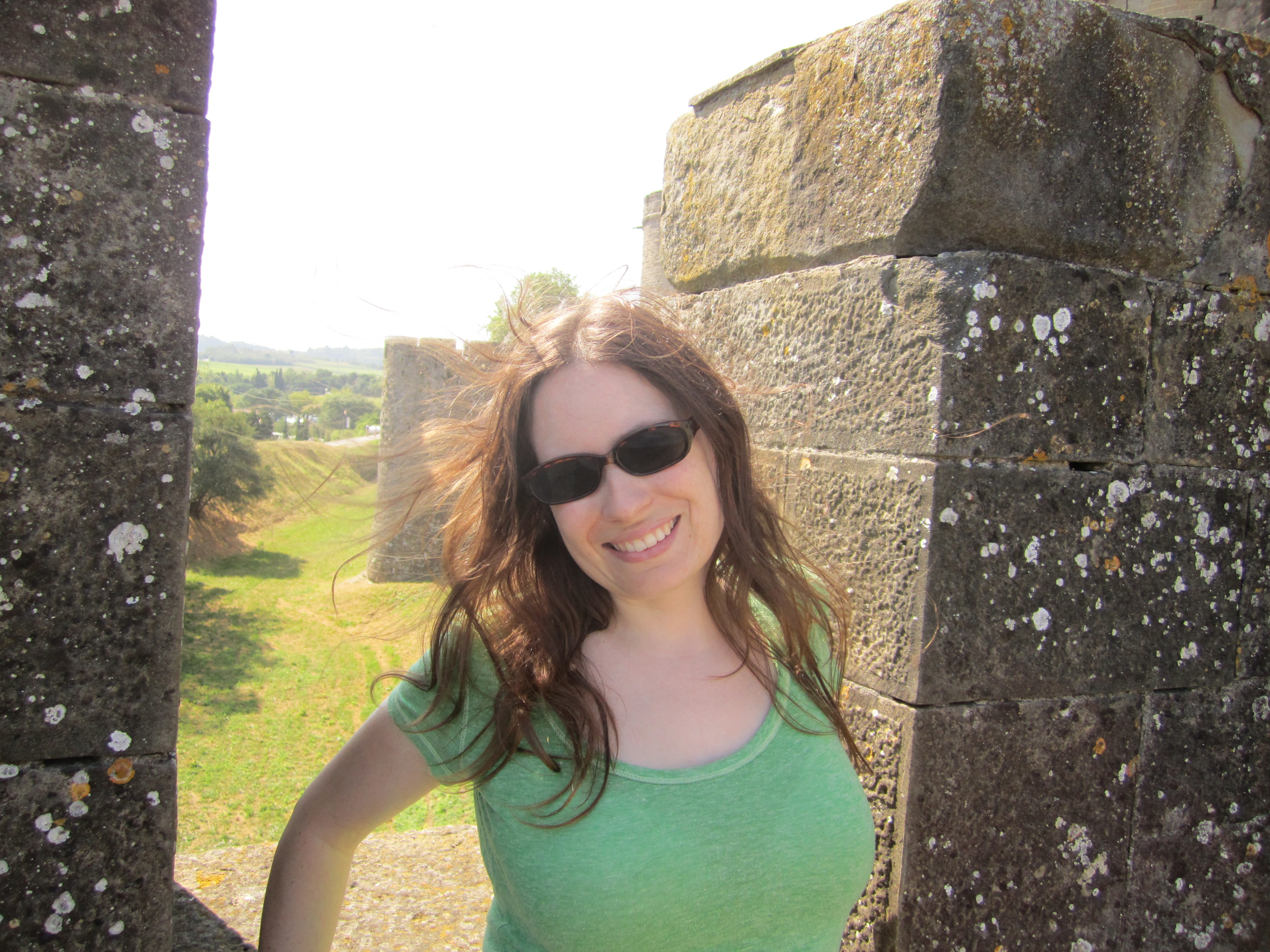
A relaxed Amy in Carcassonne.

A relaxed Amy in Carcassonne.

Taking a break from social media also reminded me afresh how much I appreciate my friends and colleagues. While I didn’t find myself overly tempted to log in, I thought about my friends a fair amount. I wondered how they were doing, and I wished I could send them little texts telling them how fabulous they are. I’m so grateful for the technology that allows me to stay connected with the people who mean so much to me.

That’s probably my greatest takeaway from my time without internet: technology is wondrous, but I’m allowed to use it on my own terms. Writers hear so often about they have to be on this social media site, or that new shiny one, or write blog posts every day, or whatever the latest trend is. But the truth is that in order to continue to do any of those things, we have to find the value in what we’re doing. We have to recognize the amazing feeling of being able to stay close to people who we can’t see face-to-face all the time. We need to appreciate the ability to connect in different ways with our readers and find the way(s) that work best for us.

I know I’ve said this before, but it bears repeating. When we hate a thing or secretly resent it, we aren’t going to be doing our best work. A grudging connection has a different quality to it than one that is celebrated.

When I look behind all the best writer social media strategies, I see people who care. They care about their audiences. They care about providing something meaningful, whether that be information or entertainment or connection. Genuine caring is hard to fake. So our job, then, is to find a way to use social media that allows us to project our caring outwards, while still being able to take care of ourselves.

So how do I feel after my social media time off? Well, right now I’m jet lagged, and I have a head cold, so I’m not exactly feeling refreshed. But I’m so proud of myself for taking the break I needed.

And guess what? Nothing terrible happened. The blog continues. My friends and colleagues are still here. No crises occurred that needed my personal attention. The world doesn’t actually require my constant attention to keep turning.

Sometimes a reminder of that can be a very good thing.

Read Full Post »

« Newer Posts - Older Posts »