Feeds:
Posts
Comments

Posts Tagged ‘meaning’

I talk about creating change a lot, and I want to be clear about what I’m talking about. Making a change in our lives is not necessarily about happiness. I mean, it can be, but that is not the only reason to change. And even if the end goal is happiness, the process of change itself is not conducive to increased happiness; it’s too difficult and stressful for that.

So why change, then? We may wish to change to create more meaning for ourselves and our lives. We may wish to tell a different story with our lives than the one we find ourselves in. We may be thirsty for challenge or new experiences. We may be on a quest to become healthier or more empowered or more mindful. Or we may sense that we are being pushed down below our natural happiness setting and wish to change the circumstances causing this.

A lot of people are looking for something. We may be looking for happiness, or we may be looking for comfort or satisfaction or excitement. We may be looking for answers to questions that echo down the years of our lives. We may be looking for something larger than ourselves.

Photo Credit: h.koppdelaney via Compfight cc

At the World Domination Summit, Donald Miller, a memoirist, spoke about the psychiatrist Viktor Frankl, who wrote the bestselling book Man’s Search for Meaning. Dr. Frankl was a Holocaust survivor, and he worked professionally with Holocaust survivors. For him, life was all about creating meaning, even in the face of horrific circumstances.

According to Mr. Miller, Dr. Frankl believed three things mattered in creating a meaningful life:

1. Having a meaningful project that helps the world in some way (note this doesn’t have to be a paying project)

2. Having personal connections with other people, whether that be family, a significant other, friends, and/or a community

3. Having a redemptive perspective on suffering; aka finding the meaning in suffering, feeling one is achieving something through one’s suffering, choosing how to respond to suffering, etc.

This is some of the best advice on how to live life that I have ever heard. It’s so practical. It doesn’t wince away from the tough realities that sometimes face us. And it crystallizes my thoughts about my own life. It’s not happiness I’m seeking, not really. It’s meaning. It’s the ability to have a life that matters to me, and one in which I’ll be okay even in the darkest of times.

“Life is never made unbearable by circumstances, but only by lack of meaning and purpose.” – Viktor Frankl

Maybe the happiness research is correct, and there isn’t very much we can do to affect our own personal happiness levels (although gratitude and mindfulness practice seem to help). But if we are most concerned with meaning, then that hardly matters. We don’t have to be the happiest people on the planet in order to create meaningful lives. We simply have to decide that meaning is important to us and make choices that reflect that belief.

A project that matters. Being brave, finding the silver lining, and experiencing gratitude even through bad experiences. Love.

Yes. These are the building blocks of the life I want to live.

Read Full Post »

Many years ago, when I was just starting up my music teaching studio, a friend and I would get together every Thursday morning to talk about writing. Sometimes we wrote to prompts when we were together, sometimes we shared what we’d been working on, sometimes we just talked. I was writing in a somewhat desultory way, since my main focus at the time was still music. But even so, I loved writing and I had the vision of seven-year-old me in the back of my mind.

My friend and I both read Carolyn See’s Making a Literary Life and then discussed it. And we decided to implement its advice on charming notes.

Photo Credit: LarimdaME via Compfight cc

What is a charming note? Exactly what it sounds like. Every week, each of us would choose one writer to whom we’d write a letter telling them how much their work had meant to us. We bought pretty paper on which to write these letters when we couldn’t get our hands on the relevant email addresses, and we began sending them out.

There is something very uplifting about writing to someone unknown to you and telling them something both true and kind for no other reward than the joy of doing it.

I was reminded of the charming note ritual a few weeks ago when Jonathan Carroll talked about a charming note he once sent, and the response he received. It made me glad all over again that I had written those letters, and I wondered if maybe I could start writing them again, especially now that more writers have email addresses and websites so I can avoid the hassle of buying new stationary and remembering to purchase stamps more regularly.

Because charming notes matter. I know how much they matter. Jonathan Carroll said, “It’s a very important thing to tell someone what they do genuinely matters to you. Especially artists, who work so much of the time in solitude and receive little feedback other than reviews.” It means so much to know your efforts have been genuinely appreciated. It means so much to hear how you’ve helped someone or inspired someone or given that person something to love.

When I’m working, I’m alone (except for the little dog fast asleep beside me). When I’m writing a novel, it can be months and months before anyone gets to see any of the results of my time, and even then, they are often reading it as a favor to me so they can tell me how to make it better. So much of my work goes on in my own head, a huge contrast from the days when I spent hours of my time engaged in face-to-face teaching. I often can’t see the effect I’m having with my words. So when someone makes the effort to write me a note or leave a thoughtful comment, whether it’s about my blog or a short story, they allow me to see my work from a completely different perspective. They give a new meaning to the words I have shared with the world. And they inspire me to continue to write. Such is the power of the charming note.

I wonder who I’ll write to next.


Read Full Post »

I have a new favorite Facebook personage whose page I have liked. He’s a writer named Jonathan Carroll, and he posts all of these amazing quotations and excerpts from his work that tend to be quite insightful and make me happy.

Here’s a quote he shared earlier this week: “It is a great art to laugh at your own misfortune.” – Danish proverb

Photo by Manosij Mukherjee

Remember how I said one mark of emotional resiliency is developing a sense of humor? (I know, I know, I keep going back to that, but I’m just so excited to have a name for one of my interests.) I suspect that an especially helpful part of humor is the ability to laugh at yourself, your life, your world. And when I can’t do that, when I can’t find anything remotely funny, even the tiniest bit that is only tangentially related, well, that’s when I know I’m in for a real emotional wringer.

I was talking to someone about absurdity, and how a sense of absurdity in life can result in a loss of meaning. But I don’t think this has to be the case. Sometimes finding that hint of the absurd is the only way I can find humor in a given situation. Absurdity also makes it easier for me to laugh at myself, as I notice my own foibles and eccentricities. The trick, then, is to notice the absurdity around yourself while not allowing it to erode those ideas, relationships, or things through which you find meaning.

Perhaps we can do this by realizing that so much of everything is absurd if you’re looking at it from a certain perspective, and accepting the absurdity while still seeing the beauty and meaning shining through. (Is this a type of idealism, perhaps? Or optimism?) Look at writing, for example. So many things about writing are absurd. The cultural norms reflected both in and around writing, the prescribed structures of fiction, the putting down words and then deleting them and then putting down more words and then deleting them ad nauseam. The basic idea of fiction, of writing down a story that never happened and never will happen, has an element of absurdity in it–enough, in fact, that some people cannot enjoy fiction because of this (although I do wonder if this reflects on their ability to deal with absurdity in other realms of life as well). What about the idea of becoming immortal through your words, an absurd idea if I ever heard one given the low chances of being one of the few writers whose works are still being read two hundred years later. And don’t even get me started on the absurdities inherent in the business aspects of being a writer, because they are legion.

And yet, writing still has deep meaning for me. I can laugh at it (and I do), and then I sit down and write some more. Absurdity doesn’t erase the importance of writing for me; it is a part of writing, and then there are other aspects of writing that call to me and make the time and energy spent on it seem deeply worthwhile. It’s a similar strangeness to that of concurrently laughing at yourself and taking yourself very seriously.

I wish I had something sage but pithy to say about how to develop the art of laughing at oneself. But the truth is, sometimes it comes easily to me and sometimes it doesn’t. I do find that the more I can gain a wider perspective and the less caught up in perfectionism I am, the easier it gets. So I suppose that’s my insight for today: Look outside of yourself. Allow yourself imperfections. Go ahead and hold yourself to a high standard to begin with, but be gentle when you fall down. Cultivate laughter. And spend time around people who do the same.

What are you laughing about today?

Read Full Post »

One of the traits I mentioned last week that is connected with resilience is perspective, and part of perspective is the ability to find or create meaning. In a conversation about resilience, that meaning is most often crafted around circumstances of difficulty, but really humans are looking everywhere for meaning all the time.

Photo by Patrick Hoesly

James Altucher gives a great example of this in his latest Q&A post, in which someone asks him whether their sadness will ever go away. James’s answer, especially the fourth point of it, is a textbook example of emotional resilience by creating meaning: “When I feel sad… the universe will grieve but then rejoice because it’s learning so much. Then I can rejoice because every pain, every sadness, every moment, is ME, the universe manifest, learning something new.” He believes that every moment of his life is a learning experience for the universe, and therefore his life is infused with meaning. And this helps him deal with feelings of sadness.

A few days after I read this Q&A, I read Karawynn Long’s latest post, “How American culture is causing widespread misery.” She talks about the correlation between a shift in American culture and increasing rates of depression, and offers some suggestions as to what we individually can do about this. It’s really fascinating, especially this part: “As our culture shifted to exalt the benefits of personal choice and individual success, Seligman explains, we were also losing confidence in the larger constructs of society. Previously, he says, Americans lived in “a context of meaning and hope.” When we encountered failure, we could take reassurance from something larger than ourselves: “a belief in the nation, in God, in one’s family, or in a purpose that transcends our lives.” But as Carter noted, in the middle of the twentieth century that reassurance began to disintegrate.”

So with an increasing distrust in government, along with declines in active religious faith and more closely knit (and often geographically close) families, Americans suffered from more depression. In other words, with loss of meaning came decreased emotional resilience.

Of course, we can, and do, find meaning elsewhere, whether or not we believe in God or our families or the government. Personally, I have found a great deal of meaning in teaching, particularly children and teens, and while I’m not teaching at present, I suspect I’ll do it again at some point in the future. I find meaning in my writing, both my fiction (fiction is inherently about creating meaning) and on this blog. I find meaning through the communities I am part of, in the relationships I have formed, and in self transformation. I find meaning through learning more about the world and universe around me, and through shifting perspectives to remember how small I really am, both in scales of size and time.

What we are fighting against is a sense of futility, the thought that nothing we do matters or makes a difference, the urge to coast or settle or fall into a rut. Instead we believe in the butterfly effect. We believe our choices matter, whether that be the choice to recycle that piece of paper or to smile at the clerk at the grocery store or to give a significant amount of money to a charity or Kickstarter. We create meaning by being mindful about the cause and effect of what we do every day.

How do you create meaning in your life?

Read Full Post »

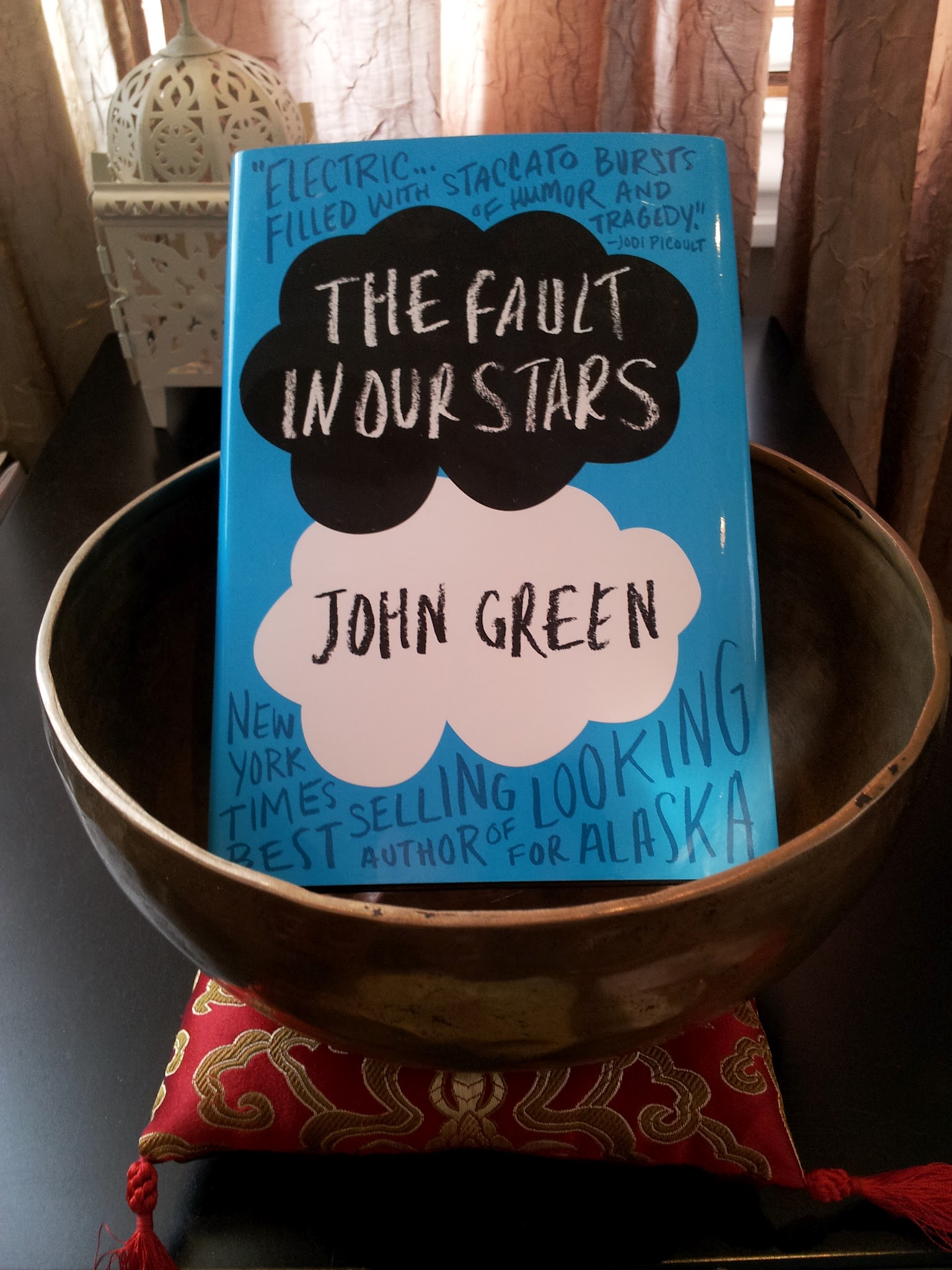
Last week I read John Green’s new novel, The Fault in our Stars.

This is not a review.

After I had read the first twenty-one pages, I told my husband this was going to be the best book I’d read all year.

A little while later I went to the bookstore and bought the hard copy because if Amazon ever disappears and I no longer have access to my e-books, not having this novel would be a particular tragedy. Also, I wanted to hold the tangible printed version in my hands.

When I was twelve, I started writing a novel from the point of view a girl about my age who had been diagnosed as HIV positive. I didn’t get very far with it, but it has lived on in my mind ever since. So when I heard the premise of The Fault in our Stars, I knew I had to read it. It is a novel from the point of view of a girl of sixteen who has terminal cancer. It is a heart sister to the novel I never wrote, that I couldn’t write, and the fact that it exists makes me breathe more freely.

This novel is not a sappy issue book that makes you want to yell at it as if it is conscious before you hurl it across the room and mope.

This novel is not an easy book to read. I can only imagine what it must have been like to write.

This novel is not perfect. Our protagonist says at one point that the movie V for Vendetta is a boy movie. I completely disagree. Of course, one could argue that this slight blemish makes the book even more perfect.

If you talk like either of the two main characters and/or think about the things they think about, I want to be your friend. We can go to a coffee shop every week and have deep existential conversations in between making ironic statements that have us internally rolling on the floor even though on the outside we only cue our mirth with a certain type of smile. If you don’t live nearby, you should move here. It will be worth it.

Also, when you worry about what your life means or may mean or may not mean, I will hold your hand, if you will hold mine.

In the meantime, enjoy this novel. Its construction is a miracle to behold. It has layers upon layers, a story within a story (and then some). It plays with language. It is a brave book. It talks about things that matter that maybe most people don’t want to talk about, like death and dying and illness and meaning and love that lasts through it all. It does not flinch away.

This book punched my heart even while it fed it. Or it filled it up till brimming even while it broke it.

Thank you, John Green.

Read Full Post »

In the book about plot I’m reading (20 Master Plots, by Ronald Tobias), Mr. Tobias talks about how plot and structure in fiction differ from real life. In real life, he says, there are not the same links of causation. Life is chaotic and sometimes (even often), things occur because of chance and wild coincidence (whereas in fiction, it’s really hard to get away with coincidence and generally denotes sloppy plotting). Some loose ends never get wrapped up in real life, we never know the true “ending”, and much of what happens seems to be without meaning and never gets explained. The Absurdists try to reflect this random reality in their literature: Camus and Kafka are two well-known writers who do this well. (And incidentally, you know who else identifies as an Absurdist? Joss Whedon. An explanation for Puppet Angel, perhaps.)

From the TV show Angel

Theodora Goss, who has a beautiful blog, has a slightly different view: “Happiness is the ability to create satisfying stories about reality. To find the stories that fulfill you, that allow you to achieve what you desire. That fill you with joy. Because reality is, to a certain extent, our perception of it. Achieving what you desire may also involve altering reality itself, changing your circumstance.”

I’m inclined to agree with her. The power of storytelling is making order from chaos and meaning from seemingly unrelated events. But stories don’t merely reside in our books and entertainments. We are constantly telling ourselves our own stories, and in so doing, we are cementing certain events into memory and into part of who we are. By doing this, we construct a reality that no longer appears quite so random and out of control.

We are in the continuous process of creating ourselves. “I’m the person who did xyz. I’m the person to whom this happened. I’m the person who spends my time in this way. This is what is important to me.” That’s why I’m always harping about the importance of priorities. Because priorities are a way of expressing deep truths about ourselves and making our most important desires into reality.

Humans as a species are fascinated by the quest for meaning. This desire for meaning is reflected in many aspects of our culture: in our art, our religions, the Enlightenment and our fervor for science, and our ease of slipping into diametric thinking (black and white, good and evil). We spend our lives trying to make sense of our childhoods, the people around us, and the huge life-altering events that intrude into our sense of order (war, natural disaster, illness and death, wide-scale oppression and resistance). We ask, why are things the way they are? How does the universe work? In what direction is human civilization heading? Or, more personally, why doesn’t So-and-so like me? What is my purpose in life? What will make me happy?

We have to be very careful with the stories we tell ourselves, the movies in our minds. (You can thank Miss Saigon for that pretty turn of phrase.) If we tell ourselves negative stories or harshly self-critical stories, these stories will eventually manifest themselves, often in self-limiting behaviors and self-fulfilling prophecies of gloom and unhappiness. If, on the other hand, we tell ourselves that we’re geniuses who can do no wrong, we can become out of touch with the humanity around us and struggle to find compassion for others.

On their own, our lives do not fit together neatly into a perfect puzzle of reality. We create the frame of reference from which we can understand ourselves and the world around us. We make our own explanations and our own meaning. What this means, I believe, is that ultimately we choose the slant of our lives until we die. Are we empowered? Can we make change? Or are we victims or characters in a tragedy, or are we taking an active role in life? Can we find the good in our situation and encourage it to grow? Or is everything about life difficult and glaring and out to get us?

In the movie Holiday, the old screenwriter Arthur tells his friend Iris that she should be “the leading lady” of her own life, but for some reason she is behaving “like the best friend.” We each have that choice in the stories we tell ourselves. Are we the hero of our tale, or are we relegating ourselves to a supporting role?

Be the hero. Be the protagonist. Be the person who acts instead of the person who is acted upon. We are all leading ladies and men. And we each get the privilege of creating the stories of our lives.

Read Full Post »

« Newer Posts