Feeds:
Posts
Comments

Posts Tagged ‘friendship’

Shortly after I published Friendship Can Be Like Dating, I received a text from a long-distance friend of mine. How did internet friendships play into my theories, he wanted to know. He had a point. After all, he and I are good friends and we definitely don’t see each other once a week. If we see each once a year, it’s time to break out the party hats. And thus, an idea for another blog post was born.

Do I think it’s possible to be close friends with people who don’t live locally? Definitely. Do I think it’s possible to be close friends with people whom I’ve met on the internet? Yes, if certain things happen.

Basically, in order to be close friends, you’ve got to find some way to have both time and intimacy with one another. Without these, it’s hard for a relationship to grow beyond a pleasant acquaintanceship. Luckily for us, both of these things are possible using technology, which means we’re no longer as limited by geography in developing friendships.
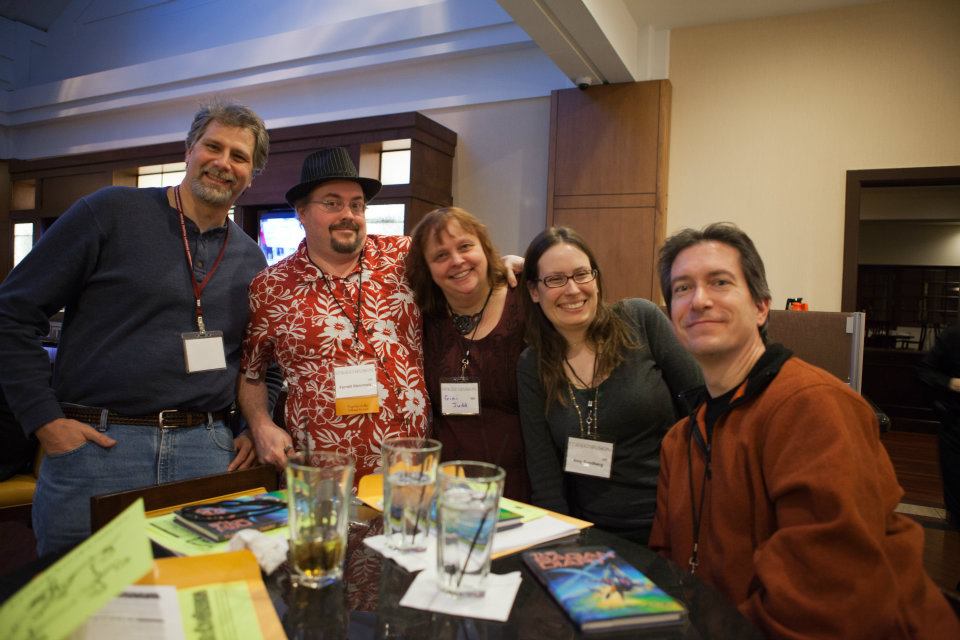
Photo by Al Bogdan (another long distance friend).

Photo by Al Bogdan (another long distance friend)

I still think the Once a Week theory holds true in the online realm. The friends we interact with on a weekly basis feel like an active part of our lives. The friends we interact with on a monthly basis still feel present. Less than that, and we become less aware of and engaged with each other. (That’s not to say you can’t still be friends; it simply means you won’t be as immediately close and involved.)

But interactions look different when we live far apart. A few of my friends and I are what I call “text friends” because we communicate primarily via text. We might have an entire conversation over text, or we might just send a quick “You are my favorite brand of awesomesauce” kind of text. But what we’re doing whenever we send one is saying, “Hey, I’m thinking about you, I love you, and I value our friendship.” I have other friends who are “Twitter friends” because we mostly chat on Twitter. Still others are e-mail friends or Facebook/Facebook message friends or Skype friends. Time spent interacting is important, but interacting at all also plays a larger role in these LDFs (long distance friendships).

One of the great things about LDFs is that it is often easier to get one-on-one time. Although there are group-focused ways to communicate, many of the most common methods require forming a personal one-on-one relationship. Whether I’m sending texts to my friends in Ohio and Washington or Skyping my friend in Boston, we’re focusing on each other.

Some of the communication techniques are also great for balancing friendships to be more two-sided. In both e-mail and text, for example, both people will get a chance to speak, talk about their lives and viewpoints, and be heard. And because there’s an inherent delay built into the communication, it’s a lot harder to be interrupted in a way that’s truly disruptive.

I do find that my LDFs are greatly enhanced by any amount of face-to-face time. Often, in fact, they begin with face-to-face time and grow into something closer over the internet. Many of my convention writer friendships have started like this. In person time can be hard (and expensive) to arrange, but when it works out it’s worth its weight in gold.

What do you think? Do you have close LDFs? How do you maintain these friendships?

Read Full Post »

A friend recently shared an article entitled “The Curse of the Connector.” Its tagline? “It’s easy to never be alone and yet very lonely.” The writer describes a glamorous Gatsby whirlwind of life in his social circle, in which everyone is supposed to always be doing something exciting and “crushing it.” But, he says, “The world desperately needs more “connections” to become true friendships.”

I live in the Silicon Valley, and I’ve experienced the culture the author is talking about. The “crush it” culture exhausts me because, on the surface at least, it seems to focus heavily on appearances. In addition, there is the “always busy” mentality. Meanwhile, we like to speculate on whether social media is making us more lonely. All of these ideas are interconnected, as they relate to the type and depth of connections with which we surround ourselves.

I’m going to rush right by the fact that the first mention about true friends in this article is that they make excellent personal brand consultants. (Really?!? That’s the first thing that comes to mind about friendship? Really?!?) At its heart, this article is about the realization that our lives are better when we have close friends as well as a large number of acquaintances, that friendship isn’t a numbers game or a mere ego boost.

Photo Credit: h.koppdelaney via Compfight cc

Yes, friendship takes time. Yes, it takes work. Yes, sometimes it can be quite difficult to find kindred spirits with whom to be close. Since last year was the Year of Friendship for me, I spent a lot of time thinking about these things, and now I have a few theories about friendship:

The Once a Week Theory: The more often you see somebody, the more likely you are to become close friends. Once a week or more is optimal. Once every other week is adequate. Less than once a month and the friendship probably doesn’t have the time to form right now. (For long distance friendship making, texts, emails, and Skypes can be substituted for in-person time. For established friendships, you can sometimes get by on less, but eventually you won’t be as close.)

It is no coincidence that many of my close friends get together every week for game night. I think of other close friends I’ve made, and there is generally either a concerted effort to see each other regularly, or a steady stream of texts or emails.

The One-on-One Theory: Sure, I can have good times with people at parties or group outings. But for me, a friendship becomes closer when I spend time one-on-one or in small groups (probably no more than four or five). The more one-on-one time I spend with somebody, the more likely we are to become close friends.

The Diminishing Returns Theory: Not everyone is going to be a perfect friend match. Maybe she’s too busy, maybe he’s going through a rough patch, maybe the two of us just didn’t click (or it was a one-sided click). Maybe there’s something in the friendship dynamic that isn’t working too well. It doesn’t mean you aren’t both great people, it just means you’re not going to become close. Happily, there are many more fabulous people out there who might become good friends. It works better to invest time with the people who will invest their time in you and can be part of a balanced and positive friendship. (Yes, friendship can be surprisingly like dating.)

Taylor’s Party Corollary: The closer the friend, the earlier you plan to arrive at their parties. It’s nice when a close friend arrives close to the start time. They can help set up, chat comfortably, hang out before the party picks up speed, or occupy early-arriving acquaintances and help the conversation flow. (Note: I am not good at this. I almost always arrive late to parties.)

How about you? Have any theories of your own about friendship?

Read Full Post »

In my ongoing quest to stop being a perfectionist and instead just be a human being, I have found the following strategies to be useful.

1. Get a dog. Dogs don’t care if you’re perfect; they only care that you love them.

Portrait of a Devoted Doggie

2. Reframe the idea of perfection. Decide it is impossible, or decide it encompasses more than a single rigid definition, or go all philosophical and decide that imperfection is perfect in its own way.

3. Spend time around people who appreciate your natural strengths.

4. Spend time around people who are okay when you falter.

5. In fact, spend lots of energy finding awesome people with whom to surround yourself. This helps with all sorts of things if you are paying attention.

6. Distinguish between situations in which you must present yourself professionally at all costs and those (often in your personal life) in which you have some more leeway.

7. For the latter, force yourself to be honest. Especially when you really don’t want to admit that you need help or that you’re having a rough time.

8. Accept that not all people are going to understand or believe your honesty. Change your response to this from a panicked “I must seek their approval at all costs” to a shrug. Be grateful for those who are supportive. (And if none of those exist in your life yet, go back to number 5 and try some more. They are out there.)

9. Remember that you are one person and that therefore you cannot do all the things. Even if other people want you to. Even if you want to.

10. Realize you can’t control everything, and that perfection doesn’t automatically equal happiness.

11. Actually, not only does perfection not equal happiness, it sometimes equals stress, burn-out, dysfunctional relationships, isolation, and despair. Remind yourself of its downsides when you’re having trouble letting go.

12. Embrace the cheesiness and tell yourself you love yourself. Tell this to yourself even more when you think you’ve fallen short.

Read Full Post »

This weekend, one of my closest friends had a heart attack. He spent most of the day Tuesday in surgery. On Wednesday, soon before I sat down to type this, he started breathing on his own again. The surgery went well, I think.

I am so relieved and grateful.

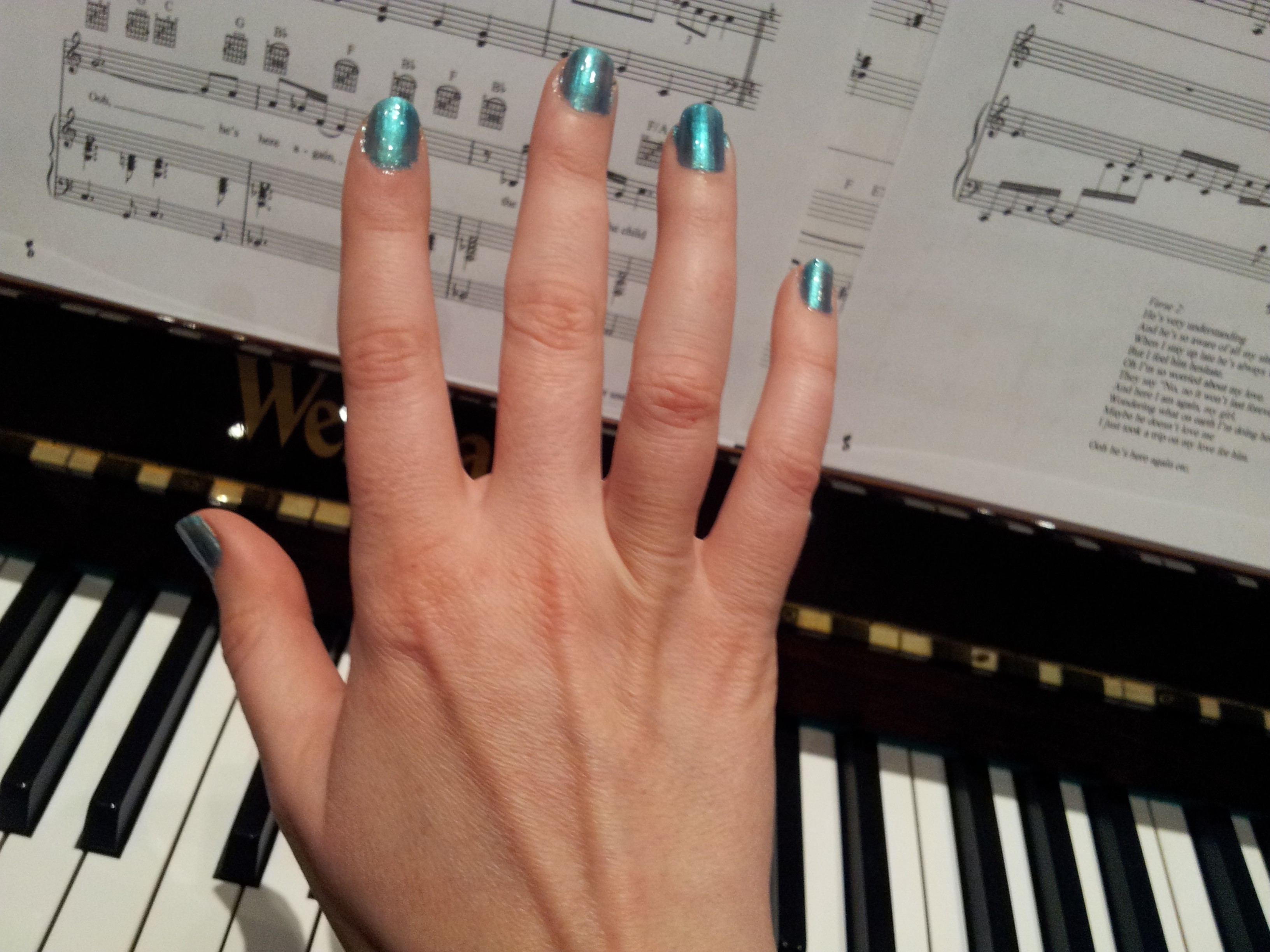
My "pretty princess" nails in support of Ferrett.

My “pretty princess” nails in support of Ferrett.

I originally became friends with Ferrett because of this blog, and in fact, he is the single person who has had the most influence on it. I came up with the idea of the Backbone Project because of his blogging advice, and in characteristic Ferrett fashion, he threw himself behind my idea with enthusiasm and support. And so we became friends.

Over time, we became better friends. And he was the first one who was there when life began to crumble apart. He was the one I could show the cracks and imperfections, the confusion and the doubt. He understood what I was trying to do, and he believed in my ability to do it, even when I couldn’t believe in it myself.

We were talking about what to do when we falter on Tuesday. If you’re lucky enough, having a friend who believes in you with all his heart can be a powerful thing indeed. And Ferrett has one of the biggest and most generous hearts of anyone I’ve met.

He’s also taught me what it means to be a friend. In a healthy, supportive, and non-people pleaser kind of way.

Through these last few days, when I’ve been mentally in a hospital in Cleveland even though I couldn’t be there physically, I’ve been reminded quite strongly of what’s important to me. I’m always big on priorities, of course, but there’s nothing like a life-or-death kind of event to give you a little extra kick and provide some perspective.

I’m in a liminal space right now, and I don’t like it. I mean, it has its advantages and interesting parts, and it is completely necessary, but it’s a hard place for me to stay for an extended period of time. But I realize that even in this space, I can and am focusing on the things that matter to me: the people I care about (and one very adorable little dog); my writing and creative work; maintaining and improving myself (physically, mentally, and emotionally); experiencing joy and wonder in the world around me.

Sometimes I feel like I don’t know what I want. But that is not actually true at all. I know exactly what I want. I just don’t always know the form it will take or the balance it will require.

Ferrett wrote a post for his blog the day before his surgery. He said: “There is a small chance that these will be the last words I ever write on this blog.  And if they are… let them be thanks and love.”

It doesn’t look like those will be his last words on the blog, thank goodness. But if they had been, they would have been very fine last words indeed.

Read Full Post »

I really miss e-mail.

Before you look at me funny and silently consider whether I’ve gone off the deep end, let me add that I don’t miss all the e-mail I actually get: various sales communications from any store I’ve ever bought something from online, e-mail list digests, appointment reminders, notifications from Twitter, Facebook, Google+, WordPress, and let’s not forget bills and bank statements.

I miss the old days of e-mail when I didn’t get any of the above, and each e-mail I did receive was an electronic letter, worthy of excitement and anticipation. You can express so much personality in an e-mail. When I read a good e-mail, it almost feels like its writer is in the room with me. And the one-on-one nature of the communication means that e-mail builds relationships in an intimate way. These words were written for my eyes only–there is value in that.

I got my first e-mail account when I went away to college. My mom would print out the e-mails I sent her, and then she’d write a response and send it through snail mail. I tried my best to stay in touch with those friends who also had e-mail addresses. Those that didn’t…not so much. Mea culpa.

That first year, visiting the computer lab across the way to check e-mail was an event. We’d head over in our slippers in friendly camaraderie until we sat in front of those old glowing screens, at which point our focus was entirely on the act of checking e-mail. I spent so much time marveling at the wonder of e-mail, I made one of my best friends of freshman year in the computer lab.

E-mail was often my lifeline when travelling alone. I’d be meeting new people every day, but still spending hours at a stretch by myself. I learned how to eat by myself at a restaurant, but it was never a particularly joyful experience. When I got too lonely or felt too detached from anything permanent, I’d find an internet cafe and write to the friends who had become, whether they knew it or not, a kind of anchor. They reminded me of what it meant to have a home.

Nowadays I rarely receive this kind of e-mail. My inbox becomes clogged with messages that feel like work. I stay in touch with people via social media, a kind of communication that, while efficient, can also be impersonal. People “like” my statuses, but we don’t have the sort of conversations we’d have if we were discussing the same topic over e-mail. And too often it feels like the friendship is being held in stasis instead of being actively developed.

I do have one friend with whom I e-mail regularly, and it’s just as good as I remember. It’s also something of a miracle that we both managed to continue the correspondence, especially in the beginning. But I’m glad we did. If we had merely stayed in touch via Facebook and Twitter, we wouldn’t know each other half as well as we do now. We would only see the edges of each other’s lives instead of being able to go deeper. We might not even be friends at all.

Yes, I miss the golden age of e-mail. Do you?

Read Full Post »

« Newer Posts