Feeds:
Posts
Comments

Posts Tagged ‘free spirit’

Since I wrote my essay on ambiversion last summer, I’ve been thinking about the introvert-extrovert continuum a great deal. Perhaps even more so because that essay is by far the most popular one on this site and continues to draw in a fair amount of search traffic. This makes me think I’m not the only person who cares about such things.

What have I been thinking? I’ve been embracing my identity as an introvert, actually. I’ve spent most of my life unconsciously believing that being an introvert is a Bad Thing. Because, you know, those extroverts have all the fun. While I do believe that American culture contributes to this belief, I see no reason why I can’t be as nonconformist about this as I am about other widely held issues.

So here is my official announcement: Being an introvert is AWESOME! I get to have deep and interesting conversations with people, either one-on-one or in small groups. I get to do amazing creative projects that often require heaps of hours by myself, and it doesn’t bother me. I can be perfectly happy and content and charged without having to take the trouble to make sure I have social plans every single free moment of the day. I get to spend lots of time thinking, which means I get to analyze and learn and have plenty of “aha!” moments. And I tend to think more before I speak, which means I have a better chance of being able to support the people I care about (not to mention a better chance of avoiding saying the most stupid things that pop into my head).

Sure, being an introvert means I have to work harder at being assertive. But since I’m not down at the far end of the introversion spectrum, a lot of the more difficult aspects of it don’t bother me. Basically, I’m an introvert who can pass. (Perhaps this is the real definition of an ambivert: Someone who is not so extreme on the spectrum, so they are able to pass for the other if convenient.) This means that often I can enjoy the best of both worlds, and I’m not dodged by people’s perceptions of my introversion.

What I have realized is that being an introvert and lacking social skills are not the same thing. Imagine my surprise at this discovery! Someone can be an introvert and still have excellent social skills (or successfully develop them). Or someone can be an extrovert who has zero social skills. While there may be a certain amount of correlation between extroverts and social ability, it certainly doesn’t seem to exclude these other possibilities.

This became even clearer to me when I took another personality test based on colors (here is a version of it if you love taking personality tests as much as I do). My highest color is blue, which is the social helper type. Yes, I’m a self-esteem builder who gets the most satisfaction from work that allows me help and inspire others and make a difference in their lives. No surprise that I’ve spent most of my adult life being a teacher and writer. It even fits in with this blog of mine, doesn’t it? And yet I’m also an introvert. These two parts of myself are not in conflict. In fact, I believe that being an introvert actually assists me to better understand and inspire others. How’s that for some positive framing?

Here’s my question for you: how does being an introvert or an extrovert help you in your life? And if necessary, can you pass as the other type (be an introvert who appears to be an extrovert or an extrovert who appears to be an introvert)?

Read Full Post »

I read this fascinating article about luck a few weeks ago, but I’ve been saving my discussion of it until after my luck story came out because I love to be thematic.
The article talks about the research of Dr. Richard Wiseman, who conducted a study comparing “lucky” and “unlucky” people. He found that unlucky people tend to miss chance opportunities because they are so focused on specifics of precisely what they’re looking for, whereas lucky people tend to be more aware of what’s actually going on and are open to different outcomes. Basically, his research supports the idea that we make our own luck by noticing and taking advantage of whatever opportunities happen to present themselves.

We’ve all heard this advice in relation to dating. “You’ll find your future boyfriend/girlfriend when you’re least expecting it.” I don’t think the catch phrase actually covers it. Did I expect to meet my future husband at the specific housewarming party where we first talked to each other? No, of course not. (Is there ever a situation in which one does expect such a thing? Unless, of course, it’s a pre-arranged relationship of some sort.) But I also didn’t think it was impossible. I was open to meeting new people and having a new experience, and I went to that party with the hope that I might make some new friends. And I felt I was ready for a romantic relationship should one present itself to me.

Here’s the kicker. You might say I was lucky to meet my husband that night. He might have decided not to attend that housewarming party. Or he might have had a conflict, or received a phone call and left before I arrived. But because I wasn’t attending the party for the sole purpose of looking for a boyfriend, I think we might have met later on anyway. I would have become better friends with the party’s hostess (who later officiated at our wedding), and she would have held another party, or invited friends to go to a group dinner, or whatever, and I would have met my husband then instead. Or I would have become friends with other mutual acquaintances met at that party, leading to the same results.

It’s very easy to think about luck as relating to one specific outcome. What if, instead, we were to think about luck as more of a continuum that depends upon both our choices and our engagement with the world around us? We have to both notice opportunities as they arise and decide to act on them.

I’ll give you another example of how paying attention can work wonders. In college, I did my senior music recital in composition. I didn’t know any undergrads who had done such a thing, but “luckily” for me, I read the Music Major handbook carefully and learned that it was an option for me. Even better, after I received permission for my recital, I allowed other students to pursue the same opportunity because I had proven it was a possibility. Was I lucky? Sure. The composition professors could have decided they didn’t want the hassle of advising an undergrad composer (or been too busy to do so) and found a reason to reject my application. But I also proved the veracity of the quotation about diligence being the mother of good luck. I had formed positive relationships with the relevant faculty members; I had pulled together a decent proposal with a realistic timeline; I had thoroughly researched my major. I would never have been the recipient of this good luck if I hadn’t thought outside of the box (in this case, that all undergrad recitals were given by instrumentalists and vocalists, not composers).

What do you think? Do we create our own luck? Do you consider yourself to be lucky or unlucky (or neither)?

Read Full Post »

A few weeks ago I was asked to write an essay, and the only requirement was that it should be inspirational. At first I wasn’t too worried: People had told me they found my essays inspirational in the past, so it was obviously something of which I am capable. Then I started to overthink and wonder if I could be inspirational on command. And finally I was given a more narrow topic (kindness) and the rest is history.
In that middle stage of overthinking, I asked myself what I find inspirational. And the first thing I thought of was one of my favorite books, Anne of Green Gables by L.M. Montgomery.
I want to be Anne Shirley (the protagonist) when I grow up. I’ve wanted to be her since the first time I read the book, which I received on my ninth birthday, and I imagine I will always want this. Possibly one of the biggest compliments someone could pay me would be to compare me to Anne. (Not that this will ever happen, since people don’t tend to go around comparing people to fictional characters. Except for Fred from the TV show Angel. I get that comparison a lot.)

Why do I love Anne? She’s wildly imaginative and creative, she’s intelligent and ambitious, and she always has good intentions. But she’s not perfect; she makes mistakes all the time, and she has character flaws that she struggles with (her temper, her vanity, her tendency to look before she leaps, an imagination that is occasionally a little bit too good). Her imperfections make her human, make her someone I can aspire to be. Perhaps L.M. Montgomery included so many faults because of the conventions of that era’s children’s literature to include morality lessons, but to me it never comes across as preaching.

At the beginning of the first book, Anne’s had a really hard life. She’s a poor orphan who has spent all of her life in and out of various dysfunctional foster families and institutions. Her schooling has been irregular, and she hasn’t been treated particularly well. She has every reason in the world to be hard, bitter, distrusting, and unpleasant. No one would blame her if she felt depressed or discouraged. But instead, Anne reframes her own life and takes control of her own story. She uses her imagination to create her own best friends and to make her world more beautiful. She notices and appreciates the little things. She has a warm open heart and the ability to find kindred spirits everywhere she goes, even when the world doesn’t initially appear very friendly. She bravely learns from her mistakes and keeps moving forward. She rises above her initial circumstances and goes on to create a life for herself filled with love, friends, scholarship, and beauty.

Through Anne’s story, we get a glimpse of a better world. One of the recurring plots in the first three novels (those are the ones I’ve read over and over because I can’t quite handle the idea of Anne grown up after college) is how Anne affects the people around her. She meets people who at first glance are difficult and curmudgeonly, and she influences them for good. She has such an open, kind heart herself, and she spreads it to the people with whom she interacts. She charms people with her refreshing sincerity and genuine good will, and she brings out the best in them. In the world of Anne of Green Gables, kindness and good intentions prevail.
I don’t believe that this idealized world is the one we actually live in. But it is the world that I wish we lived in, and my vision of it inspires me to do my little part in bringing it closer to reality. I want to be like Anne, bringing hope and beauty wherever I go and lighting up the world with my presence. I want to emerge from adversity still in touch with the joys of life and determined to learn from my mistakes. I want to inspire others the way Anne (and through her L.M. Montgomery) inspires me.

What’s the first thing to come to mind when you think of inspiration? What are the books or movies, characters or real-life people who drive you forward? What inspirational influences do you think have been especially critical for you?

Read Full Post »

I have a love-hate relationship with being a free spirit. I wouldn’t change who I am for the world, but it comes with its fair share of heart ache and difficulty.

Sometimes I want to be a sheep, happily grazing in a flock of other sheep and doing exactly what everyone else does. I don’t want to wander off on my own, I don’t want to forge my own path. I don’t want to collect data until I reach the inescapable conclusion that the traditional way isn’t my way. I want life to be easy, all in a straight line, with my only task being to connect the dots. I want to follow the rules, I want to pay my dues, I want to embrace a guaranteed path to success.

Of course, there are no sure paths. If there’s one thing life has taught me, it’s that you can never predict how it’s going to turn out or what opportunities may rise unexpectedly. It’s good to ask questions and reach your own conclusions, because what if circumstances have changed and conventional wisdom is just flat-out wrong? It’s good to take stock and figure out what will make you the happiest, even if the answer is unique and makes your friends and acquaintances shake their heads.

The sad truth is, sometimes people are judgmental. We emphasize the need to fit in during high school in YA novels and movies, and act like this social need doesn’t continue past a certain age. But does it disappear on our eighteenth birthdays? No. Life is not so simple and clear-cut as all that.

The result is, if we decide to be a free spirit, if we make nonconformist decisions or hold nontraditional ideas, we’re going to catch a certain amount of heat, whatever our age. Not only that, but we’ll be making our own road maps as we go, which can be a solitary and scary endeavor. Sometimes we’ll fail spectacularly, and our failures will be all the more visible because we were trying something unusual — something people didn’t think we should be trying, or something people assumed we couldn’t make work. Even when we do succeed, people will try to belittle what we have accomplished.

The conventional advice on this subject is that we shouldn’t care what people think, but sometimes we are going to care, no matter how hard we try to deny it. Therein lies the dark side to living a life outside the normal boundaries. It takes courage and self-respect, and sometimes it will sting in spite of ourselves. Sometimes we may weaken a little bit and wish we could be like everybody else, happily following the Pied Piper and playing it safe.

But we are not like everybody else. We cannot convince ourselves to be. It’s so much more exciting and fulfilling to question, to think, to decide what we honestly want and plot our own route to achieve it. It’s exhilarating to take risks and feel the buzzing, growing vitality of being alive and creating our own life stories. When I falter, I remind myself of how happy I am to have the power of choice, to be able to do what I love so much of the time, and to belong to a network of people who trust me to be me, no matter what choices (or even mistakes) I’m making.

What do you do when you falter? How do you stay strong in the face of judgement?

Read Full Post »

A few weeks ago I read an essay by one of my favorite bloggers, Penelope Trunk, about how to think outside the box. The entire essay is well worth the read, and I might discuss other aspects of it some other time (yes, that’s how good it is). But for now I’m going to focus on just one brilliant paragraph:“We are all creative. The only thing we really have in this world is the ability to craft a life. One day your life will be over, and we are largely unsure what happens next, but during the time we’re alive, we get to choose what we do. We create a life.”

Crafting our lives is the ultimate form of expressing ourselves, and we all do it, every single one of us. The decisions we make on a daily basis form the shape of our story, both in our own heads and in the outside world. That’s one reason why I’m so big on priorities: your priorities can quite literally determine the direction your life follows. Our priorities are the guiding vision for the complex artistic creation of who we are.  (more…)

Read Full Post »

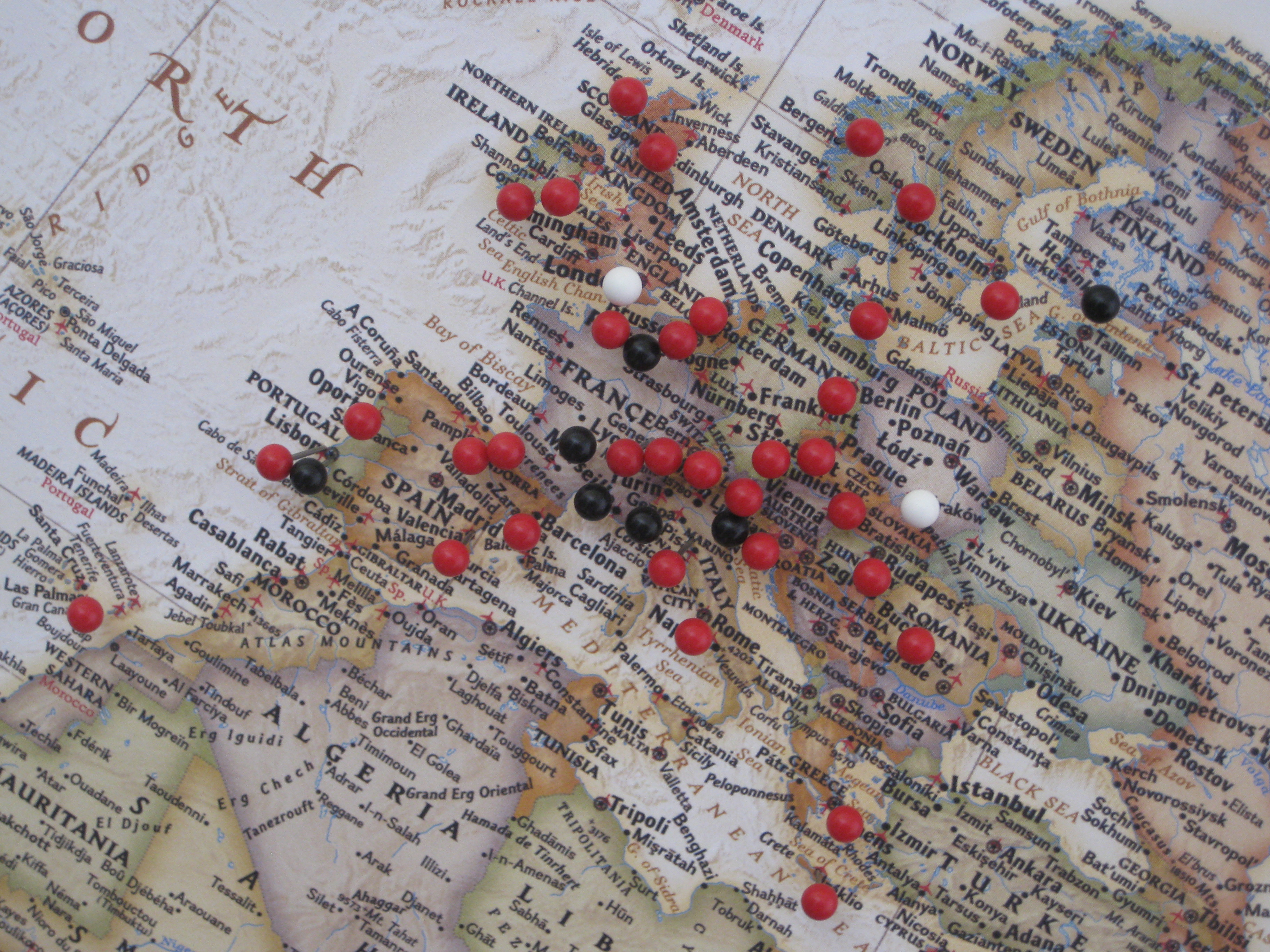
On the wall right inside my front door hangs a map of the world, stuck by a great number of little pins.  The red pins represent ME, places I’ve visited.  The black pins represent my husband.  The white pins are places we’ve been together.

Here is a close-up of Europe on this map:

Lots of red pins, huh?  I visited every place with a red pin within a five-year time span, between ages 22 and 27.  I didn’t have a salaried job, I didn’t have paid vacation.  Most of the time, I didn’t have anybody who wanted to travel with me.  I had an extremely tight budget during those years.  Consider, too, that I started my business when I was 24 and was working completely for myself before my 26th birthday.  No safety nets there, let me tell you.  So how was I able to travel to all those European countries?  (Eighteen of them, nineteen if you count the one I’ve added since that time.)

Priorities, plain and simple.  One of my highest priorities in life was to travel around Europe, and therefore I did what I had to do to make it happen.

This is probably not the last time you’re going to hear me using that word, either.  I have this theory about life, that it’s all about priorities.  Sure, people start off with different advantages and disadvantages, I’m not denying that.  And some things are literally impossible to accomplish, or at least have such a very low probability of happening that it’s almost the same thing.  For instance, I am just plain too old to enter certain professions that depend on youth or a certain current level of physical fitness (unfortunate but true fact: sometimes healing takes a really long time).

But not as many things are impossible as we think. And once we begin to contemplate the realm of the possible, everything shuffles down to priorities.  My priority was to travel in Europe, so I structured my life accordingly.  I had a very strict budget, passing up on buying stuff I really wanted like clothes and dinners out so that I could save money for travel.  I passed up regular salaried jobs for a number of reasons, but not the least among those reasons was my desire to have what I considered a reasonable amount of vacation time to allocate to travel.  I learned how to be self sufficient and more outgoing so I could travel by myself.  I took some risks.

As we get older, we often gain certain obligations: spouses, children, aging parents.  But even with these connections, which have their times of joy and their times of heartache, ultimately my life is my own.  I’m the one who’s going to look back on my lifetime with happiness or regret; I’m the one who’s going to have to live with the choices I’ve made, whether they were good or unfortunate.  Maybe, as a consequence of other choices I’ve made, I’ll have to wait and have a longer-term plan to achieve certain of my life goals.  But it’s still all about priorities.

I’m not writing this post to make you feel bad if you haven’t travelled.  Maybe you don’t even want to travel, and that’s a perfectly fair choice.  What I want to tell you is that if you really want something, whether it’s to travel or to be an artist or to achieve happiness in your own special way, think about a way to make it happen.  Strive, try, and be happy in the freedom of your choices.  And if in the process, you realize your priorities are different than you originally thought, rest easy, reset, and try again.  That’s the last great things about priorities: they can change.


Read Full Post »

Someone Else’s Story

Today I’m going to write about someone I don’t know.  I’ve never met him and I don’t know his name.  We have a mutual friend, which is how I know about him.  For simplicity’s sake, I’ll call him Bob.

Bob is going to have heart surgery in the near future.  It’s a risky, you-might-not-survive-this sort of surgery.  I picture Bob being young-ish, in his thirties or maybe forties.  Apparently he had at least a bit of warning, so he’s been doing some of the things he’s always wanted to do: jumping out of a plane, traveling, spending time with loved ones, etc.

He wrote an e-mail to his friends to give them information on the surgery and tell them what they could do to help.  And he asked his friends for something important to him.  He asked them to go and do some of the things they had been putting off.  Go live some of your dreams, he said, and do it for me.

Every time I think of Bob and this story, I get teary-eyed.  Here is a man forced to face his mortality.  It would be completely understandable if he turned inward and focused on himself during such a difficult time.  But instead, he looks out to the people he cares about, and he puts his energy towards trying to have a positive impact on their lives.  Even if, for him, it might be the end.  He has made meaning out of his illness.  And in so doing, he has succeeded in touching lives, even lives of people he doesn’t know.  Like me.  And maybe you too.

So yes, do what Bob asks.  Go out and take advantage of the opportunities you find.  Instead of putting off, figure out how you can make a cherished dream happen.  Maybe not all of your dreams, maybe not your biggest dream, even.  Just one.  Go to a baseball game for the first time, or learn how to cook beef bourguignon, or fall in love.  Look at the stars through a telescope, or go see the Taj Mahal, or test drive a car you could never afford.  Lend yourself for an afternoon so that Bob’s meaning grows.

And then, think about how to create your own meaning.

Read Full Post »

Photo by Paul Bica

I have a family history of cancer.  My mom died of breast cancer, and her dad died of prostate cancer.  I was convinced that I would inevitably get cancer as well, and that I would probably die of it.  I knew that I must have one of those cancer genes I’d heard about that skyrocket the chances.  My doctor suggested a DNA test and I was horrified at the very idea.  More bad news?  No thanks.

Fast forward to earlier this year, when 23andme was having an incredible sale on their DNA test.  I decided to purchase one in spite of the fact that the very idea filled me with dread.  I figured the test would either tell me what I already thought I knew (aka I had some horrible cancer gene) or it would tell me I didn’t and it would be good news.  I had prepared myself so thoroughly for the worst that I could take the risk of having the test done.

I got the results a few months ago.  I don’t have any of those cancer genes.  Not only that, based on my genetics alone, I actually have a lower than average chance of ever getting breast cancer.  That’s right, lower than average.  While it’s true that there are other risk factors to account for here, my little story of doom collapsed in on itself at this news.

My story is not uncommon.  The facts we think we know are not always what is true, and the stronger the fear surrounding an issue, the more likely we are to fail to see clearly.  I’m scared of death and especially of dying young, and so it takes very little effort for me to create an entire repertoire of stories to support this possibility.  Unfortunately, these fears create visions of the world that can hold us back and cause great unhappiness.  They keep us living in some imaginary wasteland instead of enjoying the present.

Fear of failure is another one I see all the time.  “Oh, I can’t possibly write a novel.  I can’t possibly travel to a foreign country.  I can’t possibly have a happy romantic relationship with a partner who respects me.  I can’t open my own business or find a job I like.  I can’t change.”  I can’t, I can’t, I can’t.

I’m here, not dying young of cancer, to tell you that you can.  The scope of human potential is infinite.  Yes, you may fail.  Yes, I may die young.  I’m not willing to let that chance keep me from living now.  Are you?

Read Full Post »

I don’t have pierced ears.  Where I live, it’s fairly unusual for a woman not to have pierced ears.  Plus I grew up in a time when people pierced other body parts to show their nonconformity.  (Or maybe to look sexy or funky or on the edge.  I’m not sure since I never did it.)  It’s the rare occasion when I meet another woman without basic ear piercings.

It’s not that I don’t like jewelry.  I actually have a weak spot for jewelry.  I wear necklaces, rings, the occasional bracelet or anklet.  I love shiny sparkly stuff, and I love how artistic jewelry can be.  I look at beautiful earrings in little boutiques and covet them.

People ask me if I don’t have pierced ears because I’m afraid of the pain.  While it’s true that I hate pain, that’s not really the reason.  I wasn’t allowed to get my ears pierced as a kid, but I could have done it when I was twelve or thirteen.  Only by then it was too late.  Without even knowing it, I had already grown up into a closet nonconformist.

I thought about getting holes punched in my ears, and then I thought about what a weird idea that actually was, punching holes in your body just so you could display a little more bling.  Suddenly ear piercings didn’t seem ordinary anymore.  They seemed like a barbaric custom of some foreign tribe.

Now please don’t get me wrong.  When I look at other people’s pierced ears, I don’t feel shock or horror or condescension.  I don’t actually think piercing is a barbaric custom.  It’s more that, once I thought of that point of view, I could never look on the custom the same way myself.  It’s been twenty years, and I’ve never found any reason to change my original decision.  I’ll keep my ears the way they came, at least until I have a provocative reason to do otherwise.

So what do you think?  Am I stubborn or an original thinker (or both)?  Either way, my lack of pierced ears is one of my tells, revealing that I am a free spirit.

Read Full Post »

Looking at the title of my blog, I began to wonder what a free spirit is, exactly.  I know the stereotype in the movies: Summer from (500) Days of Summer, or Sharon Stone’s character in The Muse, or Clementine from Eternal Sunshine of the Spotless Mind.  I’m not really like any of those women though, so there’s got to be more to it, right?  (Also, what about the free spirit men?  Why can’t I think of any movies about them?  Help me out in the comments, please.)

I turned to the internets to help me out.  Apparently, a free spirit is someone who is not restrained, for instance by convention or obligation.  Or it’s someone who has a highly individual or unique attitude, lifestyle, or imagination.  Or it’s someone acting freely or even irresponsibly (I guess that’s where the practical part of my blog title comes in?)  All the definitions agree on one synonym to describe a free spirit: nonconformist.

Oh, right.  Thank you, dictionaries everywhere, for reminding me what I’m talking about.

Here’s my definition of what it means to be a free spirit:

  • A free spirit thinks for himself, observing and collecting data in order to form his own opinions.
  • A free spirit does what she thinks is right, not what everyone else tells her is right.  She puts a high value on free choice.
  • A free spirit cares about getting to know both himself and the world around him.
  • A free spirit isn’t generally swayed by arguments of what one is “supposed” to do.  She tends to avoid, ignore, or become upset by people who are judgmental or controlling.
  • A free spirit has the courage to test life’s boundaries and limits, and to try things that other people think are impossible, unimportant, or impractical.  (These other people are often wrong.)
  • A free spirit often has her own unique vision of life and the world.

This does not mean a free spirit is a trampler, i.e. the kind of person who doesn’t care about other people’s feelings.  Nor are all free spirits incapable of compromise and discussion.  They aren’t inherently flighty or irresponsible or train wrecks on wheels.  Free spirits can be any of these things, just like everyone else, but they don’t have to be.

I also suspect there are those to whom free spiritedness comes easy, and those for whom it’s very difficult.  Or maybe there are just people like me who swing back and forth between the ease and the struggle.  There are noisy free spirits and quiet free spirits, extroverts and introverts and ambiverts, free spirits who engage in risqué behavior and those who think risqué is passé and so go to the other extreme.  (Ask me sometime why my ears aren’t pierced and you’ll see what I mean.)  Some of us are stubborn while others are fickle, some of us are dedicated while others drift from thing to thing.  We can be challenging, yes, and difficult to understand, but we love life with a passion that makes it all seem worthwhile.

Whatever our shortcomings, we make the world a more varied and interesting place.  We are agents of change and opponents of inertia.  As Arthur O’Shaughnessy, a 19th century British poet, said:

We are the music makers, and we are the dreamers of dreams.


Read Full Post »

« Newer Posts