Feeds:
Posts
Comments

Posts Tagged ‘community’

Okay, so on Tuesday we talked about loneliness and social media. But now I want to go back to my husband’s original comment: “Loneliness is the endemic disease of our time.” Specifically, I want to explore how loneliness now is different than it’s been in the past.First off, I imagine that there have been lonely people and lonely moments in all times. I don’t want to invalidate this truth, merely turn the spotlight onto the last century or so, when American society has undergone what I’m guessing is a fairly radical shift.

Once upon a time, people didn’t move around as much as they do now. It was normal to spend your whole life in the same town, or if not the same town, then the same region. As a result (and possibly also as a cause), families tended to stick together and consist of many generations and branches. Also as a result, people grew up together and had an easier time staying in touch as adults. If you lived in “Small Town America”, you might know most or even all of the people who lived in your town, at least by sight. Between these geographically close family units and towns (and add in churches to make society even more close-knit), many social needs were met.

What changed? My husband tells me that many families split apart during the Great Depression, when people had to move to find work. This is when the idea of the nuclear family (parents and their children) emerged. More people moved to big cities, in which it is easy to find anonymity (even if you don’t want it). More people began to go away to college, and only some would return to their hometowns afterwards; the rest would go where the jobs and opportunities were, or follow their romantic partners (either back to their hometowns or to where they had a good job). In 1937, 73% of Americans said they were members of a church, as opposed to between 63-65% now. But estimates are that in the past few years, as few as 20% of Americans actually attend church every Sunday (40% is the high end of the range); regular attendance does, of course, provide the strongest community ties.

So this is our new reality. None of my extended family lives in my local area, and as a result I’ve never gotten to know them particularly well. I don’t belong to a church that gives me a social safety net. I live about 60 miles from where I grew up, which is just far enough away to make in-personal social interactions difficult (especially since so many other people have moved away). I live about 40 miles from where I went to college, and many of my college friends moved into the same area, which is one reason I ended up settling here. I hear complaints all the time from people in their 20s and 30s who share how difficult it is for them to meet people and make friends now that they’re out of school (not to mention the dating problem). Plus, at least here in Silicon Valley, it is fashionable (or maybe just reality) that everyone is extremely busy almost all the time, making personal interaction even more challenging due to scheduling difficulties.

Meanwhile, many of my friends live elsewhere: in Southern California, Arizona, Chicago, the Denver area, Arkansas, Texas, Toronto, and even Australia.

Taking all of this into account, it’s not surprising that people might be experiencing a greater sense of isolation, is it?

Into this void, we’ve seen first e-mail, then cell phones with no extra fees for long distance calls, and then social media, internet dating, and Skype emerge. And thank goodness, because I think that we as a society needed something that would make connecting feasible again, that would allow us both to maintain far-flung friendships and to meet new friends. Social media has become as popular as it is because it fills our need for community. Even huddled alone in our separate suburban houses (or city apartments, or the sparsely populated countryside), we can still be a part of something bigger than ourselves.

Of course, for writers (who work alone so much of the time) and people who work from home (an expanding group), possessing some means through which to connect becomes even more critical.

Is loneliness really the endemic disease of our time? We’ve certainly seen a shift to a more isolated social model, but now we’re using technology to try to alleviate this problem. I certainly notice the difference in my day-to-day interactions, if I compare now with five years ago. What about you? How has your life changed?

Read Full Post »

“Loneliness is the endemic disease of our time.”

My husband broke out this sentence last weekend, and of course, my response was, “Where’s my laptop? I need to write that down.”

There’s a lot to unpack in that sentence: at its most basic, the state of being lonely and all it entails, the idea of loneliness as a disease (and a widespread systemic one at that), and whether loneliness is more prevalent now than it has been in the past.

And once I add in the context of the conversation, which was about social media, there’s even more to think about. How does social media (Facebook, Twitter, the blogosphere, forums, online dating, etc.) affect loneliness? Does it make us feel more connected and satisfied on the whole, or does it, by diluting our pool of friends and sometimes encouraging quantity over quality and surface over depth, make us feel even more lonely?

I don’t think there’s a one-size-fits-all answer. Even if I examine my own personal experience, I’ve had both positive and negative reactions to social media.

The Bad:

1. Hearing about a party that all your friends went to, to which you were not invited, is not so fun. On the plus side, this means that when the party comes up later in in-person conversation (which it inevitably will), at least you’re not blindsided and can respond with the appropriate blasé remark.
2. Reading the never-ending stream of advice and opinions about writing and the publishing industry can be draining and kill my own inspiration and ability to work. I imagine this is true in other fields as well.
3. Time sink. Enough said.
4. Having a lot of Facebook friends is not the same as having friends who form my support network, with whom I have a private and personal relationship. And yet, sometimes Facebook distracts from the need to maintain those deeper relationships.
5. Friends’ internet time is not equal, so I will end up with more interaction with those friends who check their social networks frequently, as opposed to those friends with whom I have the closest in-person connections.
6. Social media makes me feel like I know what’s going on for people, and it makes people feel like they know what’s going on for me. Which is great, until I start to think about all the things I never say because they are too private for public consumption.

The Good:

1. One of the reasons I love blogging so much is because it allows me to use social media in a very content-heavy way, helping me balance the whole breadth vs. depth issue. Plus it gives me the chance to be a conversation-starter or to respond in depth to interesting conversations begun by others.
2. I am able to keep myself very informed and up-to-date on any of my interests or career concerns.
3. Social media makes it easier to reach out and create or find a community of like-minded individuals.
4. I can stay in at least nominal touch with a lot more people than I could have even ten years ago. Contacting someone out of the blue is also a lot less weird than it used to be.
5. Getting multiple birthday wishes (and having an easier time remembering and acknowledging others’ birthdays) makes me happy. Yes, I love birthdays.
6. Sometimes social media is great entertainment, pure and simple. And I love the way it lets people share content.

On the whole, social media makes me feel more connected, as long as I remember that it’s not a substitute for in-person time (or e-mail for those of my friends who aren’t local). What has your experience been with different forms of social media? Does it make you feel more or less isolated?

On Thursday, I’ll be exploring the idea of how loneliness fits into modern American society, and why it might be on the rise.

UPDATE: An interesting recent article on how Facebook helps people overcome shyness. It ends with the insight that some users become more lonely because of Facebook.

Read Full Post »

I have a love-hate relationship with being a free spirit. I wouldn’t change who I am for the world, but it comes with its fair share of heart ache and difficulty.

Sometimes I want to be a sheep, happily grazing in a flock of other sheep and doing exactly what everyone else does. I don’t want to wander off on my own, I don’t want to forge my own path. I don’t want to collect data until I reach the inescapable conclusion that the traditional way isn’t my way. I want life to be easy, all in a straight line, with my only task being to connect the dots. I want to follow the rules, I want to pay my dues, I want to embrace a guaranteed path to success.

Of course, there are no sure paths. If there’s one thing life has taught me, it’s that you can never predict how it’s going to turn out or what opportunities may rise unexpectedly. It’s good to ask questions and reach your own conclusions, because what if circumstances have changed and conventional wisdom is just flat-out wrong? It’s good to take stock and figure out what will make you the happiest, even if the answer is unique and makes your friends and acquaintances shake their heads.

The sad truth is, sometimes people are judgmental. We emphasize the need to fit in during high school in YA novels and movies, and act like this social need doesn’t continue past a certain age. But does it disappear on our eighteenth birthdays? No. Life is not so simple and clear-cut as all that.

The result is, if we decide to be a free spirit, if we make nonconformist decisions or hold nontraditional ideas, we’re going to catch a certain amount of heat, whatever our age. Not only that, but we’ll be making our own road maps as we go, which can be a solitary and scary endeavor. Sometimes we’ll fail spectacularly, and our failures will be all the more visible because we were trying something unusual — something people didn’t think we should be trying, or something people assumed we couldn’t make work. Even when we do succeed, people will try to belittle what we have accomplished.

The conventional advice on this subject is that we shouldn’t care what people think, but sometimes we are going to care, no matter how hard we try to deny it. Therein lies the dark side to living a life outside the normal boundaries. It takes courage and self-respect, and sometimes it will sting in spite of ourselves. Sometimes we may weaken a little bit and wish we could be like everybody else, happily following the Pied Piper and playing it safe.

But we are not like everybody else. We cannot convince ourselves to be. It’s so much more exciting and fulfilling to question, to think, to decide what we honestly want and plot our own route to achieve it. It’s exhilarating to take risks and feel the buzzing, growing vitality of being alive and creating our own life stories. When I falter, I remind myself of how happy I am to have the power of choice, to be able to do what I love so much of the time, and to belong to a network of people who trust me to be me, no matter what choices (or even mistakes) I’m making.

What do you do when you falter? How do you stay strong in the face of judgement?

Read Full Post »

I was attending my husband’s company holiday party a few weeks ago when one of his co-workers came up to me and said, “Hey, I read your blog!”  This was, as you might imagine, a small moment of joy for me.  She went on to say something to the effect of, “Wow, you’re really optimistic.”

She was right, of course.  I am definitely of the optimistic persuasion, as I trust you may have noticed.  I hadn’t realized that optimism was such a distinguishing trait for me, though, until hearing about it from the outside.  So I’ve been spending a lot of time pondering the nature of optimism.

Part of it may well be disposition.  Optimism comes naturally to me.  I’ve said before that my neutral state, if nothing much good or bad is going on, tends to be set on the positive side.  Little things make me inordinately happy.  I get an e-mail from a friend and I’m already smiling.  My dog does something cute and I’m happy.  I think about the gingerbread cookie I’m going to have for lunch and I’m filled with anticipation all morning long.

Then comes the filtering.  We all do it, although some of us are better at it than others.  Filtering is the reason there can be horrible catastrophes somewhere else and we can continue through our day as if we don’t know that somewhere else people are dying in misery.  Filtering is forgetting or distracting yourself or not really listening.  Filtering is auto-pilot and prioritizing.  It can be enormously helpful or greatly hurtful.  I’m not always so talented at the filtering, which is why I sometimes have to take breaks and go months at a time without looking at a newspaper.

Once we’re done filtering, then we’re left to deal with whatever is left.  And Wesley wasn’t lying in The Princess Bride when he told Buttercup that life is pain.   At certain points all of us are called upon to deal with illness, with injury, with disappointment, with grinding monotony.  We experience setbacks, we make mistakes, and people don’t always treat us as well as they should.  We worry about our loved ones, our finances, current affairs.  When I was a kid we all worried about nuclear apocalypse.  Now we’re terrified of an environmental apocalypse instead.  If we look for something wrong or painful or scary, we’re sure to find it.

At this point, at least for those of us who don’t filter so well, we have two choices.  We can let the negativity pull us down and learn to expect the worst.  Pessimism is a coping mechanism, nothing more.  If we routinely expect the worst, we can protect ourselves from disappointment because we didn’t think anything good was likely to happen anyway.  It’s a thought process meant to cushion the blows of life.  The problem with it is that it also tends to keep us confined into a little box in which nothing much is possible.  It encourages us to be resigned instead of to strive.

Our other choice is optimism – to take what we find and make the best of it.  Just like pessimism, this is a coping mechanism.  It is the choice, in the face of the dark, to strive for better, which illustrates the inherent belief that things can be better.  Someone treats us badly, and we try to understand why so we can learn from their mistakes and become better people ourselves.  We get a rejection and we double our efforts to improve.  We see problems in the world and we start from the assumption that maybe something can be done to alleviate them, that maybe there’s even something we can do personally that might help a little bit.  It’s believing that the little things, like telling someone to have a nice day and meaning it, or complimenting someone on a job well done, will add up to make a difference in the world around us.

Sometimes when I am faced with a particularly daunting truth, I am a pessimist.  Sometimes I get tired and wonder if I’m making any progress.  I worry that I’m not making even a small difference.  I don’t know how I can possibly surmount what I see in front of me.  For those of us who either can’t or won’t filter, it is easy to become daunted and overwhelmed.  But as much as I can, I try to choose optimism because when I do, I’m happier.  I’d rather live a life infused with meaning.  I’d rather have the bittersweet comfort of hope.  I’d rather make the gamble that the little things sometimes matter after all.

Read Full Post »

I’ve had many people ask me about Taos Toolbox, the speculative fiction writer’s workshop I attended this past summer of 2010.  Here’s the scoop on what my experience was like.  Please note, however, that every year will inevitably be different, both in terms of participants, lectures, and details.

Taos Toolbox is a two-week residential workshop in the high mountains above Taos.  It is run by Walter Jon Williams, who teaches with one other writer (for my year, this was Nancy Kress, who will also be teaching in 2011).  During this time, each attendee has the chance to have two pieces critiqued.

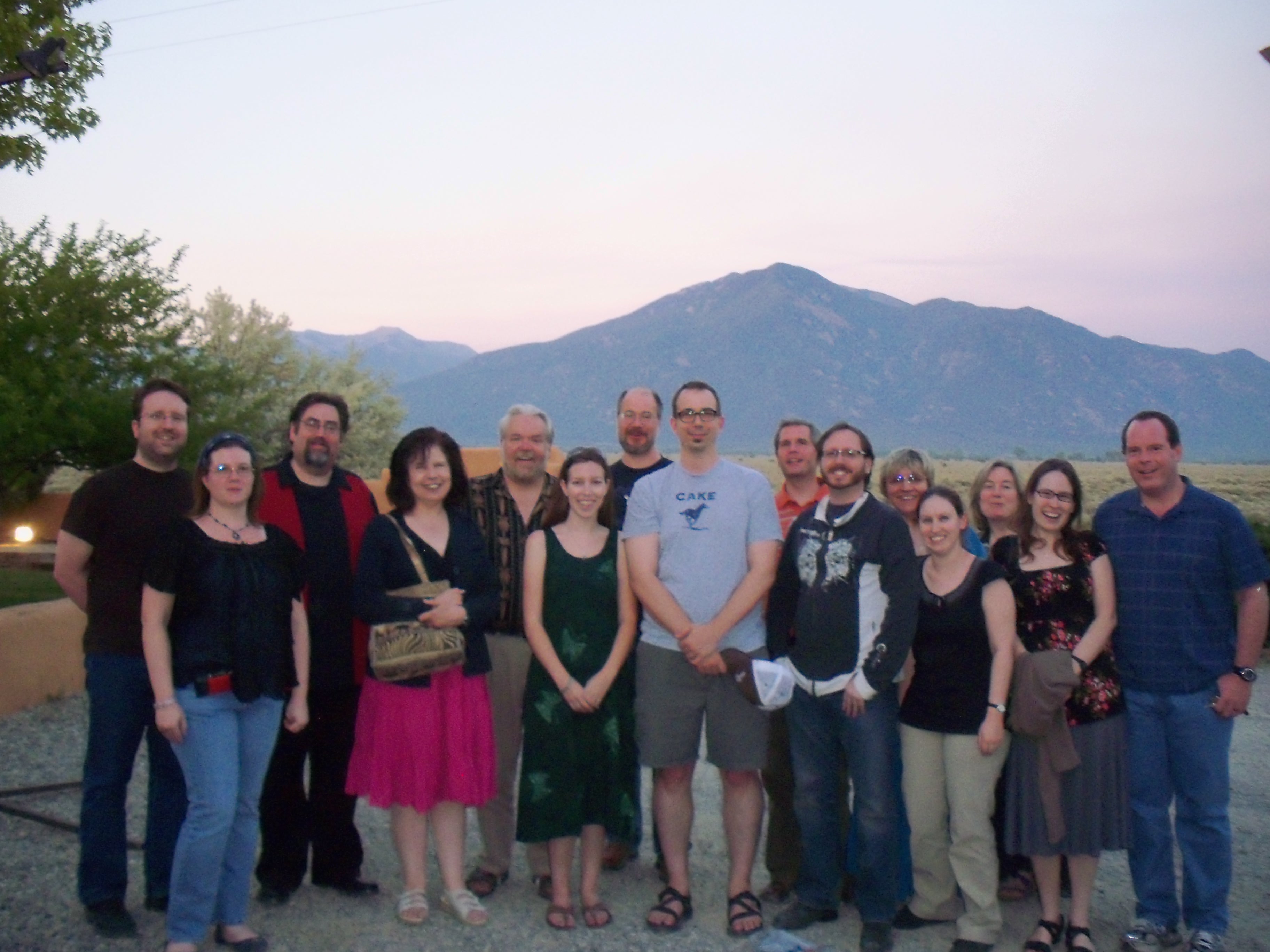
My Taos Toolbox classmates

Pros of Taos Toolbox:

1. The shorter time (2 weeks) is easier to fit into life without massive restructuring.

2. Participants can work on either short stories OR novels.  Both lengths are addressed in lecture.  In my year, I’d say about two-thirds of the attendees presented the first section of a novel plus a synopsis for at least one of their two pieces.  However, I opted to turn in two different short stories and also received valuable feedback.  So there’s flexibility here.

3. Walter Jon Williams and Nancy Kress are both experienced writers AND teachers.  Not everyone who can write can teach, but these two certainly can.  I learned a great deal about many aspects of craft and business during my two weeks.

4. Because the two teachers are teaching together and present for each other’s lectures, that means you get two different views on many subjects.  Walter and Nancy are perfect for this because they don’t have the same writing process at all.

5. The location is gorgeous and secluded.  You really do feel like you’ve gotten away from it all.  But there was (in my year, at least) still internet and cell service, so you’re not completely cut off.

6. As with other workshops, by the end of the two weeks the group had really bonded and I now have many new wonderful writer friends.  We’re still regularly in touch both one-on-one via email and social media, and through our email list.  I see Danielle every few weeks for coffee.  We’re planning other writing and critiquing events and hang out at conventions.  We even read each other’s blogs (hi guys!)

Potential Downsides:

1. Yes, it’s a wee bit expensive.  But do remember that your fee covers the instruction and critiques from two top pros, most of your meals (except for a few dinners), and your lodging.  Personally, I felt like it was worth every penny.

2. The altitude can be a killer, so be warned.  In retrospect, I wish I had come a day earlier and slept in Albuquerque for a night to help my body adjust.

3. It’s intense and involves a lot of critiquing.  A lot. Happily I learned a lot from all the critiques, whether on my own or other people’s work.  However, if you are not comfortable receiving criticism, this might not be the workshop for you.

Format and Logistics:

Every weekday, we’d gather at 10am and usually meet until around 3 or 3:30pm, with a lunch break somewhere in the middle.  During this time, we’d listen to two lectures, one from each teacher, and go through that day’s critiques, Milford style.  Each student had a two-minute time limit on critique-giving, although Walter and Nancy could speak for as long as necessary.  We were also assigned various writing exercises.

Afterwards we’d have free time to write or critique.  Many people took advantage of the free time to go down to Taos for sundries or take hikes in the surrounding mountains.  There was also much hanging out, playing music (Rich brought his guitar), soaking in the hot tub, and movie watching.  (Walter does a plot breakdown of The Maltese Falcon that shouldn’t be missed.)  We were provided with three meals a day during the week, and everyone had their own room.

I will add that I was unsure if I was qualified enough to attend the workshop, being unpublished and never having attended other workshops in the past.  Obviously it worked out well for me, and I’d encourage you to apply if you’re interested and let Walter and Nancy decide if you’re at a level that could benefit from the instruction.

Topics of Instruction:

  • Cleaning up prose
  • Story and structure
  • Writing in scenes
  • Plotting (WJW and NK have fairly different approaches to this.)
  • Literary elements and rhetorical devices
  • Plotting elements and maintaining suspense
  • Narrative modes
  • Analysis of specific works
  • Opening Scenes
  • Writing description
  • Characterization
  • World building
  • Business and contracts
  • Commercial fiction, genre, and issues specifically relating to spec fic

I would say that overall, the greatest focus was on plot and structure (and related topics).

What I Learned:

Do I think my writing improved due to my Taos experience?  Yes, indeed.  One of my critique group members back at home even commented on the difference.  My understanding of the various elements of writing fiction has been deepened in a variety of big and subtle ways.  For example, when I arrived at Taos, I was relying on intuition and my experiences as a reader to work with plot.  It feels like I was fumbling around in the dark compared with how I think about plot now.  My awareness of some of my most pressing issues has been heightened, and I now have tools to deal with these weaknesses and to gradually improve my skills.  I’ve also become more comfortable experimenting with my writing, which I think will ultimately speed up my learning process.  Combine all of these writing lessons with the fabulous friends I made, and I think of my time at Taos as a once-in-a-lifetime experience.

Final Note:

If you apply to Taos Toolbox before the end of the year, Walter is offering a discount on the cost of the workshop.  So if you’re interested, consider applying early.  Walter and Nancy are accepting applications for 2011 starting on December 1.

More questions about Taos Toolbox?  Please feel free to email me or ask away in the comments.

Read Full Post »

I was flipping through the November issue of Locus a few days ago, ensconced on my couch and trying to get over an unpleasant cold, when I came across Gardener Dozois’s review of “Dream of the Arrow,” a mainstream story by Jay Lake that was in Subterranean’s Summer 2010 Issue.  Mr. Dozois says this story is:

…a story good enough to suggest that Lake’s talents may be wasted working in the genre, as he has the literary chops to make it as a significant mainstream author instead.”

Since I’ve become more educated in the field, I have grown accustomed to the speculative genre being dismissed and marginalized.  I had no idea of any such stigma before my decision to pursue writing seriously, in spite of spending nearly twenty years making a beeline to the science fiction section of any library or bookstore I happened to enter, but I’m certainly not arguing that it doesn’t exist.  Usually when I encounter such sentiments, I blink, shrug, and move on.

But I was actually shocked when I read the above quotation in Locus.  For those of you who aren’t deeply involved in the science fiction and fantasy community, Locus is the trade magazine of the field, and Mr. Dozois is a highly respected writer, editor, and anthologist in the field.  He’s won twenty Hugo awards for his work in professional editing, which should give you some idea of his stature.  And yet, even so, his comment seems to imply that genre writing is in some way not as inherently worthwhile as mainstream (aka literary) writing.

Let’s unpack this quote a little further, shall we?  If it were merely a question of suggesting that Lake might consider a career as a mainstream author due to his particular talent for it, I wouldn’t have paused.  I have no doubt Lake has the abilities to become a literary author if that’s what he wants to do (whether or not he would achieve critical acclaim for it is another question, but not one connected to his abilities as a writer).  There is also no discussion of the possible merits of Lake’s speculative novels being shelved in the general fiction shelves as have books by such crossover successes as Susanna Clarke, Isabel Allende, and Kazuo Ishiguro.

What we get instead is the idea that Lake is wasting his talents working in science fiction and fantasy, and with this idea, I must respectfully disagree.  As a reader, I want variety in my speculative fiction, and I want to read speculative books written by authors with literary chops.  I balk at the implication (perhaps unintended) that writers only work in the science fiction field because they don’t have the ability to do otherwise.  The last thing our field needs is internal ghettoization; we get enough flak from the outside.

I’m proud to be a science fiction and fantasy writer, and I don’t write in those genres because I think it’s easier.  For me personally, writing in the speculative genres is more difficult (world building, I’m looking at you).  I don’t feel the need to apologize for the kinds of stories, worlds, and structures I find interesting and compelling.

Now Lake, of course, can do whatever he wants.  An author makes the decision on what genre to write within based on any of a number of factors (financial gain, critical acclaim, artistic inspiration or satisfaction, etc.)  If Lake wishes to make the leap over into mainstream fiction, I would certainly support that decision (and really, it’s none of my business).  But if he spends his entire career writing in the speculative genres, I believe his creative contribution will be just as valuable.

Read Full Post »

Two years ago, I had no idea that science fiction and fantasy conventions existed.  I only had a vague sense of the beast known as “fandom” and I didn’t know what anyone was saying about any of the books I was or wasn’t reading.  When I imagined a writer’s life, it pretty much consisted of me in front of my computer screen typing.  And in fact, that is exactly what I did with my first novel.  I sat in front of my screen and typed.  I didn’t talk about it much, considering how all-consuming a project it was.

It wasn’t until after I completed my rough draft that I began to learn about the social side of writing.  I learned that I was supposed to attend these events called “conventions”.  And given that I had decided to throw all in on the writing dream this time around, I dutifully bought a plane ticket and headed out.  I had no idea what to expect.

A year and a half after that first convention (Wiscon 2009, for those keeping track), I pretty much do know what to expect.  And having just returned from World Fantasy and having the convention scene firmly in mind, I’m going to share what I’ve learned.

Go to panels. People will tell you they never go to panels because they’re too busy hanging out with friends in the bar.  Don’t feel bad about this.  Go to the panels that you find interesting.  You’ll probably find less of the panels interesting later on, since you’ll have already attended many of them, so take advantage of them now.  Someday you will know enough people that you too can spend the entire con at the bar.  The fact that you don’t magically know that many people after one day (or a couple of cons) doesn’t reflect negatively on you.

Corollary: when you do start spending all of your time hanging out at the bar, enjoy it to the fullest.  Sit at the bar with glee, before it too becomes old hat.

Find your people. At every convention and conference I’ve attended, I end up spending the most time with a few people who I think are the most awesome people ever.  They might be people you knew ahead of time, although they often aren’t (they’re often the people the people you knew ahead of time introduce you to, though).

Corollary: Try not to smother your people.  That’s why you’ll ideally need more than one.  This is another good reason to attend panels and readings, giving them space, and then you can catch up with them later.

Don’t be afraid to talk to people. I know, I know, if you are an introvert, this is the most painful thing ever.  But everyone else is also there to meet people, so most of them will be nice to you.  This is yet another good reason to attend the panels and readings, because then you’ll have an automatic topic for conversation if this sort of thing is hard for you.  Sometimes the best opportunities for talking come at in-between times: in the meeting room right after the panel ends, or when you’re waiting in line outside a reading that’s about to start, or when people are randomly hanging out in the halls.

Corollary: This doesn’t mean you’re allowed to be a stalking crazy-fan person.  The established authors, editors, and agents are there to work and see their colleagues whom they only get to see a few times a year.  You can talk to them, sure, but don’t be alarmed or surprised if they can’t talk for long.

Go to parties. No con experience is complete without shoving yourself into a hot, stinky party room, forever popular for the free booze and high skill level involved to actually hear a word anyone else is saying.  However, unless you absolutely cannot avoid it, don’t go alone.  This is a time to start out with your people (which is why you craftily gave them space earlier in the day while you were busy — you got it — attending panels).  Hopefully your people will introduce you to more people, or you can be especially bold and introduce yourself to more people.  This is, after all, the main purpose of parties (I know some people who would argue with me on this point, but I’m sticking to my guns).

Corollary:  Keep your expectations low: you are, after all, in a crowded noisy place where many of the people you are trying to talk to are sleep-deprived and intoxicated.    Or their feet hurt.  (This would be me.  If you’re ever talking to me at a con party, it’s almost a sure thing that my feet are killing me.)

Remember people. I wish I could tell you that you could count on others to remember you too, but the truth is, sometimes they won’t.  The onus falls on you to maintain the connection.  Most people being confronted with a smiling person saying “Oh, it’s so great to see you again!” will in fact pretend to remember you, thereby renewing the connection.  If you can help them out further by tactfully reminding them of where you’ve met before or referencing a previous conversation, all the better.  Business card exchanges can be helpful, but only if you’ve actually had a real conversation with the person.  Otherwise, they’ll just throw your card away.  Remembering names long enough to later add the person onto your social network of choice is also good (or remembering who introduced you, so you can look at their list of contacts to jog your memory).

Corollary:  People remember better when they’ve received multiple impressions of the same thing (or in this case, person).  Repeated short interactions over the course of a convention weekend can assist others in remembering you.  Also, after you attend a few conventions, you will begin to look familiar to the other regulars and they will think you’ve met even if you haven’t.  Then you can pretend to remember them instead of the other way around.

Every con is different. You’ll be in a different stage of your career, different people will be there, maybe this time you’ll know a ton more people because you just attended Clarion or joined an online workshop or whatever.  Or maybe everyone will want to talk to you because you just won a Nebula.  The trick is to be prepared to go with whatever opportunities might present themselves while remaining outwardly calm and gracious.

And there you have it, all the con-going wisdom I have gleaned in the last year and a half.  Questions?  Snark?  Completely different con experiences?   Comment and let me know.

Read Full Post »

Tomorrow I head off into the great beyond of Los Angeles to attend SCBWI’s annual summer conference and inundate myself in all things kidlit.  To my knowledge, I know one other person attending.  Happily, this lack of acquaintance doesn’t bother me because I can rest assured in the knowledge that as a group, kidlit writers have to be some of the warmest and supportive people in existence.  I also have the happy past experience of the winter conference to bolster me.  In my experience, starting a conversation with someone with a shared and consuming interest like writing is not generally a difficult accomplishment.

However, this leads me to one of my recent subjects of interest: namely, the art of conversation.  I’m not talking about the skill of small talk, which while useful, isn’t that thrilling for me.  I’m also not talking about the art of debate, which can be interesting, but only if the debaters (or at the very least, me as their audience) aren’t completely and finally wedded to every last detail of their opinions.  No, I’m thinking about the art of interesting conversation.  You know, when you’re talking to someone and you feel you could just keep talking for hours?  Or when someone says something and it actually requires you to (gasp) stop and think?  That kind of conversation.

One of the main barriers I notice to achieving such a level of worded bliss is the question problem, which goes both ways. First and most simply, it’s been my observation that a lot of people don’t ask enough questions.  Questions have interest built-in because they include the supposition that there is more than one possible answer (otherwise, why are you asking?)  They also show a pleasing desire to get to know the conversational partner and place value on said partner’s opinions, which develops rapport.  A well-asked question can be the instigator of a lively discussion in which the people involved might actually learn something, help each other come up with new ideas, or be exposed to a different point of view.  Alternately, questions can encourage a friend to talk about something challenging or exciting in their lives that they might not otherwise have felt comfortable discussing.

On the other side of the equation, people don’t always encourage good questions with their responses.  If I offer an opening question or two and receive only monosyllables or replies designed to shut me down, I am left high and dry without any hooks to continue the conversation or discover what that hidden gem of a question might be.  In the same way, if the answers to questions aren’t approached in a thoughtful manner, it is much less likely that there will be any part of the answer worth pursuing.  And don’t even get me started on the monologue problem.

The ideal conversation requires all people involved to do some heavy lifting.  Without mutual questioning, the talk turns into a parody of an interview.  Without actively listening to your conversational partner’s points, it is difficult to be affected by the conversation or to respond in a genuine and engaged way.  Without the willingness to realize your own knowledge may be limited (or even wrong!) or another point of view might offer valuable ideas and perspectives, what’s going on isn’t a conversation so much as a two-sided internal monologue spoken aloud.

The point of conversation is to both entertain and engage (and possibly to educate, although this one is dangerous as it can lead to pomposity).  This means, among other things, making an effort to keep track of who you’ve told what funny stories in the past.  Or at the very least, for those with poor memories, you can ask your potential audience if you’ve already told them about that time in Cairo, thereby allowing them a graceful exit.  It means asking others for their opinions instead of merely expounding on your own.  It means choosing conversational topics that include all people participating – so for example, maybe you shouldn’t speak too long about a role-playing game with a group that includes one or two people who didn’t play the game, or maybe you shouldn’t have deep technical-speak shop talk with a group that includes someone who isn’t part of your field.  (Yes, I live in Silicon Valley, can you tell?)  This is not to say that you can’t talk about subjects relating to your career and/or passions (my husband and I talk about various writing, scientific, music, and computer-related topics all the time), but it does help to gear them towards a non-specialist audience when appropriate.

I firmly believe that good conversation is an art, and an art that I need to continually consider and practice.  So tell me, dear readers, what do you look for in a satisfying conversation?  What are your favorite conversational moments or pet peeves?  Let’s talk about talking, shall we?

Read Full Post »

A few weeks ago, I stumbled across this article listing the five common traits of successful artists.  If you’re an artist or love an artist, go read it now.  I promise it is short and worth the time.

I agree with all five points Lori McNee makes: passion, business sense, work ethic, resilience, and support.  We’ve already talked a bit about her fourth point, resilience, when we were discussing disappointment.

Today I want to talk about her fifth trait: having a support system of people who believe in the work.  The longer I am involved in artistic endeavor, the more I realize how important this component can be, if not to “success” than at the very least to my own personal well-being.

There is a special kind of zaniness that many artists have, a weird sort of marriage between egotism and insecurity, self confidence and self doubt, ecstasy and despair.  The roller coaster is a lot easier to ride out when you have people cheering you on from the side … or riding that roller coaster with you.  Getting negative reinforcement, not from critiques of your work (this will hopefully help make you better at your art) but from the mere fact of undertaking the work in the first place, can plunge the artist into the depths of angst.  You might even be convinced to give up.  Having powerful positive forces to help balance this out is essential unless you have an especially thick skin.

I think it’s no accident that I begin work on my most ambitious artistic endeavors when there is someone in my life actively rooting me on.  Beginning serious study of music: my mom.  Applying for and writing a senior recital: my best friend Francine.  Writing a song a week: my friend Jimmy.  And once I started dating my now-husband, I started my musical and then my novels.  I am not convinced I could have accomplished what I have without the support and energy of these fabulous people.  It’s possible I would have done it anyway, but it would have been a lonely path.

Nowadays, I’ve connected so firmly to other writers, in both the speculative and kidlit communities, that I no longer depend on one person.  This is the ideal situation for a number of reasons.

  1. Other writers understand me.  They understand what I’m going through, they understand the different steps of the process, they understand why I’m happy or sad or neurotic.
  2. Some of the writers are ahead of me in their careers and therefore can be turned to for sage advice.  Some of the writers are behind me on the path and I can help them out and pay it forward.
  3. When one person has life happen and doesn’t have time for mutual support, I can easily turn to someone else, and there are no hard feelings.
  4. I can watch and be inspired by others’ successes.
  5. I have opportunities to learn and improve my craft: through conferences and conventions, through workshops, through critique groups and sessions, through reading other people’s works and hearing about other people’s struggles.

I have to put a quick caveat about family and other firmly entrenched nay-sayers.  If your family is actively supportive of your art, hug them extra for me and realize you are extremely lucky.  However, we do not get to choose our biological families, so some of us may find that our choices baffle our relatives.  (This also holds true of certain old friends, random acquaintances, and business associates.)  Ignoring what they say about our passions can be difficult and frustrating, but it just makes having a support system all the more important.  Trying to change someone’s point of view about art (or anything, really) is an uphill battle that will often end in defeat.  Instead, I try to ignore any defeatist messages I hear, and rant about it later to someone who will understand (usually my husband, who has infinite stores of patience for listening to this sort of thing).  Do I shut these people out of my life completely?  No, not usually, and sometimes it’s impossible to do so.  Do I limit my time with them and try to steer the conversation away from potentially damaging remarks?  You betcha.

I’ll even take the assertion of spending time with supportive people one step further.  The more time I spend with people who are creative dynamic thinkers, whether they be artists, entrepreneurs, scientists, or what-have-you, the more energized and inspired I become.  Seeing other people’s accomplishments brings them firmly into my own reality frame.  I hang out with my friend who started his own tech company, or I hear about a high school classmate who started his own nonprofit, or I get sporadic updates from a college friend about the circus troupe he’s touring with, and I see beyond my own limitations of vision.  These people’s lives show me what can be possible, and they inspire me to think big and then figure out how to make the idea a reality.  I strive to be like these friends of mine, someone who can lift people up and have the courage to make bold decisions about life.  This is what I think it means to be a practical free spirit: to dream big and then create and implement a plan to make it happen.

Read Full Post »

« Newer Posts