Feeds:
Posts
Comments

Posts Tagged ‘Amy Sundberg’

I’ll be attending FogCon in Walnut Creek this weekend, and I’m moderating a panel this Friday the 30th at 1:30pm:

Body and Mind: Smash the Binary, Salon B/C
Body/Mind duality is a staple of Western philosophy and metaphysics, from the ancient Greeks through Rene Descartes through the present day. Is this a false duality or an essential truth? Come the Singularity, when we upload our personalities to the Cloud, what will be left behind or left?

Is it just me, or does that sound like two panel topics? In any case, we’ll be tackling both, and it should be interesting. I know a lot more about philosophy than I did a week ago, let me tell you.

Anyone attending FogCon, please feel free to come up and say hi during the weekend. I look forward to seeing you!

Read Full Post »

Resistance against self publishing has been steadily crumbling. Last week a writer friend of mine who had been vehemently opposed to such ideas no more than a year ago even mentioned that she’d consider self publishing. I never expected to hear those words from her, and it’s a powerful illustration for me of the mainstream acceptance self-publishing has begun to receive.

However, it is still impossible to have a discussion about self publishing without bringing up the question of quality. How will readers find the good books in the mountains of soul-rending slush? How can a writer ensure she is releasing a quality book without a publisher’s stamp of approval?

Well, Kris Rusch hits the answer out of the park in her blog entry last week, so I’m not going to repeat everything she said. In a nutshell, there have been huge numbers of books published for a long time, so the needle in a haystack problem is nothing new and has solutions (or at least aides) firmly in place. Having something come out from a publisher is not a guaranteed mark of quality. And it is possible to hire outside help when self publishing, thereby ameliorating the quality problem.

But it occurs to me that the question we are really asking ourselves as writers is, “How will I know when I’m good enough?”

The answer is, you won’t. You might never be sure you’re good enough, even if you’re traditionally published. Especially if you’re a newer writer without the benefit of years of practice and experience. You just might not know.

I’ve known writers who think they’re seriously good, and I can barely read their prose. I’ve known writers who have won multiple awards and still aren’t convinced they’re any good at what they do. I’ve known writers who were doing all right but got complacent and their work suffered. And I’ve known writers who fall everywhere in the middle.

Have you ever heard of the Dunning-Kruger effect? It’s a cognitive bias wherein people who are less competent overestimate their own abilities. When in doubt, people tend to rate themselves as above average…way more people than could possibly actually be above average at a given skill. It turns out that when people aren’t competent at something, they also lack the knowledge to correctly assess their skill level. On the flip side, people who actually are above average suffer from false consensus effect: the false assumption that their peers are performing about the same as them, as long as they don’t have any evidence to the contrary. So they tend to underestimate their own abilities. This explains why sometimes in a conversation about a subject, the loudest person is someone who obviously doesn’t know what she’s talking about, while the quiet person listening in the corner might really know her stuff.

The problem with these phenomena is that you can’t necessarily tell if they’re happening to you (although if you’re worried about being good enough, that’s probably a positive sign). You can’t know for sure that you’re good enough. And you know what? You can’t know for sure if your novel gets picked up by a small press run by one editor either. And you can’t know for sure if your novel gets picked up by a big house…and then flops. And you can’t know if you sell a story to a big market like Asimov’s because after a few months, you might wonder if you’ll ever write another story that’s good enough.

And at some point in this cognitive tail chase, you have to decide if you are willing to stand behind your work. The answer might be no, and that’s fine. Then you wait and learn and practice and slowly become a better writer. Until the answer is yes, at which point you’re going to have to take the plunge, regardless of your method of publication, without knowing for sure if you are good enough.

And you know what I think? As long as you’re producing the best work you are able, that is good enough for right now.

Read Full Post »

I’ve been reading Bill Bryson’s most recent book, At Home, which I wanted for months and then received for Christmas (and even then, it took me another couple of months to get to it, which goes to show how out-of-control my to-read stack has gotten). Its subtitle is “A Short History of Private Life,” and its chapters are named by rooms of the house. Bill Bryson’s 19th century former rectory house, to be precise.

This is what my book looks like.

I thought the book was going to be full of anecdotes about each of the rooms: what activities were typically performed there, how those varied over time, how each would be furnished, etc. And there certainly is plenty of this information in there, but that’s only a beginning. With his typical charm, Bill Bryson supplies bucketfuls of mostly random (but still fascinating) facts that are often only tied to the room in question by the loosest of associations:

  • the building of the Crystal Palace for the Great Exhibition of 1851
  • the usefulness of bats as a species and how many are now in danger of extinction because of rabies myths
  • the building of the Eiffel Tower and how it is constructed of iron, not steel
  • how ice became a commodity
  • how very dark it used to be at night, and various techniques of lighting

Although I like this cover art better!

My main take-away from the book is that it really sucked to live in the West after the Roman Empire and before the twentieth century. It was dark and painful and exhausting and dirty, full of back-breaking daily labor for almost everyone. People would get sick all the time, sometimes even from the chemicals they used in the wallpaper and paint on their walls, and there was no anesthetic. Rats and mice would scurry over your bed, especially if you were a child sleeping in a trundle bed. And if you didn’t want your loved one’s body stolen by grave robbers, you had to keep it in your house until it went bad and began producing maggots. Yuck.

As a woman, it sucked even more. You either had to perform repetitive back-breaking labor (like laundry, which also involved chemicals that made people sick) or, if you were lucky, you had to sit around and be bored out of your mind while preserving your delicate sensibilities. Thank goodness music and art were considered appropriate activities for woman, but heaven forbid you read a novel. You were considered property and in England, at least, it could be quite difficult to get a divorce. Beating was commonplace and no grounds for leaving; it merely showed you lacked sufficient patience. Doctors would often dismiss your medical complaints because you were a woman. And you’d probably end up dying in childbirth anyway.

I am even more grateful than usual to be living now, in an age of antibiotics, safer childbirth, labor-saving devices, electricity, and more opportunities for women. If I could choose any time period to live in, which would I pick? I’d pick NOW, thank you very much. I like having teeth and the right to vote.

In any case, it’s a great book and I recommend it. And now I have to ask: if you could choose any time period to live in, which would you pick?

Read Full Post »

I really miss e-mail.

Before you look at me funny and silently consider whether I’ve gone off the deep end, let me add that I don’t miss all the e-mail I actually get: various sales communications from any store I’ve ever bought something from online, e-mail list digests, appointment reminders, notifications from Twitter, Facebook, Google+, WordPress, and let’s not forget bills and bank statements.

I miss the old days of e-mail when I didn’t get any of the above, and each e-mail I did receive was an electronic letter, worthy of excitement and anticipation. You can express so much personality in an e-mail. When I read a good e-mail, it almost feels like its writer is in the room with me. And the one-on-one nature of the communication means that e-mail builds relationships in an intimate way. These words were written for my eyes only–there is value in that.

I got my first e-mail account when I went away to college. My mom would print out the e-mails I sent her, and then she’d write a response and send it through snail mail. I tried my best to stay in touch with those friends who also had e-mail addresses. Those that didn’t…not so much. Mea culpa.

That first year, visiting the computer lab across the way to check e-mail was an event. We’d head over in our slippers in friendly camaraderie until we sat in front of those old glowing screens, at which point our focus was entirely on the act of checking e-mail. I spent so much time marveling at the wonder of e-mail, I made one of my best friends of freshman year in the computer lab.

E-mail was often my lifeline when travelling alone. I’d be meeting new people every day, but still spending hours at a stretch by myself. I learned how to eat by myself at a restaurant, but it was never a particularly joyful experience. When I got too lonely or felt too detached from anything permanent, I’d find an internet cafe and write to the friends who had become, whether they knew it or not, a kind of anchor. They reminded me of what it meant to have a home.

Nowadays I rarely receive this kind of e-mail. My inbox becomes clogged with messages that feel like work. I stay in touch with people via social media, a kind of communication that, while efficient, can also be impersonal. People “like” my statuses, but we don’t have the sort of conversations we’d have if we were discussing the same topic over e-mail. And too often it feels like the friendship is being held in stasis instead of being actively developed.

I do have one friend with whom I e-mail regularly, and it’s just as good as I remember. It’s also something of a miracle that we both managed to continue the correspondence, especially in the beginning. But I’m glad we did. If we had merely stayed in touch via Facebook and Twitter, we wouldn’t know each other half as well as we do now. We would only see the edges of each other’s lives instead of being able to go deeper. We might not even be friends at all.

Yes, I miss the golden age of e-mail. Do you?

Read Full Post »

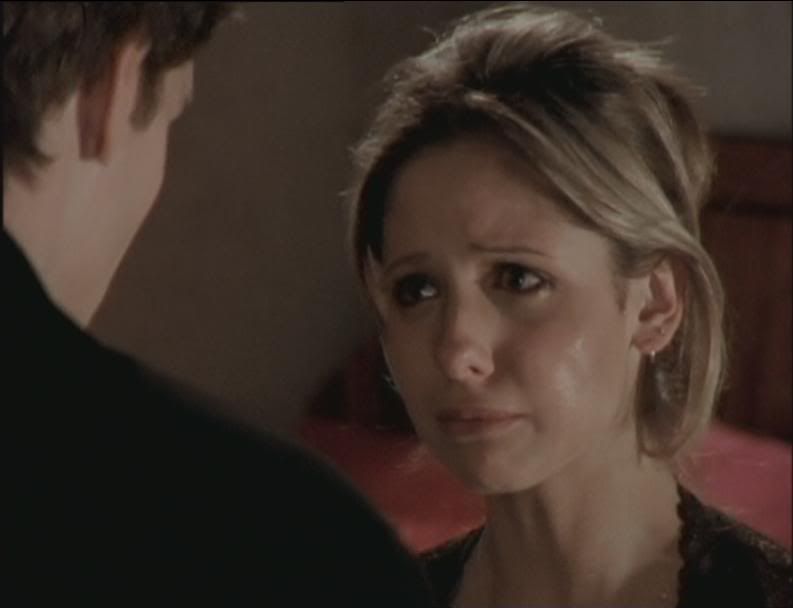
As many of you know, I’m a big Buffy the Vampire Slayer fan. I’ve watched the series more than once. I have a Buffy T-shirt. I even own a replica scythe. So what I’m about to say may shock you.

Buffy the Vampire Slayer is not a feminist show. It is sometimes egregiously sexist, in fact. It showcases repeatedly negative portrayals of female sexuality and engages in blame-placing on female characters (Buffy is accused of leading Spike on, Buffy is blamed for Jenny Calendar’s death even though Angel is the one who did it, etc.) while excusing crazy behavior of male characters (Buffy should obviously instantly forgive Riley for cheating on her with vampire women). There’s the problematic treatment of dismissing rape in Season 7. And I could go on.

However, I strongly disagree with the idea that Buffy is not a strong female character. Indeed, I’ve begun to worry about our culture’s definition of what a strong female character actually is. Yes, we obviously want to get beyond the idea that a strong woman is simply a man with boobs–what a ridiculously simplified idea. But I’ve been seeing some commentary that suggests that strong female characters still have to be…well, perfect and together and always making the right decision. And heaven forbid they ever show emotion or, you know, CRY.

Is Buffy a strong female character?

I’m going to unpack a few of these ideas in relation to Buffy so you can see what I mean. First up is Mur Lafferty’s critique of Buffy the character. (I actually agree with much of this article, especially the part about The Princess Bride, which is an awesome movie if you ignore the horrible female characters and particularly the passive MacGuffin who is Princess Buttercup.) “Buffy failed this test [of emotional strength] when Spike attacked her in Season… 5? Since the attack was sexual in nature, Buffy lost all ability to fight, and just struggled on the floor and cried…we’d seen her kill so many monsters – including her lover – I can’t believe she’d cave under that attack. It didn’t fit with the character.”

Okay, so the attempted rape scene in Season 6 is definitely an emotional moment. But that’s all it is: a moment. Buffy struggles against Spike and cries for all of fifty seconds before she succeeds in pushing him off her. (Yes, I timed it, just to be sure I was remembering correctly.) Not only that, but she does this while already badly injured, after dealing with several months of deep depression, and while dealing with the shock of having a former lover try to rape her. But her reaction time of fifty seconds, no, it’s just not quite good enough for her to be considered emotionally strong? Um… Yeah, it must be because she committed the cardinal sin of crying. (Not to mention this assessment smacks of victim blaming.)

Or does crying automatically make her weak?

Here’s another great one, this time from The Mary Sue (again, this article makes many great points but I quibble about the strong/weak character identifications): “And Buffy is textually weak in all her relationships. She falls apart not only when Angel leaves her, but when Parker (yeah, you don’t remember him, either) doesn’t want to pursue more than a one-night stand with her, too.” It goes on to discuss the badness of Buffy chasing after Riley when he flies off in the helicopter.

So does this mean a strong woman isn’t allowed to have feelings or make mistakes, even out of inexperience (as was the case with Parker)? I mean, are we just supposed to shrug after a painful break-up and decide not to care? After all, Buffy sends the vampire she loves to hell in order to save the world–not an act I’d call particularly weak. Sure, I wasn’t a fan of Buffy running after Riley, but she received bad advice from a trusted friend and had a moment of weakness. But I guess in order to be a strong woman she would have to recognize the sexist parameters of her world at all times and never have a second of doubt, disappointment, or grief… Or maybe it’s the crying.

From the same article: “And inherently problematic is the idea of the Watcher, a predominantly male presence that is the male gaze made manifest – a source of constant looking that is an explicit form of control.”

Yes, the idea of the Watcher is sexist. The origins of the Slayer are deeply problematic. But Buffy fights against this time and time again: she fires her Watcher, she rebels against the Council, she orders them to give her the information she needs about Glory, and at the end of the series, she thwarts their original intent for the Slayer by giving the power to all the Potentials. She is constantly second-guessed and undermined by everyone in her world, friends as much as foes, and yet she continues to fight and to believe in herself. How exactly is this not strong behavior? I really have no idea.

Strong female characters can still be human. They can be flawed, they can have moments of bad judgment, and they can cry. They can feel overwhelmed, and they can have bad taste in men. What they can’t be is only existing because of and judged in relationship to male characters. What they must have is some kind of personal agency. Even, and this is my key point, the agency to make mistakes and be less than perfect.

Rose Lemberg wrote an excellent article on feminist characters, and I really hope you go read the whole thing. She says:“But what we often do in genre is allow men to be uncomfortable and difficult, but erase the women who are less than warm and fuzzy-making.”

Yes. Even to the point of having unnecessarily limited definitions of what makes a strong woman. Buffy is a flawed character, but she exists in her own right, not as some kind of set piece for the male characters on the show and not only as a girlfriend, or friend, or sister, or protegé. She ultimately calls the shots and makes most of the hard decisions. And if anything, the facts that she suffers, that she feels loss and fear, that she cries, these things show how strong she really is.

So what do you think? How do you define strong female characters? And what are examples of them that you think are done well?

Read Full Post »

I returned from Washington late Sunday night, only to find I had brought a bad cold back with me. This is the kind of cold that makes me feel like the distance between my neurons has doubled, so that any thinking I might wish to do happens… very… slowly. So even though I don’t usually talk about events much on the blog, because I think maybe that is very boring for anyone who wasn’t at said event, that’s all I’ve got in me today.

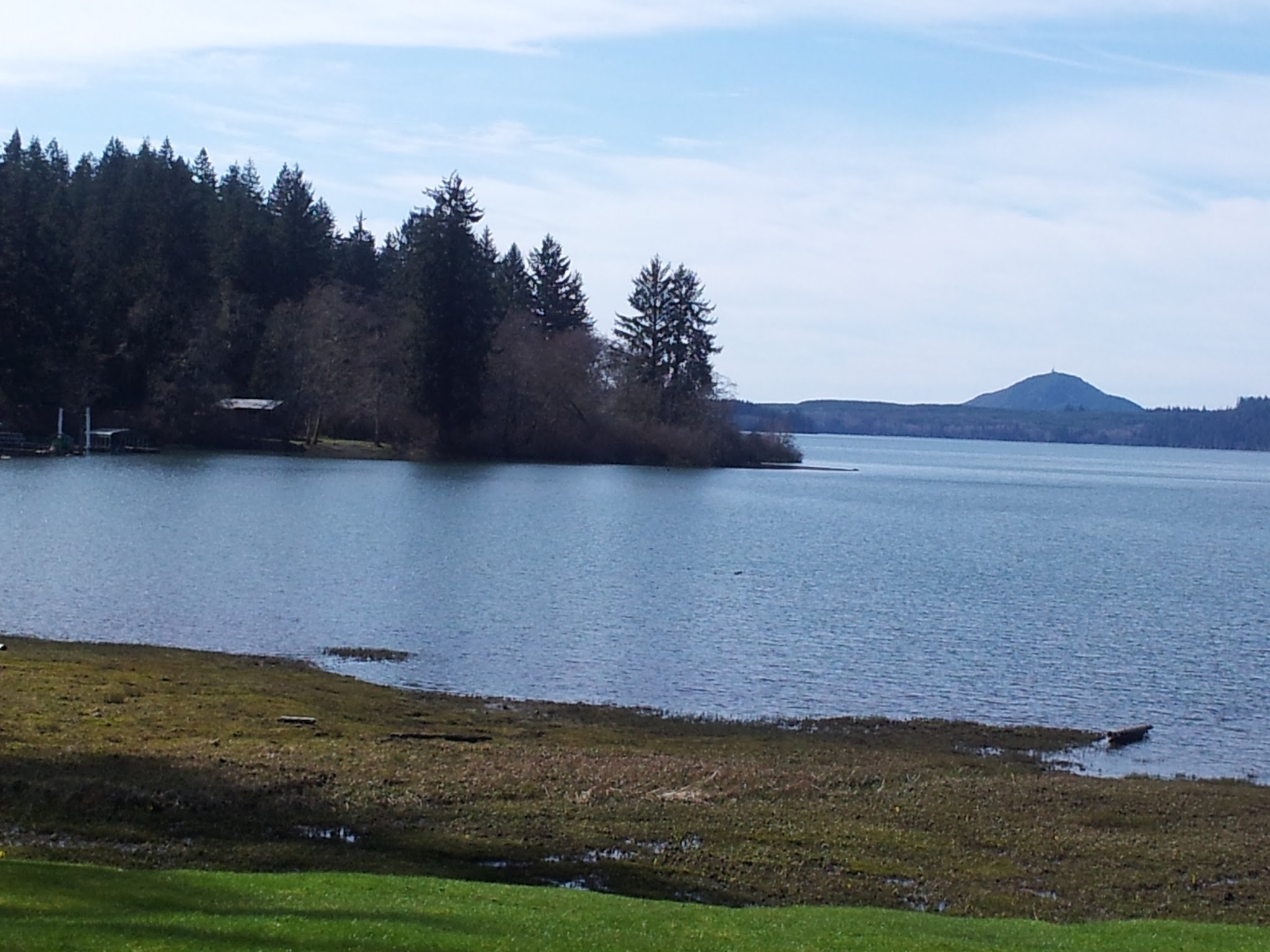
First, a few pictures. The location was truly gorgeous, right on a lake that tended to get misty in the mornings, with the rain forest on the hills behind the buildings. It rained a lot, not surprisingly, which was fine since I was supposed to be writing.

Beautiful Quinault Lake: what a view!

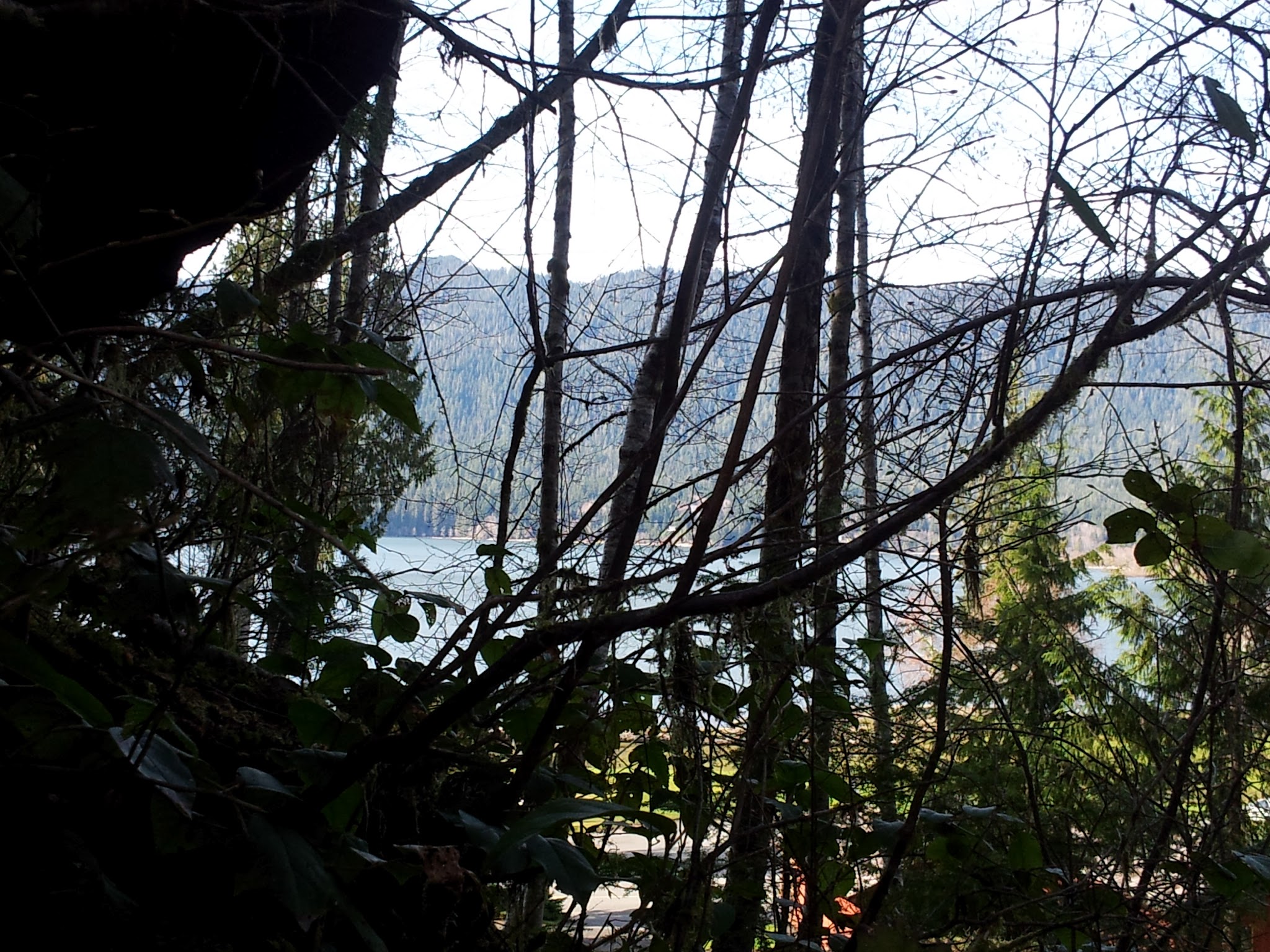
And here's the lake again through the trees.


There was lots of moss in the rain forest.

I was pleased with how much I wrote and found I was able to be more productive than my usual. I wrote until my outline broke. Of course, now I have to fix it before I can start again, and aforementioned neuron difficulties aren’t helping matters any. But figuring out how to fix broken outlines is actually one of the parts of writing I like best, even though I also enjoy complaining about it.

But really the best part of the trip was the people. No big surprise there, of course. Put me in a room full of writers, and the likelihood of me meeting someone who I find fascinating and nice increases exponentially. So do my chances of encountering a kindred spirit, and really, there isn’t much in this world that makes me more happy than making contact with that elusive breed. Except perhaps spending even more time with them. And writing.

I wonder if it’s a matter of depth, a trait all the kindred spirits I’ve met share. I don’t know if people who already have depth are drawn to writing, or if writing requires and develops depth in people. Or perhaps both? I don’t mean to imply that all people who aren’t writers don’t have depth (or contrariwise, that all writers automatically have it), as that is simply not true. But I do think the percentage of writers who have depth (or at least who express themselves in ways that reveal it) tends to be higher than average.

I think I’d like to write more about kindred spirits when my thought processes are in better working order. But in the meantime, I must conclude in order to consume liquids and lay on the sofa like a rag doll. Suffice it to say I thoroughly enjoyed my time in the Quinault Rain Forest.


Read Full Post »

Today I am away from home, attending the Rainforest Writer’s Retreat in Washington. Ah, the bliss of days on end in which I have no obligations except those of basic upkeep and writing, writing, writing! After which I get to converse with other writers to my heart’s content.

In other news, my husband and I are currently reading my old favorite The Phantom Tolbooth, by Norton Juster, at bedtime. This book is full of gems of word play and absurdity, as well as surprisingly profound insights on the nature of the world. Here is one of my favorite passages:

“…from here that looks like a bucket of water,” he said, pointing to a bucket of water; “but from an ant’s point of view it’s a vast ocean, from an elephant’s just a cool drink, and to a fish, of course, it’s home. So, you see, the way you see things depends a great deal on where you look at them from.

This passage struck me strongly when I read it as a child, and every time I re-read it, I am reminded again of what an important insight it really is. So much of the world depends on your point of view, doesn’t it? Not only does this help me keep perspective on my own life and problems, but it’s also helpful when trying to understand other people. We all see things in our own special way, and it continues to amaze me how very different those ways can be.

When one stops to consider how mutable memory is, this train of thought gets even more interesting. Let’s say I attend a small event with three other people. Each of us will perceive the event from our own perspective to begin with. So maybe Person A is really happy because she got good news earlier today and has been really looking forward to this event. Person B is trying to be chipper but is experiencing some RSI pain in his arms and shoulders. Person C is deeply annoyed because he wanted to go to Japanese food but the group consensus was for Italian and now he’s worrying about eating too many carbs. And Person D worked really hard today and is having trouble transitioning from work mode to social mode.

Already we can expect that each person will experience the evening differently. But then ask them all about it three months later, and the stories will be even more different. Each person will have personal details they remember and others they forget. Some of them will misremember. And if they’re remembering together, one them may say, erroneously as it happens, “Didn’t Person B order gnocchi?” and then another will say, “Oh, that’s right” and in such a way the erroneous memory will spread. Each person’s perspective will shift depending on what they remember.

Norton Juster got it right. It all depends on your point of view, and many more things are subjective than we might at first realize. I often think about that bucket of water and remember that today, I might be the elephant and you might be the fish.

Read Full Post »

I haven’t been writing recently about being a people pleaser, or becoming more assertive, and other topics like that. You know why? Because it’s hard. It’s hard to change how you react to things. It’s hard to tear your life apart, examine it from every angle, and then slowly put it back together again. I often put pieces on backwards, or they just don’t fit right even though I’m hammering at them for dear life.

But then I read this essay by Penelope Trunk, who is, as you know, one of my favorite bloggers, and I realized I should write about it more. Here is what she had to say:

“It’s hard to know who to take advice from. But my instinct tells me that the best advice comes from the people with the most difficulties. Not in the past. But right now. Because that’s where you want to be: doing something difficult right this moment.”

So yeah. I’m doing something difficult right now, so maybe it is worth talking about, even though it’s dangerous and messy and I don’t have all the answers. I don’t want to give you advice as much as I want to illustrate that people can in fact do this–that people can change themselves, that people can look at themselves and say, I could be a lot happier than I am, and then take positive steps to make it so. Because I meet so many people who seem to think that almost everything is impossible, and that just isn’t true.

Here are two things that happen when you have actually made strides at changing your people pleaser tendencies: people will freak the hell out, and you will realize you have spent most of your life listening to very bad advice.

People will freak out because, even if they are actually decent people (and sadly, some of them aren’t), they are used to you being a doormat. You suddenly deciding you’re not a doormat is vastly inconvenient and confusing. It disrupts the normal patterns of all your relationships. Even the people who are generally supportive of this change will sometimes freak out, because oh my god change and where do they fit into this new picture?

As for the bad advice, it’s amazing how willing many people are to support you making decisions that are outright harmful for you. Society as a whole is quite okay with this notion too. There are two forces at work here. There are the people who are taking advantage of you in some way. It is obviously in their best interest to give you bad advice about continuing to be a doormat with everyone; they have a vested interest in you continuing to drink the Kool-aid. And there are the people who are doormats just like you, who don’t have good advice to give since they are in the same unfortunate position, and who wouldn’t give the good advice anyway because then it might force them to examine their own position, which they don’t want to do because of the chaos that would then ensue in their own lives.

Of course, once you have that lightbulb moment in which you realize how generally absurd most of this advice is (and wouldn’t that make a fun post one of these days?), there is no turning back. You have taken the red pill, and you begin to wonder: why was pleasing these people ever so important in the first place? So instead you sit back and watch them freak out, and you remember that you are worth it. And you keep resisting the gravitation pull of going back to the old comfortable ways that were holding you down.


Read Full Post »

I mentioned in my post The Dangers of Advice that among the common writing advice I don’t follow myself is the adage to write every day. Apparently, Jeff VanderMeer doesn’t write every day either, at least not to a specific word count. So you know, yet more evidence that you should studiously ignore all writing advice that doesn’t work for you.

I will add that, even if I’m not churning out word count every day, you can see from my post on Tuesday that I’m constantly engaging in what I am going to call writing mind. It’s more in the forefront these days, but even when I’m not shoulder deep in novel, it is a challenge to turn it off for any length of time. Almost everything I do, think about, read, I experience through a writer’s lens, so that being a writer suffuses my entire life, to the point that constant word count is, to a certain extent, a moot point.

Writing mind: a combination of subconscious processes and experiencing the world through the lens of a writer

In a recent interview, Robin Hobb talks about her experience, which sounds an awful lot like writing mind to me:
But even when I’m not at the keyboard, I’m still writing. I think that’s what the paper notebook taught me. My brain ‘writes’ all the time. It’s just finding the time to sit down at the keyboard and record what is store there!

Certainly one has to write to be a writer, and as a whole the writer community is very insistent on this point given the number of people who say they are writers but don’t write at all. We feel obligated to be prickly about it because there is a wide-spread misconception that writing fiction is easy. But the more I write, the more I am coming to understand that the actual writing is a critical component of the whole, but not the only one.

It is a pleasure, especially for a perfectionist like me who sometimes (often) suffers under an unforgiving work ethic, to realize that the time I spend every morning sitting in front of the fire and staring into space, or feeding my brain with various economic analyses, neuroscience findings, pop psychology, and insights about books and writing is all in service to the writing. Of course if I have a particularly busy day I have to skip right past the brain feeding phase except for a brief brainstorm in the shower and jump right into the heavy lifting, but it’s nice to realize that both parts are necessary and valuable. This insight allows me to be more fully me and to enjoy the process without quite as much of the kicking and screaming (although plenty of that still goes on; you try writing a novel dealing with the mutability of memory and see how you get on).

Being a writer encourages me to keep having interesting thoughts and doing interesting things, which is an aspect of it that I value extremely highly, especially at this time in my life when I can fully appreciate the comfort that comes from slipping into a pleasant routine and avoiding challenge in favor of the pleasures I already know I enjoy. Writing itself keeps me constantly on my toes, but it also rewards me when I decide to get more adventurous.

A few recent examples for you:

  1. I went to see President Obama speak a few weeks ago, not just because it was an amazing opportunity, but because I thought, “Hmm, I’ve never been to a political rally or heard a person with high charisma speak in public. I bet that will come in handy someday in my writing.”
  2.  We are beginning to consider our summer travel, and I provided my husband with a list of places I thought might figure into the settings of my next novel. “Which of these are you interested in?” I asked. Of course, it turned out that he was willing to go to any of them because apparently the heroine of the book has excellent travel taste.
  3. I picked up some novels recently that are not my usual fare, based on recommendations in an article by my friend Damien. Now on my to-read stack: Orlando by Virginia Woolfe, The Glass Bead Game by Herman Hesse, and The Magus by John Fowles. I don’t know if I’ll like them, but at the very least I’ll learn something from them.

To sum up: Jeff VanderMeer doesn’t have a daily word count goal. Robin Hobb describes writing mind well. And writing mind meshes nicely with the desire to see life as an adventure and not settle too easily into general complacency.

Read Full Post »

My head is in the clouds. Actually, my head is in a fictional boarding school in a remote location in the Canadian Rockies.

In other words, I am obsessed by the novel I am currently writing. And when I’m not completely lost in my obsession, my mind invariably turns to the novel I want to write next.

This makes everyday interaction a bit…problematic. Because there’s a part of me that wants to spend all my time at Lincoln Academy because my god, the amount of tension and drama in the plot right now! I want to find out what happens next. (I mean, I kind of know what happens next, but it’s not the same as when the words are written. Words can be surprising.) There’s a part of me that never wants to leave my house. On days like today, when I don’t have to, I am suffused by a sense of well-being because I can just let my mind go on its haywire creative journey all day long. And I am deeply, deeply happy…even when in the depths of misery because the book will not cooperate, the book is not as good as it should be, the book is making my brain hurt because dealing with an unreliable narrator is even more mind-blowing for the writer than it is for the reader (or so I am learning).

Of course, I can’t spend every minute of every day writing. For that matter, I spend very little time actually writing, and much more time thinking about all things novel-related. But I can’t even do that all the time. However, I am finding it increasingly difficult to clear my mind enough to think or converse intelligently about other topics. I can do it, but it takes significantly more effort than usual. So when I wrote about how writers shouldn’t talk about writing on their blogs all the time, maybe I was being a touch naive. Because right now, what else could I possibly want to talk about?!?!

When I need a break from the novel, I do turn to Downton Abbey...

The blog is a particular problem because I choose the topics and the original post is just me talking about what I’m thinking about. In person I get along a bit better, because in general people are quite happy to take over most of the conversation, and I certainly have enough brain space to nod and smile at the correct intervals. I can even make vaguely relevant comments. The people who know me best can still strive for total engagement with strategic introduction of proven Amy-enticing topics: Disneyland, travel, theater, books besides my own, bridge, a sufficiently interesting intellectual topic (with extra points for neuroscience or social trends). Sometimes politics is shocking enough to dart pass my defenses, although this is invariably unpleasant.

But in the end, I am living breathing dreaming and otherwise immersed in my novel. So if I seem somewhat distracted here on the blog, or if you notice a certain, dare I say, sloppiness creeping into my thought processes, well, that is why.

Read Full Post »

« Newer Posts - Older Posts »