Feeds:
Posts
Comments

Posts Tagged ‘Amy Sundberg’

Observation: a lot of people who talk about “living your dream”

aren’t really doing so themselves.

Chris Guillebeau

I suppose this is a shot at self-styled lifestyle gurus who aren’t practicing what they’re preaching. But as easily as we bandy around the idea of “living your dream,” it isn’t always so straightforward, is it?

Sometimes it is straightforward. Sometimes it is just a case of doing some basic research, of putting together a budget in order to save toward a do-able goal, of deciding to take the risk and go for it.

But other times it isn’t quite so simple.

Do I live my dream? Kind of.

But parts of my dreams have been put on hold. I’ve let parts of them go. Some of them I haven’t yet discovered. And some of them are in the middle of being baked, and I’m not sure how they’re going to turn out.

Part of the inspirational speak is tell people how easy it actually is to live your dream. And then we will all feel all fired up and ready to tackle anything. But that’s simply not true. Sometimes it’s simpler than we think, and sometimes it isn’t. Sometimes it’s quite difficult. And sometimes we achieve our dreams only to realize we’ve been chasing the wind, and the dream we thought we wanted isn’t actually our dream anymore.

Have you ever had that happen? It’s a real eye-opener.

Perhaps living our dreams is more of a state of mind, an acknowledgment of life’s possibilities. In accepting life’s disconcerting lack of permanence, we can see how that very lack can simultaneously be one of the best and the worst parts of being human. The worst because we have things (experiences, relationships, our own physical bodies) that we don’t want to let go of. The best because now is going to change, so even if our dreams feel far away in that now, soon it will be another now, maybe one in which those same dreams feel closer.

Or perhaps living our dreams is about living an examined life instead of a blind one. Do many dreams exist without a give and take? What are we willing to sacrifice and when do we find compromise impossible? What do we give up in pursuit of our dreams?

Or perhaps, just perhaps, living our dreams is something each one of us has to define for ourselves.

May you live the dreams you wish to live, when you wish to live them. It probably won’t be easy, but it might very well be worth it.

Or, as Theodora Goss says, “When things are difficult? That’s when you know you’re having an adventure.”

Read Full Post »

Today I have a really special treat for you. I’ve interviewed Adam Baker, the producer of the documentary I’m Fine, Thanks, which was one of the Kickstarter projects I highlighted on Tuesday. I was really excited to do this interview because the subject of the documentary, complacency, is so in line with what I talk about here on the Practical Free Spirit: priority setting, having adventures, being willing to take risks, and living an examined life.

So without further ado, here is the conversation Baker and I had:

What originally drew you to the topic of complacency in modern life?

My own story! Haha.

My wife and I were living that exact life that we discuss and talk about in the movie. We were doing o.k., but we weren’t doing what really made us come alive.

We made choices based on what we should do – or were supposed to do – and not really what was in line with our values.

In one of your blog posts, you said that two of the interviews made you cry. Will you tell us which two?

Well, at least two! But I’m sure I know the ones I was talking about then.
The first was Jonathan Fields’ interview. And that was twice. The first time was during an emotional story he told about 9/11 – and the second was when he told a different story about his daughter (I could relate as a parent).

The second interview was Victoria from Austin, TX. She’s a successful attorney who finds herself stuck between her career, wanting to stay at home with her young daughter, and her overwhelming debt from law school. The weight of her decisions was heavy for all of us in the room (you’ll have to wait and see it). 🙂

What are some ways in which we can combat complacency in our lives?

We found two common things amongst those that had successfully fought this problem:
  • They changed WHO they surrounded themselves with. The spent less time with people who brought them down and more with time with people who inspired and lifted them up. It was really that simple.
  • They started to become comfortable being able to fail. I don’t mean they LIKED failing. Or even tried to fail. But they were o.k. with that being part of the process. Often, the desire NOT to fail was what kept people trapped for decades!

Why do you think so many people are struggling with this issue right now?

It’s so easy to get caught up in the default life path. It’s encouraged and safe. It’s comfortable. So we all fall into that pattern.

It’s far easier to live someone else’s plan for your life – rather than to create your own plan. Creating your own plan is tough – REALLY tough.

But all the people we talked to said one thing – it was worth it!

What has been the hardest part of the process of making this documentary for you?

The sheer amount of work.

We spent 16-18 hour days on production while on the road. And, honestly, post production has almost been that crazy, as well!

We gave ourselves an incredibly short time frame – I’m sure we’ll be happy once it’s over – but during the process it can be stressful!

How did what you learned through making this film change you or the way you want to live your life?

It re-fortified my belief in what I’ve been trying to do for the last few years.

I’ve been working towards a more intentional life – but always have ups and downs. It’s the meaningful projects like this that remind me to stay the course!

What can people do if they’re interested in supporting this movie?

First, watch the Kickstarter trailer. (Amy interjects to add: Check it out! It’s a kick ass trailer.)

Second, if they feel compelled – back the project on Kickstarter (for as little as $5) – which gets you a download of the movie. We have many more levels for you to back, but kept it very affordable to help share with as many people as possible.

By supporting the Kickstarter, you ensure that this story can get out into the world. If we’re successful we’ll be able to share this with tens of thousands more people!

Lastly, just spread the word. Whether you can back the project or not – sharing the trailer and the campaign with your family and friends means a lot!

We’re on pace to become one of the most backed projects on Kickstarter (total number of people supporting us) – which is amazing!

Thank you, Baker, for taking the time to talk to us about your film. I can’t wait to see it! And I can pretty much guarantee I’ll be referencing this interview again, especially those excellent points on how to combat complacency.

Read Full Post »

I’ve been somewhat injured the last week or two, so I’ve had some extra time on my hands. So I decided to poke around Kickstarter and see some of the awesome projects artists have in the works.

In case anyone doesn’t know, Kickstarter is a funding platform in which artists put up projects and how much funding they wish to receive, and then their fans and the interested public can pledge money towards those projects, usually for nifty rewards like art, books, tickets to live performances and screenings, etc.

What’s exciting about Kickstarter is it gives artists a viable alternative to get their amazing work out into the world while getting paid for it. Many creative projects require money up front in order to become realities, and Kickstarter allows the artist to get paid directly from their fans instead of finding corporate backing. It definitely works best when an artist already has an established fan base who can both support them financially and spread the word. For writers, a successful Kickstarter mimics the advance system of traditional publishing while allowing the writer to retain complete creative control. Which is all-around awesome sauce.

Here are some of the Kickstarters I decided to back last week:

Tropes vs. Women in Video Games, by Anita Sarkeesian

I’ve been watching all of Anita’s videos ever since she explained to me, complete with relevant examples, what the Bechdel test was. Now she’s taking on the portrayal of women in video games with a lengthy new series. I couldn’t resist backing this project, because this video series NEEDS to exist.

Fireside Magazine Issue Two, by Brian White

This looks like a promising new fiction magazine, with a lot of speculative heavy hitters in the line-up for the next couple of issues. But really I was sold by the opportunity to be drawn by my friend Galen Dara, who is an amazingly talented artist.

Amanda Palmer: the New Record, Art Book, and Tour, by Amanda Palmer

Amanda Palmer is in the process of revolutionizing the way musicians can interact with their fanbase and make a living while doing awesome things. How could I not want to be a part of this? Also, art books are cool.

Crossed Genres Publications, by Bart Lieb

I have a special place in my heart for Crossed Genres. While they weren’t my first sale, they were the first publication who ran one of my stories. Their Kickstarter has been so successful, they are now going to bring the magazine back (it folded recently), and they also have a few very interesting anthologies scheduled for publication in 2013.

I’m Fine, Thanks, by Crank Tank Studios

To make this independent documentary, the filmmakers toured the country and conducted lots of interviews. Their topic? Complacency and the pull to follow a pre-approved script instead of creating your own unique and individual path through life. Can you think of any subject of a documentary that fits in more with the spirit of this blog? Because I can’t. I am so excited a movie like this exists, and I can’t wait to watch it.

I can’t cover all the worthy Kickstarter projects out there in one blog post, so please help me out. What projects have you supported recently? What other cool things are artists out there doing?

Read Full Post »

Conventional blogging wisdom for fiction writers is that we should avoid talking about politics and religion. (Science fiction writers are perhaps the exception to this rule; see John Scalzi, one of the most prominent examples, and on the other side of the American left-right fence, Orson Scott Card.) The idea is that such views can be unnecessarily divisive and that by talking about them openly, we can alienate potential readers.

I have, for the most part, followed this advice. I don’t talk about religion on this blog or anywhere else, really. I rarely talk straight politics, although I couldn’t quite suppress my concerns about habeas corpus. But feminism keeps creeping in through the cracks of this blog and in the material I choose to share on the internet, and isn’t feminism at least partially a political issue? It certainly is a touchy one.

One result is that I’m been forced to rethink the conventional wisdom. I can say without a shadow of a doubt that it is easier not to blog about religion or politics or social justice. And I can understand the choice not to do so when it feels like a livelihood hangs in the balance of what we allow ourselves to discuss. Plus some of us find conflict to be very unpleasant. But at what point does talking about matters of importance become more of a question of conscience?

Does blogging give you a voice?

I’m not talking about being safe here. There’s this trend that happens in the science fiction blogosphere, wherein a few of the really big bloggers share their opinions of a current issue, followed by a quiet ripple of smaller bloggers chiming in with “Me too”s and “basically exactly what has already been said about this issue in almost the same words.” Because when we follow in the footsteps of the big guns, then we’re relatively secure. I’m not saying it’s bad to offer a show of support, but it’s not the same as pushing the discussion forward. The conventional wisdom is consunmately safe.

Let’s talk about danger instead. If, as a writer, we develop a greater reach, then we have to decide how to use that reach. We have a greater ability to help, and an equally heightened ability to harm. We can set the topic of conversation instead of merely echoing and reacting. We can affect the way people view the world, often subconsciously, through our stories and our words. We can decide whether to point something out as problematic or whether to be silent and let it float on in obscurity. And whether we like it or not, these abilities come with certain responsibilities.

We don’t have to blog about politics or religion, not if we don’t want to. We can choose to communicate exclusively through our fiction. But at some point, I think every artist has to ask, “What am I really trying to say here? What do I really need to say about human experience and about the world? What might I be saying by accident that I don’t actually want to be saying?”

But sometimes, we might be compelled to blog about something risky, about something uncomfortable. And sometimes we are willing to pay the price for having a voice. In which case, that conventional wisdom can go right out the window. There are times when safety is not the most important goal.

What do you think? Do you ever talk about politics or religion on your blog or over social media? Are there issues that you feel compelled to talk about, even though they lack an approved-for-fiction-writers (or approved-for-polite-conversation) stamp?

Read Full Post »

My husband was telling me about a friend of his who is a good listener. “But I think she’s the one who needs emotional support right now,” he told me.

So we are going to be revisiting a topic I’ve talked about before, problem comparing, because obviously one time was not enough.

Just because your friend has problems does not mean you can’t talk about your own problems. Even if your friend has really big problems. Keep the following in mind:

1. Your friend may have more times during which they can’t listen to you. If they’re fully in crisis mode, right in the middle of dealing with their problem, whether it be physical, mental, or emotional, they probably can’t be there for you right this minute. However, unless there’s a problem with codependence in your friendship (and if there is, that’s a whole separate issue), they will tell you if now isn’t a good time. And if it’s not a good time, that doesn’t mean there won’t be a better time in the future.

2. Your friend may not be able to track you as well. Meaning, they may not have the bandwidth to check up on you, make sure you’re doing okay, send you texts and invitations, and come to you to see if you need anything. That doesn’t mean that if you go to them, they won’t be able to listen.

3. Your friend might find it a welcome break to hear about someone else’s problems for a change. Distraction can be very helpful in certain circumstances. They might also feel better knowing they’ve been able to be supportive to a good friend.


The other aspect of this issue I’ve noticed lately is how invalidated some people feel when their problem isn’t the one getting the full spotlight. It’s as if there’s some kind of suffering quota that they’re afraid is going to be filled up before it’s their turn.

Let me help you out. Everyone suffers. Every single person. And everyone deserves compassion for the suffering they face. It doesn’t matter if your suffering is different than mine, or worse than mine, or not as bad as mine. You still deserve compassion because suffering is hard for everyone.

But when we use our own personal suffering as an excuse to shut down conversations about institutionalized suffering, we are becoming so caught up in our own heads that we are not showing compassion to others. I see this kind of thought process again and again in conversations about race, gender, class, and sexual orientation. Just because we are talking about these issues, just because there is lots of statistical evidence that institutionalized injustice exists, does not mean your own personal suffering does not also exist. But not every conversation has to be about you. Sometimes we need to talk about suffering that affects wide swathes of people, even though you are not one of those people.

Don’t worry. The suffering quota won’t be filled up any time soon.

Read Full Post »

“Fear is the mind-killer.
Fear is the little-death that brings total obliteration.”

Dune, by Frank Herbert

I am afraid of so many things.

I am afraid of death, my own and others’. I am afraid of incompletion. I am afraid of bad health. I am afraid one day I’ll try to get out of bed and my knees will hurt so badly I won’t be able to leave the room. I am afraid I’ll crack more teeth and end up subsisting on gruel; forever, because most of my fears don’t allow room for the possibility of change. That’s what makes them extra scary.

I am afraid of being deeply alone. I am afraid I will discover a massive regret too late to do anything about it. I am afraid I’ll go crazy. I am afraid I will lose my sight or my hearing. I am afraid I’ll be attacked by a giant swarm of angry wasps. I am afraid of pain and grief and loss. I am afraid of the necessity of being brave.

I am afraid to fail. I am even more afraid to fail over and over and over.

Last week I had a particular scenario in my head that was causing me large amounts of worry (something that hadn’t even happened yet). This weekend, I read a blog post that talked about another person who was in a similar scenario, and how she was crippled with worry. The way it was written up, my first instinct was to think, oh, that’s silly, she’s not so badly off. It took a couple more beats for me to realize that meant my hypothetical wasn’t so bad either.

Because Frank Herbert got it right. Fear makes us stupid. It clouds our judgment. It squeezes us so we can’t breathe, can’t reason, can’t accept what’s happening. It transports us to fictional futures and makes them real in our minds, even though those futures may never become true in reality. It causes us to give up or settle or take the easy answer, even if it’s not the best answer.

Of course, we put ourselves in danger anyway. We become police officers and firefighters. We join the military. We bare our souls as artists, even while we’re embracing rejection. We fight to save lives. We deal with the up-and-down uncertainties of being entrepreneurs. We give away our hearts. We jump from airplanes, walk home in the dark, and swim deep underwater. We sing challenging arias in Italian in front of other people. Risk-taking is woven into the fabric of living.

Fear is difficult. Sometimes we face it and emerge stronger. Sometimes we become paralyzed and cannot move past it. Sometimes we don’t even realize what it is that we’re really afraid of.

I am afraid of so many things. All I can do is remind myself that in this present moment, I am okay. And if I am ever faced with a killer swarm of furious wasps, I’ll deal with that then.

What are you afraid of?

Read Full Post »

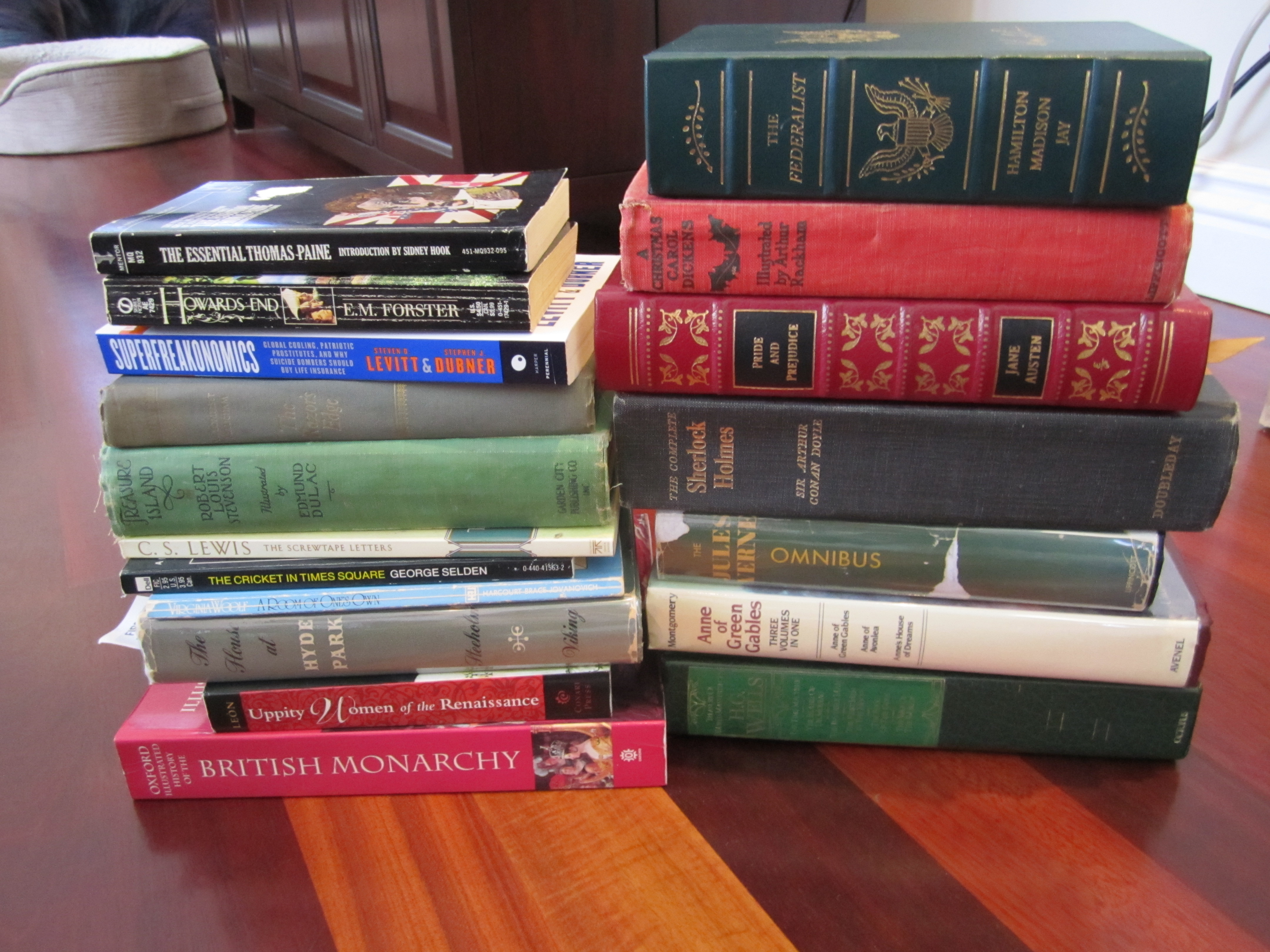
Book worm: a person who cannot imagine an existence without reading.

It just occurred to me the other day that most people are not book worms. I mean, I know that most American adults do not read that many books; in 2007 the media had fun complaining about how 27% of Americans hadn’t read a book in the last year, and looking at that same study, of the remaining 73% of people who did read, 25% of them had only read 1-3 books in the past year.

Sometimes numbers take a while to sink into my brain. But I met someone at a party recently who announced, “I don’t read.” I appreciated his bluntness: no excuse making, no pretending. And I realized these hypothetical people who don’t read (or don’t read much) actually exist. They are all around me, all of the time! My lifestyle, in which books have always featured prominently, is not the way everyone I know lives. What an epiphany to have, right?

I love reading. I feel physically hungry to read more good books. When I purchased William Shakespeare’s complete works for the Kindle, I almost started crying because I can now carry all of Shakespeare’s words wherever I go. I cannot contemplate a life in which I don’t have time to read; my brain cannot even compute the possibility.

Photo by Eneas de Troya

You know you’re a book worm when:

1. You worry when you leave your house and don’t have a book with you.
2. The idea of having hundreds of books on a portable device reduces you to tears of joy.
3. Libraries and bookstores are the most amazing places on the planet because you can experience physical proximity to so many books at once.
4. The idea of having your bedroom lined with bookshelves gives you a cozy feeling.
5. When you think of being stranded on a desert island, your first concern is what books you would choose to have with you (and how you’d survive if you didn’t have any books at all).
6. One of the best parts of planning a vacation is choosing the books you’ll take with you.
7. You buy a special book for your birthday each year so you know you’re guaranteed to have a pleasant day.
8. You know every section of wall in your home that could be used for more bookshelf space in the future. Book storage is one of the most important uses of your home.
9. You have trouble getting rid of books, even duplicates.
10. When called upon to choose between reading a good book and doing another activity, it is a really tough choice. (Or it’s an easy choice; of course you’d rather stay home and read.)
11. Your favorite gift to receive is a gift certificate to buy more books.
12. It is hard to leave a library or bookstore without a large stack of books.


13. You are pretty much always in the middle of at least one book.
14. Your most important criteria when purchasing a purse/bag is how big a book it will fit (the winners are the ones that will accommodate hardcovers).
15. You want to live forever because otherwise, think of all the books you’ll miss!

I love being a book worm. It brings me so much joy. What about you? Are you a book worm? Do any of the above behaviors sound like you too?

Read Full Post »

When I was in Seattle, I bought a vampire T-shirt. It’s a flattering light blue, nice soft cotton, and on the front there’s a picture of a woman, her mouth surrounded by red blood. It is my new favorite T-shirt, even more so than the Star Wars one of Princess Leia saying, “Don’t call me princess” or my classic Buffy the Vampire Slayer shirt. (Although thinking about those two T-shirts also makes me pretty happy.)

In a way, my new vampire T-shirt is like Max’s monster costume from Where the Wild Things Are. I wonder if I like it for the same reason he liked to dress as a monster. Wearing it is both embracing the monstrous nature of life–the violence, the cruelty, the confusion and uncertainty, the inevitability of death, whether you are ready for it or not–and embracing the reflection of the monster that lives inside.

Because we are all monsters in some way, aren’t we? We all have some fragments of a dark side, and some of us have full-on Darth Vader scale issues. Nobody wants to be “nice” all the time, and indeed, as I have been discovering, being nice can have decided drawbacks. Being nice can turn out to be not so nice after all; even such an innocuous-sounding desire can have hidden depths.

We’re fascinated with that monster inside, though. Look at the popularity of Dexter. I have not actually seen Dexter, so I can’t talk specifics, but it is a show featuring a serial killer as its anti-hero protagonist. Oh, but it’s okay, because he’s a serial killer with a moral code. Um…yeah. I guess we believe our morals can keep the monster on a leash. I guess we want to believe that the end justifies the means.

At the same time, we need that monster. It gives us courage and strength, and it allows us to come to grips with strong and sometimes overwhelming emotions: anger, fear, grief. It gives us a feeling of power, of control. In the case of the vampire woman on my T-shirt, it hints at something unsuspected: you might have thought I was powerless, she says, but now that my mouth is ringed with blood, perhaps you have different ideas of who I am and of what I am capable. If we are dressed in the guise of a monster, then we can see ourselves as the empowered individual instead of the victim. We can act instead of being acted upon.

When I was a kid, I had a stuffed animal monster called an Oof. It had yellow eyes, a beaver tail, and horns. It sat on the top of my bookshelf and watched over me while I slept, and I loved it. Because some monsters are loveable: Cookie Monster, Roald Dahl’s the BFG, Sulley from Monsters Inc., even Patrick Ness’s The Monster Calls (which is one of the most devastating, true, and perfect books I have ever read). A monster can sometimes show greater compassion than everyone else. A monster can sit with you and be okay with who you are, even when who you are is messy and complicated and not the way you’re supposed to be.

We all live with monsters. When we’re lucky, we then get to come home to our bedrooms where our suppers are still piping hot. Thank you, Maurice Sendak, for the truth you told.

What do you think about monsters? Do you have a favorite kind? Do you have something you like to wear that’s like my vampire shirt or Max’s monster costume?

Read Full Post »

My short story “The Box in my Pocket” has recently come out in the anthology Fantastic Stories of the Imagination, which is available as a paperback and an e-book. Here it is directly at Amazon (paperback and Kindle e-book) and B&N (for the Nook).

I wrote this story in January of 2011.  I remember thinking of the story seed, writing the first line, and then the story had its hooks in me. I put aside the novel project I was supposed to be working on in order to write this story instead. (And given that I usually become quite single-minded during my novel writing time, this is saying something.)

Yes, that is my name on the cover. 🙂

This story is one of the most personal I have written to date.  The point of view character is a teenage girl who is losing her mother to cancer. This character is not me, but the situation is one with which I am intimately familiar. Well, except for the fantastical element, of course. That part didn’t happen to me. Really.

Normally I shy away from writing anything too autobiographical. Bits of me will inevitably worm their way into the words I write and the telling details I choose; I am never completely separate from my work. But early in my writing days, I found myself defending characters’ behavior in a story I had written, saying, “But this actually happened exactly like this.” It didn’t matter, of course. It didn’t work in the story. Real life doesn’t always translate well into fiction. People don’t always behave in “believable” ways. So now I don’t tend to write with real circumstances in mind.

I do not, however, avoid writing about the emotional truths I have experienced. “The Box in my Pocket” is one emotional truth of what it feels like to lose a mother at a relatively young age. It deals with the dual themes of death and memory, both of which I find myself addressing in my fiction repeatedly; my fascination with them never seems to fade. It asks the questions, how do we deal with loss, and how do we finally let go (or do we hold on forever, and at what price)?

As for the anthology itself, Warren Lapine is its editor, and it includes stories by Mike Resnick, Harlan Ellison, Sharon Lee and Steve Miller, Kelly McCullough, Barry Longyear, and many other writers, so I am in extremely good company.


Read Full Post »

People like to find a scapegoat.

Recent articles link the rise of loneliness in modern society with the use of social media, and although I have explored the idea before, I have become less convinced. Isn’t it convenient that we can blame technology, that behemoth with which we traditionally have an uneasy relationship, for the lack of connection we might feel? And yet, even if, as some figures suggest, Americans are now lonelier and have fewer confidants than in the past, there is still little data to show this trend is being caused by social media.

I agree with Dr. Grohol, who states: “[Using social media] doesn’t stop me from having those in-depth, face-to-face conversations, or put them off. I’m under no illusion (or delusion) that having a social networking circle of hundreds or thousands makes me more social.”

Instead, what social media allows us to do is maintain, in unprecedented volume and frequency, our weak ties. What is a weak tie? Someone who we don’t know very well, an acquaintance, if you will. By fostering so many weak ties, we are able to continue to expand our social networks and have potential reach to larger numbers of people, many of whom we will never directly meet or communicate with.

Obviously this is a major boon when we are, say, trying to sell something or build a reputation for ourselves or looking for a different job. But it can also be valuable because of the different insights and opinions we are exposed to, the potential actual friends we might meet, and the recommendations we might receive. Not to mention the benefits of being able to keep in touch, however superficially, with friends and family who live far away.

However, it’s not hard to see how social media might appear to make us lonely, especially if used as a kind of social substitute that it isn’t. If I am already feeling lonely and then I hop onto Facebook, the odds that spending half an hour reading my “friends’” status messages will make me feel any better are fairly low. But I have noticed a certain irrational expectation in myself that seeing all those photos and clicking “Like” a few times will magically pick up my spirits. Note to future self: that doesn’t work! Go out and see someone instead.

It’s interesting to watch ourselves learning how to deal with so many weak ties at once, a feat about which we are only now gaining experience. I like to think of social media as a party: a few of your really good friends are there, which is especially awesome. Then there’s those people who you’ve been seeing at these parties for years, and that’s the only time you talk to them. And there’s the newcomers, the people you don’t know so well but it’s interesting to chat with them for a few minutes. Except this is happening all the time on your computer, not just for three or four hours at a scheduled event.

And just like at a party, most people are trying to present their best selves. Many of them will keep their dirty laundry and deeper troubles mostly under wraps. A few of them might have embarrassingly public meltdowns. We’re surprised when  the perfect married couple announces their impending divorce, when that vibrant woman turns out to have been suffering from a life-threatening disease, when bits and pieces of messy life burst unavoidably out into public view.

And social media is very much the same. We are presented with a smooth and managed facade, and sometimes we forget the facade does not always reflect what’s going on under the surface. All those people in your social media networks who have perfect lives with adorable children and exciting jobs and exotic vacations? Maybe her child vomited all over the living room this morning, or that exciting company is going through a round of layoffs, or that exotic vacation meant forty-eight hours of pure, unadulterated suffering from food poisoning. Some people show this underbelly of their lives, but many choose not to. It’s the way weak ties work. And as depressing as all this seeming perfection can occasionally be, we mostly find it depressing because we are not used to weak ties; we haven’t internalized the knowledge that these public statuses are only a small percentage of the whole. We believe, often without question, the stories people choose to tell about themselves.

The societal shift we are experiencing is certainly not without its difficulties. But social media, and the internet as a whole, are just technological tools like all other such tools. Sometimes we use them skillfully, and sometimes we don’t. Sometimes we lack the understanding of how such tools work or for what they work best. Sometimes we’re not very interested in trying them out at all.

But I suspect loneliness arises much more from our physical environments and the strong ties that we either have or don’t have with other people. Strong ties that are fostered by face-to-face interaction, video chat, phone calls, and the exchange of letters and emails. Blaming a tool meant for developing weak ties for any trouble with strong ties seems misguided at best.

What do you think? Do you have less in-person conversations or strong ties because of the advent of social media? Have you been able to develop strong ties as well as weak ties through a social media service? How much does face-to-face time matter in your close relationships?

Read Full Post »

« Newer Posts - Older Posts »