Feeds:
Posts
Comments

Posts Tagged ‘Amy Sundberg’

The blog post that I have found to be the most influential on my life is James Altucher’s How to Deal with Crappy People (and its follow-up How to Deal with Crappy People Part 2).

I don’t remember when I read it, probably a couple of years ago, and it was a revelation to me. Just the bare fact that there are crappy people who exist and we’re allowed to acknowledge this as truth was amazing to me. And that we are actually allowed to do something about it besides silently suffering? Wow. Heady stuff.

Then I read this article last week on The Problem of Being Too Nice (an issue I’ve written a little about myself). And I realized why receiving permission from that James Altucher article to call a spade a spade was so important.

Here’s the problem. If you come from a certain background, a background that generally includes at least a few influential and crappy people (usually but not always involving a dysfunctional family), then you become more likely to attract other crappy people. You turn into a Crappy People Magnet. And you’re so used to being around crappy people, and dealing with them, and having crappy things happen, that it all becomes normalized. You assume everyone is like that, and it’s all on you to make everything work out anyway. You can’t tell who is crappy and who isn’t. They just all blur together into an incoherent pile of people.

Photo Credit: jessicalsmyers via Compfight cc

With so many crappy people involved in your life, though, things never stabilize. There always seems to be stress and drama. You’re so rarely getting what you need that you get more and more tired. It takes all your energy to keep your head above water. And the worst part is you might eventually become a crappy person yourself. After all, it’s not like you’re learning healthy behaviors.

As a young girl, it was strongly instilled in me that everyone else was good and I should tolerate most behaviors. Even now I find writing about crappy people to be really uncomfortable. The people pleaser in me wants to make a million excuses for them. But the fact is, there’s a real difference between being an imperfect human who makes mistakes sometimes and being a crappy person. Maybe the crappy person is only crappy to some people. Maybe the crappy person won’t always be crappy. Maybe the crappy person has extenuating circumstances. It’s good to be compassionate. But…

It’s even better to take care of ourselves first.

I know there are plenty of happy people out there who mostly know other good and happy people. I am so glad they exist because they are excellent role models for those of us who have more of a struggle. But this post is not for them.

This post is for those of you who do have crappy people in your lives. This post is for those of you who need permission to call a spade a spade. This post is for those of you who might need to make some difficult decisions in order to take care of yourselves.

There are people out there who are kind and care about what you need. And life without so many crappy people? It isn’t perfect. There are some things about it that are sad.

But it’s also like being able to take a full breath of air for the first time.

Read Full Post »

This summer I went to a workshop about dealing with fear, and I left it feeling disappointed. The teachers didn’t tell me anything I hadn’t already known. They kept using examples that either weren’t really about fear or that were about being afraid of public speaking. So it wasn’t a talk geared for me.

Apparently fear of public speaking is the second most common fear in the United States. But to me, it just doesn’t seem like a big deal. I get nervous ahead of time, and I over-prepare, and I don’t always do a good job with it. But it’s so much better than having to sing operatic arias in a foreign language I don’t actually speak that contain high notes I can’t actually hit from memory and then have my performance critiqued in front of a group of fellow singers. That’s what I spent my college years doing. Which was still better than actual auditions.

So one way to manage fear is to do something a lot harder, and then easier things might not seem so bad. Another way is to do whatever you’re afraid to do A LOT. So basically you’re practicing your way out of fear.

But really I was disappointed in the talk because there is no easy answer. Whether you’re afraid of speaking in public or dying, uncertainty or being treated poorly, there is no one-size-fits-all solution. And I wish there was. Fear is such an uncomfortable emotion. It can both hold us back and make things a lot more miserable even as we trudge forward. It can warp the nature of reality itself, making things that might be true seem like they are actually true. And it can make us physically ill in a variety of ways.

I have spent a lot of time being afraid. And ultimately it’s always the same thing that pushes me through.

Belief.

I remember once as a student, I was walking towards the music building where I had an audition. I think I was sick (I was almost always sick), and I already knew I wasn’t going to get the part. I thought to myself, Why are you even bothering? Why don’t you just go home? Why are you doing this to yourself?

But the answer was clear. I had decided to do this. I believed this was what I should be doing, even though I felt awful and I was really nervous and I knew I wouldn’t get the part. I had a vision of what I wanted my life to be, and this crappy audition experience was a part of that. So I went, and I did the audition, and I didn’t get the part, and I moved on.

Belief is still what gets me through fear. I fix my eyes on my idea of the future, and I clench my jaw, and I do what needs to be done to give myself a chance of getting there. The fear is still there, making things harder, making me pause and ask myself why I am putting myself through such difficulty. But I believe in my vision, and I hold onto that belief as if my life depends on it.

So I guess if I were to give a workshop on overcoming fear, I’d explore how to create a vision strong enough to withstand whatever fear can throw at us. I’d look for some exercises to promote self esteem, because in order to believe in a vision, I think we also have to believe in ourselves. And I’d talk about how to take care of ourselves and handle rejection and disappointment and failure and other obstacles in a resilient way that allows us to keep moving forward.

How do you overcome fear?

Read Full Post »

I really like James Altucher’s blog. I disagree with him some of the time, but he usually makes me think, whether I agree or not, and I appreciate that. Of course, one of the challenges in reading his blog is ignoring his heightened rhetoric. (Heightened rhetoric is great for blog traffic, but it makes ideas harder to talk about.)

My friend pointed me to the recent James Altucher post “How to be a Slave.” Its main point is that if you work for someone else, you’re trapped and getting a bad deal: you’re losing all this money you could be making in the company’s overhead and paying your boss’s salary, and then also you have to sit through boring sexual harassment seminars and dress a certain way and act a certain way. So you should go work for yourself and be free.

But it’s not that simple. First off, there is a trade-off working for a company vs. working for ourselves, and it depends on our individual personalities and circumstances which one we’ll be more comfortable with.

Working for yourself or the Man? (Photo Credit: Alan Cleaver via Compfight cc)

If you work full-time for a company, you often get paid time off (vacation, holidays, sick days) and access to cheaper and sometimes better health insurance. This is part of your compensation package, so yes, you’re paying for it, but it’s nice to have vacation days and good health insurance, so it might be compensation that you want. If you receive a salary, you know about how much money you’ll make this year. On the other hand, there’s also the possibility you could be laid off. You have an imposed structure to work within, which some people find quite appealing. Overall, people at companies are perhaps less self-directed, but the amount of self direction depends from job to job and company to company.

If you work for yourself, you do not get paid for time you don’t work, and health insurance is more of a problem (although we’re all crossing fingers it will get better in January). Basically you have to earn more money to make up for the alternate compensation methods you’re not receiving. You have complete control of your time, but this can be a double-edged sword. The amount of money you’ll make in a year tends to be more variable. You can’t be laid off, but your business might do poorly. My favorite part of working for myself is that ultimately, the decision-making is up to me. But some people don’t like calling all the shots; it can be a lot of responsibility.

In addition, it is simply not true that if you work for yourself, you automatically can spend all your time the way you like or dress the way you like or treat people like crap because they’re the opposite sex from you. It is true that you can avoid a certain amount of red tape, wasted time and money, and procedures that are inefficient and ineffective. But many people who work for themselves have clients/customers, and in order to be successful, they have to cater to these clients. I couldn’t dress like a slob as a music teacher, or no one would have hired me. I had to do tasks I didn’t enjoy to keep the business running healthily. I always tried to be polite, respectful, and professional in all my interactions with my students. If I hadn’t done these things, my business would have failed. Sure, I had more choice, and that was fabulous. I didn’t have to deal with policies that had no purpose. But I still didn’t have the leeway to consistently make poor decisions.

The irony is that even though I disagree with many of the arguments in that article, I have done what it suggests. I have never had a full-time salaried position. I like being in control of my time. I like working for myself.

But what I would like to suggest is that different people need and want different things. Some people will thrive working for a company, and there’s nothing wrong with that. Other people will do better working for themselves, and there’s nothing wrong with that either. Some people will go back and forth between the two. If you’re miserable, by all means change things up.

But if it doesn’t work for you, you don’t have to live somebody else’s dream. You get to create your own.

Read Full Post »

I just got home from WorldCon in San Antonio. I’m tired and I think I might be coming down with a cold, so my brain is not cooperating with interesting thoughts tonight.

They say a picture is worth a thousand words. In this case, I hope they’re right.

In which I ultimately can't resist and take my turn on the Iron Throne.

In which I ultimately can’t resist and take my turn on the Iron Throne.

Thanks to everyone who contributed to my wonderful weekend!

Read Full Post »

Last week my friend asked me why I didn’t write more about singing on this blog. I told her I didn’t think anyone would be interested, and I wasn’t sure what I’d even say. She suggested I write about what singing means to me. She is one of my blog muses and I tend to listen to them, so I agreed, and I’ve spent the last week thinking about it.

But as it turns out, music and singing and musical theater all mean so much to me, it’s hard to write a short essay on the topic. I devoted over fifteen years of my life to focusing primarily on music. It wouldn’t be accurate to say it was everything to me during that period, but it was a huge part of what I cared about, how I spent my time, and ultimately, who I was. I will always be a musician.

Summing that up in a snappy list doesn’t feel right. So instead I’ll tell you a story.

It was the autumn of my freshman year of high school. I was fourteen. I didn’t like high school so much. Most of my classes were boring. The social scene was boring. I was still very shy and kept myself somewhat isolated.

My mom saw an ad in the paper for a local production of the musical Peter Pan, and she encouraged me to join. It was a new company in town, and they didn’t require auditions. At first I dismissed the idea, but at the last minute I changed my mind, and my mom and I hopped into the car to attend the informational meeting.

That night changed my life.

Fast forward several months to March of the next year, when the show was opening. We were performing in the big Civic Center auditorium. Through hard work and persistence, I had won two performances, including the gala opening, as Wendy, in spite of originally being completely overlooked for the part. I got to FLY. I got to arrive at the gala opening performance in a LIMOUSINE. I was a part of something bigger than myself.

A local news station came down during a dress rehearsal to do a segment on the show, and they asked to interview me. They chose my clip to end their segment, when I said, “It’s like a dream come true.” It was cheesy but also the truth. Musical theater gave me a dream.

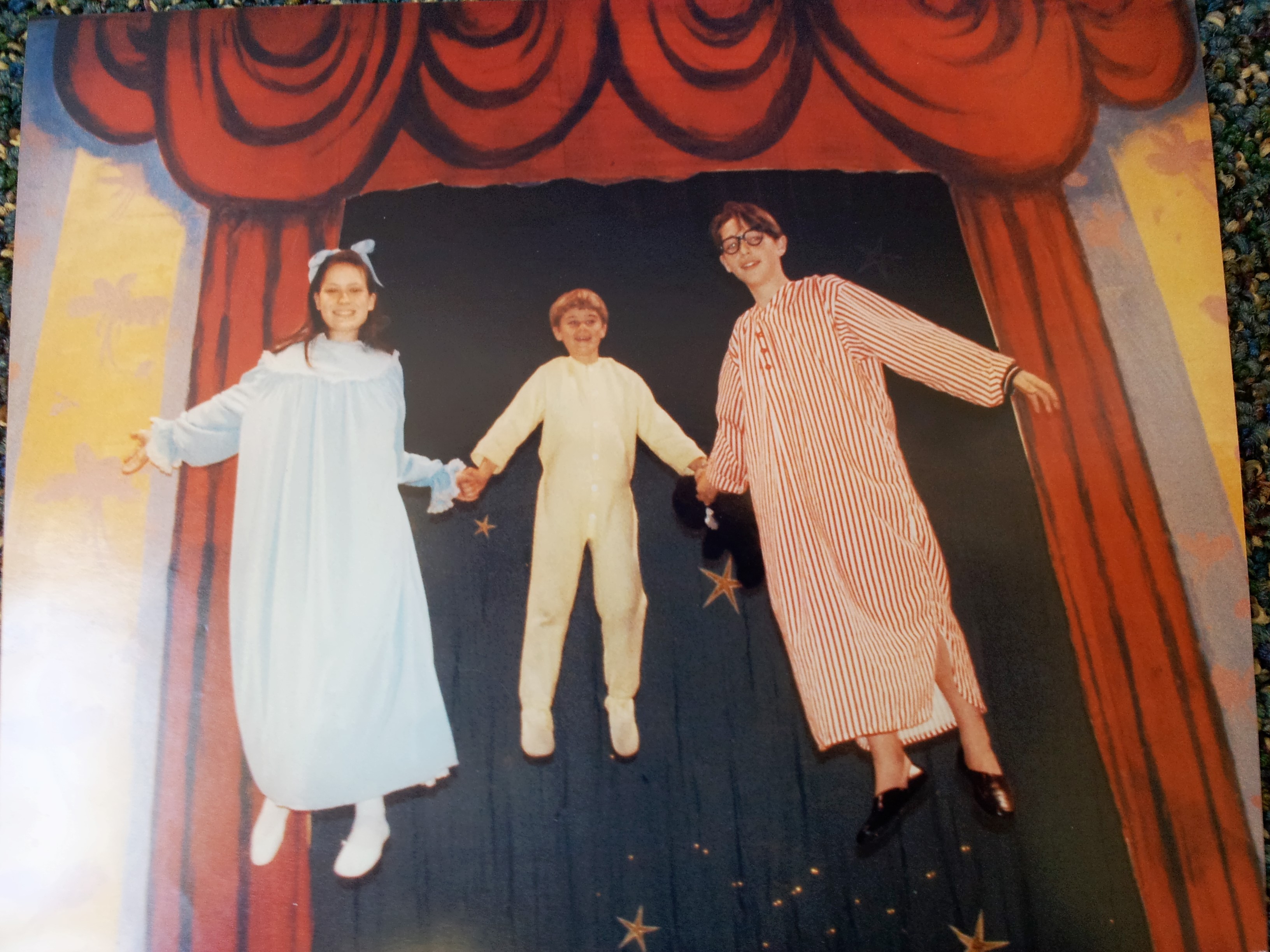
That's a teenaged me on the left.

That’s a teenaged me on the left.

To this day, I have this photo on the top of my piano: me at age 14, wearing a blue nightdress and a blue hair ribbon, holding hands with a little boy in footie pajamas (Michael) and an older boy in a nightshirt (John). All three of us are flying. I kept this photo displayed throughout my years of teaching because I never wanted to lose sight of how I’d gotten started and how much of a difference singing and musical theater had made, and continued to make, in my life.

I have learned so much about myself through singing. And I have gained an incalculable amount of joy, both from singing myself and from sharing that gift with others.

When I sing, the good parts of the world draw closer, even as the bad parts of the world fall away.

Read Full Post »

Today you are reading one of my (relatively) rare writing posts, in which I am mostly going to share intelligent things that other people have said about writing. I admit that I am somewhat motivated by the selfish reason of wanting these articles available in the future for my own easy reference. But I’m also motivated because I’ve been thinking more about short stories lately because I’m critiquing three of them for WorldCon’s writing workshop, which takes place later this week.

First off, Goodreads did a survey on why people stop reading books. I’m fascinated by how many people don’t stop reading in the middle of a book because “as a rule, I like to finish things”: 36.6%! I’m so interested because I stop reading books all the time. I always have so many books in queue that I either should read or want to read that I’ll stop for any number of reasons: I’m not in the right mood, there’s another book I want to read more, the book doesn’t grab me, I can tell it’s not to my taste, etc.

But probably the most interesting number from that survey is that the single biggest reason why people stop reading a novel is because they find it BORING. From what I’ve heard, this is also one of the biggest reasons why slush readers stop reading novels and stories. So if you’re a writer, wanting to learn how to not be boring is a legitimate concern.

Photo Credit: Esellee via Compfight cc

Rahul Kanakia, otherwise known as my favorite blogger, shares some thoughts about the difference between short stories and novels in the boredom department. Rahul was a slush reader for Strange Horizons and now teaches writing to unsuspecting undergrad students at John Hopkins, so he knows that of which he speaks. He talks about having the “So what?” reaction to short stories, which is one I often have as well, and how to work towards inspiring a stronger reaction.

(Incidentally, it’s really interesting to think about the different things that a reader tends to want from a short story vs. from a novel. There definitely seem to be things you can get away with more easily in a novel than a short story, and vice versa.)

Ann Leckie, who edits GigaNotoSaurus, among other things, writes about a problem she often sees in her slush pile: namely, that much of the work she reads is not very original and involve ideas that haven’t been thought all the way through. Which results in what exactly? You guessed it: BORING stories.

Finally, I think anyone involved in narrative storytelling should check out this article, which I first read more than three years ago and still refer back to. (I expect to be referring back to it thirty years from now.) James Van Pelt wrote an outline of a talk he was going to give about writing a great ending. I am such a stickler for stories and novels landing the ending, and this blog post is the best discussion of how to achieve this that I’ve come across so far.

Have you stumbled across any great writing resources or articles lately? Been thinking about any aspect of writing in particular? Feel free to share in the comments!

Read Full Post »

My friend posted a link to “Writing — for health and happiness?” a few days ago with a funny comment about how people use Facebook as therapy. The article talks about the therapeutic benefits of writing down thoughts and feelings and explores whether doing so online gives the same benefits as private writing. It also hints at a few obvious drawbacks to talking about traumatic experiences publicly, although it doesn’t explore that issue in depth.

But what I found most interesting about it had nothing to do with the internet: “…People who had had an early traumatic sexual experience were more likely to suffer health problems later in life… Prof Pennebaker said he realised it was because that experience was a secret.”

Secrets cause stress. Secrets cause health problems. Secrets can quite literally kill you (and I’m not talking about like in those “solve a murder every week” detective shows, either).

A big secret feels like it’s gnawing into you from the inside out. It’s always there, waiting for your fragile moments to twist you into knots. It works on you, changing who you are and how you see the world. It grows bigger and bigger the longer you wait, ever more impossible to talk about. It saps your happiness and mental well-being. And it causes physical consequences.

That’s why I talk again and again about the importance of having connections with other people. Writing about a secret will take away some of its power, and so will talking with a trustworthy someone. It doesn’t matter so much who it is, as long as that person knows how to be supportive: your family, your friends, your SO, your therapist.

Secrets left untold become all-consuming, but once they are out in the open, they return to their original sizes. And sometimes the act of keeping them can trap us, keeping us from facing the reality of a situation. That doesn’t mean they aren’t still hard and painful and traumatic. But some of their significance comes from the act of keeping them secret, and that part of the emotional load can be dropped.

I think this is part of why I always feel so confused when people say happiness isn’t something that can be improved upon. Secrets actively cause emotional unhappiness, and we can make the choice to tell them and work through them. Secrets lead to poor health, which also causes unhappiness (chronic pain, anyone?), and we can change our health risks by keeping a journal or finding even one person to talk to, online or off.

Sadly, I can’t have a discussion about secrets without adding this caveat: personal safety comes first. And telling secrets can sometimes jeopardize that. In such cases, you might need to seek professional help in order to keep yourself safe.

Telling secrets is hard. Writing down the truth is hard. Finding someone you can really trust is hard. Deciding to change is hard. And it might take a long time. But none of that changes the fact that keeping secrets is unhealthy.

Whereas finding a way to tell a secret might just save your life.

Read Full Post »

I talk about creating change a lot, and I want to be clear about what I’m talking about. Making a change in our lives is not necessarily about happiness. I mean, it can be, but that is not the only reason to change. And even if the end goal is happiness, the process of change itself is not conducive to increased happiness; it’s too difficult and stressful for that.

So why change, then? We may wish to change to create more meaning for ourselves and our lives. We may wish to tell a different story with our lives than the one we find ourselves in. We may be thirsty for challenge or new experiences. We may be on a quest to become healthier or more empowered or more mindful. Or we may sense that we are being pushed down below our natural happiness setting and wish to change the circumstances causing this.

A lot of people are looking for something. We may be looking for happiness, or we may be looking for comfort or satisfaction or excitement. We may be looking for answers to questions that echo down the years of our lives. We may be looking for something larger than ourselves.

Photo Credit: h.koppdelaney via Compfight cc

At the World Domination Summit, Donald Miller, a memoirist, spoke about the psychiatrist Viktor Frankl, who wrote the bestselling book Man’s Search for Meaning. Dr. Frankl was a Holocaust survivor, and he worked professionally with Holocaust survivors. For him, life was all about creating meaning, even in the face of horrific circumstances.

According to Mr. Miller, Dr. Frankl believed three things mattered in creating a meaningful life:

1. Having a meaningful project that helps the world in some way (note this doesn’t have to be a paying project)

2. Having personal connections with other people, whether that be family, a significant other, friends, and/or a community

3. Having a redemptive perspective on suffering; aka finding the meaning in suffering, feeling one is achieving something through one’s suffering, choosing how to respond to suffering, etc.

This is some of the best advice on how to live life that I have ever heard. It’s so practical. It doesn’t wince away from the tough realities that sometimes face us. And it crystallizes my thoughts about my own life. It’s not happiness I’m seeking, not really. It’s meaning. It’s the ability to have a life that matters to me, and one in which I’ll be okay even in the darkest of times.

“Life is never made unbearable by circumstances, but only by lack of meaning and purpose.” – Viktor Frankl

Maybe the happiness research is correct, and there isn’t very much we can do to affect our own personal happiness levels (although gratitude and mindfulness practice seem to help). But if we are most concerned with meaning, then that hardly matters. We don’t have to be the happiest people on the planet in order to create meaningful lives. We simply have to decide that meaning is important to us and make choices that reflect that belief.

A project that matters. Being brave, finding the silver lining, and experiencing gratitude even through bad experiences. Love.

Yes. These are the building blocks of the life I want to live.

Read Full Post »

“I’m not interested in blind optimism, but I’m very interested in optimism that is hard-won, that takes on darkness and then says, ‘This is not enough.’ But it takes time, more time than we can sometimes imagine, to get there. And sometimes we don’t.”

Colum McCann (by way of Jonathan Carroll’s Facebook page)

I think this is important to remember. Hoping for the best without taking the time to educate ourselves is not particularly helpful. Blindly doing the same thing we’ve been doing over and over while expecting a different (and better) outcome is Albert Einstein’s definition of insanity. Looking at silver linings to the extent that we’re blinded to reality and won’t look for changes we can make to better our situations keeps us stuck in one place.

But taking a real look at our lives and making change, real change, takes optimism as well. Optimism allows us to believe we’ll be okay whatever is happening. Optimism allows us to think change is possible for us. Optimism allows us to create a vision of a better future. Optimism gives us courage. And optimism gives us a greater capacity for both kindness and happiness.

The trick, then, is in being able to tell the difference between the optimism that holds us down and the optimism that lifts us up.

Photo Credit: Ira Gelb via Compfight cc

Read Full Post »

“…Pursuing an artistic career gives you permission to divorce your sense of self-worth from the economic marketplace.” – Rahul Kanakia

I was raised in a household that tied together self-worth, the value of any given activity, and finances. Being able to be financially independent was seen as the pinnacle of achievement. Education was important, but primarily as a means to an end, the end being making money. (Why my maintaining a 4.0 grade point average was so important therefore becomes a bit of a mystery, since my family couldn’t afford to send me to a prestigious university, student loans were frowned upon, and being able to get all A’s has very little to do with earning money outside of school. But I digress.)

I remember the revelation my senior year of high school when I met a musician who made ends meet with a variety of accompaniment gigs and modeling for art students. I had no idea that was a choice people could make: that money, instead of being the entire goal, could merely be the means to an end, the end in this case of being an artist. My whole conception of what my life could be changed.

But even so, the insidious feeling that the financial returns of an activity and its worth were linked persisted. In my father’s eyes, I didn’t feel like my music was terribly important until it became my means of supporting myself. I was forbidden from even considering pursuing a BM (Bachelor of Music) in college instead of a BA in case it affected my future job prospects.  (As it turns out, it wouldn’t have made any difference.) I always had doubts as to whether I was a real musician until I opened up my music studio and it became successful.

Photo Credit: StGrundy via Compfight cc

Of course, that was all very silly. Being a musician is much more about attitude than it is about money. Many musicians never make any money at all through their music. Similarly, being a writer is more a state of mind than anything else. It has to do with discipline and dedication, time spent and patience to practice, and the personal importance of it. The identity of being a writer has very little to do with money.

At this point, I have, as Rahul puts it, divorced my sense of self-worth from the economic marketplace. I am grateful that I was taught the skills to be financially responsible, but I don’t believe who I am and how I feel about myself should have anything to do with where my money comes from or how much money I have.

Ultimately, attaching our self worth to anything outside of ourselves is a risky business. The kind of self esteem that endures through the ups and downs of life comes from inside. The outside will disrupt it, of course, but so often that interference turns out to be only noise.

Being an artist is useful not so much for finding a substitute to tie to self worth (a recipe for unhappiness in the tumultuous world of rejections, revisions, and critics). Instead, being an artist can inspire us to ask questions that allow us to make different choices about our relationships with ourselves.

What is your relationship with money? How much does it affect how you feel about yourself?

Read Full Post »

« Newer Posts - Older Posts »