Feeds:
Posts
Comments

Posts Tagged ‘Amy Sundberg’

I got the flu shot, and now I’m feeling pretty sick. So, instead of the post I was planning…

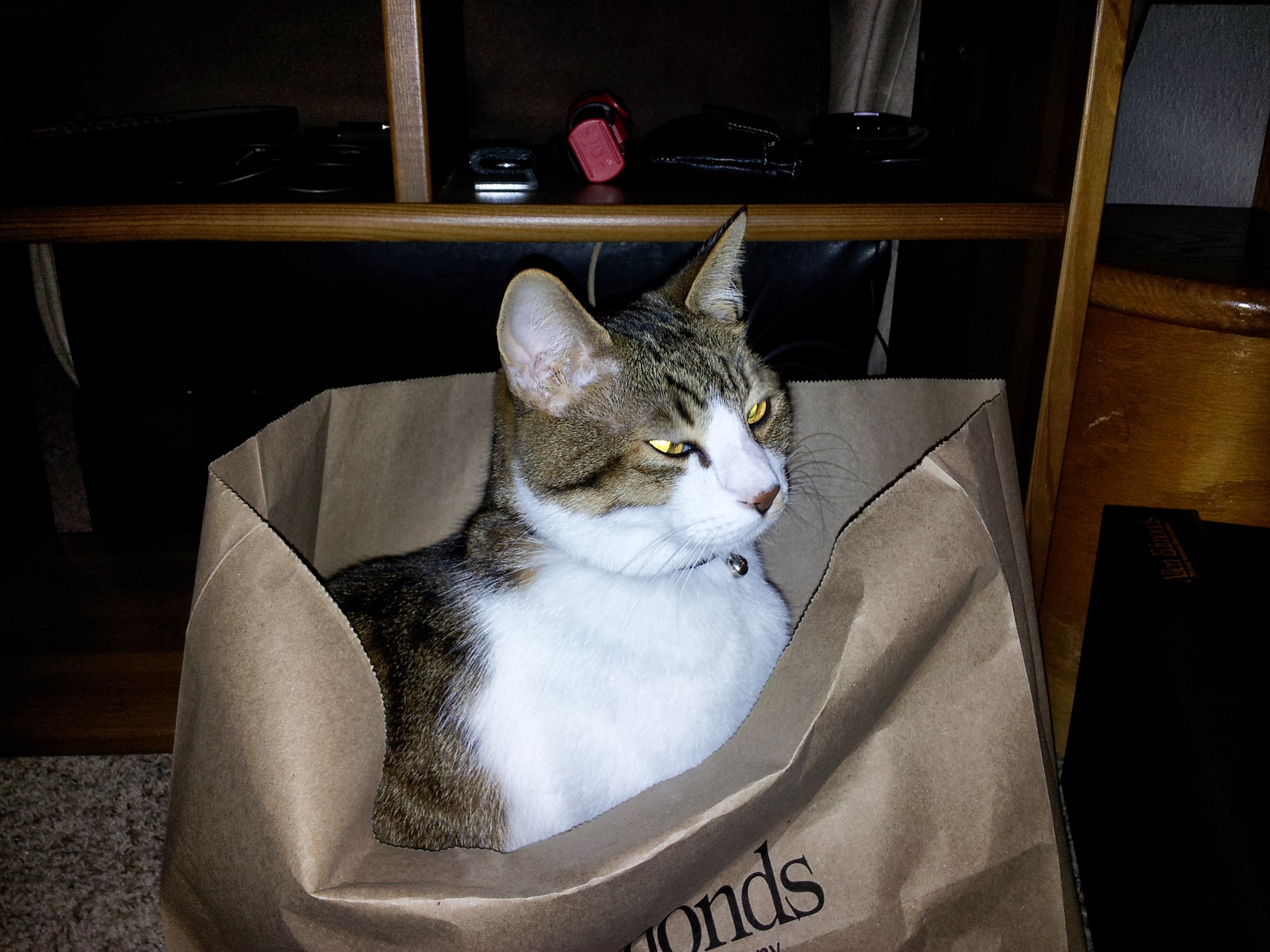
Here is a cat in a bag:

Saber made a lot of effort to get into this bag.

Saber made a lot of effort to get into this bag.

And here is a little dog who loves to be petted:

Nala is particularly fond of belly scratches.

Nala is particularly fond of belly scratches.

I’m going to go do nice, wholesome things like sleep and eat soup now.

Read Full Post »

Theodora Goss recently wrote one of those lists of what she’s learned in her life. The entire post is worth a read, but I was particularly interested in her #9:

“Your habits create who you are.”

I completely agree with Dora. Our habits are the building blocks of our lives and of our identities. I actually love this truth because while changing habits can be difficult, it is very possible. So that means if we don’t like our lives or identities, we can work towards doing something about that.

Photo Credit: Celestine Chua via Compfight cc

Take the identity of being a writer, for example. (How could I not go there?) Some people are satisfied with the daydream of being a writer, which is fine but unlikely to bring about the reality. But for people who seriously want to claim the writer identity, it’s all about habits. It’s about making the time to write on a regular basis. It’s about making a commitment to finish projects. It’s about revising and reading other people’s work and thinking critically and educating yourself to become better. All those activities can be developed into habits over time.

This works for personality traits to a certain extent, too. We all have our original set points for different traits, and some of us will have to work harder than others to change and maintain those points, or will have limits to where we can move those points. But we can choose to encourage new habits that develop a certain trait. I used to be quite shy when I was younger, but I decided it wasn’t really very fun to be shy. So I practiced meeting people, I practiced inviting people to do things, I said yes to invitations, and I cultivated new hobbies that encouraged me to be social. I still have my shy moments, but now I often look at those moments as a challenge or game that I can try to succeed at as opposed to a miserable experience. And really, most of the time I’m not very shy at all because of the habits I eventually formed. I’ve talked to several other people who have had similar experiences.

And finally, habits even affect the kind of thoughts we have. That’s what Cognitive Behavioral Therapy (CBT) is all about. If we decide we want to be more positive, we can explicitly practice framing our thoughts in more positive ways until it becomes second nature. If we want more self esteem, we can practice thinking kinder thoughts about ourselves until, you’ve got it, those thoughts become second nature (or at least more frequent). Sometimes a lot of how we see the world is affected by our individual thought patterns, which are really just habits of thinking we’ve picked up over time.

When I think about it, I realize how strongly my habits shape my life, from how I spend my time to what and how I think to what my actual expressed priorities are. Of course, habits can arise FROM those priorities as well as shape what those priorities are. I think that’s why I care so much about living an examined life, so I can be more conscious about choosing those priorities and figuring out how to express them rather than have priorities happen TO me.

What habits have you chosen to develop? What habits do you want to change?

Read Full Post »

Apropos of nothing, I watched Bridget Jones’s Diary last week. Afterwards, I realized that the third book in Helen Fielding’s series, Bridget Jones: Mad About the Boy is coming out this week. So my timing was impeccable.

To provide some context, Bridget Jones’s Diary  was originally published as serialized fiction in a column in The Independent in 1995. The novel form came out in 1996. And the movie version came out in 2001. So the movie is twelve years old but based on material that is eighteen years old.

Thoughts:

1. Bridget Jones doesn’t seem to be good at anything. We can assume that she’s okay at her job in the PR department for a publishing company, but we don’t get to see her being okay at it. We get to see her talking to friends on the job and doing a stunningly bad job doing public speaking, and that’s about it.

When she gets a new job, it’s not because she’s worked hard and studied; instead, she gets hired when she confesses that she needs a new job because she shagged her boss. And even when she lands the exclusive interview that makes her career, she does so in spite of her complete ignorance of the subject and missing the shot she was supposed to get because she decided to go get cigarettes. The only reason she succeeds is because Mark Darcy decides to help her.

It’s not that I want Bridget to be perfect or super intelligent or have any social skills whatsoever. But I want to see her be good at a few things, you know?

2. Really, the reason everything works out okay in the film is because of Mark Darcy. Not only does he prevent Bridget from being sacked, he warns her about her dangerous romance with the Hugh Grant character and ends up being completely right about that too. He provides the Happily Ever After, apparently because Bridget’s many awkward social outbursts and blue soup win over his heart. They never seem to actually bond over anything, but True Love wins out in the end anyway. And he even strips meaning from the end, Bridget’s plucky run outside in the snow in only underwear and a cardigan, because it turns out he was only popping out on an errand and wasn’t actually offended by the terrible things she wrote about him in her diary.

3. The mother is portrayed as largely unsympathetic and ridiculous until she reunites with the father, at which tender moment he calls her a “daft cow.” Suddenly I had a complete picture in my mind of why she decided to leave her marriage in the first place.

4. It is possible my life is anomalous because I’ve never had almost complete strangers inquire about my love life or ask me pointed questions about why I was single. If they did, I would not feel obligated to be polite.

5. Happily, at age thirty-two I also wouldn’t feel obligated to wear terrible outfits picked out for me by my mother. Even if it was the holidays.

6. The way the film handles sexual harassment at the workplace stood out to me. Bridget wears a short skirt to work and her boss makes comments about it in a documentable form (email? IM? I can’t remember). Of course, it’s all fine because Bridget is happy to have the sexual attention from her sexy boss. I wonder if this would be portrayed the same way in a film today.

7. All this being said, Renee Zellweger does an excellent job of selling Bridget as a goofy and endearing protagonist. As long as you don’t think about any of it.

7. James Callis, who played Gaius Baltar in Battlestar Galactica, is ridiculously fun to watch as one of Bridget’s best friends. He was also ridiculously fun to watch in the recent film Austenland. I wonder if I should hunt down everything he’s been in to watch even more ridiculous fun.

What do you remember from Bridget Jones’s Diary?

Read Full Post »

Seth Godin said something wise the other day:

“The hardest way to disagree with someone is to come to understand that they see the world differently than we do, to acknowledge that they have a different worldview, something baked in long before they ever encountered this situation.”

His suggestion for dealing with this kind of disagreement? To stop assuming the other person is ignorant or stupid or doesn’t get it, and instead focus on telling compelling stories. Stories, I’m assuming, that encourage empathy, that maybe crack open the door to give a glimpse of another worldview in a sympathetic way.

We’re telling stories all the time in our culture. We tell stories about the running of our government (politics). We tell stories to convince each other to buy something (advertising). We tell stories about how we do our jobs (annual reviews). We tell stories about how to live life (philosophy, child-rearing, religion). We tell stories about how the world works (mythology, pop science).

Photo Credit: kygp via Compfight cc

I was thinking about a question on OkCupid asking whether you have a problem with racist jokes. My answer was yes, I do; but plenty of people answer that racist jokes aren’t a big deal. I’ve never been a big fan of racist jokes; I don’t usually find them terribly funny. However, I might have once agreed that maybe they weren’t a big deal.

But then I read a lot of stories that showed me how racist jokes can cause harm, how they perpetuate the status quo of privilege and racism, and how they tangibly affect real people. And because of those stories and the empathy they caused me to feel, I notice these jokes and I feel uncomfortable. And yes, I do have a problem with them. My worldview changed. So now for me, those jokes ARE a big deal.

A worldview doesn’t always need to change dramatically. Sometimes it’s enough to recognize other experiences, even if you’ve never had them yourself. Even if you don’t agree. Even if you don’t think you’ll ever agree. The respect of recognition goes a long way to allowing a dialogue to take place.

The bedrock of empathy is the idea that however different our worldviews may be, we are all human beings. We all suffer, and we all want to be loved. Sometimes stories are the key to reminding each other of this truth.

Read Full Post »

A Happy Life:

I have few or no worries and low stress. I am healthy and pain-free. I don’t have to deal with change very often. I spend time doing pleasant activities: reading books, playing games, watching movies, eating good food, making music, doing fun work, hanging out with friends. I go on fun outings on the weekends. I have enough money to do what I want to do.

A Meaningful Life:

I don’t walk away from something only because it is difficult. I embrace change when it is necessary. I enjoy challenges. I prioritize time for the things that matter to me: building close connections with others, helping others, working towards artistic mastery, creating things, doing work I’m invested in, learning more about the world and about myself, feeling gratitude and appreciation for the little things, evoking emotions and uncovering truth. While I still search for a balance in order to take care of myself, I make trade-offs in order to live in line with my priorities.

*****

I don’t think these two lives are necessarily mutually exclusive, but they do sometimes come into conflict with each other. And when I’m being honest with myself, I know that the happy life, while sometimes tempting, also sounds…empty. I’d enjoy it for a while, sure, but if that was all there was for me, I’d get restless.

When I think back on my life so far, what gives me the most personal satisfaction are not the pleasant activities I’ve done. I can hardly remember most of them. Most of the things I’m actively glad I did were challenging and not always comfortable. I’m glad I moved to London for a year. I’m glad I studied music. I’m glad I got to travel. I’m glad for the relationships I formed, with students, family, friends, romantic partners. I’m glad I taught. I’m glad I wrote a musical, and short stories, and novels. I’m glad I got a dog. None of those things were easy, and none of them were unadulterated happiness (although the dog was close!). But they are what matter to me.

I was struck by something in the Atlantic article “There’s more to life than being happy:”

“Having negative events happen to you, the study found, decreases your happiness but increases the amount of meaning you have in life.”

Now there’s a silver lining if ever I’ve heard one. Right after reading the above article, I happened across my friend Myke Cole’s essay on PTSD, and he also talks about finding meaning in the face of adversity:

“We have to find a way to construct significance, to help a changed person forge a path in a world that hasn’t changed along with them.”

This is how we move forward in the world, through the meaning we create, through the choices we make. The more I think about this idea, the more clarity I find. Buddhism talks a lot about the inevitability of suffering. But the suffering can give birth to meaning, and that meaning? It’s a truly beautiful thing.

Read Full Post »

On Tuesday night Jonathan Carroll had a quotation on his Facebook that resonated with me:

“Life shrinks or expands in proportion to one’s courage.”

Anaïs Nin

There are different kinds of events that call for courage. There is the desire to make change, of course, which I’ve talked about a fair amount in the past. There is the question of how we face and handle adversity. There is the desire to try something new. And there is the willingness to go back and do the same scary thing again and again, even if it doesn’t get all that much easier.

I think when we choose to be artists–whatever that means to you–we are, in a sense, choosing to face fear again and again. There might be times when we aren’t seeking change, when we’ve got the adversity of life under control, when we’re living in a comfortable groove of existence. But if we’re actively working as artists, we’re constantly pushing, striving, experimenting, and revealing ourselves to others.

I can see it getting easier with time and practice, but I can’t imagine it ever being easy.

I have three main projects I’m working on right now: I’m querying my completed novel to agents, I’m in the middle of writing a novel rough draft, and I’m planning a future project that involves experimental elements. Each of these projects involve artistic courage.

-Querying puts me straight in the path of the rejection of my work, and while most of the time I shrug it off fairly easily, occasionally a rejection will sting.

-The rough draft is not coming together like I’d hoped it would, so writing it has become quite the struggle. I also deliberately chose to work on a concept that I knew depended on a writing ability in which I lack confidence and feel fairly weak.

-The new project is something new and experimental, and I’m not sure if I’m going to do it yet. But if I do, I’ll be trying all kinds of new things, and because of this, the entire project has a higher likelihood than many of tanking. It takes courage even to consider doing it.

reaching for origami cranes

Photo Credit: Βethan via Compfight cc

And then there’s the drive as an artist to go deeper, to explore dark corners, to shine a light on truths that are hard and uncomfortable and scary. There is the call to show vulnerability in our work. All of this requires so much courage.

So I would say not only do our own lives expand or contract in relation to the courage we can bring to bear, but our artistic work does the same.

What do you have the courage to see? What do you have the courage to feel? What do you have the courage to communicate?

Read Full Post »

Cute Dog!

Here, have some cuteness to brighten your day:

Nala is so fond of her fox, she's decided to incorporate it into her wardrobe. Photo by Yvette Ono.

Nala is so fond of her fox, she’s decided to incorporate it into her wardrobe. Photo by Yvette Ono.

Happy October!


Read Full Post »

Lately I’ve become very excited by tabletop storygames and also indie RPGs in general. Most storygames are indie, but not all indie RPGs are storygames; that being said, the indie games I’ve been exposed to tend to be rules-light and more focused on storytelling than mechanics.

Storygames often have affinities to RPGs, live storytelling, story structure, and/or improv. As the Story Games Codex defines it, a tabletop storygame is “a type of role-playing game experience with a lesser focus on “My Character” and a greater focus on “Our Story” (meaning the story that all the players at the table want to make).” Since as a role player, I am firmly in the narrativist camp, these storygames are an intriguing new avenue for me to explore.

This past weekend, I had a few friends over to try out the storygame Fiasco for the first time. Fiasco is a storytelling GM-less game that focuses on telling “capers gone wrong” stories a la the Coen Brothers, Snatch, and the Italian Job. You roleplay the story, breaking it into two acts, two scenes per act per player. The game uses six-sided dice as a mechanic for choosing elements for your story from a bunch of charts, deciding whether things go well or poorly during each scene, and determining some twists and your characters’ endings.
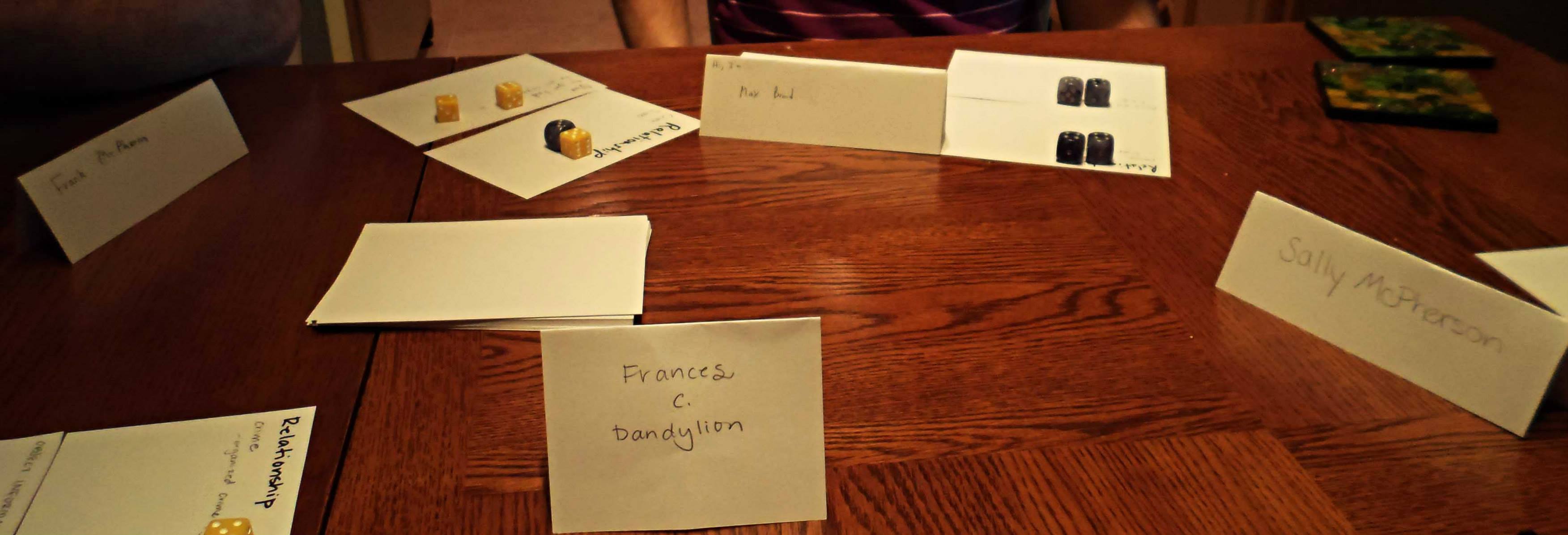
In which we make up our characters.

In which we make up our Fiasco characters.

I had a great time trying a system that puts storytelling ahead of mechanics. It was very challenging for a diehard outliner like myself to participate in a game with sixteen scenes that I couldn’t outline ahead of time, but the difficulty was part of what made it fun for me. Plus I am really motivated to play several more times to try to improve my pantsing skills. While Act 1 lagged for us as we tried to figure out what to do, Act 2 really picked up, and the endings were hilarious and satisfying.

In fact, I’m so excited about these games that I’ve compiled a list of games I’d like to try in the future:

1. Spirit of the Century: Okay, I’m actually in the middle of a campaign in this system. It deserves its own post, but for now, suffice it to say that the system is made of awesome. It’s a pulp adventure game tailored specifically for one shots. It does need a GM, however.

2. Microscope: A world building storygame about epic histories. I have access to this game, so I’m hoping to try it out soon!

3. Monsterhearts: I have this on order and I’m super excited about it. It’s a storygame set in a high school where the students are discovering mystical powers (aka Witch, Werewolf, Chosen One, etc.) with a Buffy flavor. I’d love to play a longer campaign to try out this one.

4. Shooting the Moon: A love triangle storygame.

5. A Penny for My Thoughts: A game about trauma and lost memory. (After working so long on The Academy of Forgetting, this game sounds like a great fit for me and my interests.)

6. The Shab-al-Hiri-Roach: A game about competitive and backstabbing professors in a small-town university. I wish I owned tweed, because I would wear it while playing this game.

7. Shock: Social Science Fiction: To be honest, I don’t really understand what this one is about yet exactly. But it references Ursula Le Guin, Kim Stanley Robinson, and Philip K. Dick in its flavor text, so I want to find out.

8. Polaris: A storygame about brave knights living in a corrupting world. Yes please.

9. Primetime Adventures: An RPG in which you and your friends put on a TV show.

10. The Extraordinary Adventures of Baron Munchausen: A wagering storygame in which you sit around telling wild stories.

11. Once Upon a Time: A storytelling card game.

12. Gloom: A perverse card game telling the tragic story of a group of misanthropes.

13. The Quiet Year: A post-apocalyptic map storygame. 

14. Winter Tales: This board game is coming out later this year so it’s a little hard to tell exactly what it is. It might be a story-based board game similar to Tales of the Arabian Nights, but it looks like its mechanics are a bit more involved and focused on collaborative storytelling. Stay tuned!

Have you ever played any of the above games? Do you have more games I should add to my list?

Read Full Post »
I got into a conversation today on Twitter about the high costs of housing in the San Francisco Bay Area.

I was looking at houses for sale in the Seattle area, and they are just gorgeous. They have tall pine trees outside, they have views of lakes or Puget Sound or downtown Seattle, they have huge sheets of glass. A lot of them have three or more bedrooms, and some of them even have basements that you can convert into game rooms (air hockey! ping pong!) and/or home theaters. And they aren’t all that expensive.

Someone suggested I look into Omaha, Nebraska, and I found huge houses on huge lots with price tags that seem cheap by Seattle standards…which seem cheap by Bay Area standards. The consensus, whether you’re John Scalzi or Patrick Rothfuss, is that if you’re a writer, it’s best to live somewhere on the cheaper side. Read: not New York City, and not the San Francisco Bay Area. (The happy news is that you live one of those places, everywhere else looks wonderfully cheap.)

It’s a dilemma. For a long time, Silicon Valley kind of irritated me: too much engineer speak, too much social awkwardness, too much busyness competition, and not enough appreciation of the arts. But just when I was beginning to consider a move, it started to grow on me.

Photo Credit: Abe K via Compfight cc

I didn’t choose Silicon Valley as my home; I just ended up here. And once I’d started my business, I was stuck here; while the cost of living is absurdly high, that also meant I could charge more. I looked into moving to Portland at one point and discovered that what I’d save in cost of living expenses wouldn’t equal the amount of income I’d be losing, not by a long shot. I couldn’t afford to move.

Now I can afford to move, but I’ve made dear friends in the meantime, and I’m also more aware of the things I’ve been taking for granted. I like the energy of Silicon Valley. I might not like the culture of the busy, but I do like that people are engaged with projects and ideas that they feel passionately about. I like that people here are nerdy and geeky and care about science fiction movies and maker culture and playing laser tag. (Not to say there aren’t people in many other places who care about the same stuff, but I don’t know as many of them.) I like that a lot of people I know are living full-on lives of the mind. I like that people are liberal here, and by liberal, I mean they are supportive of free spirits and different lifestyle choices and basic women’s rights. Not that it’s perfect (because it isn’t), but it’s a step in the right direction.

Then there’s the weather (it doesn’t get much better than this) and the FOOD. I have the choice of at least twenty different types of cuisine within a fifteen minute drive of my condo. Maybe more. And if I’m willing to drive a little further, I have all of San Francisco to pick from. The beach is in driving distance, the mountains are less than a day away. I can take a day trip to a world-class aquarium or go to one of many excellent science museums (the Tech, the Exploratorium, the Academy of Sciences).

So therein lies my conundrum. I live in a beautiful and vibrant place. It also happens to be really expensive. There’s a push and pull that goes on whenever I consider my options.

Where we live matters. And there are always tradeoffs involved.

Read Full Post »

There’s been a spate of recent research and popular science writing on happiness and what affects it (and what doesn’t affect it). I find this research to be fascinating stuff in its own right, and often a great leaping point. I write about it a fair amount, but I don’t think of what I’m writing to be scientific.

I actually think I write about philosophy. The philosophy of happiness, if you will. I use my own personal experience, the personal experience of others, the philosophy of others, and scientific studies that show certain trends, and I put it all in a blender, and you read the results.

I want to emphasize, though, that I don’t think that what makes me happier will make everyone in the entire world happier. If having a more fulfilling life is something you’re interested in, then collecting different viewpoints and ideas is one way of pushing forward your own quest. Maybe some of the theories and ideas I talk about will inspire or resonate with you.

But when ideas about individual happiness are presented as scientific fact or a fait accompli, then the issue becomes more confused. Which is why I was really happy to read the recent Scientific American blog post by Jamil Zaki entitled “Psychological studies are not about you.” Dr. Zaki decries popular science writing that implies that the studies cited are about individuals. Indeed, he says:

“…Psychological studies… can tell us about how changes in behavior (again, think generosity) might affect the well-being of whole populations…. Most sciences—including psychology—are much better suited to these broad applications than to telling any one person about their life.”

This is because psychological studies mostly involve groups and use statistics. So their findings focus on large-scale trends as opposed to the individual. For example, on average, people may increase their happiness by a certain amount if they engage in gratitude practice. But you as an individual might find that using gratitude practice increases your happiness a lot more than that, or alternately that is doesn’t have a very strong effect at all. Neither of those things make you at all strange since the study in question was talking about averages over a certain population.

Then of course there are the controversies where there are differing points of view. For example, there is a theory of happiness called the set point theory of happiness, or the hedonic treadmill, that states that people have a predetermined happiness set point. There have been a few famous studies, one that looked at people who had been paralyzed and ultimately returned to the same levels of happiness they had been at prior to injury and another that looked at lottery winners that returned to their pre-winnings level of happiness.

But now there are studies showing that this isn’t always the case: that indeed, sometimes people who win the lottery do have increased happiness over a period of time, and sometimes people who divorce do have increased happiness afterwards. There are also examples of individuals having permanently decreased happiness levels. There is more discussion about the forty percent of happiness levels that aren’t controlled by genetics but by intentional activity. And even if the set point theory of happiness is statistically present over a large population, that doesn’t mean it will necessarily apply to you personally. Maybe it will, maybe it won’t.

Which isn’t to say that reading about these studies or about other people’s personal anecdotes or philosophies can’t be enlightening and helpful. Just as with writing advice, we’re allowed to take whatever works for us and throw everything else away. We each get to learn about the unique combination of what makes us tick and make decisions based on that self knowledge.

What advice about happiness and fulfillment hasn’t worked for you? What advice has?

Read Full Post »

« Newer Posts - Older Posts »