Feeds:
Posts
Comments

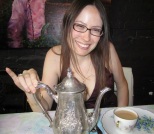
I don’t have pierced ears.  Where I live, it’s fairly unusual for a woman not to have pierced ears.  Plus I grew up in a time when people pierced other body parts to show their nonconformity.  (Or maybe to look sexy or funky or on the edge.  I’m not sure since I never did it.)  It’s the rare occasion when I meet another woman without basic ear piercings.

It’s not that I don’t like jewelry.  I actually have a weak spot for jewelry.  I wear necklaces, rings, the occasional bracelet or anklet.  I love shiny sparkly stuff, and I love how artistic jewelry can be.  I look at beautiful earrings in little boutiques and covet them.

People ask me if I don’t have pierced ears because I’m afraid of the pain.  While it’s true that I hate pain, that’s not really the reason.  I wasn’t allowed to get my ears pierced as a kid, but I could have done it when I was twelve or thirteen.  Only by then it was too late.  Without even knowing it, I had already grown up into a closet nonconformist.

I thought about getting holes punched in my ears, and then I thought about what a weird idea that actually was, punching holes in your body just so you could display a little more bling.  Suddenly ear piercings didn’t seem ordinary anymore.  They seemed like a barbaric custom of some foreign tribe.

Now please don’t get me wrong.  When I look at other people’s pierced ears, I don’t feel shock or horror or condescension.  I don’t actually think piercing is a barbaric custom.  It’s more that, once I thought of that point of view, I could never look on the custom the same way myself.  It’s been twenty years, and I’ve never found any reason to change my original decision.  I’ll keep my ears the way they came, at least until I have a provocative reason to do otherwise.

So what do you think?  Am I stubborn or an original thinker (or both)?  Either way, my lack of pierced ears is one of my tells, revealing that I am a free spirit.

The Quest for Balance


Photo by Thomas Gibbard

I recently finished reading Guns, Germs, and Steel by Jared Diamond.  I’ve read in many places what an invaluable resource this text is for writers, especially in regards to world building, and I agree one hundred percent.  I learned so much from reading this book, and in spite of taking a month to get through the whole thing, I never wavered in my resolve to finish it.

Something in the Epilogue struck me as particularly interesting (although that is relative, since I learned something in every chapter that I found particularly interesting).  Diamond was discussing why it might be the case that Europe obtained global power and multiple colonies on most of the continents before China.  After all, in earlier history, China was far ahead in the technology race and had united a much larger area and population into a single nation.

Diamond concludes that this result is another effect of geography.  China didn’t have geographical barriers to inhibit its unification, while it did have helpful rivers.  Europe, on the other hand, had many geographical barriers to discourage unification (islands, peninsulas, and high mountain ranges) without China’s helpful rivers.  But European nations weren’t that isolated from each other.  This meant that if one ruler in Europe decided a technological innovation was horrible, other nations would still use it until all nations ultimately were forced to use it in order to compete.  In China, on the other hand, if the Chinese ruler, say, took a dislike to ships and shipyards, the technology could be completely lost.

So being too isolated (and on a north-south axis), as many civilizations were in the Americas, meant that technology wouldn’t diffuse easily or quickly between different groups.  But being too unified, as China was, also had an adverse effect on some critical technologies.  Europe achieved that happy balance of fairly easy communication without unification that pushed several of its nations into being colonial powers.  (There’s a lot more to it than this, and Diamond explains it better, so really you should go read his book if you haven’t already.)

It’s amazing to me how critical balance proves to be, on both large and small scales.  On an individual level, the problem is similar.  Take a practical free spirit such as myself, for example.  I could swing too far onto the side of the free spirit, in which case I might become flaky, never complete projects, create a financial mess for myself and need bailing out, or a host of other problems.  Or, I could swing too far onto the practical side and believe, like my friend did, that nonconformist lifestyles aren’t real, stay in a job that makes me unhappy, or save my money and never spend it on amazing experiences or experiments.  Either way, I’d ultimately end up pretty unhappy.

I think most of us struggle with this same problem of balance.  Family time vs. career time vs. me time vs. when I am going to write that novel?  Or what diet can I try that doesn’t deprive me of so many treats that I can’t stick to it?  Or what makes this relationship (or this career or this hobby) worth the work to me, and how can I remain comfortable while still keeping it fresh?  This is an even more familiar problem to the ambivert, who often has to balance alone time with social time in some complex ratio.

We’re all walking multiple tightropes at once, making adjustments (both miniscule and large) as we go.  Sometimes we stop paying attention or over-correct and down we go.  Other times it feels almost effortless.  We often don’t even notice all the balancing acts going on around us every day.

Doesn’t mean we’re not all out on that same rope.

She works for a video game company, writing in a universe she’s loved since childhood.  In return for doing this job she loves, she gets a salary, vacation days, health benefits.  This is a dream.

She discovered the story of a brave boy in New Orleans, who during Hurricane Katrina drove a busload of people to safety.  Lack of publisher interest didn’t make her lose faith in her story and the courage of this boy, and she decided to self publish to make sure his story was told.  This is a dream.

She worked on her novel for several years, joined a critique group, participated in the writers’ community, and kept trying.  Her debut novel is coming out in the spring of 2012 from a major publisher.  This is a dream.

He made his own publishing deal with a small press and has his second novel in a series (third book total) coming out in 2011.  He was nominated for a Hugo, and was invited to be Guest of Honor to a regional convention.  This is a dream.

She started her own business, which would allow her to support herself comfortably only working halftime.  She spent the rest of her time engaged in whatever creative projects struck her fancy.  This is a dream.

Her dad wants her to attend an Ivy League college she couldn’t afford.  She wants to study voice, composition, and writing and live abroad for awhile.  She’s like an echo of myself, but she’s not.  This is a dream, and it’s hersHere’s hoping she gets to live it.

Allow people to live their own dreams.  Every dream is as different as the dreamer, and each one is valid and special in its own way.  When we look down on someone else’s dream, it’s because it threatens something inside of us.

We can do better than that.

Over the past two years, since my entering into this crazy fiction-writing world, I’ve noticed that many of my compatriots are often discouraged, depressed, worn out, or feeling hopeless about their writing.  Serious devotion to writing as a calling and career seems to take quite the emotional toll.  And two years has been enough time for me to experience this emotional stress firsthand.

What is interesting to me is that I come from an arts background in music.  I did musical theater, got a BA in music, played my own music publicly in London, etc.  And my experience with music and being a pre-professional musician was in no way as brutal as my experience now of being a pre-professional writer.

Please note this is not because I think writing is inherently harder than playing music.  If anything, I think I have slightly more of a natural knack for writing than I do for music.  And I don’t think being a professional musician, especially one who makes her entire income through performance, is any easier than being a professional writer who makes his entire income through writing fiction.  But on the whole and in my own experience, being a pre-professional musician was easier than being a pre-professional writer.1 Here’s why:

1. Higher barrier to entry: Most American adults can sit down and write a sentence without having to practice first.  But have you ever heard someone pick up a violin for the first time and draw the bow across the strings?  If you haven’t, count yourself lucky because the results can be painful to the ear.  This basic difference means that being an aspiring musician generates more respect than being an aspiring writer.  It also weeds out most of the wannabe and non-serious musicians right out the gate, because to achieve even a basic level of musical competence requires non-trivial amounts of practice time.  This is not so with writing.

2. Simple mentorship system: As a musician, it’s common to have a private teacher who will mentor you, give you tons of individual attention, and keep you on the straight and narrow in terms of continuing practice and improvement.  Or you might even have several teachers for different instruments (for instance, at various times I’ve had private piano teachers, voice teachers, and composition teachers).  A good teacher will keep you encouraged and inspired most of the time, and kick you in the ass when you really need it.  There are many resources available for finding a teacher, and you pay a set fee for the privilege of study.  This contrasts to finding a writing mentor, which I don’t know how to do and which has no set way to achieve.  Interest one of the teachers at your workshop or your writing class, perhaps?  But once the class ends, then what?  There’s not a clearly defined business model for this as there is in music.

3. A more respected educational system: It is also common wisdom that a writer should major in something besides creative writing, and the opponents of the usefulness of an MFA in creative writing seem to be as numerous as the proponents.  While I’m not arguing these points one way or another, it stands in marked contrast to music’s mentorship system (discussed above) and higher educational system.  While if you’re doing certain kinds of music, a degree might not be necessary, most music programs help develop skills that will obviously come in handy later on, and musicians don’t tend to argue about their usefulness.  This means if you know that you need to build skills as a musician, you can have the institutional support of a university music program while not constantly worrying that you might be wasting your money.  I’m not saying there aren’t MFA programs that are fabulous, just that general opinion is mixed.  And thank goodness for workshops like Clarion, Odyssey, and Taos Toolbox and organizations like SCBWI that take up some of the slack here.  But workshops and organizations don’t generally offer the same consistency as a four-year program.

4. More emphasis on collaboration: As a musician, I had many opportunities to perform with various groups.  I was taught how to work with other musicians and had group performance opportunities in choirs, musicals, and operas.  Instrumentalists have orchestras, bands, and chamber music ensembles.  And then there are jazz bands and ensembles and rock or pop bands.  Finding other musicians to make music with tends to be pretty easy.  Writing, on the other hand, is a fairly solitary experience, and while one could argue that the critique group is the equivalent of a band, a lot of critique groups don’t meet as often and/or aren’t working together as closely.  The result of this can be a lack of deep working relationships.

5.  Possibilities to practice art in the real world: Speaking of performance, not only did I have many opportunities, both during college and afterwards, but it was highly encouraged, even expected.  A young and inexperienced musician went out and gigged, auditioned, joined a band, whatever.  And if you weren’t paid for your efforts for awhile, well, that was the norm while building up your chops.  Contrast this to writing, in which well-respected writers advise new writers not to submit to markets that pay less than five cents a word (the current “pro” rate).  Leaving aside the absurdity that a couple of cents per word one way or another isn’t going to make a difference in quitting your day job anytime soon, this attitude means that new writers are actively discouraged from showing their work in public unless it can hit the bar and taste of the few pro markets.  This in turn lowers motivation and increases both pressure to improve at unattainable rates of speed and accompanying feelings of futility and isolation.  For the pre-professional artist, any recognition, however small, is powerful incentive to continue, and in writing, there just don’t seem to be as many of these opportunities.

6. The stigma (or lack thereof) of indie artists: The indie music scene is vibrant, exciting, and most importantly, not overtly stigmatized.  In fact, it’s hip to be an indie musician.  Sure, you might have trouble paying your bills, but in return you get to make the music you want to make, thumb your nose at The Man, and live a musical life.  Most other musicians will either be actively supportive or not care one way or another.  Cutting your band’s own CD has gotten a lot easier with recent technology, and bands do it all the freaking time.  Contrast this with the indie writer scene (otherwise known as self-publishing).  You may have a hard time paying your bills this way too (or you may have an easier time if your name is J.A. Konrath), but regardless, other writers will sneer at you.  I’m not kidding.  The stigma against self publishing of any sort is incredibly strong.  It’s so strong that a lot of established professional writers aren’t putting their backlists (the rights of which have reverted to them) up on all the electronic platforms.  Now this might just be lack of business sense, lack of interest, or technophobia, but I find it very striking.  To me, this doesn’t even count as real self publishing because the work has already been published with a publishing house and received the full traditional treatment.  But I digress.  Most writers I’ve met are firmly in the “traditional-publishing-deal-or-bust” camp, even though distribution channels and producing a final e-edition of a novel have gotten much easier with recent technology, just as producing CDs is now easier.  The main effects of this attitude are less options for writers of all levels, not just the pre-professionals, and less emphasis on business innovation and experimentation with new business models.  Meanwhile, there are already huge amounts of self-published material flooding the marketplace with no gatekeeper, and somehow readers seem to be surviving the onslaught just fine.

All this said, I’m incredibly grateful for the assistance I’ve received from the writing communities I belong to.  My friendships and discussions with other writers have been some of the highest points of my writing life.  If anything, this analysis shows how critical these communities and fellow writers truly are.  But if nothing else, I hope this comparison between pre-professional musicians and writers will serve to illustrate the difficulty of the writing path, and encourage us to be supportive, patient, and kind to one another.

For those of us who are nonconformists, it can also act as a reminder that change may be coming, but change isn’t always such a terrible thing.

1 Note that I am most familiar with the speculative and YA communities in writing, and have at least passing familiarity with Classical, jazz, rock/pop, and musical theater in music.  What I’m talking about may not hold true in other genres or styles.

Looking at the title of my blog, I began to wonder what a free spirit is, exactly.  I know the stereotype in the movies: Summer from (500) Days of Summer, or Sharon Stone’s character in The Muse, or Clementine from Eternal Sunshine of the Spotless Mind.  I’m not really like any of those women though, so there’s got to be more to it, right?  (Also, what about the free spirit men?  Why can’t I think of any movies about them?  Help me out in the comments, please.)

I turned to the internets to help me out.  Apparently, a free spirit is someone who is not restrained, for instance by convention or obligation.  Or it’s someone who has a highly individual or unique attitude, lifestyle, or imagination.  Or it’s someone acting freely or even irresponsibly (I guess that’s where the practical part of my blog title comes in?)  All the definitions agree on one synonym to describe a free spirit: nonconformist.

Oh, right.  Thank you, dictionaries everywhere, for reminding me what I’m talking about.

Here’s my definition of what it means to be a free spirit:

  • A free spirit thinks for himself, observing and collecting data in order to form his own opinions.
  • A free spirit does what she thinks is right, not what everyone else tells her is right.  She puts a high value on free choice.
  • A free spirit cares about getting to know both himself and the world around him.
  • A free spirit isn’t generally swayed by arguments of what one is “supposed” to do.  She tends to avoid, ignore, or become upset by people who are judgmental or controlling.
  • A free spirit has the courage to test life’s boundaries and limits, and to try things that other people think are impossible, unimportant, or impractical.  (These other people are often wrong.)
  • A free spirit often has her own unique vision of life and the world.

This does not mean a free spirit is a trampler, i.e. the kind of person who doesn’t care about other people’s feelings.  Nor are all free spirits incapable of compromise and discussion.  They aren’t inherently flighty or irresponsible or train wrecks on wheels.  Free spirits can be any of these things, just like everyone else, but they don’t have to be.

I also suspect there are those to whom free spiritedness comes easy, and those for whom it’s very difficult.  Or maybe there are just people like me who swing back and forth between the ease and the struggle.  There are noisy free spirits and quiet free spirits, extroverts and introverts and ambiverts, free spirits who engage in risqué behavior and those who think risqué is passé and so go to the other extreme.  (Ask me sometime why my ears aren’t pierced and you’ll see what I mean.)  Some of us are stubborn while others are fickle, some of us are dedicated while others drift from thing to thing.  We can be challenging, yes, and difficult to understand, but we love life with a passion that makes it all seem worthwhile.

Whatever our shortcomings, we make the world a more varied and interesting place.  We are agents of change and opponents of inertia.  As Arthur O’Shaughnessy, a 19th century British poet, said:

We are the music makers, and we are the dreamers of dreams.


voting guide

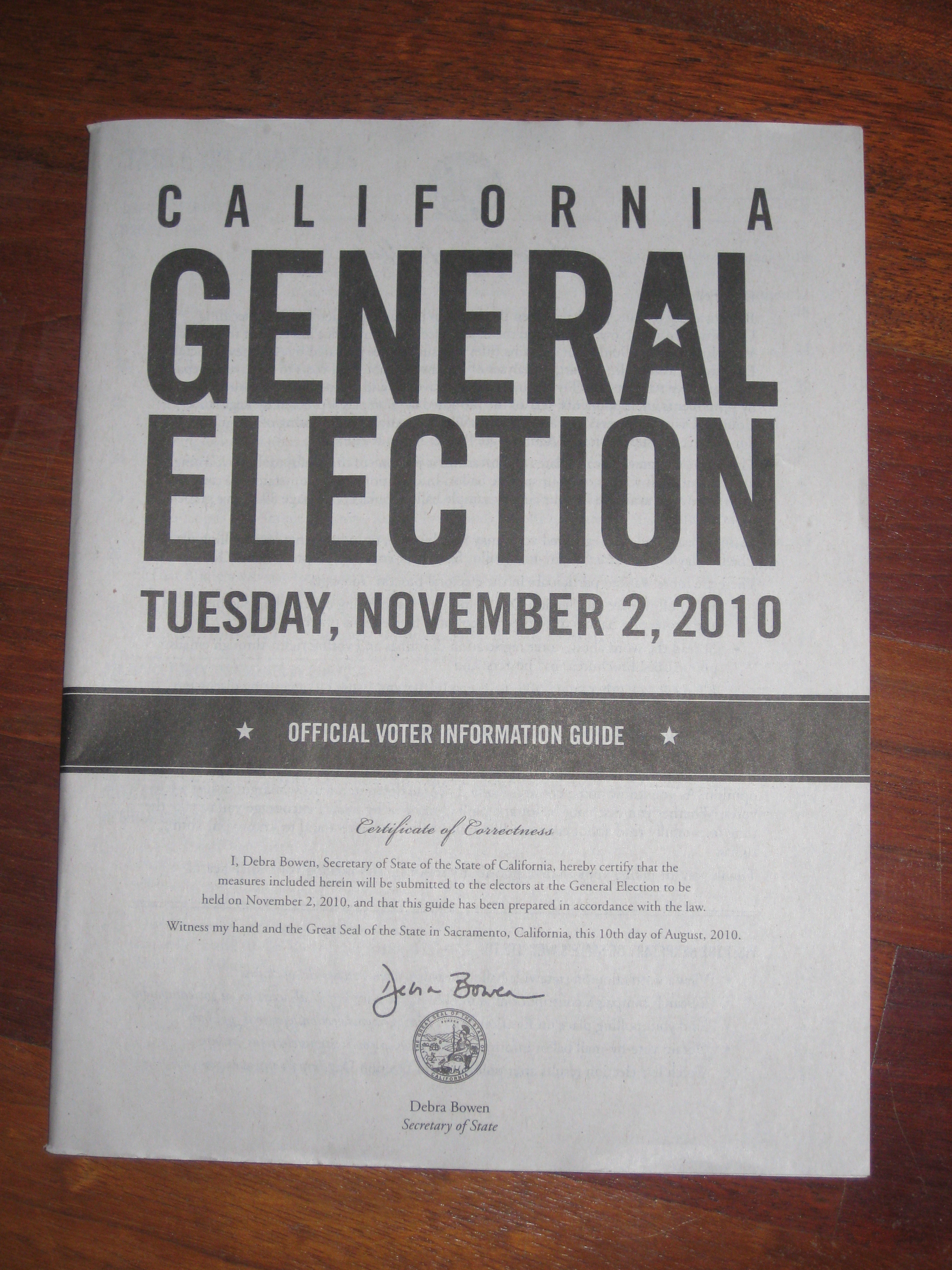
It’s that time again: election time.  I recently received my California General Election information guide in the mail, along with my absentee ballot (I’m on the permanent absentee ballot list because I find it encourages me to vote).  And once more I prepare to climb into the morass of trying to figure out who and what to vote for, which involves trying to find information about people I’ve never heard of and wading through dense legalese.

Some quick statistics, based on numbers I found here and here.  California has an estimated 18-and-over population of 27.7 million.  As of April of this year, there were 16.9 million registered voters in the state.  Some easy math tells us that only about 61% of those over 18 are even registered to vote (leaving over 10 million adults in the dust).  And of course, just because someone is registered doesn’t mean they’ll actually cast a vote in any particular election.

Voting is very important to me.  I feel lucky to have the chance to participate in my government and to have duties as a citizen.  But when I’m faced with my 127-page information guide (which does come in languages besides English, I am happy to say, although how easy it is to obtain one in the correct language is outside of my experience), I’m not so shocked that only sixty percent of those eligible elect to participate (or even have the possibility of participation).  In fact, I’m surprised it’s that many.

(By the way, my actual ballot is printed in both English and Spanish.  Good move, whoever is in charge of such things.)

It takes a lot of time for me to vote, and it causes me a fair amount of anxiety.  I read the text of each proposition carefully, trying to understand what it actually says, and I usually pop on the internet and have a look at the opinions of a few established groups.  And then I hope I’m actually understanding something outside of my expertise and cast my vote.  In this year’s election, I will go through this process ten times, once for each proposition.

And then there are the elections for mysterious positions such as State Controller, Insurance Commissioner, Board of Equalization members, and Water District Director.  (Thank goodness my handy guide tells me what these positions are because otherwise I might not know.)  Meanwhile, I’m just feeling relief that there don’t seem to be any local elections this time around, with all kinds of City Council members, Judges, and assorted bureaucrats who aren’t even associated with political parties in case I need to fall back on blind party voting. (EDIT: Oh no, wait, there are City Council members up this year.  Sigh.)

Then there’s the propaganda problem.  Thankfully I don’t watch TV so at least I miss the commercials, but when digging through available information, how do I know who to believe?  And while I’m willing to dig through the voting records of presidential candidates (during primary time, since by the final election I only have two choices anyway), do I really have time to do so for every single candidate on the ballot?  Hmm.

So I muddle through the ballot, doing my best to make responsible, informed decisions and sometimes falling short.  If I weren’t so personally invested in my voting rights, I could see getting lazy and just not bothering with the whole thing, since it often results in my feeling helpless and/or stupid.  Yet another instance in which my stubbornness comes in handy, forcing me to do the right thing.

Because voting is the right thing.  No matter how unpleasant or confusing, no matter how complicated or mysterious, casting my vote is a concrete action in the face of widespread apathy and ignorance.  It says that I care about my country, I care about my fellow citizens, and I care about my hard-earned right to have a say.  It says that I’m not taking the status quo for granted.  It says that I believe each one of us is involved in creating the world we live in.

Are you planning to vote in November? If not, I hope you consider changing your mind and joining me in the baffling yet important process of participating in our government.

Photo by D. Sharon Pruitt

1.  Pumpkins.  This includes jack o’lanterns, pumpkins as decoration, and various pumpkin-derived foods, such as: pumpkin soup (be still, my stomach), pumpkin bread and muffins, pumpkin cookies, pumpkin pie.

2.  Other flavors of autumn: warm soups and stews, tea, hot cocoa with marshmallows, sweet potato fries, allspice and cloves, cinnamon and ginger.  And candy corn.

3.  Wearing short skirts with tall boots and not freezing to death.

4.  The chilly damp tang to the air, especially in the evening, when you can almost taste the crispness, edged with a tinge of decaying leaves and smoke.

5.  Halloween, with the costumes, consumable goodies, and discernable glee of children.

6.  The leaves changing colors (I have two Japanese maples in my yard) and eventually falling off and collecting in large crispy heaps.

7.  Toasting by the fireplace for the first time in months, and watching Nala the Hound’s glee at being able to sleep by the fire again.

Photo by Stuart Williams

What do you love about the fall?


The weekend before last, I was having a writerly conversation with a group of writerly friends.  One of them was expressing heartfelt admiration of a mutual friend of ours, who, he said, had totally mastered the problem of emotion getting in the way of writing.

Even if you’re not a writer, you probably know about this little problem.  It’s when you have a to-do list a mile long, or angelic plans to clean out your closet today, or work projects to complete, or writing to accomplish.  And then something happens.  It doesn’t matter exactly what something is (a particularly disappointing rejection letter, bad personal news, someone wrote something nasty about your favorite hat on Facebook, or what have you); the salient feature of the something is that it’s completely upsetting and derails any work you had plans to accomplish that day (or that week, that month….)

Back to my writerly conversation.  I thought to myself, “Well, that’s great, but it’s not so difficult really.  After all, when I’m writing a first draft of a novel, I’m pretty reliable about cranking out my daily word count in spite of everything else going on.”

Be careful what you think to yourselves, my friends, because four days later, life took a swing at my head with an oversized and ridiculously colored hammer (I think it was fuchsia, but it took me so much by surprise I wasn’t at my observational best).  And before I knew it, I was eating my words.  Imagine me staring at the blank page that was supposed to be my blog post the next day.  Not so difficult, huh?  How could I possibly write an entertaining and interesting blog post with a pounding head (the hammer struck pretty hard, apparently) and emotional turmoil swirling in my brain?

Well, obviously I managed, since I published a blog post last Thursday.  And equally obviously, I’m managing again with this post.  But now this pesky problem has earned my interest.  Life is, in my experience, going to knock me down every so often; how do I keep my productivity in the face of these challenges?  Here’s what I’ve come up with so far:

1.  Manage expectations. So maybe I won’t get everything done on the to-do list today after all.  But if I can prioritize the tasks that are really critical, or pick a couple tasks that I feel more confident I can manage (this may be errands, or reading the next chapter in my current nonfiction book, or cooking dinner), then I won’t completely lose momentum and will be better set up to deal with tomorrow.

2.  Take a break. Anything I need to accomplish will seem extra overwhelming while I’m in the heat of strong emotions.  If I can take a short break and do something soothing (play the piano, take a walk, read something fun, play mindless computer games), I’ll be in better shape to tackle what I need to do.

3.  Vent. I’ve recently read that venting actually makes a person more angry instead of less, but even if that’s the case, I find it helpful.  Just knowing someone is on my side comforts me to the point where I have a clearer head.

4.  Channel your emotions into your work. Maybe that anger can give you the extra burst you need to put all those packets together.  Or maybe your disappointment will encourage you to send out that story again.  Or maybe you can use what has happened as inspiration for your blog post (hmm, now you see what I’m up to, don’tcha?)

5.  Compartmentalize. If you can get this down, it can be golden (as long as you don’t take it to extremes, of course).  As I’m writing this blog post, I’m still upset.  If I stop to think about it, I can feel the headache, the neck tension, the tightness in my stomach, and I can dwell upon exactly why I’m feeling the way I do.  Or I can not stop to think about it right now and write this blog post instead.  It’s not that I’m not upset, it’s that I can push the upset off to the side while I complete this task, or even several tasks.  At some point, I’ll have to stop and deal, but it doesn’t always have to be right now.  Believe me, if what you’re upset about is important, it’ll be there waiting for you when you finish.

6.  Find the silver lining. Yeah, I know I just wrote about this, but it too belongs on the list.  Finding a good point, any good point, can be crucial for managing your mood, especially once you’re over the initial shock of whatever is going on.  And if you can manage your mood, then writing (or project planning, or programming, or making phone calls) won’t seem quite so hard after all.

Anyone else have any ideas on how to keep on task in the face of emotional difficulty?  Anything you find particularly effective?  I eagerly await hearing about your experiences.

A fringe benefit of being a writer (or other artist, since this certainly applied to my songwriting and singing) is that everything that happens in your life can be recycled into your work later on.  And by everything, I mean the bad stuff.  I recycle the good stuff too, of course, but while that good stuff was happening, I probably wasn’t thinking, “Oh, this is character building and I can use it in a novel someday, which will make it worthwhile in end.”  I was probably just enjoying my happy moment.

No, it’s the repurposing of the bad stuff that is the real benefit.  I find it oddly comforting that when life throws something unpleasant my way, it might come in handy later for some character or plotline.  Of course, we’ve all heard the phrase “stranger than fiction”; one has to be careful not to stay too true to the actual facts for fear it will sound unbelievable (or be offensive to the involved parties) — I’ve personally had a story slip into the implausible from mirroring reality too closely, from which I learned that writing in too autobiographical a fashion can be a mistake.  But the feelings, those are a rich mine to draw upon, as are the general categories of experience.

Write what you know is the kind of writing advice that is misleadingly simple.  If writers literally only wrote what they knew, there would be precious few fantasy novels and no science fiction novels whatsoever.  Instead there would be a lot of boring novels in which nothing much happens and a lot of time is spent sleeping and doing chores and working in tiny increments towards the exciting goal.  I’ve never known anybody who was murdered, for example – does that mean I can’t write a murder mystery?  Plus, even when I do write what I know, sometimes I can’t remember all the details, at which point I’m still back to relying on Google to fill in the gaps.

But I think write what you know hides a deeper truth.   Maybe we should say instead: write what you feel.  Write what you believe in.  Write what matters to you.  Look deep inside and see what all that life stuff, good and bad, has left you with, and write about that.  Don’t shy away from the stuff that’s dark or scary or sad, because some of that will give your work the lasting resonance you’re looking for.  But don’t feel you have to look away from your streak of idealism or optimism, either.  It’s all material.

So I write a lot about death and mortality and family relationships.  At some point I’ll add in a dash of chronic pain and difficulty walking.  I also write about romantic relationships – usually in which something goes crashingly wrong (the story’s got to have a secondary conflict, after all), but once in awhile in which it goes wonderfully right … at least for awhile.  If I didn’t feel these things myself at some point in my life, I wouldn’t be half as convincing when writing about them.

And the stories that it kills me the most to write are the ones without happy endings.  Because fundamentally, I believe in the happy ending the most.  Or at least the silver lining ending.  Just as in life, in my narratives, I’m always searching for that silver lining that will make even the bad stuff worthwhile.

Ask yourself: what material has your life given to you?

I was all ready to write a riveting post on urban fantasy (really, this was going to be world-class stuff) when I read this interview with Paolo Bacigalupi this morning.  And I realized I had to write about it instead.

For those of you not in the know, Paolo won about a bazillion awards for his debut science fiction novel The Windup Girl; in addition he received strong reviews for his first YA novel Shipbreaker.  The entire interview is interesting, but what I want to respond to is what Paolo says at the end:

I realized I’d actually been carrying a lot of baggage from people who would make offhand comments like, ‘well, it’s not like you’re working.’

I was still accumulating some sort of psychic pain over it. You know, that all these people really did think I was a loser, and slacking around and doing nothing, basically. And when you’re writing your fifth book, and four of them have already failed, you’re obviously a joke, right?

Yes, this.  Exactly this.

As many of you know, I closed my successful business (in the arts!  how did that happen?) at the end of May to pursue writing full force.  And the kind of psychic pain Paolo is talking about here is my current reality.

It’s an insidious kind of discomfort, comprising of little pauses, supportive assumptions, and politeness.  No one comes right out and says, “But what about your real job?”  A few people have delicately inquired how my husband feels about it (I would hope the answer would be self apparent, but perhaps not.)  People get frustrated when they can’t reach me by telephone when they’re calling during business hours because it’s not like I have other commitments.  (I do.  They’re called writing.)

It doesn’t help that so much of writing does look exactly like slacking off.  I do some of my best work in the shower, or walking the dog, or sitting there staring out the window.  When I’m planning a project, I can fuss around the house for weeks trying to figure it all out.  And without a word of manuscript to show for it.  (Although maybe my reams of notes count?)

And then there’s the entire publication question.  I am at the stage in my career that is known as pre-professional.  This is the nice way of saying I have no writing credits, no agent, and no deals in the works.  I like to think of it as my apprentice stage, a necessary stepping stone if I’m ever to achieve more.  People in the arts understand this.  Other people, well … some of them understand it.  Others are baffled.

In the end, I’ll embrace this psychic pain; it’s the cost of getting to do what I love all day every day, and well worth paying.

But it sure feels good to see another writer with similar feelings getting the last laugh.