Feeds:
Posts
Comments

Archive for the ‘Writing’ Category

I’ve been going through a bunch of my boxes of old memorabilia, trying to consolidate and store stuff in boxes that aren’t collapsing from age. It has proven to be a fascinating experience–albeit an allergy-inducing one–punctuated by shrieks whenever I come across an unexpected bug. Good times, good times.

In the excavation process, I found something I thought was lost in the mists of time forever: my first book. Written when I was seven years old, it is called “The Princess and the Cave” and reflects my undying love for fairy tales, and also probably for The Princess and the Goblin, which I believe I’d read shortly before writing my own story. Here is the cover:
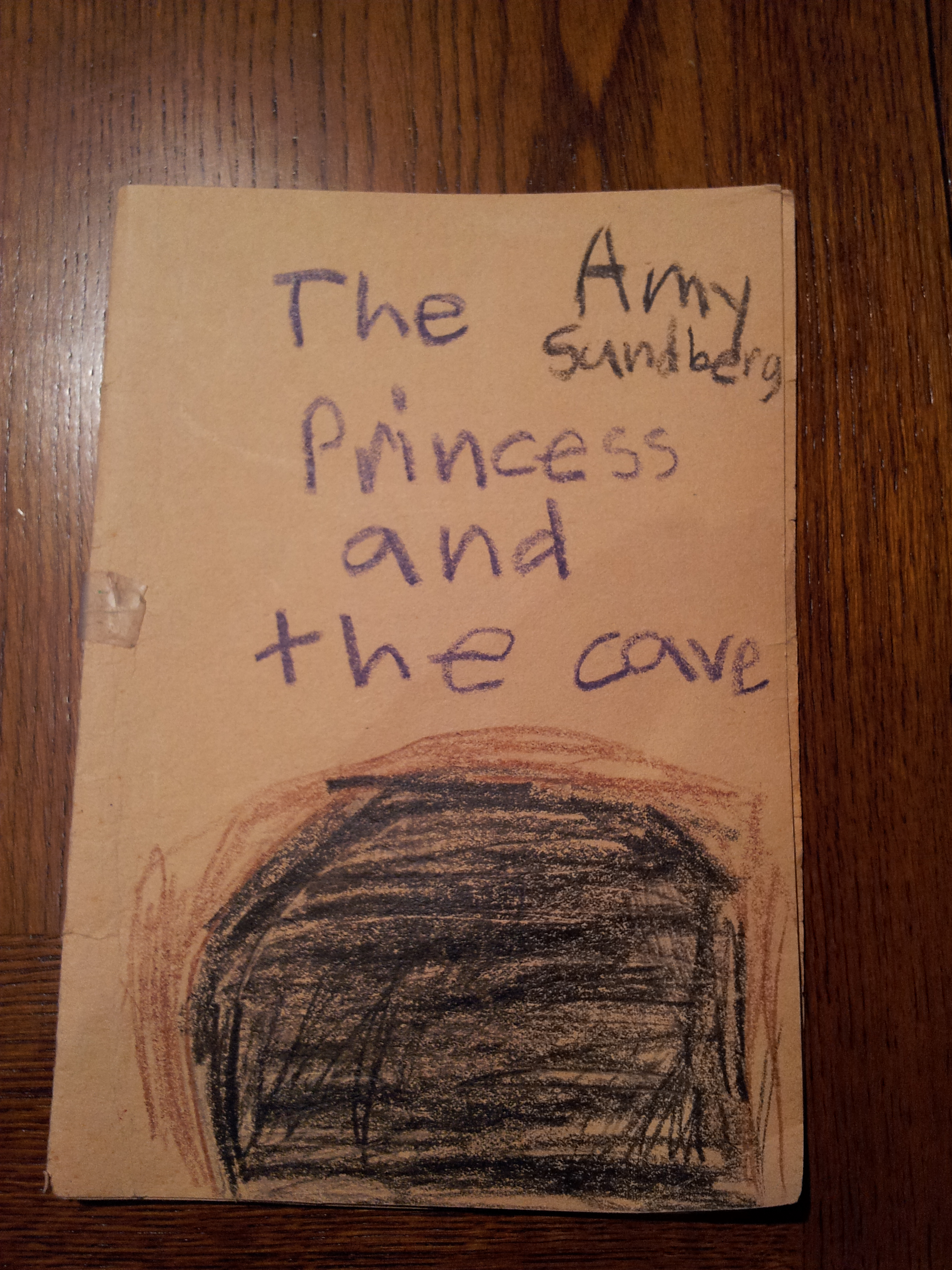
The Princess and the Cave

 And here is a taste of the artwork inside:
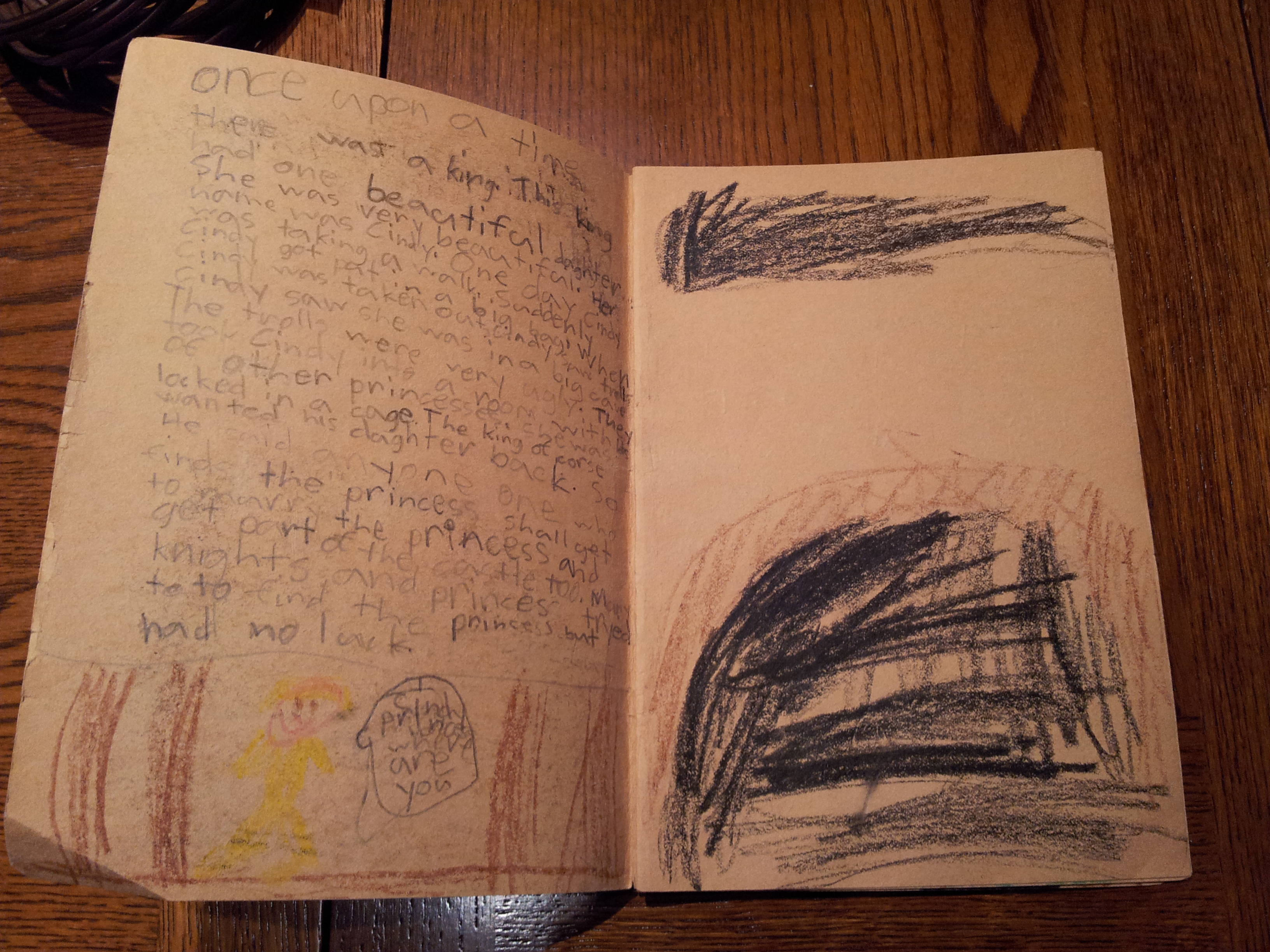
Amy's cave drawing

We can see two things from these photos: first, that I was fascinated with the idea of caves, and second, that it’s not surprising I didn’t go on to have a career in the visual arts.

I loved writing “The Princess and the Cave” so much that I promptly sat down and wrote a second book:
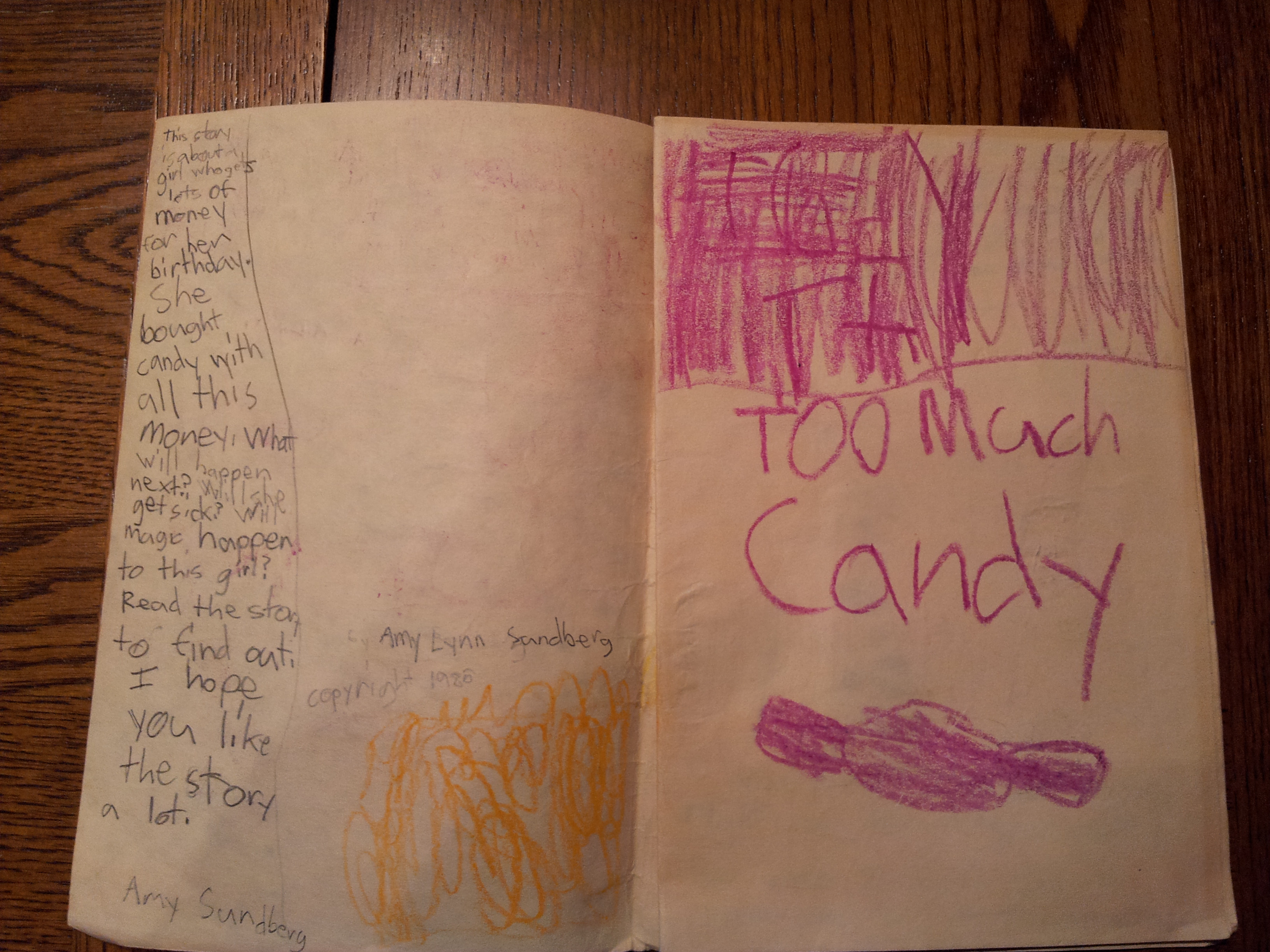
Too Much CandyI find these books to be noteworthy because it was when I was writing them for a classroom assignment that I understood that the books I loved to read were actually, really truly written by other people. And I decided that when I grew up, I wanted to be an author.

I never changed my mind. I decided I wanted to be a musician too, and I devoted many years of my life to primarily focusing on music. But even then, I was writing bad poetry or memoirs or short stories or lyrics or the book of a musical. And I always held onto the idea in the back of the mind that one thing I wanted to accomplish in my lifetime was to write a novel. I thought I might not do it until I was fifty (I’m glad I was wrong about that), but it was always a part of my vision for my life.

Having a vision for our lives can be so powerful, whether the vision was formed when we were seven or it’s brand new. A vision can give us purpose and direction, something to aim towards as we make the decisions that shape our lives. And in times of change, it’s the powerful vision of what we’re striving for that carries us through. I’m not talking so much about visualizing what we want, which some research shows actually makes us less effective at carrying out our plans. Rather, I’m talking about knowing what we want (or learning what we want if we don’t already know) and believing it could become a reality.

We can become so limited by what we believe to be impossible. Obviously we aren’t capable of every thing under the sun, and sometimes we don’t want to set the corresponding priorities or make the sacrifices necessary to make something possible, and that’s fine. That’s different than experiencing a failure of imagination, imagination being the capacity that perhaps allows us to have vision in the first place. We get to choose our vision, after all. But we can become stifled by a narrow view, or by exhaustion, or by fear.  We can forget that so many amazing dreams are worthwhile not so much because of the end result (although that can be quite nice, of course) but because of the journey we take to follow them.

Do you have a vision for your life?
 

Read Full Post »

Over the last months I’ve been asked a few times by wonderful people to do “The Next Big Thing,” which is a writer meme in which writers talk about their latest work. I said no because I’d already talked a lot about The Academy of Forgetting here, so it wouldn’t have been very interesting. But then my friend Amy asked me to do it this past weekend, and I thought, ooh, I can talk about the new book! So I said yes.

I’m going to post Amy’s bio here, and I’ll also tell her a little about how we met. She was in my first critique circle at my first SCBWI conference in New York, and I heard her read the first page of the YA novel she was working on, and I thought, “I want to be friends with her.” Happily, it turned out she is as kind and intelligent as she is talented.

Amy K. Nichols is a YA author from the Phoenix area. She is represented by Quinlan Lee of Adams Literary. Her first novel, Another Here, Another Now, will be published by Knopf BFYR in fall of 2014. You can read samples of her work at http://www.amywrites.com.
Blog: http://www.amyknichols.wordpress.com
Twitter: @amyknichols

But I’m not going to follow the rest of the directions. First of all, I don’t like tagging people because it reminds me of those chain letters I got in first grade that my mom wouldn’t let me do. I think she had a point. Plus, this meme has been going on for long enough that I have no idea who has done it and who hasn’t.

Second of all, I started reading through the questions, and I realized that, even talking about my new work-in-progress, my answers were mostly going to be…pretty boring. Or nonexistent. I mean, how could I possibly know what actors I’d want to play my characters when I’m still getting to know those characters? (And it’s not like I have ideas for any actors for Academy of Forgetting characters either. This is just not how I think.)

So instead I’m just going to tell you about my new book. It’s a YA murder mystery set in space, and I think I’m going to call it Nikki in Space on the blog because I have no idea what the real title is going to be yet. That’s why it’s called a work-in-progress.

I’m really excited about it for the following reasons:

1. Space! The setting is just the most fun ever to write. It’s set in the same universe as my short story Daddy’s Girl, and the beginning is set on a single family space habitation, and the rest is set on a space station. So fun.

2. Murder mystery! I’ve inhaled Agatha Christie mysteries for most of my life. (And I also really like Laurie King’s Mary Russell mysteries, which reminds me that I should read more of them soon.) And now I’m getting to do one myself.

3. Nikki! I’ve had Nikki’s voice in my head for over a year now, and it’s very satisfying to finally get to explore it.

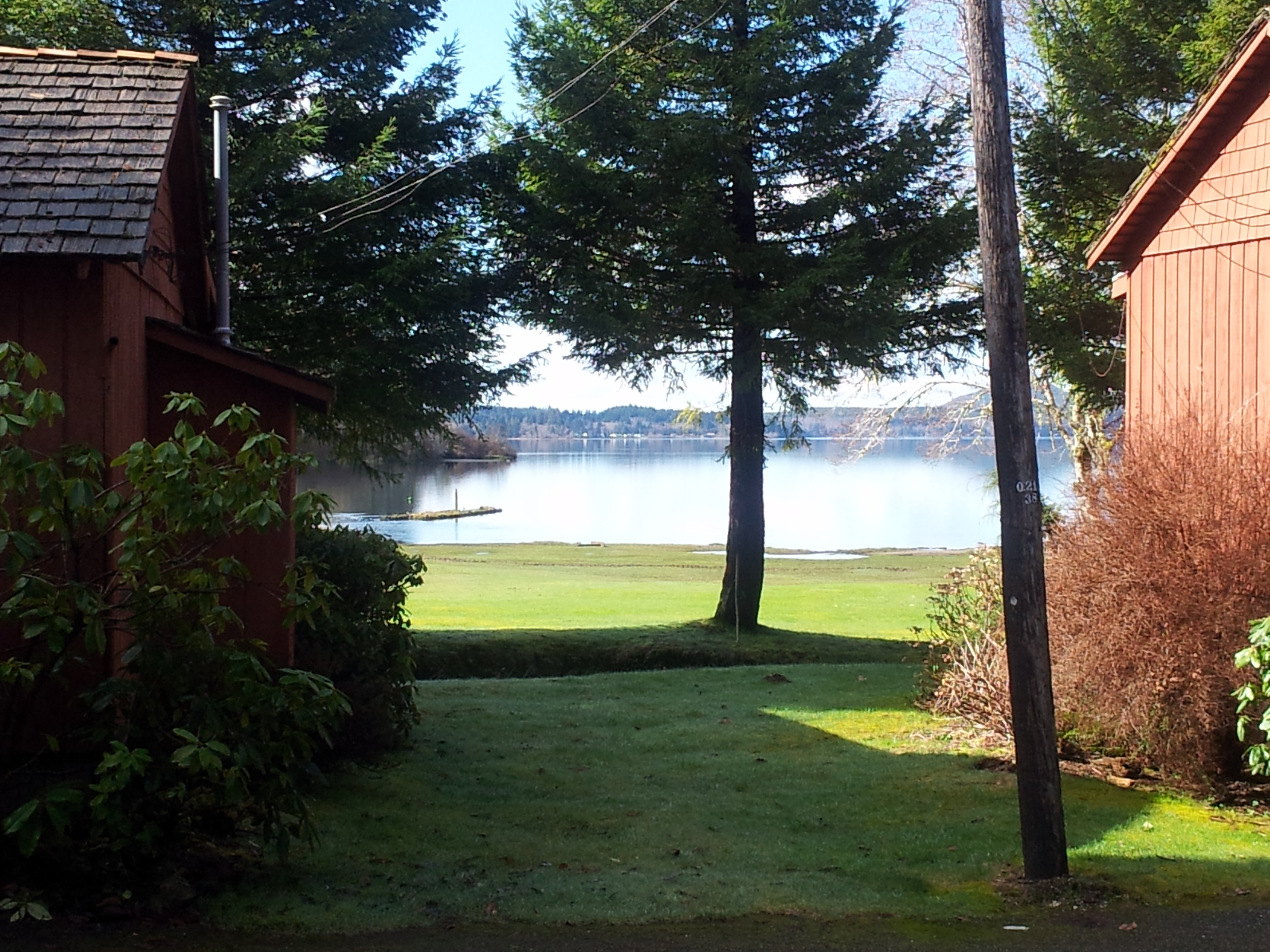
I did my usual playing with index cards to outline (although I did a simpler version this time), and I’ve been working on the rough draft for the past three weeks. Last week I went up to the Rainforest Writers Village in Washington and pounded out the words. (It was lovely, the people there have become a core part of my writing family, and I feel so lucky I got to go.)

The view from my cabin up in Washington.

The view from my cabin up in Washington.

At this point, I’m very close to finishing Act 1 of the novel. In fact, by the time you’re reading this, hopefully I already have. This means I’m theoretically about 25% through the rough draft.

So that’s what I’m working on right now, and hence that’s where a lot of my brain is going. What about you? Working on any cool projects?

Read Full Post »

One of the things I love best about being a writer is the wonderful necessity of feeding my muse.

Don’t get me wrong; I do my very best not to follow my Muse’s fickle whims. I try to write a prescribed amount of words regularly. I try not to start new projects if it will mean leaving an already started project unfinished. I force myself to write when I don’t feel like it.

But that doesn’t mean my brain doesn’t need feeding while I’m engaging regularly in the creative process. In fact, it can be positively voracious. And the more I feed it, the happier my writing process tends to be.

Favorite Ways to Feed the Muse:

1. Travel. Yes, I know, I am constantly singing the praises of travel, but I am hard pressed to think of anything that delivers a bigger punch of Muse deliciousness. New places and cultures, new experiences, new people, the beauty of nature, art treasures, learning about history, eating amazing and sometimes strange foods–travel has it all.

2. Doing something I haven’t done before. Because we don’t need to travel far from home to have new experiences, whether that be going to a new place in the area or trying a different restaurant or taking a different route for your daily walk/jog. In a couple of weeks, I have tickets to go see my first magic show, and even if it’s on the cheesy side, I am fascinated to be having this experience. (Plus, I get to wear a cocktail dress. Double win!)

3. Going to museums. Because at most museums, I learn something new or see something beautiful or experience something different (see #1). Next on my list? The Disney museum in San Francisco.

4. Experiencing story outside of my own writing. This can be anything from novels to movies, TV series to theater, role-playing games to video games. Sometimes I need to read a certain kind of novel, and other times I really need a different vehicle to experience story. Lately I’ve been reading a lot of plays. Good, bad, or wildly uneven, it’s all grist for the mill.

5. Finding another creative outlet. Even though my current focus is on writing, I feel so lucky to have spent so much of my life practicing and studying to be a musician. Sometimes there is nothing my brain needs as much as becoming entirely focused on something creative but DIFFERENT. Very very different. A quick thirty minute voice practice session and I can come at a writing problem in an entirely different way. Which is similar to

6. Moving the body. Exercising, dancing, taking a walk around the block, or jumping up and down for twenty seconds, all of these activities pull us back into our physical bodies and give our brains a chance to work on a subconscious level.

7. Talking to people. The more interesting people we surround ourselves with, the more likely our social time will prove to be inspirational. You never know when an off-hand comment from a friend will trigger a thought that turns into a blog post, the perfect telling detail, or a solution to a tricksy plot problem.

What our your favorite ways to feed your muse?

Read Full Post »

Very soon after I decided that I wanted to be a YA writer, I learned the following “truth:” that girls will read novels with both male and female protagonists, but boys will only read novels with male protagonists. So if you want the widest crossover, you write a boy protagonist, and if you write a girl protagonist, that means you’re mostly writing for a female audience.

Then I heard the oft repeated story about how J.K. Rowling decided to use her initials as her author name so that the readers would not know she was a woman. And I heard about how YA was dominated by women writers, sometimes as though this were a bad thing.

Then I heard a couple of male writers who I respect talking about the problem of there not being enough boy books in YA. Later on, I heard about what a problem it was that there were too many female protagonists and “girl books” in modern YA.

Shall I define “boy book” for you? A boy book probably has a male protagonist. It features action and adventure and is quick paced. It probably doesn’t have much if any romance. The language and structure might also be more straightforward and simple, since one of the main reasons having YA boy books is supposed to be important is to encourage reluctant boy readers to read.

A “girl book,” by contrast, probably has a female protagonist. It may have action and adventure and be quick paced. It almost certainly includes a romantic element. It might focus more heavily on social interactions and relationships in general, as well as issues of social status (because of course, men aren’t interested in status at all. Ha!). There might also be a stronger focus on emotions. The language and structure run the gambit between simple and complex.

I’m not going to mince words: these truths about boy readers, the YA genre, and boy and girl books are harmful and sometimes flat-out false. If boys won’t read books with girl protagonists, especially by the time they are teenagers, this is not a good reason to write and publish fewer books with girl protagonists. This is a red flag that something is wrong with the message our society is sending to these boys.

Often this argument gets lost in the rush to emphasize the importance of boys learning to read. It’s fine to perpetuate this “truth” of boys being unwilling to read anything not entirely male-centered, the unstated message goes, as long as we can wheedle them to read anything at all. And this is how sexist thinking gets passed on to the next generation.

Obviously boys learning to read is important. It’s important that everyone learn to read. And it’s also important that we throw away outdated and harmful ideas about gender and stop teaching boys that girls and anything related to girls are somehow shameful or uninteresting or embarrassing. THESE CAN BOTH BE IMPORTANT AT THE SAME TIME. Revolutionary idea, I know.

If YA did have such a predominance of female protagonists, I’d be happy, given all the messages female teens receive to the contrary, that there was at least one place where they could experience other females being front and center, having agency and their own individual identities. But it is not necessarily even true that YA has more female protagonists than male. According to this study, 49% of YA protagonists are male. 49%. And only 36% of YA protagonists are female. (15% have protagonists of both genders.)

You know what else isn’t true? That YA is dominated by women writers. The same study found that 56% of YA writers were women, which is hardly an overwhelming majority.

When we talk about female protagonists in YA books as if they’re somehow a bad thing, we’re strengthening harmful stereotypes. When we believe boys won’t read books with female protagonists, we’re sending them the message that they shouldn’t want to, or that there’s some kind of problem with reading these so-called “girl books.”

The Feminist Batwoman wrote a fabulous essay called “Boys Don’t Read Girl Books and Other Lies My Society Told Me.” She ran a successful experiment exposing her little brother to novels about girls as well as boys, and she has this to say about boys not reading books with girl protagonists: “My outlandish theory is that if boys aren’t belittled for reading books about girls, if they’re not taught that girls are lesser, if they’re not teased about cooties, if we don’t teach them to fear the feminine… they’d probably like more “girl” stuff.”

We need to stop talking about boy books and girl books as if this is some kind of important and valid distinction. We need to wake up and realize that 56% of YA writers being women does not mean that women dominate the genre. And we need to think long enough to realize that if girls are happily reading novels with protagonists of both genders, there’s no reason we can’t work towards encouraging boys to do the same. Plenty of boys already do.

For a long time I took these assumptions about YA and YA readers for granted. I’m guessing I’m not the only one. Therefore, if you think this is an important and interesting issue, I encourage you to share this essay or start a conversation with your friends and colleagues. Let’s challenge what everyone knows and find out what lies underneath, shall we?

Read Full Post »

I always wanted to have a voice. What I didn’t know about were the obligations that come along with it.

Last night I sat with a group of friends and watched the Academy Awards. Aside from one meaningful look, I didn’t say anything about the Boob Song. It was exactly the brand of humor that I don’t know what to do about, because I can see why people think it’s funny, and yet, if I think about it for more than five seconds, it’s not at all funny. (Libba Bray’s suggestion, however, is.) It actually completely pisses me off, especially in reference to an already deeply misogynistic industry.

But I didn’t say anything. (Although I did splutter indignantly at the joke at Penelope Cruz’s expense that combined sexism and racism. I mean, wow.) I’d like to think it was a world-weary kind of not saying anything, but it wasn’t. It was a self-doubting, “other people find this funny so maybe there’s not actually a problem and anyway I don’t want to seem like a negative killjoy” sort of not saying anything. Even when I have a voice, it seems, it can be difficult to use it.

When I started writing, I knew very little about social issues: sexism, racism, homophobia, ableism, classism, etc. But I very quickly became aware there was a lot for me to learn, because I began following the science fiction community in early 2009, which was around the same time the Racefail conversations were happening. It was at that point that I realized how much I didn’t know and how important it was for me to start educating myself.

I still have a lot to learn. I know I don’t always get it right. But I feel strongly that with the privilege of having a voice, of becoming a writer whose works will be read, whether that’s here on the blog or in my fiction, comes the responsibility for me to learn about issues of gender, of race, of class, and of sexuality. Because whether I like it or not, whether I mean to or not, whether I am conscious of them or not, my own biases will come through in my work.

I can’t erase all my biases, certainly not in the four years I’ve been thinking more deeply on these subjects, but at the very least I can examine myself, aspire to understand more, and do what I can to counteract these biases. Because as a writer, I am engaging in the conversation of our society, and what I say (or do not say) matters. The words I choose matter.

So when I fail to say anything about a derogatory Boob Song, I have to examine that response. I have to ask myself if I’m being wishy washy in my writing, if I’m worrying about being un-fun and trying to convince myself things are fine when they aren’t instead of working harder and writing about my convictions and observations.

This kind of self reflection makes me want to tell you how offensive I find the premise of the new Oz movie, Oz the Great and Powerful, which seems like it’s going to be about all these awesome, powerful, and magical women who, in spite of their power, need a bumbling man who’s not from around here to set everything (and everyone) straight. And then I begin to wonder if the movie is going to feminize magical power while the Wizard saves the day with common sense and practical and/or technical know-how that the magical women can’t possibly do themselves. And then I think about how the original Oz stories, in spite of being written in the early 20th century and being deeply problematic in several ways, featured Dorothy and Ozma as the prominent protagonist-heroines. I think of how uncomfortable I was the first time I read The Marvelous Land of Oz at age seven when —spoiler alert–the boy protagonist Tip turned out to be the girl princess Ozma, and how this made me question gender assumptions until upon re-reading I was completely on board with that particular plot twist. And how having this movie set in the same world in 2013 only with a man to save the womenfolk seems like we’re going backwards instead of forwards.

This self examination makes me wonder how many times I’ve decided not to write about things like the Oz movie here on the blog, because it’s so much easier not to speak up.

The truth is, since I’ve begun learning and thinking about social issues, I see and experience things that make me uncomfortable all the time. And one of the most uncomfortable thoughts of all is knowing there’s so much stuff I’m missing, so many problems I’m not seeing because they’re so tightly embedded into my cultural context, into my upbringing, and into the assumptions I bring with me when I view the world. And one of the other uncomfortable thoughts is how often I keep my mouth shut.

So this is me, using the voice I worked hard to get. The Boob Song wasn’t actually funny as much as it was depressing and offensive. The Oz movie looks dreadful, even if the previews are pretty. We are all informed by the society we grew up and live in, whether we realize it or want it to be true or not.

And we can try our best to say something about what we notice and what we learn.

Read Full Post »

Today I started writing another novel.

It took a long time. In addition to actually typing some words, I did the following activities:

– I ate a Japanese cinnamon flavored mini Kit Kat, an extra peanut butter cup, and way too much cranberry sauce.
– I pet the dog. More than once.
– I spent time on Craigslist.
– I spent a little time emailing before throwing up my hands in despair at how far behind I am.
– I did laundry.
– I played Minesweeper.
– I emptied the trash can in my study.
– I took the dog to the park.
– I worried about the novel.
– I worried about things having nothing to do with the novel.
-I worried about other things having nothing to do with the novel.
– I practiced music.
– I played Solitaire.
– I thought about texting people and then didn’t get around to it because if they texted back, that would be the end to any pretense of productivity.
– I wandered around the house.
– I rinsed out a glass jar of jelly.
– I looked at the clock a lot.

Really, it’s a miracle I squeezed a thousand words out of my brain somewhere in the middle of all that activity, the majority of which was based around me not wanting to start the new novel.

It’s not that the actual writing is so unpleasant. I like writing. Even when it’s difficult, it’s still generally very satisfying. But even so, there’s a certain amount of resistance that I have to push through at the start of any new project. And I expect that resistance to continue for at least another week or two.

I’ve become very good at Solitaire, let me tell you.

The beginning is hard because I don’t know what to expect. I don’t know my characters very well, and my outline is full of vague comments like “They come up with a plan” (Fabulous! Now if only I knew what the plan was) and “She does something awesome” (if only I knew what awesome thing she could do) and “She’s given an important assignment” (but who knows what that might be). I don’t feel comfortable in my world. I can’t remember everything I’ve thought about it, and as soon as I commit sentences, I realize all the things I haven’t figured out yet. And then I realize all the things I know that I have to make sure the reader knows too, even though it would be so much easier to just breeze past those bits.

Beginnings are like that in general, aren’t they? We don’t know what to expect when we start something new. There’s no routine to fall back on, fewer tested assumptions to use as mental shortcuts. It’s scary because we don’t know if we’ll be any good, or if we’ll like whatever new thing we’re starting, or if we’ll be somehow screw things up because we don’t know any better yet. They’re uncomfortable and uncertain.

But beginnings are also a time of great promise. We don’t know what to expect so maybe amazing things will happen. It’s exciting to strike out and start something new. It lets us learn more about ourselves and more about the world around us.

So tomorrow when I sit down and begin the whole lengthy push-a-thousand-words-out-of-my-head process again, that’s what I’m going to try to think about. That even though I’m uncomfortable, maybe amazing things will happen.

I hope they happen for you too.

Read Full Post »

I’d been wanting to write that post on forgiveness I published last week for a long time. But I kept punting it for other ideas because I was afraid to write about it. I was convinced the ENTIRE WORLD would disagree with me and be horribly upset that I didn’t think of forgiveness as something that can be forced, and somehow this would be an awful thing for me.

The longer I write for this blog, though, the more I realize that really, the world doesn’t care. Most people will never read my essay on forgiveness. And most of the people who did read my essay recognized something in it that resonated with them. So when I think the entire world will disagree, that is some bizarre thought process I am better off ignoring.

My friend Ferrett wrote some excellent blogging advice, where one of his main points was: “No, Seriously. Haters Are Going to Hate.” As a blogger or someone who is interested in maintaining a public example, this will inevitably be an issue at some point. Ferrett says that once you become sufficiently popular, there will always be people who hate you, and he’s completely right. It is amazingly hard to be sufficiently wishy washy to keep everyone happy. I don’t even know if it’s possible, although I suspect it isn’t. There will always be people out there disagreeing loudly, people looking for an argument, or people wanting to tear other people down.

Photo Credit: HeyThereSpaceman. via Compfight cc

For example, it is always amazing to me how angry people have gotten over my essay about intelligent women. They are upset because they don’t think women can possibly be as intelligent as men (seriously, what century are we living in?) or because they don’t think smart women ever encounter anything I mention so therefore I must be old and bitter (because only old and bitter people can engage with ideas about sexism?) or because of course all intelligent people must make loads of money because that’s the way intelligence should be measured in our society (I guess most artists and academics are just pretty stupid since they don’t prioritize making large amounts of money). But what is more interesting to me than the actual arguments is the amount of anger expressed because there are different opinions in the world. Opinions, it seems, can be very scary things.

But as strange as it seems to me that people can get so worked up over my six hundred word essays, this doesn’t change the fact that the world is largely indifferent. And in fact, as a writer, if my words cause anyone to feel angry or scared or hopeful or inspired or any emotion at all, then that means I’ve done my job. In the grand scheme of things, obscurity is more an artist’s enemy than controversy, however safe the obscurity might feel and however challenging the controversy might be. (And of course, how challenging the controversy feels will vary wildly from person to person.)

I think part of becoming an artist is learning to be comfortable with controversy. Not because it is bound to be necessary, but because part of an artist’s job is to express their perception of the truth. And if you are afraid of what the world is going to think about your truth, then maybe you won’t dig as deep as you can and maybe you won’t take the risks you need to take and maybe you’ll choose the easy way instead of the raw way. Creating art is a commitment to your own vision of reality.

So I wrote that essay on forgiveness anyway, even though it scared me. I was scared to write The Academy of Forgetting. I’m about to start a new novel, and even though I’m excited about it, I occasionally feel sudden spasms of anxiety when I think about sitting down and typing “Chapter 1.” I feel a tightness in my stomach and a sudden strong desire to do anything else.

But I’m glad I feel the fear. It’s like a compass, letting me know I’m going the right direction. It means I’m not taking the easy way. It means I’m challenging myself, and my writing is better because of it.

Read Full Post »

But first, it’s the time of year when science fiction and fantasy writers begin to mention award season. I’ll make this short and sweet.

I am in my second (and final) year of eligibility for the Campbell Award for best new writer in science fiction and fantasy. You can vote for this award if you are voting for the Hugos. Here is my list of publications to date. I’m happy to send you a copy of anything on that list–just shoot me an email at practicalfreespirit@gmail.com

Also for the Hugos, I can be nominated in the Fan Writer category for my writing on this blog. I recently updated my Best of Blog page to include some blog posts from 2012. And if you’re looking for other people to nominate, I recommend checking out Theodora Goss and Ferrett Steinmetz, both of whom have strong blogs relevant to fandom and our community.

I had four short stories published last year, all of which can be nominated for the Nebulas and the Hugos. The complete list is here, but in my opinion the strongest one is Daddy’s Girl.

And now, for something completely different.

I have something new I’m really excited about. It’s a vlog called The Lizzie Bennet Diaries, and one of its executive producers is Hank Green of Vlogbrothers fame (he vlogs with his brother, writer John Green).

This vlog combines modern media and storytelling in a way that is special. Its conceit? It’s a modern-day adaptation of Pride and Prejudice. The main vlog belongs to Lizzie (aka Elizabeth) Bennet, who starts it with her friend Charlotte as a project for her communications masters. We are slowly introduced to the concerns and people of Lizzie’s world, and the acting and writing are both quite strong.

The audience can watch only these main videos and have a great time. However, for those who want more, it’s out there to find. Lizzie’s little sister Lydia starts her own vlog. Charlotte’s little sister Maria does a short series of videos as well. Each of the characters in the vlog has their own Twitter handle, and they tweet at each other and with the audience. (Unfortunately, whoever’s in charge of the Twitter accounts doesn’t understand the technicalities of how Twitter works so the responses aren’t threaded to each other in a way that is easy to read. Still very cool, though.) One of the characters (Jane) has a semi-active Tumblr account. There’s even a fake website of the company Lizzie is about to go visit for an independent study project next week.

Lizzie and Charlotte, dressed up as Lizzie’s parents

I’m fascinated by how the story is being updated to modern times. For example, the proposal of Mr. Collins to Lizzie isn’t exactly what it was in the book, even while it remains true to the spirit. There are plenty of references to catch for those who love Pride and Prejudice. I particularly love how so far the videos are very effective at highlighting the flaws in Lizzie’s character. But even for those who aren’t so into the book, this is a fascinating experiment of a different way of storytelling using a combination of video, websites, and social media.

I don’t know how I avoided hearing about this for so long, but now that I’m all caught up, I’m looking forward to experiencing the serial feel going forward. Another thing I really like about this vlog is how each episode feels complete in itself even while maintaining suspense and forward momentum. When I watch my other favorite web series, The Guild, I am often frustrated by how short each episode seems and how I feel like I’m constantly left hanging (maybe I got spoiled by getting to watch the first five seasons after they were completed, making them more like five movies). In contrast, each episode of The Lizzie Bennet Diaries has its own mini-arc that leaves me feeling satisfied.

I would love love love to be involved in the writing and/or producing of a project like this. Truly fabulous storytelling.

What media are you geeking out over right now?

Read Full Post »

While I don’t often make New Year resolutions (except when I do), I like to stop and take stock of my life at the end of the year and set some goals for the year to come. After all, it’s hard to live your life according to your priorities if you don’t know what your priorities are!

amy and nala christmas 2012

Writing:

In 2012, I had several more stories come out, and I qualified to become a full member of SFWA. I also sold my first (and second) science fiction stories. I spent the bulk of the year working on my YA novel The Academy of Forgetting.

My plan for 2013 is to query a large number of agents and complete another YA novel. I’d also like to participate in at least a couple weeks of Codex’s Weekend Warrior (writing flash fiction). And of course, I want to continue to increase my focus, improve my writing skills, and read a lot.

Health:

Well, given that I spent six months waiting for my foot to heal, this year was on the frustrating side. But I was able to stay focused on my writing through it all, which I am very pleased about. My tooth from the drama of 2011 rarely bothers me anymore. And since the fall I’ve definitely been in less overall pain than I have for the last few years.

My wish for 2013 is that I can continue this whole less pain trend. I’d like to begin gradually increasing my strength. What I wish for the most is that I can begin to reintroduce some activities that I love but haven’t been able to do the past few years. Like dancing! And hiking!

Travel:

I wanted to get out of the country in 2012, and that didn’t end up happening. I mean, I went to World Fantasy in Toronto, but given that I pretty much only saw the hotel, I don’t think that really counts. However, I fell in love with Seattle, got to see Chicago for the first time, and faced down a hurricane in New York, so the year wasn’t without its adventures. I attended seven writing events, including three I’d never done before, and had a truly fabulous time.

So my wish for 2013 will be the same as last year’s: that I leave the country. And actually SEE and EXPERIENCE stuff while abroad. I’m considering trying to travel somewhere in Europe pre-World Fantasy in Brighton, which seems the most likely way to make this happen this year. I’ve already mostly planned out which writing events I’ll be attending for the year, although a few remain up in the air.

Personal Growth:

Oh, 2012. I cannot sum it up in one paragraph. I learned a lot, I changed a lot, I made progress towards becoming the person I want to be. My understanding of myself and the world around me is clearer than it’s ever been.

My wish for 2013? To take a loooong vacation. Ha! But seriously, 2013 is going to be a year of external change, when I get to put my clearer understanding into practice. I anticipate a fair amount of trial and error, so that should be … exciting. I’ll build on what I’ve been working on for the past two years, continue to practice my own definition of assertiveness, and look to create good habits so I can conserve energy.

Have any goals for 2013 you’d like to share?

Read Full Post »

You know that novel I’ve been talking about all year? The Academy of Forgetting, a riveting (I hope) YA psychological thriller set in the near future and full of awesomesauce?

Finished. Done. Kaput. Complete.

I’m having trouble believing it. But I am also very, very happy!

Celebratory pie! (Photo by Poppy Wright)

So what’s next, my non-writer friends ask me? Will we see your book on shelves soon? (Writer friends, bear with me here, as I’m sure you’ve received similar questions.)

The answer is NO. In fact, the book isn’t truly finished, as in it is not yet ready for publication. It is ready to be seen by agents, which means it is as good as I can make it. However, if an agent were to be interested, and if I were to sign with said agent, and then if said agent were to sell the book to a publisher, there would most likely be several more rounds of edits between the version on my computer right now and the version that would show up in bookstores.

This entire process can be remarkably time-consuming. And there are no guarantees at any particular step. The trick, I think, is to focus on what I can control, which is writing a novel that I can stand behind and be proud of.

So what’s next? I am updating my agent spreadsheet, I am working on short summaries for a potential book 2 and book 3 in the trilogy, and I am revising my query letter and synopsis. Then I will start sending queries to agents on the spreadsheet. And meanwhile, the fun will start:

A NEW NOVEL.

Which realistically means I will spend the month of December brainstorming and fleshing out various novel ideas. If I’m really, really lucky, I’ll also choose one of those ideas and outline it. If the brainstorming goes more slowly, though, I won’t be doing the outlining until January. If the brainstorming goes very slowly, I might squeeze a short story or two in there somewhere too. (And for those wondering, no, this new novel will not be book 2 to follow The Academy of Forgetting. I’ll only write that book if AoF sells. Or if I get an agent, and my agent believes that starting book 2 before selling could be strategic, and I agree with him/her. Or if I have another particularly compelling reason.)

I am very excited about this, and it also feels weird. It feels weird to get ready to let go of this novel project that I have focused so much of my life on for the past ten and a half months. It feels strange to contemplate starting something new, with characters I don’t know better than I know my real-life friends and no limits at all until I lay some down in the outline. Soon I’ll be having new entirely made-up adventures instead of the familiar old ones.

It’s also interesting to see how finishing this novel, my third, feels different from finishing the first two. When I finished my first novel, there was this sense of euphoria because until I crossed that finish line, I wasn’t completely one hundred percent positive I could actually write a novel. When I finished my second novel, there was a sense of relief that the first one wasn’t a fluke.

But with The Academy of Forgetting, I feel more of a quiet satisfaction that I was able to tell the story I wanted to tell and grow as a writer. I already knew I could write a novel. And I know I’ll be writing another novel in the not-too-distant future. This is my life now.

And that is a truly wonderful thing.

Read Full Post »

« Newer Posts - Older Posts »