Feeds:
Posts
Comments

Archive for the ‘Writing’ Category

Blog Retrospective 2013

I’ve been looking over the last year of posts on the Practical Free Spirit. It’s always very satisfying to do this, looking at all the essays I’ve managed to write and post in the course of the year. Especially during a year like this one, when I did not accomplish all I wanted to, writing-wise, it’s helpful to look at what I did accomplish.

I chose THIRTEEN of my favorite essays that I wrote this year. Which I guess since we’re talking about the year 2013 is at least somewhat appropriate. These are what I consider to be the year’s greatest hits. So if you are a regular here at the blog, you might remember some of these or even be re-inspired by them. And if you’re new-ish to the blog, this list is probably a decent place to start.

I Don’t Care if You Understand Me

If Boys Really Won’t Read Books About Girls, We Have a Problem

On Trolls and Obscurity and Making Art

How to Start Over

We Need to do Better when Dealing with Death

Remember Who You Are

I am not Sorry

Commitment Leads to Awesome

How to Overcome Fear

If you have a lot of secrets, this blog post could save your life.

The Best Life Advice I’ve Ever Heard

Taking time off from social media is actually no big deal.

Failure is the New Black


Hope you enjoy! I’ll be back next week to talk more generally about the year that is ending and to share what I’m focusing on for 2014.


Read Full Post »

I made a hard decision on Friday.

I decided to abandon my current novel-in-progress.

Currently at 61,000 words in length, this novel represents a large amount of my time and effort. It is about 75% completed.

It is also not working. And I don’t mean that in a rough-drafts-suck kind of way, but in a there-are-several-deep-systemic-problems-here-and-most-of-this-needs-to-be-thrown-out kind of way. So I am putting it aside. Maybe at some point I’ll know how to fix these deep systemic problems and I’ll return to the project. Or maybe I won’t. It’s hard to say.

Scott Adams had a good point in his widely shared article about failure: that there are people who focus on goals and people who focus on systems, and it is the people who focus on systems who tend to do better.

Don’t get me wrong; I think having goals is important. I’m a planner, and goals help structure planning. But ultimately, we want to have goals that support our system. When the goal no longer supports the system, it is time to change the goal.

My system is to be continuously improving myself as a writer while looking for opportunities to advance my career. My goal was to complete this novel. When I started the novel, the goal was in line with the system, but that is no longer the case. Being aware of the broken aspects of the novel, at this point I’ve been going through the motions, which isn’t teaching me all that much. (If I didn’t know how to finish projects, or if I felt I could learn a lot about endings by finishing, this might not be the case. But neither of those applies this time.) And finishing a novel this broken won’t do anything for my career except take time I could be using elsewhere.

That’s not to say I haven’t learned a lot from this project because oh wow, have I ever. I’ll take all of that knowledge and experience with me to the next project, where I’ll put it to good use. But sometimes it’s important to be able to figure out when to cut your losses and walk away. My own personal tendency is to hang on too long. This is another opportunity to practice not doing that.

If you’re wondering how I’m feeling, well, I just put 61,000 words into a drawer, which is not the most pleasant experience ever. But at the same time, I do feel good about this decision. I am excited to have more time to work on other projects that I believe in. I’m happy to be moving forward.

Failure is hard, but it’s also necessary when we’re trying to push our limits and become better. So this is not a horribly discouraging thing. I’d feel a lot worse if I no longer believed in my system, but I do. Nothing fundamental has changed. I’m just moving on to the next stepping stone.

What is your system? Are your goals in line with it? How do you feel about failure?

Read Full Post »

On Tuesday night Jonathan Carroll had a quotation on his Facebook that resonated with me:

“Life shrinks or expands in proportion to one’s courage.”

Anaïs Nin

There are different kinds of events that call for courage. There is the desire to make change, of course, which I’ve talked about a fair amount in the past. There is the question of how we face and handle adversity. There is the desire to try something new. And there is the willingness to go back and do the same scary thing again and again, even if it doesn’t get all that much easier.

I think when we choose to be artists–whatever that means to you–we are, in a sense, choosing to face fear again and again. There might be times when we aren’t seeking change, when we’ve got the adversity of life under control, when we’re living in a comfortable groove of existence. But if we’re actively working as artists, we’re constantly pushing, striving, experimenting, and revealing ourselves to others.

I can see it getting easier with time and practice, but I can’t imagine it ever being easy.

I have three main projects I’m working on right now: I’m querying my completed novel to agents, I’m in the middle of writing a novel rough draft, and I’m planning a future project that involves experimental elements. Each of these projects involve artistic courage.

-Querying puts me straight in the path of the rejection of my work, and while most of the time I shrug it off fairly easily, occasionally a rejection will sting.

-The rough draft is not coming together like I’d hoped it would, so writing it has become quite the struggle. I also deliberately chose to work on a concept that I knew depended on a writing ability in which I lack confidence and feel fairly weak.

-The new project is something new and experimental, and I’m not sure if I’m going to do it yet. But if I do, I’ll be trying all kinds of new things, and because of this, the entire project has a higher likelihood than many of tanking. It takes courage even to consider doing it.

reaching for origami cranes

Photo Credit: Βethan via Compfight cc

And then there’s the drive as an artist to go deeper, to explore dark corners, to shine a light on truths that are hard and uncomfortable and scary. There is the call to show vulnerability in our work. All of this requires so much courage.

So I would say not only do our own lives expand or contract in relation to the courage we can bring to bear, but our artistic work does the same.

What do you have the courage to see? What do you have the courage to feel? What do you have the courage to communicate?

Read Full Post »

Today you are reading one of my (relatively) rare writing posts, in which I am mostly going to share intelligent things that other people have said about writing. I admit that I am somewhat motivated by the selfish reason of wanting these articles available in the future for my own easy reference. But I’m also motivated because I’ve been thinking more about short stories lately because I’m critiquing three of them for WorldCon’s writing workshop, which takes place later this week.

First off, Goodreads did a survey on why people stop reading books. I’m fascinated by how many people don’t stop reading in the middle of a book because “as a rule, I like to finish things”: 36.6%! I’m so interested because I stop reading books all the time. I always have so many books in queue that I either should read or want to read that I’ll stop for any number of reasons: I’m not in the right mood, there’s another book I want to read more, the book doesn’t grab me, I can tell it’s not to my taste, etc.

But probably the most interesting number from that survey is that the single biggest reason why people stop reading a novel is because they find it BORING. From what I’ve heard, this is also one of the biggest reasons why slush readers stop reading novels and stories. So if you’re a writer, wanting to learn how to not be boring is a legitimate concern.

Photo Credit: Esellee via Compfight cc

Rahul Kanakia, otherwise known as my favorite blogger, shares some thoughts about the difference between short stories and novels in the boredom department. Rahul was a slush reader for Strange Horizons and now teaches writing to unsuspecting undergrad students at John Hopkins, so he knows that of which he speaks. He talks about having the “So what?” reaction to short stories, which is one I often have as well, and how to work towards inspiring a stronger reaction.

(Incidentally, it’s really interesting to think about the different things that a reader tends to want from a short story vs. from a novel. There definitely seem to be things you can get away with more easily in a novel than a short story, and vice versa.)

Ann Leckie, who edits GigaNotoSaurus, among other things, writes about a problem she often sees in her slush pile: namely, that much of the work she reads is not very original and involve ideas that haven’t been thought all the way through. Which results in what exactly? You guessed it: BORING stories.

Finally, I think anyone involved in narrative storytelling should check out this article, which I first read more than three years ago and still refer back to. (I expect to be referring back to it thirty years from now.) James Van Pelt wrote an outline of a talk he was going to give about writing a great ending. I am such a stickler for stories and novels landing the ending, and this blog post is the best discussion of how to achieve this that I’ve come across so far.

Have you stumbled across any great writing resources or articles lately? Been thinking about any aspect of writing in particular? Feel free to share in the comments!

Read Full Post »

It didn’t occur to me when I started this blog three years ago (THREE YEARS, WOO!) that every year, I’d have two posts back to back about birthdays. I was newly returned home after attending the Taos Toolbox writers’ workshop, and I was rearing to start this new project I had in mind: a blog called the Practical Free Spirit, about…well, I wasn’t really sure what it would be about. Mostly I was sure that I was excited to give it a try.

Since that time, I have written three hundred twenty-three posts. This one you’re reading right now is number three hundred twenty-four. If you multiply that number by ten, you’ll have some idea of how many comments have gone through this site. (Arithmetic! It is surprisingly fun!)

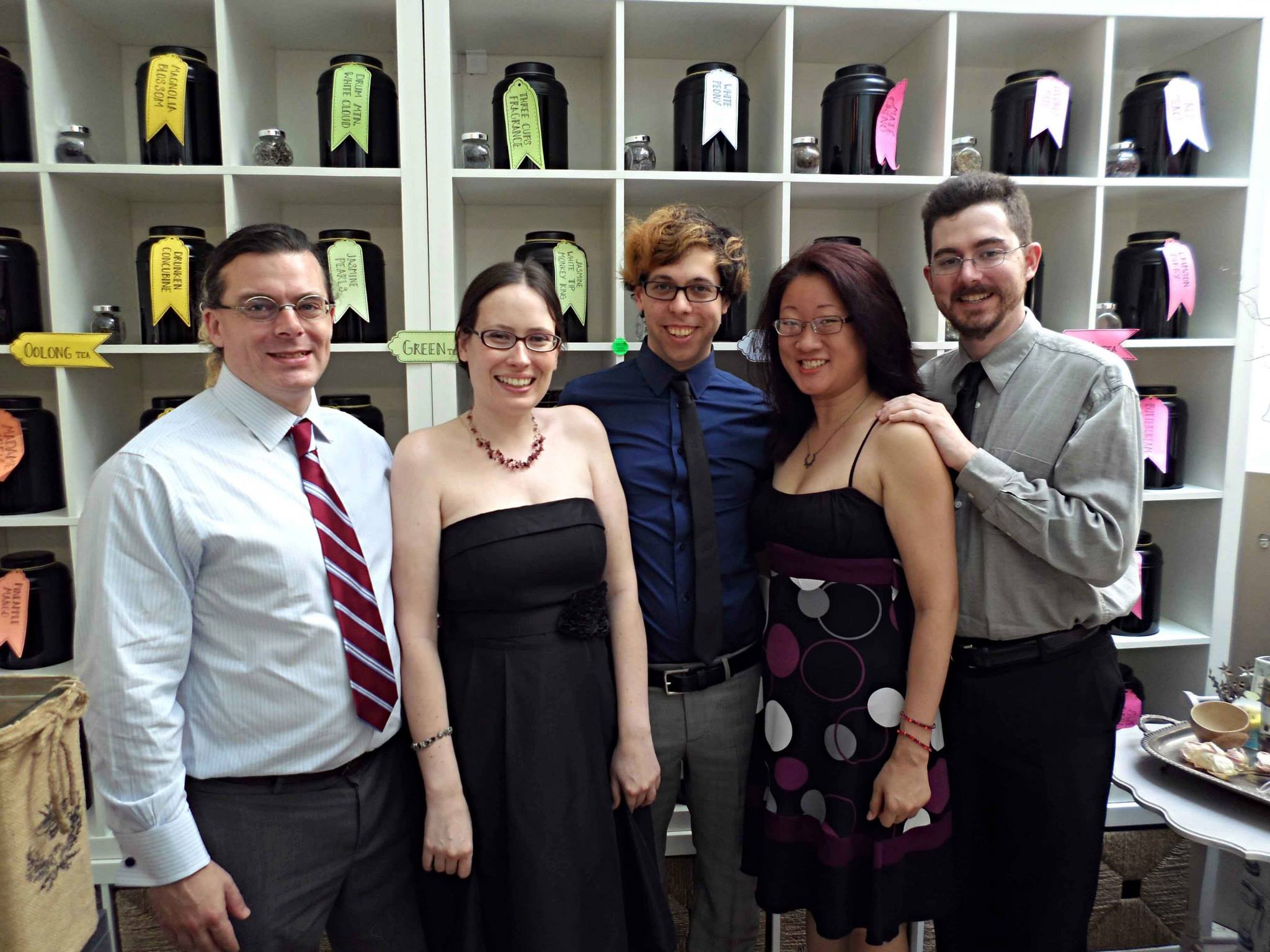
What did I do on my blog's birthday? I went to a fancy tea!

What did I do on my blog’s birthday? I went to a fancy tea! (Technically it was to celebrate MY birthday, but I won’t tell the blog if you won’t.)

I have written about a variety of subjects, many of which I never would have guessed I’d ever write about when I started the blog. I’ve written about things I didn’t want to write about, and I haven’t written about things I did want to write about. I’ve tried to strike a balance that is personal but not too personal, which, as it turns out, requires a fair amount of skill. I’ve also tried to keep things mixed up enough to stay interesting. (I’ve succeeded in keeping myself interested, in any case, which is critical for this blog continuing to exist, so I’m going to call that a win.)

This blog has thoroughly woven itself into the rhythms of my days. If it’s a Monday or a Wednesday, I’m writing an essay. If it’s a Tuesday or Thursday, I’m telling you all that I wrote it. If it’s a Friday, I’m wondering what in the world I’m going to write about next week. And then I start the process over again.

Anyone who reads this blog eventually learns how much I love it. That love has changed over the years, but it hasn’t faded. Sometimes it is a difficult love: when I don’t know what to write about, or when I’m feeling pressed for time, or when I don’t express myself as well as I hoped I would. And sometimes it is a dazzling love: when I get feedback by comment or email or conversation that something I said resonated or helped somebody, when I get to talk about subjects I think are very important, when I get to create art.

Thank you for coming along for the ride. I can’t wait to see what the blog has in store for us in the next year.

Read Full Post »

Writing is not glamorous.

I don’t know if there’s anyone left who thinks it is glamorous, but since there are apparently still people who think writers are all rich (excuse for a minute while I try really hard to stop laughing), I bet there are also people who believe in the glamor.

Don’t get me wrong. I love writing (except when I hate it). I’m glad I’m a writer. It suits my personality and my interests like nothing else I’ve discovered. But I don’t love it because it’s glamorous. I love it because I love story and characters and thinking hard and messing about with words and plot points and how is this emotional arc going and playing with index cards and taping them all up on my closet like some very strange modernist piece of art.

There is a little bit of glamor. Occasionally I dress up and go to an awards ceremony that most of the world doesn’t know is happening. I’ve met a few writers I really admire. In my book club, when we were talking about the motivations of the author this one time, I could say, “Well, I’m friends with her, and these were the points that seemed most important to her.” But this isn’t the bulk of my experience.

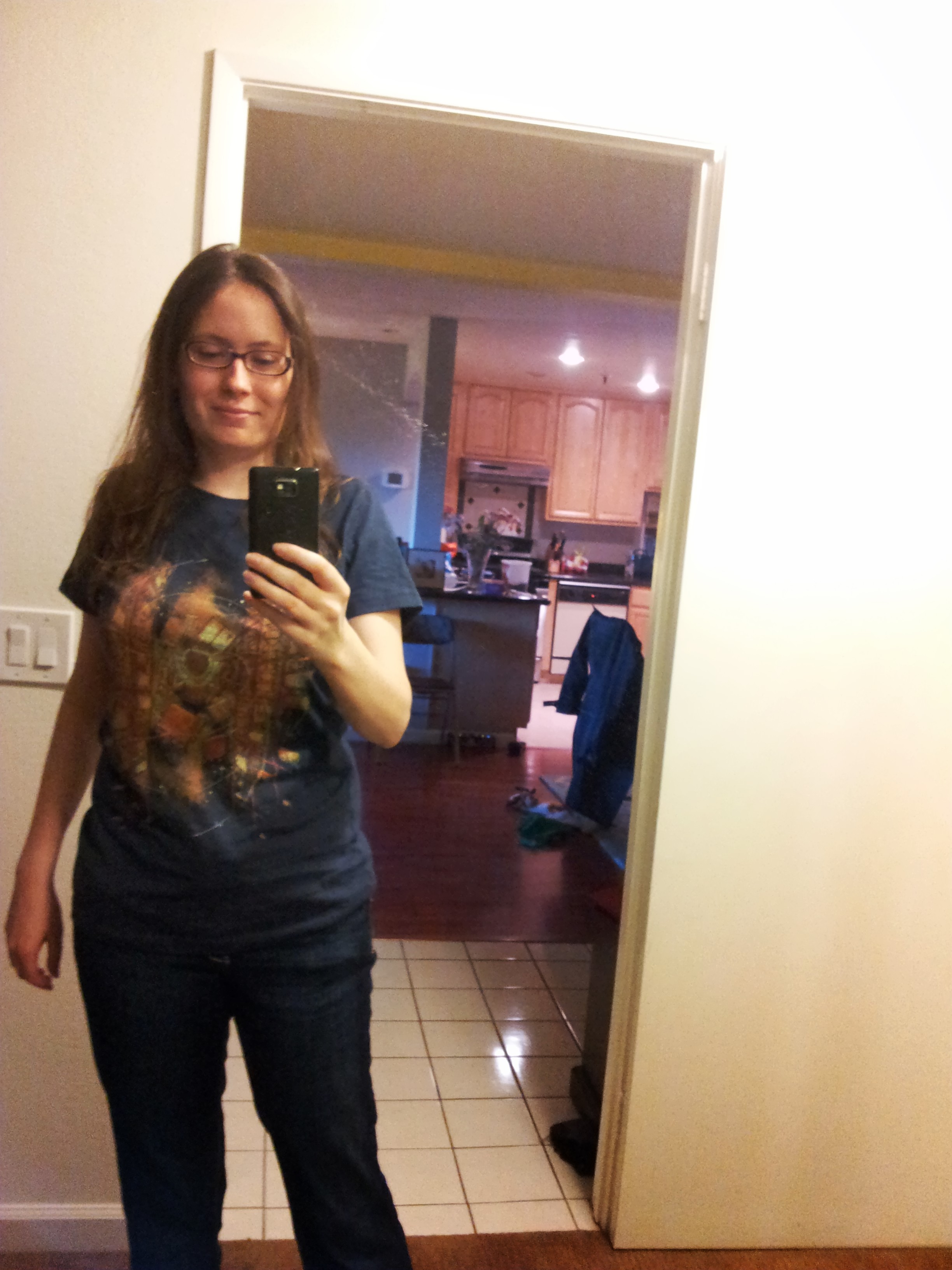
My writing uniform: jeans and a T-shirt.

My writing uniform: jeans and a T-shirt.

Talking about being a writer isn’t glamorous at all. People want to tell you about how they think they could be a writer (Awesome! Go do it.) or they had this one idea and why don’t you use it and split the profits (No thanks, I have plenty of my own ideas) or what about that self-publishing thing they read one article about that one time? They want to talk about the money involved, which I pretty much NEVER want to talk about, or they want to talk about what other job I have, which I also pretty much NEVER want to talk about. They want to know what I have published, even though even if I had a novel out, odds are they wouldn’t have heard of it. They want to tell me how they don’t read, or they used to read, or how their friend’s cousin’s husband’s mother is also a writer. Some of this is fine, some of it is less fine, but none of it is terribly glamorous.

Neither are the daily realities of being a writer. I used to spend large swathes of time in my pajamas until I moved and had to get dressed to take the dog out (although I have considered putting on a coat on top of my pajamas to get around this little problem). I sit at the computer for hours at a time, often not doing all that much. In fact, I’ve become a master starer. Also a master of switching to my browser window when I should be solidly in my word processor window.

I track word counts and pages and chapters and daily goals. I get worried if I’m not in possession of a sufficient quantity of blank index cards. I try to fix problems and then fail and eventually get frustrated and wander to the fridge, only to realize I’m not hungry. Then I go stare at the screen some more. Sometimes I stop and think about how I spend my time, and I’m simultaneously thrilled at what I do and dumbfounded by how boring it all seems from the outside.

“What did you do today?” someone will ask, and I stare in confusion for a moment before saying, “Well, I wrote.” I decide to leave out the getting the mail and washing the dishes and hanging out with the dog and reading a bunch of articles that have nothing to do with anything I’m working on but are pretty interesting and checking to see when that movie I want to see comes out. My days are all very mundane, really. The excitement happens inside my head, completely out of view of the casual observer.

No, writing is not about glitter and wealth and fame. It’s not about slinky sequined dresses every day or eating caviar out of inappropriate stemware. It’s not easy or simple or painless or uniformly pleasant. It’s not about glamor.

It is, for me, about passion, and that’s something I find altogether more interesting.

Read Full Post »

A sex columnist and a children’s book writer went out on a first date. The conversation flowed, the chemistry was palpable…but ultimately the children’s book writer decided there couldn’t be a second date. He was afraid his dating a sex columnist wouldn’t work for his career. True story.

I thought of this story again when I read Penelope Trunk’s recent post about being honest about who you are at work, in the context of Jason Collins’ coming out story in Sports Illustrated: “The more you hide, the harder it is to find a job that’s right for you.”

I think a lot about the post I wrote about the distinctions of public, personal, and private, especially when I’m talking to people about social media strategy. Because in order to be genuine, in order to connect with people in a deeper way, it’s often necessary to share some of the personal. But figuring out what’s personal and what’s private isn’t easy. And when the career you love and your private life (or alternate for-money career, as is the case for many artists) don’t quite mesh together, it’s hard to reconcile. Hence the children’s book writer making the tough decision not to date a woman in whom he was interested in order to avoid a later dilemma.

Our society is in the middle of a shift involving the availability of information and the level of connectedness between us. I met a book editor last month who complained about how often his writer Facebook friends posted about their politics and how much this bothered him. A decade ago, this wasn’t an issue. It’s so much easier to avoid talking much politics when you’re going out for drinks with your editor than it is to avoid posting about anything remotely politically every day. And even if you talked about politics over those drinks, that conversation has a different contextual place for both you and the editor than it does in a social media feed.

So we find ourselves wrestling with two related problems: having less control overall over the information the world can access about us, and having more of a platform from which to release our own information about ourselves, which means we have to decide what to say (and what not to say). In addition, we have to deal with the implications of all this information floating around (or the potential of it to be released) to our careers, to our loved ones, to our complicated social landscapes, and in terms of ethics.

Our lives as open books. Photo Credit: Honou via Compfight cc

These issues are exacerbated for artists because of our society’s collective difficulty in considering works of art as something apart from their creators. This is when we begin to see parents objecting to a children’s book because its author is not seen to be of sufficient moral character. I also know people who don’t want to go see the Ender’s Game movie this fall not because they object to any of the material they think they’ll see but because they don’t want to give money to Orson Scott Card. Certainly as content consumers we have every right to decide what art we will and won’t consume, but it is interesting watching the trends towards making that decision based on the creator instead of the work. Why is this change taking place? Because more information about these artists is generally available (both from themselves and from outside sources).

As privacy becomes less possible and we have less control over accessible personal information, it will become increasingly important to use our platforms to tell our own stories about ourselves. As Justine Musk says, “If you don’t tell your story, someone else tells it for you.”

It is going to become harder and harder to hide. Sometimes we might be able to make decisions like that children’s book writer and keep things simpler for ourselves. But other times, what’s at stake will be too important. And perhaps it’s at that point when having the platform and ability to communicate in your own way becomes the most important.

Read Full Post »

Many years ago, when I was just starting up my music teaching studio, a friend and I would get together every Thursday morning to talk about writing. Sometimes we wrote to prompts when we were together, sometimes we shared what we’d been working on, sometimes we just talked. I was writing in a somewhat desultory way, since my main focus at the time was still music. But even so, I loved writing and I had the vision of seven-year-old me in the back of my mind.

My friend and I both read Carolyn See’s Making a Literary Life and then discussed it. And we decided to implement its advice on charming notes.

Photo Credit: LarimdaME via Compfight cc

What is a charming note? Exactly what it sounds like. Every week, each of us would choose one writer to whom we’d write a letter telling them how much their work had meant to us. We bought pretty paper on which to write these letters when we couldn’t get our hands on the relevant email addresses, and we began sending them out.

There is something very uplifting about writing to someone unknown to you and telling them something both true and kind for no other reward than the joy of doing it.

I was reminded of the charming note ritual a few weeks ago when Jonathan Carroll talked about a charming note he once sent, and the response he received. It made me glad all over again that I had written those letters, and I wondered if maybe I could start writing them again, especially now that more writers have email addresses and websites so I can avoid the hassle of buying new stationary and remembering to purchase stamps more regularly.

Because charming notes matter. I know how much they matter. Jonathan Carroll said, “It’s a very important thing to tell someone what they do genuinely matters to you. Especially artists, who work so much of the time in solitude and receive little feedback other than reviews.” It means so much to know your efforts have been genuinely appreciated. It means so much to hear how you’ve helped someone or inspired someone or given that person something to love.

When I’m working, I’m alone (except for the little dog fast asleep beside me). When I’m writing a novel, it can be months and months before anyone gets to see any of the results of my time, and even then, they are often reading it as a favor to me so they can tell me how to make it better. So much of my work goes on in my own head, a huge contrast from the days when I spent hours of my time engaged in face-to-face teaching. I often can’t see the effect I’m having with my words. So when someone makes the effort to write me a note or leave a thoughtful comment, whether it’s about my blog or a short story, they allow me to see my work from a completely different perspective. They give a new meaning to the words I have shared with the world. And they inspire me to continue to write. Such is the power of the charming note.

I wonder who I’ll write to next.


Read Full Post »

People will try to take your voice away.

They will try to make you shut up if you are different than them, if you have a different opinion than them, if you are engaging with an idea that makes them uncomfortable, if you are a woman, if you are below a certain age or above a certain age, if you have a darker skin color, if you are gay, if you belong to a different religious or political group, if the things you believe to be important are not the same things that they believe to be important.

People will try to take your voice away.

They will mock you, harass you, and make fun of you and what you are trying to say. They will tell you that women are inherently not as smart, talented, important, or fill in the blank as men. They will ask you why you have to think the way you think, why you have to ask the questions you’re asking, why you have to pick everything apart. Leave well enough alone, they tell you. You’re reading too much into it, they say. Be grateful for what you have. As if gratitude for the good requires a blanket of silence. (Anyone who tells you that you should be grateful has an agenda, and it’s not one that involves being particularly kind to you.) They will say that you are whining or bitchy or too negative.

People will try to take your voice away.

They will reward you for your silence. They will reward you for smiling, for agreeing, for not bringing it up, for being the nice one or the good one. You will get to avoid conflict and uncomfortable silence (until you start to realize that uncomfortable silence is not really all that bad a price to pay in order to refuse to be smothered). You will feel like one of the group, you might even be able to pretend that these people are your friends. (Except real friends will not try to pressure you into silence. They might change the subject or say they prefer not to discuss a specific topic, but they won’t try to make you feel small. And if they slip up, they will apologize.)

People will try to take your voice away.

They will feign ignorance, or maybe they genuinely will not understand how toxic they are being. They will be doing it for your own good. They will mean well. They won’t even notice. They will do some nice things for you, and you won’t realize your voice has died down to an inaudible whisper. Eventually you will internalize their voices and be harsh with yourself for doing positive activities like engaging in critical thinking. Their attempts to keep you quiet will become your own attempts to silence yourself.

People will try to take your voice away. But you don’t have to let them. You can keep talking, keep writing, keep singing, keep questioning, keep engaging, keep thinking, keep pushing out of your comfort zone. You can keep asking why: Why does the new Dove ad campaign make you uncomfortable? Why are you being criticized for doing something you didn’t do? Why do you like what you like and dislike what you dislike?

In both singing and writing, finding your voice is so important. Once you’ve found it, cherish the discovery and don’t let anyone take it away from you.

Read Full Post »

« Newer Posts - Older Posts »