Feeds:
Posts
Comments

Archive for the ‘Writing’ Category

Last week we talked about thinking of writing as a business, which includes educating ourselves about the industry and making informed choices. Today I want to talk about something that keeps us from making clear-headed business decisions. 

Desperation.

Desperation rears its ugly head for most writers, often (although not exclusively) toward the beginning of a career. We want so badly to be published, to be chosen, to have public validation that we aren’t wasting our time. We want to get our words and stories to the public. We want to be able to tell our friends and acquaintances, “Why, yes, I have an agent now. And Big Publisher XYZ wants to buy my novel.” Or “Why, yes, my indie-published novel is on the Kindle Best-seller List now, thanks for asking.” We want to know that we’re moving forward with our craft and not staying stuck in a hellish holding pattern. We want we want we want.

Some amount of ambition and desire for success is healthy. It might keep us on a daily writing schedule or encourage us to continue sending out those queries. It might motivate us to improve our craft or take a workshop. But it’s so easy to cross from these helpful impulses into the dark side of desperation.

The danger of entering that desperate place is that our decision-making process becomes impaired. Instead of making practical, well-reasoned decisions, we’re suddenly willing to do almost anything to see our work in print. We’ll sign with an agent even though we either haven’t done thorough research on the agent’s history or have a bad feeling about the working relationship. We’ll sign a publishing contract even though it offers poor terms. We’ll rush into self-publishing our novel electronically without enlisting first readers and/or editors to help us make the book the best it can be. We’ll say something best left unsaid on the social media of our choice because we’re so stressed/insecure/jealous/upset that we just can’t help ourselves.

Acting from a place of desperation is the opposite of acting from empowerment. It doesn’t matter whether you’re dealing with a traditional publishing structure or taking the indie path. In either case, desperation will lead to poor decisions (unless you’re very, very lucky). Desperation will tempt you to devalue yourself and your work and believe me, you don’t want to go down that path.

So what is a poor writer to do? Stop. Breathe. Try to convince yourself that you’re not in a race and you don’t have to hurry to the detriment of everything else. Avoid comparing yourself to other writers who are doing everything better, faster, with more shiny. Avoid it like the plague. Postpone any big decisions until you can talk yourself into a calmer state of mind.

And remember you’re not alone. I think writer desperation is very common, but we don’t always talk about it. I am writing this to tell you that I have felt it, I have been there, and I might very well be there again. All of the doubt and the waiting and the anxiety and the rejection and the lack of understanding–it SUCKS. Of course we sometimes feel desperate. But we don’t have to give the desperation the power to take over our lives. We can feel it and then keep going, keep trying, keep believing in ourselves. And we can do our best to make our business decisions based on the facts and our priorities instead of on a crazy-making emotional state.

Does anyone else ever experience writer desperation? Have any good tips on how to avoid it or deal with it once it’s happening? Please share!

Read Full Post »

On Tuesday night my husband and I went on a date night to see The Adjustment Bureau. During the car ride home, I proceeded to tear the movie apart: partly its plot (especially the end, ouch) and partly its portrayal of women. My direct quote: “Was this movie written by people who hate women?” Yeah, not pretty. (Also, just for the record, this movie is urban fantasy, not science fiction.)

Well, at least the poster is pretty.

While I could easily spend an entire blog post critiquing this movie (and wouldn’t my snark be amusing?), I’m going to restrain myself and instead point out something else. If I had watched this movie three years ago, I would have thought it was mildly entertaining and left it at that (except the end. I still would have thought the end was stupid.) I wouldn’t have noticed the negative depiction of women, and I definitely wouldn’t have noticed the issues I had with the plot.

Becoming a writer has changed me in many ways, not the least of which is the way that I engage with entertainment. I read differently, and I watch TV series and movies differently. If I still played video games, I’d probably experience them differently too. Even when I force my mind out of critique mode (which I can usually do if the errors in front of me aren’t super egregious), I notice aspects of the narrative that I never saw before. I think about conflict, I think about stakes, and I think about character motivations. And I notice when women are being portrayed as playing pieces instead of fully realized characters.

When I’m not enjoying a novel, instead of just putting it aside, I start to analyze why it isn’t working for me. Are there too many info dumps, or is the beginning too slow? Do I not understand or buy into the world building ? Does a character’s voice not ring true? Or is it merely a personal preference issue? (I tend to bounce off fairly dense prose with large amounts of description. Sometimes I can objectively see that this is good, but it doesn’t matter. I’m still bored out of my mind.)

When I am enjoying a novel, I try to pay attention to why I’m loving it so much. What combination of techniques is the author using to give me such a reader happy? How is that Guy Gavriel Kay switches POVs and tenses as much as he does without making me hate the book? How is it that Suzanne Collins keeps the pace so breathless in The Hunger Games?

I don’t usually mind this interference. It sounds awful, and if I had known about it ahead of time, it might have given me pause. But in reality, it’s kind of like a nerdy, intellectual game. It’s fun to be able to have solid reasons to put behind my opinions. It’s even entertaining to have debates on the relative merits and drawbacks of a certain work.

But perhaps most importantly, I haven’t merely learned how to read or view media differently. Becoming a writer has changed how I see and understand the world and its history, present, and future. It has changed how I see the people in that world. And I wouldn’t give that up for anything.

If you’re a writer, how has it changed how you read or experience the world? If you’re not a writer, have you encountered something else that has had a similar effect on you?

Read Full Post »

I’ve been wanting to write about the rising popularity of self-publishing (or indie publishing) for quite some time. Several months, actually. I keep putting it off, partly because there’s already quite a lively conversation about it going on, and partly because I’m conflict adverse. (I know, and I’m a blogger, right? What was I thinking?)

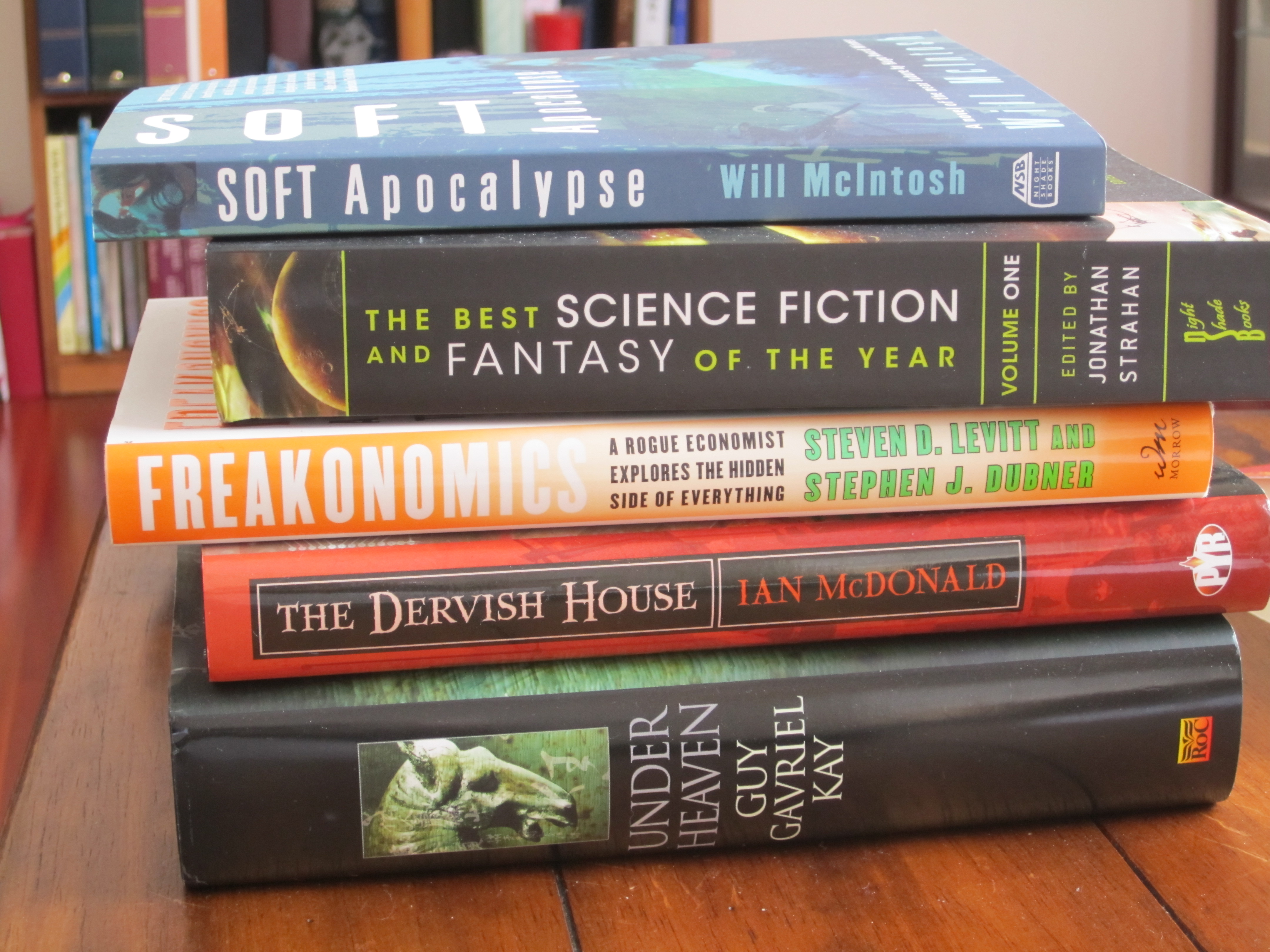
Yum, look at all this reading goodness.

I’ve been studying the publishing industry, and the indie publishing movement, with my trademark intensity for the past year or more. I have a lot of thoughts about it that I’ve been keeping, for the most part, to myself. But one of the key insights that I would like to share is this: Writing is a business.

It’s easy for us, when speaking about the arts, to entangle our emotions with our work. Which is as it should be. But in my experience, the farther apart we can keep our emotions from business, the better. I’m not saying we as artists and creators cannot or should not have emotions. But emotions can easily blind us towards making pragmatic business decisions (see the “practical” in my blog’s title).

Writing is a business. Every writer whose goal is to have a writing career is, in essence, running a small business. Whether she knows it (or wants it) or not. This seems obvious to me because I’ve just come off seven years of running my own small business in another arts-related field. But I’ve noticed that not all writers display this attitude, and it certainly wasn’t ever something I considered before becoming a small business owner.

Here’s the thing about starting and running your own small business: There is always risk involved. Always. Business is about calculated risk. There is always the chance that the business will fail. There is always the chance that your marketing campaign won’t work the way you hoped, even if you spent tons of time and money to make it happen. There’s the chance that the economy will take a downturn and shoot you in the foot. There’s the (terrible) chance that you won’t end up being any good at your business of choice.

It’s the same deal with writing. Even though writing doesn’t necessarily require a large outlay of financial capital, we’re putting ourselves on the line. Our work may not be popular. It may not attract the attention it needs to be successful. We may make it partway down the line, only to come to an abrupt halt. As in all businesses, there are many things that can go wrong.

Self-publishing carries this same risk. Because writing is a business. And maybe the material we self-publish will turn out to be really badly received. Or maybe no one will even notice it exists. Or, horror of horrors, maybe it will keep us from ever getting a traditional publishing deal if it turns out we made the wrong choice (or are playing it safe by pursuing both options at the same time).

As business people, our job is not to condemn without thought and research. Our job is to examine, as dispassionately as we are able, our different business options. Some of us will feel more comfortable doing this than others; some of us have a more entrepreneurial spirit, whereas some of us feel more comfortable taking an established path. There is no right answer here, folks. But after examining the current state of publishing, I believe that self publishing is a viable alternative (or a building block in a larger overall strategy) that should not be ignored.

Those of you following this debate on the internet have heard all about Amanda Hocking and J.A. Konrath, and now the big news this week is Barry Eisler turning down a $500k traditional publishing deal to self-publish instead. Yes, these are big names. No, not everyone who tries self-publishing will enjoy their degree of success. No, I don’t believe it’s a clear-cut decision about which path to pursue.

My point is this: Whichever path we choose as writers, there will always be risk involved. Anyone involved in the industry has heard a few choice horror stories about how traditional publishing has gone horribly awry. Self-publishing has its own unpleasant pitfalls. When we dive into either side of the industry, we don’t know how it’s going to go. When I started as a music teacher, I put up some ads on Craigslist. I didn’t know if anyone would answer them. My business could have been a bust before I even started. We experience the same thing in publishing, whether we send our manuscript out to agents or stick it up on Amazon and Smashwords.

Whatever path we choose, it won’t be easy. Self-publishing isn’t a shortcut; it requires a lot of hard work. Whatever path we choose, it won’t be fast. Craft takes the same time to develop, regardless, and while traditional publishing can take years even after you have a viable book (between finding an agent, finding a publisher, getting a release date, actually releasing the book, and performing all the necessary work between these steps), self publishing can take a long time too (between outsourcing various needs like editing and cover art, building a catalog of titles for sale, building a reputation as a writer, etc.) The key is to educate ourselves about the options (traditional publishing, self-publishing, the small presses, the e-editions only presses), look at the different risks involved, crunch some numbers, and then decide which option (or combination of options) makes the best sense for our business. While doing this, we need to keep in mind our business goals and our unique blend of strengths and weaknesses while making sure we consider both sides of a strategy (this means reading thoughts by people who are both for and against self-publishing, and the valuable neutrals if you can find them). Businesses in the same sector have different strategies, and that’s okay. Some will fail, which is sad but not out of the ordinary.

However, I can’t help but feel that innovation can be exciting as well as scary. I’m following the twists and turns of the publishing landscape with great interest, and I’m trying to avoid being overly critical of anyone. Because technology is changing the landscape, and we’re all a part of that, and we’re all trying to figure out what parts we can play in the change. Ultimately, we all love writing, and we all love books, and we all want to ensure that many wonderful books (in whatever format) are available to be loved and enjoyed. I see a lot of badmouthing on both sides of this issue, which is perhaps inevitable, but in the essentials, we’re all in this together. We merely have different visions of how to chart a course forward.

In the meantime, writers are experimenting. Some of them are combining traditional publishing releases with self-published short stories or novellas. Many are making their out-of-print backlists available. Some are turning their backs on large traditional deals, while others are accepting them with excitement. Personally, I’m glad that I get to be a writer in a time of experimentation, when the rules aren’t as cut and dried and innovation is more encouraged. While a small part of me wishes that there was One Right Way to get published, the truth is that there never has been; it’s just become more obvious.

Now it’s your turn. Please try to be civil, but tell me: what are your thoughts on today’s publishing world? How do you think self-publishing has changed the equation (or DO you think it’s changed)? What benefits do you anticipate receiving from your own business strategy? I eagerly await your opinions.

Read Full Post »

Last week I got some exciting news.

I’d been on an airplane for several hours, flying home from a very successful vacation. I was slightly brain-dead, and I’m sure my in-flight dinner of Pringles and peanut butter cups hadn’t helped matters. After having survived the little dog frenzy of homecoming, I settled by the fire to check my e-mail, happily procrastinating from unpacking my suitcase.

I clicked on one of my e-mails, read the first sentence, and screamed. Literally. I think my husband thought I’d seriously hurt myself, because he came running from the other room.

What did that e-mail say? It told me that I sold my first story! Daily Science Fiction wants to publish my story “Forever Sixteen”. Hooray!

(And no, I don’t know when it will come out, but I’m guessing it will be awhile. Stay tuned….)

I was feeling pretty good about myself, in an I’ve-spent-all-day-on-a-plane sort of way. And I felt even better when, the very next day, I found out that I’d received an Honorable Mention in the most recent quarter of the Writers of the Future contest.

(Taking my moment to bask, giggle, jump around the room, and basically celebrate!)

******
Okay, I’m back.

Now I’m going to share a bit of unproductive thinking that went along with this good news. When I found out about the sale, I was happily sharing my news on Twitter and Facebook, celebrating with the great people who have been supporting me. But, when I found out about the Honorable Mention the next day, after the requisite excitement, I turned to my husband and said, “I don’t know if I should tell anyone about this.” He asked me why not, and I continued, “Well, it’s just too soon after yesterday’s good news. Plus won’t it seem like I’m bragging if I say anything?” Then I paused, thought about what I’d just said, and cried, “Oh no! I just did that thing!”

Do you see that thing I did? I automatically wanted to downplay my success instead of sharing it. I worried about “bragging”, even though I would never think that of another writer posting the same news. Is this because I’m a woman who has been trained to be a team player and never toot my own horn? Is this because I’m a writer with the prerequisite insecurities so often found in my profession? Even after noticing my strange behavior, I still rationalized with a “Maybe I should say something on Twitter but not Facebook.” Because somehow that would make a difference? Hello, irrationality!

I’d love to say that this was an isolated case, but the truth is I see it all the time. Just this past weekend I was spending time with two lovely women writer friends of mine. Both of them have blogs. Both of them are active on Twitter and Facebook. But neither of them regularly post notifications of their new blog posts on Twitter or Facebook. This drives me crazy because I forget to read their blogs as a direct result.

I talked to one of them about it, and she said, “Oh, I don’t know if people would really be interested.” And that’s the clincher, right? I think most of us have moments of thinking the same sort of thoughts. Why would anyone care about what we have to say? Maybe it’s not a good idea after all to put ourselves out there.

Newsflash! People are following you because they’re interested in what you’re doing, and they’re interested in what you have to say. So if you don’t let them know about your newest blog post, you are shooting yourself in the foot. After all, they don’t have to click on the link you provide if they don’t feel like it. You’re not forcing them into anything. You’re just letting them know what’s available.

This ties directly into Sheryl Sandberg’s advice to women on the video I linked to earlier this week. Her first point? Sit at the table. What did she mean? That if we sideline ourselves, letting other people sit at the table while we hang off at the edges being self-effacing and shy, we aren’t giving ourselves the same chance at success. We aren’t giving ourselves the same respect that we give others. And if we don’t give ourselves that respect, then why will anyone else?

Sit at the table. I dare you.

Read Full Post »

I will be attending FOGcon this weekend in San Francisco, and I’ll be moderating two panels. Please feel free to find me and say hello!

Here is my schedule:

No-Blah Blog: Friday, 4:30-5:45pm, California Room

In 2011, many authors are not just writing stories, novels and articles. They’re blogging. How do you create a blog readers will want to return to again and again without sacrificing your other writing projects?

Why London? Saturday, 8-9:15pm, California Room

What is it about England’s capital that inspires so many stories positing the existence of a second, evil twin city? Maybe it’s that there’s enough history there for two separate cities. Or that there’s enough ghosts that a second, spectral city is the only answer to affordable housing. Whatever the reason, London keeps authors coming back to build: above, below, instead and sometimes in ways we really don’t have prepositions for. But why?

My husband will also be moderating an awesome world-building panel (How to Build Your Own City: the Past) at 8pm on Friday night in the Redwood Room, after which I might very well get my karaoke on in Gold Rush A. Unless I run in fear in the other direction after hearing a particularly ear-splitting yodel. I’d say the chances are about 50/50.

Hope to see you there!

Read Full Post »

If I become a successful writer someday, will you like me less? According to this TED talk, the answer might be yes. Sheryl Sandberg, the COO of Facebook, talks about the negative correlation between power and likeability in women (whereas for men, power and likeability are more likely to go hand in hand). She cites a study in which two managers are presented, in which the only differences (literally) between the two are their names (Heidi and Howard). The results? While both were ranked as being equally competent at their jobs (which is some good news, at least), Howard was seen as being a great guy to work with whereas Heidi was seen as being too much out for herself, with many more reservations about working with her. The same person, described with the same language. Chilling, isn’t it?

Luckily women in the writing profession don’t face the same endemic problems as those trying to rise to the “C” level of corporations (CEO, COO, CTO, etc.). But I began to think about how this might affect female characters in the stories I write.

I use a lot of female protagonists in my work partly because I think that historically, there haven’t been enough of them in the speculative field (particularly science fiction). Hopefully things have gotten better in this regard (although I haven’t done any formal surveys for protagonist gender in recent short fiction), but I enjoy writing female characters in any case. Now I can’t help but wonder, though, whether some of these characters will be less liked and less sympathetic than their male counterparts if they’re put into positions of power.

Sometimes I’m able to sidestep this problem completely because I write a lot of teenage female protagonists who inherently lack power because of their young ages. But if I write a female president, will her anger read justified, or will it read like a mood swing? Will a discontented female read frustrated or merely whiny? And how much of this will be because of my mistakes in characterization vs. our society’s preconceptions about women in power?

It’s also easy, as a writer, to fall into one way of showing gender. For instance, I have a couple of stories about relationships in which it’s fairly obvious that the man has most of the power over the woman, and I show the women grappling with (and possibly overcoming) this imbalance. But being that I’m a science fiction writer who gets to write about the future, I don’t want to limit myself to portraying women who find ways to empower themselves while starting out unequal. What about the women who start out confident and in power, who can take over the traditional “hero” role in a story? What about the women who take for granted that they can be both powerful and likeable in a changed future society? I certainly don’t want to forget about showing those women characters.

What has your experience been as a reader or a writer? Do you find women characters in power to be sympathetic? How much do you think our society’s bias against this is reflected in our current literature?

Read Full Post »

I have noticed a lot of confusion in the speculative community about the difference between Young Adult (YA) fiction and Middle Grade (MG) fiction. Indeed, some people seem unaware that there is a difference, a problem with which I sympathize, since I had no idea about this myself until a few years ago. So I am going to attempt to explain the difference, and I’m counting on my Kidlit colleagues to correct me where I go wrong (or expand, as the case may be). 

Middle Grade:

Age: These novels are targeted at readers aged 8-12. The protagonists are often (but not always) aged 8-14. (Kids tend to read up. So do teens.)
Word count: The word count tends to run 25-40k for a completed novel.
Conflict: Characters are learning how they fit into their own world. At the same time, the conflict is more likely to be focused on the external (ie our Hero is trying to save the world or save the day).
Edge factor: No sex, no drugs, no swearing. Usually not much romance at all, although there are often boy-girl friendships with hints that it may become romantic someday in the future, and/or “crushes” that don’t lead to serious, deep relationships.
Action: MG novels tend to be more action-packed, with tighter writing, faster pacing, and less time for reflection and/or angst. That doesn’t mean that well-drawn characters aren’t important in MG, just that the focus is different.
Themes: often focusing on the protagonist’s family, friends, and community. Can deal with puberty changes. Often wide in scope (the protagonist as Hero).

Young Adult:

Age: These novels are targeted at readers aged 12 and up. The protagonists are often (but not always) 15-18 (due to the reading-up phenomenon mentioned earlier).
Word count: The word count tends to run 45-80k, and longer if it is a speculative fiction YA (then 90-100k is not uncommon, and sometimes you see books running in the 120k range).
Conflict: Characters are confronting adult problems, often for the first time (coming of age, etc.).The conflict is more likely to focus on the internal (although this by no means excludes external plot as well, particularly in speculative YA).
Edge factor: Writers can get away with a lot more edge in YA, although sometimes these books will be recommended for ages 14 and up, instead of age 12. Also romance plays a much larger role in many of these books, as either the main plot or an important subplot. (This is possibly because so much of the YA market is currently focused on a female audience.)
Action: It depends on the book, but with more focus on the internal and subtle character nuances, YA novels are often less action-packed than their MG cousins (although not always). Keep in mind, too, that YA novels can easily be two to three times longer than MG novels, so the action is often more spread out.
Themes: often focusing on the protagonist growing up and becoming an adult. Often shows a teen’s relationship with society (hence why YA dystopia is an easy fit). Can still be epic in scope, but is more likely to spend more time dealing with the teen’s internal life.

Examples: (WARNING: SPOILERS AHEAD)

Harry Potter series (J.K. Rowling) – in my opinion, the first three books (maybe four) are clearly MG, and then it gets a bit more murky as the series gets darker in tone and spends more time focused on Harry’s inner life.  People enjoy arguing about the classification of this series.

Twilight (Stefenie Meyer) – classic YA. Bella is 17 years old when the first book begins. The book’s main plot is a romance, it’s more internally focused, Bella is dealing with growing up; by the end, she’s married with a baby.

Hunger Games (Suzanne Collins) – YA. Katniss is 17 (I think?) at the beginning of the first book. While this book has a lot of action, its focus is on Katniss’s inner journey just as much as her outer one. It begins when Katniss performs an act of sacrifice and takes on an adult role, and follows her struggles to perform that role. Also has a strong romantic subplot.

Charlie and the Chocolate Factory (Roald Dahl) – MG. Charlie is younger, and his family relationships are of crucial importance to him (and not in a breaking away from the family as he grows up kind of way). Lots of cool stuff happens in this book, and at the end Charlie is the Hero, the winner of Willy Wonka’s challenge. Has a more external focus.

Charmed Life (Diana Wynne Jones) – MG. Again, a lot of focus on Cat’s relationships with his family (Gwendolyn) and his surrogate family. Lots of cool stuff and action happens. Cat gets to save the world, something he didn’t know he was capable of doing. Has a more external focus.

13 Reasons Why (Jay Asher) – YA. A lot of focus on intricate social relationships as framed by high school. Talks frankly about suicide, sex, rape. Shows a coming-of-age that fails, and how that failure shapes the coming-of-age of a classmate.

All right, now it’s your turn to chime in. What did I get wrong? Do you have other examples of YA  or MG books? What exceptions can you think of?

Read Full Post »

– People should travel around the world to learn more about both themselves and other cultures.
– People shouldn’t waste their time and money traveling abroad when you can learn everything that’s really important about life in your own backyard. 

– People shouldn’t write more than one book a year because the quality of their writing will suffer if they try to do more.
– People who don’t write at least two books a year don’t have a strong work ethic.

– People shouldn’t have children because studies prove that parents are less happier than people without children.
– Everybody should have children because passing on your genes and knowledge to the next generation is the most important and fulfilling work there is.

– All authors should aspire to be offered a traditional publishing contract because that is the only established way of both distributing your work and filtering for quality.
– All authors should consider going indie because not only is the market tightening, but the contract terms from big publishers are becoming less and less favorable to new (and some mid-list) writers.

– Moms shouldn’t work because you don’t want strangers raising your children.
– Moms shouldn’t stay at home because women shouldn’t give up rewarding careers and fail to reach their full potential.

Remember that just because something is true for you does not mean it’s equally true for someone else. We all live in this world together, but we’re all individuals, each with our own point of view.

Read Full Post »

You may not be surprised to learn that I think a lot about blogging, both in terms of this blog and in terms of best practices. As a consequence, I also tend to read a lot about blogging, although it has become harder and harder to find new material, the more I learn. However, I read a post a few weeks ago that made me stop in my tracks and hit myself on the forehead.Kristen Lamb is another one of my favorite bloggers – she had a killer series on novel structure that I looked forward to every week while it was running – and she also blogs about blogging. In her essay “Selling Our Blog to the Readers,” she talked about a common pitfall, one that I had done myself. Argh! Hence the forehead hit, and I immediately changed my blog per her suggestion.

What was my mistake? On my header, beneath my main title (where it now says “Amy Sundberg’s Blog), I had the text “Amy Sundberg’s Adventures and Ramblings”. Kirsten very rightly points out that we tell our readers how to judge our blogs, and “ramblings” is not a word that holds the most positive of connotations. It makes it sound as if we don’t know what we’re talking about, or as if we haven’t put any thought into what our blogs are about. Now, for some bloggers, that might even be true, but I put a lot of thought into this blog and here I was, accidentally waving my hands around and saying, “Oh, but it’s just something I threw together on the fly, it’s not worth much at all.” Oops.

I wasn’t going to say anything about here, in the hopes that maybe no one had noticed. But then, in the last few weeks, I noticed something very insidious. These sorts of words pop up ALL THE TIME in relation to blogs, and now that I’m paying attention, it’s driving me slightly crazy. Apparently I got the idea in the first place through some kind of evil osmosis of the internet. Plus the use of these words doesn’t even seem to directly correlate with the overall quality of the blog, meaning they aren’t actually a clear signal for whether I want to read the blog or not.

Here is a list of some of the words that now send up my red flag: ramblings, musings, random thoughts, random anything, reflections, ponderings. It’s not that bloggers should never use these words, but if they’re in either the header text for the whole blog or in a blog post title, it’s generally a sign of either lack of focus, lack of confidence, or both. More research made me realize that I don’t care how much I like a particular blogger, most posts with the title “Random Musings” or similar are just not going to grab me. I might go for a round-up of links, if I really like a blogger’s taste in such matters, but other than that, well, I read Facebook and Twitter for my dose of daily random thoughts. I probably don’t need to read a whole blog post of them, given how much reading I do in the average day.

A big thanks to Kristen for setting me straight on this. From now on, I’m going to be doing my very best to avoid “ramblings” and its cousins and not sell myself, and this blog, short.

Can you think of any other red flag words we bloggers should work to avoid?

Read Full Post »

Lightspeed, December 2010

As we descend into award season for the speculative fiction community, I would like to bring to your attention the wonderful new science fiction magazine Lightspeed and its editor, John Joseph Adams.1

Lightspeed began its publication last June and released seven issues in 2010. Every issue features two original stories and two reprints, as well as several nonfiction pieces that often (although not always) connect to the stories. It’s available on-line (for free) or as an e-edition, purchasable as either a subscription or on an issue-by-issue basis.

I’ve been deeply impressed by the quality of the stories published at Lightspeed, and I’m not the only one. Out of the 16 original stories published in Lightspeed in 2010, a full 50% of them have been selected for Year’s Best Anthologies. I’ll repeat that: FIFTY PERCENT.

In line with what I spoke about yesterday, John Joseph Adams seems to select the risky stories, the stories that say something, the subversive or vaguely disturbing stories, the interesting, mind-bending stories. Happily for me, the stories I want to read most.

So first of all, if you haven’t already, I encourage you to check out the magazine for yourself. You might also wish to consider nominating Lightspeed in the Best Semiprozine category for the Hugos, or its editor John Joseph Adams for Best Editor, Short Form. (He also had some anthologies out in 2010, including The Way of the Wizard and The Living Dead 2.)

Any other semiprozine or editor you think should be considered for this year’s Hugos? Let me know below!

1 Disclaimer: Yes, I know John in Real LifeTM.

Read Full Post »

« Newer Posts - Older Posts »