Feeds:
Posts
Comments

Archive for the ‘Writing’ Category

At this time of year, I always feel like I’m straddling the flow of time. Half of myself is looking backwards and evaluating what has gone on before, while the other half is looking forward to what the next year may hold for me. I don’t make New Year’s resolutions per say because I prefer a continuous evaluation process, but thinking in terms of units of time can be helpful when trying to look at the bigger picture of my life.

So, without further ado, here are a few reflections on 2011 and few wishes for the year to come.

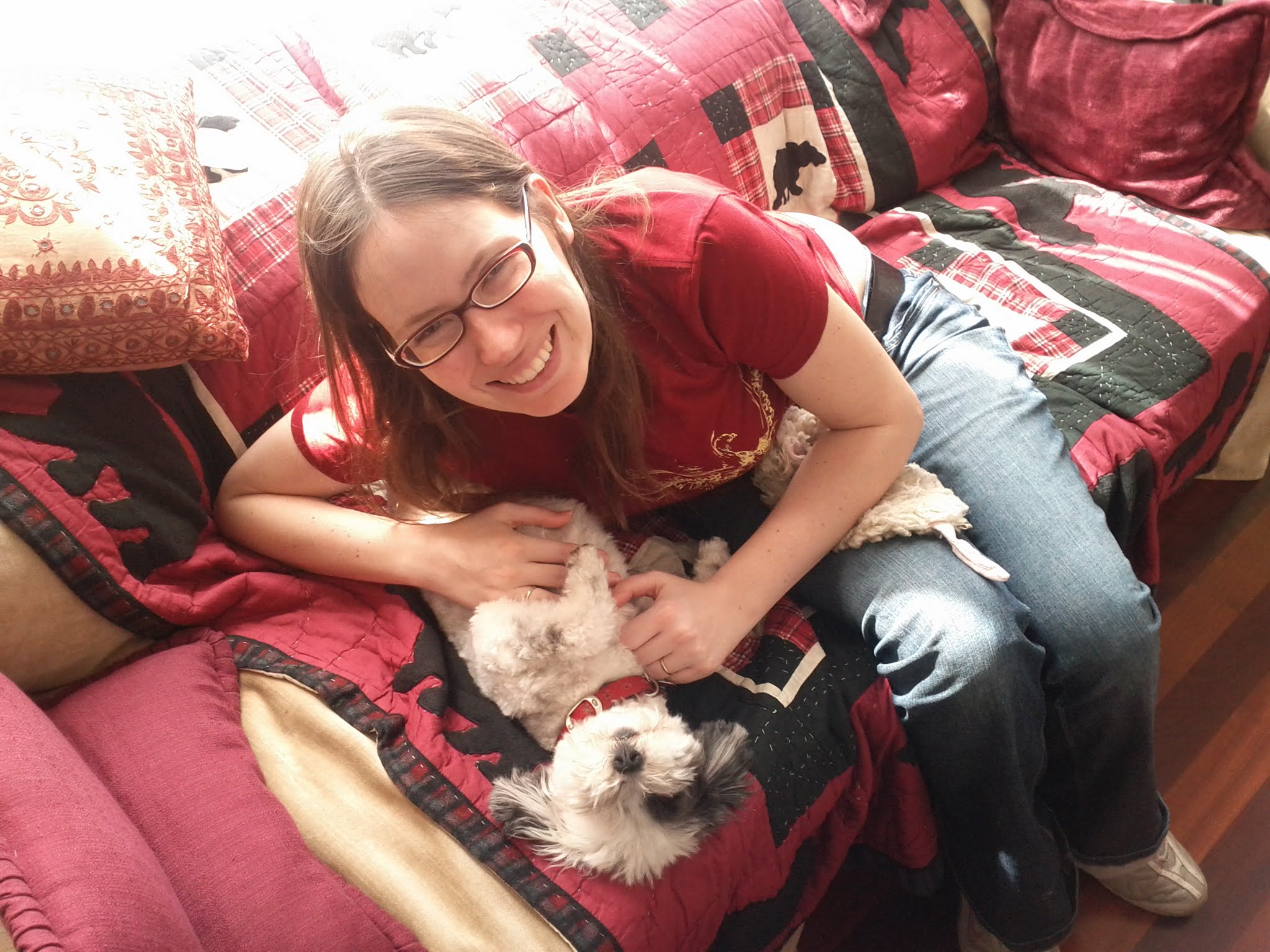
Cute little Nala and me

Writing:

2011 was an exciting year because it was the first year I had something published, thus realizing a dream I have cherished since I was seven years old. Hooray! In fact, I had three short stories published this year, one of them to a pro market. I was also able to join SFWA as an associate member.

My wish for 2012 is that I am able to use the lessons I learned this year to increase both my productivity and my enjoyment in writing. (Being greedy, I also wish for more sales.)

Health:

The first half of 2011 was dominated by crazy dental problems. While that silly crown still often aches, the level of pain has subsided to the realms of the tolerable. I also had more ankle problems. But on the plus side, my knees continued to improve in a most pleasing fashion. I also began to eat more healthily, trying to limit my consumption of saturated fats in particular, and have done fairly well with it (although not when traveling. Eating healthily when traveling is ridiculously hard).

My wish for 2012 is to keep growing stronger so I have less overall aches and pains, and to continue following my moderate diet.

Travel:

2011 was the first year in a long time that I didn’t leave the country. Various health concerns dampened my travel ambition somewhat, and I mostly stayed close to home. My favorite trip of the year was my first time in Washington D.C. in March. I would definitely return there for a follow-up visit someday. We also attended the Shakespeare Festival in Ashland, Oregon, visited Disneyland with friends, and relaxed over Thanksgiving at our favorite Maui vacation spot.

I was able to attend five writing conferences and conventions, two local and three an easy traveling distance: Potlatch, FogCon, SCBWI LA, WorldCon, and World Fantasy. I particularly enjoyed attending the inaugural FogCon and moderating my first two panels, and catching up with my wonderful writer friends (and making new ones) at the larger conventions was fabulous as usual.

My wish for 2012 is to leave the United States. We’re thinking either Japan or certain favorite Western European locations…

Personal Growth:

I wrote about the two most important lessons I’ve learned this year last week. I feel like I’ve made a fair amount of progress on the people pleaser front and have developed a stronger backbone. I’m more likely to stand up for myself and less likely to take responsibility for everyone else. So, yay!

My wish for 2012 is to continue tackling my vicious perfectionist streak and to do further work towards trusting myself and my abilities. I’d also like to be able to reach out more to other people.

Happy upcoming New Year, dear readers! What are your wishes for 2012?


Read Full Post »

I love the end of the year. Not only do I adore Christmas (it is my favorite holiday), but I like that it’s cold and it gets dark early, both of which encourage me to snuggle up indoors and reflect upon the year that is coming to a close. I plan to spend a lot of time in the next two weeks doing just that, and this week I’m going to write about the two lessons I learned this year that were most helpful to me.

I’ve been struggling with my writing for most of the year–not, thank goodness, with my nonfiction writing, so the blog hasn’t suffered unduly, but with my fiction. I have spent A LOT of time thinking about why I’m struggling and trying various strategies to make the writing work better for me. Most of those strategies failed. But in the last few weeks, I’ve finally found one that feels right.

I was reading snippets from Ray Bradbury’s Zen in the Art of Writing when I had my Aha! moment. He gives this three-fold advice to writers: Work, relax, and don’t think. Work I felt I understood, so I began turning around the other two steps in my head. What would it look like if I relaxed while I was writing? What would it be like to stop thinking so frantically? What if I stopped trying to avoid all the objectionable components of writing, stopped being obsessed with not making any of the obvious and embarrassing mistakes? What would happen if I gave myself permission to write what I wanted to write? In short, what would happen if I trusted myself as a writer and gave myself free rein?

Photo by Paul Moody

I am cerebral sort of person, so it’s difficult for me to even imagine not thinking, but I’m also stubborn and I was determined to give it a try. I sat down and spent the next week and a half writing a short story without censoring myself. I looked forward to working on it, and the words came more easily. I even voluntarily worked on it on the weekend. Here was the joy I had somehow misplaced for so much of the year. When I finished it, I felt a sense of completion. Whether or not I had written something good, I had written something I felt connected to and could take satisfaction from.

I gave the story to my husband, my faithful first reader, without telling him I had been trying anything different. When he finished reading, he told me it was the best thing I’ve ever written.

In creative work, I think it’s important to strive. I believe in working to learn and improve, in tackling difficult themes and uncooperative characters, in experimenting to learn your craft (whatever it might be) to the best of your abilities. But what I didn’t realize until now is that there is a point when I have to let go. I have to trust that my writing knowledge will be there for me. I have to stop second-guessing every decision I make. I have to believe in my vision and voice as an artist.

And it turns out, I do have my own voice. It’s been there all this time, waiting for me to be willing to listen.

Relax. Don’t think. Trust yourself.

What lessons pertaining to your work, artistic or otherwise, did you learn this year?

Read Full Post »

A friend of mine wrote me awhile back and asked me if I could write a post about resources for the YA writer. I’ll admit, I was stymied. In spite of the fact that I began writing in the YA genre, and as such it is my first true literary love, I realized I didn’t know nearly the number of resources that I could spout if he had asked the same question about speculative fiction. There is SCBWI, of course, the teenlitauthors yahoo group (although it tends to get a bit bogged down with congratulations and personal news), and Vera Kay’s Blueboards (where I’ve rarely been active). I’m sure there must be how-to-do-it books on YA (mustn’t there?), but I’ve never read them. Likewise, there must be various relevant blogs, but the few truly YA-focused ones I used to read are rarely if ever updated anymore.

Meanwhile, YA continues to be hot, hot, hot, even while agents and editors are cautioning writers that there is a glut of YA, and maybe writing some quality MG wouldn’t be a bad idea right around now. They say this at conferences, in any case, but I’m still hearing stories of agents recommending that their actual clients write YA, even if they’ve gotten their start in writing for adults. (Which incidentally tends to make me cringe. I understand intellectually that there is more money for fiction writers in YA, and the sales might be easier to make due to the aforementioned hotness, so it makes sense from a business perspective. But I’d like to think there’s more to writing YA than just good business sense; that it’s the end result of receiving a calling, of having some kind of affinity to teenagers, of what kind of stories a writer deeply desires to tell. I’m not saying a writer can’t write both YA and adult fiction–I do that myself. I just want it to be a case of good business uniting with a true interest in writing for teens. But I digress.)

I could write another whole post on the differences between the speculative and YA communities from where I sit (and maybe I will), but the fact remains that I don’t have a treasure trove of resources to share. Instead I will give three pieces of advice (which you can take or leave), advice that unfortunately does not offer any shortcuts but has helped me learn more about YA in the last three years than anything else.

READ YA. Read a lot of it. Read MODERN YA written and published in the last ten or so years (at least some of which has been published in the last three years) so you know what’s going on now instead of what was going on when you were a kid (trust me, unless you’re close to being a teenager yourself, it is different now). Read some MG (Middle grade) so that you understand the difference through examples instead of relying only on my handy-dandy list. Read different genres of YA; you might only be interested in writing science fiction YA, but read at least a few paranormal, fantasy, and contemporary novels as well. Read a few of the really “girly” book series so you know what’s going on there. Read the blockbusters of the field. I don’t care if you don’t like Twilight; if you want to write YA, you should read it anyway (at least the first one) so you can understand what about it tapped into the zeitgeist of the time and understand the ripples it generated (and still generates). Likewise, you should read The Hunger Games, and even though much of it is MG (in my opinion), you should read at least some of the Harry Potter books. Then go read some obscure titles no one has heard of.

STEEP YOURSELF IN TEEN-NESS. If you haven’t spent any in-person time with teens since you were a teenager yourself, it’s time to change that. I don’t care how–you can hang out with a family member, volunteer, teach a class, offer to mentor a teen writer. If all else fails, you can scout out where the local teens hang out after school, go there, and shamelessly eavesdrop. You can watch TV shows and movies targeted at teens (just NOT during your writing time, please): Buffy the Vampire Slayer is old school but still helpful, and lately I’ve been spending time watching Veronica Mars, Glee, The Vampire Diaries, and Gossip Girl (and I’m sure there are others). I don’t watch these shows thinking they are necessarily a realistic representation of teenage life, but to watch for more widespread trends: how do relationships/hook-ups work now? how do teens use technology? what are the latest fashion trends and the current slang? how do the characters speak to each other? what issues tap into today’s teen experience that might be a little different from your own teenage years? Sure, if you’re writing a far future dystopic novel, today’s slang might not be so relevant, but it’s still important to try to understand how your readers see themselves now.

REMEMBER WHAT IT WAS LIKE. Not just the clichés, and not from a superior, “now I’m a wise and mature adult” perspective. How can you understand as deeply if you’re looking down at someone? No, exercise that empathy muscle and try to remember how you actually felt: the frustration of not having complete power over your life, even if you were spending a lot of time watching adults royally screw up; the surging hormones and confusion when trying to deal with lust and affairs of the heart; the uncertainty of not knowing exactly who you were and how you fit into the larger world (or perhaps bending self perception of who you were to fit into a fantasy); the endemic unfairness; the world-crushing importance of everything going on in your life; the huge milestones bearing down on you, one after another (and whether you looked on them with excitement, horror, or a co-mingling of the two). And then remember that all of the above plays out differently for different people, both in terms of which ones are relevant to each person and what’s going on inside versus the show they’re putting on for the outside.

That’s all I’ve got. If you know of any YA resources I didn’t mention, please give them a shout-out below. Also, if you think all a modern YA writer needs to read is the juvenile Heinlein oeuvre, tell me that too because then we can have a truly epic argument.

Read Full Post »

When we think about social media, it is important to remember how much the internet, and the ways we interact with it, are evolving. The rate of change is fairly rapid, and because of this, it is easy for conventional wisdom regarding best practices to fall behind.

Think about it: the internet is still fairly new. Some of us might have trouble imagining life without it, and yet the first commercial service providers didn’t start up until the late 1980s, just a bit more than twenty years ago. Google got started in 1996-1997 (about 15 years ago); Livejournal began in 1999 (12 years ago); MySpace was founded in 2003 (about 8 years ago); and Facebook launched in 2004 (7 years ago). All of these services took time to develop and find their audiences. So even experts in social media haven’t been doing it for very long, because not long ago, nothing existed to do.

What this means is that there’s still a lot of space for experimenting, being creative, and developing your own unique way of using social media. Take, for example, the author Tobias Buckell. A year ago, contrary to all advice, he decided to shut down the comments on his blog. Experts told him that this was crazy talk, that he needed to enable comments on his blog to encourage conversation and engagement with his audience. Some people went as far as to say that without comments, it wasn’t even a real blog any longer. But Tobias was feeling drained from all the time and energy he had to spend moderating the comments, and he was censoring what he allowed himself to talk about as a result.

He recently published the results of his experiment: he went from 20,000 unique visitors/month when he shut off comments to 100,000 unique visitors/month a year later, which is the highest traffic he’s had in the seven years he’s run the blog. And he sounds happier because of it too, saying: “It’s really been a lot more fun since I starting letting myself be myself.”

So obviously the conventional wisdom that a blog has to have a commenting option, and that you can judge a blog’s impact and degree of engagement by looking at how many comments are being made on it, is flat-out wrong in this case. Yes, the experts were wrong. Would the no-comments approach work for everyone? No, probably not. But apparently it’s not the deal breaker everyone thought it was.

When considering my own use of social media, I find this distinctly comforting. It’s human to hit a wall sometimes. I’m sure many of us have a social media tactic that we’re “supposed to do” but makes us cringe. I’ll tell you mine, although maybe you can already guess. I’m supposed to write blog posts that are less complete and leave more room for all of you to respond. (And I love it when you respond, really I do.) But right now, it’s hard for me to even consider being less than complete–the thought makes my inner perfectionist rear up and ululate in horror. I imagine a blogging horror story in which I deliberately delete something I really wanted to say in order to leave it for someone else to say, and then…NO ONE SAYS IT.

An example of ululation.

I know, I know, clearly I have my work cut out for me. In the meantime, it’s reassuring to think that I am sometimes allowed to experiment with a more essayist approach to blogging, even while I’m trying to improve my conversationalist style of blogging. And I hope you find it reassuring to know that if you can’t juggle five different social media platforms all at once, the world won’t end. And if you just don’t “get” one of the popular services, you can maybe just skip that one or do something completely different from the norm when you use it.

So, time to dish. I told you my social media cringe-point; what’s yours? Is there a service that you just can’t get into? Is there common advice that makes you want to throw your laptop across the room? Is there something that, if you allowed yourself not to do it, would make you enjoy social media more or allow you to be more authentic to yourself? Let loose below.

Read Full Post »

I’ve recently stumbled over a conversation in SF circles about the dearth of positive written science fiction, in spite of the demand for such stories from readers. Not that this is a brand new conversation in the genre; while attending my first Worldcon in Montreal back in 2009, I met Jetse de Vries, who was in the process of pitching the idea of his anthology of near-future optimistic science fiction stories.

I don’t seek to disagree with the argument in favor of positive stories but instead to offer a more nuanced view. I think there is plenty of room within science fiction for optimism and stories of a basically positive nature. I also emphatically agree that the demand for such stories is high; we have but to look at Analog, which has the highest circulation numbers of the Big 3 science fiction magazines and the most prominent focus on more upbeat endings for stories, to see the popularity of positivity. And if we take a peek at novel-length science fiction, we see many of the genre’s favorite writers who take a generally positive tone (or at the very least, not excessively bleak): Connie Willis, Lois McMaster Bujold, and John Scalzi come to mind, as do Charles Stross and Robert Sawyer, all authors who have been nominated for Hugos in the novel category in recent years. Indeed, my husband and I have often wondered if the recent upsurge of the steampunk subgenre is related to a general desire for nostalgia and shiny adventure stories decked out with amazing flashing gadgets and mad science.

On the other hand, I would be disappointed to see the hunger for positive stories lead to less ambiguity in modern science fiction and fantasy. Bryan Thomas Schmidt says he misses old-fashioned stories “where good people fought for good causes and came out ahead, making for a better world.” He argues that the wildly popular Song of Ice and Fire books by George RR Martin are gritty but feature “admirable heroes who fight against evil for good.” Perhaps it’s been too long since I’ve read these books, but I don’t remember any admirable heroes–what I remember are flawed human beings who make a lot of mistakes and get caught up in the throes of power in various interesting ways. While some characters are worse than others and there are exceptions (Jon Snow comes to mind as being more noble than most of the characters, and also one of my least favorite, although as I’ve said, it’s been a while), the reason I enjoy those books is because of the ambiguity, not the noble heroes…an ambiguity that equates more with how I view our own world. In fact, I have a problem reading many fantasy novels that have the obviously good guys (constructed of cardboard) fighting the obviously evil forces of darkness (made of a lesser grade of cardboard). I don’t object to novels where good people win in the end, but paint the villain too evil or the hero too saintly and good and the story loses a lot of its tension for me.

Meanwhile, my colleague Brad Torgersen states, “Yet a good deal of written sci-fi adores the “downer” ending, the anti-hero, the morally ambiguous and ultimately meaningless stories…” While you all know I love a good comfort read, I don’t find all science fiction that isn’t optimistic and upbeat to be meaningless, and I think describing dystopias and darker science fiction in such terms is doing the genre a disservice. Sometimes people fail. Sometimes moral questions have more than one answer depending on a person’s point of view. Sometimes downer endings and ambiguous stories show us more about ourselves and what we hold to be important.

Speaking as a reader, I didn’t discover science fiction through the optimistic Golden Age of science fiction. I didn’t read Asimov’s short story gems or Heinlein’s romping juveniles as an adolescent. My gateway drug, at age 11 or 12, was Ender’s Game, by Orson Scott Card, a novel I would not classify as particularly lighthearted. Sure, we get the fun zero-G and gaming bits, but we also get a faceful of child brutality, emotional isolation, and the morality of war and genocide (or xenocide, in this case). We follow our protagonist into dark places, and ultimately it is his nearness to perfection that damns him. I fell in love with science fiction not because of its ability to uplift (although nothing to sneer at) but because of its penchant for dealing with difficult questions of humanity.

Granted, Ender’s Game does end on a hopeful note. I find that overall, I prefer reading novels that do have some sort of hopeful or positive note at the end (although there are exceptions, 1984 being the first to come to mind). I don’t need a crystal-clear happy ending, mind you; I enjoy goals achieved but at a high price, or goals achieved that the protagonist then realizes weren’t what she wanted. I enjoy the bittersweet. But I do like some kind of positive salve to end with. Short stories, though, are a different beast altogether for me. They can end in an extremely dark place, they can devastate me and make me cry, and often I’ll like them better for it. I don’t tend to feel despair from a sad ending as much as I feel empathy and an increased understanding of the more painful aspects of being human. The more positive, romping short stories often (although again, not always) lose my interest as they don’t always seem to be about anything in particular, and they more often fail to make me think about things in a different way.

So my complaint of some positive stories is that they are not sufficiently challenging to satisfy me, while my colleagues’ complaint of some dark stories is that they’re depressing and overly pessimistic. All of this makes me suspect that the problem may not be nihilism so much as differing tastes of the reader. Some readers like happy stories; some readers like dark stories. Some readers like a nice variety. Readers will be depressed by different things, readers are looking for different experiences, and readers find meaning filtered through their own perspectives. Perhaps we have an imbalance of dark short sf fiction (in novel-length, I’m not seeing it as much), and if more writers begin to explore optimistic ideas in short form, I won’t be sad. But I’m also very glad there’s a place for experimenting with darkness, exploring the ugly parts of humanity, and shining a light onto those things we most fear.

Your turn to weigh in! Would you like to see more positive science fiction stories? What are your reading preferences (or writing preferences, for that matter)? Anything you’d like to add?

Read Full Post »

I’m freshly back from the World Fantasy Convention in San Diego, where, as expected, I had a lot of conversations about writing. And even some conversations about writing YA (aka teen fiction). At one point, I said, “One of the most critical things in a YA novel is to get the voice right.” And my friend said something to the effect of, “Oh, I’m pretty sure I got it right. My protag is a whiny teenager.” The conversation quickly moved on to other subjects.
However, this reminded me about one of my pet peeves regarding would-be writers of YA. Why is it that so many of them assume that all (or even most) teens are so easily characterized as consistently whiny? And inevitably, if they’re not whiny, they must be snarky. Or ideally both whiny AND snarky.

Why, if these writers have such a low opinion and one-dimensional idea of teenagers as whiny butts, are they writing teen characters for a teen audience? Why? Please explain, because I fail to understand how this would be fun for either the writer or their prospective readers.

Yes, teenagers can be whiny. Some teenagers whine a lot. But you know what? Sometimes adults whine a lot too. Believe me, I’ve listened to them. Sometimes even I whine more than I should. But some teenagers rarely if ever whine, and some teenagers only whine sometimes, and some teenagers whine mostly to their parents. So if you want to write a teenage character who happens to be a very whiny person, fine, but that doesn’t mean you’ve nailed the elusive teen voice. If anything, it means that you’re going to have to be careful that your character doesn’t become really annoying to your readers. Because guess what? Teenagers can be annoyed by whining too.

As for snark, well, I like it as well as the next person. It’s entertaining, it’s funny, and a snarky character can be very engaging and likeable. But not all teenage characters have to be snarky. Depending on their backgrounds, their environments, and the stories you want to tell about them, it might even be impossible for them to be snarky. And adding more snark is not necessarily the way to go either (a lesson I have learned the hard way). Too much snark and a character might just be plain mean. Not to say that you can’t have mean characters, but you want to write a character mean because you’ve decided they’re going to be mean right then, not accidentally because you’re piling on the snark in an effort to be funny or edgy or have “an authentic teen voice.”

Perhaps these terms are mere shorthands that we fall back upon when trying to communicate about our writing. But I’d encourage writers who are trying their hands at YA (and more and more of them are, given its hotness in the book marketplace) to develop a more nuanced view of the teenagers they are writing for and about. I’ve worked with a lot of teens over the years, and you know what? Some of them are super sarcastic, or complain a lot, or are scattered and irresponsible. And some of them are brilliant and talented and working really hard and rising to the challenge of coping with difficult circumstances. All teenagers have some combination of positive traits and drawbacks, just as all adults do. But when they think about themselves, do you think the first word that pops into their heads is “whiny?” I doubt it, but perhaps they would be justified if the first word they think about adults is “condescending.”

Our job as YA writers is not to condescend but to understand. And in my mind, that’s a very big difference.

Disagree with me in the comments, or chime in and tell me that I’m not the only writer who thinks this way.

Read Full Post »

Some of my favorite novels are ones in which nothing much happens. That’s not to say that nothing at all happens, or that the stakes aren’t sometimes raised, but the story unfolds in a leisurely, unrushed sort of way, allowing me to feel like I’m really getting to know the characters and being allowed to inhabit their lives. In fact, I’m so fascinated by the characters and the setting, I feel wrapped up in a different world and don’t feel the slightest bit bored.

My favorite example of this kind of writing is (no surprise here) Anne of Green Gables and sequels, in which we basically get a window into the life of Anne Shirley and get to watch her grow up. She has victories and struggles, sadness and happiness, and a penchant for getting into scrapes, but there are no real antagonists or villains, no sweeping natural disasters, no explosions. There is the occasional gentle mystery, but that’s about it. I find reading these books to be profoundly restful.

Other examples include the Betsy-Tacy books by Maud Hart Lovelace and much of Jane Austen’s oeuvre, Little Women and even Jane Eyre. I wonder if Ishiguro’s The Remains of the Day could also fall in this category; indeed, perhaps that is part of the reason why I love it so much. Dramatic events happen but there’s plenty of time for the build-up to them and ample space to discuss social events, meals, and daily life.

These books are in stark contrast to the plot-driven fast-paced novel that is currently in vogue (at least in my part of the literary world). Cut cut cut, the advice for writers says. Every scene has to move the plot forward. Commercial fiction needs an antagonist, or maybe even a series of antagonists that lead up to the final Big Boss. I can read a screenwriting manual like Save the Cat! and find it completely relevant to novel-writing because so many novels feel at least somewhat like long-form movies, except instead of fancy cinematography they have ripples of beautifully garlanded prose. Meanwhile, these slow-paced books I’m talking about? They’re made into mini-series and too many versions of artsy costume films.

I want more of these books I love. I want to read books that have a plot but aren’t raising the stakes every five minutes. I want to read books that don’t have predictable plot twists because there aren’t so many plot twists to fit in, and that don’t have cliffhangers at each chapter ending because they are relying on enchantment rather than adrenaline to keep you reading. I want to read books that, while they don’t go off on hundred-page-long tangents like Hermann Melville is famous for doing, meander a little bit on their way to the ending. I want comfort food books in which nothing too awful happens, or at least, not too terribly often. I want more Agatha Christie novels in which, inevitably, justice is served in the end, and even in the face of brutal murders, characters carry on having dinner parties and taking care of their mustaches. I want more screwball comedies like To Say Nothing of the Dog in which the main character can’t remember what he is to do, takes a lazy trip down the Thames, returns a cat, and has to engage in some complicated matchmaking. Sure, the stakes are that the entire fabric of time could unravel, but did anyone feel really worried that such a thing would actually happen? I know I didn’t.

I don’t know if this desire makes me old-fashioned or out of touch. I’d like to think that somewhere out there is a cohort of readers who want the same things I want, who sometimes like to take a break from the page-turners and convoluted plot machinations, or the implausible series of misunderstandings and caricatured character flaws that so often characterize a less plot-driven novel. I’d like to think that this is why novels like Pride and Prejudice are still so popular.

But don’t mind me. I’ll just be curling up by the fire with A Civil Campaign by Lois McMaster Bujold. Or maybe Among Others by Jo Walton, which is my new comfort book find of the year.

Have any comfort reading recommendations? Think I’m crazy to not always want the stakes raised? Please share.

****
I’ll be at World Fantasy Convention in San Diego for the rest of the week, so if you’re also here, please feel free to find me and say hi! I’ll be participating in the Crossed Genres reading on Sunday at 10am (suite number not yet announced), so if you want to be able to say you witnessed my very first reading ever, you know where to be.

Read Full Post »

So you’re a writer using social media. Either your agent or publisher has persuaded you to do it, or you’ve heard that new writers should start building a platform even before they have a deal on the table, or you’ve decided to take a greater role in publicity for your creative work. Whatever the initial motivation, a writer on social media has to answer the basic question: what am I going to talk about?

A lot of writers fall back on the obvious answer: well, we’ll talk about writing, of course. After all, that’s why we’re here interacting with strangers in the first place. And that’s what we’re passionate about, and what we think about all the time, and what we are closest to being an expert about. From this thinking arises the bottomless pit of word count stats, updates on the WIP, and pleas revealing writerly insecurities, not to mention the massive sharing of articles about writing.

This may come as a big surprise, but the nitty-gritty details of writing? NOT interesting to the average non-writer person. And guess who you’re trying to connect with via social media? Potential readers, many of whom will hopefully be non-writers. See the problem here?

I’m not saying we can never talk about our writing. Indeed, part of why social media is effective is because we can use it to promote our work, whether that be our latest book, short story, or blog post. We can also become more active in a writer community, through which we can learn information about craft and business and be supported by like-minded writers. This is all fabulous and useful. But we also want to be building a network of readers, people who theoretically might be willing to spend money to read our work, and if all we do is post how many words we’ve written today or that we’ve had a good or a bad writing day, these potential readers might get bored.

However, fear not. We are writers, and we are capable of writing engaging content, even if we secretly fear that we are boring. All we need to do is think about our audience (those potential readers I keep talking about), think about ourselves and our interests, and find a place where those two groups intersect. Easy, right?

I’ll use science fiction and fantasy as an example since those are the genres and audience most familiar to me. (YA, unfortunately, is a bit trickier, since the audience and the purchasers are not necessarily the same people.) Subjects to consider discussing via social media if you write sf/f include: books, movies, comics, etc. in the genre (or even outside of it); politics (after all, Lois Bujold says that speculative fiction novels are fantasies of agency, but be aware that discussing politics on the internet has its perils); history (esp. for writers of historical fantasy and alternative history); technology; futurism; science and advances in science; folklore; anthropology; geek culture; gaming (board gaming, RPGing, etc.); costuming; philosophy. The list goes on and on. Not that every writer should talk about every subject mentioned here; we each get to choose subjects that we like and feel comfortable talking about.

So in between posting about your newest story coming out and sharing a great article your friend wrote about writing, you can ALSO muse about some interesting strategy ideas you had during your latest game of Dominion and share an article about a recent awesomesauce scientific discovery or some recent photos from the Mars Rover. And if you’re being especially organized, you can share that great writing article with only your writer friends via your Writers circle on Google+ or your Writers list on Facebook.

And if you want to talk more accessibly about writing, think about what aspects are most intriguing to non-writers. However irritating you might find the oft-asked question about where your ideas come from, the reason that question pops up again and again is because people find it interesting. Think of the more “glamorous” aspects of a writer’s life and write about them: where ideas come from; strange facts you discovered while researching; travel due to conventions, conferences, and book tours. You can also take problems you’ve faced while writing and universalize them to apply to other creative disciplines or develop them into general life lessons.

Finally, the use of key words are essential. People find writers on the internet in a variety of ways, and perhaps the strongest of these is the network effect (aka word of mouth). But there are other ways to connect online. Let’s say I’m obsessed with Dominion and post about it once a week. And let’s say a reader who also happens to be obsessed with Dominion searches for it on Google+ and finds my posts. The reader might start following me not because I’m a writer but because they like to talk to me about Dominion. And then, months later, when I announce my next book is coming out, this Dominion friend of mine might decide to check it out. Why? Because now she knows me and wants to support me. Or she finds me interesting and thinks she might like the book. But this reader would never have found me if I didn’t make myself easy to find by using key words. If you’re talking about something related to psychology, make sure to use the word psychology somewhere in your post. If you’re talking about the Mars Rover, perhaps you can slip in the words “space exploration” into your post. Help people find you.

The community of writers needs its wonderful specialist blogs on the craft and business of writing, and the writers involved in these blogs are providing an invaluable service. Writers also need ways to communicate with and support each other, and networking with industry professionals can provide us with opportunities and expert insight. But when we think of the bigger picture of social media, we need to remember the non-writers too. Think of each social media platform as a cocktail party. We want to be witty, well spoken, and concise. We don’t want to be the prima donna who simply talks about herself all the time or the bore who drones on and on and on; instead we want to ask questions and discuss subjects that are interesting to more than just ourselves.

So ask yourself these questions: what am I interested in besides writing? what do I enjoy talking about? who is my audience? what do we have in common? (The most obvious answer here is, of course, a love of BOOKS. But then dig deeper.) We don’t have to be perfect on social media, and we can’t always be interesting to everybody, but a little bit of effort can make a huge difference.

Read Full Post »

Earlier this week we covered Facebook’s new direction, including both the potential large upside for writers and the accompanying privacy concerns. But what about Google+? Where does it fit into this picture? (Disclaimer: my husband, you may remember, works on Google+, so I’m not an uninterested party here. Apparently I also need to tell you explicitly that these are my opinions and not his. So yes, all mine. Especially the brilliant parts.)

Google+ has only been public for a little more than a week, and has only been live at all for the past three months. So we’re still in the very early days, which means there is still a lot of room for conjecture. First, let’s talk about a few differences between Facebook and Google+ (although with all of FB’s recent changes, there are less of them than there were). I was happy to have independent verification that Google+ is not doing the creepy cookie thing that makes me so concerned about Facebook and its privacy. There’s also less chance of accidentally posting information you don’t want posted, which is always nice. With its recent integration of Hangouts (group video chat) with new tools, especially Google Docs and screen views, Google+ lends itself well to collaboration in creative, business, and educational fields (and even recreational). The Google+ stream is not filtered the way Facebook is; you see all the posts being shared with you, although not in straight reverse chronological order as sometimes new comments will make an old post jump back higher in your stream. Google+ has garnered a reputation for hosting more in-depth discussions and conversations and for being a great platform for meeting new people.

I’m reluctant to talk about Google+’s real names policy because I know that many people feel passionately about it and I don’t want this conversation to center only on that. Regarding writers, I will say that I don’t think it’s Google’s aim to penalize those of us who write under pseudonyms. I personally expect that once Google+ has matured a bit more, this policy will lose its relevance, if for no other reason than that Google will find it impossible to enforce such a policy. For writers in particular, as long as your pseudonym looks like a standard American name (ie first and last), the odds are that you won’t have problems. But it is a concern that Google needs to address in some way so that users feel completely comfortable investing in the site.

A baby hedgehog with a lot of potential… (Okay, you’ve got me, I just wanted to include a hedgehog photo.)

Why might writers consider being on Google+ right now?

1. Hatred of Facebook. It happens, and now there’s an alternative for having an online presence that is more conducive for conversation with fans and communities. Twitter can also do this, but it feels more ephemeral in time and is difficult for communicating more complicated ideas or sharing links (since they are truncated and therefore very mysterious). So this may partly depend on your style of communication, and of course, carries the downside of not having the sheer number of users as Facebook.

2. Early adopter status. One of the main benefits of this is getting a head start. Users who are early adopters tend to have large follower counts, both because they’ve been doing it longer and because they are present at the beginning when more people are looking for interesting content for their streams. For example, I have well over 1000 people following me on Google+ after three months, whereas I have friends in the three hundreds on both Facebook and Twitter.

3. If you are an sf/f writer, being active on Google+ right now is a no brainer, because guess what? Your fans make up a large portion of the current user base. Google+ is known to be particularly popular with the high-tech crowd, many of whom enjoy science fiction and fantasy. So the potential for building your fan base is very good. Not to mention that the artist communities (comic book artists, photographers, and writers in particular) are well represented as well–hence why Google+ is great for collaboration and networking.

4. Positioning. Writers want to be in the best place to take advantage of whatever changes may benefit them. Keeping up to date with what’s going on with these social platforms and understanding the basics of how they work means greater speed in adapting and leveraging them to work for you.

What I am most excited about, though, is the huge future potential of Google+. Remember how I said that it is becoming known as a great place to meet new people? Well, guess what the point of having a social media strategy is in the first place. Yes, that’s right: meeting new people in order to build a fan base. On Facebook, the vast majority of my friends are people I’ve met in real life. On Twitter, the vast majority of my followers are newer writers like myself, indie writers, and social media professionals who use words like SEO in their personal descriptions. I certainly have a fair number of writers following me on Google+ as well, but I’m also being followed by lots of..wait for it… normal people! I know, right? Who knew that could happen? And these people are all potential readers who might like my work. Plus, for an added bonus, they’re really interesting to talk to. So while I stand by my assertion that Facebook is great for more established writers due to its larger reach, Google+ is great for writers actively trying to build a fan base before they even have a publishing track record. If you read a lot about social media and writers, you have doubtless read how we’re all supposed to start building a “platform” a few years before our first novel hits the presses. Google+ seems positioned to be a powerful tool to do just that.

With its new search feature that came out last week, Google+ became a tool for discovery. I can now search for posts about subjects I care about on Google+, which is a great way to meet people. With its release of shared circles, in which users can take a screenshot of a current circle and share it with their followers, we’ve been given the means to share groups of people who we know are interested in photography, or current events, or reading, or whatever topic we want, which will also facilitate discovery. My hope is that Google will continue to pursue this line of development and begin to offer more advanced and refined methods of finding other users with similar interests.

Next week I’m planning to discuss ways for writers (or anyone else) to be interesting and discoverable on social media. And then maybe I’ll be able to tear myself away from this topic for long enough to talk about something else.

Read Full Post »
There have been a lot of shifts in social media in the last few months. Google+ has entered the field and become known for its Hangouts (which can now even be broadcasted), its conversations, and its potential for collaboration. Facebook launches the rest of its redesign on or around September 30, including Timeline (the scrapbooking and record-keeping replacement of the profile and wall) and deep integration with applications, most notably media applications (music, movies, TV, news and articles, etc.).

First, a few more details about Facebook’s newest features. Its application integration will make it easy to automatically share information on the internet, from what article you’re reading to what recipe you’re cooking to what song you’re listening to. Once you give a certain app–whether that be Spotify, the Washington Post, or Hulu–permission to share your activities (you only need to give this permission one time ever per app), it will stream all your behavior directly to Facebook without you having to make additional clicks for each item you’re sharing. The idea is that this will make it easier for people to serendipitously discover media based on what their friends are doing, and there are already discussions about how this could be revolutionary for the music industry in particular (not to mention a possible savior of the faltering print news organizations). All of these application updates will be shown in the scrolling ticker box on the righthand side of your screen, as well as being recorded on your Timeline. (I’ve also already seen some of them creeping into the News Feed.) And speaking of the Timeline, you (and your friends) will be able to see anything and everything you’ve ever put up on Facebook.

What I’m interested in is how these changes will affect possible social media strategies for writers (although much of what I’m thinking may affect other creatives as well). First, Facebook. Honestly, it is difficult (although not impossible) to avoid strategies that don’t incorporate Facebook in some way, either through a personal account or through Facebook Pages, at least not for writers who have at least one novel published. Once you have fans, Facebook becomes logical since it has the largest user base, therefore making it much more convenient as a way for people to find you. The less of a niche market you’re targeting, the more important Facebook becomes. Having an author website and/or blog is great, but following a blog, whether through RSS, bookmarks, or email subscription, takes a greater level of engagement and commitment than simply liking an author page, and therefore Facebook gives writers a greater reach, allowing them to keep a larger fan base updated as to their activities and upcoming releases.

Once the changes to the Open Graph (aka the applications) roll out, Facebook offers even more advantages to the established writer. While I didn’t see Amazon, B&N, or Goodreads on Facebook’s truncated graphic of partners, that graphic by no means represents their complete list of media partners. Rest assured that one way or another, you’ll be able to share the books you’re reading through this system sometime in the not-so-distant future. Factor in the burgeoning e-book market, and it doesn’t take a social media expert to figure out that Facebook will play an even larger role in book marketing. The ticker feed, through which uses will share without even having to remember to do so beyond granting the initial permissions, has huge potential for increasing word-of-mouth on books people are reading, and word-of-mouth is among the very best of marketing that a book or business can receive. This is a big deal, dear writers, not just for the music and newspaper industries but also for the publishing industry. And hopefully you are beginning to see why I think refusing to be on Facebook as a writer carries a hefty cost. Granted, you’ll receive the ticker word-of-mouth regardless of whether you have an account, but how much better if a user finds you via Facebook and is then able to Like your page?

However, I do have serious concerns about the privacy implications of these new features, which seem to me to be ultimately much more about what’s good for Facebook and advertisers than what’s good for the users. Of course, this is all very new and not even rolled out for most users, but I’ve already had a friend who accidentally shared that he had read an article on a controversial subject. Not a great sign, and obviously Facebook users will have to stay really on top of their sharing. Plus there have recently been allegations that Facebook monitors everywhere you visit through your browser, even if you are logged out (through cookies, for those of you technically cognizant people), which means you could be sharing an awful lot of information with them (often without even realizing it). If this is true (it is certainly technically possible), there are measures that can be taken to minimize this while still using Facebook, like denying all apps access to your account, using an incognito window of the Chrome browser for Facebook and not opening any other tabs in that window, or using a dedicated browser for just Facebook (ex. if you use Firefox for your normal internet usage, you can download Chrome and use it for only Facebook). But I worry that these potential security problems and accompanying measures might be too confusing for many writers to understand and implement.

My other concern has to do with noise. If everyone on Facebook is sharing all their daily activities with everyone else, literally every movie, song, TV show, hike, meal, book, article, run, sleep cycle, etc., how effective will this be as a marketing strategy? Will significant numbers of people actually discover new authors and books through their tickers, or will any such discovery be drowned out by the sheer overwhelming volume of information? We will have to wait and see how sophisticated Facebook’s ranking abilities are–will they be able to skillfully filter and show users information that is actually of interest? Will they be able to choose your friends who have a similar taste in books to you? Possibly, but right now it’s anybody’s guess.

At the present moment, Facebook is a powerful tool enabling writers to reach their readers. I plan to continue to use it, while staying very aware of what’s going on with my privacy and taking measures to alleviate Facebook’s intrusion into my life. As skeptical as I am that I will find enjoyment hearing every detail about what my many Facebook friends are liking/reading/watching/eating/listening to, I am sure I can survive at least five to ten minutes per week to keep up a minimal presence on the site. However, I can’t find fault with those writers who are concerned enough about their privacy to opt out of using Facebook.

So where does that leave Google+? Tune in on Thursday and I’ll tell you what I’m thinking.

Read Full Post »

« Newer Posts - Older Posts »