Feeds:
Posts
Comments

Archive for the ‘Life’ Category

I was attending my husband’s company holiday party a few weeks ago when one of his co-workers came up to me and said, “Hey, I read your blog!”  This was, as you might imagine, a small moment of joy for me.  She went on to say something to the effect of, “Wow, you’re really optimistic.”

She was right, of course.  I am definitely of the optimistic persuasion, as I trust you may have noticed.  I hadn’t realized that optimism was such a distinguishing trait for me, though, until hearing about it from the outside.  So I’ve been spending a lot of time pondering the nature of optimism.

Part of it may well be disposition.  Optimism comes naturally to me.  I’ve said before that my neutral state, if nothing much good or bad is going on, tends to be set on the positive side.  Little things make me inordinately happy.  I get an e-mail from a friend and I’m already smiling.  My dog does something cute and I’m happy.  I think about the gingerbread cookie I’m going to have for lunch and I’m filled with anticipation all morning long.

Then comes the filtering.  We all do it, although some of us are better at it than others.  Filtering is the reason there can be horrible catastrophes somewhere else and we can continue through our day as if we don’t know that somewhere else people are dying in misery.  Filtering is forgetting or distracting yourself or not really listening.  Filtering is auto-pilot and prioritizing.  It can be enormously helpful or greatly hurtful.  I’m not always so talented at the filtering, which is why I sometimes have to take breaks and go months at a time without looking at a newspaper.

Once we’re done filtering, then we’re left to deal with whatever is left.  And Wesley wasn’t lying in The Princess Bride when he told Buttercup that life is pain.   At certain points all of us are called upon to deal with illness, with injury, with disappointment, with grinding monotony.  We experience setbacks, we make mistakes, and people don’t always treat us as well as they should.  We worry about our loved ones, our finances, current affairs.  When I was a kid we all worried about nuclear apocalypse.  Now we’re terrified of an environmental apocalypse instead.  If we look for something wrong or painful or scary, we’re sure to find it.

At this point, at least for those of us who don’t filter so well, we have two choices.  We can let the negativity pull us down and learn to expect the worst.  Pessimism is a coping mechanism, nothing more.  If we routinely expect the worst, we can protect ourselves from disappointment because we didn’t think anything good was likely to happen anyway.  It’s a thought process meant to cushion the blows of life.  The problem with it is that it also tends to keep us confined into a little box in which nothing much is possible.  It encourages us to be resigned instead of to strive.

Our other choice is optimism – to take what we find and make the best of it.  Just like pessimism, this is a coping mechanism.  It is the choice, in the face of the dark, to strive for better, which illustrates the inherent belief that things can be better.  Someone treats us badly, and we try to understand why so we can learn from their mistakes and become better people ourselves.  We get a rejection and we double our efforts to improve.  We see problems in the world and we start from the assumption that maybe something can be done to alleviate them, that maybe there’s even something we can do personally that might help a little bit.  It’s believing that the little things, like telling someone to have a nice day and meaning it, or complimenting someone on a job well done, will add up to make a difference in the world around us.

Sometimes when I am faced with a particularly daunting truth, I am a pessimist.  Sometimes I get tired and wonder if I’m making any progress.  I worry that I’m not making even a small difference.  I don’t know how I can possibly surmount what I see in front of me.  For those of us who either can’t or won’t filter, it is easy to become daunted and overwhelmed.  But as much as I can, I try to choose optimism because when I do, I’m happier.  I’d rather live a life infused with meaning.  I’d rather have the bittersweet comfort of hope.  I’d rather make the gamble that the little things sometimes matter after all.

Read Full Post »

The Cowardly Lion


The one thing I’ve always known about courage is that you don’t need to be brave unless you’re afraid.  If jumping out of an airplane is no big deal for you, then it doesn’t take courage to strap on your parachute and leap.  It’s just something cool that you’re doing.  But if you’re terrified of jumping and keep imagining your terrible and bloody death when you reach the ground, well, then you have something to be brave about.

What I’ve been less clear about is what courage really is and where it comes from.  I do so many things I’m afraid of because I don’t feel like I have a choice.  Take shots, for instance.  I’m really scared of shots, especially the Tetanus shot, but I dutifully go in and receive said shot when I need it.  In fact, I’m probably more dutiful about receiving it on schedule than someone who is less afraid of it.  But is it courage if I don’t have a choice?

I’ve been having a lot of problems with my back tooth over the past several weeks, and last weekend my injury came to a head.  I woke up in the middle of the night in simply excruciating pain.  It was hard for me to breathe, and involuntary tears streamed down my face.  My heart rate accelerated and my chest felt like it would explode.  So much pain to be caused by such a small part of my body.  In those moments, my nerve completely broke.  I would have done anything to make the pain stop.

The pain eventually receded, the Ibuprofen kicked in, my nerve came back, and there I was refusing to take the Codeine I’d been prescribed.  But that moment of sheer panic and helplessness made me realize something.

Courage is the choices we make every day.  Courage is my conscious decision to go to the doctor’s office and get that stupid Tetanus shot even though I know my arm’s going to hurt for the next week or two.  Courage is going to get a root canal instead of letting the infection spread.  Courage is allowing myself to fall in love again after suffering from a broken heart.  Courage is saying what I really think instead of being bland and inoffensive and nice.  Courage is doing what I want to do even when I know people will be mean or insensitive about it and I’m going to care that they don’t understand.

When I’m about to force myself through something scary, I sometimes forget that I do have a choice.  I’ve just already made it.

Read Full Post »

1. Being in a foreign country, even one in which they speak my native language, forces me to see.  It shines a light on the world around me, but even more important, it opens myself up.  Whatever I’ve been trying to ignore, whatever I’ve been trying to leave behind me unexamined, well, there it is.  I return to the U.S. a different person from when I left.

2. The day we leave, we decide to get a cab after all because it’s raining, and slogging to the Tube with all the luggage and the wet only to squeeze into the steaming commute-time train sounds distinctly unappealing.  Plus I barely slept the night before.  Our cab driver talks to us the entire drive to the airport.  He is worried about the foreign embassy workers who won’t pay their parking tickets.  It’s mostly the Arabs, he says.  He’s been to Florida and Disney World, and he wonders if California is the same.  It’s not, I say.  Then it begins to snow in light swirling flakes.

3. It’s maybe one in the morning as I enter the large square room laid bare by its strong fluorescent lighting.  I instantly want to back out and run the other direction, but I’m an adult now and I have to deal with things like this.  I sit in the dentist’s chair in the otherwise bare room, noting how there is absolutely no high-tech equipment in sight.  No, wait, there’s a box that looks like a machine of some kind.  Until I realize it’s an old PC vintage 1998.  Not reassuring.  The assistant, wearing baggy white clothes that remind me of the gangster rapper wannabes at my high school, looks like he’s not more than eighteen.  He tells me, without knowing anything about my case, that it will either be a root canal or an extraction.  I laugh nervously and try to make a joke, only to realize that he is completely serious.  Those are the two things that happen in this room.  The dentist holds the X-ray up to the light, does a bunch of fast talking, tries to make me feel stupid and small, but luckily I’m too stubborn for that.  No way do I need a root canal in the middle of the night with old instruments and two assistants who cover themselves from head to foot with plastic bags.  I wonder about the sanitation.  I leave.  My cheek doesn’t swell up horribly the way he said it would if I didn’t get treated, so I feel pretty good about that decision.

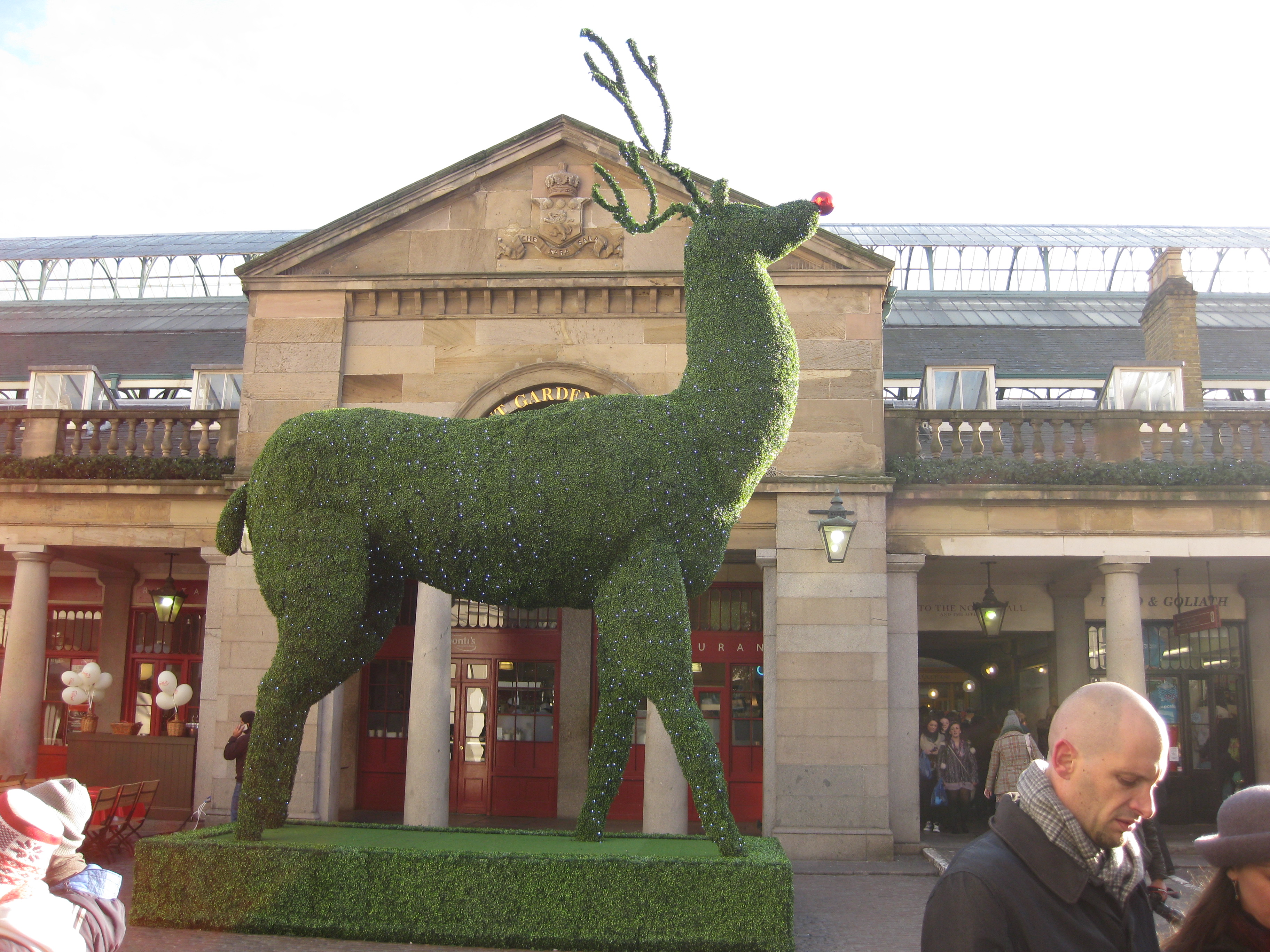
4. Shiny twinkle lights adorn every shopping area in London.  Oxford Street is a steady stream of shoppers, already laden with paper bags on every arm, prominently emblazoned with big brand names that even I have heard of.  A sidewalk vendor sells crepes.  We stop and I have my favorite, with apricot jam.  My leather gloves are covered with stickiness by the time I am finished.  Shiny red ornaments, grotesquely over-sized, hang from the ceiling at the Covent Garden market, and a large green reindeer, two to three times as tall as me, stands to one side with a red ornament nose.

5. Thanksgiving night, we are going to the theater.  We stop off at a nearby pub and both order fish and chips.  I eat my chips with gallons of ketchup.  It feels like just another night but I’m okay with that.  I’ve been doing the “five things that make me happy” exercise pretty faithfully lately, so I’m very aware of just how much I have to be thankful for.  Back home I will have pie and think Thanksgiving thoughts.  I just have to decide between pumpkin and cherry.

Read Full Post »

Happy Thanksgiving!

Here, have a picture:

Have a wonderful celebration today!  And don’t forget the pie.  Pie is key. 🙂

Read Full Post »

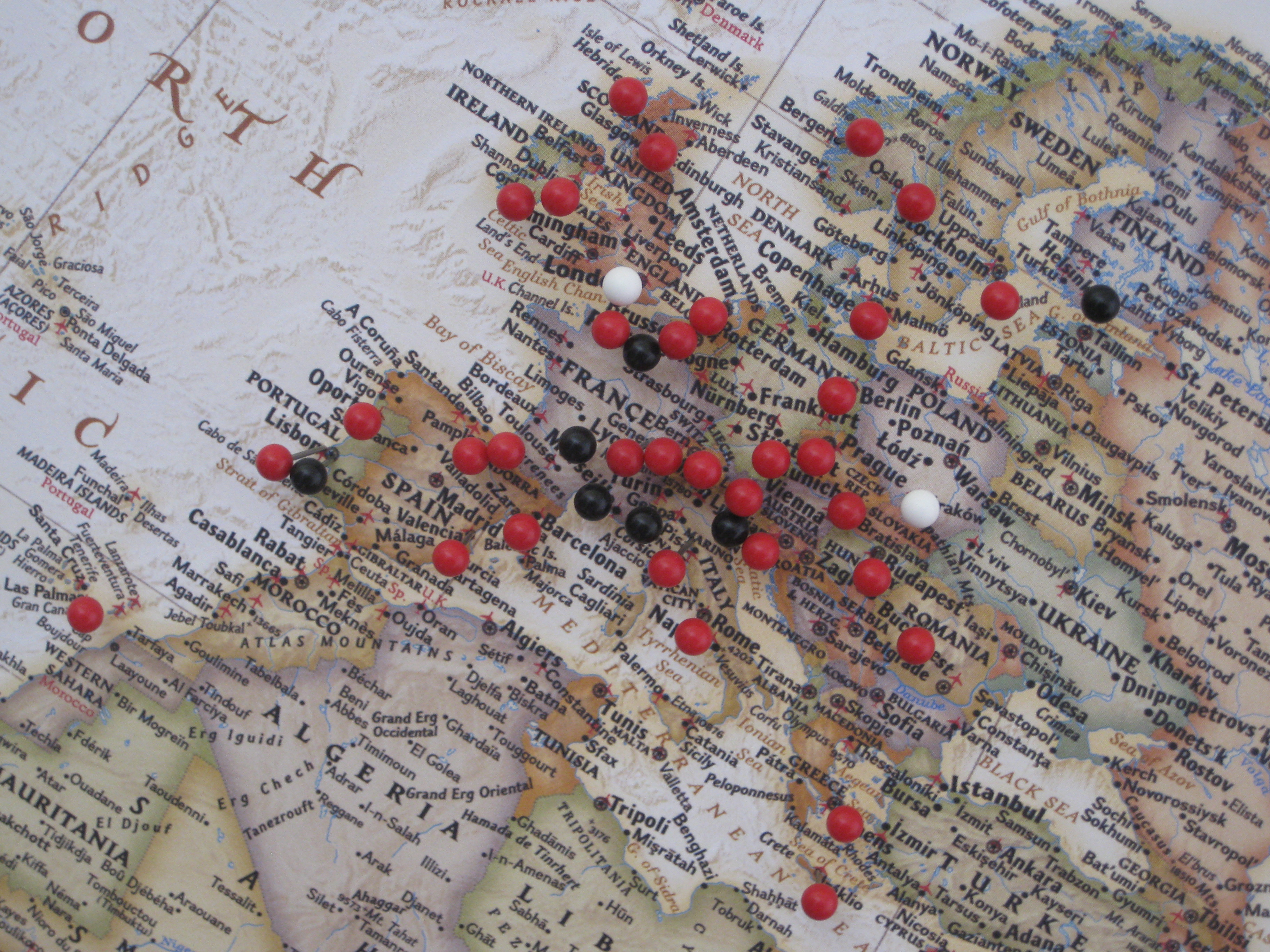
On the wall right inside my front door hangs a map of the world, stuck by a great number of little pins.  The red pins represent ME, places I’ve visited.  The black pins represent my husband.  The white pins are places we’ve been together.

Here is a close-up of Europe on this map:

Lots of red pins, huh?  I visited every place with a red pin within a five-year time span, between ages 22 and 27.  I didn’t have a salaried job, I didn’t have paid vacation.  Most of the time, I didn’t have anybody who wanted to travel with me.  I had an extremely tight budget during those years.  Consider, too, that I started my business when I was 24 and was working completely for myself before my 26th birthday.  No safety nets there, let me tell you.  So how was I able to travel to all those European countries?  (Eighteen of them, nineteen if you count the one I’ve added since that time.)

Priorities, plain and simple.  One of my highest priorities in life was to travel around Europe, and therefore I did what I had to do to make it happen.

This is probably not the last time you’re going to hear me using that word, either.  I have this theory about life, that it’s all about priorities.  Sure, people start off with different advantages and disadvantages, I’m not denying that.  And some things are literally impossible to accomplish, or at least have such a very low probability of happening that it’s almost the same thing.  For instance, I am just plain too old to enter certain professions that depend on youth or a certain current level of physical fitness (unfortunate but true fact: sometimes healing takes a really long time).

But not as many things are impossible as we think. And once we begin to contemplate the realm of the possible, everything shuffles down to priorities.  My priority was to travel in Europe, so I structured my life accordingly.  I had a very strict budget, passing up on buying stuff I really wanted like clothes and dinners out so that I could save money for travel.  I passed up regular salaried jobs for a number of reasons, but not the least among those reasons was my desire to have what I considered a reasonable amount of vacation time to allocate to travel.  I learned how to be self sufficient and more outgoing so I could travel by myself.  I took some risks.

As we get older, we often gain certain obligations: spouses, children, aging parents.  But even with these connections, which have their times of joy and their times of heartache, ultimately my life is my own.  I’m the one who’s going to look back on my lifetime with happiness or regret; I’m the one who’s going to have to live with the choices I’ve made, whether they were good or unfortunate.  Maybe, as a consequence of other choices I’ve made, I’ll have to wait and have a longer-term plan to achieve certain of my life goals.  But it’s still all about priorities.

I’m not writing this post to make you feel bad if you haven’t travelled.  Maybe you don’t even want to travel, and that’s a perfectly fair choice.  What I want to tell you is that if you really want something, whether it’s to travel or to be an artist or to achieve happiness in your own special way, think about a way to make it happen.  Strive, try, and be happy in the freedom of your choices.  And if in the process, you realize your priorities are different than you originally thought, rest easy, reset, and try again.  That’s the last great things about priorities: they can change.


Read Full Post »

Someone Else’s Story

Today I’m going to write about someone I don’t know.  I’ve never met him and I don’t know his name.  We have a mutual friend, which is how I know about him.  For simplicity’s sake, I’ll call him Bob.

Bob is going to have heart surgery in the near future.  It’s a risky, you-might-not-survive-this sort of surgery.  I picture Bob being young-ish, in his thirties or maybe forties.  Apparently he had at least a bit of warning, so he’s been doing some of the things he’s always wanted to do: jumping out of a plane, traveling, spending time with loved ones, etc.

He wrote an e-mail to his friends to give them information on the surgery and tell them what they could do to help.  And he asked his friends for something important to him.  He asked them to go and do some of the things they had been putting off.  Go live some of your dreams, he said, and do it for me.

Every time I think of Bob and this story, I get teary-eyed.  Here is a man forced to face his mortality.  It would be completely understandable if he turned inward and focused on himself during such a difficult time.  But instead, he looks out to the people he cares about, and he puts his energy towards trying to have a positive impact on their lives.  Even if, for him, it might be the end.  He has made meaning out of his illness.  And in so doing, he has succeeded in touching lives, even lives of people he doesn’t know.  Like me.  And maybe you too.

So yes, do what Bob asks.  Go out and take advantage of the opportunities you find.  Instead of putting off, figure out how you can make a cherished dream happen.  Maybe not all of your dreams, maybe not your biggest dream, even.  Just one.  Go to a baseball game for the first time, or learn how to cook beef bourguignon, or fall in love.  Look at the stars through a telescope, or go see the Taj Mahal, or test drive a car you could never afford.  Lend yourself for an afternoon so that Bob’s meaning grows.

And then, think about how to create your own meaning.

Read Full Post »

Photo by Paul Bica

I have a family history of cancer.  My mom died of breast cancer, and her dad died of prostate cancer.  I was convinced that I would inevitably get cancer as well, and that I would probably die of it.  I knew that I must have one of those cancer genes I’d heard about that skyrocket the chances.  My doctor suggested a DNA test and I was horrified at the very idea.  More bad news?  No thanks.

Fast forward to earlier this year, when 23andme was having an incredible sale on their DNA test.  I decided to purchase one in spite of the fact that the very idea filled me with dread.  I figured the test would either tell me what I already thought I knew (aka I had some horrible cancer gene) or it would tell me I didn’t and it would be good news.  I had prepared myself so thoroughly for the worst that I could take the risk of having the test done.

I got the results a few months ago.  I don’t have any of those cancer genes.  Not only that, based on my genetics alone, I actually have a lower than average chance of ever getting breast cancer.  That’s right, lower than average.  While it’s true that there are other risk factors to account for here, my little story of doom collapsed in on itself at this news.

My story is not uncommon.  The facts we think we know are not always what is true, and the stronger the fear surrounding an issue, the more likely we are to fail to see clearly.  I’m scared of death and especially of dying young, and so it takes very little effort for me to create an entire repertoire of stories to support this possibility.  Unfortunately, these fears create visions of the world that can hold us back and cause great unhappiness.  They keep us living in some imaginary wasteland instead of enjoying the present.

Fear of failure is another one I see all the time.  “Oh, I can’t possibly write a novel.  I can’t possibly travel to a foreign country.  I can’t possibly have a happy romantic relationship with a partner who respects me.  I can’t open my own business or find a job I like.  I can’t change.”  I can’t, I can’t, I can’t.

I’m here, not dying young of cancer, to tell you that you can.  The scope of human potential is infinite.  Yes, you may fail.  Yes, I may die young.  I’m not willing to let that chance keep me from living now.  Are you?

Read Full Post »

How to Try to be Happy

To celebrate my birthday this year, I had a Data barbecue party.  In lieu of gifts, I asked each guest to be prepared to share some interesting knowledge with me.  They could tell me about something about which they were an expert, or something they had read recently, or go on Wikipedia and randomly pick a few facts.

The party turned out surprisingly well, and I was fascinated by the variety of data presented to me.  One friend brought some rope and taught me how to make some basic knots; another gave me a list of Amazon’s top-selling titles ranked by their readability scale; a nurse practitioner friend of mine shared strange and cool facts about the body.  The information itself was interesting, but equally interesting was the choice of subject that each of my friends made.

One of my friends talked to me about happiness.  He had been involved in a personal happiness research project over the past several months.  His gift was telling me the number one most effective technique he had found for increasing personal happiness.  (Which, by the way, ranks in top gifts received ever.  Who needs a bunch of stuff if one knows how to be happy, right?)

His discovery was very simple, and I recognized it right away as a technique I have sometimes used myself, never knowing that I had accidentally stumbled upon Knowledge.  Now this advice is permanently lodged in my head, readily accessible in case of emergency (or just general unhappiness). Ready for it?  This is what he told me to do:

Think of five things that you’re happy about.  Do this every single day.

Read it again.  Its very simplicity is what makes it so effective.  It’s not very difficult to think of five happy things.  And it doesn’t take very long.  And yet in the process of so doing, you’re restructuring the way your brain works.

Fast forward to now.  I’ve been having a bit of a tough time lately.  For starters, I’ve been really sick.  And my tooth broke.  And it just went on from there.  At a certain point, the snowball effect kicked in when the negative thoughts built on each other, and suddenly I felt negative about things I wouldn’t normally have a problem with.  I was framing the story of my life from an unhappy point of view, and I’d lost all sense of perspective.  Eventually this led to insomnia, which just served to feed the cycle further.  Rinse, wash, repeat.

Or maybe not.  Because instead I remembered my friend’s present to me.  Before bed I took a soothing hot bath and told my husband every single good thing about the past year I could possibly think of.  Not just five, but all of them.  Luckily, once I get started I’m very good at thinking of positive things.  I think this skill might be part of the reason why I’m happy a lot.  (Also because little things make me pretty happy, and after a while little things add up.)

I slept soundly that night, and the next day I felt ten times better, and therefore much more able to deal with the real challenges I was facing.  The next night, I only thought of a couple good things, but that was enough because I had spent the whole day framing my life in a more positive way.  I had believed what my friend told me at my party, but it took dramatic results for the knowledge to really sink in.

Do I think that anyone who tried this technique would get equally fast and dramatic results?  No, probably not.  I’ve spent years programming my mind to think more positively, after all.  But I do think it’s a worthwhile exercise.  People spend so much time worrying and hurting and complaining and seeing the bad side and being self-critical.  Setting aside a few minutes for happiness sounds pretty reasonable.

Have you thought of five things that make you happy yet?  Feel free to share them in the comments.  Or e-mail me and tell me about them.  Or keep them to yourself.  As long as you think them, that’s what matters.


Read Full Post »

I don’t have pierced ears.  Where I live, it’s fairly unusual for a woman not to have pierced ears.  Plus I grew up in a time when people pierced other body parts to show their nonconformity.  (Or maybe to look sexy or funky or on the edge.  I’m not sure since I never did it.)  It’s the rare occasion when I meet another woman without basic ear piercings.

It’s not that I don’t like jewelry.  I actually have a weak spot for jewelry.  I wear necklaces, rings, the occasional bracelet or anklet.  I love shiny sparkly stuff, and I love how artistic jewelry can be.  I look at beautiful earrings in little boutiques and covet them.

People ask me if I don’t have pierced ears because I’m afraid of the pain.  While it’s true that I hate pain, that’s not really the reason.  I wasn’t allowed to get my ears pierced as a kid, but I could have done it when I was twelve or thirteen.  Only by then it was too late.  Without even knowing it, I had already grown up into a closet nonconformist.

I thought about getting holes punched in my ears, and then I thought about what a weird idea that actually was, punching holes in your body just so you could display a little more bling.  Suddenly ear piercings didn’t seem ordinary anymore.  They seemed like a barbaric custom of some foreign tribe.

Now please don’t get me wrong.  When I look at other people’s pierced ears, I don’t feel shock or horror or condescension.  I don’t actually think piercing is a barbaric custom.  It’s more that, once I thought of that point of view, I could never look on the custom the same way myself.  It’s been twenty years, and I’ve never found any reason to change my original decision.  I’ll keep my ears the way they came, at least until I have a provocative reason to do otherwise.

So what do you think?  Am I stubborn or an original thinker (or both)?  Either way, my lack of pierced ears is one of my tells, revealing that I am a free spirit.

Read Full Post »

The Quest for Balance


Photo by Thomas Gibbard

I recently finished reading Guns, Germs, and Steel by Jared Diamond.  I’ve read in many places what an invaluable resource this text is for writers, especially in regards to world building, and I agree one hundred percent.  I learned so much from reading this book, and in spite of taking a month to get through the whole thing, I never wavered in my resolve to finish it.

Something in the Epilogue struck me as particularly interesting (although that is relative, since I learned something in every chapter that I found particularly interesting).  Diamond was discussing why it might be the case that Europe obtained global power and multiple colonies on most of the continents before China.  After all, in earlier history, China was far ahead in the technology race and had united a much larger area and population into a single nation.

Diamond concludes that this result is another effect of geography.  China didn’t have geographical barriers to inhibit its unification, while it did have helpful rivers.  Europe, on the other hand, had many geographical barriers to discourage unification (islands, peninsulas, and high mountain ranges) without China’s helpful rivers.  But European nations weren’t that isolated from each other.  This meant that if one ruler in Europe decided a technological innovation was horrible, other nations would still use it until all nations ultimately were forced to use it in order to compete.  In China, on the other hand, if the Chinese ruler, say, took a dislike to ships and shipyards, the technology could be completely lost.

So being too isolated (and on a north-south axis), as many civilizations were in the Americas, meant that technology wouldn’t diffuse easily or quickly between different groups.  But being too unified, as China was, also had an adverse effect on some critical technologies.  Europe achieved that happy balance of fairly easy communication without unification that pushed several of its nations into being colonial powers.  (There’s a lot more to it than this, and Diamond explains it better, so really you should go read his book if you haven’t already.)

It’s amazing to me how critical balance proves to be, on both large and small scales.  On an individual level, the problem is similar.  Take a practical free spirit such as myself, for example.  I could swing too far onto the side of the free spirit, in which case I might become flaky, never complete projects, create a financial mess for myself and need bailing out, or a host of other problems.  Or, I could swing too far onto the practical side and believe, like my friend did, that nonconformist lifestyles aren’t real, stay in a job that makes me unhappy, or save my money and never spend it on amazing experiences or experiments.  Either way, I’d ultimately end up pretty unhappy.

I think most of us struggle with this same problem of balance.  Family time vs. career time vs. me time vs. when I am going to write that novel?  Or what diet can I try that doesn’t deprive me of so many treats that I can’t stick to it?  Or what makes this relationship (or this career or this hobby) worth the work to me, and how can I remain comfortable while still keeping it fresh?  This is an even more familiar problem to the ambivert, who often has to balance alone time with social time in some complex ratio.

We’re all walking multiple tightropes at once, making adjustments (both miniscule and large) as we go.  Sometimes we stop paying attention or over-correct and down we go.  Other times it feels almost effortless.  We often don’t even notice all the balancing acts going on around us every day.

Doesn’t mean we’re not all out on that same rope.

Read Full Post »

« Newer Posts - Older Posts »