Feeds:
Posts
Comments

Archive for the ‘Life’ Category

Homes of the Heart

I drove down to Santa Cruz with my dog this weekend. I’m not sure when I had been there last, but I have a sneaking suspicion it was for my birthday last year, which would mean a whopping fifteen months between visits. I felt lighter the minute my car was in the midst of the pine trees that line Highway 17, and by the time I’d reached my favorite view of the ocean, the entire world felt like a better place.
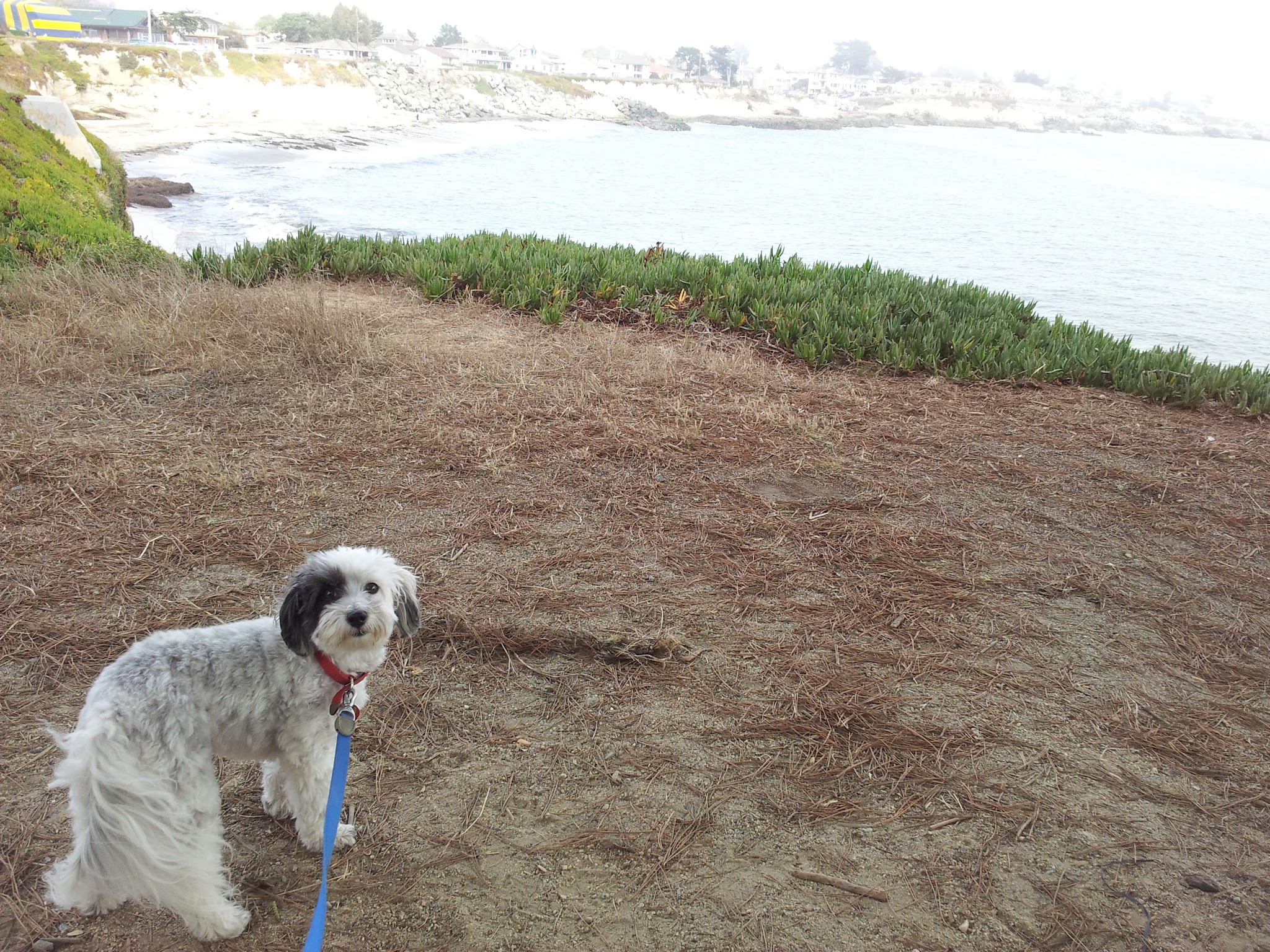
The egregious cute dog picture here.

This got me thinking about the homes of my heart. I have two places I’ve lived in the past that have the same effect on me. I feel happier thinking about them, and when I am actually physically present within them, I feel this strong sense of homecoming. Of rightness. One of them is Santa Cruz, and the other one is London.

That’s not to say that Silicon Valley, where I live now, isn’t my home. I know a lot of people here and have some fabulous friends close enough to see often. I really like the park near my house. I know my way around. I know where to obtain goods and services. I have spent several years of my life here. But it isn’t my heart’s home. I don’t feel joy from simply living here. I feel grateful for the mild weather, but that’s not really the same thing as joy.

Now Santa Cruz, I can tell you what makes it special (even though I do not go down there anywhere near often enough). London, I can talk on and on about why I love it. I wish more people would do that, actually: give me the opportunity for a long London monologue. If we are together and you want to make me happy, bring up London, be ready to listen patiently, and we’ll be all set. But Silicon Valley, well. If you want to be involved with a tech start-up, this is the place to be.

However, I am NOT involved in a tech start-up. (Don’t get me wrong, I’m sure it would be fascinating. But it’s not what I’m doing right now.)

What effect does it have, I’ve been wondering, when you spend so many years not living in one of your heart’s homes? I’ve been here for eleven years this winter, and even the first year, when I lived in San Francisco proper, was not what I’d call an unqualified success (although that might be related to the neighborhood I chose to live in). It must happen to a lot of people, living in a place because of work or family or finances or because that’s just how it worked out, even though it doesn’t resonate with them. Maybe it doesn’t really matter. Your friends and communities are probably more important in the grand scheme of things than your geographical location.

And yet, here in Santa Cruz, I look so much like ME.

But I miss looking out my bedroom window at redwood trees. I miss walking by the ocean. I miss London’s parks and the indifferent sandwiches I’d eat on the omnipresent benches, and I miss taking the Tube down to the Tate Modern on a Sunday afternoon. I miss rambling on the Heath and getting lost beforehand and afterwards, and I miss carrying my A to Zed everywhere I went (although now, I suppose, cell phones have replaced A to Zeds). I miss the late night excursions to the physics building’s merry-go-round and the cheap music concerts and the two pound coins and the inevitable pub and the scarf shops.

I could go back, I suppose, but I think there’s an element to heart’s homes that is related to time and context. I don’t think we can simply return to living in our heart’s homes whenever we feel like it. They might no longer fit exactly right. Sometimes we may be lucky and another right time to live there may come along. Other times we have to discover new ones instead.

Where are your heart’s homes?


Read Full Post »

One of the traits I mentioned last week that is connected with resilience is perspective, and part of perspective is the ability to find or create meaning. In a conversation about resilience, that meaning is most often crafted around circumstances of difficulty, but really humans are looking everywhere for meaning all the time.

Photo by Patrick Hoesly

James Altucher gives a great example of this in his latest Q&A post, in which someone asks him whether their sadness will ever go away. James’s answer, especially the fourth point of it, is a textbook example of emotional resilience by creating meaning: “When I feel sad… the universe will grieve but then rejoice because it’s learning so much. Then I can rejoice because every pain, every sadness, every moment, is ME, the universe manifest, learning something new.” He believes that every moment of his life is a learning experience for the universe, and therefore his life is infused with meaning. And this helps him deal with feelings of sadness.

A few days after I read this Q&A, I read Karawynn Long’s latest post, “How American culture is causing widespread misery.” She talks about the correlation between a shift in American culture and increasing rates of depression, and offers some suggestions as to what we individually can do about this. It’s really fascinating, especially this part: “As our culture shifted to exalt the benefits of personal choice and individual success, Seligman explains, we were also losing confidence in the larger constructs of society. Previously, he says, Americans lived in “a context of meaning and hope.” When we encountered failure, we could take reassurance from something larger than ourselves: “a belief in the nation, in God, in one’s family, or in a purpose that transcends our lives.” But as Carter noted, in the middle of the twentieth century that reassurance began to disintegrate.”

So with an increasing distrust in government, along with declines in active religious faith and more closely knit (and often geographically close) families, Americans suffered from more depression. In other words, with loss of meaning came decreased emotional resilience.

Of course, we can, and do, find meaning elsewhere, whether or not we believe in God or our families or the government. Personally, I have found a great deal of meaning in teaching, particularly children and teens, and while I’m not teaching at present, I suspect I’ll do it again at some point in the future. I find meaning in my writing, both my fiction (fiction is inherently about creating meaning) and on this blog. I find meaning through the communities I am part of, in the relationships I have formed, and in self transformation. I find meaning through learning more about the world and universe around me, and through shifting perspectives to remember how small I really am, both in scales of size and time.

What we are fighting against is a sense of futility, the thought that nothing we do matters or makes a difference, the urge to coast or settle or fall into a rut. Instead we believe in the butterfly effect. We believe our choices matter, whether that be the choice to recycle that piece of paper or to smile at the clerk at the grocery store or to give a significant amount of money to a charity or Kickstarter. We create meaning by being mindful about the cause and effect of what we do every day.

How do you create meaning in your life?

Read Full Post »

A couple of weeks ago, I was reading over some of my older blog entries. When I’d finished, I sat back and thought, “Huh. That was actually kind of personal.” At least, more personal than I had remembered.

There’s a place where the personal and the important intersect. And we who blog are then called to make a decision: how important is so important that I can’t stay silent about this? In my case, that means I often end up blogging about issues related to people pleasing and boundaries (and occasionally feminism). I know there are lots of people who grew up in dysfunctional families just like I did, who have similar issues, and I know how helpful it can be to know there are others out there in the world dealing with the same kind of thing you’re dealing with. It’s too important for me to stay silent.

This trade-off was brought strongly to mind during this year’s Worldcon, where I was lucky enough to spend some time with Jay Lake. For those of you who don’t know who he is, Jay is a prolific SF/F writer of some note. He also blogs. For the past few years, he has blogged in an unusually open fashion about his difficulties with cancer. He blogs about disease, about mortality, about what he feels his cancer has stolen from him. He blogs about determination, depression, despair, and joy.

He told me he gets more fan mail from his cancer blog than he does from all his published fiction.

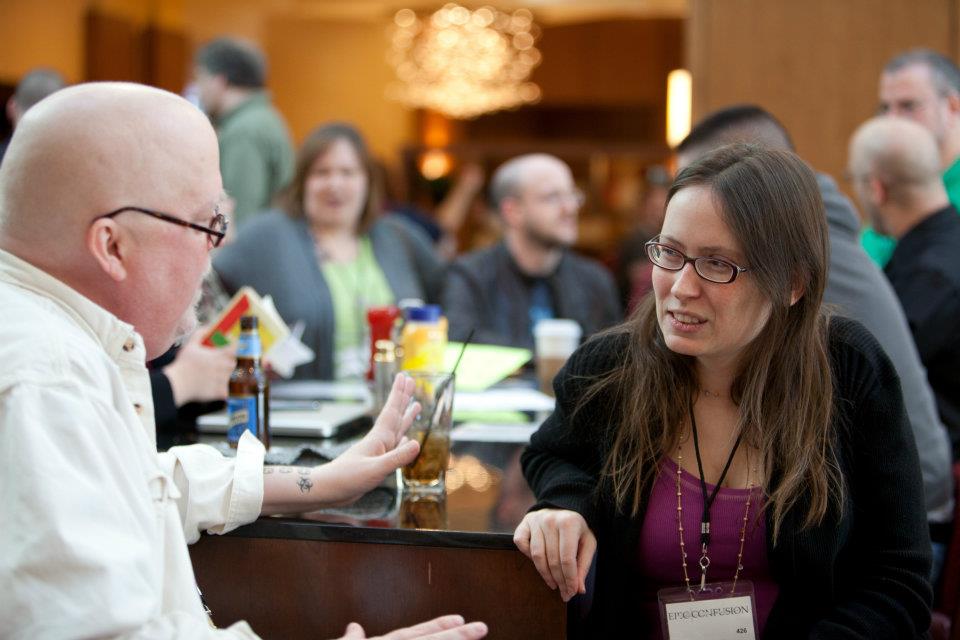
Me and Jay at Epic ConFusion this January. Photo by Al Bogdan.

And he pays a price for being personal. I spent time with him at several points during the convention, and every single time, we were approached by people who expressed their sorrow about his health, or asked about it, or gave him their good wishes that he would recover. On the one hand, it was beautiful to see this outpouring of support from the community.

But I looked at him at one point, late-ish in the evening, after a particularly long stream of generic good wishes, and I thought, “This must get completely exhausting.”

And that is the price. Not everyone will be able to look past the cancer and see the man. Because he has blogged so openly about his disease, he can’t necessarily create a veneer of normalcy for himself when at public events like Worldcon. Part of his public identity is linked to his cancer.

But he pays the price with grace, and I admire him so much for doing so. Because it is too important to stay silent. We need to hear about cancer, about illness, about mortality, and about the physical and emotional struggles that come with these oh-so-human things. Our society tends to have dysfunctional attitudes around illness, around death and dying, around grief and loss, and part of changing those attitudes is talking about these things in a frank and open way. And people who have cancer, people who have other serious illnesses, people who have loved ones who are sick, many of them are helped by Jay’s blog, where by writing authentically about his own personal experience, he puts words to so many other people’s experiences.

So I think about this blog, which is perhaps a bit more personal than I had originally intended. And then I think about Jay. And I’m glad to have written about what I think is important.

I’m in fabulous company.


Read Full Post »

I’ve written a fair amount about being happy, feeling gratitude, dealing with disappointment, and other related topics over the last two years. But it was only last week that I realized that a lot of what I talk about is actually how to be emotionally resilient.

I’ve been thinking about emotional resilience (although not under that particular label) since I was a kid. I took a good look at the people around me who were dealing with stress and adversity, and who appeared to be miserable most of the time, and I thought, “I don’t want to turn out like them.” Thus began my strong determination to become an emotionally resilient person.

At first my plan was to become resilient to tide me over to the point where my life would no longer have any upsetting bits. Now I realize that second part of my plan is never going to come to pass. Adversity is a part of life, and similar to whack-a-mole, the minute one difficult thing is more or less under control, another one pops up to do its own excited little “look at me” dance. The world is changing around us all the time, and inevitably some of those changes aren’t going to be ones that we want to happen. Health changes, life circumstances change, families change, employment and careers change, accidents happen. I can’t stop these things from changing because nobody can.

However, the first part of my plan, to become as resilient as I could, has been enormously helpful. It’s something I still work on and attempt to improve, and I expect I’ll continue to do so for the rest of my life.

Photo by Tom Magliery

Why is resilience so important? Because it’s something constructive we can do in the face of adversity. It tends to make us happier people. It makes it easier for us to deal with disappointment and rejection, which in my case means I’ve been able to continue working on my writing skills (and my singing skills before that). Resilience is what causes us, in the face of difficult circumstances, to be able to stand up, brush ourselves off, and continue forward. It allows us to hold onto the belief that whatever happens, we will ultimately be okay. It keeps us from becoming bogged down in a never-ending morass of negativity and powerlessness. It helps us live more fully in the present.

Resilience is real strength.

I found an article that describes eight of the attitudes and characteristics that encourage resilience, and I found myself nodding along as I read. It lists the following: emotional awareness, optimism, support, internal locus of control, perseverance, sense of humor, perspective, and spirituality. I’ve written about many of those ideas already on this blog, and I’m sure I’ll continue writing about them.

What about you? What helps you be more resilient? In what areas do you run into trouble?

Read Full Post »

I’ve been thinking a lot lately about the difference between being nice and being kind.

I was having a conversation with a friend of mine who also used to be a people pleaser. (There are few things more encouraging than finding and talking to people who used to be people pleasers and now are completely not that way at all.) He told me how he felt that in some ways, in order to change who he was and stop being a people pleaser, he had to swing to the other extreme for a time. But now he was at the place where he was hoping to become kinder and more generous.

A few days later Justine Musk posted her brilliant piece on nice vs. kind that does a great job defining terms, and everything clicked together for me.

Since I know not all of you are going to read her essay, I’ll quickly define the difference. Nice is doing things because you’re supposed to, because you feel you have to, because it’s expected, because you’re being pressured into it in some way, because you don’t feel you have the option to say no. Kind is doing things because you want to: you want to help, you want to be there for someone, you want to give of yourself.

Photo by Martina K

When you’re a people pleaser, when you’re nice all the time, you have trouble telling the difference between nice and kind. And forcing yourself into constant niceness erodes the capacity to be kind. Why? Because you are tired. Because you have nothing left to give.

In order to stop being a people pleaser, you have to start saying no. You have to pay conscious attention to the difference between nice and kind, and it’s difficult, and it takes a lot more energy than it would usually take. And my friend was correct. You swing over to the other side, because you’re saying no to being nice, but you haven’t yet built up your reserves to the point that you can be kind as often as you’d like.

I know because this is where I am right now. I want to be kind. But sometimes I can’t. And sometimes I’m accidentally nice, and sometimes I don’t have the energy NOT to be nice. Because as exhausting as it can be, nice is what I’m used to. Nice is my default setting, and as such, it’s what I tend to fall back on when I’m stressed or tired or in any way not one hundred percent.

Resetting a default, I’m finding, takes a lot of time and patience and mistakes and experimentation.

But I’m making progress. Understanding how kind is different than nice is a part of that progress. I am a lot less nice than I used to be. I say things that people don’t want to hear. I allow people to be uncomfortable instead of automatically smoothing things over. I say no and take care of myself instead.

Nice is something I’m happy to leave behind. Kindness is what I have to look forward to.

What about you? Do you have trouble telling the difference between nice and kind? What kind of balance do you try to strike between kindness and taking care of yourself?

Read Full Post »

I’m back from Chicago and Worldcon and what proved to be quite a whirlwind experience. I’m also sick. Alas, using hand sanitizer and taking Vitamin C and eating fruit wasn’t enough to keep this particular miserable virus at bay. And I’m sick enough that my brain is somewhat foggy. So I’m going to table the topic I had planned to write about (which deserves my fully functional brain) and give you some snippets instead.

– I met a lot of people at Worldcon and spent most of my time socializing. And one thing that I find continually fascinating is how everybody has their own story. Some people wear their stories on their sleeves. Other people keep their interactions entirely surface to the point that it’s easy to forget they have  stories at all. And some people gradually reveal their stories to you, one layer at a time. But they’re always there: the goals and dreams, the insecurities, the setbacks and old wounds, the history, the personality quirks, and the bedrock of character.

– Many people seem to have a lot of social anxiety around convention going. There was a lot of talk about various kinds of social nervousness, as well as more than one person talking about trying to let go of worrying about what they might be missing. (“Just enjoy the con you’re at” was the chief advice being bandied about.)

I don’t have any particular insight to share about this because, as it turns out, these are not my particular problems. I tend to get nervous before a con, and sometimes I have a short period of nerves upon first arrival (although even this seems to be lessening more and more), but once I dive in, I’m pretty much fine. And I hardly ever worry about what I might be missing because what’s the point? Besides, I’m usually having a fine time doing whatever it is I’m already doing. This makes me think that perhaps some people have very different goals for their cons than I do.

That’s not to say I don’t have any problems at a con. I worry about when and what I’ll eat (because sometimes food just doesn’t happen, and sometimes I end up subsisting on French fries). I worry about my body holding up through so much standing and walking and lack of sleep. I feel sad that I don’t have as much time as I would like with many of these fabulous people I’m surrounded by. Sometimes I’m too tired to have the conversations I want to have. And sometimes I’ve had enough superficial chit chat and really want a more substantial conversation than what I’m getting. But so far, at least, I’ve found that these are workable problems.

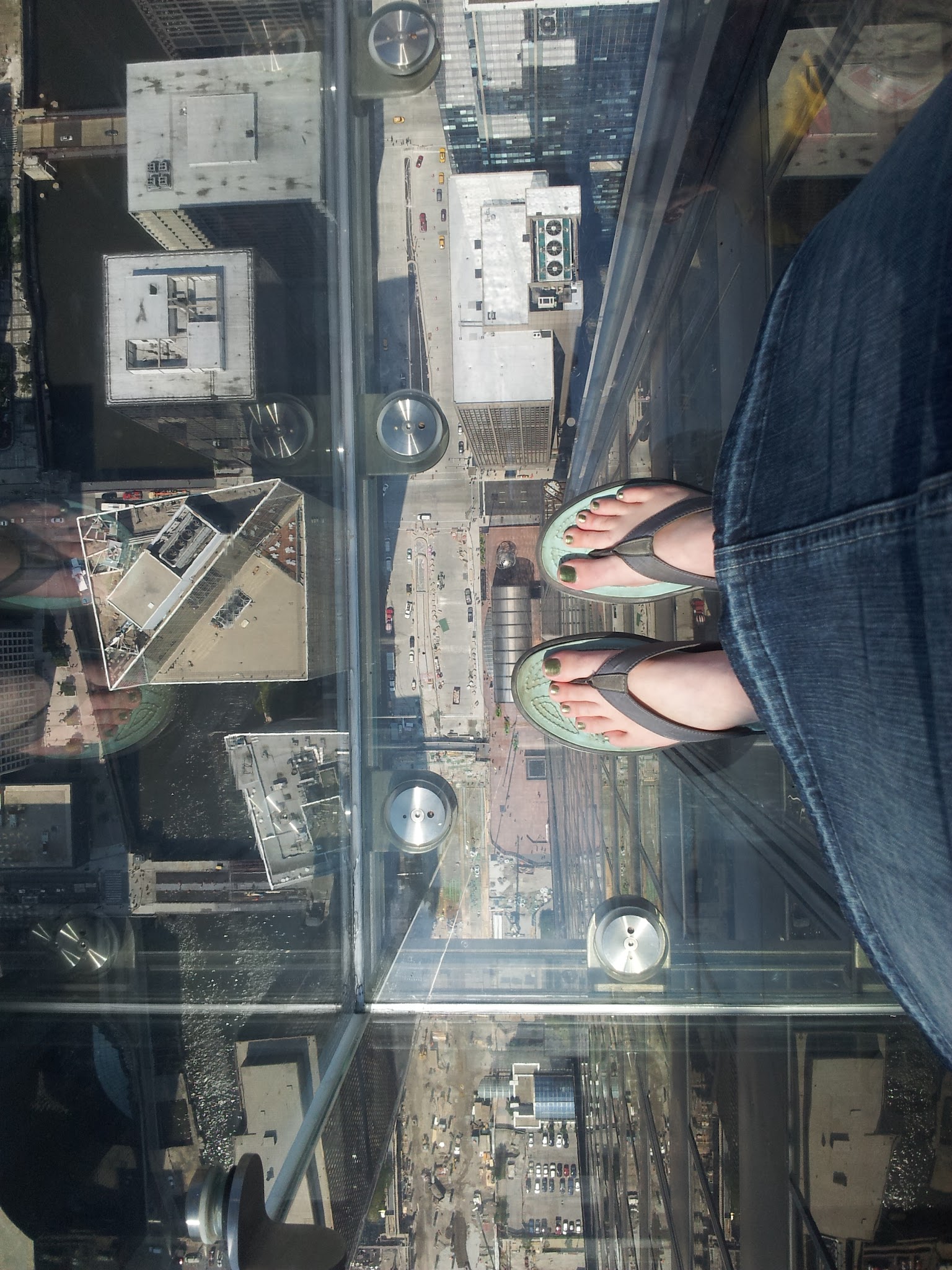
My feet over Chicago.

– I really like Chicago. I love the varied architecture of the buildings downtown, and I love the beauty of the lake. The Art Institute was a real treat, and the pizza was intense.

– My sprained foot got hurt on an overcrowded elevator one evening, which resulted in a fair amount of pain (and possibly some tears, but don’t tell anyone). I was really struck by the generosity of spirit from the people around me. Let me tell you, I was taken care of. Before I knew it (and I certainly didn’t have the presence of mind to make any of this happen myself), I was sitting down with my foot elevated, I had ice in a ziplock bag, I had taken Ibuprofen, I had tissues to dry my eyes, and I was being diverted by kind people talking to me while not expecting me to provide a coherent response. Later, a few friends went to dinner with me in the hotel to save me extra walking, and other friends were visibly concerned, sympathetic, and willing to help. My heartfelt thanks go out to everyone who contributed in turning what could have been a catastrophic event into a demonstration of kindness and thoughtfulness.

– Now I want to sleep for a week. Possibly two.

Read Full Post »

I read this essay by A.V. Flox about leisure last week, and it lit up a lamp inside my brain:

“There is something very wrong with defining yourself by your work and achievements, it drives people to a point where the most important goal is the acquisition of things instead of the enjoyment of things. And for what? You should work — don’t get me wrong. But work so you can enjoy. Don’t make achievement a substitute for living.”

I love leisure. I love lazy mornings and lazy afternoons. I love spending the day buried in a book or three. I love finding an interesting person and talking to them for hours about everything and nothing. I love losing track of time, not in a stressful, “now I’m going to be late” kind of way, but in a “it doesn’t really matter because I’m not missing something pressing, and isn’t this delightful?” kind of way. I love meandering through cities and towns and parks, and stopping for ice cream or crepes or lemonade.

I also love noticing pleasure. The pleasure in a fine day of the ideal temperature. The pleasure of running your hand through the soft fur of a little dog or cat. The pleasure of food, the pleasure of fresh air, the pleasure of a warm hand in mine. When I think about being happy, I often think about those things that give me especial pleasure: Disneyland. Christmas. Little dogs. Ice cream. Magical conversations at 1 in the morning.

Photo by John Althouse Cohen

I agree with A.V. that American culture does not encourage the cultivation of leisure. I too have known the driven person who is scheduled within an inch of her life or who can’t bear to spend half the day doing nothing much. Sometimes, of course, one can’t afford the luxury of leisure. But often it doesn’t seem to be encouraged even if one has the time. It is not looked upon kindly.

I call your attention to the virtue associated with rising early. I do not rise early. I get up later than the majority of people, and I stay up later. I understand that I am fortunate to be able to dictate my own hours, and I know this might not always be case. But in the meantime why shouldn’t I do as I like? And yet some people react to my late wake up time as if it is a personal affront or an illustration of laziness. Why? Is it perhaps a reaction against the perceived leisure that comes with being able to follow one’s own internal rhythms of sleeping and waking?

And yet living for enjoyment is such an effective way to be happier. When I am writing to achieve, I feel stress and worry and come out of the present moment. When I write because of the pleasure it gives me, I feel as if I could continue writing for the rest of my life. When I have an unpleasant day and then I sit down to a bowl of ice cream or a game of backgammon, I am able to renew my positive energy and truly believe that tomorrow will be a different day, even while I’m discovering what there is to appreciate about today.

Do I regret that the two hours I meant to be spending playing Go with a friend on Saturday turned into four? No. Do I regret the sleep I’ve lost having conversations about how to live and how to die and what we’re afraid of and what we wish for? Never. Do I look back on my times wandering the cities of the world and wish I could have spent that time more focused on achievement? Not once. Connection, inspiration, exploration, introspection, the exchange of ideas–these all give me immense pleasure.

These times are the jewels of my life.

###

And speaking of jewels, I’ll be collecting some more at Worldcon in Chicago this week. As usual, feel free to come say hi to me if you’re planning to attend; I love meeting new people. And I’ll be taking a break from the blog while I’m traveling, so I’ll see you here again on September 6th.


Read Full Post »

“Only those who truly love and who are truly strong can sustain their lives as a dream. You dwell in your own enchantment. Life throws stones at you, but your love and your dream change those stones into the flowers of discovery… People like you are unknowing transformers of things, protected by your own fairy-tale, by love.”

— Ben Okri (Thanks to Theodora Goss for bringing this quotation to my attention.)

I love this idea, of sustaining life as a dream. Dora rightly stated that this is what artists do, but it is what all of us can do, if we so choose. It is what I would like to do, and I think my (limited) ability to do it is part of the best of me.

Of course, most of the time I don’t think of my life as a dream, or a fairy tale, or an adventure. I forget. I get caught up in my to do list, the daily minutiae, my worries and little dramas. One of the reasons I loved living in London so much was that being removed from the very familiar helped remind me of life as a dream. But here in my life right now it is much harder to stay connected to my own fairy tale.

So as I think about the not-so-distant future, I am asking myself: If I was running my own fairy tale (which I pretty much am), what would I do? Where would I go? How can I help myself develop my own personal world of enchantment?

Photo by Frank Wuestefeld

Transformation is a powerful magic. I half-joke about hating change, and of course the reason I hate it is because of the price. As any budding fantasy writer knows, all magic has a price; all magic systems must have drawbacks in order to compensate for the sometimes insanely powerful effects magic can gift to its user. In our world, the price is often pain and discomfort.

The trick, I think, is to turn that pain, that profound sense of displacement, into a fairy tale. To give the pain meaning, if you will. Part of that is finding the petals amongst the stones, the good that comes from the bad, the silver lining, the twist of happiness hiding at the heart of bitterness. Part of that is surrounding yourself with reminders of enchantment. And part of that is being aware of the story as you live it, to become a lucid dreamer of life.

Ben Okri is right. To stay in the dream takes enormous strength, and openness, and willingness to pay the pain price. It is not for everyone.

But for those of us who aspire to dwell there, it is its own reward.

Read Full Post »

My favorite movie is Star Wars. Star Wars: A New Hope, to be precise. I chose this favorite movie at some point during high school, and it stuck.

Now, some people will argue that The Empire Strikes Back is a superior movie, and I don’t disagree with this. However, high school me had a copy of Star Wars on VHS (without commercials, even, which was a big score) that I could watch over and over again. High school me did not have a copy of The Empire Strikes Back. (And when I eventually got one, it DID have commercials.) So Star Wars has the nostalgia win there. Also, The Empire Strikes Back has that cliffhanger ending, which means you don’t get a complete viewing experience unless you then watch Return of the Jedi, and Return of the Jedi is definitely NOT my favorite movie. Whereas Star Wars has a complete story arc contained in its two hours.

Star Wars has a lot of things going for it. Light sabers. Comic relief droids. Space ships. The neat blue lines that signal a jump to lightspeed. A kick ass princess with a sharp tongue (although alas, she is the only female character, which I consider to be one of the movie’s worst flaws). A walking carpet. An iconic bad guy who can be identified by sound, not just sight. High stakes. Guts, glory, and scoundrels.

The iconic villain also has a very recognizable silhouette.

But the reason Star Wars is my favorite movie? The emotions it evokes in me and the way I feel after I watch it. When Luke succeeds against all odds, blowing up the Deathstar and saving the entire Rebel Alliance, it reminds me of what is possible. It pumps me up and makes me feel ready to tackle my own life, my own goals, and my own problems. This feeling was valuable back when I was eleven and has continued to be inspiring ever since.

I love that Luke is just some guy, and nobody really thinks he has what it takes to make such a difference. (Well, no one except Obi Wan, anyway.) But through hard work (we don’t get to see it, but it’s implied that he’s spent large amounts of time on flying and target practice before the movie starts), courage, and belief in himself, he is able to rise above other people’s expectations of him and do his true best.

We all receive negative messages about our capabilities at some point. There are always the naysayers who think (and sometimes tell us) that we don’t have what it takes to accomplish our goals. Sometimes the loudest naysayer of all is inside our own heads. What I love about Star Wars is that it reminds me to ignore these naysayers. It reminds me that I won’t know my capabilities unless I fully commit. It encourages me to dream and strive and achieve my own personal best.

What about you? What movie inspires you? What movie makes you feel like you can take on the world?

Read Full Post »

Sometimes my world feels very small.

I’ve been spending a lot of time in my house for the last three months, waiting for my foot to heal. The truth is, I usually spend a lot of time in my house, but there’s a difference between doing it by choice and doing it by necessity. When staying in by necessity, the entire structure seems to shrink and squeeze, and free time that would normally seem pleasant and relaxing slows down into something resembling tedium.

And then there’s the physical energy that has no real outlet, leaving my mind restless. I’m ready for action that my body cannot perform.

The most critical part of this kind of long-term healing isn’t the regularity of icing, or elevating, or taking Ibuprofen. It’s mood management. It’s keeping the spirits up so I don’t fall into a funk or give up in despair or become deeply depressed. It’s focusing on what I can do instead of what I can’t do. It’s dealing with the stress of constantly having to ask for help, and then doing without the help I can’t bring myself to ask for. And it’s letting go of the times when I make my physical limitations known and people ignore them and I wonder how many more days of healing this has added to the final recovery.

It’s also cherishing the moments when people help me take care of myself. When people sit down to talk to me instead of making snide comments about how sitting is bad for your health. When people give up a chair for me. When they go out of their way to drop me off right in front of our destination so I don’t have to walk as far. When they slow down their pace to match mine. When they think of an activity I can do to alleviate the sameness of my days.

We don’t talk much about what it’s like to have a slow-healing or chronic injury, do we? After all, I don’t want to be defined by my limitations. Even as I type this, I’m thinking about how there’s going to be somebody out there who thinks I’m whining or how so many other people are worse off (problem comparing for the win!) or who just isn’t going to get it. Because somehow whining has become equivalent to talking about things that are hard. So then we just don’t talk about it; it’s easier to be silent.

But this is my reality. And it feels a little strange not to talk about it.

What really helps with mood management is reminding myself that, however small my world might feel right now, it is actually big and rich and varied and dynamic. Sometimes I do this by imagining what I’d like to do in the future: travel to China, go to the Walt Disney Museum and the Academy of Sciences, go walk by the ocean, travel to London, travel to Morocco, travel travel travel. Make it to the park with my dog, even though it is a very, very long block away.

Little dogs are also very helpful for mood management. 🙂

Sometimes, though, thinking about the future doesn’t help because it feels like I’m never going to get there. So then I think about how I can enrich my life right now. I romanticize the idea of living a life of the mind. I take adventures and learn what it’s like to be other people through fiction: books, movies, TV shows. I write. I read about economics or neuroscience or Mars or feminism. I sing. I learn how to play new games. I enter into interesting conversations. I feel grateful for all the interesting people in the world who help to keep me entertained and engaged.

What about you? What do you do to manage your mood when times are tough? Have you ever experienced an illness or injury that you had to overcome? I’d love to hear your stories.

Read Full Post »

« Newer Posts - Older Posts »