Feeds:
Posts
Comments

Archive for the ‘Life’ Category

I read this essay by the movie reviewer Film Crit Hulk (it’s interesting, but it is also super, super long, so fair warning), and I thought, oh, I should blog about despair. Because it seems to be going around lately. I know a lot of people who have been having a rough time personally, and then there’s been the whole GamerGate thing, and the global warming impending apocalypse thing, and the posting nude pictures of actresses thing, and a bunch of other things. And, well, it’s not a huge stretch to think that some people are experiencing despair right now.

Despair is a difficult experience to live through. It comes with its own built-in gravity well, in that once you find yourself in that despair place, it is not always obvious how to move forward or through it. So there you sit, in this incredibly painful state, feeling like really important things are broken and there’s nothing you can do about it.

And then I read my friend Damien’s post about Brene Brown’s book Daring Greatly, and you might remember I adore Brene Brown and think the work she’s done is really important. And reading through the list of strategies she talks about, I think they are somewhat applicable to dealing with despair as well as living a wholehearted life. So that’s one resource that’s out there.

But really I want to talk about what I do when facing despair, because that’s what I know. As usual, take what seems useful and discard the rest.

  1. Self care, self care, self care. If you are feeling despair, then you are going to need to self care the shit out of yourself. Beyond the basics (eat, hydrate, sleep, exercise/move), this includes giving yourself alone time or people time depending on what you need. For me, I often want lots of time with Nala. This also includes allowing yourself to be distracted or take a break from the despair. I don’t care how a big a problem it is or how big a realization you’ve had; being in full-on despair mode 24/7 is simply not healthy. Dealing with it is great, but not at the cost of complete burn-out. Finally, this covers allowing yourself to disengage and set boundaries as needed.
  2. Focus on the present moment. Sometimes despair involves things that happened in the past or things we’re afraid will happen in the future. And those things are important and provoke strong feelings and need to be grappled with. But to pull myself out of the despair, paying attention to right now right this second instead can be helpful.
  3. Baby steps. Despair requires patience, because maybe you’re beginning to feel better and then something happens and you fall right back down the well. But if I can think of even one tiny positive thing I can do to help my situation or take care of myself or reframe, then I am better off than I was before.
  4. Vent. Or cry. Or both. Sometimes I just need to let it out, and if I have a safe space in which to express myself, it can be extremely helpful. This one requires judgment because it totally backfires if the space turns out not to be safe after all. But you can do it alone or in writing (or with a pet) too.
  5. Try to stand apart from your emotional reality. Or in other words, try to call yourself on your black and white thinking. Despair can be overwhelming, and it can feel really, really big. For example, if you have been experiencing a lot of really bad behavior from other people, it can begin to feel like all people are awful, or all people are going to betray you, or whatever universal your brain has decided to come up with. But while your experience of that feeling is real, that doesn’t mean it necessarily reflects the external reality. So to pull out of it, you can think of one person who has treated you well. Maybe you can even text them or message them or call them or whatever it is you do to communicate. Or you can just think of a nice thing they did or said that one time. Then think of another person. Then another. Look at data if you need to: pull up a nice text or a nice email someone sent you.
  6. Don’t give up on yourself. Even if you really feel like it. You can give up on everything and everybody else, especially if you’re having a nice venting session, but hold onto that self-esteem like you’re in space and it’s your oxygen tank. YOU WILL NEED IT. GUARANTEED.
  7. Find a reason to hope. It can be a dumb reason, like the fact that ice cream exists or Nala is consistently adorable. That’s okay.
  8. Remember: everything changes. I don’t know if anyone else finds this idea comforting, but it has been my fall-back in hard times for at least ten years, maybe longer. If none of the above works, or if it’s not possible at the moment, and you’re wrapped up in the stifling blanket of despair, knowing it won’t go on forever and ever because that’s not how the world works gives you something to hold onto.

A reason to hope.

A reason to hope.

Hang in there, my friends. Or, as Theodora Goss said:

Read Full Post »

If Not Me, Who?

Once upon a time (last week, if you want to get particular about it), I wasn’t in the best mood. I’d slept poorly, so I was very tired, and I’d just gotten my flu shot, so my arm hurt, and I’d been feeling socially disconnected and it didn’t seem to be getting any better, so I was grumpy.

I was perusing Facebook that afternoon, and I saw a friend’s status message. It was obvious she was feeling as disconnected as I was, and that she was dealing with a lot of hard emotions. I made a comment about my own desire for a tribe and left it at that.

Later that evening, she made a long, clarifying comment on the thread. It was a pretty long thread at this point, with many of her friends offering love, support, Skype time, etc. And I thought, she still sounds pretty upset. Maybe I should call her.

I immediately thought of lots of good reasons why calling her was a terrible idea. It was almost ten p.m., and I’d be putting her on the spot, and I hadn’t phoned her up in years (mostly seeing her at group events), and some people hate talking on the phone, and I was tired, and it might be weird, and she obviously had all these friends from this thread who were offering support, so she didn’t need mine. Who did I think I was, anyway?

But then I thought of Emma Watson’s UN speech on feminism, which I had watched earlier in the week. She’d talked about how she questioned why it was her standing up in front of the UN talking about feminism. And then she’d asked herself these two questions:

If not me, who? If not now, when?

Photo by Amy Sundberg (Hey, that's me!)

Photo by Amy Sundberg (Hey, that’s me!)

Those two questions echoed in my mind. They aren’t particularly original, perhaps, but more importantly, they are pertinent and simple. If I wasn’t willing to reach out to my friend in need, who would? And what did that say about me? And did I really think some vague Facebook comment was sufficient support?

I was afraid of looking stupid and awkward. But was that fear really what was important? I didn’t think so. And I picked up the phone and called her.

I was the only friend that day who did so.

If not me, who? No one, that’s who.

I hope the conversation we had helped my friend, but it ended up being exactly what I needed. It got me out of my head loop and back into reality.

Here’s what I learned or was reminded of:

  1. Appearances can be deceiving. Just because a person looks like they have a million and one friends does not mean they’re getting the support they need. Just because a person looks happy does not mean they’re doing great.
  2. Active reaching out matters. When we’re in a state of overwhelm or emotional overload, sometimes even picking up the phone and deciding who to call or text can be really hard. Making an offer to support a friend is great, but following it up with something concrete is better. (Especially something concrete that can be easily refused, like with a phone call that the person doesn’t have to answer.)
  3. Sometimes helping someone else is the best way to help yourself.
  4. Connection takes courage. I’ve been feeling unsafe in some of my usual social spaces. And it’s so easy to allow that feeling to leach into feeling unsafe in general. And feeling unsafe is such a deeply icky experience. But at some point, I needed to open myself up to the possibility that not all connections will lead to a lack of safety, and to trust in my own ability to deal with inappropriate circumstances should they arise.
  5. Conversation is a give and take. My friend really wanted to hear about similar problems I have been experiencing. Me being willing to be open and vulnerable with her helped her to do the same with me, and vice versa.
  6. Connection starts with me. I can’t expect meaningful connection in my life if I’m not willing to take a risk and give what I wish to receive.
  7. Connection is a state of mind. That phone conversation cracked me wide open, and then I could more easily appreciate all the connections I’m so happy to have in my life.
  8. If not me, who? If not now, when? 

Read Full Post »

I’ve been very tired lately, so it probably shouldn’t come as a surprise that I’ve come down with a cold. I’m taking it easy for a few days, and I don’t have the brainpower to tackle the post I wanted to write today, so instead it is obviously time for some adorable dog photos.

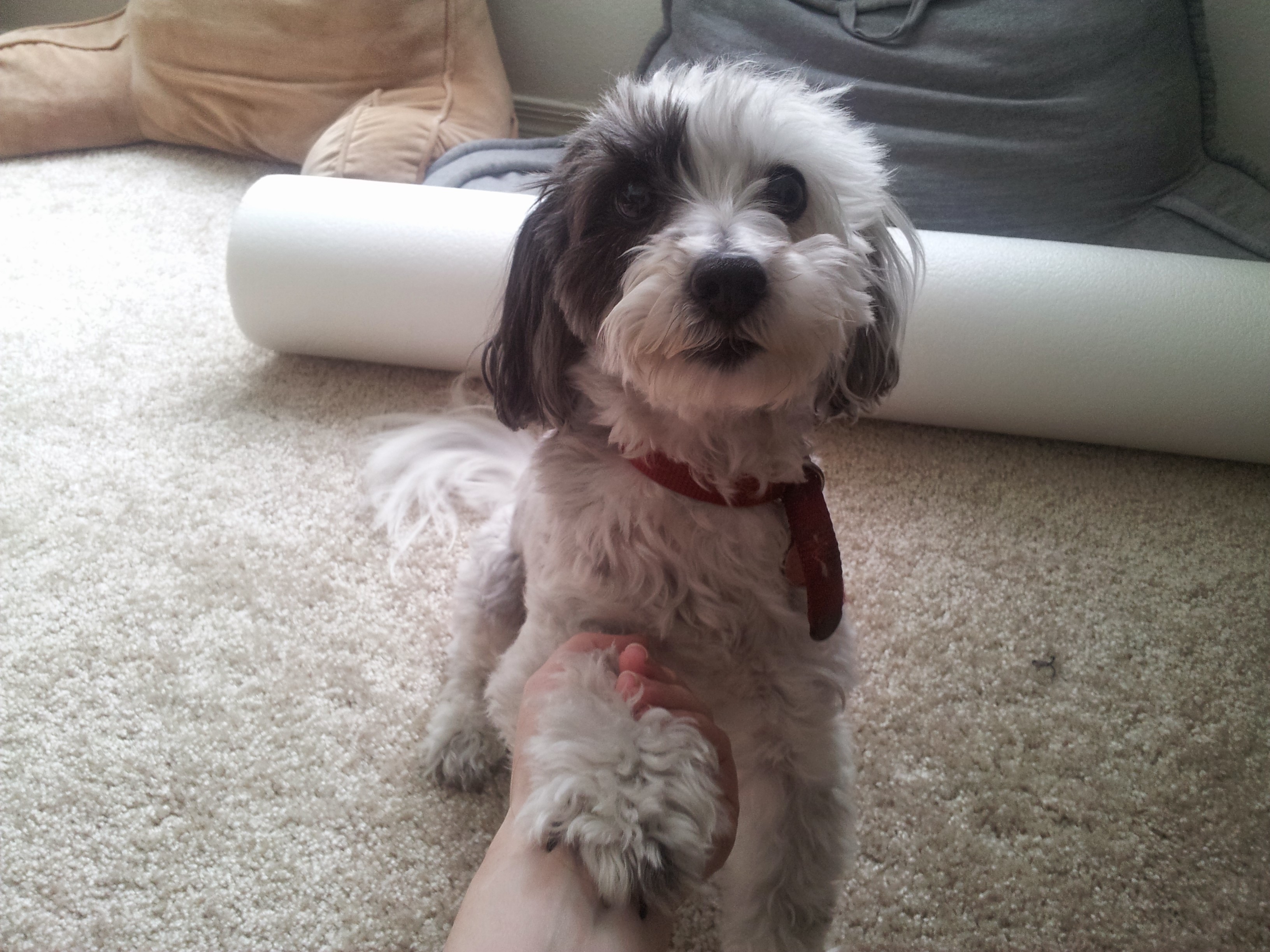
Nala shaking my hand.

Nala shaking my hand.

Nala is a very food-motivated dog, so the main problem with doing tricks with her is that she gets so excited, she has trouble focusing enough to figure out which trick I’m asking her to do. Instead she tends to wave her paws wildly in the air and/or wag as fast as she can. But with a little bit of patience, she is happy to shake hands.

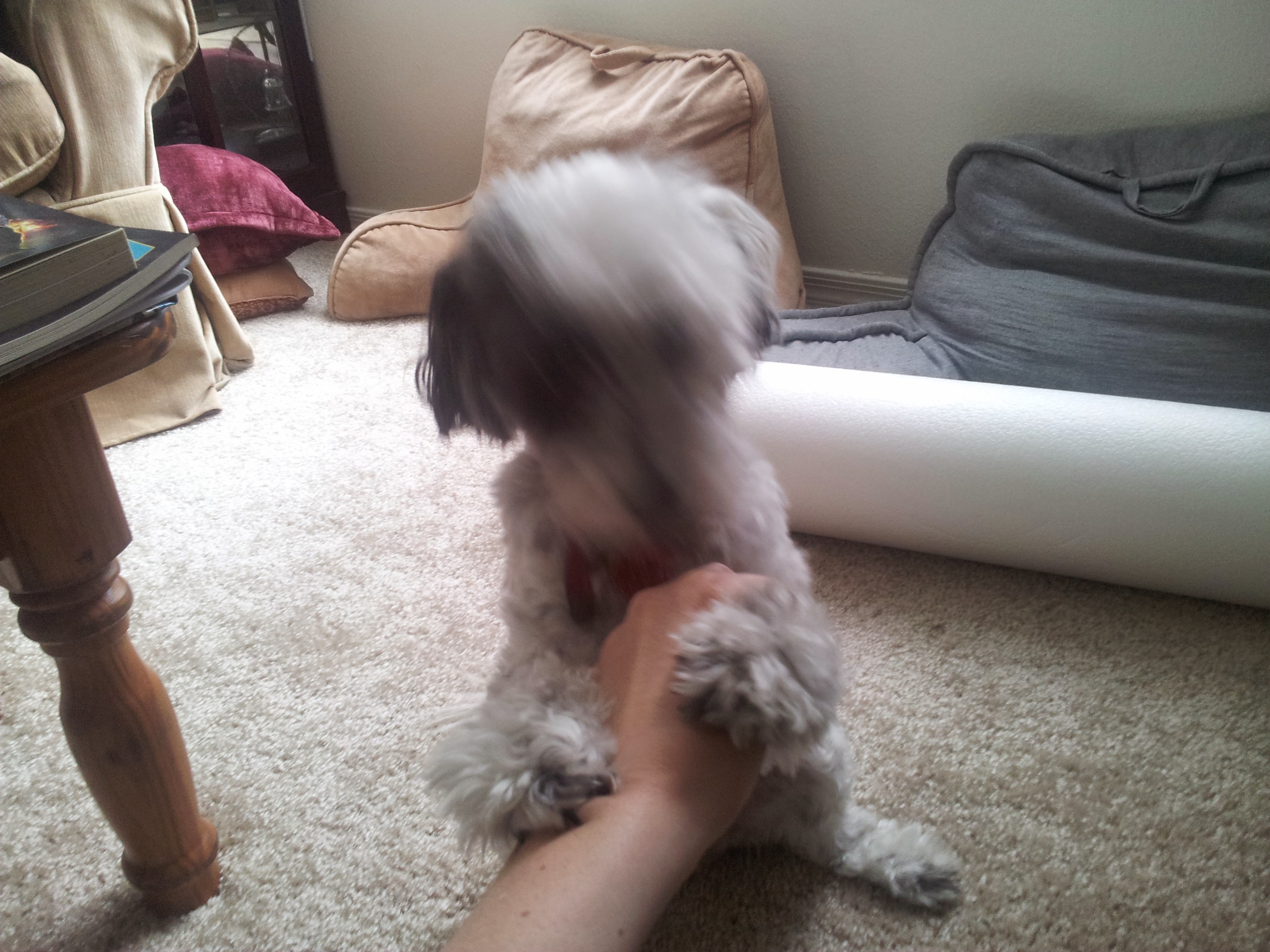
The Nala blur.

The Nala blur.

I know this isn’t a great photo, but I love it because it captures how excited Nala gets. She just can’t stay still. This is a different trick in which she grabs my hand with both paws.

In other news, it seems like fall has come along with my cold. When I took Nala outside today, I shivered and realized I’d have to wear heavier clothing if I actually had the capacity to leave my house today. It’s getting dark earlier, and the time change is less than two weeks away. I’m wearing boots again, and the house has held steady at 80 degrees Farenheit today without any A/C. (Yes, I live in a very hot location in a very hot apartment. Who knows what this experience may have done to my already poor temperature regulation abilities.)

I generally dislike cold weather, but for the first time in my life, I am so ready for winter.

I’m also going to take this opportunity to opine on this year’s general disdain towards all things pumpkin spice. I guess it’s supposed to be funny? Are peppermint, egg nog, and gingerbread flavors funny in December? Personally I think they’re tasty, just as I’m happy to be able to order my favorite pumpkin spice chai at the coffee shop again. I’d order that drink all year if I could. As it is, I limp along with the occasional vanilla chai in the spring, but it’s not the same.

Anyway, is the pumpkin spice hatred because of ridiculous marketing? Occasionally I feel like there’s this whole slice of American culture that I’m missing out on because I don’t watch television commercials. I’m pleased to miss it, but once in a while I have a conversation in which I have to plead ignorance and change the subject. In any case, I have trouble seeing how pumpkin spice marketing could reach anywhere near the ridiculousness of Christmas marketing, but I suppose stranger things have happened.

And now it is time for me to rest some more. Until Thursday, my friends.

Read Full Post »

I received a good reminder earlier this week, so I thought I’d share.

If you aren’t familiar with the website Meetup.com, it’s a website where people put together activity groups. So you can join and then find groups in your area that host events that you can attend, and if there isn’t any group in your area, then you can start one yourself! There are hiking groups, book groups, parenting groups, board game groups, support groups, and on and on.

Meetup.com is a website that comes up often in online advice about how to make new friends. The idea is that you can meet people while pursuing your interests and hobbies that you want to do anyway. And you instantly have something in common! I personally know a few people for whom this strategy has worked quite well.

However, I myself tried a Meetup group some years ago now, and I was not impressed. I went to one event, and I didn’t click with any of the people present. It was hard to get there, and then it was all small talk, small talk, small talk, and someone suggested we should arrange meetings to all work out together at the gym, and I threw up a little in my mouth. (To be clear, there is nothing wrong with having a Meetup to hang out at the gym; it is just really not my thing.) I was relieved to go home, and ever since then, I’ve thought, “Oh, Meetup. That totally doesn’t work for me. At all. The end.”

But I still get their emails because I am lazy about getting myself off email lists, and a few weeks ago, I saw a new Meetup group that was exactly my thing. Of course, the first Meetup group I’d tried had also seemed to be exactly my thing and look what happened there, but this was maybe even more so. So I decided I’d try it out.

My first meeting was on Monday evening. I was nervous, and I kept thinking of all the ways in which it might be uncomfortable or boring or plain obnoxious, and I kind of didn’t want to go. But I’d RSVP’d and I’d spent considerable effort preparing for the meeting, and this felt like one of those times I needed to ignore my brain and push myself to go anyway. So I went.

And it was FABULOUS. It was interesting and informative, we had a wide-ranging conversation about topics that I want to learn more about, the people were respectful and articulate and insightful. I was so glad I went.

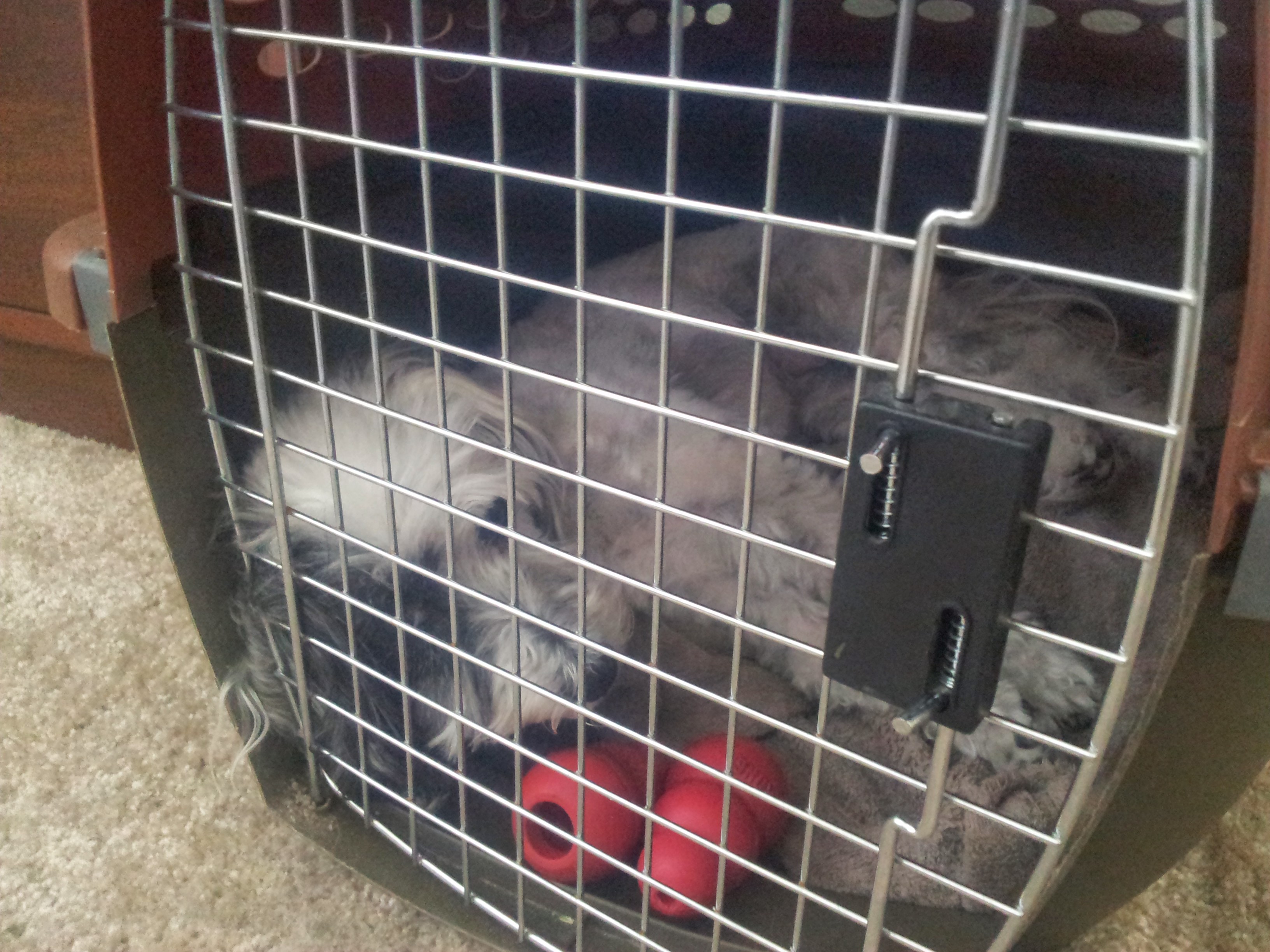
Nala used to hate her kennel, but now she wants to hang out in there all the time. (Yeah, I might be reaching a tiny bit, but...cute dog photo!)

Nala used to hate her kennel, but now she wants to hang out in there all the time. (Yeah, I might be reaching a tiny bit, but…cute dog photo!)

So here’s the reminder I took away from this experience: Just because you’ve tried something once doesn’t necessarily mean you shouldn’t try it again. Generalizations can sometimes be a useful shorthand, but when they’re formed with too little information and without being aware of variation, they can be inaccurate and potentially harmful.

Also, sometimes brains are overly negative. And sometimes we have to do our best to ignore them until we can prove them wrong. Being able to tell the difference between a real threat or issue and unfounded negativity is an incredibly valuable life skill.

And Meetup.com can sometimes be awesome! Good to know.

Read Full Post »

I want to write about solitude today, and finding myself uncertain as to how to begin, I looked up some famous quotations on solitude.

From these, I ascertained that people are very divided about the idea of solitude. Some people love solitude, finding it absolutely essential to their well-being, while other people wouldn’t choose solitude if they had another choice. Solitude is simultaneously viewed as exalting and painful, beautiful and tragic.

I found a reference to Rainer Maria Rilke’s Letters to a Young Poet, and I located my copy, given to me when I was a young artist myself, and started flipping through it, and now I want to read the whole thing again. He references solitude several times in its pages. I particularly like this passage:

“Therefore, dear Sir, love your solitude and try to sing out with the pain it causes you. For those who are near you are far away, you write, and this shows that the space around you is beginning to grow vast…be happy about your growth, in which of course you can’t take anyone with you.”

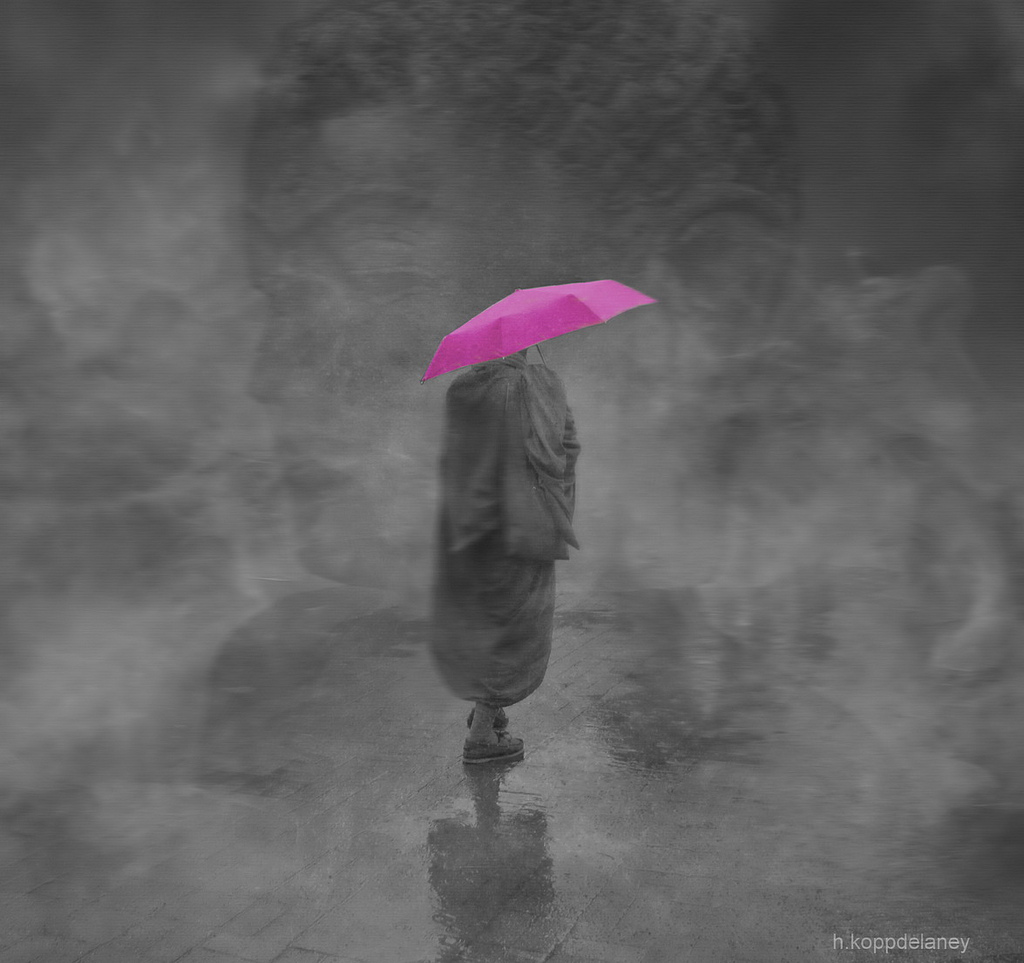
Photo Credit: h.koppdelaney via Compfight cc

Photo Credit: h.koppdelaney via Compfight cc

There is this common idea that solitude is helpful and perhaps even necessary for artists to develop their own voices (and visions) and do the work required of them. Certainly writers have to sit and be focused inside their own heads while writing, even if they are physically surrounded by people. For some other types of artists, solitude is perhaps less critical.

We each have our own capacity for solitude, and that capacity can change over time and in different circumstances. It can be deliberately expanded (meditation retreats, anyone?) and it can be deliberately contracted. Within limits, of course.

I have been craving more solitude recently. I hit the point far more quickly than usual when I must take time for myself. It’s not simply laziness or fatigue, although I am tired; it’s a strong need for the space to introspect and just be. There is so much going on inside of my head right now, and it’s not that it’s so very private in nature but rather that it feels like the kind of thing I need to sort out for myself, with the occasional helping hand along the way.

Perhaps solitude is important not just for creative work but also for personal change. It’s almost as if I need some time to get to know myself again.

Read Full Post »

Change is an Inside Job

I’ve gotten two pieces of advice repeatedly over the last week, and they’ve both proven to be quite helpful, so I thought I’d share.

  1. “Things will get better now that the pretending is passed.” aka you don’t have to pretend everything is completely fine.
  2. Talk to your friends about your problems.

So I followed this advice. I stopped pretending, and I talked, and I talked, and I talked some more, and some more after that. And in between I did nice things for myself and gave myself a lot of alone time.

And eventually the clouds began to lift, and I began to feel better.

In the process, I learned something interesting about change.

There’s this feeling I’ve been having for quite some time, a fear that the change I’ve been working toward all this time isn’t real or long-term, that it won’t stick, that one day it will disappear without warning, that I’ll find myself back where I started. It’s very powerful, this fear, and not all that helpful.

Here is what I have realized: conscious change does not ultimately depend on external factors. Change does not rest on the shoulders of one or two key people in our lives, or on a job, or on geography. Change does not rest on our communities, or on a hobby, or on a lifestyle choice. All of these things can help facilitate change, yes, absolutely. But strip any of them away, and what are we left with?

The internal change. We can be thrown into situations that we might have hoped all this change would have prevented. But if there has been internal change, we will respond differently. We will have different skills and different strengths. We will see the situation differently, we might be aware of different options, and we will be able to make different choices if that is what we want to do.

Internal change is not something that just goes away. Can we experience a backslide? Sure. Some confusion? You bet. But I could no more find myself back where I started than I could snap my fingers and cause instantaneous deep change on a whim. Everything–all the hard work, all the insights, all the frustrations and setbacks, all the small victories–builds on itself to create the change.

And perhaps one of the last steps is to gain the confidence that such change can be both true and lasting. That it is not something that can be irrevocably lost or taken away. That failures and difficult situations are an opportunity to learn more rather than some kind of final grim judgment of self-worth.

That the change is not dependent on any one thing or any one person except myself.

Photo Credit: Bindaas Madhavi via Compfight cc

Photo Credit: Bindaas Madhavi via Compfight cc

Read Full Post »

I wrote a short story with that title once: “This is Not Your Story.” I think it was a fantasy story, but really all I can remember now is the title. I suspect the story itself was not overly memorable.

When I was in London, I spent a lot of time walking around the city, and most of all, the parks. There is something intensely soothing to me about walking in that city’s leafy green spaces, occasionally stopping to take a picture or read a few chapters of a novel. And thinking. So much space for thought.

One thing I thought about a lot was how so much of what has been going on around me has very little to nothing to do with me. In one sense, it does, of course, because I have been present, I have been involved, I have had relationships of all kinds with people throughout my life. But even so, so much of it isn’t about me at all. It doesn’t have a lot to do with what has happened to me, or how I’ve felt, or what I’ve wanted, or what I’ve been thinking.

This is not my story.

Photo Credit: Brujo+ via Compfight cc

Photo Credit: Brujo+ via Compfight cc

I would like to be able to say that this realization has helped me take things less personally. That might even be true. But at the same time, it has made me keenly aware of my propensity to allow things to become my story, even though they really don’t belong to me.

I allow myself to be invisible. I allow myself to be crowded into a small space so there is more space for others. I allow my voice to cease being heard. I think, if only I say the right thing, if only I behave the right way, if only I am an even better listener, if only I am more understanding, if only I let this slide or keep my mouth shut or let it go because it’s not like it matters that much anyway (it’s not like I matter that much anyway, is really what I’m telling myself here), then everything will work and everyone will like me and I will finally be given the space I need to thrive.

To be clear, this is complete bullshit. It doesn’t work.

I’ve been having a hell of a time writing blog posts lately because I’m afraid to even lay claim to my own story. If I say anything about x topic, I think, then this person will think I’m writing about them, even though actually it has nothing to do with them, or maybe it does but that doesn’t mean it’s not an appropriate topic for the blog, but that means I can’t write about that topic, unless I find a way to be very clever so I’m kind of writing about it without writing about it. And three hours later, here I sit with no blog post to show for it. Or I’m bending over backwards to be incredibly vague, even while suspecting that it’s impossible for me to ever be vague enough. And the writing suffers as a result. This also doesn’t work.

Okay, so what does work?

Being authentic works. Being honest works. Speaking up works. Being firm and clear works. Not wanting everyone to like me works. Noticing when other people’s stories are coming strongly into play works. Refusing to take responsibility for other people’s stories works. Laying claim to my own story, yeah, that works too.

This is my story, and I’m going to write about it.

Read Full Post »

Joining the Dance

Okay, I have a great quote for you guys today. No surprise, I found it on Jonathan Carroll’s Facebook page, which remains a great inspiration.

“The only way to make sense out of change is to plunge into it, move with it, and join the dance.” – Alan Wilson Watts

Photo Credit: CEBImagery.com via Compfight cc

Photo Credit: CEBImagery.com via Compfight cc

I’ve been thinking about breaking up this quote onto different pieces of paper and posting it around my living room. We shall see, though, because I don’t want my living room to remind me of an inspirational calendar. Well, at least not an overly cheesy inspirational calendar.

Anyway. I am of course right in the thick of a long, extended period of change, and within such periods, there are spikes of bigger change and then those times when you can get a little rest. I’m definitely in the middle of a spike at present. And I’ve been thinking about what I want my life to look like.

I have a few thoughts about creating a life vision, if you will.

First, a life vision will be constantly evolving. That’s in its nature. As we learn new things, as we experience setbacks, as circumstances change, as who we are changes, our life vision will shift and grow to fit the present time. How many times have I thought I wanted a particular thing in my life only to find out once I had it that I didn’t want it after all? Enough times to know this is a thing that happens, that’s for sure. But it can be difficult to allow our vision to change because it’s so easy to get attached to the old way of thinking.

Second, as much as I wish I could think or imagine everything out ahead of time, that is not necessarily the best strategy. Hence the above quote. I am a planner and a thinker, so that’s where my comfort zone lies. But sometimes we have to take a leap and see what happens, and then adapt to it. Sometimes we have to try things out to experience them for ourselves. I feel like this can be especially powerful when something isn’t working. Sometimes when we can loosen up our thinking, we find a completely different solution or direction that wasn’t in the original vision at all.

Third, I’m interested in the inevitable biases that creep into our visions of what our lives could be. To me, an obvious one is that of our family of origin. (Another one is the broader society in which we are raised.) When we’re kids, we learn what is possible by watching our parents and close family groups. That sets our basis for what is “normal.” As adults then, we are constantly challenged to learn from our surroundings and seek out exposure to different people and ideas. We can use these to disrupt our original basis for understanding reality in order to create visions that more truly reflect who we are and what we’d like to see for ourselves.

There are so many ideas in our brains, and we haven’t necessarily had a chance to deeply examine them. What it means to be a certain age. What it means to be a certain gender. How we choose to express ourselves. What goals are worthy of pursuit. What gives life its meaning. How we run our social lives. And lots of smaller stuff, like the proper way to bake cookies and what kind of food is comforting and the amazing sweetness of fluffy poodley little dogs and habits of making lists and what kind of stuff you like to do for fun.

A lot of these ideas are great and useful and practical and work really well. But sometimes they don’t all work so well. And sometimes even when they do work well, they act as barriers between ourselves and other people with different biases. Sometimes they even work as ways of shutting down empathy. And sometimes they can keep our life visions more limited than they’d otherwise have to be.

So right now I’m doing my best to put at least part of my inner planner on the back burner and enjoy plunging into the change. I don’t know exactly what will happen next, but then, right now, that’s the entire point.

Read Full Post »

I’ve been thinking a lot about grief and loss and inspiration and kindness.

How are you going to tie all of those ideas together in an essay, Amy? Yeah, I’m not really sure either. But I am going to try.

When I first checked my phone on Tuesday morning, I learned that fantasy writer Graham Joyce had died. I felt sad. Sad because many of my friends are grieving the loss of someone important to them. Sad because the one time I met Graham, he had been kind and generous to me.

Sad because then I thought about Jay, and I miss him. I don’t talk about it much. I’m not sure there’s very much to say. The sadness is here, inside of me. That’s all.

We try so hard to distract ourselves, and others, from the reality of this sadness. We want so badly to fix, to take away pain, whether it’s our own pain or somebody else’s. Distraction, cheering up, intellectual discussions about philosophical implications.

But at some point we have to stop all of that and just sit. Sit with sadness. Sit with whatever emotions there are. Turn off the fixer, because there is no fixing death. There is no fixing loss. There is no fixing of so many things.

Sometimes there is someone who is willing to sit with us so we will not be alone. But we are not always so lucky. And sometimes being alone makes it easier. Either way, at some point, the sitting must occur.

Graham Joyce’s final blog post is being widely quoted because it is brilliant. This is my favorite part:

“Actually I know what the dragonfly said.  It whispered: I have inhabited this earth for three hundred million years old and I can’t answer these mysteries; just cherish it all.

And in turn the Heron asks, with shocking clarity as it flies from right to left and left to right: why can’t our job here on earth be simply to inspire each other?”

Cherish. There is so much that is beautiful and good in the world, and it deserves the attention. It is so easy to miss seeing it; it’s so easy for it to be drowned out by the ugly and the ignorant and the damaging. But the good still matters; it keeps us going.

Inspire. We all need a hand up from time to time, or a new idea, or a fresh way of seeing. We help each other to be creative and kind and informed and engaged. We help each other to be better than we could be on our own.

Photo Credit: Eden-Lys via Compfight cc

Photo Credit: Eden-Lys via Compfight cc

I’m reminded of another quote I’ve been thinking about a lot lately. It’s from E. Lockhart’s novel We Were Liars: “Be a little kinder than you have to.”

That’s it. Be a little kinder. I hear these words in my head several times a week. They help me get out of my head when I’m about to stand up for myself or deliver bad news. They help me get past the empathy response that encourages me NOT to stand up for myself, because they give me a guide for how to behave that honors that empathy while also taking care of myself. They remind me that I can be clear and firm and honest without being unnecessarily cruel.

And they encourage me to a little kinder to myself as well.

Cherish, inspire, and be a little kinder when you can. Yes. That is what I’d like to spend my life doing.

Read Full Post »

I was approached by a few people who read my last blog post and were concerned that bad things had happened to me on my vacation.

On the contrary, friends. On the contrary. I had an amazing trip.

The plan was as follows: to begin in East London at WorldCon, to move to central London to enjoy a week of blissful London time, and then to end with a few days in southeast Wales. This turned out to be an excellent plan.

I had an emotionally challenging summer. Any time your best inspirational words are “things get worse before they get better,” you know things aren’t going so great at that particular moment, however optimistic you may feel about the future. My hope was that my vacation would give me a chance to clear my head, gain perspective, and get some emotional rest. And it certainly succeeded at giving me all these things.

For me, travel, whether it is recreational or to a convention or a combination of both, takes me outside of my familiar, everyday world. I see people I normally wouldn’t see, I have conversations I normally wouldn’t have, I learn about things I wouldn’t normally learn about, I spend my time differently. Not only does this refill the creative wells, but it also serves in a larger sense as a reminder of what is possible.

I think this is always valuable, but when you are having a difficult time, it becomes even more so because it shows you potential ways forward. It encourages movement instead of paralysis. It encourages analysis with an eye toward positive change instead of hopelessness. It gives new context to old problems.

It allows space to imagine a better world. Or at least a healthier life.

Why is this important? Because you can’t move closer to that life unless you can see enough to know what direction to take. It’s difficult to make choices based on your priorities until you are very clear on what those priorities are. And sometimes they need to be reaffirmed several times before they become truly internalized.

The other helpful ingredient for imagining a healthier life is hope. And WorldCon delivered big time on this one. I cried at the Hugo ceremony. Okay, I always cry at the Hugo ceremony, but this time was different. Kameron Hurley and her double win for Fan Writer and for her brilliant essay “We Have Always Fought” meant a lot to me. This recognition from my community for such important work gave me hope. The respect and support of my colleagues gave me hope. The steps forward I had been making in recent months, however difficult, began to give me hope too.

So yes, it was a wonderful vacation indeed. And I’m looking forward to what’s coming next.

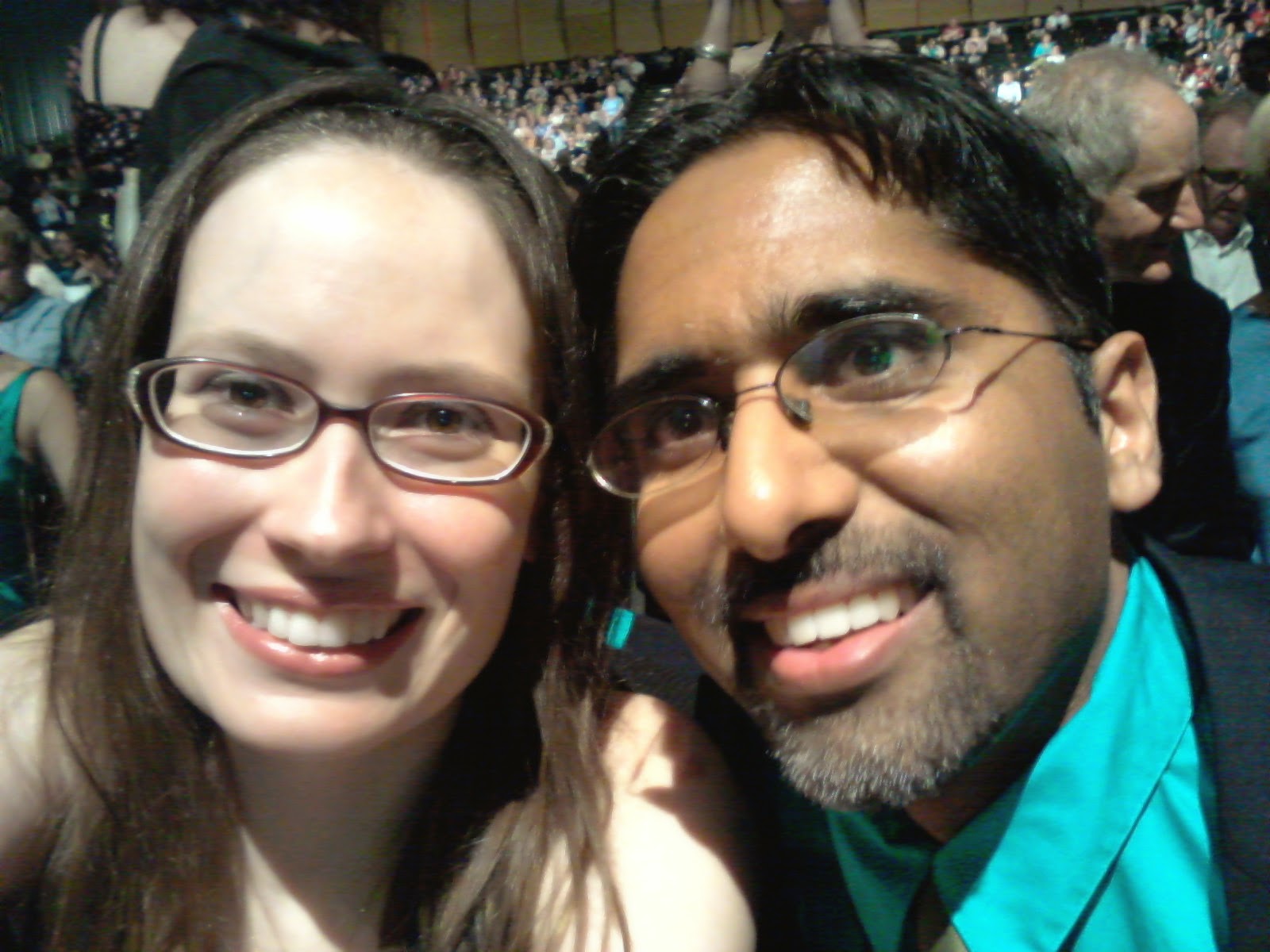
At the Hugos.

At the Hugos.

Read Full Post »

« Newer Posts - Older Posts »