Feeds:
Posts
Comments

Archive for the ‘Arts’ Category

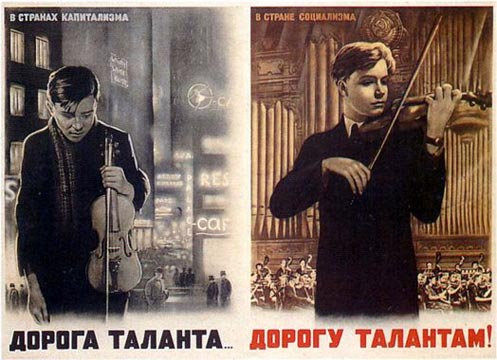
The Tate Modern currently has an exhibition of Soviet era propaganda posters.  I spent a lot of time looking at them, but here is the one that sticks the most in my mind:

"Road to Talent"

On the left, we are shown a (presumably) talented violinist in the U.S., cold, poor, and hungry, wandering the streets at night and being unable to make a living from his music.  On the right, we see a similar violinist in the U.S.S.R., his skills being properly nurtured by the state, elegantly dressed, performing with an orchestra.  Of course, what the poster doesn’t show are any of the drawbacks of the state-sponsored system. 

My husband told me this poster wasn’t so far off the mark.  Many Soviet-trained musicians immigrated to Israel and it was common to see these world-class musicians busking on the streets.  There were simply not enough orchestra seats in the country to accommodate all of the incoming talent.

This got me thinking about the price we pay, as artists, for our art.  When does the price become too high?  Although in some ways the Soviet Union was ideal for artists, many were stifled: denied religious, sexual, or political freedom, not allowed to manage their own careers, censored.  For some musicians, it was obviously better to be busking in Israel than having a glamorous concert career back home.

Here is the U.S. the price for artists is very different.  There is the money/time trade-off: do you get a day job for money and then run low on time, or do you take the time for your art and embrace possible financial insecurity?  Can you achieve the dream of being successful enough to have both time and money?  Or can you find a compromise between the two like I did?  There is the rejection price: lots of hard work, often for years, with very little recognition or reward beyond that of the creation itself.  There is the voice of public opinion, wondering at the value of what you do, telling you that you’re wasting your time, confused as to why it’s taking you so long to become “famous”.  There is the pedestal-pit price of everyone either telling you how what you do is impossible (“I could never sing”) or how what you do is so simple (“I’ve always thought I could write a book”), to the point that it becomes hard to explain that art is rarely either impossible or simple, consisting mostly of a lot of hard work.

American artists complain about all these prices a lot, and that’s fine.  We’re letting off steam so we can go back and focus on our work.  Or we’re commiserating with one another.  Or we’re educating the public and trying to change the necessary prices.  But overall, I think we’re lucky.  I can write a book including controversial interpretations of American history or compose an opera on the evils of capitalism, and I won’t be thrown in jail.   I can believe what I want and talk about it ad nauseam on my publicly accessible blog.

Sure, the price can still become quite a hardship sometimes.  But we all have a choice about what priorities we’ll set, and we can even change our minds later on if it’s not working out the way we hoped.  I’ll choose the life of that violinist wandering around in the dark every time.  The confusion in the dark makes the art even more valuable in my eyes.

Read Full Post »

My friend Sean Craven recently wrote an essay about practice.  (Has anyone not heard of Ericsson’s 10,000 hours of practice makes an expert theory?)  The entire essay is interesting, but what particularly struck me was this section:

But I have noticed not just in myself, but in most of the serious beginning writers I know, a sense of stern duty, of feeling that we must steel ourselves for the rigors to come. Writing these days feels like a polar expedition, where we expect to lose a finger or nose to frostbite in the process of starving to death while surrounded by bears.

I laughed out loud in recognition, of both myself and many of my writer friends.  In the last few months, I’ve lost contact with that touchstone of living an artistic life: remembering that I love what I do, and making sure I continue to love it.

It’s so easy to become concentrated on the duty aspects of learning a craft.  I must practice this many hours per week, or I must meet this minimum daily word count.  I must write x number of short stories, or add x number of songs to my repertoire.  I must work diligently on mastering a, b, and c issues that I know are holding me back from being the artist I want to be.  I need to submit or audition more, write better and faster, keep up with Writer K who seems to be achieving SO MUCH MORE than me in the same period of time.  And maybe I should consider attending another workshop or masterclass.

It’s not that these goals are inherently wrong or bad (except possibly for keeping up with Writer K, which is a slippery slope filled with disappointment).  But when your brain is filled with the ear-splitting chorus of duty, sometimes it becomes hard to remember why you started in the first place.  In other words, once a beloved hobby transitions into being “work”, how do we keep the fire going?

I faced a similar transition when I moved from office work to teaching music.  I worried that by making my living with music, I might lose my love for it.  This fear proved to be  unfounded because:

1. Teaching music was infinitely better than the office work I had previously been doing.

2. I really like teaching and working with kids and teens.

3. I really do love music and singing and particularly musical theater that much.

4. Finally, and I think this point is crucial, my job was to spread a passion for music, so I was constantly reminding myself of how cool and amazing music was and pointing out these elements to others.

I had to make some small adjustments to keep myself going: I transitioned away from teaching how to sing pop music, for example, because it began boring me to tears.  And my job was certainly not free of duty, not by a long shot.  But when I closed my studio this summer, I still loved music, singing, and musical theater just as much as when I started.  Thinking about this now, I realize I achieved no small feat in keeping my passion alive.

It is my belief that I love writing, fiction, and narrative just as much as I love singing and musical theater.  I’m just so weighed down by duty that I forget to think about the positive, and unlike at my studio, one of my principle duties isn’t to show how amazing writing can be.  On the contrary, I sometimes feel a certain amount of grumbling is required just so people understand that I’m actually working at all.

So I’m going to be trying out a little experiment for the next few weeks.  When I sit down to list my five happy things, I’m going to add something to the end: reminding myself of concrete reasons why I love to write.  My hope is that this exercise will allow me to enjoy writing more thoroughly, not because it’s an item on my to-do list but for the sheer joy of it.  When I stop and think, it doesn’t take me long to realize what a privilege it is for me to have artistic and challenging work.  I’m officially giving myself the time to remember.

Read Full Post »

She works for a video game company, writing in a universe she’s loved since childhood.  In return for doing this job she loves, she gets a salary, vacation days, health benefits.  This is a dream.

She discovered the story of a brave boy in New Orleans, who during Hurricane Katrina drove a busload of people to safety.  Lack of publisher interest didn’t make her lose faith in her story and the courage of this boy, and she decided to self publish to make sure his story was told.  This is a dream.

She worked on her novel for several years, joined a critique group, participated in the writers’ community, and kept trying.  Her debut novel is coming out in the spring of 2012 from a major publisher.  This is a dream.

He made his own publishing deal with a small press and has his second novel in a series (third book total) coming out in 2011.  He was nominated for a Hugo, and was invited to be Guest of Honor to a regional convention.  This is a dream.

She started her own business, which would allow her to support herself comfortably only working halftime.  She spent the rest of her time engaged in whatever creative projects struck her fancy.  This is a dream.

Her dad wants her to attend an Ivy League college she couldn’t afford.  She wants to study voice, composition, and writing and live abroad for awhile.  She’s like an echo of myself, but she’s not.  This is a dream, and it’s hersHere’s hoping she gets to live it.

Allow people to live their own dreams.  Every dream is as different as the dreamer, and each one is valid and special in its own way.  When we look down on someone else’s dream, it’s because it threatens something inside of us.

We can do better than that.

Read Full Post »

Over the past two years, since my entering into this crazy fiction-writing world, I’ve noticed that many of my compatriots are often discouraged, depressed, worn out, or feeling hopeless about their writing.  Serious devotion to writing as a calling and career seems to take quite the emotional toll.  And two years has been enough time for me to experience this emotional stress firsthand.

What is interesting to me is that I come from an arts background in music.  I did musical theater, got a BA in music, played my own music publicly in London, etc.  And my experience with music and being a pre-professional musician was in no way as brutal as my experience now of being a pre-professional writer.

Please note this is not because I think writing is inherently harder than playing music.  If anything, I think I have slightly more of a natural knack for writing than I do for music.  And I don’t think being a professional musician, especially one who makes her entire income through performance, is any easier than being a professional writer who makes his entire income through writing fiction.  But on the whole and in my own experience, being a pre-professional musician was easier than being a pre-professional writer.1 Here’s why:

1. Higher barrier to entry: Most American adults can sit down and write a sentence without having to practice first.  But have you ever heard someone pick up a violin for the first time and draw the bow across the strings?  If you haven’t, count yourself lucky because the results can be painful to the ear.  This basic difference means that being an aspiring musician generates more respect than being an aspiring writer.  It also weeds out most of the wannabe and non-serious musicians right out the gate, because to achieve even a basic level of musical competence requires non-trivial amounts of practice time.  This is not so with writing.

2. Simple mentorship system: As a musician, it’s common to have a private teacher who will mentor you, give you tons of individual attention, and keep you on the straight and narrow in terms of continuing practice and improvement.  Or you might even have several teachers for different instruments (for instance, at various times I’ve had private piano teachers, voice teachers, and composition teachers).  A good teacher will keep you encouraged and inspired most of the time, and kick you in the ass when you really need it.  There are many resources available for finding a teacher, and you pay a set fee for the privilege of study.  This contrasts to finding a writing mentor, which I don’t know how to do and which has no set way to achieve.  Interest one of the teachers at your workshop or your writing class, perhaps?  But once the class ends, then what?  There’s not a clearly defined business model for this as there is in music.

3. A more respected educational system: It is also common wisdom that a writer should major in something besides creative writing, and the opponents of the usefulness of an MFA in creative writing seem to be as numerous as the proponents.  While I’m not arguing these points one way or another, it stands in marked contrast to music’s mentorship system (discussed above) and higher educational system.  While if you’re doing certain kinds of music, a degree might not be necessary, most music programs help develop skills that will obviously come in handy later on, and musicians don’t tend to argue about their usefulness.  This means if you know that you need to build skills as a musician, you can have the institutional support of a university music program while not constantly worrying that you might be wasting your money.  I’m not saying there aren’t MFA programs that are fabulous, just that general opinion is mixed.  And thank goodness for workshops like Clarion, Odyssey, and Taos Toolbox and organizations like SCBWI that take up some of the slack here.  But workshops and organizations don’t generally offer the same consistency as a four-year program.

4. More emphasis on collaboration: As a musician, I had many opportunities to perform with various groups.  I was taught how to work with other musicians and had group performance opportunities in choirs, musicals, and operas.  Instrumentalists have orchestras, bands, and chamber music ensembles.  And then there are jazz bands and ensembles and rock or pop bands.  Finding other musicians to make music with tends to be pretty easy.  Writing, on the other hand, is a fairly solitary experience, and while one could argue that the critique group is the equivalent of a band, a lot of critique groups don’t meet as often and/or aren’t working together as closely.  The result of this can be a lack of deep working relationships.

5.  Possibilities to practice art in the real world: Speaking of performance, not only did I have many opportunities, both during college and afterwards, but it was highly encouraged, even expected.  A young and inexperienced musician went out and gigged, auditioned, joined a band, whatever.  And if you weren’t paid for your efforts for awhile, well, that was the norm while building up your chops.  Contrast this to writing, in which well-respected writers advise new writers not to submit to markets that pay less than five cents a word (the current “pro” rate).  Leaving aside the absurdity that a couple of cents per word one way or another isn’t going to make a difference in quitting your day job anytime soon, this attitude means that new writers are actively discouraged from showing their work in public unless it can hit the bar and taste of the few pro markets.  This in turn lowers motivation and increases both pressure to improve at unattainable rates of speed and accompanying feelings of futility and isolation.  For the pre-professional artist, any recognition, however small, is powerful incentive to continue, and in writing, there just don’t seem to be as many of these opportunities.

6. The stigma (or lack thereof) of indie artists: The indie music scene is vibrant, exciting, and most importantly, not overtly stigmatized.  In fact, it’s hip to be an indie musician.  Sure, you might have trouble paying your bills, but in return you get to make the music you want to make, thumb your nose at The Man, and live a musical life.  Most other musicians will either be actively supportive or not care one way or another.  Cutting your band’s own CD has gotten a lot easier with recent technology, and bands do it all the freaking time.  Contrast this with the indie writer scene (otherwise known as self-publishing).  You may have a hard time paying your bills this way too (or you may have an easier time if your name is J.A. Konrath), but regardless, other writers will sneer at you.  I’m not kidding.  The stigma against self publishing of any sort is incredibly strong.  It’s so strong that a lot of established professional writers aren’t putting their backlists (the rights of which have reverted to them) up on all the electronic platforms.  Now this might just be lack of business sense, lack of interest, or technophobia, but I find it very striking.  To me, this doesn’t even count as real self publishing because the work has already been published with a publishing house and received the full traditional treatment.  But I digress.  Most writers I’ve met are firmly in the “traditional-publishing-deal-or-bust” camp, even though distribution channels and producing a final e-edition of a novel have gotten much easier with recent technology, just as producing CDs is now easier.  The main effects of this attitude are less options for writers of all levels, not just the pre-professionals, and less emphasis on business innovation and experimentation with new business models.  Meanwhile, there are already huge amounts of self-published material flooding the marketplace with no gatekeeper, and somehow readers seem to be surviving the onslaught just fine.

All this said, I’m incredibly grateful for the assistance I’ve received from the writing communities I belong to.  My friendships and discussions with other writers have been some of the highest points of my writing life.  If anything, this analysis shows how critical these communities and fellow writers truly are.  But if nothing else, I hope this comparison between pre-professional musicians and writers will serve to illustrate the difficulty of the writing path, and encourage us to be supportive, patient, and kind to one another.

For those of us who are nonconformists, it can also act as a reminder that change may be coming, but change isn’t always such a terrible thing.

1 Note that I am most familiar with the speculative and YA communities in writing, and have at least passing familiarity with Classical, jazz, rock/pop, and musical theater in music.  What I’m talking about may not hold true in other genres or styles.

Read Full Post »
A fringe benefit of being a writer (or other artist, since this certainly applied to my songwriting and singing) is that everything that happens in your life can be recycled into your work later on.  And by everything, I mean the bad stuff.  I recycle the good stuff too, of course, but while that good stuff was happening, I probably wasn’t thinking, “Oh, this is character building and I can use it in a novel someday, which will make it worthwhile in end.”  I was probably just enjoying my happy moment.

No, it’s the repurposing of the bad stuff that is the real benefit.  I find it oddly comforting that when life throws something unpleasant my way, it might come in handy later for some character or plotline.  Of course, we’ve all heard the phrase “stranger than fiction”; one has to be careful not to stay too true to the actual facts for fear it will sound unbelievable (or be offensive to the involved parties) — I’ve personally had a story slip into the implausible from mirroring reality too closely, from which I learned that writing in too autobiographical a fashion can be a mistake.  But the feelings, those are a rich mine to draw upon, as are the general categories of experience.

Write what you know is the kind of writing advice that is misleadingly simple.  If writers literally only wrote what they knew, there would be precious few fantasy novels and no science fiction novels whatsoever.  Instead there would be a lot of boring novels in which nothing much happens and a lot of time is spent sleeping and doing chores and working in tiny increments towards the exciting goal.  I’ve never known anybody who was murdered, for example – does that mean I can’t write a murder mystery?  Plus, even when I do write what I know, sometimes I can’t remember all the details, at which point I’m still back to relying on Google to fill in the gaps.

But I think write what you know hides a deeper truth.   Maybe we should say instead: write what you feel.  Write what you believe in.  Write what matters to you.  Look deep inside and see what all that life stuff, good and bad, has left you with, and write about that.  Don’t shy away from the stuff that’s dark or scary or sad, because some of that will give your work the lasting resonance you’re looking for.  But don’t feel you have to look away from your streak of idealism or optimism, either.  It’s all material.

So I write a lot about death and mortality and family relationships.  At some point I’ll add in a dash of chronic pain and difficulty walking.  I also write about romantic relationships – usually in which something goes crashingly wrong (the story’s got to have a secondary conflict, after all), but once in awhile in which it goes wonderfully right … at least for awhile.  If I didn’t feel these things myself at some point in my life, I wouldn’t be half as convincing when writing about them.

And the stories that it kills me the most to write are the ones without happy endings.  Because fundamentally, I believe in the happy ending the most.  Or at least the silver lining ending.  Just as in life, in my narratives, I’m always searching for that silver lining that will make even the bad stuff worthwhile.

Ask yourself: what material has your life given to you?

Read Full Post »

I was all ready to write a riveting post on urban fantasy (really, this was going to be world-class stuff) when I read this interview with Paolo Bacigalupi this morning.  And I realized I had to write about it instead.

For those of you not in the know, Paolo won about a bazillion awards for his debut science fiction novel The Windup Girl; in addition he received strong reviews for his first YA novel Shipbreaker.  The entire interview is interesting, but what I want to respond to is what Paolo says at the end:

I realized I’d actually been carrying a lot of baggage from people who would make offhand comments like, ‘well, it’s not like you’re working.’

I was still accumulating some sort of psychic pain over it. You know, that all these people really did think I was a loser, and slacking around and doing nothing, basically. And when you’re writing your fifth book, and four of them have already failed, you’re obviously a joke, right?

Yes, this.  Exactly this.

As many of you know, I closed my successful business (in the arts!  how did that happen?) at the end of May to pursue writing full force.  And the kind of psychic pain Paolo is talking about here is my current reality.

It’s an insidious kind of discomfort, comprising of little pauses, supportive assumptions, and politeness.  No one comes right out and says, “But what about your real job?”  A few people have delicately inquired how my husband feels about it (I would hope the answer would be self apparent, but perhaps not.)  People get frustrated when they can’t reach me by telephone when they’re calling during business hours because it’s not like I have other commitments.  (I do.  They’re called writing.)

It doesn’t help that so much of writing does look exactly like slacking off.  I do some of my best work in the shower, or walking the dog, or sitting there staring out the window.  When I’m planning a project, I can fuss around the house for weeks trying to figure it all out.  And without a word of manuscript to show for it.  (Although maybe my reams of notes count?)

And then there’s the entire publication question.  I am at the stage in my career that is known as pre-professional.  This is the nice way of saying I have no writing credits, no agent, and no deals in the works.  I like to think of it as my apprentice stage, a necessary stepping stone if I’m ever to achieve more.  People in the arts understand this.  Other people, well … some of them understand it.  Others are baffled.

In the end, I’ll embrace this psychic pain; it’s the cost of getting to do what I love all day every day, and well worth paying.

But it sure feels good to see another writer with similar feelings getting the last laugh.

Read Full Post »

When I decided I was going to write a novel, I was really scared.  I was also really irritated to be scared.  I mean, how many big projects had I completed with no problems?  How many times had I gotten up in front of an audience and sung in a foreign language I don’t even speak?  (Sometimes even when I knew I couldn’t sing the song in question very well at all.)  And yet sitting in front of a computer alone in my study with a blank screen in front of me was somehow terrifying?

To push myself to go through with my decision, I wrote a note to myself on a yellow post-it and placed it on the bottom right of my screen.  Here’s what my note says: “Writing isn’t so hard, it won’t take long, and I’m sure I can learn while I’m doing it.  No one else will judge me and my work because they are already so busy with their own problems.”

I wrote what I needed to hear, and I read that note a hundred times over the course of writing that novel.

Unfortunately, the note didn’t work quite as well when I was sending my novel out to agents and my short stories out to editors and getting form rejections.  It sure felt like the world was judging my work.  So I wrote a new post-it and put it beside the first one.  This one reads: “Concentrate on doing the very best you can.  This is what is important.”  This helped me focus on doing my own personal best instead of spending so much time obsessing on everything I wasn’t good enough at yet.

Over the last year, I’ve collected a few more helpful quotations on a white piece of paper taped up on my bookshelf, right next to my screen.  Happily these are all up and shareable via the powers of the Internet.

First I have The Happy Stop on the Writer Train, by Dorothy Winsor.  This helps me remember to focus on the part of writing I love; namely, the writing.

Then I have Neil Gaiman’s great take on rejection slips.  (The last paragraph is the one on my paper.)

Last week, I added Seth Godin’s Exploration and the risk of failure.  This reminds me of which category I am in (the second) and the source of a lot of my anxiety (the pull I feel towards the first).  It also reminds me that failure is a good thing.  (I know, what crazy talk is that?  Any other perfectionists out there?)

I love my collection of pieces of paper.  I don’t even have to read what’s written any longer to feel a sense of reassurance.  And have I ever needed reassurance this summer.  Transitioning away from my business has been, in many ways, very wrenching.  My brain is still muddled from my Taos Toolbox experience to the point where I second guess much of what reaches the page – which means that right now, the part of writing that I love is not writing after all.  I’ve been in a fair amount of physical pain, which distracts me like crazy, and I’ve received a few rejections that have cut to the bone more than usual.

Why am I telling you this?  Because I think all of us go through this kind of time, particularly during transitions.  And when you are going through your rough transition, or get that especially disappointing rejection note, or start going down the dark and dangerous road of comparing yourself to others, or can’t write well because your brain is buzzing or you have a headache or your ankles hurt so much you’re contemplating chopping them off and good riddance, well, maybe you’ll remember this entry and realize you’re not alone.  Maybe you’ll look at your own reassuring notes and be comforted.  (Maybe you’ll even add some of mine to yours.)

Maybe you’ll do what I’m going to do today: grit my teeth (although I don’t recommend this for dental health reasons), hold my chin up, and keep going in whatever way I can.  I’ll write some bad words, I’ll submit a few stories, and I won’t give up.  At least not today.

And tomorrow I’ll do it all over again.

Read Full Post »

I’ve just returned home from the LA SCBWI conference with a head swarming with information about writing.  What has stuck to the forefront of my thoughts are two talks by M.T. Anderson, author of such novels as Feed and the two Octavian Nothing novels, among others.

MT had a lot of interesting stuff to say, but what caught my attention the most was what he said about literature, and perhaps by extension, all art.  In a nutshell, he posited that the purpose of literature is to help the reader see the familiar in a different way.  (For those curious about reading more, this is a theory espoused by the Russian formalist school of literary criticism.)  By estranging the reader (for example, through use of language or various literary devices), the author causes the reader to experience the world differently and restores a sense of the unknown to what was before a habitual reaction.

I know how easy it is for me to something for granted and stop seeing what’s right in front of me.  It’s this sort of closed mind that makes it difficult to see from another person’s perspective, to fail to notice what’s going wrong (or right) in our everyday routines, relationships, and desires, to become cemented in attitudes, beliefs, or knowledge that might be inaccurate.  In much the same way as spending time in a foreign culture can shock the system and dislodge rusty thought patterns, so can experiencing art, whether that be through literature, theater, visual art, music, etc.

Following this train of thought, literature can act to help us see the world afresh like children do.  In general, children are a lot more flexible and adaptable than many adults, and they are constantly having brand new experiences.  Assumptions are harder to make without a few decades of experience and collected data to draw upon.  While reading a novel that’s using estrangement to wake us up, we can regain our childlike perspective on the world, both as a place full of wonder and weirdness and as a terrifying mystery in which many things remain unexplained or beyond our understanding.  The curtain of adult security and certainty that gives us the illusion of being safe in a world of rational order is drawn aside to expose the truth: that life is always uncertain, whether you’re two years old or eighty, and that any object, person, or event has several layers of reality beyond the surface.

While this ability to see beyond the surface is certainly useful for artists of all types, I would argue that it is invaluable to anyone who wishes to fully appreciate the human experience.  Art forces us to take notice and stop moving through our daily lives on automatic pilot.  It reminds us of what it was like to be fourteen, or helps us imagine an entire collection of possible lives we might have led (or might still lead).  It shows us the world through someone else’s eyes, someone inherently other because they are not us.  Whether we look at a Dadaist painting that skews common objects and reminds us of universal themes such as the passing of time or read a novel in which language describes a commonplace object in terms we would never have applied, the jolt tickles our brains.  Remember, it says, to really *look* instead of merely knowing.  Remember to breathe in an experience instead of getting too caught in our own heads to notice.  Remember to listen and delve deep.  Live what it is like to be a child, when the world lies before you, scary and stunning and exquisite.

Read Full Post »

A few weeks ago, I stumbled across this article listing the five common traits of successful artists.  If you’re an artist or love an artist, go read it now.  I promise it is short and worth the time.

I agree with all five points Lori McNee makes: passion, business sense, work ethic, resilience, and support.  We’ve already talked a bit about her fourth point, resilience, when we were discussing disappointment.

Today I want to talk about her fifth trait: having a support system of people who believe in the work.  The longer I am involved in artistic endeavor, the more I realize how important this component can be, if not to “success” than at the very least to my own personal well-being.

There is a special kind of zaniness that many artists have, a weird sort of marriage between egotism and insecurity, self confidence and self doubt, ecstasy and despair.  The roller coaster is a lot easier to ride out when you have people cheering you on from the side … or riding that roller coaster with you.  Getting negative reinforcement, not from critiques of your work (this will hopefully help make you better at your art) but from the mere fact of undertaking the work in the first place, can plunge the artist into the depths of angst.  You might even be convinced to give up.  Having powerful positive forces to help balance this out is essential unless you have an especially thick skin.

I think it’s no accident that I begin work on my most ambitious artistic endeavors when there is someone in my life actively rooting me on.  Beginning serious study of music: my mom.  Applying for and writing a senior recital: my best friend Francine.  Writing a song a week: my friend Jimmy.  And once I started dating my now-husband, I started my musical and then my novels.  I am not convinced I could have accomplished what I have without the support and energy of these fabulous people.  It’s possible I would have done it anyway, but it would have been a lonely path.

Nowadays, I’ve connected so firmly to other writers, in both the speculative and kidlit communities, that I no longer depend on one person.  This is the ideal situation for a number of reasons.

  1. Other writers understand me.  They understand what I’m going through, they understand the different steps of the process, they understand why I’m happy or sad or neurotic.
  2. Some of the writers are ahead of me in their careers and therefore can be turned to for sage advice.  Some of the writers are behind me on the path and I can help them out and pay it forward.
  3. When one person has life happen and doesn’t have time for mutual support, I can easily turn to someone else, and there are no hard feelings.
  4. I can watch and be inspired by others’ successes.
  5. I have opportunities to learn and improve my craft: through conferences and conventions, through workshops, through critique groups and sessions, through reading other people’s works and hearing about other people’s struggles.

I have to put a quick caveat about family and other firmly entrenched nay-sayers.  If your family is actively supportive of your art, hug them extra for me and realize you are extremely lucky.  However, we do not get to choose our biological families, so some of us may find that our choices baffle our relatives.  (This also holds true of certain old friends, random acquaintances, and business associates.)  Ignoring what they say about our passions can be difficult and frustrating, but it just makes having a support system all the more important.  Trying to change someone’s point of view about art (or anything, really) is an uphill battle that will often end in defeat.  Instead, I try to ignore any defeatist messages I hear, and rant about it later to someone who will understand (usually my husband, who has infinite stores of patience for listening to this sort of thing).  Do I shut these people out of my life completely?  No, not usually, and sometimes it’s impossible to do so.  Do I limit my time with them and try to steer the conversation away from potentially damaging remarks?  You betcha.

I’ll even take the assertion of spending time with supportive people one step further.  The more time I spend with people who are creative dynamic thinkers, whether they be artists, entrepreneurs, scientists, or what-have-you, the more energized and inspired I become.  Seeing other people’s accomplishments brings them firmly into my own reality frame.  I hang out with my friend who started his own tech company, or I hear about a high school classmate who started his own nonprofit, or I get sporadic updates from a college friend about the circus troupe he’s touring with, and I see beyond my own limitations of vision.  These people’s lives show me what can be possible, and they inspire me to think big and then figure out how to make the idea a reality.  I strive to be like these friends of mine, someone who can lift people up and have the courage to make bold decisions about life.  This is what I think it means to be a practical free spirit: to dream big and then create and implement a plan to make it happen.

Read Full Post »

Another reason I really like the Newsweek article on creativity is that it explodes the myth of creativity has some kind of magical, inherent talent that someone either has or doesn’t have.  No, creativity can be learned, creativity can be taught, and creativity can be practiced.

When decoupled from its traditional fused relationship with artistic pursuits, this assertion makes perfect sense.  Thinking creatively is just another way of processing information, and if the human mind can be trained to memorize (and believe me, my brain was resistant to this one), it follows that it could also be trained to work creatively, that is, to combine divergent and convergent thinking into a coherent and well-practiced process.

Artists know this about creativity already, at least subconsciously.  It is why we obsessively practice.  Not only are we practicing our craft and our discipline, but we are also practicing creativity.  I’ll give myself up as an example.  I wanted to write a musical for several years before I sat down to do so.  Why did I wait so long?  Partly because I had no idea what to write about.  I couldn’t think of a single idea that I felt had enough merit to pursue.  I eventually had an idea, sat down, and wrote my musical in 2006-2007.  After a short-ish break, I wrote my first novel in 2008.  It was still hard for me to think of ideas, and I’m not just talking about that one break-out idea that is the best thing I ever thought of.  I had trouble coming up with any ideas, but at least it wasn’t as difficult as thinking up the idea for the musical.  During this time period, if I had a truly good idea, I felt like I had to hoard it, save it away until my writing skills improved enough to do it justice.  I certainly didn’t want to waste a good idea, after all.

It’s been two years since I started writing that first novel, and now I have lists of ideas.  There are so many of them that I’m sloppy and sometimes don’t write them down.  It feels as if there is a never-ending FLOOD of IDEAS pouring from my brain that I will never have time to explore.  I can sit in the bath and come up with two or three ideas that I believe have merit in twenty minutes.  No kidding, I did that last week.  Granted, coming up with novel ideas is still more fraught than thinking up ideas for short stories, because writing a novel is a much bigger investment of time and effort, so I want to be sure I’ve picked an idea that will still appeal to me in three months, or six months, or however long.  But it doesn’t seem to be the insurmountable task that it did only two or three years ago.

Why the radical change?  I think it’s because I’ve been practicing coming up with ideas to the point where it’s not a huge deal anymore.  Ideas don’t seem like rare precious things to hide away; the more I play with them, the more of them are born.  This may also be why there’s this huge disconnect between readers, who always ask where ideas come from, and writers, who get so sick of what seems like an obvious question that they sometimes lapse into snide remarks.  Writers have trained themselves to come up with endless ideas.  Readers who don’t also write have not, so to them it remains a mysterious process.

I don’t want to get into a big brouhaha about the current educational system in the United States, and how it’s not training creativity much at all.  Feel free to rant in the comments if it makes you feel better, but I’m just going to take lack of creativity nurturing in the public schools as a given at present.  Until this can be changed, the onus of teaching children how to think creatively lands squarely on the shoulders of parents.  I don’t have kids so perhaps I’m not the best suited to speak on this topic, but I have spent many years teaching kids, so I’ll have a go anyway.

Creativity Training for Kids:

  1. Avoid over scheduling. I’m serious.  Even if it’s all artistic classes, having constant structure even when at play is not going to foster kids’ opportunities to role-play, play make-believe, make up elaborate fictional worlds, or even develop the ability to entertain themselves.
  2. If a child shows a passion for a certain artistic or creative pursuit, encourage it. If he shows an interest in music, see if you can get him music lessons.  If she shows an interest in building complex buildings with Legos, see if you can provide the materials necessary for really innovative construction ideas.
  3. But don’t force a passion that doesn’t exist. As a long-suffering piano teacher, I can attest that forcing a child to play an instrument they hate is probably not going to encourage them to think creatively, unless they get elaborate in coming up with reasons why they can’t practice.  Instead, the child will develop negative associations with an activity typically associated with creativity, and therefore might ultimately devalue creativity itself.
  4. Allow a child to reason out the answer to her own question. Help her out if she needs it, but let her be an active participant in the process.  Also let the child hear you going through creative problem solving processes out loud, and if he wants to , even let him join in.
  5. Limit time with more passive, less creativity-motivating media. Yes, like TV.  I’m not saying no TV, but spending less time watching TV will give a child more time to do other activities that will engage their creativity.
  6. Read read read. Yeah, I know this one is obvious, but I couldn’t resist.  Read to your child, encourage your child to read to herself, ask your child questions about what he has read and what he thinks happened after the story ended.

Let me know if you have other ideas for how to help kids think creatively.  Also feel free to throw out your ideas of how you stimulate your own creativity.  (If you have no ideas about the latter, check out the blog post I linked to yesterday for a starting point.)

Read Full Post »

« Newer Posts - Older Posts »