Feeds:
Posts
Comments

Posts Tagged ‘writing’

Many of you will remember my first backbone post in which I gave my own take on how critiques can go wrong. Now, I think that critiques can sometimes be an extremely helpful tool for writers, so I’d like to talk about my ideal critique. Before I begin, though, I’d like to emphasize that all writers are different. Thus, my idea of an ideal critique and your idea of an ideal critique may in fact be radically different. I’m not saying that my ideas are the only right ideas. There are several different styles of learning, so it follows that there are probably several helpful ways of critiquing. The trick is to figure out which one works for you. If what works for you is ignoring everything I’m about to say, more power to you!

For me, critiques are all about learning. When I’m receiving a critique, I’m doing so in order to learn more about writing and to improve my writing abilities. While it is lovely when critiques end up making my story stronger, that is not my primary motivation for seeking critiques. Instead, my goal is to continue to improve by gaining insight into what works and what doesn’t work. When I’m giving a critique, I’m doing the same thing: trying to teach the writer in question by pointing out what worked and didn’t work for me as a reader.

One thing I am not trying to learn from critiques is how to deal with rejection. I understand that others feel differently, but honestly, I get plenty of practice dealing with rejection by…getting rejected. There is no shortage of editors and agents happy to help me out in this regard, except with them, there is always at least the chance that they will instead decide to help advance my career and/or give me monies! Another thing I’m not looking for in critiques is warm and fuzzy validation that everything I write is awesome. If everything I wrote was awesome, I’d be getting warm and fuzzy validation from my fans, who would be–guess what!–paying monies to read my work. Yes, I know, again with the monies. Notice a trend?

I look at critique as a learning process between colleagues; therefore, my main focus is on how I can help the other writer, and this focus informs my delivery. My husband tells me that people get promoted into higher tiers of management partially because of their ability to deliver bad news. Delivering bad news well is hard! And yet this is, I believe, an essential skill in giving a good critique because almost every critique is going to include the bad news that our work isn’t perfect (and it might even be hanging together precariously with paper clips and duct tape).

Here are some guiding principles that I try to think about as I critique:

1. Mention the positives as well as the negatives. It is so tempting not to do this, and instead just focus on what’s broken. Sometimes, honestly, it’s hard to even think of any positives. But not only does this leave the writer more receptive to thinking about any criticism, it also shows the writer what she’s doing right, what she shouldn’t mess with, and what her strengths are (that she can showcase and allow to shine in future work).
2. Discuss what doesn’t work in a matter-of-fact and positive manner. Example A: “I can’t believe you used all those adverbs. There were just adverbs adverbs adverbs flying all over the place. Get rid of those goddamned adverbs, okay? It was just so bad how you used all those adverbs.” Example B: “I noticed you used a lot of adverbs. I’d suggest going back through and deciding which of them you actually need.” Example A makes people feel bad and stupid and discourages experimentation. But if you’re not experimenting as a writer and taking risks, how are you ever going to get better? (Note I am not actually advocating vast amounts of experimentation with adverbs in particular.) Example B or something similar is what I prefer.
3. State your points in a clear and concise manner. So often I hear people speak at length about one point of criticism that they could have easily expressed in a few sentences. In a verbal critique, using loads of examples to make your point is not required. Instead, mark them on the hard copy of the manuscript or in track changes, and summarize when you’re speaking. The writer can always ask questions later if something is not clear.
4. Use ditto freely. Another thing I hear a lot is several critiquers waxing long about the same point, one after the other. There is no need to do this. Instead, just say, “I ditto Katherine that the beginning seemed slow” and move on. My Taos crew were experts at doing just this, and it was amazing how much it sped critiques along…as did the two-minute time limit per person.
5. Decide what key points you wish to make verbally ahead of time. Prepare for the critique as you would for a lesson. (Can you see my teacher background here?) Consider typing up a summary sheet of your critique that you can give to the writer afterwards. I know a few writers who are masterful at doing this, and I always look forward to receiving critiques from them.
6. Help the writer by talking about their story, not yours. We all have the types of stories we like to read, and the types of stories we like to write. These types might not be the same for other writers! (I know, it’s shocking, but there it is.) Give feedback and suggestions while keeping in touch with the story you think the writer was trying to tell instead of figuring out what story you would be telling. The second rarely provides a useful learning experience since it mostly just reflects your own personal taste.
7. Critique with an eye towards making clear the promise and/or vision of the story. Benjamin Rosenbaum said something very intelligent in the comments of my critique backbone post. “I think detailed, specific positive critiques — not just cheerleading, but analysis of what worked — are actually more useful than negative ones which focus on what’s not working. Both are useful, but in the end you want to revise towards a vision, not away from problems. Doing the latter will result in a dead story — all rough corners smoothed away, with what’s left being something no one would object to, but no one is excited about either.” What he said. If we as critiquers can help the writer hone his vision, then we’ll leave him excited, both to potentially revise this story and to write in general.
8. Be encouraging. There is no reason for a writer to leave a critique feeling like a swollen and bloody rat. Honestly, I don’t care how bad the piece might have been. If a writer is regularly working and improving, there is something to be encouraging about, whatever the flaws. I’m not saying to lie and say this was the best story you’ve ever read, but a few kind words acknowledging that the writer has worked hard can go a long way. No, editors and agents won’t usually give these words. That’s why it’s even more important that they be given by supportive colleagues.

Of course, this list covers my ideal critique. In practice, I often fall short in execution, but it is what I strive for. I have been lucky enough to receive many fine critiques that have taught me both how to be a better writer and how to critique with an eye towards helping a writer learn instead of tearing them down.

What is your ideal critique? What are your guiding principles when you’re preparing a critique? What about giving a critique do you find the most difficult? Let me know!
Read Full Post »

Why I Write YA

Ooh, it’s reader question time! I adore good reader questions. Derek asks, “I’m rather curious about the distinction between YA and “regular”/adult fiction writing.  What makes you prefer one over the other?” (He actually asked a couple other really good questions about YA too, but I’m going to save them for another post.) I have blogged about why I like to read YA, but not why I like to write it. One of my first reactions was that I don’t necessarily prefer writing YA to writing adult fiction, but then I thought about it some more, and yeah, I kind of do prefer it. We will pass very quickly over my one attempt at writing an adult novel, which was an unmitigated disaster, and take a look at my short fiction, which I write to sell to so-called “adult” markets. Even so, most of my short stories include characters who are kids, teens, or college-aged. Not all, but most.

I think the reason for this preference is that I love teenagers. A lot of adults look at me kind of funny when I make statements like this (especially if they are parents of teenage children), but there it is. I think teenagers are great. I love teaching teenagers; as a group, they have consistently been my favorite age to teach (and I add preteens into this group, so think ages 11-18 or so).

Teenagers are so inspiring to me. They have most of their lives in front of them, and they genuinely believe they can accomplish great things. Many of them are passionate and smart, ambitious and driven. Sometimes they are complete wrecks, but they haven’t ossified into their wreckitude.  They also haven’t developed the thicker persona that so many adults have, so they feel very, very real. They’re in the thick of trying to figure stuff out, complicated life stuff, and their emotions are flying all over the place, and who knows how it will all end up? Teenagers are exciting.

In a typical conversation with a teenager, they’ll talk about their friends and some recent friend/boy drama, or they’ll talk about school work. They’ll talk about their interests with huge amounts of enthusiasm once they’ve gotten comfortable with you. They’ll talk about their plans and/or dreams for the future, they’ll talk about the problems they’re having with their parents, they’ll talk about prom (or fill-in-the-blank Big Event). They laugh a lot and still know how to be silly. Sometimes they cry too, because they’re not all about keeping up that perfect veneer. Sometimes they’re flaky and irresponsible, but they’re still learning so at least they might not be forever flakes. They literally vibrate with possibility.

Contrast that with adults, with whom I might normally converse about the weather, or health problems, or their crappy jobs, or home improvements, or “what do you do for a living,” and really the only question remaining in my mind is, why don’t more people prefer teenagers since they are obviously so much more interesting? I’m the kind of person who is always changing and afraid of stagnation. I’m not saying I always like change, but I’m fascinated by it and ultimately see it as a positive thing. I get excited when other people are changing too. And pretty much all teenagers are changing, whether they like it or not.

Luckily I know many interesting adults too (and no, I’m not just saying that), but I find the teenage years to be of inherent interest and inherent conflict. And inherent conflict and characters in the throes of change theoretically lead to riveting story; it’s a little more complicated than that, obviously, but it’s one of my strongest reasons for liking to write YA.

What about you? Why do you like to read and/or write in your genre(s) of choice?

Read Full Post »

While I was definitely kept busy last week with the Backbone Project, I was also hard at work on Theodora Goss’s YA Novel Challenge, which officially began last Wednesday on June 1. I knew going into it that I wasn’t going to start with the actual prose writing by Wednesday because I needed time to plan out the novel first. I am a die-hard outliner; the mere thought of beginning a novel without any idea as to where I’m going fills me with horror. Mind you, I understand that some writers find an outline too constraining, and we all have our own creative processes, but for me, I want to have a clear plan. Maybe it goes with my list-making compulsion, I don’t know.

I’ve been spending the last year learning more about structure as it relates to the novel. I’ve used the basic index card outlining method ever since my first novel, and it’s one of my very favorite parts of the process. I LOVE index cards! So much less pressure than the actual committing words to the page part. At Taos Toolbox last summer, I learned about the three-act structure in more detail (which left me slapping my forehead, I might add). I then devoured Kristen Lamb’s blog series on structure (there are eight parts to this series, although I was unable to find a page that listed all of them together, unfortunately) and was completely fascinated by thinking about story in this new way. And finally, I picked up Blake Snyder’s Save the Cat, which is a book about screenwriting that spends a lot of time on structure, and devoured it in three or four days at the end of May.

Now, I understand that a screenplay for a blockbuster Hollywood movie and a novel are not exactly the same in structure, but they can have a certain amount in common, depending on genre and related concerns. Plus, just as I have an inordinate fondness for index cards, I love organization of all types. I love being organized! It’s such a great feeling. So I decided to try applying some of the things I’ve learned during my outlining process.

My YA novel’s working title is The Academy of Forgetting. Isn’t that evocative? I’m in love with my idea. I first conceived of it back at the SCBWI Winter Conference in January 2010, so it’s been floating in my head for a while. I’d already completed some brainstorming, a basic premise write-up, and some thoughts about characters and various “reveal” moments. Oh, and research, especially about neurobiology (which, by the by, is a crazy and fascinating subject). So last week I printed everything out so I could have it in front of me, and then I got to work on my version of a beat sheet, adapted from the one described in the aforementioned Save the Cat! This beat sheet gives me an idea of the various components of the story that need to happen, and around when they need to happen.

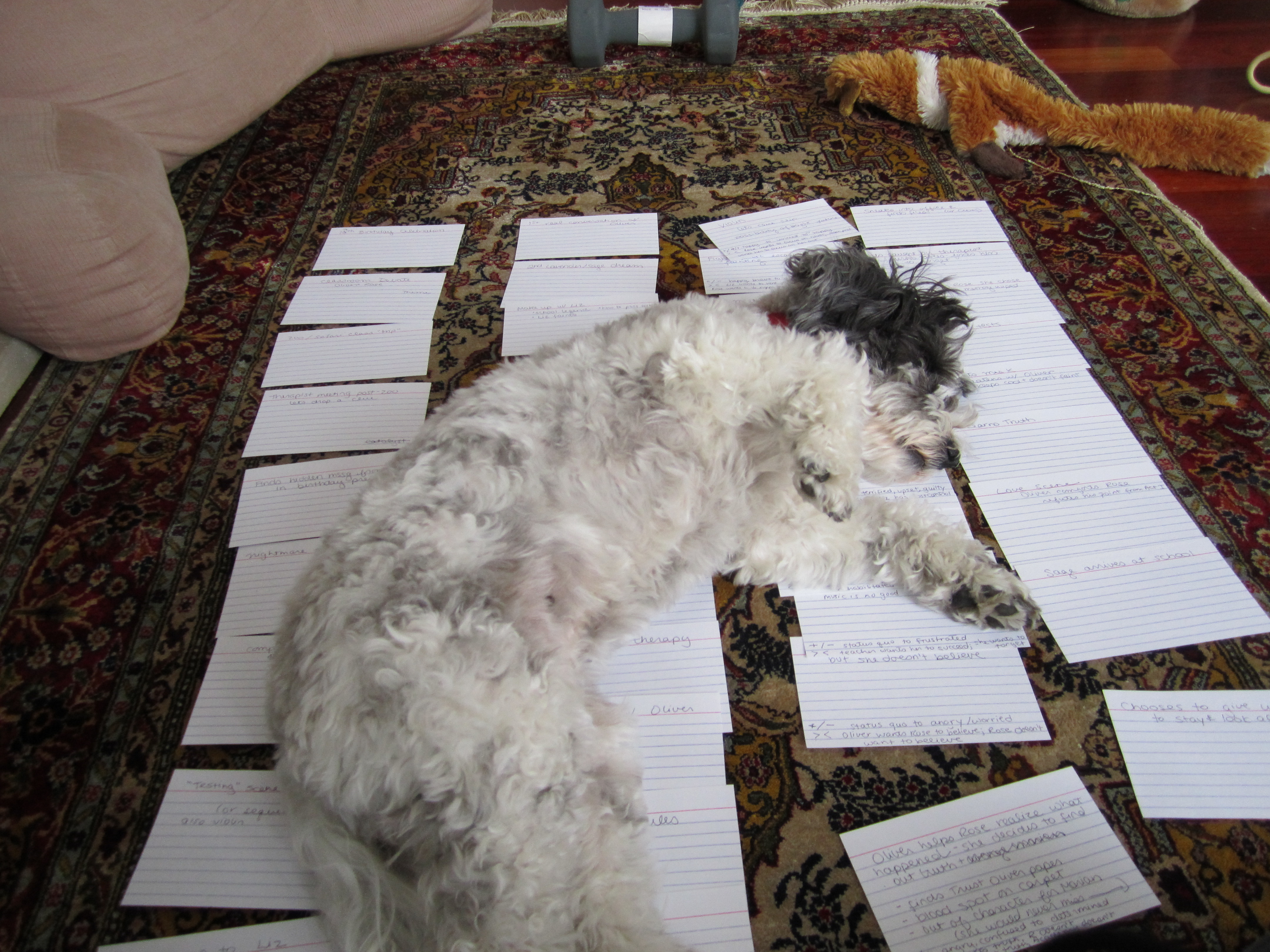
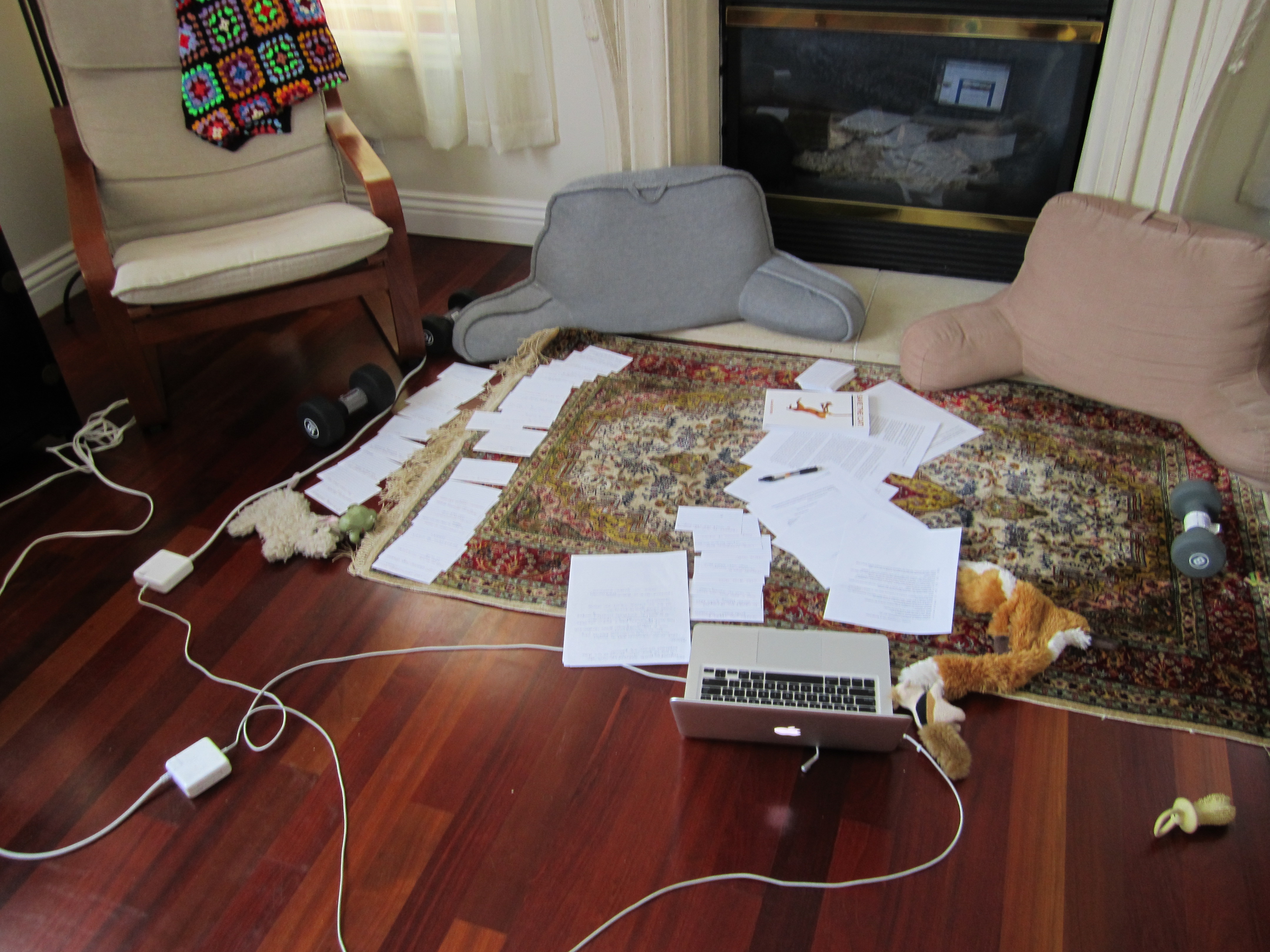
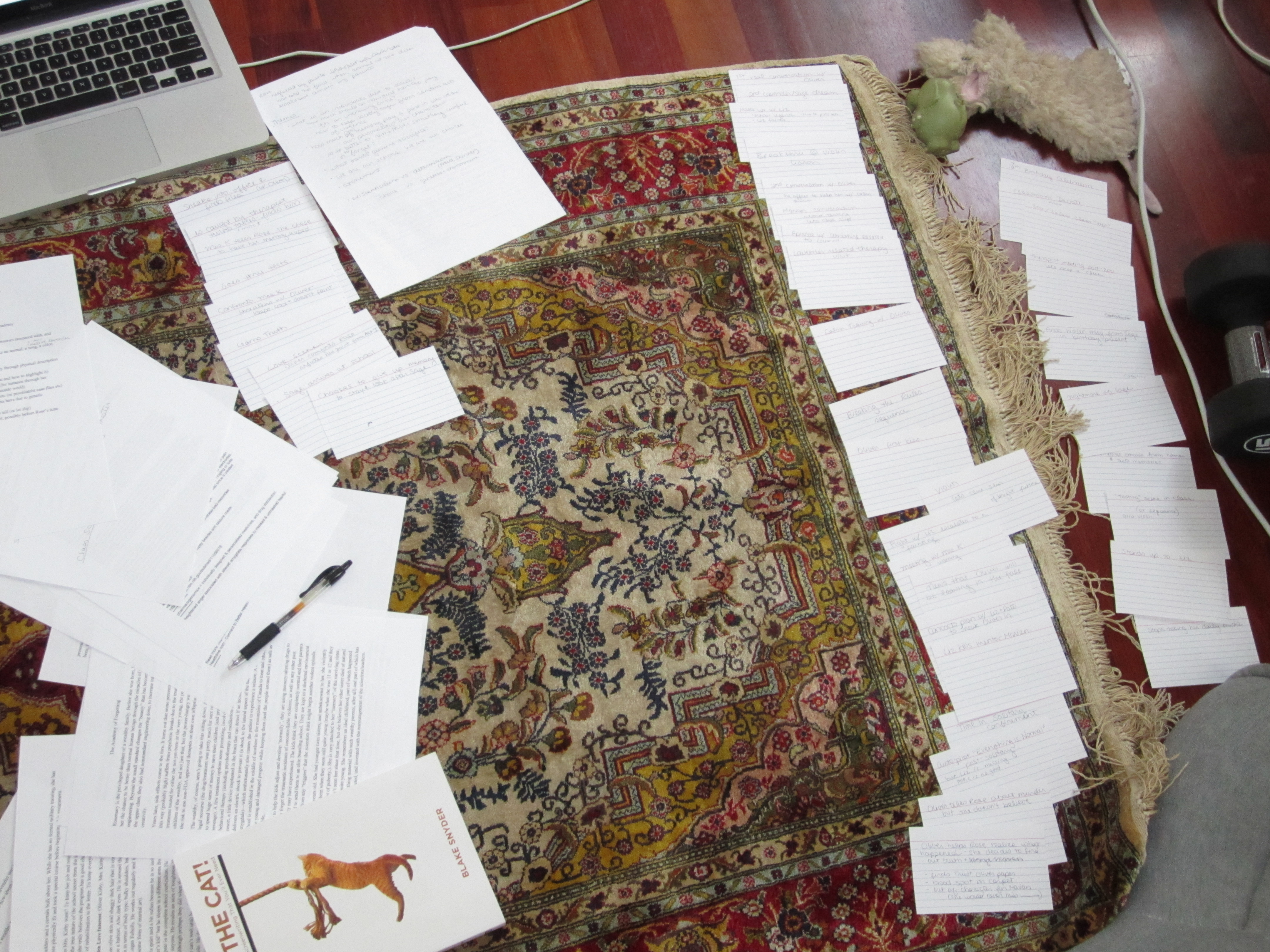
Then I got to break out my beloved index cards and begin to arrange my three acts:

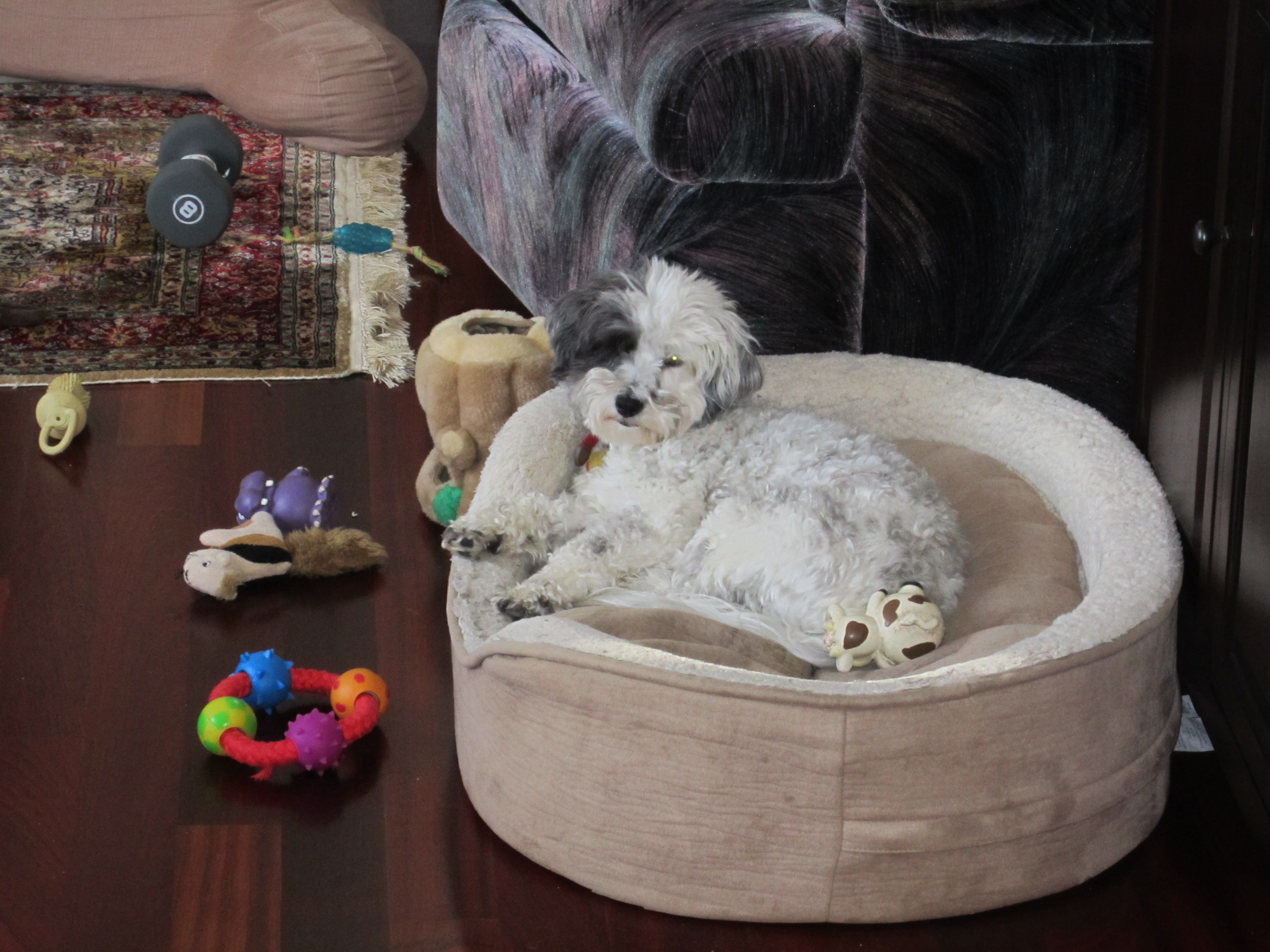
Obviously the proper work environment must include dog toys and weights….

Strangely, I ended up with Act 1 on the far right and Act 3 on the left, which feels backwards, but I decided to go with it.

Luckily, I had the services of a prime story consultant, and her favorite toy cow.

This kept happening once I arranged the acts in their proper order. I’m not sure if she’s so in love with the story that she wants to sprawl all over it, or if she hates it and wants to hide it from view. Maybe she believes in a Zen-like teaching method….

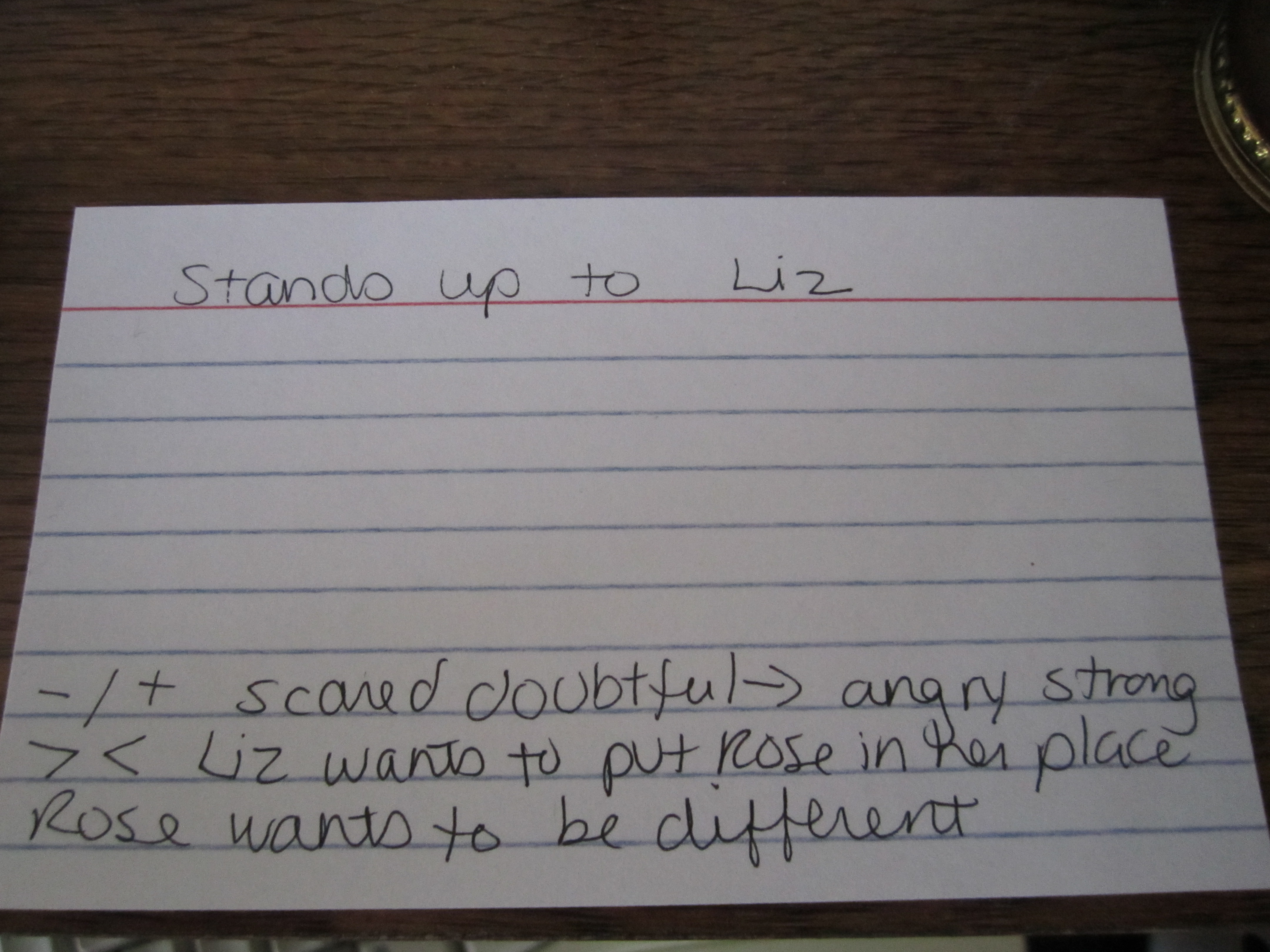
Once I had the novel laid out like this, I began adding two things to each index card: +/- (or -/+) to denote the emotional change for the protagonist in the course of the scene depicted on that index card; and a >< to denote the conflict going on in the scene. So a finished card looks something like this:

I know that conflict description is a bit cryptic (actually, maybe the entire card is cryptic; I chose one that wouldn’t be too spoilerific), but the important thing is that I know what I’m talking about.

Finally, I typed up all of my cards, creating a four-page outline. To this document I added my adapted beat sheet that includes approximate page numbers of when things should maybe happen. And now I have a road map for the book, from which I can feel free to detour wildly if I don’t think it’s working.

What do you think about structure and writing a novel? How extensively do you outline, if at all? What about your process makes you deeply happy, the way index cards make me giddy?

Read Full Post »

As you can imagine, I’ve been giving a lot of thought to the subject of my first Backbone Project post. I’ve decided to take on a writing-related topic (I’ll try to pick a more general interest topic next week for the non-writing inclined), and I chose this one specifically because I expect many writers to disagree with my take on it. So, onwards into the fray! (And yes, my stomach is doing lopsided cartwheels, thanks for asking.)

When I first ventured into my various writing communities, I was regaled by the sanctity of the critique. How to become a better writer? The answer seemed to be to get critiqued. A lot. Really, as much as possible. Any writer who was truly serious about their craft would join a critique group. Or two, or even three or more. Not to mention purchasing critiques from the pros at conferences and for charity, attending workshops that consisted at least partially of critiques, etc. And then post-critique, the writer was expected to exhaustively compile all that criticism and somehow use it to patch together the remaining shreds of story (occasionally there might be more than shreds remaining, a cause for joyous celebration).

I am not being conciliatory when I say that I have learned a lot as a writer from the critiques I have received. It is plain fact. And I am very grateful to everyone who has taken the time to help me learn. But another important fact that I never seem to read about anywhere in the cult of the critique is this: All critiques are NOT created equal. Not by a long shot. And what we as writers are told to do with critiques is not always what works. I have learned this from painful, critiqued-out-of-my-mind experience. In fact, I have gone months without much productivity because of the backlash from a bad critique. I don’t think this makes me a weenie. I think it makes me human; it’s natural to get discouraged from nonconstructive critiques, especially when you are a relative beginner. I mean, do I tell my beginning voice students in detail exactly how they suck at singing, complete with subtle (or not-so-subtle) disparagement, and then have their peers tell them the same thing? Um, no. That would be insane. And yet…

Here is what I have learned about critiques:

FICTION: You can expect a fair, unbiased critique.
REALITY: Some people will always hate what you do (even if you are awesome) because they just don’t dig your style. Some people will get set off by a random, unpredictable aspect of your story and be completely unable to get over it enough to say anything helpful. Some people will read your story in a sloppy manner and give you a half-assed critique. Some people just don’t know how to critique, period.

FICTION: If you’re upset after a critique, you just need to toughen up and take it. After all, you need a thick skin to succeed as a writer.
REALITY: Some critiques are harsh in a constructive way. Some critiques are harsh in a non-constructive way. Some critiques are just plain mean-spirited. Learn to deal with the first of these. The other two? Consider not getting critiqued by these people again or…

FICTION: Take all critiques into thoughtful consideration.
REALITY: Some critiques you can pretty much ignore. That’s not to say you shouldn’t listen while they’re being given, but after a while you can tell which critiques are completely irrelevant to any learning or revising you might be doing.

FICTION: You need critiques to become better as a writer.
REALITY: There are many ways to become better as a writer. The critique is merely one helpful tool among many. After all, there were still great writers before the current fad for critique.

FICTION: You should implement all suggestions given in a good critique.
REALITY: You should listen to the issues a good critiquer is having, and figure out what you, the writer, want to do about it. Often critiquers try to completely retell your story for you (although I wouldn’t personally call this a good critique). In that case, you need to work backwards to figure out what actually wasn’t working for them, and then change it in your own way. And only if you want to.

FICTION: A critique should always be followed by a revision.
REALITY: As long as you’ve learned something from a critique, it doesn’t matter what you do afterwards. Sometimes you need to revise to complete the learning. Sometimes you want to revise. Sometimes you want to chuck the story into the fire and never think of it again. Sometimes you nod, say hmm, and make a few small changes before submitting. Sometimes, if you’re Dean Wesley Smith, you submit the story before the critique so you’re not tempted to revise the life out of your story. (And oh yes, it is so possible to revise your story to death.)

FICTION: If a person is a “pro” or just has a few more credits than you, their word is God in the critique department.
REALITY: I wish. Some pros are amazing teachers and critiquers. Others, not so much. Some people with more credits than you will have amazingly helpful things to tell you about your work. Others will not. Some readers who know nothing about writing will have insights that are equally useful. And some will not. You get the picture.

FICTION: You should be involved in as much critiquing as possible.
REALITY: If you get too involved in critiquing, it might interfere with finding time to do the actual writing. And most of us ultimately want to be WRITERS, not critiquers. Right? Otherwise why would we be putting ourselves through all this?

FICTION: If you can’t handle a critique, you shouldn’t be a writer.
REALITY: If you can’t handle rejection and revision requests from professional editors and agents (who you are doing business with), then you’re going to have some trouble. If you can’t handle the occasional critique (or even the more than occasional critique), maybe something else is going on.

FICTION: Critique trumps all!
REALITY: It’s more important to manage your writing life in whatever way works for you. And if your way is not exactly the same as everyone else’s way, that’s okay. We’re artists, after all. We’re supposed to be different.

Okay, have at it! Disagree with me (or tell me how you’ve been secretly thinking the same thing). I’m going in for more dental torture this morning (if we ever meet in person and you want to see me cry, mention dentistry), but I’ll be commenting with gusto (and pain-induced bravado) later today.

Read Full Post »

I have a guest post over at Cole Drewes’s blog today. It is entitled Writer’s Block: Amusing Myth or Grim Reality. Go ahead and check it out, and let me know if you believe in writer’s block or not.

Also, here is a picture of a cute little dog. Just because.

Read Full Post »

When I read about self publishing, I notice that it’s often being lumped together (ie all self publishing is the same). But of course, the truth of the situation is much more complicated. I decided to make a list (I love lists!) of some less obvious, more creative ways that a writer can use self publishing to further a career.
  1. Out-of-print back list: okay, this isn’t particularly creative, but it’s the most obvious no-drawbacks use of self publishing today.
  2. Short story anthology, using (mostly) previously published works: I think this would be especially good to do if you have a novel coming out soon (or that has recently come out). Numbers show that short stories and their anthologies don’t sell as well as novels, but fans of a novel already out might very well be interested. Of course, even without a novel out, this could still be useful. (A few writers I love are talking about doing this, and I can’t wait to have all their stories in the same place.)
  3. Short stories (previously published or NOT) that tie into the world of a novel you have out (or that is about to come out): Novelettes and novellas that tie in would also fall into this category. Of course, it may be better to offer some of this content for free on your website to draw readers in. The question is, are you using the stories to draw readers in, or to profit from your already-established reader base? Doing both is probably the best of all.
  4. Continuing a series that has been cancelled by its publisher: This is a win for a writer who wants to finish their larger-scope project and the readers who want to find out what happens. One thing to consider, however, is how available the first book(s) of the series are. Are they still in print? Is the publisher offering them as e-books? At a non-prohibitive price?
  5. Writing for a niche or non-obvious market: Some books cannot be sold to big publishing because they simply don’t have a big enough proven audience. This has more to do with business than with quality (although obviously it’s possible that it’s about both). My favorite example is novels set in college. These are often a hard sell because current YA is not set in college, period (with a few exceptions). Sometimes these college books can be sold as mainstream lit or chick lit, but often not. It’s hard to know where to shelve them in a bookstore, and it’s hard to find them. Yet there is obviously an audience for books set in college (I know this because I love them myself and am always on the lookout for more. Diana Peterfreund’s Secret Society books, anyone?) There are other examples of niches like this in fiction, and even more in nonfiction.
  6. Having novels come out both from big houses AND self-publishing: This is an interesting strategy for faster writers, which potentially allows the writer to profit from the upsides of both traditional and self-pub at the same time. It also solves the problem of prolific writers. Honestly, when I read this article, I cringed, because it feels like writers who happen to be fast and have a good work ethic are being penalized. (Note: not all writers, or even first timers, have the long wait discussed in this article.) Of course, this is only an option if the writer doesn’t have a non-compete clause with the big house or is willing to use a pen name (if it’s a secret pen name, several of the advantages of this set-up will be wasted; an “open secret” pen name may or may not go against contract. I have no idea what most contracts specify in this regard).

Have any other creative ideas about how to use self publishing? Thoughts about the pros and cons of the ones I’ve listed above? Let me know!

Read Full Post »

“Anyone can write popular fiction… You just tell a story that everyone likes.”

Does this quote make anyone else’s blood boil? This type of talk makes me want to be alternately scathing, snarky, and pitying. I got it from an essay by Kat Howard, about her chance parking lot encounter with some fellow who made light of her post doc position in medieval and speculative literature.

I know I’m preaching to the choir here, and that most (if not all) of my readers understand how truly challenging and difficult it is to write a novel, whether it be mainstream or genre, adult or children’s, an epic tome or a light-hearted romp. And I don’t want to get into the genre/literary question, so let’s please not go there.

Instead, I’m going to break down this statement. Anyone can write popular fiction, can they? Let’s take a look.

Writing Fiction — Lifestyle — What It Takes

1. Hours upon hours of sitting by yourself doing the writing. Not to mention the research. Not to mention the revisions. Not to mention the nit-picky copy editing.
2. Avoiding the lure of Facebook, Twitter, Wikipedia, Farmville, MMORPGs, Solitaire, Minesweeper, etc. so you can actually do said writing.
3. Carving the time out of your already busy life, in which you’re also expected to have a day job, take care of your family, clean and do chores, and deal with life’s multiple disasters and time sinks.
4. Smiling and nodding when people say patronizing things to you. Explaining kindly and gently that building a writing career takes a long time, and no, it won’t make you rich. Alternately, getting into a lot of arguments.
5. Thinking about your story in the shower, while walking the dog, while doing the above-mentioned cooking and cleaning, while driving from point A to point B, and while you should be sleeping.
6. In your copious spare time (ha!), reading tons and tons of books, both in and out of your genre. Not to mention your nonfiction research materials.
7. Dealing on a daily basis with rejection and maintaining a positive upbeat attitude, a can-do spirit, and continued forward thinking to the next project.
8. Reading unpublished work from other writers of roughly your same level (at least in theory), learning how to both give and receive critiques

Writing Fiction — Craft — Required Understanding

1. Characters. This includes understanding every character in your book, knowing their back story, knowing their mannerisms and how they speak (word choice, etc.), knowing what they would know, knowing their motivations (what they want) and making sure you’re consistent about it. You need to keep your POV consistent over the course of the book, whatever you decide (first, close third, omniscient, etc.) Your protagonist needs to be sympathetic in some way. He/she/it needs to be a driving force in the novel, not a passive character who is only acted upon. Also your protagonist and probably other characters as well need a moving and well executed character arc, in which they grow and change and react to events and are different by the end of the novel.
2. Plot. This includes knowing how to structure a novel, making sure there is interesting conflict, making sure the stakes are periodically raised and the conflict builds over the course of the novel, knowing what your main narrative engine is, as well as keeping track of subplots and planning the correct number of them. Also the plot needs to hold together and make sense (no plot holes, please), you need to know the purpose of and conflict in each scene. You’ve got to keep the pace up (make stuff explode or whatever) or it will get too boring. This would also include making sure the continuity is sound and that the scenes happen in the correct order. You must make sure you create a hook at the beginning to draw the reader into the novel, and you aim for achieving emotional resonance and a certain closure at the end of the novel (unless it’s in a series, in which case you’re busy thinking about the overall series arc as well as the novel arc as well as deciding whether the novel needs to stand on its own or not).
3. World building. This is understanding how your world works. This includes the magic system, which needs to have rules and costs; geography, especially of a secondary world or another planet; economy; political system; social structure and mores; religion; technology level as well as any invented tech; magical creatures and/or aliens and how they differ from humans; and various existing infrastructure. Then once you’ve created your world, you have to get it across in the novel without over-utilizing info dumps or slowing down the pace.
4. Prose. This is being able to use the English language passably well, which is surprisingly difficult, even for native speakers. This includes knowing as many grammar rules as you can cram into your brain and then knowing when to break them. Points to remember include the following: eschew adverbs and speech tags other than “said” and “asked” and minimize speech tags in general. Vary sentence structure. Try really, really hard not to overwrite or use too many adjectives for your really shiny setting. Remember that you do have to say something about the setting, though. Try not to overuse words such as “that” or “really” or the “to be” verb. Use active verbs, but not too many weird verbs or it’s distracting. Spelling skills also help as spellcheck won’t catch all your mistakes.

Writing Popular Fiction that Everyone Likes — Good luck.

1. In order to make your fiction popular, you have to sell it. Unfortunately, being able to sell something is not necessarily the same skill set as being able to create something.
2. Ability to write and deliver pitches, queries, synopses, and basic summaries of your book that will make random people on the street want to read it instead of getting on with their lives. Also organizational ability to keep track of it all, including short story submissions, workshop/conference deadlines, and market research.
3. Social media and promotion! Blogging, tweeting, Facebooking, keeping up-to-date on the latest trends, recording a podcast. Being interviewed for blogs, radio programs, and podcasts. Writing guest posts, being active on forums, making a book trailer, always presenting your best possible face to the public. School visits, public readings, convention and conference appearances.
4. Being lucky enough to write in line with the current zeitgeist and have your novel come out before it ends.
5. Having your publisher decide that your novel is SO AWESOME that they’re going to pour big marketing dollars into its production and promotion. Getting good bookstore placement. Getting into many bookstores at all. Having your cover not suck. Getting big names to blurb the novel. (Please note that many of these things are outside the writer’s control.)

What did I miss? Feel free to kvetch below. Even being incomplete, I think my list makes it clear that writing a novel is never easy, and writing a really good novel is even harder than that. I rest my case.

Read Full Post »

Last week we talked about thinking of writing as a business, which includes educating ourselves about the industry and making informed choices. Today I want to talk about something that keeps us from making clear-headed business decisions. 

Desperation.

Desperation rears its ugly head for most writers, often (although not exclusively) toward the beginning of a career. We want so badly to be published, to be chosen, to have public validation that we aren’t wasting our time. We want to get our words and stories to the public. We want to be able to tell our friends and acquaintances, “Why, yes, I have an agent now. And Big Publisher XYZ wants to buy my novel.” Or “Why, yes, my indie-published novel is on the Kindle Best-seller List now, thanks for asking.” We want to know that we’re moving forward with our craft and not staying stuck in a hellish holding pattern. We want we want we want.

Some amount of ambition and desire for success is healthy. It might keep us on a daily writing schedule or encourage us to continue sending out those queries. It might motivate us to improve our craft or take a workshop. But it’s so easy to cross from these helpful impulses into the dark side of desperation.

The danger of entering that desperate place is that our decision-making process becomes impaired. Instead of making practical, well-reasoned decisions, we’re suddenly willing to do almost anything to see our work in print. We’ll sign with an agent even though we either haven’t done thorough research on the agent’s history or have a bad feeling about the working relationship. We’ll sign a publishing contract even though it offers poor terms. We’ll rush into self-publishing our novel electronically without enlisting first readers and/or editors to help us make the book the best it can be. We’ll say something best left unsaid on the social media of our choice because we’re so stressed/insecure/jealous/upset that we just can’t help ourselves.

Acting from a place of desperation is the opposite of acting from empowerment. It doesn’t matter whether you’re dealing with a traditional publishing structure or taking the indie path. In either case, desperation will lead to poor decisions (unless you’re very, very lucky). Desperation will tempt you to devalue yourself and your work and believe me, you don’t want to go down that path.

So what is a poor writer to do? Stop. Breathe. Try to convince yourself that you’re not in a race and you don’t have to hurry to the detriment of everything else. Avoid comparing yourself to other writers who are doing everything better, faster, with more shiny. Avoid it like the plague. Postpone any big decisions until you can talk yourself into a calmer state of mind.

And remember you’re not alone. I think writer desperation is very common, but we don’t always talk about it. I am writing this to tell you that I have felt it, I have been there, and I might very well be there again. All of the doubt and the waiting and the anxiety and the rejection and the lack of understanding–it SUCKS. Of course we sometimes feel desperate. But we don’t have to give the desperation the power to take over our lives. We can feel it and then keep going, keep trying, keep believing in ourselves. And we can do our best to make our business decisions based on the facts and our priorities instead of on a crazy-making emotional state.

Does anyone else ever experience writer desperation? Have any good tips on how to avoid it or deal with it once it’s happening? Please share!

Read Full Post »

On Tuesday night my husband and I went on a date night to see The Adjustment Bureau. During the car ride home, I proceeded to tear the movie apart: partly its plot (especially the end, ouch) and partly its portrayal of women. My direct quote: “Was this movie written by people who hate women?” Yeah, not pretty. (Also, just for the record, this movie is urban fantasy, not science fiction.)

Well, at least the poster is pretty.

While I could easily spend an entire blog post critiquing this movie (and wouldn’t my snark be amusing?), I’m going to restrain myself and instead point out something else. If I had watched this movie three years ago, I would have thought it was mildly entertaining and left it at that (except the end. I still would have thought the end was stupid.) I wouldn’t have noticed the negative depiction of women, and I definitely wouldn’t have noticed the issues I had with the plot.

Becoming a writer has changed me in many ways, not the least of which is the way that I engage with entertainment. I read differently, and I watch TV series and movies differently. If I still played video games, I’d probably experience them differently too. Even when I force my mind out of critique mode (which I can usually do if the errors in front of me aren’t super egregious), I notice aspects of the narrative that I never saw before. I think about conflict, I think about stakes, and I think about character motivations. And I notice when women are being portrayed as playing pieces instead of fully realized characters.

When I’m not enjoying a novel, instead of just putting it aside, I start to analyze why it isn’t working for me. Are there too many info dumps, or is the beginning too slow? Do I not understand or buy into the world building ? Does a character’s voice not ring true? Or is it merely a personal preference issue? (I tend to bounce off fairly dense prose with large amounts of description. Sometimes I can objectively see that this is good, but it doesn’t matter. I’m still bored out of my mind.)

When I am enjoying a novel, I try to pay attention to why I’m loving it so much. What combination of techniques is the author using to give me such a reader happy? How is that Guy Gavriel Kay switches POVs and tenses as much as he does without making me hate the book? How is it that Suzanne Collins keeps the pace so breathless in The Hunger Games?

I don’t usually mind this interference. It sounds awful, and if I had known about it ahead of time, it might have given me pause. But in reality, it’s kind of like a nerdy, intellectual game. It’s fun to be able to have solid reasons to put behind my opinions. It’s even entertaining to have debates on the relative merits and drawbacks of a certain work.

But perhaps most importantly, I haven’t merely learned how to read or view media differently. Becoming a writer has changed how I see and understand the world and its history, present, and future. It has changed how I see the people in that world. And I wouldn’t give that up for anything.

If you’re a writer, how has it changed how you read or experience the world? If you’re not a writer, have you encountered something else that has had a similar effect on you?

Read Full Post »

I’ve been wanting to write about the rising popularity of self-publishing (or indie publishing) for quite some time. Several months, actually. I keep putting it off, partly because there’s already quite a lively conversation about it going on, and partly because I’m conflict adverse. (I know, and I’m a blogger, right? What was I thinking?)

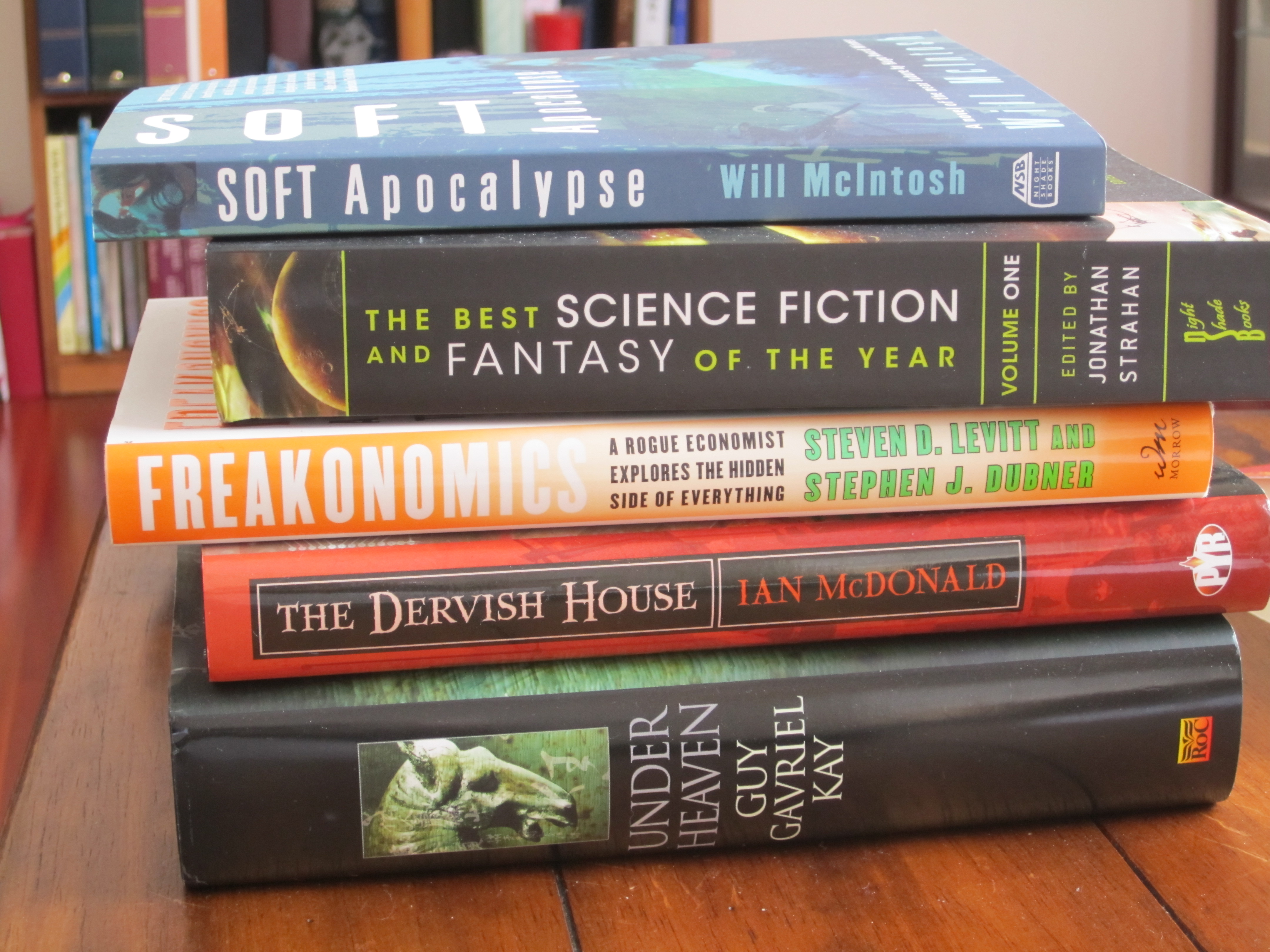
Yum, look at all this reading goodness.

I’ve been studying the publishing industry, and the indie publishing movement, with my trademark intensity for the past year or more. I have a lot of thoughts about it that I’ve been keeping, for the most part, to myself. But one of the key insights that I would like to share is this: Writing is a business.

It’s easy for us, when speaking about the arts, to entangle our emotions with our work. Which is as it should be. But in my experience, the farther apart we can keep our emotions from business, the better. I’m not saying we as artists and creators cannot or should not have emotions. But emotions can easily blind us towards making pragmatic business decisions (see the “practical” in my blog’s title).

Writing is a business. Every writer whose goal is to have a writing career is, in essence, running a small business. Whether she knows it (or wants it) or not. This seems obvious to me because I’ve just come off seven years of running my own small business in another arts-related field. But I’ve noticed that not all writers display this attitude, and it certainly wasn’t ever something I considered before becoming a small business owner.

Here’s the thing about starting and running your own small business: There is always risk involved. Always. Business is about calculated risk. There is always the chance that the business will fail. There is always the chance that your marketing campaign won’t work the way you hoped, even if you spent tons of time and money to make it happen. There’s the chance that the economy will take a downturn and shoot you in the foot. There’s the (terrible) chance that you won’t end up being any good at your business of choice.

It’s the same deal with writing. Even though writing doesn’t necessarily require a large outlay of financial capital, we’re putting ourselves on the line. Our work may not be popular. It may not attract the attention it needs to be successful. We may make it partway down the line, only to come to an abrupt halt. As in all businesses, there are many things that can go wrong.

Self-publishing carries this same risk. Because writing is a business. And maybe the material we self-publish will turn out to be really badly received. Or maybe no one will even notice it exists. Or, horror of horrors, maybe it will keep us from ever getting a traditional publishing deal if it turns out we made the wrong choice (or are playing it safe by pursuing both options at the same time).

As business people, our job is not to condemn without thought and research. Our job is to examine, as dispassionately as we are able, our different business options. Some of us will feel more comfortable doing this than others; some of us have a more entrepreneurial spirit, whereas some of us feel more comfortable taking an established path. There is no right answer here, folks. But after examining the current state of publishing, I believe that self publishing is a viable alternative (or a building block in a larger overall strategy) that should not be ignored.

Those of you following this debate on the internet have heard all about Amanda Hocking and J.A. Konrath, and now the big news this week is Barry Eisler turning down a $500k traditional publishing deal to self-publish instead. Yes, these are big names. No, not everyone who tries self-publishing will enjoy their degree of success. No, I don’t believe it’s a clear-cut decision about which path to pursue.

My point is this: Whichever path we choose as writers, there will always be risk involved. Anyone involved in the industry has heard a few choice horror stories about how traditional publishing has gone horribly awry. Self-publishing has its own unpleasant pitfalls. When we dive into either side of the industry, we don’t know how it’s going to go. When I started as a music teacher, I put up some ads on Craigslist. I didn’t know if anyone would answer them. My business could have been a bust before I even started. We experience the same thing in publishing, whether we send our manuscript out to agents or stick it up on Amazon and Smashwords.

Whatever path we choose, it won’t be easy. Self-publishing isn’t a shortcut; it requires a lot of hard work. Whatever path we choose, it won’t be fast. Craft takes the same time to develop, regardless, and while traditional publishing can take years even after you have a viable book (between finding an agent, finding a publisher, getting a release date, actually releasing the book, and performing all the necessary work between these steps), self publishing can take a long time too (between outsourcing various needs like editing and cover art, building a catalog of titles for sale, building a reputation as a writer, etc.) The key is to educate ourselves about the options (traditional publishing, self-publishing, the small presses, the e-editions only presses), look at the different risks involved, crunch some numbers, and then decide which option (or combination of options) makes the best sense for our business. While doing this, we need to keep in mind our business goals and our unique blend of strengths and weaknesses while making sure we consider both sides of a strategy (this means reading thoughts by people who are both for and against self-publishing, and the valuable neutrals if you can find them). Businesses in the same sector have different strategies, and that’s okay. Some will fail, which is sad but not out of the ordinary.

However, I can’t help but feel that innovation can be exciting as well as scary. I’m following the twists and turns of the publishing landscape with great interest, and I’m trying to avoid being overly critical of anyone. Because technology is changing the landscape, and we’re all a part of that, and we’re all trying to figure out what parts we can play in the change. Ultimately, we all love writing, and we all love books, and we all want to ensure that many wonderful books (in whatever format) are available to be loved and enjoyed. I see a lot of badmouthing on both sides of this issue, which is perhaps inevitable, but in the essentials, we’re all in this together. We merely have different visions of how to chart a course forward.

In the meantime, writers are experimenting. Some of them are combining traditional publishing releases with self-published short stories or novellas. Many are making their out-of-print backlists available. Some are turning their backs on large traditional deals, while others are accepting them with excitement. Personally, I’m glad that I get to be a writer in a time of experimentation, when the rules aren’t as cut and dried and innovation is more encouraged. While a small part of me wishes that there was One Right Way to get published, the truth is that there never has been; it’s just become more obvious.

Now it’s your turn. Please try to be civil, but tell me: what are your thoughts on today’s publishing world? How do you think self-publishing has changed the equation (or DO you think it’s changed)? What benefits do you anticipate receiving from your own business strategy? I eagerly await your opinions.

Read Full Post »

« Newer Posts - Older Posts »