Feeds:
Posts
Comments

Posts Tagged ‘taking risks’

I recently received an email from a friend of mine asking for travel advice for an upcoming trip to Europe. I am always thrilled to be asked about travel, because any excuse to talk about it is a good excuse in my book. So I wrote back promptly sharing what I knew, and when he thanked me, he also said, “You talk and blog about the wonders of travel, but for us newbies the actual process can be a bit intimidating.” And I knew I had today’s blog post.
One of my favorite things about travel (and also one of the things I most dread, paradoxically enough) is how uncomfortable it can be. It can shake us loose from our daily routines, from our preconceptions, even from who we might think we are. It challenges us, it taxes us, and sometimes things go wrong. Sometimes things go very, very wrong.

But I realize that maybe that’s not what I tend to talk about. My excitement and passion for travel shines through so brilliantly that it tends to eclipse all else. I gloss over many of the hard bits, or I don’t mention them at all. Plus many events that were quite difficult at the time seem funny or interesting in retrospect. Even as they’re happening, I try to see them as all part of the adventure, and that attitude carries through even when I’m back home.

So yes, the process of travel is intimidating, and not just if you’re a travel newbie. It takes a certain amount of energy to get started, and at this time in my life when I’m getting more settled and am dealing with lingering physical limitations, I have that energy less often than I used to. And while I’m not overly intimidated by travel to Europe anymore (which wasn’t always the case), I’m still easily overwhelmed by contemplating trips to other parts of the world. (Exotic diseases are my bugaboo. If the ailments I read about in the medical part of the guidebook are too disgusting, I lose all enthusiasm for visiting. I’m also convinced that I will get malaria in many parts of the world because mosquitoes love me soooo much.)
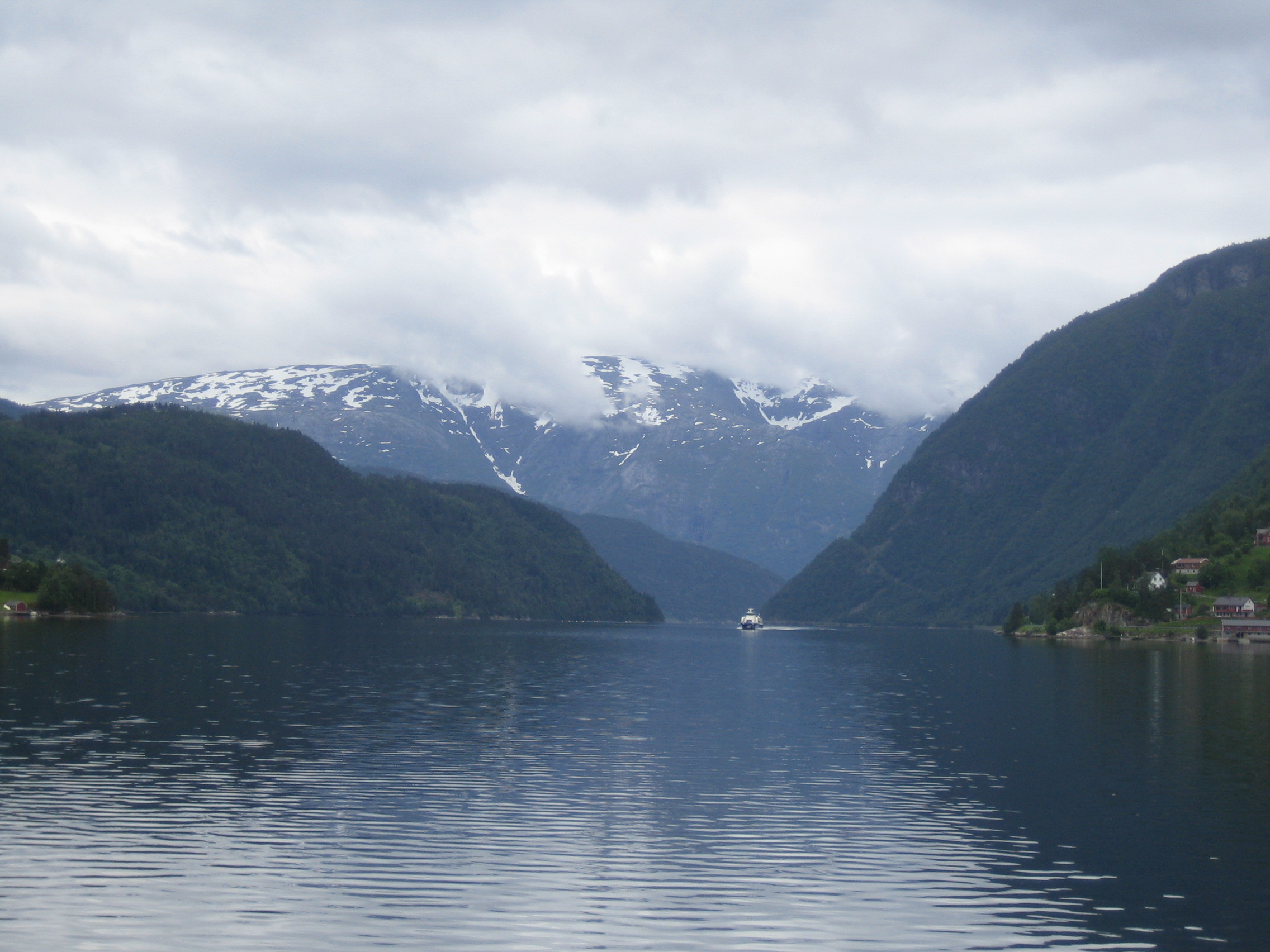
I didn't have a digital camera when I was in Sweden, so a photo of Norway is going to have to do...

Still, it is through the discomfort that transformation can occur, which is why I love it in spite of itself. The first non-English-speaking country I visited by myself was Sweden. Very modern, almost everyone speaks at least some English there, the food isn’t too crazy. I’d arranged to stay in a dorm room in Stockholm, so I even had a place to head upon arrival. I went out and about my first day, and I was so overwhelmed by being alone in a foreign place that I went back to the dorm and hid. I’m not even kidding, I hid and watched TV and cooked food in the dorm kitchen and felt miserable. I thought I’d made a terrible mistake, and it took all my willpower to eventually leave the safety of my room and continue my travel adventure.
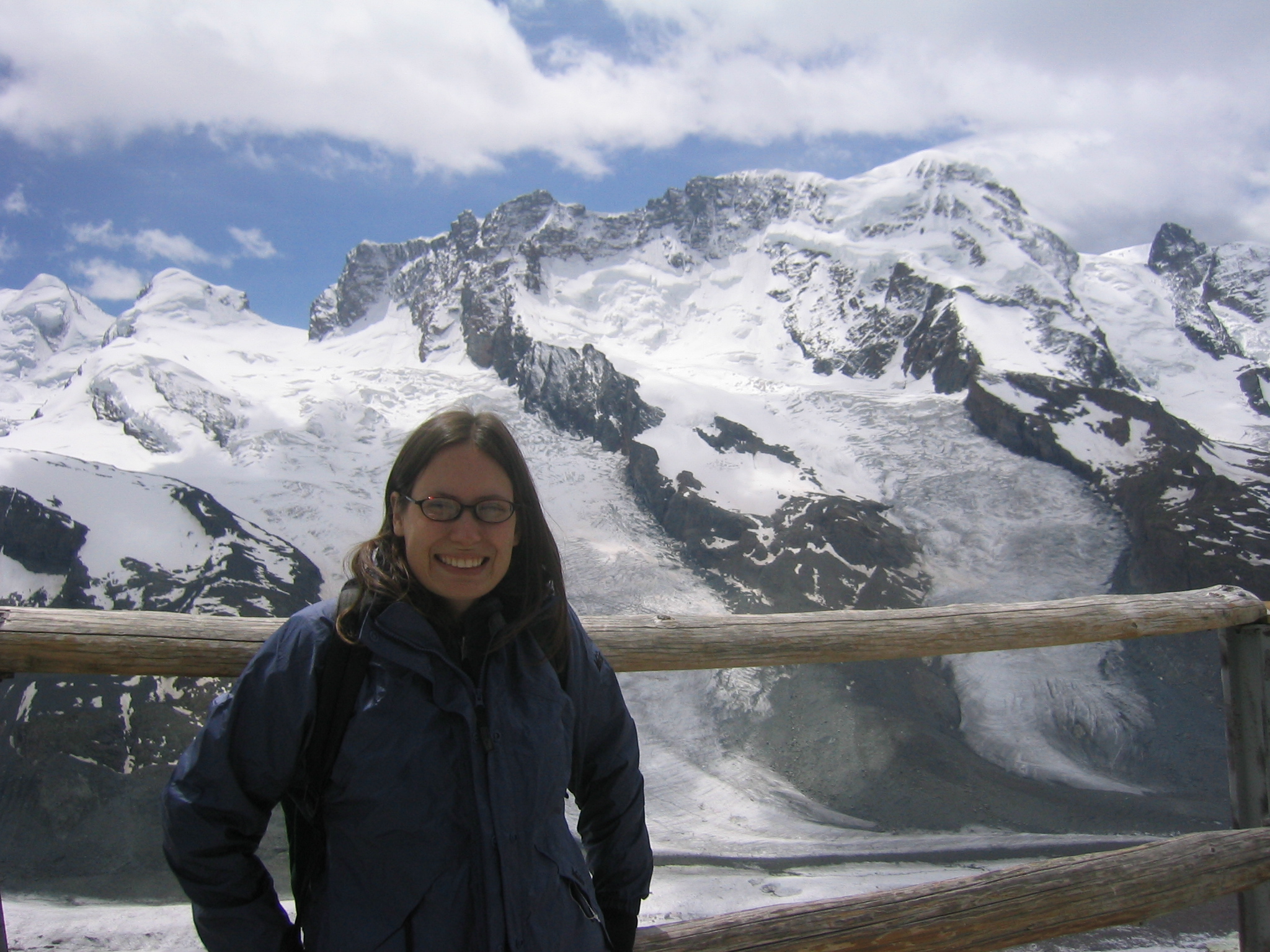
On top of the world... in Switzerland.

Fast forward two months and I was in Switzerland, also alone, but completely transformed. It wasn’t that I was so much more comfortable, but I knew I could rely on myself. I had more confidence, I had seen amazing places and met a huge array of different people, and I had survived. I had faced up to the strong surges of grief I still felt over my mom’s death, and I had finally found a measure of peace around it. I was a different person, and to this day I believe that those two months are among the most important experiences of my life.

So is travel amazing? Yes, but it’s not for the weak of heart. It can be dizzying and terrifying, tedious and stimulating, painful and healing, and no matter how carefully we plan, travel will turn out differently than we expect.

What is an amazing travel experience you’ve had? Or, if you haven’t traveled much, what destination are you eager to visit?

Read Full Post »

I read this fascinating article about luck a few weeks ago, but I’ve been saving my discussion of it until after my luck story came out because I love to be thematic.
The article talks about the research of Dr. Richard Wiseman, who conducted a study comparing “lucky” and “unlucky” people. He found that unlucky people tend to miss chance opportunities because they are so focused on specifics of precisely what they’re looking for, whereas lucky people tend to be more aware of what’s actually going on and are open to different outcomes. Basically, his research supports the idea that we make our own luck by noticing and taking advantage of whatever opportunities happen to present themselves.

We’ve all heard this advice in relation to dating. “You’ll find your future boyfriend/girlfriend when you’re least expecting it.” I don’t think the catch phrase actually covers it. Did I expect to meet my future husband at the specific housewarming party where we first talked to each other? No, of course not. (Is there ever a situation in which one does expect such a thing? Unless, of course, it’s a pre-arranged relationship of some sort.) But I also didn’t think it was impossible. I was open to meeting new people and having a new experience, and I went to that party with the hope that I might make some new friends. And I felt I was ready for a romantic relationship should one present itself to me.

Here’s the kicker. You might say I was lucky to meet my husband that night. He might have decided not to attend that housewarming party. Or he might have had a conflict, or received a phone call and left before I arrived. But because I wasn’t attending the party for the sole purpose of looking for a boyfriend, I think we might have met later on anyway. I would have become better friends with the party’s hostess (who later officiated at our wedding), and she would have held another party, or invited friends to go to a group dinner, or whatever, and I would have met my husband then instead. Or I would have become friends with other mutual acquaintances met at that party, leading to the same results.

It’s very easy to think about luck as relating to one specific outcome. What if, instead, we were to think about luck as more of a continuum that depends upon both our choices and our engagement with the world around us? We have to both notice opportunities as they arise and decide to act on them.

I’ll give you another example of how paying attention can work wonders. In college, I did my senior music recital in composition. I didn’t know any undergrads who had done such a thing, but “luckily” for me, I read the Music Major handbook carefully and learned that it was an option for me. Even better, after I received permission for my recital, I allowed other students to pursue the same opportunity because I had proven it was a possibility. Was I lucky? Sure. The composition professors could have decided they didn’t want the hassle of advising an undergrad composer (or been too busy to do so) and found a reason to reject my application. But I also proved the veracity of the quotation about diligence being the mother of good luck. I had formed positive relationships with the relevant faculty members; I had pulled together a decent proposal with a realistic timeline; I had thoroughly researched my major. I would never have been the recipient of this good luck if I hadn’t thought outside of the box (in this case, that all undergrad recitals were given by instrumentalists and vocalists, not composers).

What do you think? Do we create our own luck? Do you consider yourself to be lucky or unlucky (or neither)?

Read Full Post »

When I decided a few years ago that I was going to get serious about my writing, I knew I was going to be writing novels. Novels were, after all, the bulk of what I read. I sat down and wrote a novel to prove to myself that I was capable of doing it.

That’s when I actually became serious about writing. I knew I had the discipline, I knew writing was something I enjoyed and found satisfying. And I fell in with a genre critique group and said to myself, “Oh, I’m supposed to be writing short stories too. Sure, I’ll give it a try. After the novel, how hard could it be?”

Cue the laugh track. Yes, I was being stupid, but I figured out my own stupidity soon enough. I wrote a short story, and it was very hard. So much worldbuilding for so small a project! It drove me nuts. And then I had to rewrite the story, and rewrite the story, and it didn’t matter how much I rewrote this stupid story, because it was never going to work.

Over the course of the next year, I wrote more stories (although perhaps not as many as I should have). At some point I got the bright idea that I should also be reading short stories. (I know. Genius at work here.) That entire year, I hated writing short stories. I actively disliked it. I wasn’t even sure why I was doing it (probably stubbornness). I told myself that short stories didn’t matter anyway, because obviously I was meant to write novels.

Then I finally worked on a story that I enjoyed writing (probably not coincidentally, the one I just sold). I thought to myself, “Maybe short stories aren’t so bad. I mean, they’re annoying, but they have their good points.” I wrote more short stories.

Yesterday I found myself thinking, “You know, even if I got a book deal right now,” — for the record, this is impossible as I have nothing out on submission, but a girl likes to dream — “I’d still want to keep writing short stories.” I stopped and realized what I had just said, and shook my head at myself.

Why am I telling you this rather long story? Because so often we pigeonhole ourselves. Sometimes this can be useful to keep focus and make sure we’re prioritizing our goals, but sometimes we accidentally limit ourselves instead.

It’s especially easy to limit ourselves when we start something new and, surprise surprise, we’re not very good at it. It’s so easy to say, “I don’t like this anyway” or “This is too hard” or “I’m going to do shiny thing z instead.” I’ve seen this over and over as a music teacher. A lot of students thought they wanted to learn how to sing, but once they realized that singing is difficult, that it requires hard work and practice and dedication and failure, many of them would drop out. (Especially adults. It always seemed especially surprising to the adults.) A lot of my children students didn’t enjoy practicing the piano because it was hard and they weren’t very good. If they stuck with it for awhile, though, and were able to pass a certain threshold of competence, all of a sudden playing the piano became much more pleasurable.

I think a lot of pursuits are like this. When we’re starting out and don’t have many skills, it kind of sucks. But then as we start to improve, it gets more and more interesting and exciting. Remembering this helps us keep trying when we’re still in the stage of unpleasantness.

Has anyone else had an experience like mine? Care to share?

Read Full Post »

– People should travel around the world to learn more about both themselves and other cultures.
– People shouldn’t waste their time and money traveling abroad when you can learn everything that’s really important about life in your own backyard. 

– People shouldn’t write more than one book a year because the quality of their writing will suffer if they try to do more.
– People who don’t write at least two books a year don’t have a strong work ethic.

– People shouldn’t have children because studies prove that parents are less happier than people without children.
– Everybody should have children because passing on your genes and knowledge to the next generation is the most important and fulfilling work there is.

– All authors should aspire to be offered a traditional publishing contract because that is the only established way of both distributing your work and filtering for quality.
– All authors should consider going indie because not only is the market tightening, but the contract terms from big publishers are becoming less and less favorable to new (and some mid-list) writers.

– Moms shouldn’t work because you don’t want strangers raising your children.
– Moms shouldn’t stay at home because women shouldn’t give up rewarding careers and fail to reach their full potential.

Remember that just because something is true for you does not mean it’s equally true for someone else. We all live in this world together, but we’re all individuals, each with our own point of view.

Read Full Post »

I have a love-hate relationship with being a free spirit. I wouldn’t change who I am for the world, but it comes with its fair share of heart ache and difficulty.

Sometimes I want to be a sheep, happily grazing in a flock of other sheep and doing exactly what everyone else does. I don’t want to wander off on my own, I don’t want to forge my own path. I don’t want to collect data until I reach the inescapable conclusion that the traditional way isn’t my way. I want life to be easy, all in a straight line, with my only task being to connect the dots. I want to follow the rules, I want to pay my dues, I want to embrace a guaranteed path to success.

Of course, there are no sure paths. If there’s one thing life has taught me, it’s that you can never predict how it’s going to turn out or what opportunities may rise unexpectedly. It’s good to ask questions and reach your own conclusions, because what if circumstances have changed and conventional wisdom is just flat-out wrong? It’s good to take stock and figure out what will make you the happiest, even if the answer is unique and makes your friends and acquaintances shake their heads.

The sad truth is, sometimes people are judgmental. We emphasize the need to fit in during high school in YA novels and movies, and act like this social need doesn’t continue past a certain age. But does it disappear on our eighteenth birthdays? No. Life is not so simple and clear-cut as all that.

The result is, if we decide to be a free spirit, if we make nonconformist decisions or hold nontraditional ideas, we’re going to catch a certain amount of heat, whatever our age. Not only that, but we’ll be making our own road maps as we go, which can be a solitary and scary endeavor. Sometimes we’ll fail spectacularly, and our failures will be all the more visible because we were trying something unusual — something people didn’t think we should be trying, or something people assumed we couldn’t make work. Even when we do succeed, people will try to belittle what we have accomplished.

The conventional advice on this subject is that we shouldn’t care what people think, but sometimes we are going to care, no matter how hard we try to deny it. Therein lies the dark side to living a life outside the normal boundaries. It takes courage and self-respect, and sometimes it will sting in spite of ourselves. Sometimes we may weaken a little bit and wish we could be like everybody else, happily following the Pied Piper and playing it safe.

But we are not like everybody else. We cannot convince ourselves to be. It’s so much more exciting and fulfilling to question, to think, to decide what we honestly want and plot our own route to achieve it. It’s exhilarating to take risks and feel the buzzing, growing vitality of being alive and creating our own life stories. When I falter, I remind myself of how happy I am to have the power of choice, to be able to do what I love so much of the time, and to belong to a network of people who trust me to be me, no matter what choices (or even mistakes) I’m making.

What do you do when you falter? How do you stay strong in the face of judgement?

Read Full Post »

A few weeks ago I read an essay by one of my favorite bloggers, Penelope Trunk, about how to think outside the box. The entire essay is well worth the read, and I might discuss other aspects of it some other time (yes, that’s how good it is). But for now I’m going to focus on just one brilliant paragraph:“We are all creative. The only thing we really have in this world is the ability to craft a life. One day your life will be over, and we are largely unsure what happens next, but during the time we’re alive, we get to choose what we do. We create a life.”

Crafting our lives is the ultimate form of expressing ourselves, and we all do it, every single one of us. The decisions we make on a daily basis form the shape of our story, both in our own heads and in the outside world. That’s one reason why I’m so big on priorities: your priorities can quite literally determine the direction your life follows. Our priorities are the guiding vision for the complex artistic creation of who we are.  (more…)

Read Full Post »

When I was a teenager, I enjoyed dreaming big. I wanted to be a novelist, I wanted to work on animated features at Disney, I wanted to write games at Sierra (this was back when they were still doing cool stuff like Quest for Glory, Castle of Dr. Brain, and the King’s Quest series). I wanted to be a singer and actress and perform in musicals, I wanted to write musicals, I wanted to direct musicals. I knew that many of these aspirations were unrealistic and difficult, but I wanted them all anyway.

However, a family member who shall remain nameless said something to me one day, perhaps just an offhand remark, that became fully lodged in my young impressionable brain. “Amy,” the person said, “you have delusions of grandeur.” They might as well have said, “Why try, because the only possible outcome is failure.” Even today, half my lifetime later, whenever I think of trying something daring or risky or simply ambitious, those words go through my mind. “I don’t know if I can do this,” I say to my husband, “because so-and-so said.” And then he has to go through the work of convincing me to do whatever it is anyway.

Photo by Tony Fischer


I was reminded of this when I read Christie Yant’s recent essay, Lessons from the Slushpile: Good vs. Great. She discusses what distinguishes the great stories (and incidentally, the ones that are bought) from the rest, and one of the distinctions she’s made is that truly great stories have something to say. They say something that matters, that makes us as readers think or question or feel. They are ambitious, meant to illuminate as well as entertain.In my limited experience, these kinds of ambitious stories are rare, but it was by finding them that I first learned to appreciate, and later to love, short stories as a form.So why are these stories thin on the ground? Perhaps for one or more of these reasons (and there might well be others):

1. It’s difficult to come up with something to say in the first place.
2. Even if you’ve got something to say, it’s difficult to express it in a clear and original fashion.
3. Writing such a story means that on some level, you’ve got to have delusions of grandeur.

I think I had it right as a teenager. Delusions of grandeur are what allow us to strive, to push ourselves beyond our perceived capabilities, to dive into projects of vast scope. They give us permission to take risks, do things that make us uncomfortable, and ignore those who don’t believe we can do it. Delusions of grandeur are what allow us to become great.

So right now, I’m going to finish up this essay, and then I’m going to sit down and work on a short story that scares the pants off me. It makes me uncomfortable, it kind of makes me want to cry, I’m not quite sure I know where it’s going, and even if I did, I’m pretty sure I don’t want to follow it there. All I can do is believe in its potential, as I believe in my own.

Delusions of grandeur are the necessary caterpillars if we want our words to fly.

Read Full Post »

A few days ago, I read the excellent article “Writing and Mortality” by Rachel Swirsky, and I’ve been thinking about it ever since.  I recommend reading it and coming back here, but since I don’t always do that myself, I’ll summarize. She talks about some advice she read about writing, how if the project you’re working on is not the project you’d be working on if you only had six weeks to live, then it’s the wrong project. Rachel calls foul on this advice, saying that if she had only six weeks, she’d be busy spending time with her loved ones. “Artists,” she says, “aren’t only real artists if they would spend their last few days creating art.” 

I agree with Rachel one hundred percent. Creating art is a high priority for me; in fact, I’ve structured my life around increasing my time to do so. But it’s not my highest priority, and that’s okay. This truth was brought home to me recently when I was suffering from root canal complications.  Mostly I was thinking, “My god, the pain, the pain, please make it stop, I’ll do whatever it takes to stop the pain.”  But when I could focus beyond the immediate suffering, what did I care about the most?  I wanted to spend time with my husband and my little dog, and I wanted to write long e-mails to my best friend.  I’m an ambitious person, but when it came down to it, I wasn’t thinking about my writing anymore.  What mattered to me was the people I love.

Taking a step back, this entire discussion was sparked from a piece of writing advice. I read a lot of writing advice every week.  I even occasionally write some writing advice.  It’s amazing how much helpful information about writing I can learn from the internet (although at this point, a lot of the advice I read is a reminder more than a revelation).

But this advice is not infallible, and it cannot be followed blindly.  Each piece of advice requires consideration, and if you find it doesn’t work well for you, that doesn’t mean you’re wrong or a bad writer or anything else.  It means that advice is not for you, full stop.

People try to give me advice all the time (and not just about writing, either).  Here are some examples of advice I do not take:

1. You should write every day. Yeah, I don’t write every day.  I usually take weekends off, and then I come back to the computer on Monday full of fresh ideas and vigor.  That’s what works for me, for now.
2. You should write what you know. Sorry, I don’t actually live in a world with working magic or a world set in the future, but I still write about them.  (Yes, this advice has deeper connotations that are more helpful, but its phrasing can be misleading.)
3. You should write x words every day. Unfortunately, only I know how many words I can write per day, and this number changes over time and depending on circumstances (like, for instance, a root canal or quitting the day job).
4. You should only submit to pro paying markets. I actually kind of follow this one, but the more I think about it, the more I think it’s silly.  Really I should submit to any markets I feel like submitting to, right?  If I’d be happy seeing my work at a certain publication, then I’ll submit.  If I won’t feel happy or I think the publication is shady in some way, then I won’t submit.  So this advice isn’t for me.
5. You should/shouldn’t outline. Um, really good writers go both ways on this one.  So I’ll do whatever I like, and experiment with both.  (For those wondering, yes, I outline for novels.  For short stories, it really depends.)

I could go on, but you get the idea.  Advice is in the eye of the beholder.  People give advice about what works for them as individuals.  But we are not cookie cutter people, and therefore some of this advice will not work for you.  The trick is to learn what you can, and then adapt that learning to fit your own lifestyle, your own priorities, your own artistic strengths and weaknesses, and your own voice.

I would love it if you would comment with some advice you have read or received (writing advice or otherwise) that doesn’t work for you.  It can even be something that I have said here on the blog (gasp). I can’t wait to see what you all come up with!

Read Full Post »

The Cowardly Lion


The one thing I’ve always known about courage is that you don’t need to be brave unless you’re afraid.  If jumping out of an airplane is no big deal for you, then it doesn’t take courage to strap on your parachute and leap.  It’s just something cool that you’re doing.  But if you’re terrified of jumping and keep imagining your terrible and bloody death when you reach the ground, well, then you have something to be brave about.

What I’ve been less clear about is what courage really is and where it comes from.  I do so many things I’m afraid of because I don’t feel like I have a choice.  Take shots, for instance.  I’m really scared of shots, especially the Tetanus shot, but I dutifully go in and receive said shot when I need it.  In fact, I’m probably more dutiful about receiving it on schedule than someone who is less afraid of it.  But is it courage if I don’t have a choice?

I’ve been having a lot of problems with my back tooth over the past several weeks, and last weekend my injury came to a head.  I woke up in the middle of the night in simply excruciating pain.  It was hard for me to breathe, and involuntary tears streamed down my face.  My heart rate accelerated and my chest felt like it would explode.  So much pain to be caused by such a small part of my body.  In those moments, my nerve completely broke.  I would have done anything to make the pain stop.

The pain eventually receded, the Ibuprofen kicked in, my nerve came back, and there I was refusing to take the Codeine I’d been prescribed.  But that moment of sheer panic and helplessness made me realize something.

Courage is the choices we make every day.  Courage is my conscious decision to go to the doctor’s office and get that stupid Tetanus shot even though I know my arm’s going to hurt for the next week or two.  Courage is going to get a root canal instead of letting the infection spread.  Courage is allowing myself to fall in love again after suffering from a broken heart.  Courage is saying what I really think instead of being bland and inoffensive and nice.  Courage is doing what I want to do even when I know people will be mean or insensitive about it and I’m going to care that they don’t understand.

When I’m about to force myself through something scary, I sometimes forget that I do have a choice.  I’ve just already made it.

Read Full Post »

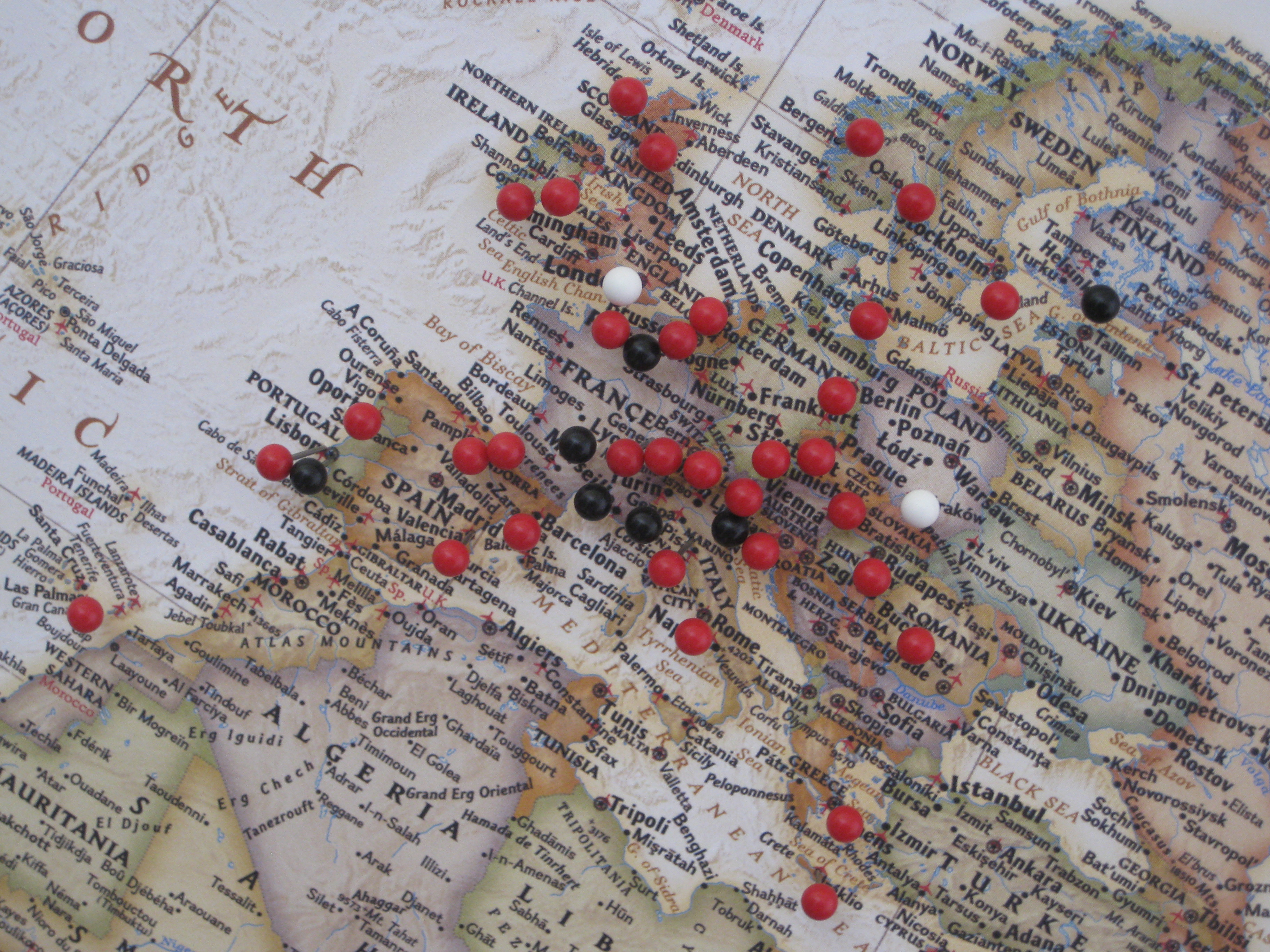
On the wall right inside my front door hangs a map of the world, stuck by a great number of little pins.  The red pins represent ME, places I’ve visited.  The black pins represent my husband.  The white pins are places we’ve been together.

Here is a close-up of Europe on this map:

Lots of red pins, huh?  I visited every place with a red pin within a five-year time span, between ages 22 and 27.  I didn’t have a salaried job, I didn’t have paid vacation.  Most of the time, I didn’t have anybody who wanted to travel with me.  I had an extremely tight budget during those years.  Consider, too, that I started my business when I was 24 and was working completely for myself before my 26th birthday.  No safety nets there, let me tell you.  So how was I able to travel to all those European countries?  (Eighteen of them, nineteen if you count the one I’ve added since that time.)

Priorities, plain and simple.  One of my highest priorities in life was to travel around Europe, and therefore I did what I had to do to make it happen.

This is probably not the last time you’re going to hear me using that word, either.  I have this theory about life, that it’s all about priorities.  Sure, people start off with different advantages and disadvantages, I’m not denying that.  And some things are literally impossible to accomplish, or at least have such a very low probability of happening that it’s almost the same thing.  For instance, I am just plain too old to enter certain professions that depend on youth or a certain current level of physical fitness (unfortunate but true fact: sometimes healing takes a really long time).

But not as many things are impossible as we think. And once we begin to contemplate the realm of the possible, everything shuffles down to priorities.  My priority was to travel in Europe, so I structured my life accordingly.  I had a very strict budget, passing up on buying stuff I really wanted like clothes and dinners out so that I could save money for travel.  I passed up regular salaried jobs for a number of reasons, but not the least among those reasons was my desire to have what I considered a reasonable amount of vacation time to allocate to travel.  I learned how to be self sufficient and more outgoing so I could travel by myself.  I took some risks.

As we get older, we often gain certain obligations: spouses, children, aging parents.  But even with these connections, which have their times of joy and their times of heartache, ultimately my life is my own.  I’m the one who’s going to look back on my lifetime with happiness or regret; I’m the one who’s going to have to live with the choices I’ve made, whether they were good or unfortunate.  Maybe, as a consequence of other choices I’ve made, I’ll have to wait and have a longer-term plan to achieve certain of my life goals.  But it’s still all about priorities.

I’m not writing this post to make you feel bad if you haven’t travelled.  Maybe you don’t even want to travel, and that’s a perfectly fair choice.  What I want to tell you is that if you really want something, whether it’s to travel or to be an artist or to achieve happiness in your own special way, think about a way to make it happen.  Strive, try, and be happy in the freedom of your choices.  And if in the process, you realize your priorities are different than you originally thought, rest easy, reset, and try again.  That’s the last great things about priorities: they can change.


Read Full Post »

« Newer Posts - Older Posts »