Feeds:
Posts
Comments

Posts Tagged ‘Amy Sundberg’

Tell Me If This Is Art

In our discussion about what it means to be an artist, the question of the definition of art came up more than once. This issue–what exactly IS art?–has been the subject of all kinds of learned debate, study, essays and books. So why not tackle it in a single blog post? The things I do for my readers! (Not that I’m complaining–it gives me the perfect excuse to use this image I found the other day.)

Hmm... is this art?

So what are some factors we can consider?

1. Exposure/size of audience: Has nothing to do with whether something is art. Pop/rock musicians and TV shows reach an audience of millions, whereas new classical music works are sometimes lucky to break into the thousands. We can get into an argument about low vs. high art, but let’s not.

2. Opinions of the experts: Have been proven wrong in the past, and are likely to again in the future. Critical acclaim is great, but who among us hasn’t read the rejection letters from expert editors regarding books that later became classics?

3. The Ka-ching! factor: Has nothing to do with whether something is art. Some people make a lot of money from art they create…and some people really don’t. Take Vincent Van Gogh from Tuesday’s post. He made hardly any money from his art, and is anybody really going to argue with me that Starry Night is not art? Anyone?

4. Skill: So maybe most of us agree that Starry Night is art. But what about that novel you trunked? What about your kid’s crayon drawing of the family that she spent several days on, but that consists of stick figures? What about your first musical performance, when you cracked on that high note? What about that song that consists of three chords? Is that song art if it has a catchy melody as well? What if it has especially original lyrics? What if it’s a parody of another popular song? Yeah, this category is tricky.

5. Artistic freedom: How much control over the work of art does the artist have, and does this affect its classification as art or not-art? For example, is graphic design to a client’s specifications art? What about animating someone else’s graphics/story? (Is that any different from a singer or actor interpreting a song or script? If so, how?) What about a tie-in novel with pre-existing characters and a pre-approved plot? How about if an opera company commissions you to compose an opera? That’s definitely art, right? So how is it different from any of the above scenarios? (I’d argue that in this case, the composer retains most of the artistic vision for the project. But what about portraiture?)

6. Intent: The idea that art can be defined by the intent of its creator. So if I put my dog’s paws into paint and let her walk around a blank canvas, she is not an artist. Maybe I am though, if I had the idea of making art based on this plan. If I’m singing in the shower and not thinking about it, that’s not art, but if I’m performing in front of a room of my students, perhaps it is. What about when I’m practicing that performance by myself? This is the broadest definition of art, and the one I resonate with the most, as a teacher as well as an artist. Were my singing and piano students not artists because they hadn’t achieved mastery yet? No, but I’d argue that some of them were perhaps not artists because they didn’t understand or care about what they were doing (and therefore lacked artistic intent).

7. Art is in the eye of the beholder. In which case it is inherently defined by those experiencing it as opposed to those creating it. Although do you experience it while creating it? What about afterwards?

I know, I’m asking a lot more questions than I’m answering. I’m hoping some of you will be moved to comment and tell me your opinions about the questions I’ve raised. So let me leave you with one final question:

A few years ago, in a sublime and slightly insane act, I decided to create a mosaic as part of the decorations for a Greek/Norse Gods & Goddesses party I was throwing. I don’t know anything about mosaics. I’ve seen a few in Portugal, but that’s about it. So I bought some materials and a book telling me how to do it, and I got to work. I spent hours and hours on this piece. In the middle, I got RSI in my hand from squeezing the glue container (I kid you not) so I had to recruit my husband to squeeze the glue while I painstakingly placed each tile. Here is the finished result:
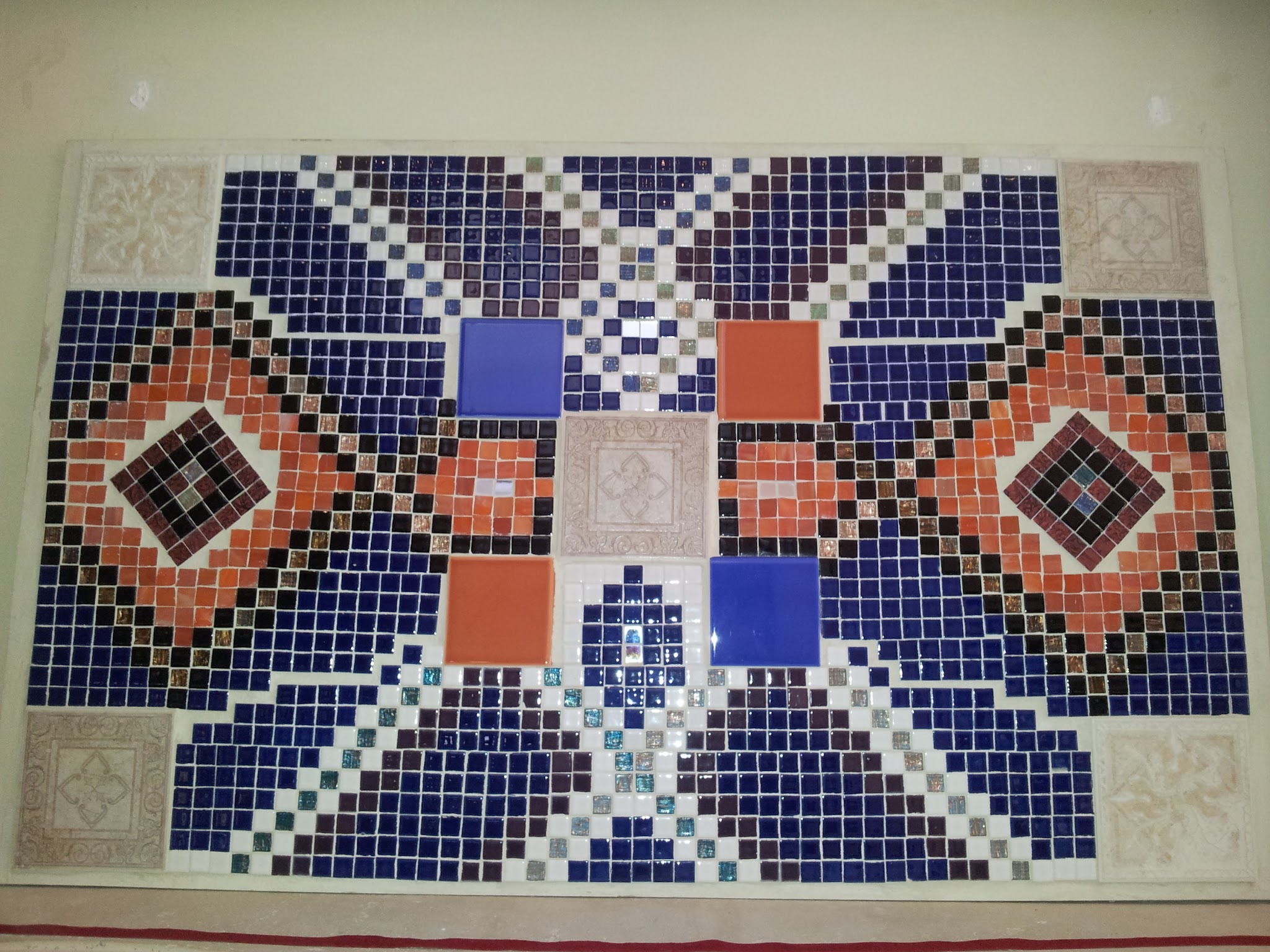
As I said, I know next to nothing about mosaics, and this was my first attempt and therefore most likely a flawed and amateurish effort. The skill wasn’t there, the money certainly wasn’t, and everyone was so involved in other aspects of the party that they hardly noticed the mosaic (ah, party planning 101). I did, however, have complete artistic freedom and an intention to create art. So my question is, is this mosaic art? Or not art?

I can’t wait to hear your thoughts!

Read Full Post »

What does it mean to be an artist?

I’ve been asking myself this question, in various forms, for most of my life. It’s a question that bears repetition because there are so many possible answers, and my own personal answer sometimes changes. When I first began creating, the question wasn’t clearly formulated and the answer was simple: Joy! As I grew older and awareness of economic realities intruded, the questions became How can I be an artist? and Should I even try?

For a year or two, I chose not to be an artist. Oh, I still dabbled in this and that, but I wasn’t wholly or even halfheartedly invested. It was a dark and boring time.

When I recommitted myself, I felt such a deep sense of relief. I was spending my time the way I was supposed to again. I was focusing on what was important again.

Perhaps that relief, that sense of purpose, is part of what it means to be an artist.


We can judge our artistic success on so many levels:

1. Financial: how much money we make, can we make a living as an artist
2. Recognition/acclaim: receiving opportunities, reviews, awards
3. Size of audience: how many people experience what we are doing
4. Growth as an artist: how we are improving and/or taking risks as an artist
5. Producing a piece or performance that works the way we wished it to

But perhaps being an artist doesn’t have so much to do with traditional success. Some of the most lauded artists labored in obscurity in their lifetimes. Many famous writers self published their own work. Vincent Van Gogh, Jane Austen, Emily Dickinson, Jan Vermeer, Franz Schubert, Henry David Thoreau.

If money and fame are of less importance, then what does it mean to be an artist? It means we create. It means we dream. It means we explore the fundamental question of what it means to be human: what it means to be conscious, what it means to experience emotions because of a painting or a symphony or a poem or a novel, what it means to have the capability for empathy. The exploration is inherently of value, regardless of the outcomes.

Stephen King said, “Life isn’t a support system for art. It’s the other way around.” Art supports life; it creates meaning, some semblance of order created from the complications of existence. It takes us outside of ourselves and pushes us more deeply inside of ourselves. It raises as many questions as it provides answers.

Being an artist, then, is about more than a job or a career. Being an artist becomes a state of mind. 

And the seven-year-old me was right after all. What else does it mean to be an artist? Joy!


Read Full Post »

I can hear your groans already. Not another social media site!

But I have good news: Pinterest is simple, fun, and pretty. It can be a helpful creative tool. And it is absolutely NOT necessary for a solid writer platform. Use it if you enjoy it, but if you don’t have the time or inclination, this isn’t a make-or-break proposition.

Aren’t you feeling better already?

What is Pinterest?

Most simply, it is a social image-collecting site. You can create “boards” that are collections of various images you have “pinned.” For instance, you can have a “Books I love” board or a “Beautiful photos” board or a “Yummy recipes to try” board. The boards tend to be visually pretty.

You can re-pin images directly from the Pinterest site. You can pin images from other sites, either by adding a “Pin It” link to your browser’s bookmark bar or by copying and pasting the image’s url into Pinterest. You can also upload your own images for your boards.

Finally, you can browse through other people’s boards and images, comment on them, re-pin others’ images, and like others’ images. You can follow other people on a board-by-board basis, and they can follow you. Hence the social media part.

Downsides of the site:

1. Massive time suck. Massive.
2. You can only use the service if you already have either a Facebook or Twitter account. Given my privacy concerns around Facebook, I chose to use my Twitter account. However, that means I can’t look for other friends who use Pinterest, as you can only do that (to my knowledge) by linking to Facebook.
3. You can’t re-arrange the images pinned to your board, so whatever order you enter them, that’s the order you’re stuck with. Hopefully they will eventually add a click and drag sort of interface to make the boards more customizable.
4. The user interface of the site can occasionally be a bit confusing, and the “Pin It” browser button doesn’t always work.
5. As far as I can tell, there is no way to make a board private. So everything you do on the site will be in full public view. Otherwise it would make a great archival/bookmarking tool.

Ways to Use Pinterest as a Writer:

1. Settings boards: Make boards of photographs of various settings in your WIP. I recently wrote a story set in Rio, and I had an entire browser window with twenty tabs devoted to the photos I’d found. I would have loved to have the convenience of pulling all the photos together in a board instead.

2. Blog boards: If you use interesting pictures on your blog, you can pin them all onto your blog board, and have a beautiful visual representation of your blog. You can see mine here.

3. Book boards: I adore books, and it gives me happiness to click on my “Books I Love” board and see all my favorite covers staring back at me. This can also work as a recommendation board or as a record of the books you’ve read this year.

4. Mood boards: I know a lot of writers use music, often carefully crafted set lists, as a tool to get into the mood of their book. For those of us who can’t use music (I find it too distracting), we can make a visual board instead and take a look for inspiration before a writing session.

5. Random inspiration: If you can be disciplined enough to avoid the time sink factor, scrolling through the aesthetically pleasing images can be just the thing to kick-start those creative juices. Also, need an idea for a story? Maybe you can find an image that gives you the first nugget of an idea.

6. Hobbies: If you happen to have an interest in design, fashion, architecture, photography, visual art, cooking, etc., you might find this site fun outside of any writerly benefits it may provide.

Notice that not once do I mention the social aspect? That’s because I really think of Pinterest as more of a creative tool than a social site. And if you’re using it as a tool, the social aspect will follow. You’ll begin re-pinning and liking other users’ images…and they’ll know you did. You’ll find some people who have such awesome boards that you want to follow them. Maybe you’ll have to comment on a particularly thought-provoking image. You get the idea. The social part, I think, can happen organically.

What do you think? Have any more great ideas for ways to use Pinterest? Need to vent some social media angst? I’d love to hear your thoughts.

Read Full Post »

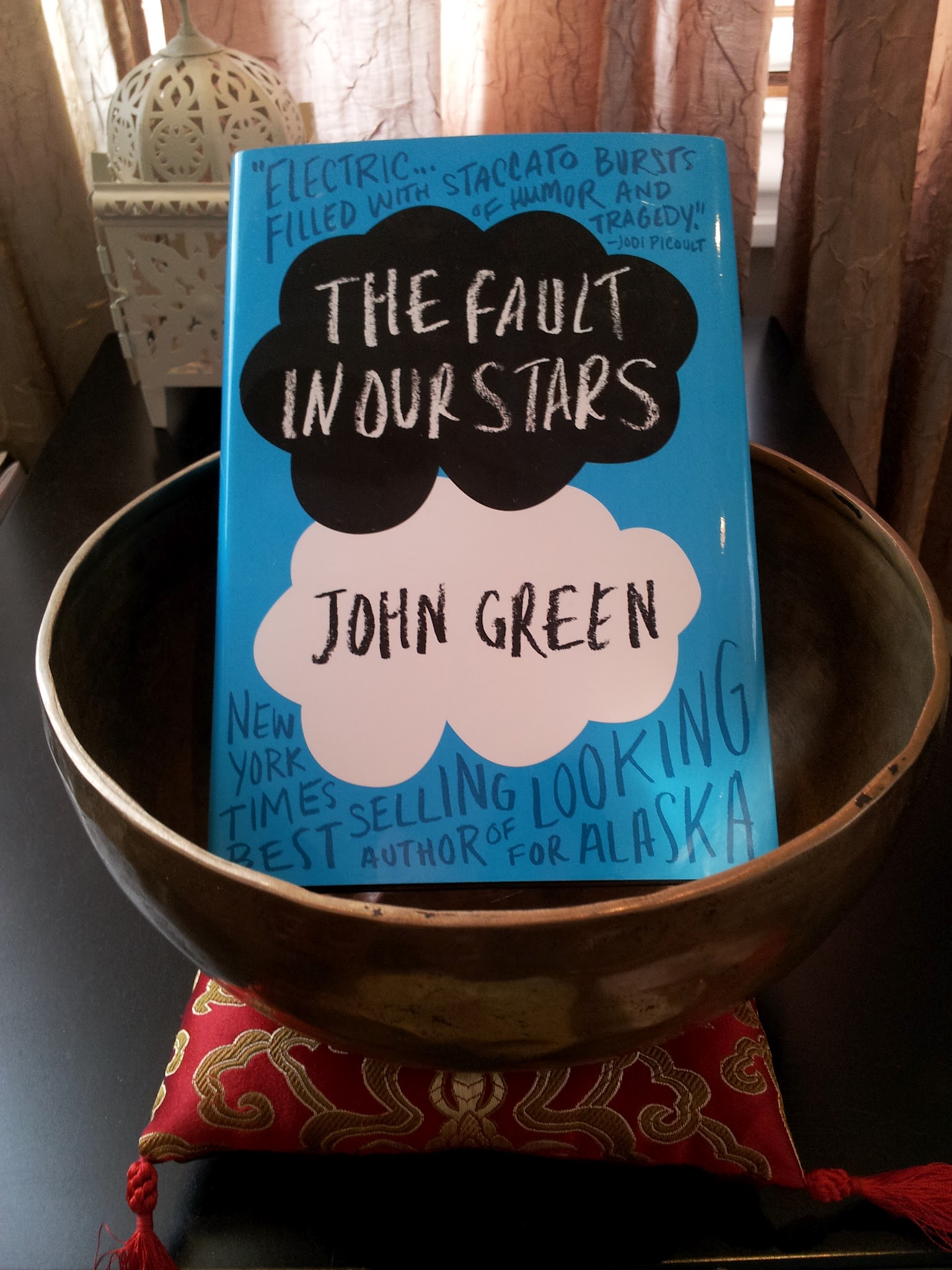
Last week I read John Green’s new novel, The Fault in our Stars.

This is not a review.

After I had read the first twenty-one pages, I told my husband this was going to be the best book I’d read all year.

A little while later I went to the bookstore and bought the hard copy because if Amazon ever disappears and I no longer have access to my e-books, not having this novel would be a particular tragedy. Also, I wanted to hold the tangible printed version in my hands.

When I was twelve, I started writing a novel from the point of view a girl about my age who had been diagnosed as HIV positive. I didn’t get very far with it, but it has lived on in my mind ever since. So when I heard the premise of The Fault in our Stars, I knew I had to read it. It is a novel from the point of view of a girl of sixteen who has terminal cancer. It is a heart sister to the novel I never wrote, that I couldn’t write, and the fact that it exists makes me breathe more freely.

This novel is not a sappy issue book that makes you want to yell at it as if it is conscious before you hurl it across the room and mope.

This novel is not an easy book to read. I can only imagine what it must have been like to write.

This novel is not perfect. Our protagonist says at one point that the movie V for Vendetta is a boy movie. I completely disagree. Of course, one could argue that this slight blemish makes the book even more perfect.

If you talk like either of the two main characters and/or think about the things they think about, I want to be your friend. We can go to a coffee shop every week and have deep existential conversations in between making ironic statements that have us internally rolling on the floor even though on the outside we only cue our mirth with a certain type of smile. If you don’t live nearby, you should move here. It will be worth it.

Also, when you worry about what your life means or may mean or may not mean, I will hold your hand, if you will hold mine.

In the meantime, enjoy this novel. Its construction is a miracle to behold. It has layers upon layers, a story within a story (and then some). It plays with language. It is a brave book. It talks about things that matter that maybe most people don’t want to talk about, like death and dying and illness and meaning and love that lasts through it all. It does not flinch away.

This book punched my heart even while it fed it. Or it filled it up till brimming even while it broke it.

Thank you, John Green.

Read Full Post »

Disclaimer: This post in no way reflects the opinions of my husband or his employer. Yup, it’s one hundred percent me. So without further ado, here’s what I’ve learned from Google.

1. Filtering is critical.

Google is not a media company, and it doesn’t produce any content of its own. Its core idea is to filter and organize data in a way that makes it useful to the end-user (that’s you and me). Without a way to make sense of the huge masses of data, the internet would lose much of its practicality and all of its convenience. And when you think about, filtering is critical for communication in general. If you asked about my day and I gave you a minute-by-minute breakdown, you’d probably be so bored you’d miss anything important I chose to relay.

2. People will hate on you, and there’s nothing you can do about it.

No matter what decisions Google makes, some people are unhappy about them. I don’t even work there, and I hear about it all the time. The bigger and more successful you are, the larger a target you become for other people’s judgment and rage. (Seriously. Random people rage at my husband all the time. It drives me crazy.) Just a reminder, I suppose, of the truism that you can never please everyone.

3. The power of data is nothing without the power of distribution.

So Google offers this great filtering service to the world. And yet, this service by itself generates very little revenue for Google, which makes almost all its money from advertising. Meanwhile, what do I insist on spending my money on? Internet access in my home and a data plan on my phone, so I can get to the filtered data. Infrastructure for distribution is key. (Look at the publishing industry. This fact has been screwing them over for decades.)

4. People love the idea of free food.

For a long time when people found out my husband worked for Google, they wanted to hear about the campus and the food. Had I eaten at Google myself? What did I think of the food? (Not much, as it turned out.) There was a near endless fascination by the idea that Google fed its employees for free. And in fact, until we moved in together, my husband barely had anything in his kitchen because he ate almost all his meals at work.

Photo by Trey Ratcliff

5. It’s possible to change the world, and you don’t even have to be Einstein to do it.

Larry Page and Sergey Brin were two CS grad students when they founded Google. Now they are among the richest people in the world, and they have had a deep impact on the way we all experience that world. Plus they continue to use their resources to investigate other potential changes in the future, like self-driving cars. You can never be sure how much power the right idea at the right time will have.

6. A catchy motto can come back to haunt you.

“Don’t be evil.” I’m sure it sounded good at the time, but now it gives people yet another reason to be asinine while complaining. If I read one more “clever” twist of this motto, in which people are for some reason shocked to discover that Google is in fact a corporation and not some shiny Kumbaya fest, I’m going to have to go hide in an isolation chamber.

I wrote this post on Google Docs, I’ll get notified of any comments through Gmail, I’ll promote this content on Google+, and I looked up the correct spelling of Kumbaya on Google Search. Whatever your opinion of Google (and I certainly don’t agree with everything they’ve ever done either), the company impacts my life on a day-to-day basis. So the last thing I’ve learned from Google is the incredible value of easy access to data. Remember the days of encyclopedia sets that never told you everything you wanted to know, so you’d just be left wondering? I, for one, am glad those days are behind us.

Read Full Post »

Sometimes when we are on the road to excellence, we get a little tired. We wish we were already there. We wish the road had a literal signpost saying “You have made it, and you can officially stop worrying and consider yourself to be awesome.” We wonder if we should have chosen something easier to do with our time. And we think that maybe there is a magic bullet, something we can do that will–Bibbidi bobbidi boo!–make us more amazing.

Let me make this part of the road simpler for you.

There are no short cuts. There are no magic bullets. There are no sure things. There are no easy paths. So if you want something quick and easy, excellence isn’t the end goal for you.

Photo by Trey Ratcliff

Sure, there are activities beyond diligent practice you can do that will help you progress. In writing, these include attending workshops, reading slush, seeking out critique experiences, reading craft books like The 10% Solution, etc. In singing, these include participating in master classes and workshops, auditioning, obtaining performance opportunities (however humble), studying with different teachers, etc. But none of these methods are foolproof, and not all of them will pan out.

Take the various Clarion workshops, for example. Working professional writers often cite their Clarion experience as being pivotal in their development as writers. These are the stories about Clarion that we hear most often. But then there are the writers like Alexandra MacKenzie, who took ten years after the workshop to be ready to learn from one of her instructors. Because you can’t always control the timing of these sorts of things. And there are also the Clarion attendees who stopped writing altogether; these are the ones we hear about the least, and yet they assuredly exist. Why? Because no way of leveling up is foolproof. No way of advancing works for every single person.

The path to excellence doesn’t often go flat like a plateau only to suddenly rocket steeply upwards into awesomeness. It is a gradual process, a long slow incline upwards. As Seth Godin says, it is a series of hills, one after another. Those who continue to improve keep choosing new hills to climb that are just on the edge of their abilities.

Sometimes the path feels like a flat-line that suddenly springs up, but this is an illusion. I saw it all the time with my students in voice lessons. They would work steadily and gradually improve, so gradually that they didn’t even notice it happening. They would struggle with a concept and it wouldn’t quite be clicking, and they’d get frustrated and discouraged. At this stage in the process, it was my job as the teacher to keep pushing them, keep encouraging them, keep them singing even if they were ready to throw in the towel. And then inevitably, they’d finally understand. Their bodies would finally coordinate correctly, the muscle memory would finally develop, the ideas we were talking about would finally make actual instead of theoretical sense. And they’d experience a leap in ability. A leap that was really a slow mounting of ability all along.

That leap in ability is just around the corner for all of us. If we practice diligently and intelligently (directed practice as opposed to blind repetition), we are pushing ourselves forward along the path. The leap may come next week or it may come next year. It may come after we take a month-long break or it may come after a few weeks of intense practice. We don’t know when it will come. Excellence requires us to have the faith to sustain us while we work.

We must believe the leap will come. But it won’t come because of magic. It will come because of our own hard work.

Read Full Post »

I have devoted my life to the pursuit of excellence. The Greeks called this areté, striving for excellence, living up to the best of one’s potential, and facing challenges with courage and persistence. I wanted to be the best student. I wanted to become a skilled singer. I wanted to travel around the world. I wanted to be an effective teacher. And now I want to be a masterful writer.

Areté has been one of the driving forces of my life. I care about people and relationships, I care about my health (only because I can’t get away with being indifferent to it), and I care about excellence. That’s not to say I don’t have other interests, passions, and concerns, but these three things I think about every single day.

Here’s the thing about mastery: it tends to be all-consuming. It requires commitment to make your practice one of the highest priorities in your life. It requires patience and fortitude while you struggle to improve. It requires the willingness to be bad (especially when starting out) and the strength to fail.

J.S. Bach--an undisputed master of musical composition.

Mastery takes time. It’s not easy to achieve, and anyone who tells you otherwise doesn’t know what they’re talking about (or they’re looking for a snappy headline that will drive page views or book sales). I used to have voice students come in for lessons, expecting to become fabulous singers with a month or two of lessons (and barely any time outside of that devoted to practicing). Guess what? They never became fabulous singers. They learned some basics, and that’s as far as they went. (Strangely, parents understand this about their kids and usually (although not always) insist on more commitment. Adults were by far the most egregious in terms of thinking singing would be an easy skill to acquire.) Sure, some of my students could skate by on their natural skills for a while, only to eventually arrive at the realization that if they wanted serious chops, they’d have to put the effort in.

Mastery takes focus. I’ve always hated it when people ask me what my hobbies are. The question triggers me to think about how I spent my time. For years, the real answer was: I sing in different genres. I play the piano. I love to sight-read. I compose and write songs. I adore musical theater. I think about educational theories and new ways to help my students learn. I think about the psychology of singing.

Nowadays, I write and I read. I analyze and research and think and learn. I go to bookstores and conventions and signings. It’s not that I have no interests outside of writing, but I have to dig deeper to unearth them for casual conversation, and I have a tendency to relate my other interests to writing in one way or another. Have a bad experience? Well, it will be useful for my writing sometime down the line. Like RPGs or theater? Well, they let me study different ways to structure stories. Travel? Broadens my horizons and lets me envision worlds outside my daily one.

Mastery takes diligence. I love this example of Steve Martin. He devoted himself to learning how to perform live comedy and play the banjo. Then he changed over to making movies. Then he changed over to writing fiction. Then he began to focus some more on the banjo again (and won a Grammy for his efforts). The article (which you should go read because it is super interesting) posits that his success is due in no small part to his practice of diligence.

Commitment. Time. Focus. Diligence. And the dream of someday being able to accomplish what you can only imagine right now.

Read Full Post »

What is that elusive concept in writing known as voice? Plot, character, setting, world building, theme: all of these aspects of fiction, while complicated in their own right, are at least fairly simple to explain as basic concepts. But for me, voice has always been trickier to talk about in an intelligent way. I know it when I see it, but what is it that I’m noticing?

First, I’d like to differentiate between authorial voice and narrative voice. By authorial voice, I mean a way of writing that is unique to the author, so that you can read a story by him and know who wrote it by how it is written. Ernest Hemingway has a particularly distinctive authorial voice. So does Herman Melville. By narrative voice, I mean the voice of the protaganists in the story. In first person, this voice completely permeates the text, but even in close third, the descriptions and prose will be affected by whose point of view we are in. (Don’t take these definitions as a golden standard, by the way; the internet disagrees about what these terms mean, so I’m merely sharing my own personal definitions so we can understand each other.)

When we talk about voice in YA, the voice we are usually talking about is narrative voice, not authorial voice. The narrative voice will change from novel to novel and story to story by the same author (except in series). For example, the narrative voice in M.T. Anderson’s Feed is very distinct from the narrative voice in his Octavian Nothing novels.

What does the world look like through her eyes?

So what aspects contribute to a specific narrative voice?

1. Vocabulary and word choice, aka diction: What is this character’s likely vocabulary? What words does this character use that may be unique to her world? How much slang is used? How can the choice of words reflect this character’s reality?

2.  Range of language: Possibly a subset of word choice. How does this character speak differently to different sets of people? How does this character’s thoughts differ from what he says out loud? Does the range of language change over the course of the story in reaction to external events?

3. World view/perspective and experience: The perspectives of the character reflect themselves in the voice. This includes her backstory, her priorities (look at how obsessed with food Katniss is in The Hunger Games, for example) and views of the world.

4. Psychic distance (a term coined by John Gardner): This refers to the distance the reader is held from the story and is related to POV. In YA, this distance tends to be close and  immediate, which is why first person is so popular in the genre.

5. Syntax/sentence length and pacing/density of prose: YA tends to be less densely packed than some adult fiction; to see what I mean, compare Ian McDonald’s Planesrunner (MG, but still a good example) to his adult The Dervish House, or Paolo Bacigaluipi’s Shipbreaker with his adult The Wind-up Girl. Pacing in YA tends to be on the faster side, although there is plenty of adult fiction that is paced just as fast or faster (and there are the occasional slow YAs). Boy books in particular tend towards the fast paced.

6. Maturation of voice over the course of the narrative: Because most YAs are, at least in part, coming of age stories, the voice generally changes as a consequence of maturation and realizations. The change is often subtle.

7. Emotional urgency: YA highlights emotional urgency. Everything is a big deal or the end of the world because the protaganist lacks the experience to see things differently. Speculative YA often literalizes the metaphor and deals with the actual end of the world or life and death situations.

8. Dialogue: The dialogue in fiction directly illustrates the characters’ personalities and way of speaking. It allows us to experience their actual out-loud voice.

9. Interior monologue: This is a critical component of voice in YA. It is used to convey a character’s reactions, emotions, judgments, perspective, and sense of humor. It shows how a character feels about herself as well as the world around her. It allows the readers to understand and feel for the protagonist. (And according to agent Krista Marino, this is the aspect of voice that is most often missing from YA manuscripts that she reads.)

As you can see, voice and character are inextricably linked. In order to be effective, the narrative voice must fit the character, sound like the character, and reveal the character. The better you the writer know the character, the more likely an authentic voice will emerge in your work. (Or conversely, sometimes you may grow to know the character through his voice, depending on how you work.) YA voice in particular is very close to the protagonist(s), very emotionally immediate, and reflects the unique experience of a person in her teens. The voice in YA often changes and matures over the course of the story, and spends time focusing on the internal dialogue of the protagonist as well as the external dialogue.

What did I miss? Please feel free to weigh in.

Further Reading/References:

Perfecting Your YA Voice Part 1, by Ingrid Sundberg

Perfecting Your YA Voice Part 2, by Ingrid Sundberg

Evolving Voice in the Young Adult Novel, by Swati Avasthi

YA vs. Adult: Do You Have the Voice?, by Heather Howland

Narrative Voice and Authorial Voice, by Ruth Nestvold and Jay Lake (This article talks about both narrative and authorial voice, but while I’m a bit unclear as to its actual definitions of the terms, I believe they are different than the definitions I use above.)

Read Full Post »

I was talking to a new friend at Epic ConFusion about YA and the difficulties that many newcomers to the genre (especially those writers who started in adult markets) have in identifying it. This may be the reason why we keep getting these awful panels at sf/f cons that devolve into an hour-long discussion trying to differentiate between Middle Grade and YA (even though that is not the topic) or complaining about Twilight (which has gotten to be quite old hat). In an amazing recent SF Signal roundtable (which I hope to blog about more extensively soon-ish), Malinda Lo said, “Perhaps I’m the odd one out, but I guess I don’t think the definition of YA is that hard to pin down. I feel that publishers and the YA community have a pretty clear idea of what it is, and it’s folks who are new to YA who don’t understand and often make assumptions about what it is and who reads it.” Which is exactly the problem: the YA community knows exactly what YA is, but writers from other communities? Maybe not so much.

I’ve spent the last three years reading YA (and a bit of MG on the side) voraciously, and so yes, I have a pretty clear idea of what YA is. I told my friend that many times, the place where writers go wrong when trying to write YA is the voice of their novel. When trying to quantify that more for him, I could only say, “I know it when I see it.”

While it’s nice for me to be able to know it when I see it, that assertion is problematic on a few levels. It means I can say, “No, this isn’t really a YA voice,” but then draw a blank when I have to explain why that is so (not so helpful for other writers, is it?). It also means that I can’t work as concretely on improving my own YA voice. So obviously working to analyze what YA fiction really is and breaking down the different components that contribute to a YA voice is very useful. I’ve always wanted to attend a panel titled “The Differences Between Adult and YA Fiction,” but I haven’t seen it yet. So consider this that panel, and hopefully I can encourage others who know YA well to contribute to the conversation in the comments.

Yay, reading!

So what makes YA different than adult fiction?

1. The age of the protagonist: In YA, the protagonist is almost always a teenager, theoretically 14-18 years old. In practice, I haven’t seen that many 14-year-old protags–they indicate borderline Middle Grade (which is for readers age 8-12, and these kids tend to read up) and tends to read on the youngest side of YA at best. So practically speaking, 15-18. In a novel set in the modern world or its equivalent, the protagonist is always a high schooler. The summer after high school is fair game, but anything beyond that (read: college) is usually not done (which is another post of its own).

2. POV and tense: Arguably the most trendy POV and tense in YA right now is first person present tense (although I’m seeing something of a move away from it recently). First person past tense and limited/close third person past tense are also okay. Omniscient is out of fashion just like it is in adult fiction. Most novels limit themselves to one or two POV characters. If there are two POV characters, they often (but not always) change in alternate chapters. A trend right now is to have one female and one male POV that alternate chapters.

3. Tone: YA fiction can run the gamut between very light and very dark. It’s hard to go too dark, and there are very few taboo subjects.

4. Theme: YA fiction covers many themes, but very often feature some kind of coming-of-age plot. The teenage protagonist vs. society is also very popular (hence the dystopia, for example), as are issues of identity, peer relationships, and romance.

5. Genre: The most popular genres right now are paranormal and dystopian. The dystopias are beginning to show more sf-nal elements (yay for YA in space!), but dystopias and post-apocalypses are still the most common. There are also the high fantasies and the historicals (historicals w/ fantasy elements are probably more popular than the straight ones). In contemporary, we have the “issue” books, the romances, the thrillers, and the just plain contemporary books.

6. Boy books vs. girl books: I hate that this divide exists, but it does. Boy books usually have a male protagonist, and get readers of both genders. Girl books are more likely to have a mostly female audience. Boy books tend to be more externally focused, plot focused, and full of action. They often read a bit younger to me than girl books. Girl books tend to be more internally focused and usually include a romantic element. Some books lie somewhere in the middle and are particularly awesome. For example, John Green tends to write contemporary novels with male protags who are more internally focused, and The Hunger Games has a female protag and is full of action; there is a love triangle, but it’s not the primary focus of the story. (This is also its own blog post, and a super touchy subject, so keep in mind I’m doing a fast and dirty summary, and there are many exceptions. That being said, people in the industry do talk about “boy” books, so it’s a reality in the marketplace right now.)

7. Narrative Voice

We can see from looking at the above list how critical narrative voice actually is. YA is basically a teenage character reflected in the narrative voice of the novel who is embroiled in a plot that is relevant to them. Krista Marino says, “An adult looking back on the teen experience is an adult book.” It follows, then, that a YA novel is filtered through the immediate viewpoint of a teenager. And so much of how that viewpoint is expressed is through voice.

Next time, I’m going to break down voice into various aspects so we can hopefully gain a better understanding of what it is and how it contributes to that YA feel of “I know it when I see it.” In the meantime, please feel free to comment below and tell me your opinion: what I missed, what I got wrong, examples in current YA novels, questions, etc.

Read Full Post »

I am a very unlucky person:

I had a difficult childhood. I suffer from chronic health problems. My mom died when I was nineteen. I don’t fit in easily with many groups. I attract people to me who take advantage of my over-niceness/over-empathy. Sometimes people have treated me very poorly. There have been many times in my life when I’ve been forced to make hard choices. I’m a little bit accident prone. I’ve had dreams and aspirations that haven’t come true and never will in the future. I get rejected a lot. Sometimes people don’t listen to what I have to say. I have often felt very isolated.

I am a very lucky person: 

I gain immense personal satisfaction from my creative work. None of my medical issues thus far have been life-threatening or impacted my quality of life permanently. Also I have health insurance. I take a great deal of joy from life, both from the small things and the large ones. I have traveled all over the world. I have been able to spend the majority of my life pursuing interests and careers that I deeply care about. I had access to a good education. People have gone out of their way to be helpful and kind to me. I am able to change. My empathy allows me to connect with people on a deeper level.  I have a lot to look forward to. I have plenty of resources and opportunities. I have been able to help and inspire people. I have people (and dogs) who I love deeply.


These are both stories I can tell about myself and my life. Both of them contain statements of truth; both of them contain some statements that have nothing whatsoever to do with luck (and some that do).

I had trouble writing the unlucky one. Not because I was making things up, but because that is not the predominate story I tell myself. It’s the one that creeps up on me when I’m tired or discouraged or in pain. It’s the one that makes me doubt myself. It’s the one that makes me want to choose the easiest way.

The lucky story is what I tell myself every day. It is where I find much of my happiness.

In which story do you spend most of your time?

Read Full Post »

« Newer Posts - Older Posts »